
A complete issue · 28 pages · 1917
Judge — March 24, 1917
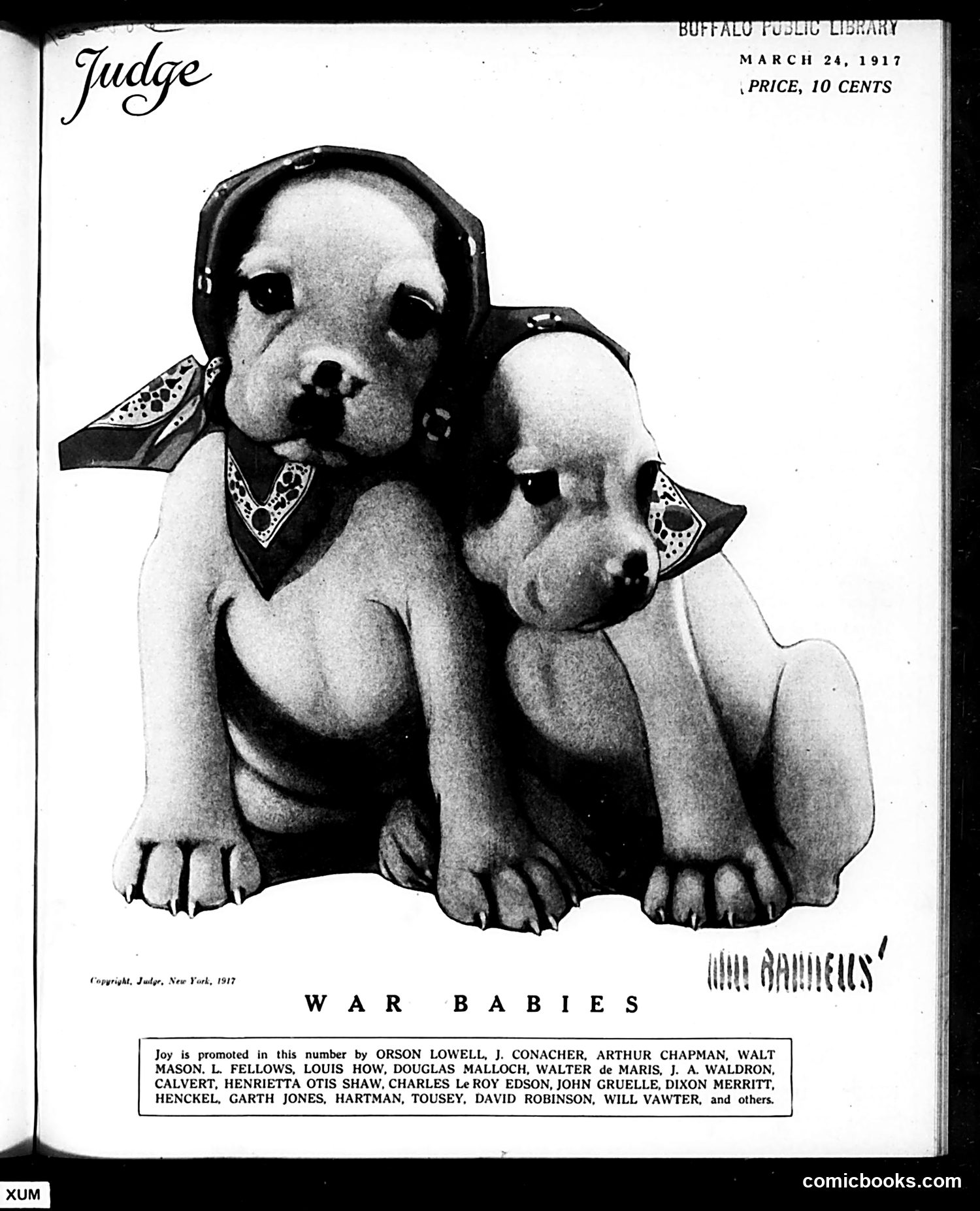
This satirical cartoon depicts two anthropomorphized bulldogs wearing military headgear and decorative collars, labeled "War Babies." The image was published just weeks before America's April 1917 entry into World War I. The "war babies" metaphor appears to mock the inevitable offspring of military conflict—suggesting the destructive consequences of warfare. The dogs' aggressive posture and military attire satirize the martial spirit of the era. The list of prominent names promoting "joy" in this issue (Orson Lowell, Arthur Chapman, Walt Mason, and others) suggests Judge was using humor to process America's impending involvement in the global conflict. The cartoon likely critiques either warmongering attitudes or the grim realities awaiting soldiers, though the exact satirical target remains somewhat ambiguous from the image alone.
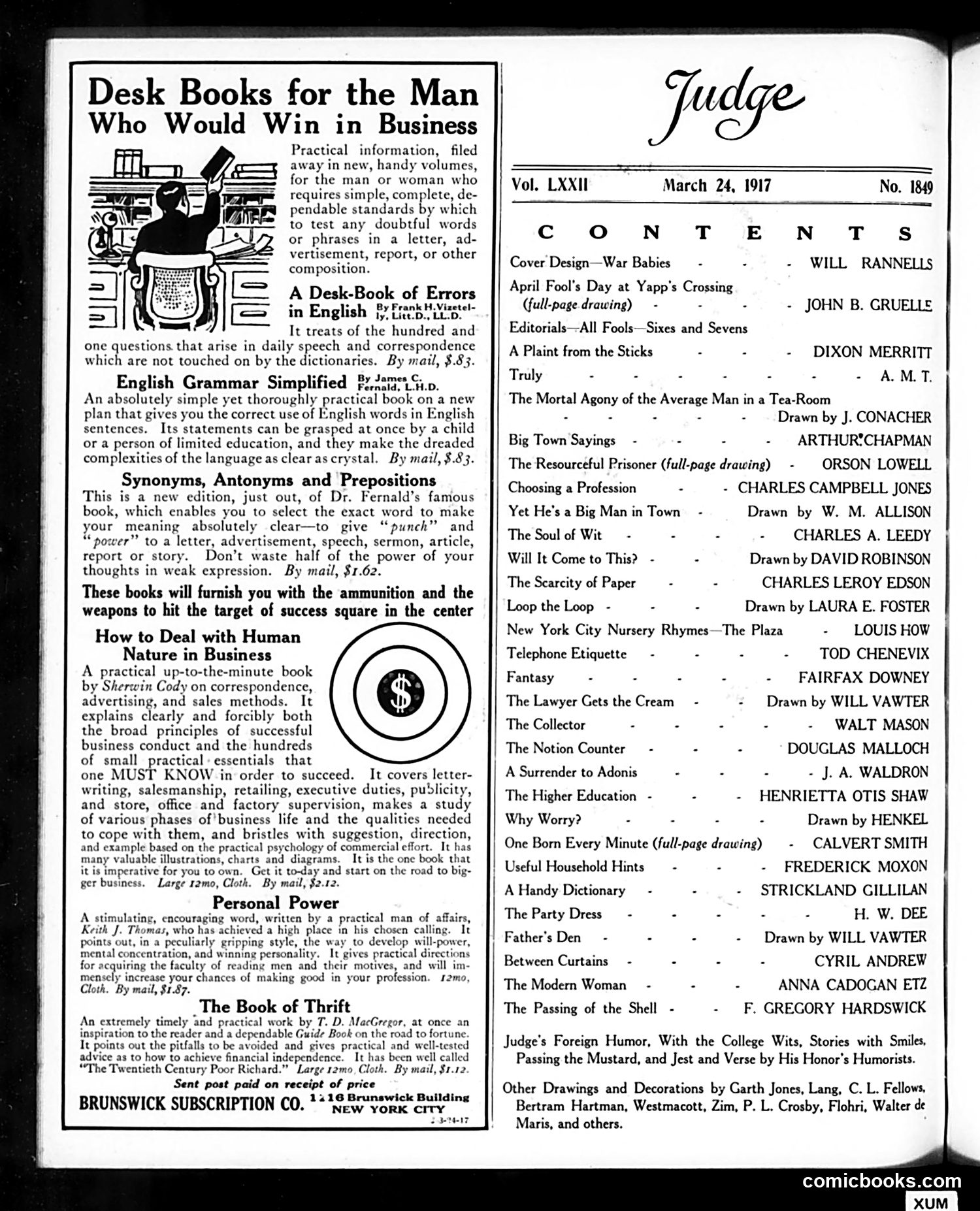
This is primarily a contents page and advertising for Judge magazine (March 24, 1917). The left side advertises business-focused books published by Brunswick Subscription Co., targeting readers seeking professional success—covering grammar, business psychology, sales methods, and financial management. The right side lists the magazine's contents for that issue. Notable pieces include "April Fool's Day at Yapp's Crossing" (a full-page drawing) and several satirical articles like "The Mortal Agony of the Average Man in a Tea-Room" and "The Scarcity of Paper." The date (March 1917) places this just before America's entry into World War I—relevant given the cover design references "War Babies." Most content appears focused on general American humor and social commentary rather than explicit political satire.
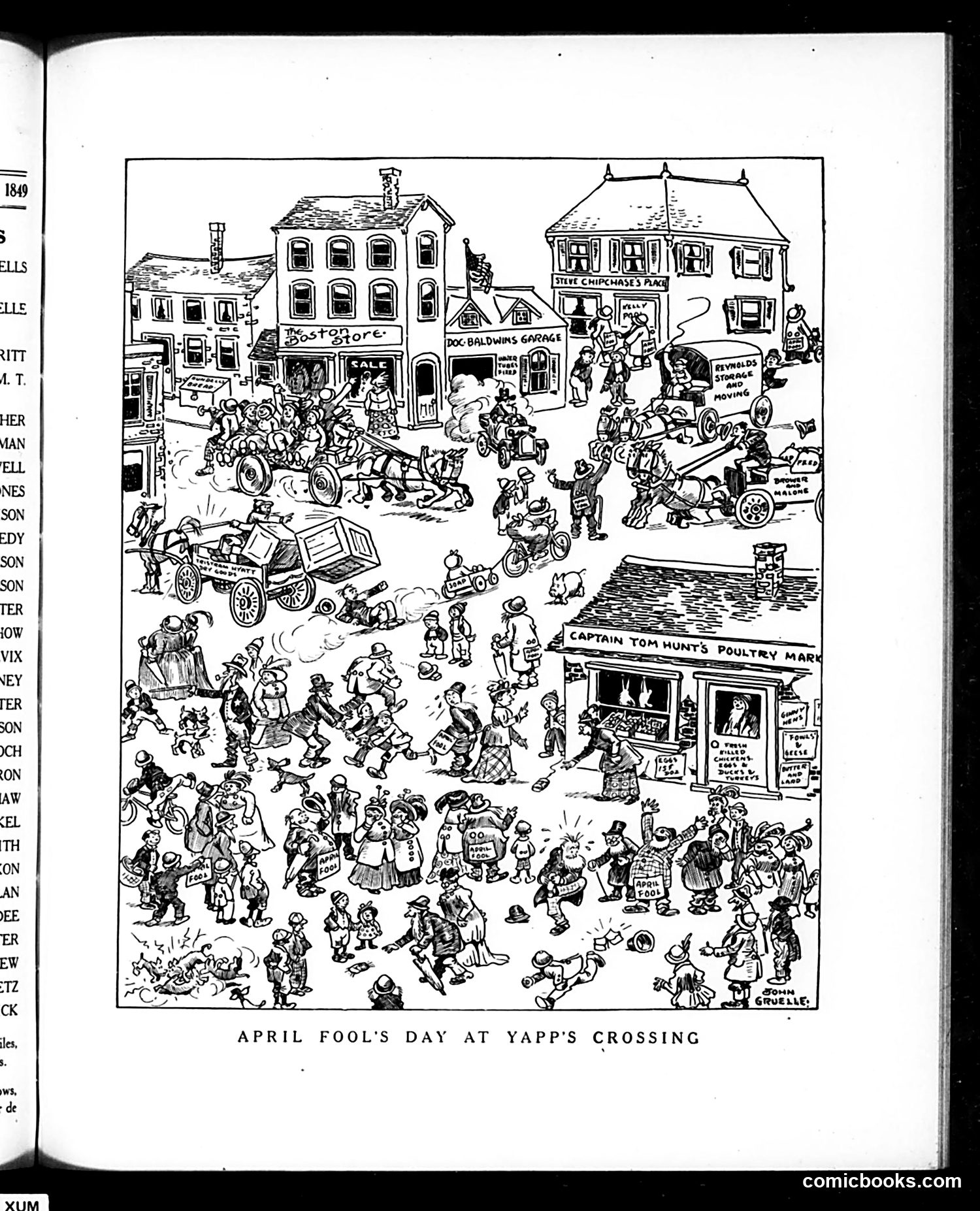
This is a humorous illustrated scene depicting an April Fool's Day celebration in a small town called Yapp's Crossing. The cartoon shows numerous townspeople engaged in pranks and foolish activities in a busy street scene, with various buildings including a "Post Store," "Doc Baldwin's Garage," and "Captain Tom Hunt's Poultry Market" visible. The humor derives from the chaotic mayhem of April Fool's Day pranks—horse-drawn carts, people in various states of confusion, falling or tumbling figures, and general disorder. The satire appears to mock small-town American life and the absurdity of community-wide prank celebrations. The detailed crowd scene is typical of Judge magazine's style, filled with visual gags and satirical commentary on everyday American social customs.
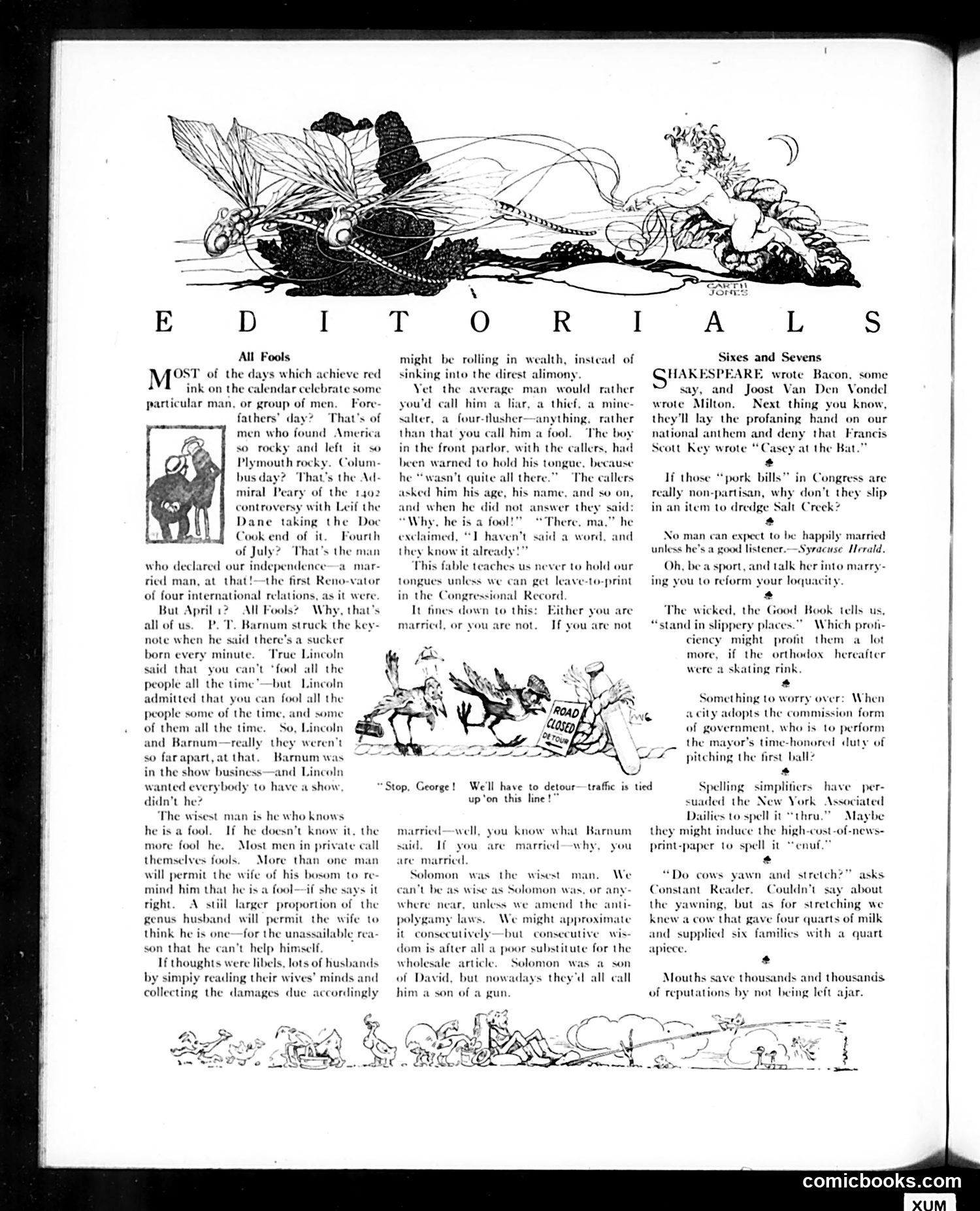
This page from *Judge* magazine presents satirical editorials on early 20th-century American topics. The main cartoon depicts traffic congestion with the caption "Stop, George! We'll have to detour—traffic is tied up on this line!" The editorials mock various subjects: - Congressional foolishness and politicians' inability to keep quiet - Marriage dynamics and wives' influence over husbands - P.T. Barnum's showmanship and the public's gullibility - Lincoln's political acumen versus common foolishness - Minor spelling and linguistic quirks The cartoons use humor to critique social pretension, government inefficiency, and domestic relations. The traffic cartoon appears to reference early automobile congestion as a growing urban problem. Overall, the page employs satire to comment on contemporary American society, politics, and everyday absurdities.
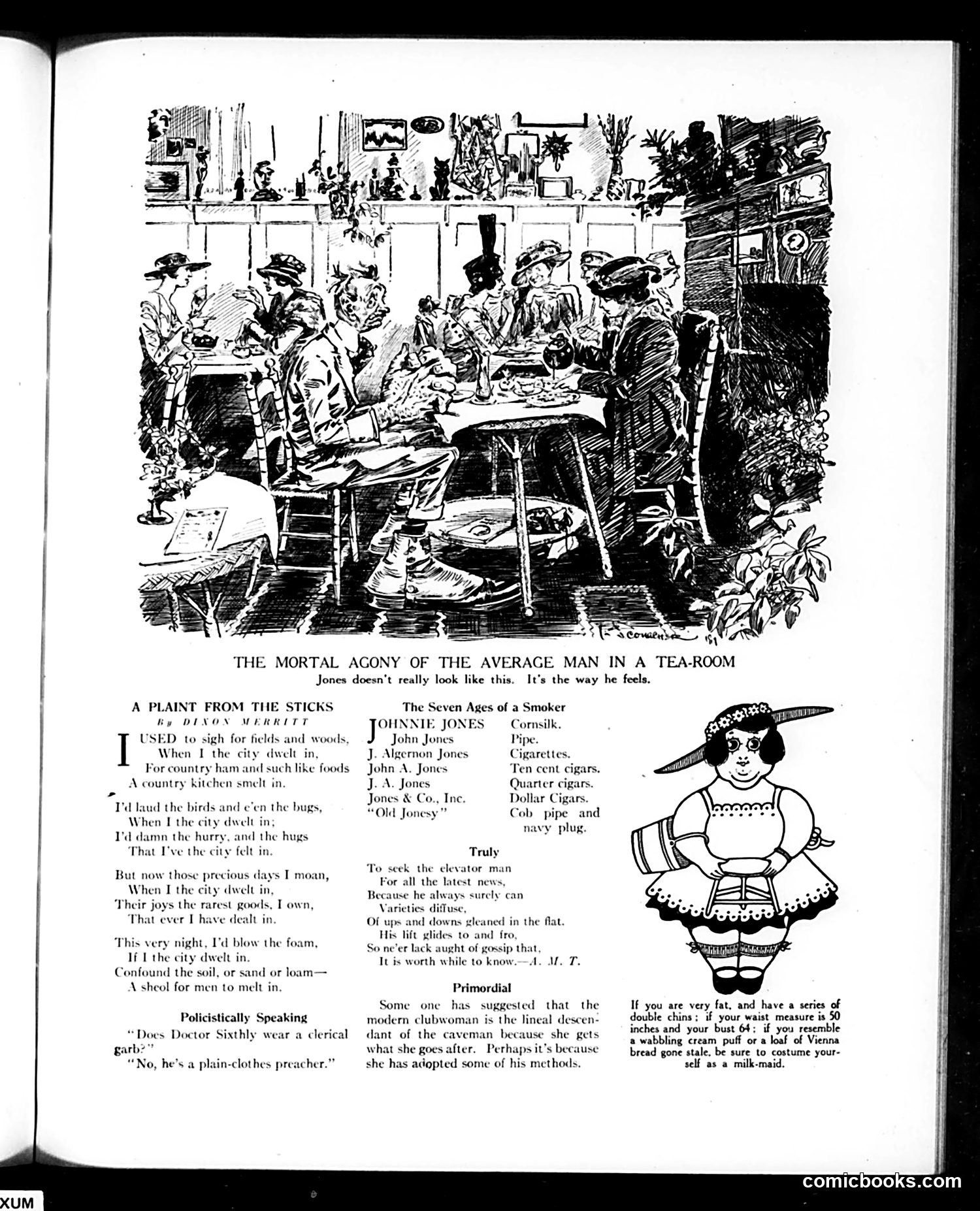
The main cartoon depicts "The Mortal Agony of the Average Man in a Tea-Room"—showing a crowded, chaotic social gathering where the central figure appears deeply uncomfortable amid fashionable society. The caption notes Jones "doesn't really look like this. It's the way he feels," suggesting anxiety about social performance and class consciousness. The surrounding content includes humorous poems and a joke about "Doctor Sixthly" wearing clerical dress, playing on religious hypocrisy. "The Seven Ages of a Smoker" features a cartoon of a woman progressing through smoking habits, from pipes to cigars. Overall, this page satirizes early 20th-century American anxieties about social status, gender roles, and modern urban life—portraying the psychological discomfort lurking beneath polite society's surface.
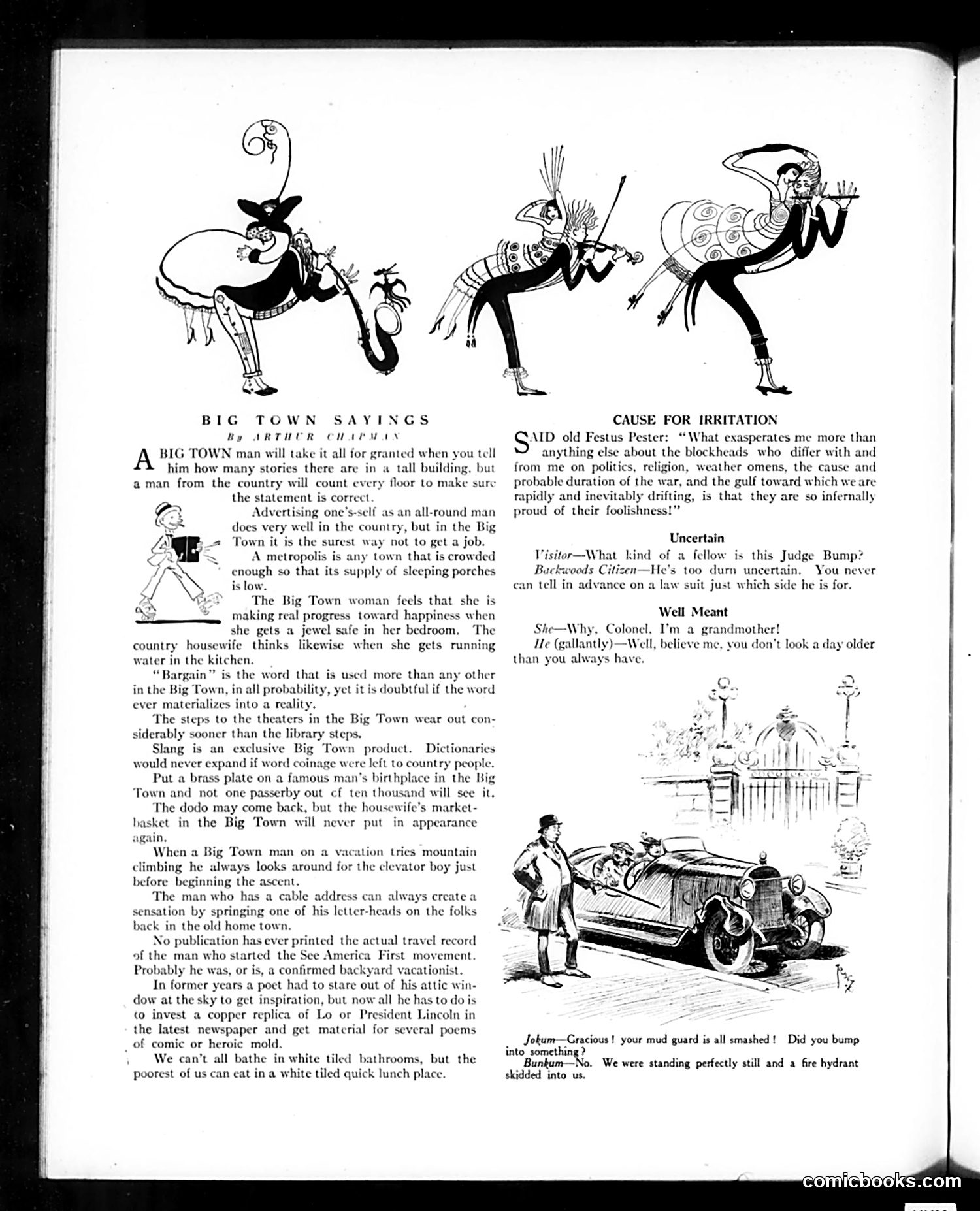
This page combines satirical commentary on urban life with humor pieces. The top illustration shows exaggerated figures performing acrobatic feats, likely satirizing the frenetic pace of city living or financial speculation. "Big Town Savings" mocks urban pretensions and social climbing, suggesting city dwellers use buzzwords like "bargain" to justify excessive consumption. The piece critiques how city folk adopt affected language and behaviors, contrasting them unfavorably with practical country people. "Cause for Irritation" features a character expressing frustration about political disagreement during wartime, suggesting war-related tensions divided public opinion. The lower cartoon depicts a car accident, with characters arguing about blame—typical slapstick humor about modern automobile chaos and the disputes it generates. The page blends social satire with light comedy reflecting 1920s urban anxieties.
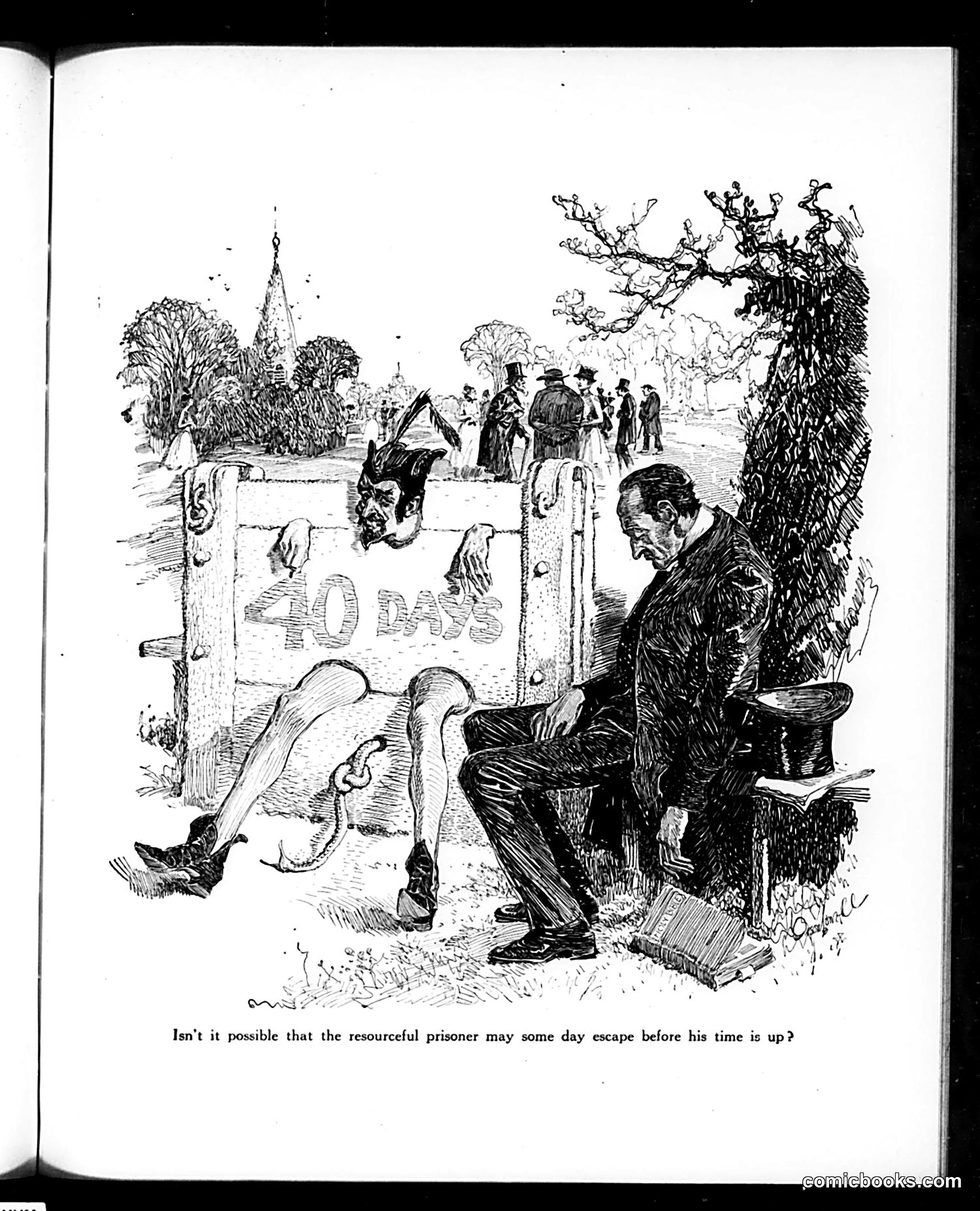
This cartoon depicts a man sitting by a gravestone marked "40 DAYS" in what appears to be a cemetery. The caption poses a rhetorical question about a "resourceful prisoner" escaping before serving his full sentence. The satire likely concerns a prisoner or detainee whose sentence or confinement is set to end in 40 days. The joke suggests that an enterprising or clever prisoner might find a way to "escape" — though the gravestone imagery implies the only escape available is death, making dark humor of the situation. Without additional context about specific historical events or figures from Judge magazine's publication date, the precise political or social reference remains unclear, though it appears to comment on prison conditions or a particular notable case.
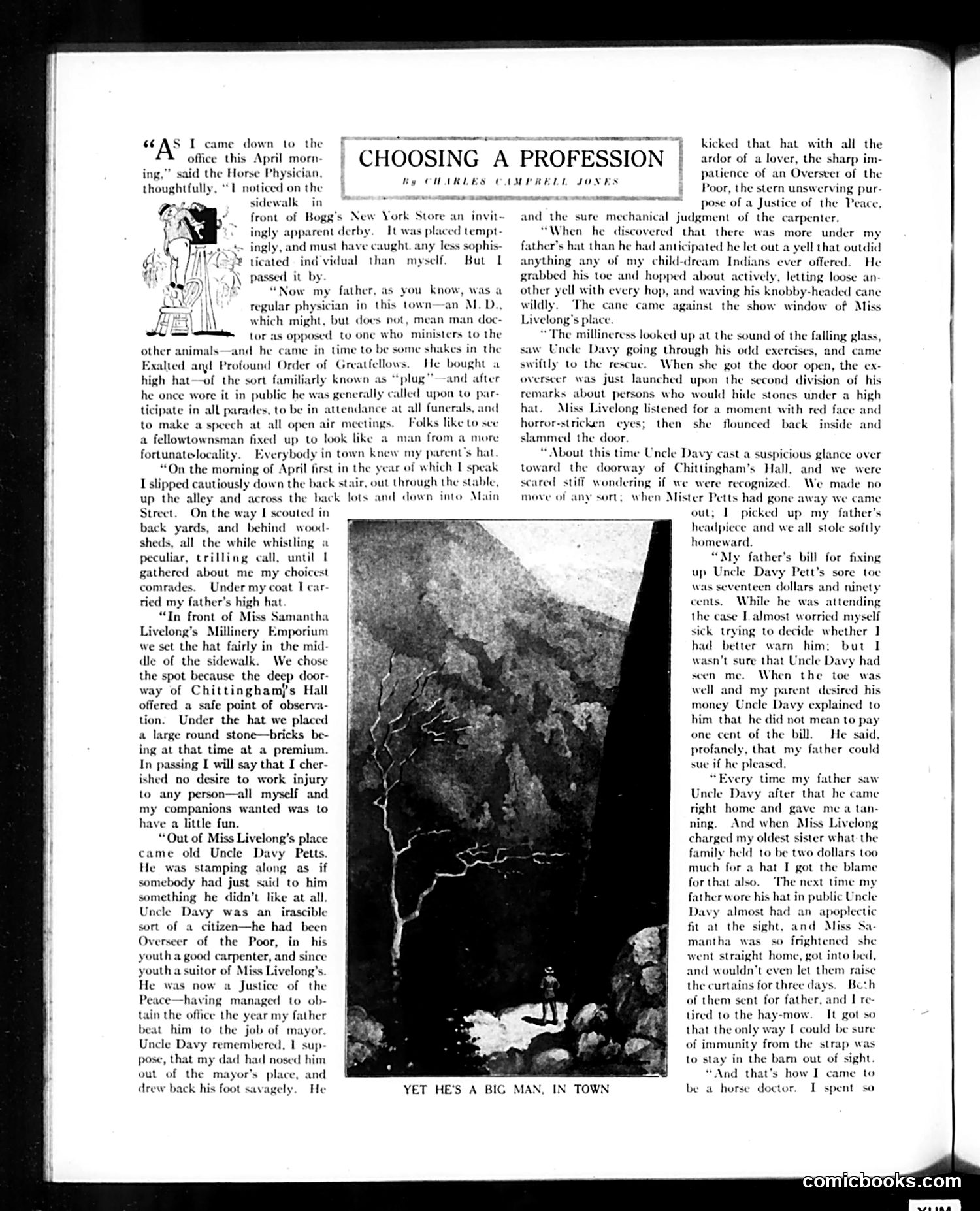
This is a humorous narrative story (not a political cartoon) by Charles Campbell Jones about a boy's April Fools' prank. The tale satirizes small-town social hierarchies through exaggerated character types: the narrator's father, a physician elevated to importance simply by owning a fancy top hat; Uncle Davy Petts, an irascible ex-Overseer of the Poor now claiming Justice of the Peace status; and Miss Livelong, the milliner. The joke: the boy places his father's prized derby over a stone in front of Miss Livelong's shop. When Uncle Davy kicks it, the stone injures his toe spectacularly. The humor derives from slapstick physical comedy and the narrator's deadpan account of small-town pretension—how townspeople grant respect based on appearance and minor official titles rather than genuine merit.
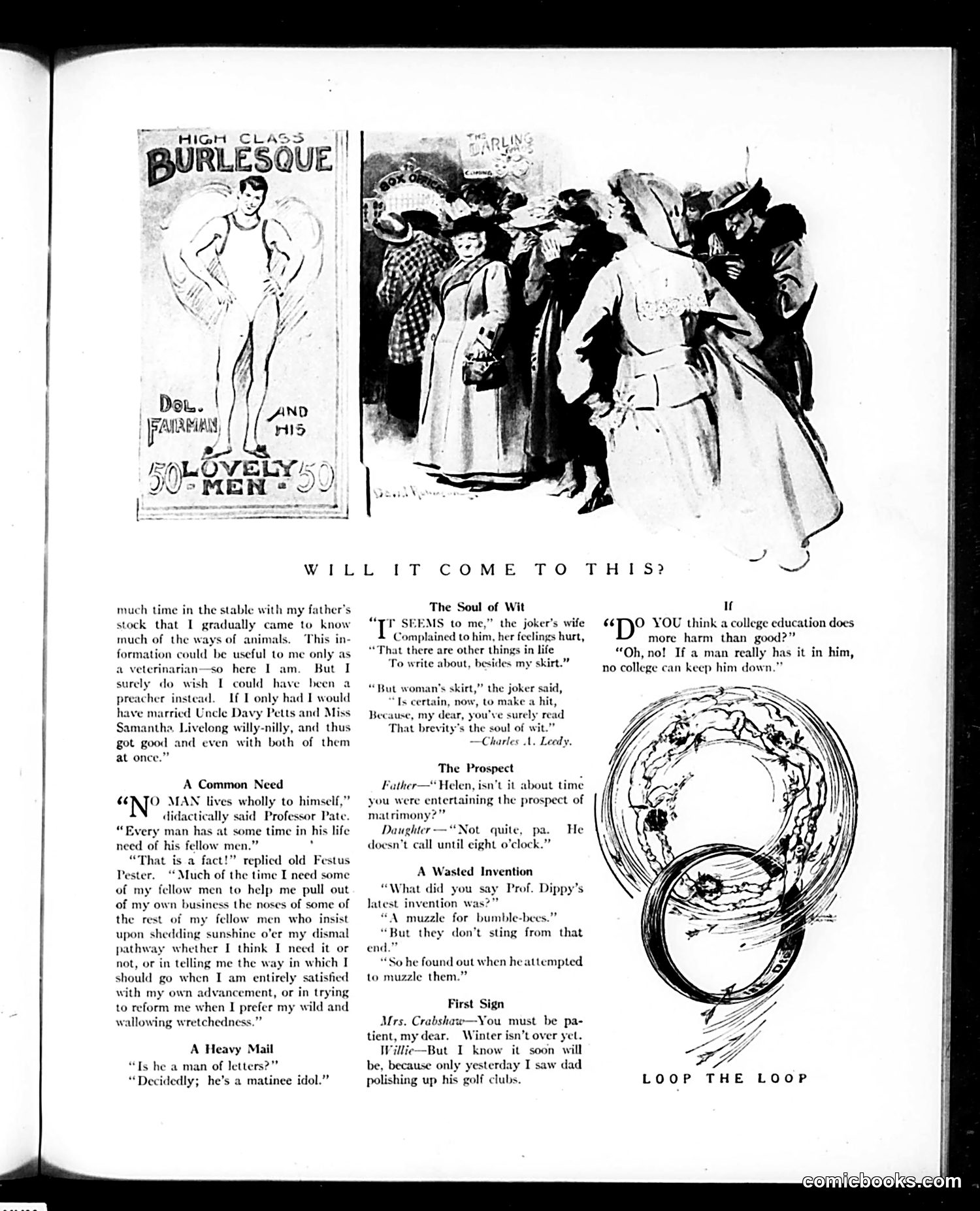
This page contains several brief humorous sketches typical of early 20th-century satirical magazines. At the top left is an advertisement for a "High Class Burlesque" show featuring "50 Lovely Men," with the top image showing a provocative female performer—likely satirizing the popularity of burlesque theater at the time. The main cartoons use dialogue to deliver social commentary: - "Will It Come to This?" appears to mock anxieties about women's changing roles, showing what seems to be concern about new social freedoms - Multiple sketches joke about marriage, courting customs, and relationships - "The Soul of Wit" references the classical idea (from Hamlet) that brevity is wit, while ironically suggesting that writing about women's skirts—a fashionable topic—makes a hit - Other sketches humorously criticize pretentiousness, failed inventions, and seasonal behavior The right illustration labeled "Loop the Loop" depicts what appears to be an early amusement park ride, suggesting entertainment culture commentary. Overall, this represents typical Judge satire: social observation about contemporary manners, fashion, courtship, and entertainment through witty dialogue and visual gags.
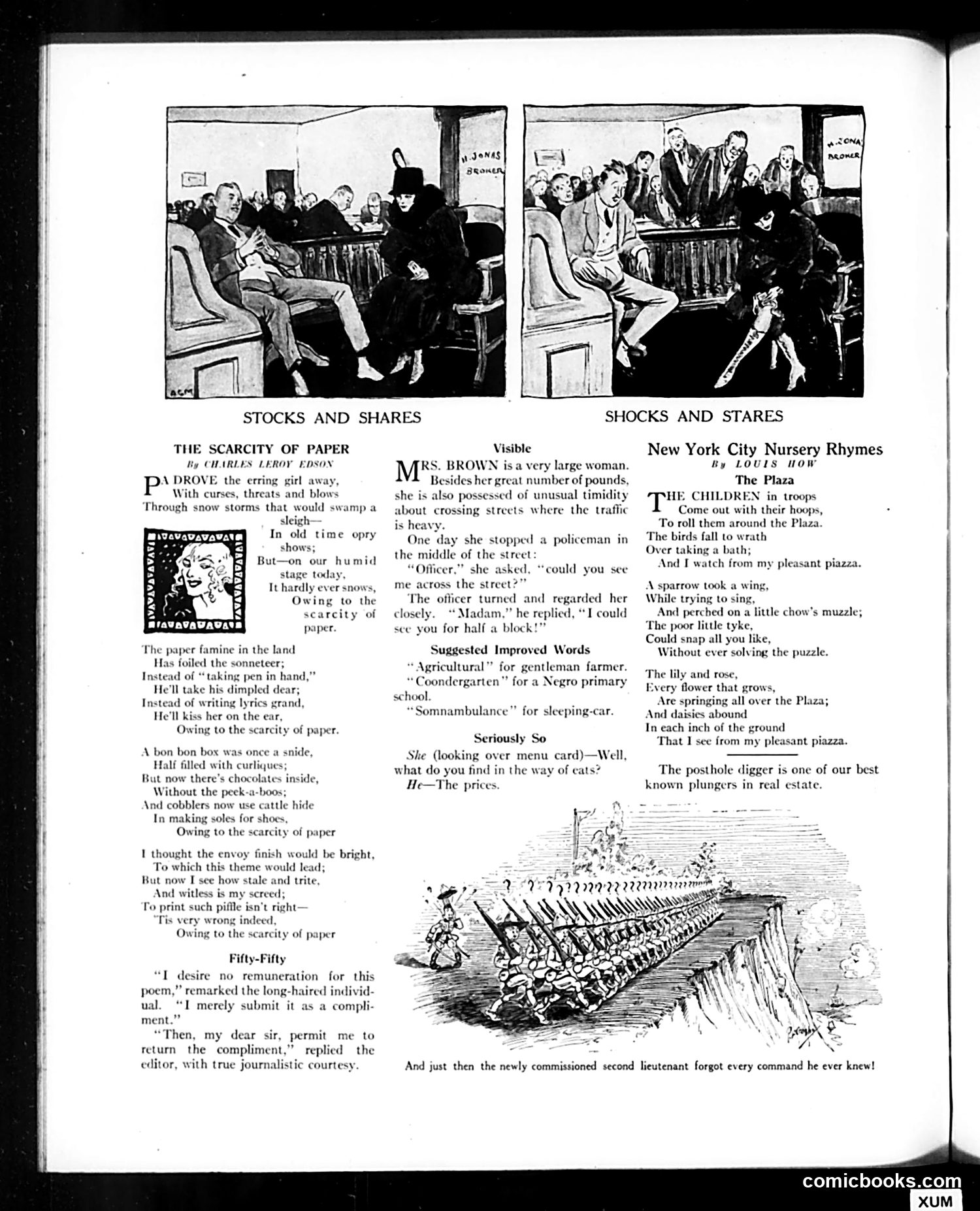
This page from *Judge* satirizes early 20th-century social and economic conditions through humor and light verse. **"Stocks and Shares"** (left) jokes about a wartime paper shortage affecting everyday life. The poem absurdly claims that because paper is scarce, stage productions can't show snow, lovers must kiss instead of write poetry, and candy boxes contain actual chocolates rather than decorative paper. The editor's final quip—rejecting the writer's poem due to paper scarcity—is self-aware satire. **"Shocks and Stares"** (right) contains two unrelated pieces: a comic sketch showing Mrs. Brown, a large woman asking a policeman to help her cross the street, and his quip that he could see her "for half a block"; and "New York City Nursery Rhymes" describing pleasant scenes at the Plaza with children, birds, and flowers. The page also includes crude ethnic humor ("Coondergarten") typical of the era's *Judge* magazine—reflecting period attitudes now recognized as offensive. The bottom military cartoon appears to reference wartime confusion or incompetence among newly commissioned officers.
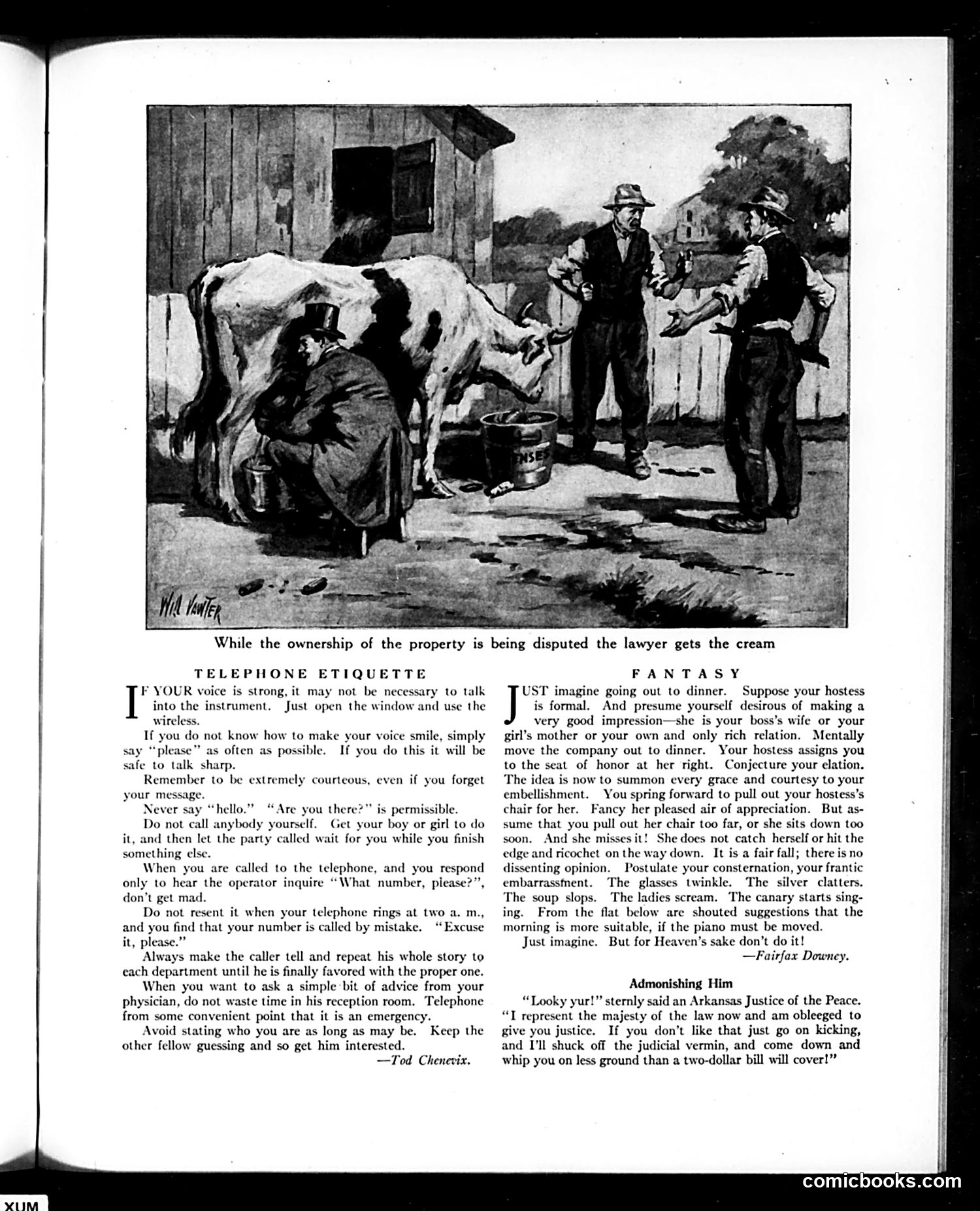
This page contains three satirical pieces mocking early 20th-century etiquette and social behavior. **"Telephone Etiquette"** by Ted Chenevix sarcastically advises readers on improper phone conduct—shouting through windows instead of using the handset, being rude while claiming politeness, making callers wait, and not identifying yourself. The joke targets people adopting new telephone technology while maintaining poor manners. **"Fantasy"** by Fairfax Downey depicts a dinner party disaster where pulling out a hostess's chair too far causes her to fall, triggering chaos (broken dishes, screaming ladies, a falling canary, angry downstairs neighbors). It satirizes overwrought anxiety about making good impressions in formal social settings. **The cartoon** (signed "Hal Hanter") shows a cow being milked while men in suits and hats stand by; the caption jokes that lawyers profit from property disputes. This mocks how legal disputes benefit attorneys regardless of the actual outcome. All three items ridicule either social pretension, technological awkwardness, or professional exploitation.
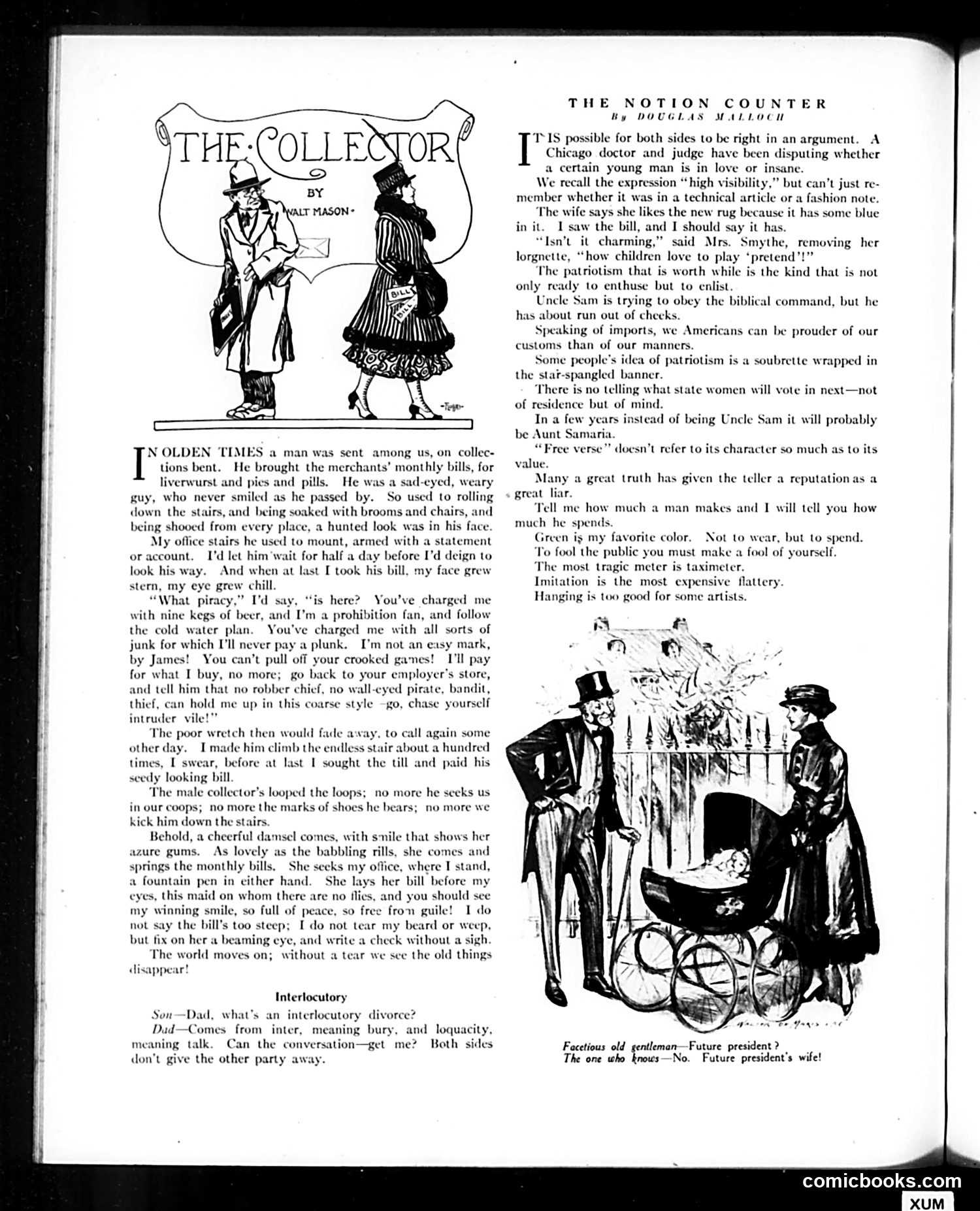
This page contains two distinct pieces of satire: **"The Collector"** (left): A narrative comic by Walt Mason contrasts how bill collectors were historically treated versus how they're treated by modern women. The old male collector was routinely abused—thrown down stairs, soaked with brooms—yet kept returning. Now a young female collector arrives with charm and a smile, and the narrator immediately pays without complaint. The satire targets male hypocrisy: men who brutalize male bill collectors instantly capitulate to feminine appeal, suggesting men are easily manipulated by women's appearance rather than treating all workers fairly. **"The Notion Counter"** (right): A miscellany of brief satirical observations on contemporary American life, touching on patriotism, divorce law, female voting rights, imports/customs, and social pretension. The cartoon below illustrates one quip about "future presidents"—depicting gentlemen discussing prospects, with the caption's humor being unclear without fuller context. Both pieces reflect Progressive-era social commentary typical of Judge magazine's audience.
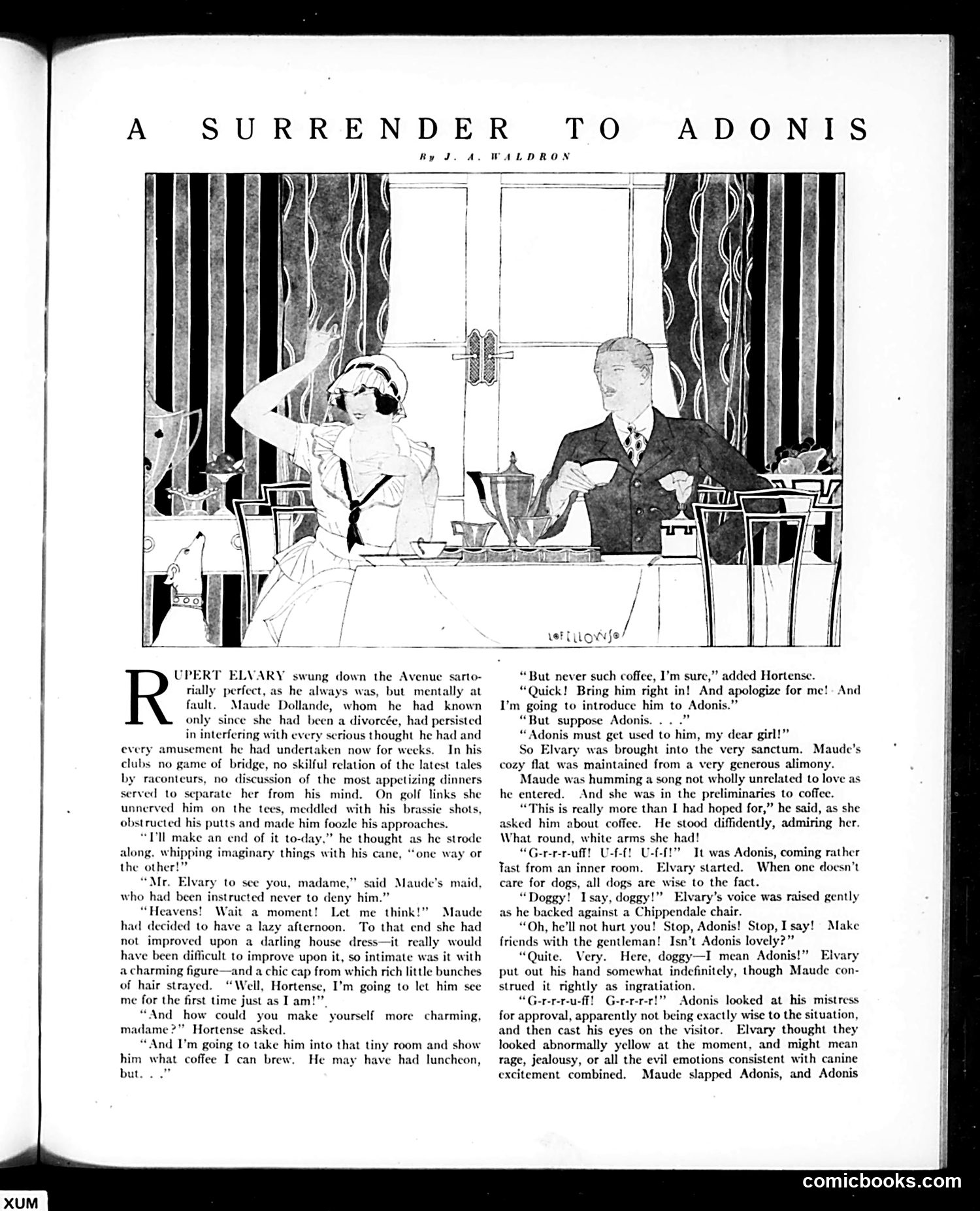
This is a romantic comedy story illustrated with a single panel showing an elegant couple dining. The narrative follows Rupert Elvary, a well-dressed man obsessed with his ex-mistress Maude Dollande (a divorcée), who decides to end their relationship. When he visits her apartment, Maude attempts to charm him by appearing casual and domestic, brewing coffee. However, her plan backfires when her dog—also named Adonis—emerges and aggressively confronts Elvary. The joke centers on the dog's jealousy and Elvary's discomfort: a man trying to reclaim romantic attention is thwarted not by the woman's resistance, but by her pet's protective behavior. The title's double meaning (the mythologically beautiful Adonis versus the actual dog) adds ironic humor to Elvary's romantic "surrender" being derailed by a canine rival.
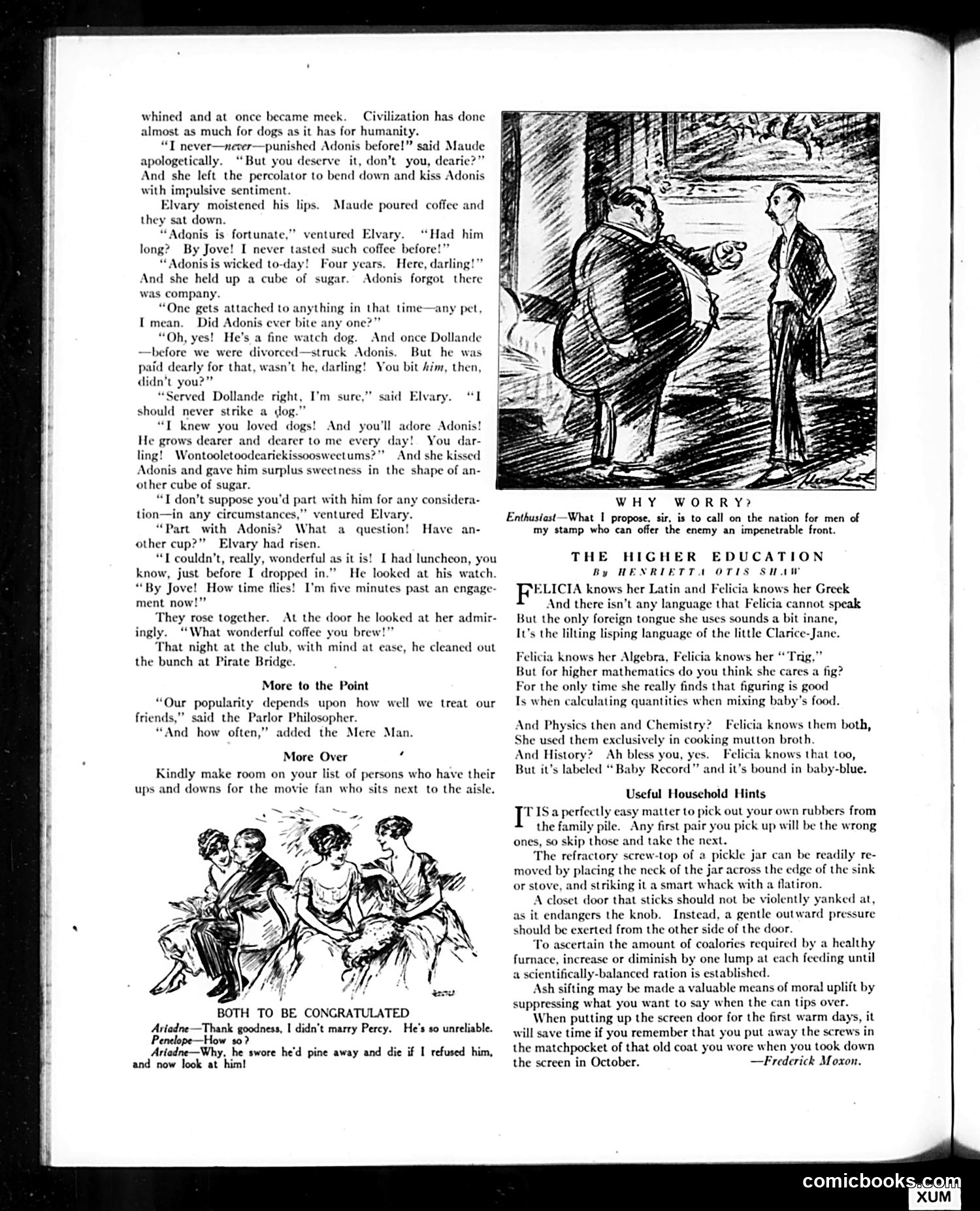
This page contains three distinct satirical pieces typical of Judge's humor: **Main Story Cartoon (top left):** A narrative about a man (Elvary) visiting a woman obsessed with her pet dog named Adonis. She showers the dog with affection while Elvary tries to acquire it. The satire targets wealthy women's excessive sentimentality toward pets—a common target of early 20th-century social criticism. Elvary's polite interest masks mercenary motives; he leaves and "cleaned out the bunch at Pirate Bridge" (gambling), suggesting he manipulates sentiment for personal gain. **Minor Cartoons & Verses:** Include jokes about unreliable suitors, social etiquette, and women's education. "The Higher Education" satirizes educated women (Felicia) whose knowledge serves only domestic purposes—cooking, childcare, and baby records—implying formal education is wasted on women who ultimately fulfill traditional roles. **Practical Advice Column:** "Useful Household Hints" offers domestic tips, reinforcing the magazine's assumption that readers prioritize homemaking. The overall tone reflects era-typical gender attitudes and class commentary.
This page appears to be from *Judge* magazine and contains a single satirical image with the caption "ONE BORN EVERY MINUTE." The phrase "one born every minute" is a variation of P.T. Barnum's famous quote about suckers being born regularly—a reference to gullibility and easy deception. The stark, dark image depicts what appears to be a nighttime scene with minimal visible detail, making the specific satirical target unclear from the image alone. Without additional context or clearer visual elements identifying particular figures or events, the exact subject of this satire cannot be determined with certainty. The caption suggests social commentary on human foolishness or deception, but the specific target—whether political, social, or cultural—remains ambiguous from this reproduction.
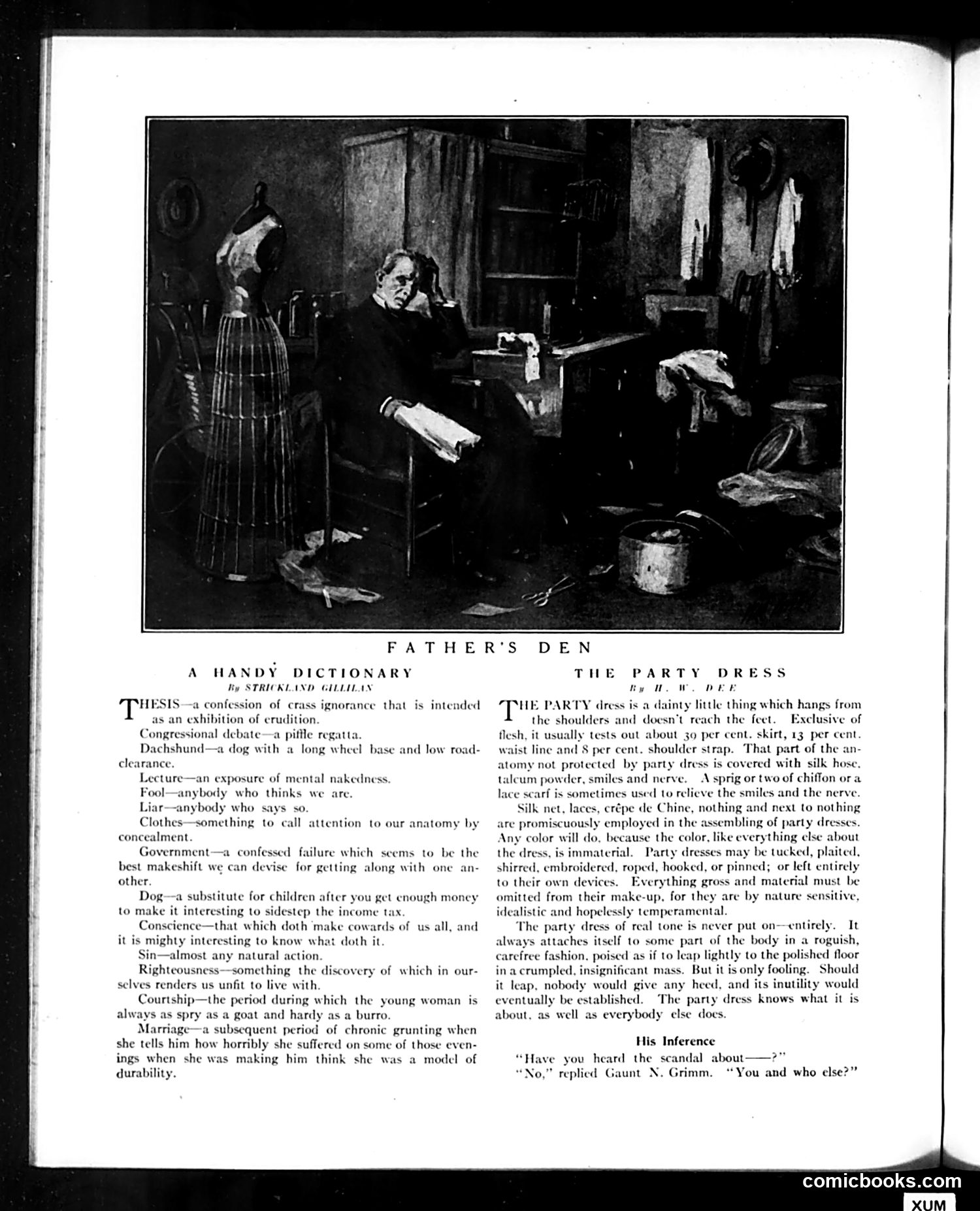
This page from *Judge* presents satirical definitions by Strickland Gillilan mocking American social conventions and hypocrisy. The humor relies on cynical redefinitions—"Government" is a "confessed failure," "Conscience" makes cowards of us, "Marriage" is "chronic grunting." The accompanying illustration depicts a shabby domestic interior, likely illustrating the marriage definition's sardonic tone about post-courtship disillusionment. The "Party Dress" section continues the satire, describing women's evening wear with mock-serious fashion analysis. It suggests party dresses are impractical, requiring constant adjustment, designed more for appearance than function—a commentary on frivolous feminine fashion and the gap between social pretense and reality. The brief dialogue at bottom references unspecified scandal gossip, characteristic of society's rumor-mongering. Overall, the page exemplifies *Judge*'s cynical critique of American middle-class morality, gender relations, and social pretension through humor.
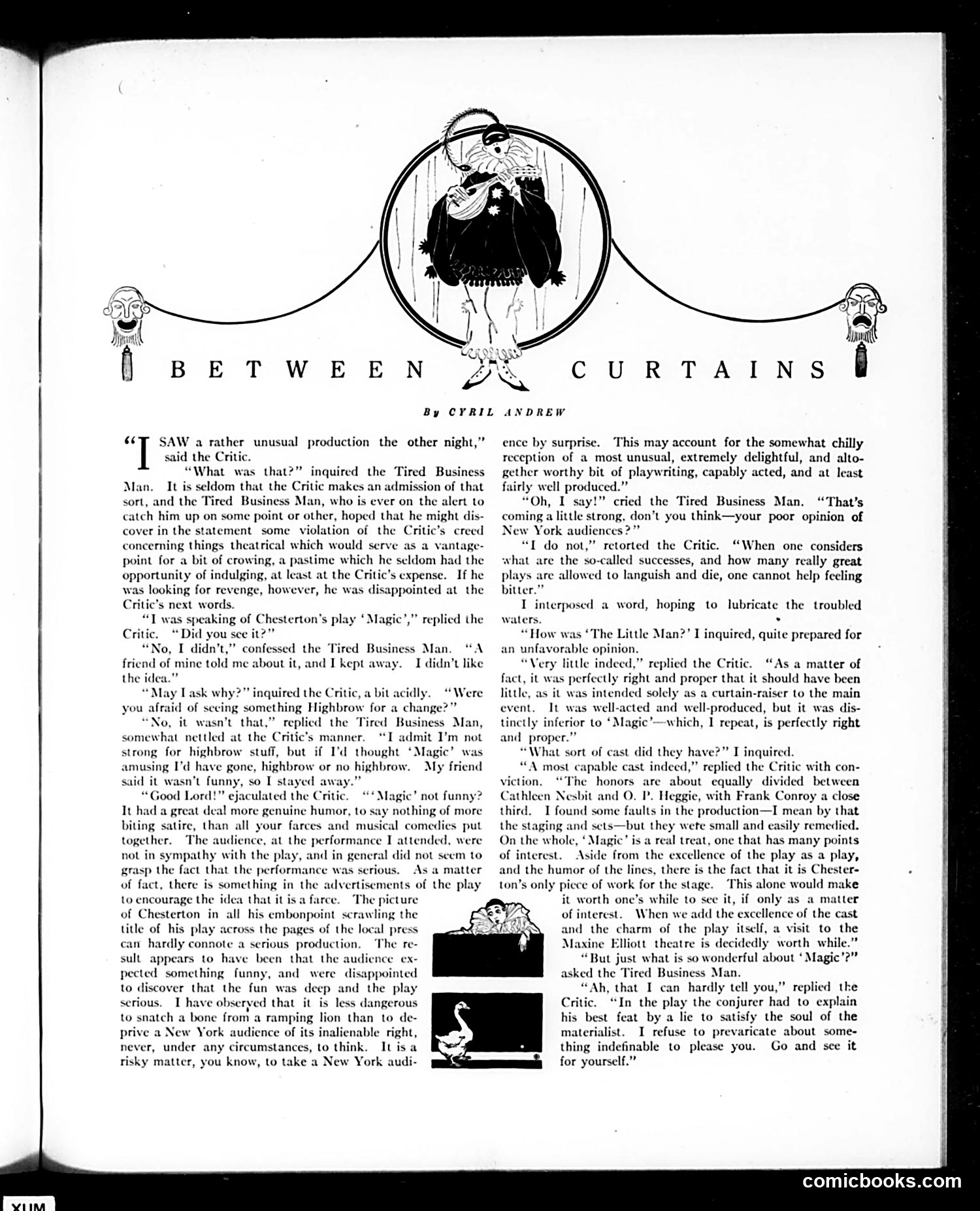
This is a dialogue piece between a Critic and a Tired Business Man discussing G.K. Chesterton's play "Magic." The satire targets **New York theater audiences' intellectual laziness**. The Critic defends "Magic" as genuinely sophisticated and serious, while audiences—expecting the advertised farce—rejected it for failing to entertain them simply. The Critic's complaint: New Yorkers possess an "inalienable right, never, under any circumstances, to think." The cartoon mocks the disconnect between **what audiences want** (broad comedy) and **what serious theater offers** (intellectual substance). The Tired Business Man represents the average theatergoer who avoided the play based on hearsay, embodying the very anti-intellectual attitude the Critic critiques. This reflects early 20th-century tension between **commercial entertainment and artistic merit** in American theater—a complaint about mass audiences that persists today.
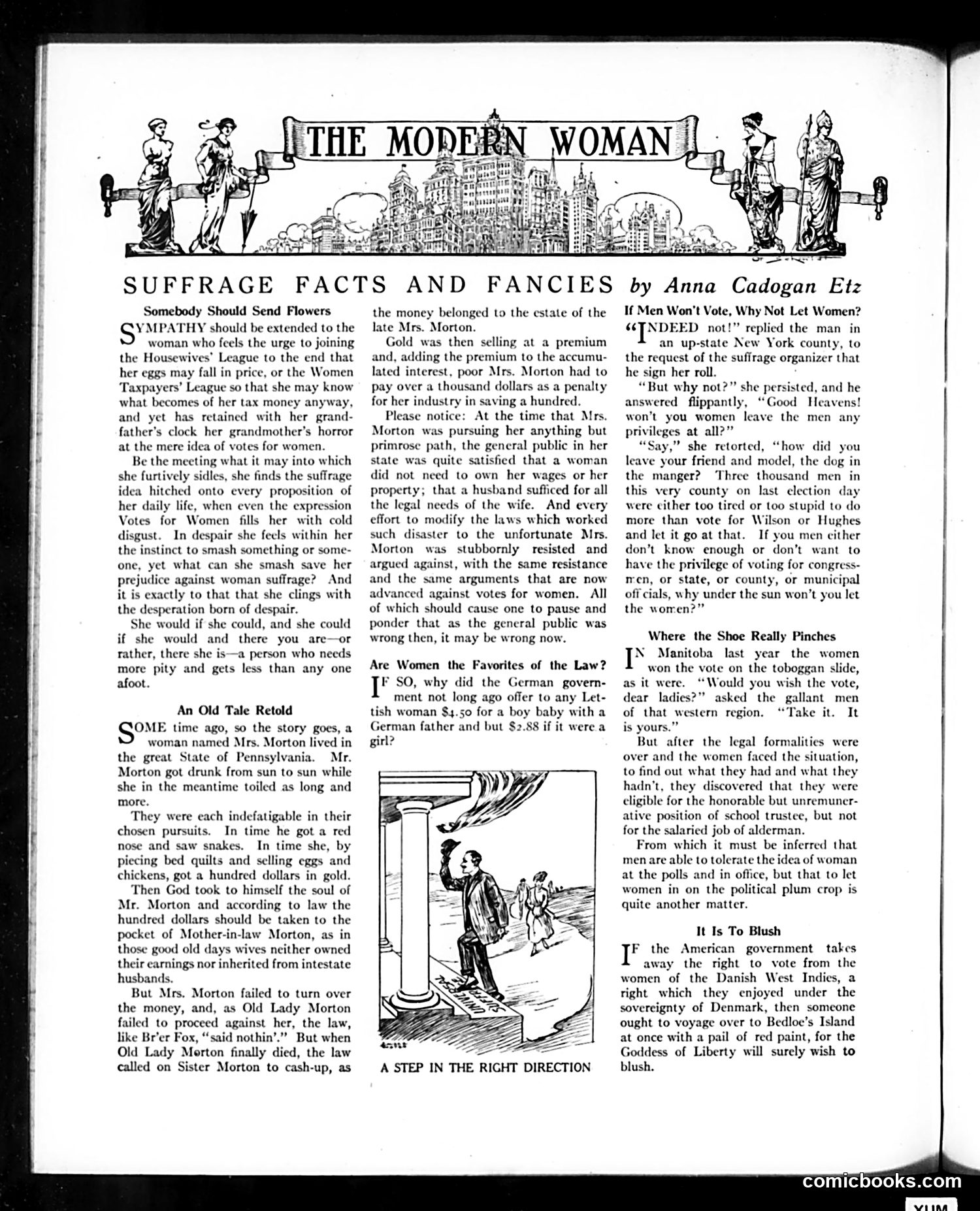
This page presents pro-suffrage arguments by Anna Cadogan Etz, using satire to mock anti-suffrage positions. The main cartoon ("A Step in the Right Direction") shows a woman at a polling place—likely representing the recent achievement of women's voting rights in some jurisdictions. The text mocks male resistance to female suffrage through several tactics: 1. **The Mrs. Morton parable**: Demonstrates how laws denying women property rights caused financial ruin—arguing that opposing suffrage uses the same flawed logic as opposing women's property ownership. 2. **The anecdote about the New York man**: A voter refuses to sign the suffrage petition, claiming men deserve *some* exclusive privileges. Etz sarcastically notes that men barely exercise their own voting right ("three thousand men...were either too tired or too stupid to do more than vote"). 3. **The German government example**: References real incentive programs (suggesting Germany valued male births), implying governments don't actually favor women legally. The piece uses humor and historical example to argue suffrage opposition is irrational prejudice masquerading as principle.
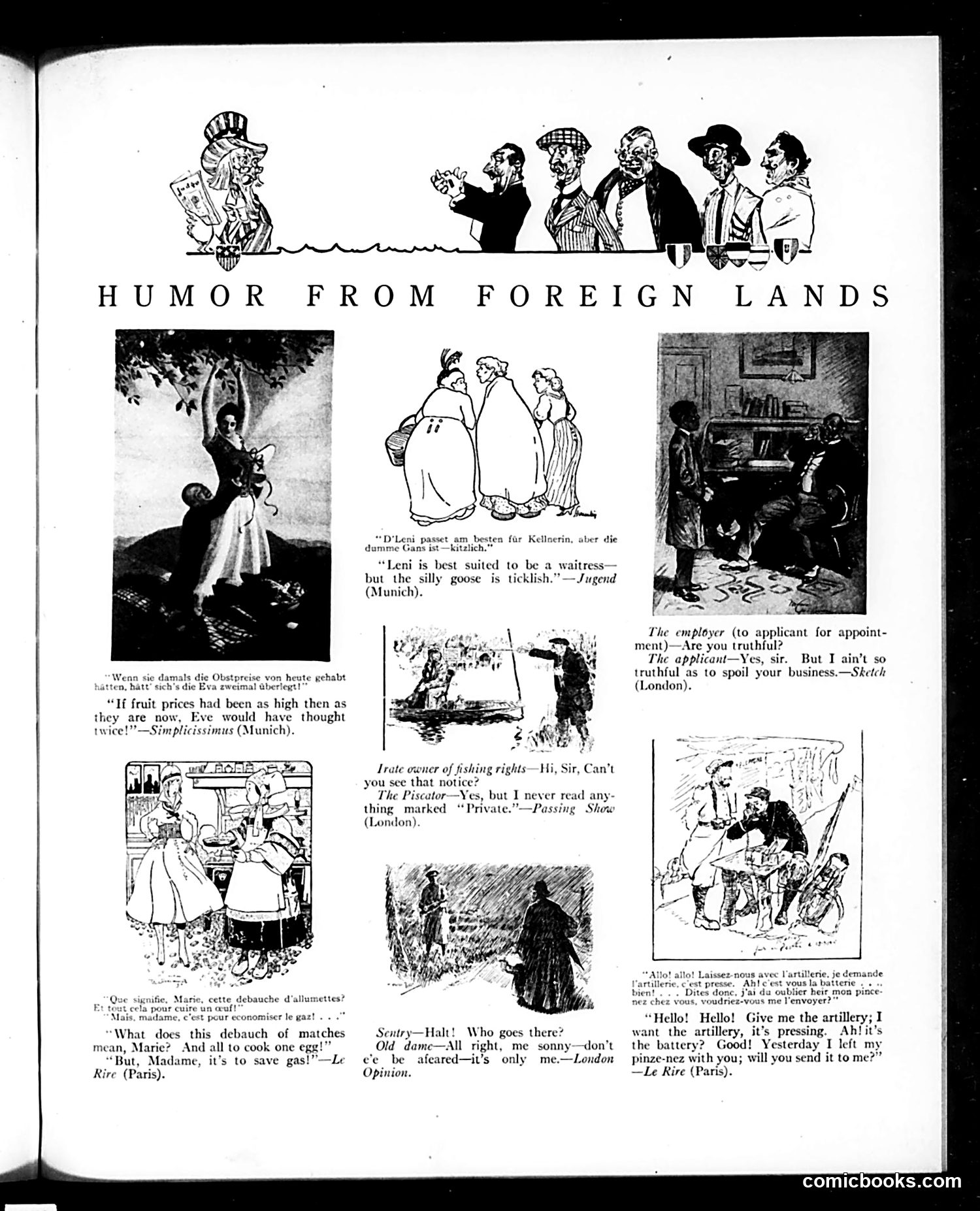
This page collects international jokes and cartoons from European publications (Munich, London, Paris), presenting them as exotic humor for American readers. The content satirizes everyday absurdities: **Key sketches include:** - A woman ticklish during intimate moments (German humor) - A job applicant admitting dishonesty helps business (British satire on workplace ethics) - A man ignoring "Private" fishing signs (poking fun at rule-breakers) - A Frenchwoman confused about "artillery" vs. "battery" (language/culture gag) - A woman wasting matches to save gas (wartime rationing logic) - An elderly woman passing a military sentry (likely WWI-era) **The broader point:** Judge presents foreign cartoons to amuse American readers by highlighting different national character traits—German sentimentality, British propriety, French linguistic confusion, and British wartime practicality. It's essentially "look how other countries joke about their own people."
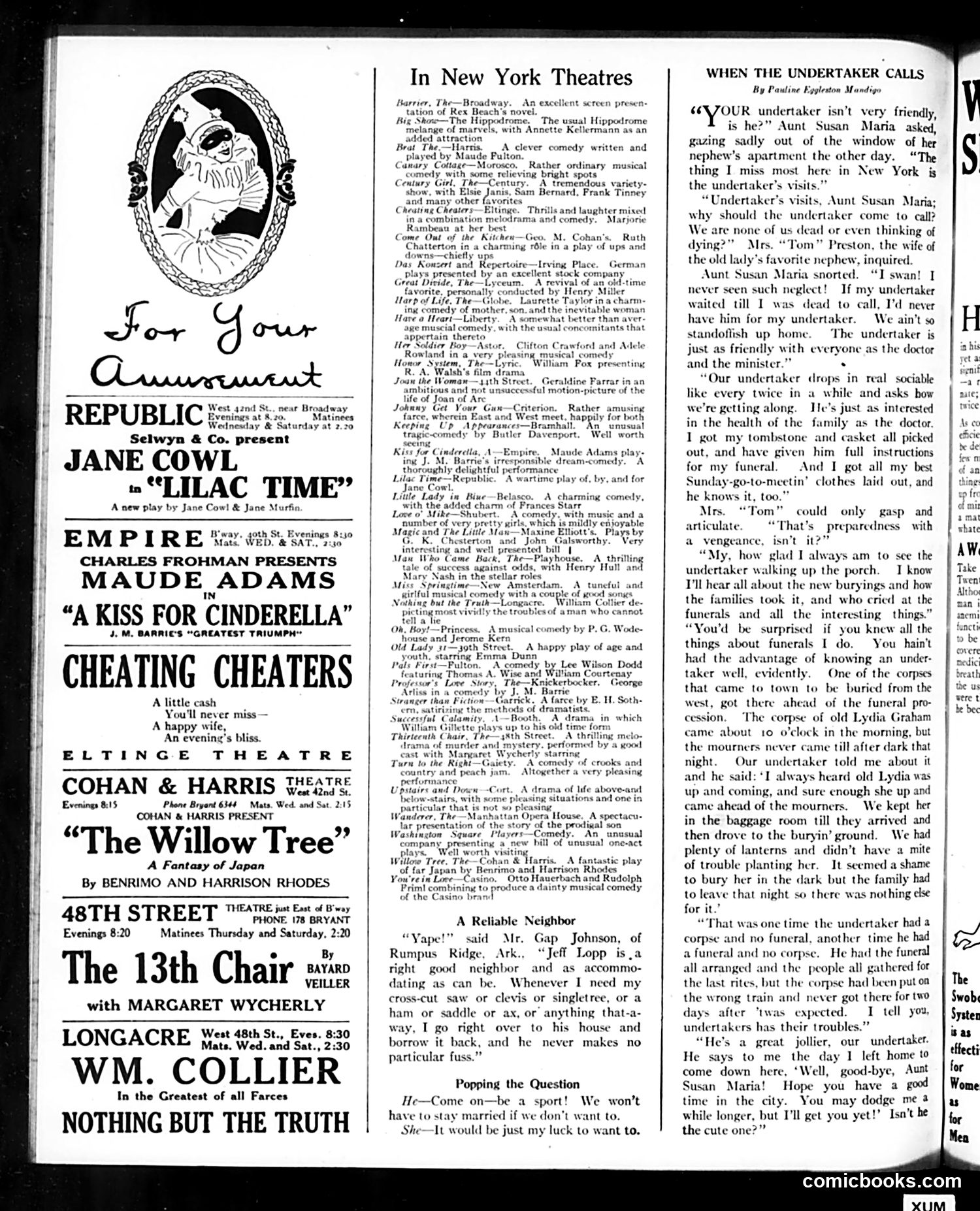
This page is primarily **theatrical advertising and listings**, not political satire. It showcases New York theater productions circa 1918-1920, featuring prominent Broadway plays and stars. The left side displays advertisements for comedies and dramatic productions: Jane Cowl in "Lilac Time," Maude Adams in "A Kiss for Cinderella," and farces like "Cheating Cheaters" and "Nothing but the Truth." The center-right contains an extensive listing of current New York theatrical offerings with brief reviews. The only notable cartoon element is a decorative oval portrait (upper left) accompanying the "Republic" theater ad—a stylized face illustration typical of era advertising design. The small story "When the Undertaker Calls" (upper right) is humorous domestic fiction about an elderly woman discussing funeral arrangements, not political commentary. **This is essentially a theater guide page with period advertising, lacking satirical or political content a modern reader would need historical context to understand.**
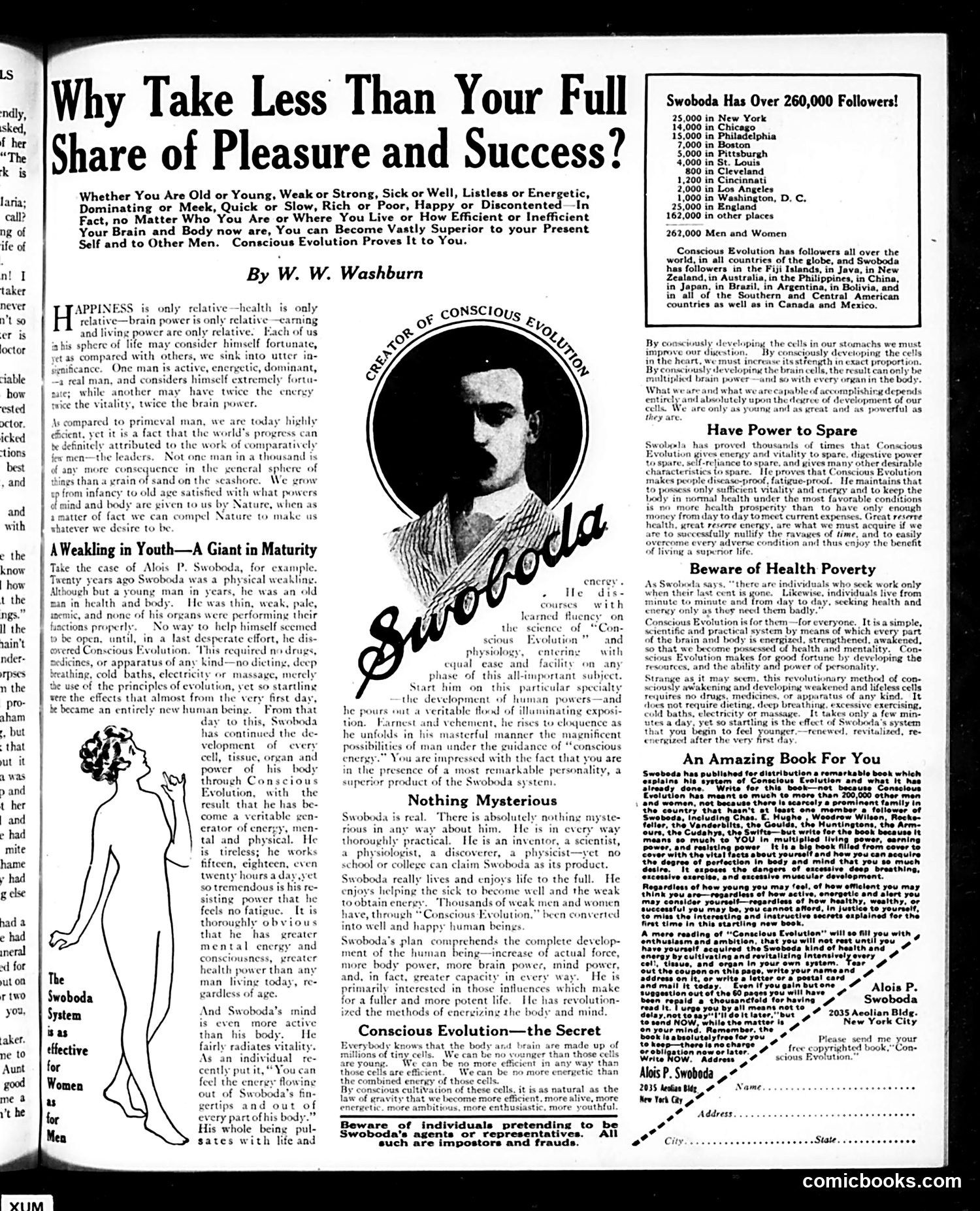
This page is primarily **advertising disguised as editorial content** for Alois P. Swoboda's "Conscious Evolution" self-improvement system. The article presents Swoboda as a rags-to-riches health transformation story: a formerly weak, sickly young man who became a vigorous, energetic adult through Swoboda's methods (notably requiring "no drugs, medicines, or apparatus"). The sidebar claims Swoboda has 260,000+ followers worldwide. **The satire lies in Judge's lampooning of self-help pseudoscience.** The breathless testimonial—with its vague promises that anyone can become "vastly superior" regardless of current condition—exemplifies the dubious wellness marketing that Judge's educated readership would recognize as hucksterism. The repeated emphasis on Swoboda's personal vitality and magnetism (you can "feel the energy flowing") parodies the guru personality cult typical of early-20th-century wellness schemes. This represents Judge's satirical exposure of American credulity toward pseudoscientific self-improvement movements popular in that era.
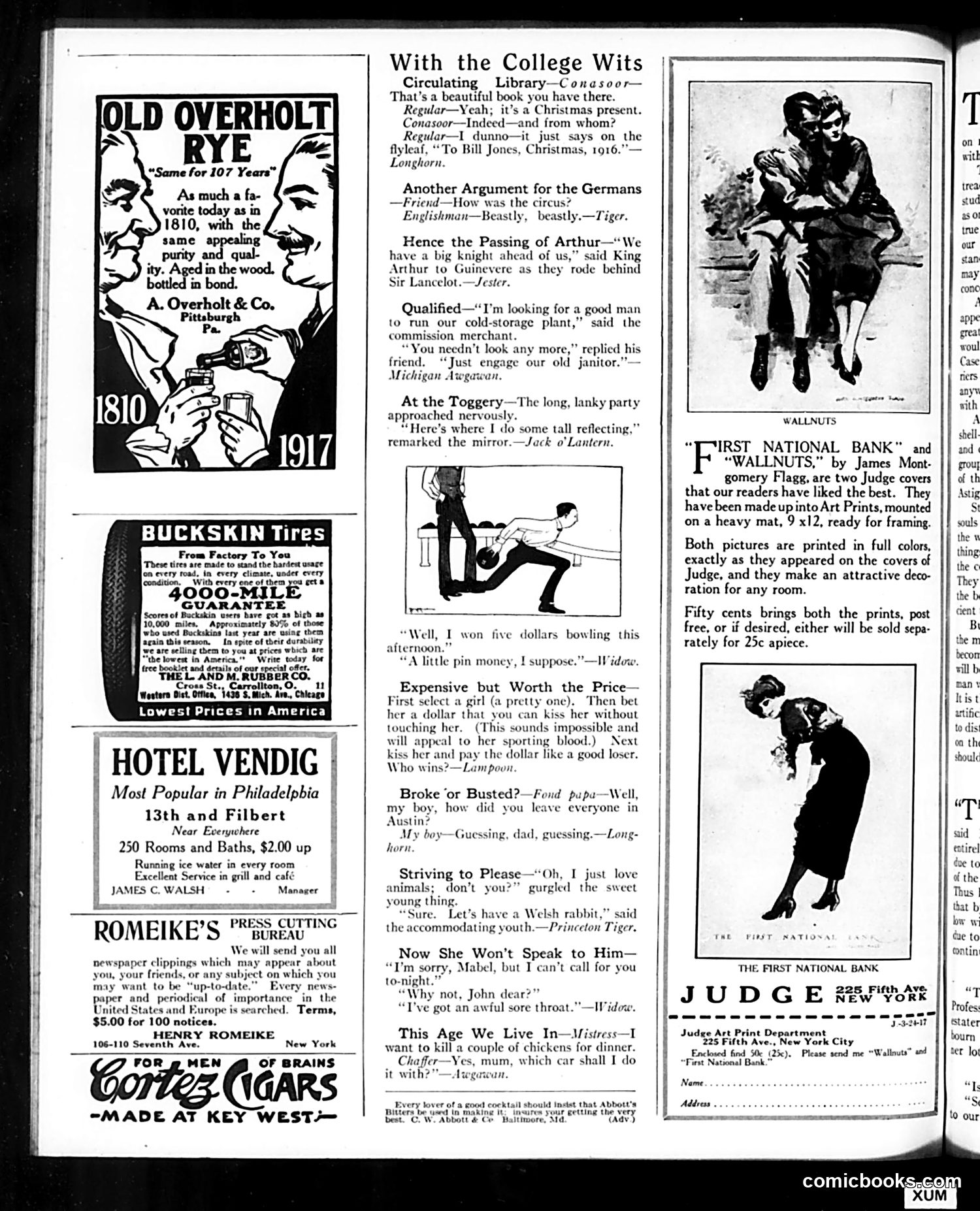
This page combines humor columns and advertisements typical of Judge's early 20th-century format. **The humor pieces** are brief jokes reprinted from college publications (Michigan Awgawan, Princeton Tiger, etc.), targeting educated readers. They include wordplay ("tall reflecting" at a mirror), romantic comedy (betting to kiss without touching), and period comedy ("Welsh rabbit" as a euphemism). One joke references the slow adoption of automobiles—a chauffeur asking "which car shall I do it with?" to kill chickens, suggesting cars were still novelties. **The cartoons** (top right) are Judge covers by James Montgomery Flagg titled "First National Bank" and "Wallnuts," now offered as art prints for 50 cents. The images show men in business attire in comedic situations, typical of Judge's middle-class humor. **The advertisements**—Old Overholt Rye, Buckskin Tires, Hotel Vendig, Cortez Cigars—target affluent male readers with products emphasizing durability and value. The page reflects 1917 America's consumer culture and genteel college humor focused on romance, business, and modern conveniences.
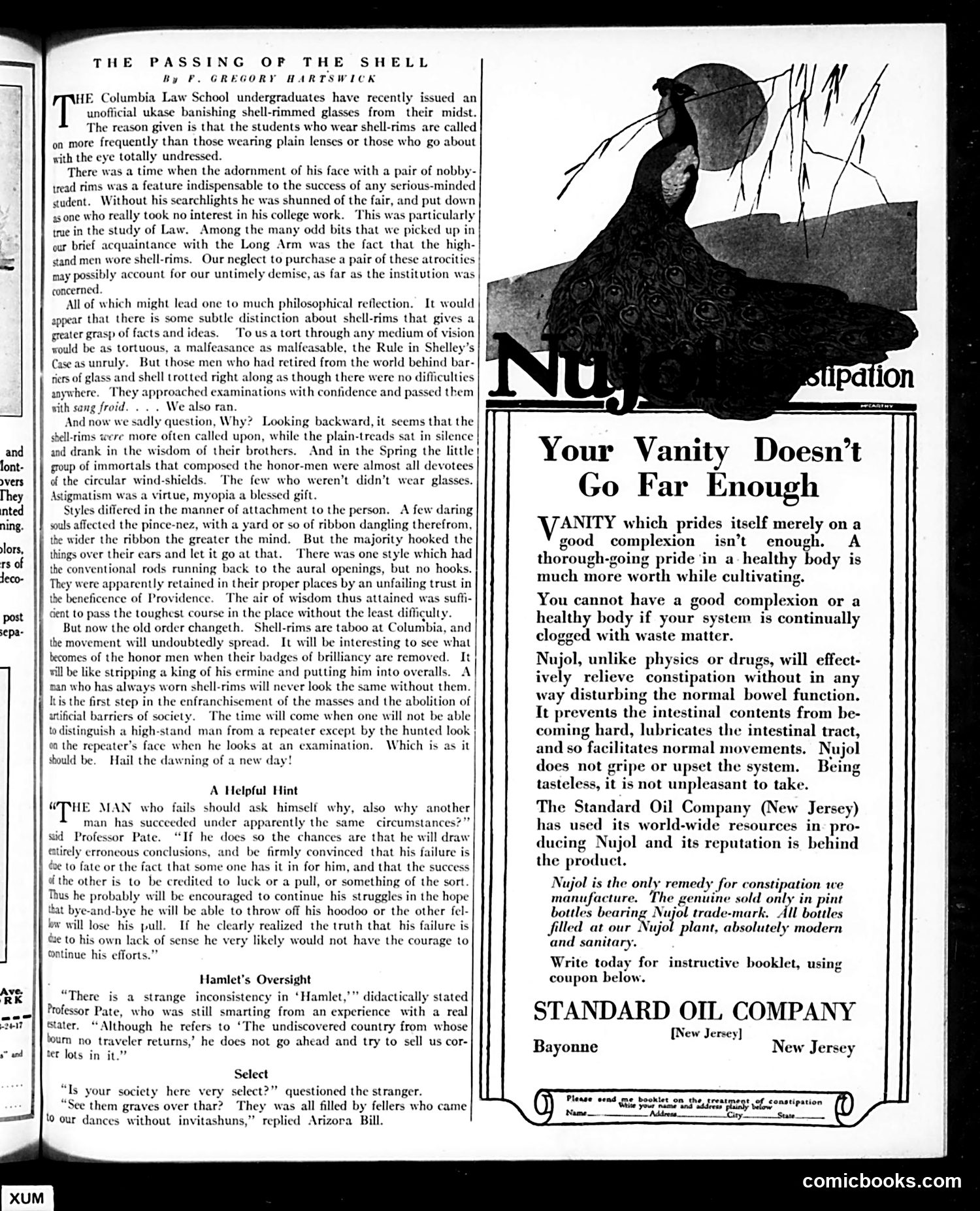
This article satirizes Columbia Law School students' fashion trends and academic pretensions. The "shell" refers to shell-rimmed eyeglasses, which became a status symbol among law students—wearing them supposedly signaled intellectual seriousness and academic success. The satire mocks how students attributed their exam performance to these glasses rather than actual studying. The author notes that professors called on shell-rimmed wearers more frequently, yet these students paradoxically performed better, leading to a circular logic: the glasses became marks of "wisdom" and academic prowess. The piece is really critiquing intellectual vanity and superficiality—the notion that appearance or accessories create competence. When Columbia banned shell-rims, the author humorously suggests it signals social leveling, removing "badges of brilliancy" that distinguished high-performing from failing students. The joke: students believed fashionable eyewear granted them intelligence, when success actually derived from effort and ability.
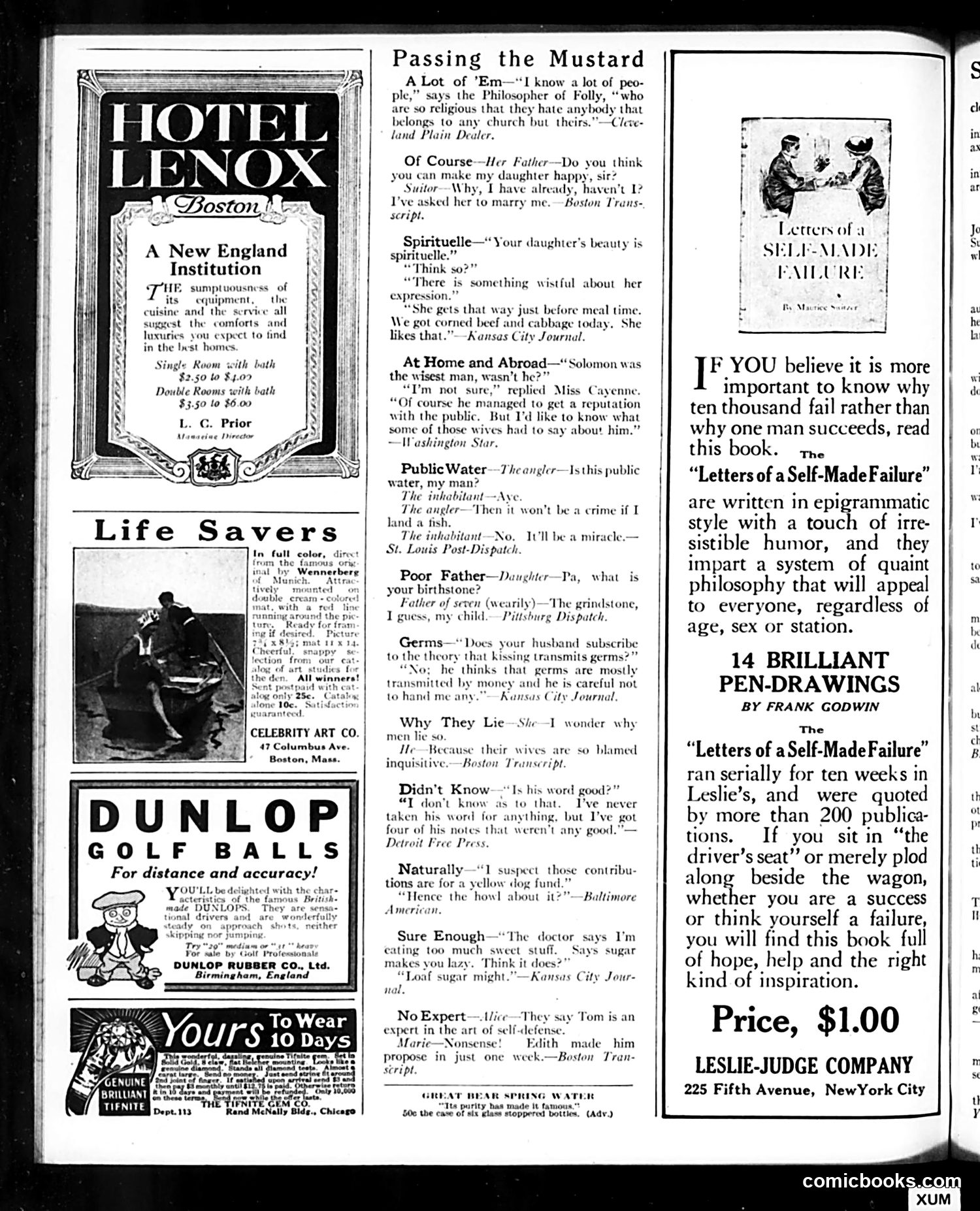
This page is primarily **advertisements and humor columns**, not political cartoons. The "Passing the Mustard" section contains brief satirical jokes on social topics: - **Religious hypocrisy**: A jab at people claiming piety while condemning others' faiths - **Marriage realities**: A suitor's claim he's made his fiancée happy by proposing (implying she wanted marriage above all) - **Women and materialism**: A joke suggesting wives care mainly about food and meal timing - **Solomon's wives**: Mocking the biblical figure's wisdom by suggesting his many wives would've contradicted his reputation - **Gender dynamics**: Multiple jokes about wives being "inquisitive" and manipulative with money The humor reflects early 20th-century stereotypes about marriage, women, and domestic life—portraying wives as nagging, materialistic, or dishonest. The page also advertises "Letters of a Self-Made Failure," a book of philosophical humor with Frank Godwin illustrations, plus hotel and product ads typical of this era's magazine format.
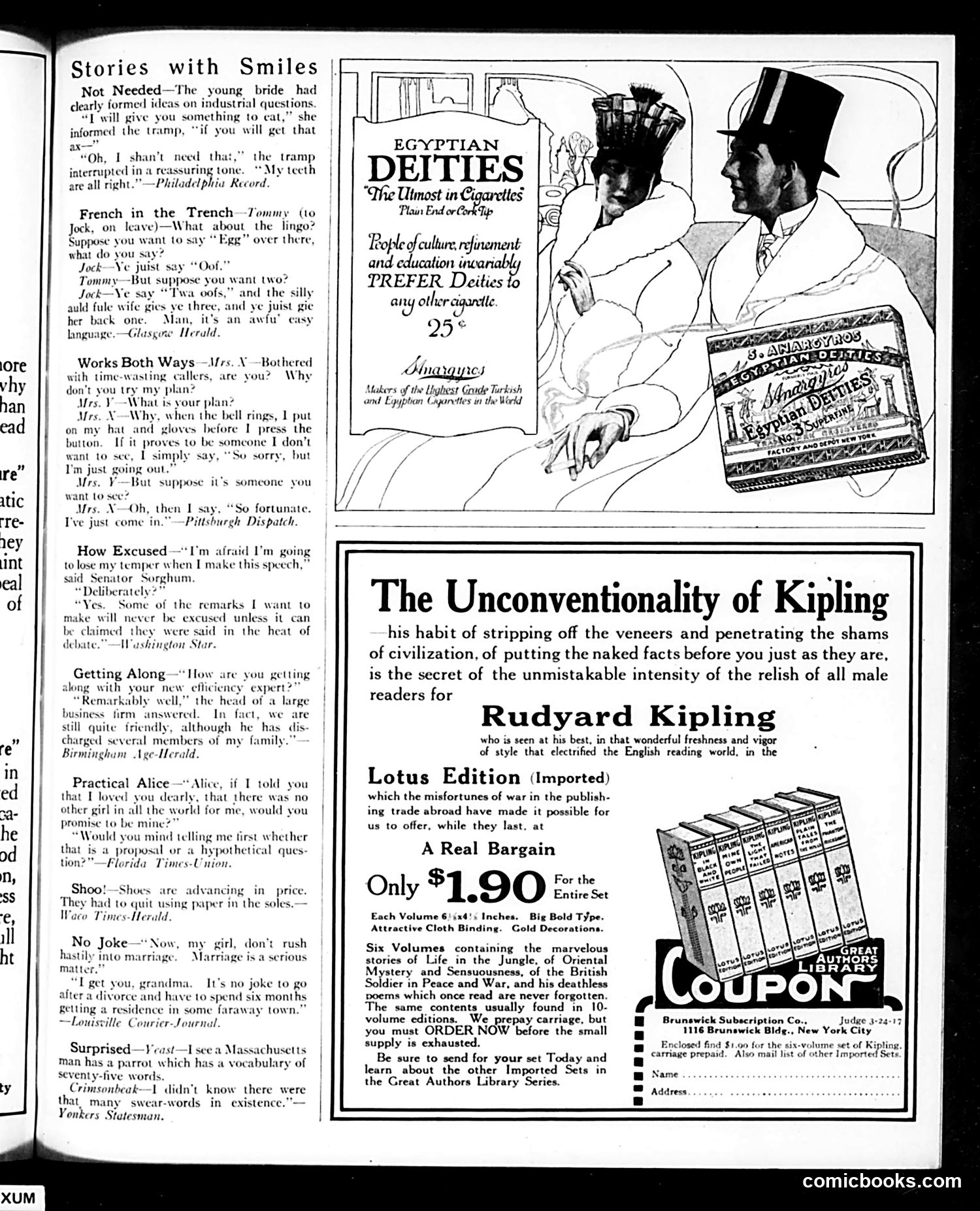
This page contains primarily **short humor pieces and advertisements** rather than political cartoons. The left side features "Stories with Smiles"—brief comedic anecdotes on everyday topics: a tramp declining food, Scottish soldiers discussing French, a woman's trick for avoiding callers, and workplace efficiency. These reflect early 20th-century concerns: poverty, World War I (the "Trench" reference), social calls, and industrial management. The right side contains **two advertisements**: Egyptian Deities cigarettes (appealing to "people of culture and refinement") and a Lotus Edition of Rudyard Kipling's works for $1.90. The Kipling ad emphasizes his "unconventionality" in depicting "naked facts" and "shams of civilization"—suggesting his appeal to male readers seeking frank, unsentimental storytelling. The page's social context includes WWI references, class anxieties about etiquette and callers, and marketing that associates commercial products with cultural sophistication. There are no identifiable political figures or sustained satirical targets—just period observations presented as humor.
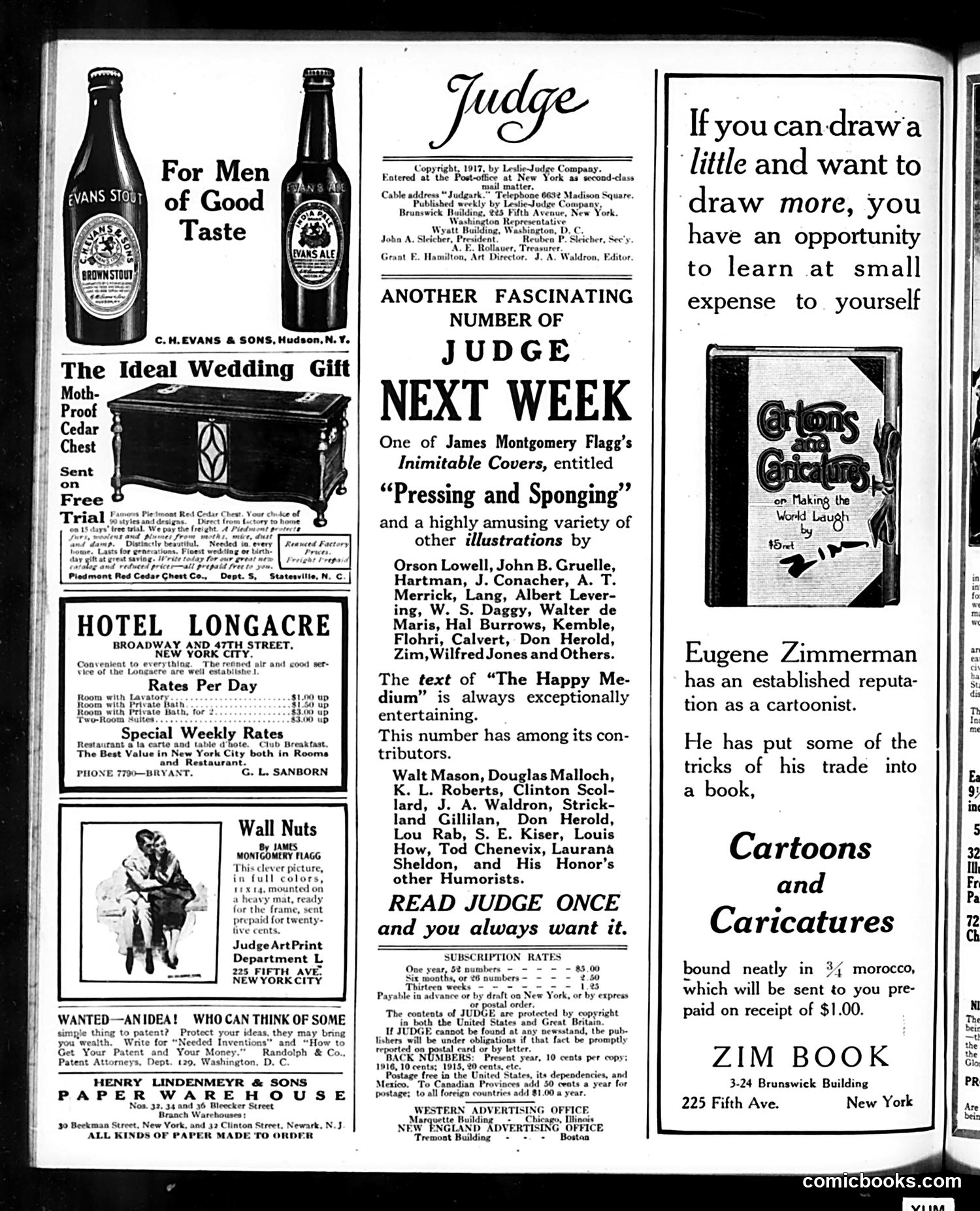
This is primarily an **advertising and promotional page** from Judge magazine, dated 1917. The page contains no political cartoons or satirical content requiring historical context. The main elements are: 1. **Beer advertisement** (Evans Stout) - targeting male consumers with "good taste" 2. **Hotel Longacre ad** - Broadway lodging rates 3. **"Wall Nuts" cartoon** by James Montgomery Flagg - a humorous illustration (the specific joke is unclear from this reproduction) 4. **Judge magazine promotion** - advertising next week's issue, featuring James Montgomery Flagg's cover "Pressing and Sponging" and contributions from various cartoonists and humorists 5. **Zimmerman's book advertisement** - promoting a how-to book on cartooning and caricature ($1.00) The page essentially serves as a house advertisement and revenue generator through classified ads. No specific political or social satire is evident here—it's a typical early 20th-century magazine layout mixing editorial promotion with paid advertising.
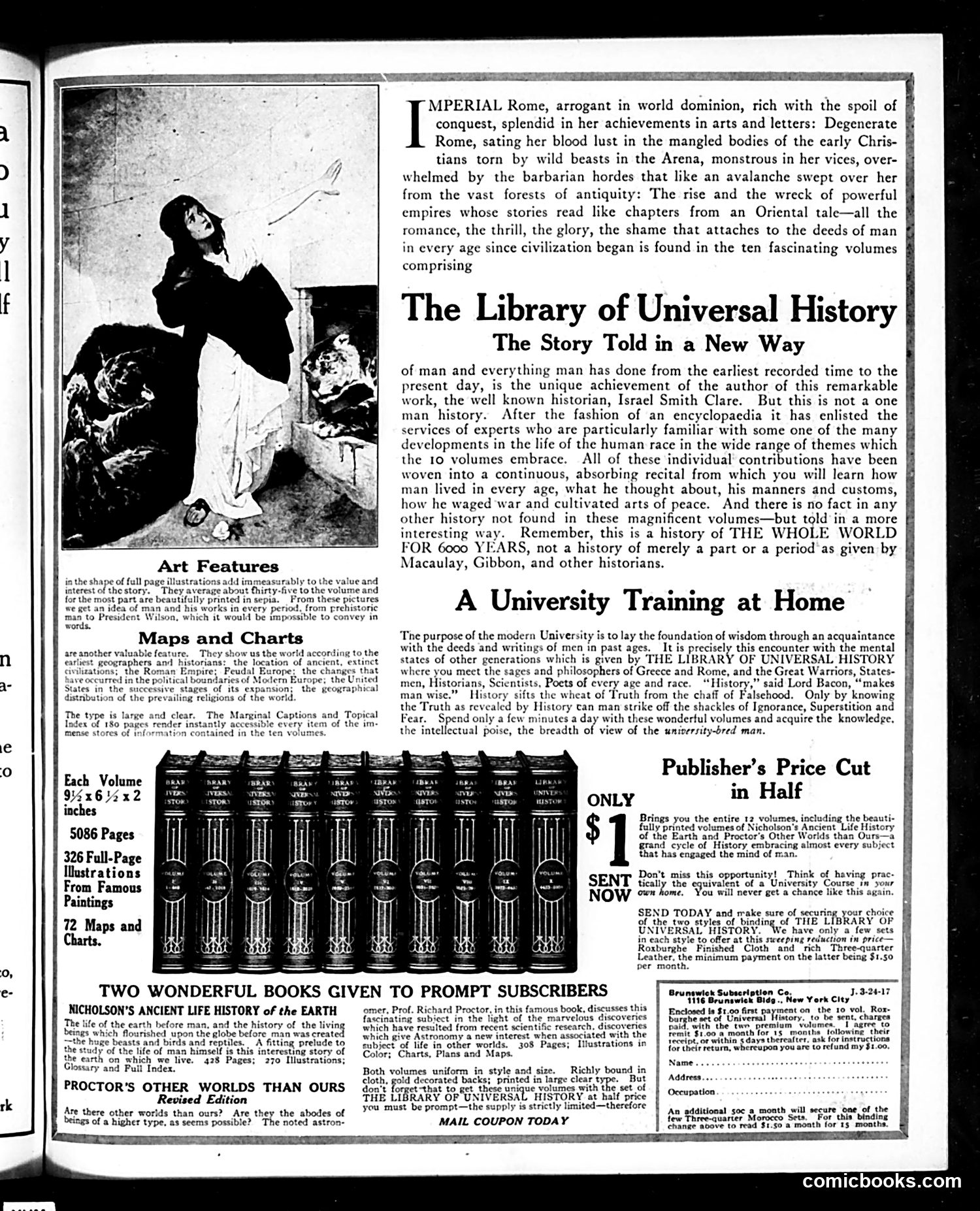
This page is primarily **advertising copy**, not satire or political commentary. It promotes "The Library of Universal History," a 12-volume encyclopedia by historian Israel Smith Clare. The artwork—a dramatic illustration of a robed figure gesturing toward classical ruins—functions as decorative marketing material emphasizing the grandeur of human civilization across ages. The lengthy text opening invokes Imperial Rome's rise and fall to establish the historical scope and drama readers can expect. The advertising emphasizes self-improvement through home education, positioning the encyclopedia as an affordable alternative to university training. The "Publisher's Price Cut" announces the volumes at $1 (with payment plans), framed as a remarkable bargain for acquiring comprehensive world knowledge. This reflects early 20th-century direct-mail marketing in educational publishing, targeting middle-class readers seeking cultural improvement and intellectual authority. The page contains no identifiable political satire or caricature—it is straightforward product promotion.
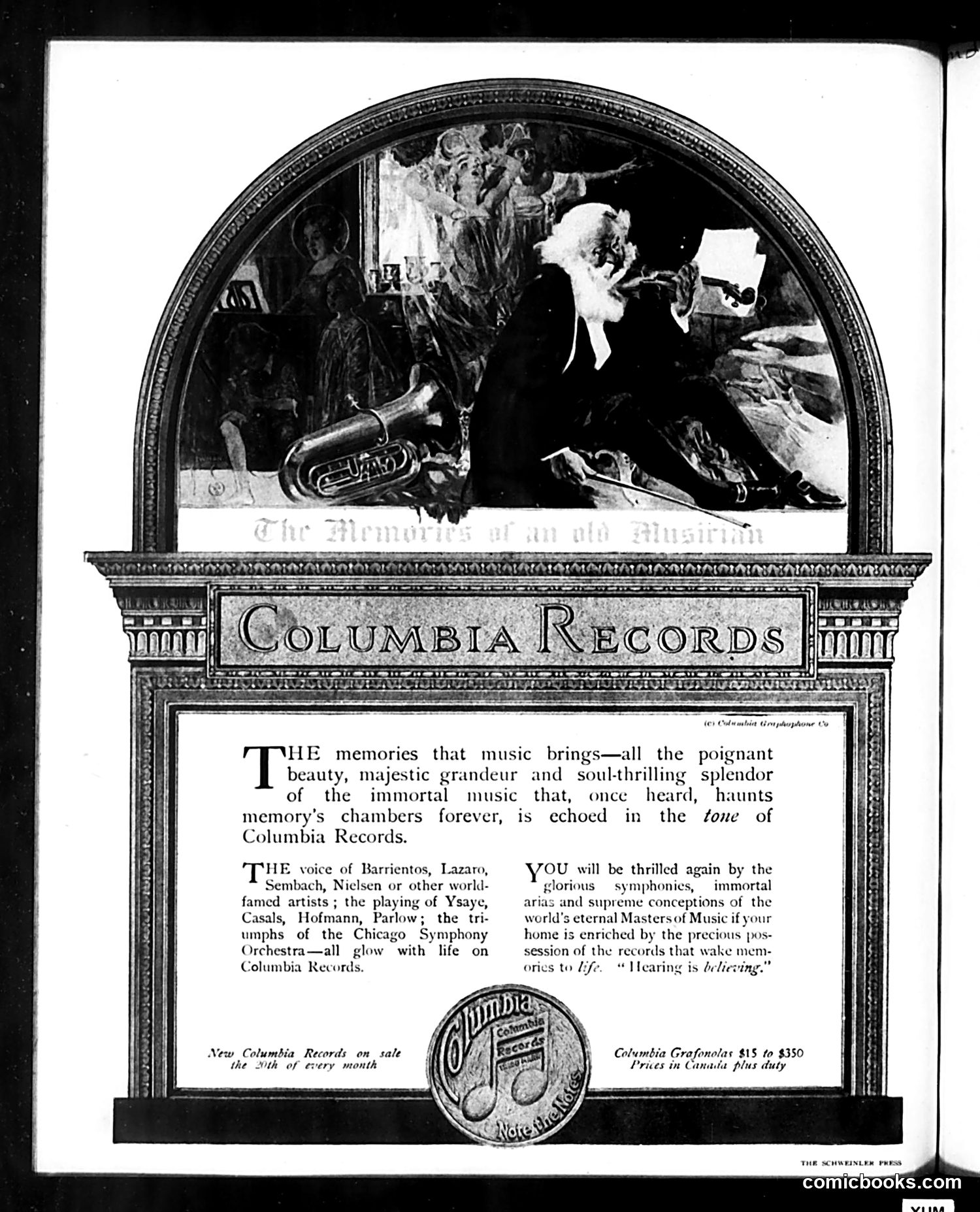
This is primarily a **product advertisement**, not political satire. It promotes Columbia Records and Gramophones (early phonographs) to early 20th-century consumers. The upper illustration depicts an elderly gentleman listening to recorded music, appearing transported by the experience—a common marketing trope suggesting the emotional power of recorded sound. The composition evokes classical refinement. The text celebrates famous classical musicians (Barrientos, Ysaye, Casals, the Chicago Symphony Orchestra) whose performances are preserved on Columbia Records, emphasizing how recordings allow listeners to experience "immortal music" repeatedly. The slogan "Hearing is believing" suggests the fidelity of the recording technology. The graphone prices ($15-$350 in Canada) indicate this was luxury merchandise for affluent households. The advertisement's romantic language about memory and emotion reflects early recording industry marketing strategies that positioned phonographs as cultural necessities for refined homes.