
Judge, 1917-03-24 · page 16 of 28
Judge — March 24, 1917 — page 16: what you’re looking at
What you’re looking at
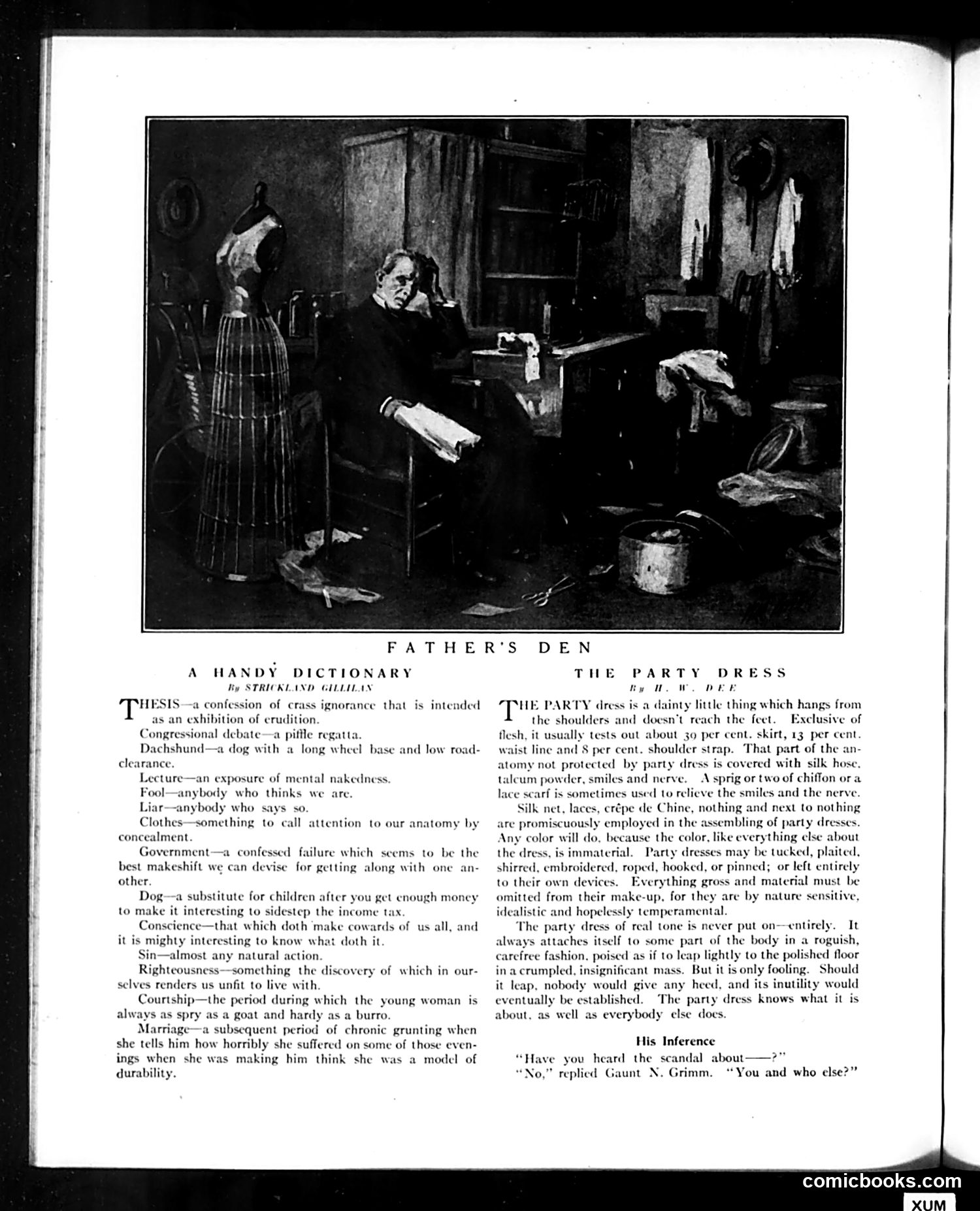
This page from *Judge* presents satirical definitions by Strickland Gillilan mocking American social conventions and hypocrisy. The humor relies on cynical redefinitions—"Government" is a "confessed failure," "Conscience" makes cowards of us, "Marriage" is "chronic grunting." The accompanying illustration depicts a shabby domestic interior, likely illustrating the marriage definition's sardonic tone about post-courtship disillusionment. The "Party Dress" section continues the satire, describing women's evening wear with mock-serious fashion analysis. It suggests party dresses are impractical, requiring constant adjustment, designed more for appearance than function—a commentary on frivolous feminine fashion and the gap between social pretense and reality. The brief dialogue at bottom references unspecified scandal gossip, characteristic of society's rumor-mongering. Overall, the page exemplifies *Judge*'s cynical critique of American middle-class morality, gender relations, and social pretension through humor.
📄 Transcribed text from this page (OCR, searchable)
Machine-transcribed from the original scan — historical spelling and the odd misread are preserved.
FATHER’S A HANDY DICTIONARY Ry STRICKLAND GILLILAN Thess a confession of crass ignorance that is intended as an exhibition of erudition Congressional debate—a piffle regatta. Dachshund—a dog with a long wheel base and low road- clearance, Lecture—an exposure of mental nakedness. Fool—anybody who thinks we are nybody who says so. Clothes—something to call attention to our anatomy by concealment. Government best makeshift we can devise other. Dog—a substitute for children after you get enough money to make it interesting to sidestep the income tax Conscience—that which doth make cowards of us all, and it is mighty interesting to know what doth it Sin—almost any natural action. Righteousness—something the discovery of which in our- selves renders us unfit to live with Courtship—the period during which the young woman is always as spry as a goat and hardy as a burro. urriage—a subsequent period of chronic grunting when she tells him how horribly she suffered on some of those even- ings when she was making him think she was a model of durability. a confessed failure which seems to be the for getting along with one an- DEN THE PARTY hy WW inty little thing which hangs from Exclusive of DRESS DEE TH PARTY dress is ad: the shoulders and doesn’t reach the feet. flesh, it usually tests out about 30 per cent. skirt, 13 per cent. waist line and 8 per cent. shoulder strap. That part of the an- atomy not protected by party dress is covered with silk hose, talcum powder, smiles and nerve. _.\ sprig or two of chiffon ora lace searf is sometimes used to relieve the smiles and the nerve. Silk net, laces, de Chine, nothing and next to nothing are promiscuously employed in the assembling of party dresses. Any color will do, because the color, like everything else about the dress, is immaterial. Party dresses may be tucked, plaited, shirred, embroidered, roped, hooked, or pinned; or left entirely to their own devices. Everything gross and material must be omitted from their make-up, for they are by nature sensitive, idealistic and hopelessly temperamental. The party dress of real tone is never put on—entirely. It always attaches itself to some part of the body in a roguish, carefree fashion, poised as if to leap lightly to the polished floor in acrumpled, insignificant mass. But it is only fooling. Should it leap, nobody would give any heed, and its inutility would eventually be established. The party dress knows what it is about, as well as everybody else docs. His Inference about— “Have you heard the scandal “You and who else?” “No,” replied Gaunt N. Grimm. comicbooks.com