
A complete issue · 28 pages · 1917
Judge — March 3, 1917
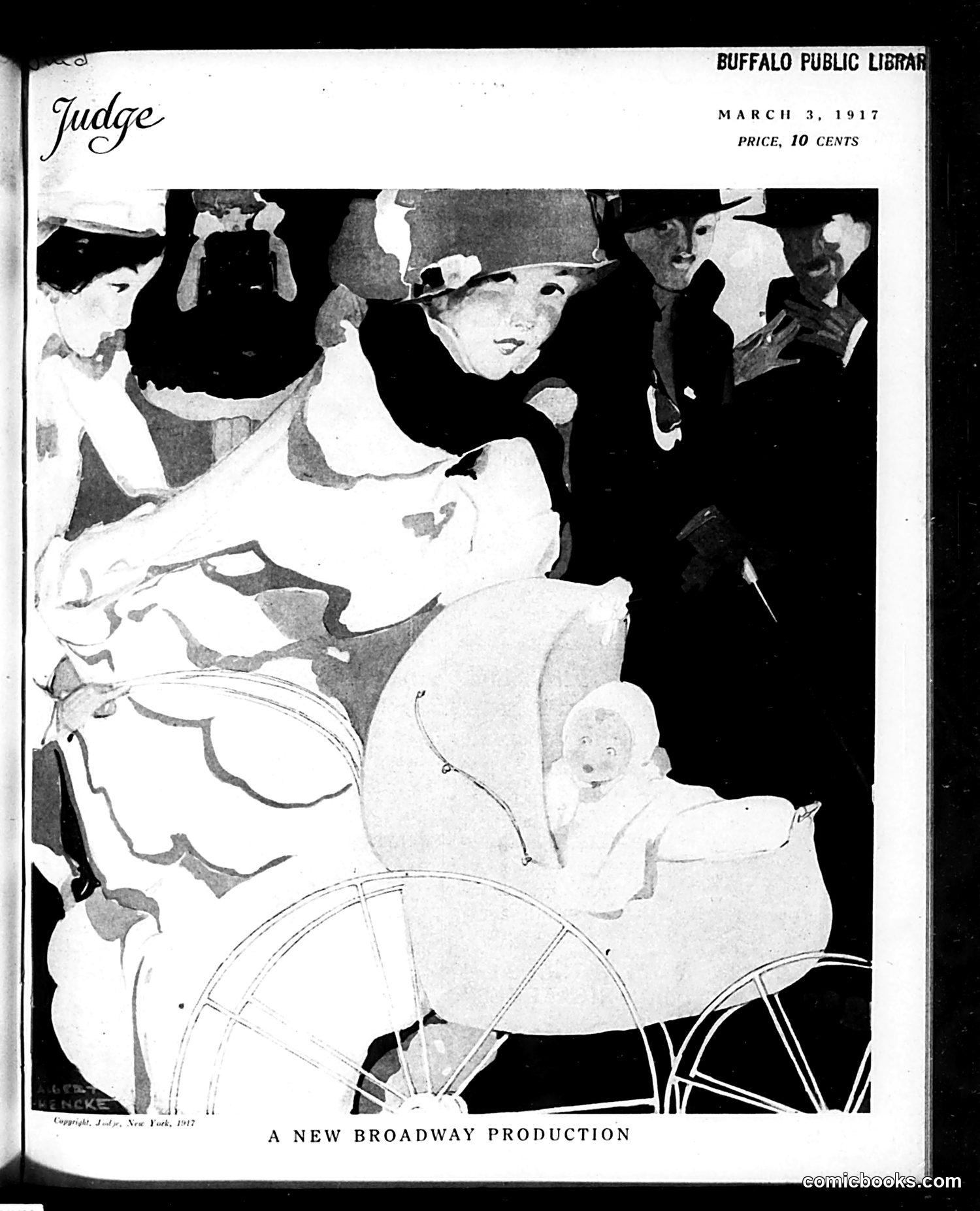
This Judge magazine cover from March 3, 1917 shows "A New Broadway Production" — apparently a theatrical satire. The image depicts fashionably dressed women gathered around elaborate baby carriages/prams in what appears to be a crowded social scene, with well-dressed men observing in the background. The satire likely comments on upper-class affectation and conspicuous consumption around motherhood and childcare — the ornate carriages suggest wealthy women displaying their status through elaborate baby equipment rather than genuine parental concern. The crowded, gossipy atmosphere implies mockery of high-society pretension. Given the 1917 date, this may also reference contemporary theatrical productions about modern womanhood, though specific identification of the play or figures remains unclear without additional context.
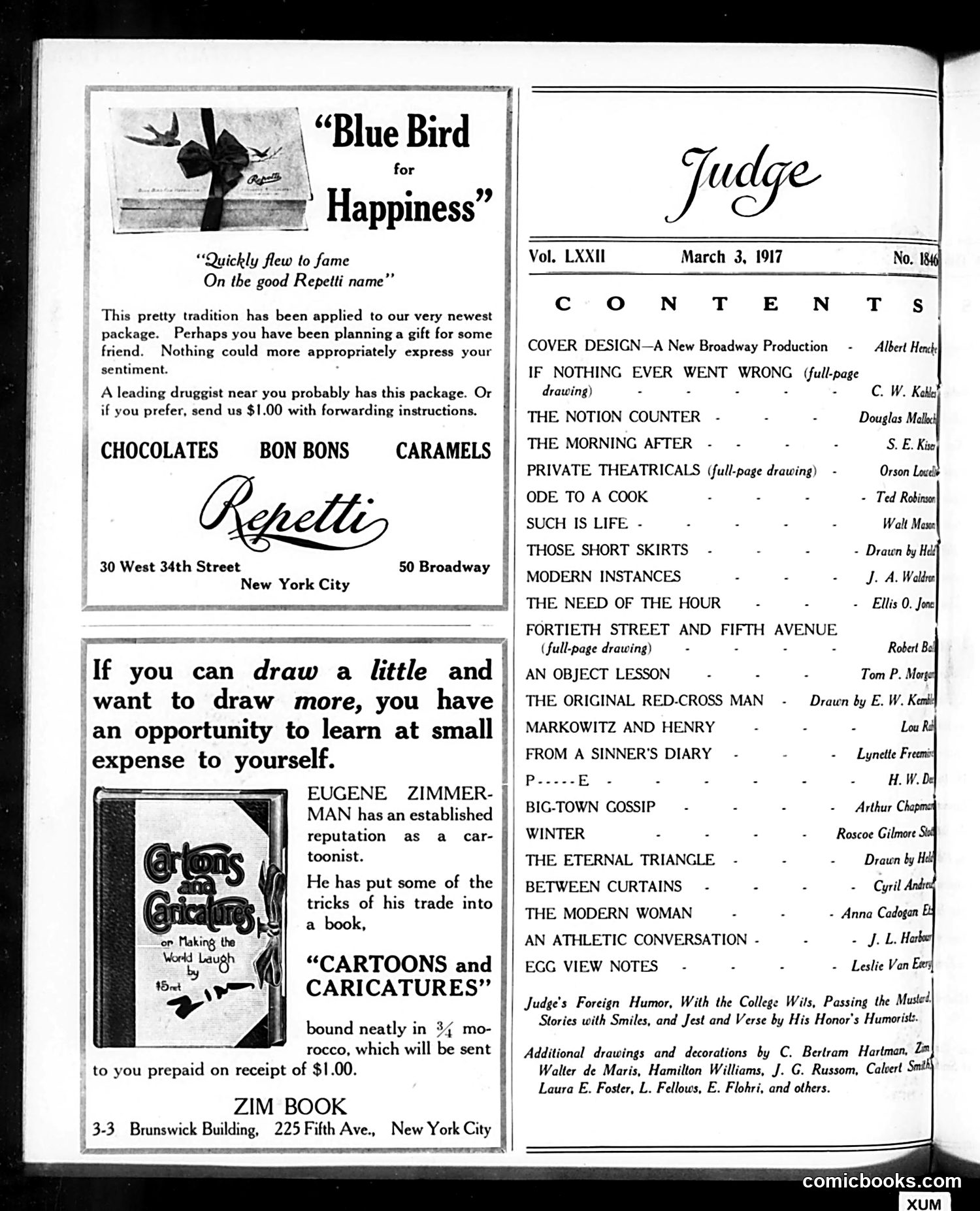
This page is primarily **advertising and table of contents** rather than political satire. The left side contains ads for Repetti chocolates, a Eugene Zimmermann cartooning instruction book, and a "Blue Bird for Happiness" candy package. The right side lists contents for this issue of Judge magazine. The only substantive content clue is the date: **March 3, 1917**, just weeks before America entered World War I (April 1917). However, this particular page contains no visible political cartoons addressing that momentous event. The listed articles ("The Modern Woman," "Winter," "Bigtown Gossip") suggest general satirical humor rather than war commentary. This appears to be a standard issue mixing commercial advertisements with entertainment content.
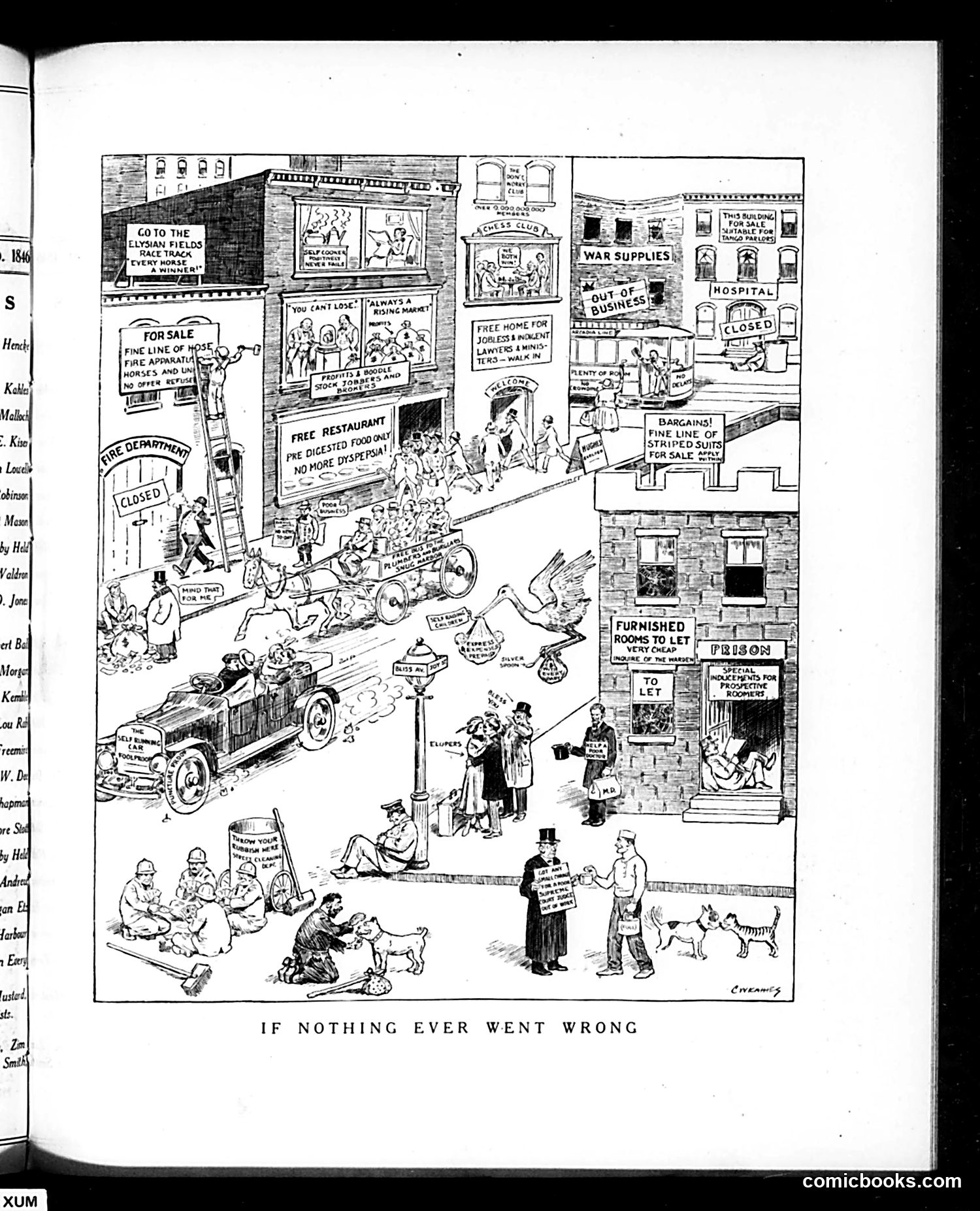
This satirical cartoon depicts an idealized urban fantasy where social problems have vanished. The street scene shows businesses thriving—a "Free Restaurant" offering food without charge, a "Free Home for Jobless & Indigent," an "Always a Rising Market," and "War Supplies" shop standing open rather than closed. The satire critiques economic inequality and systemic failures of the era (likely post-WWI or 1920s). By presenting these impossibilities—free housing, perpetually rising markets, abundant jobs—as a contrasting utopia, the cartoon highlights the actual deprivation and desperation of the period. Homeless people, unemployed workers, and struggling families inhabit the streets, emphasizing the gap between this imagined paradise and grim reality.
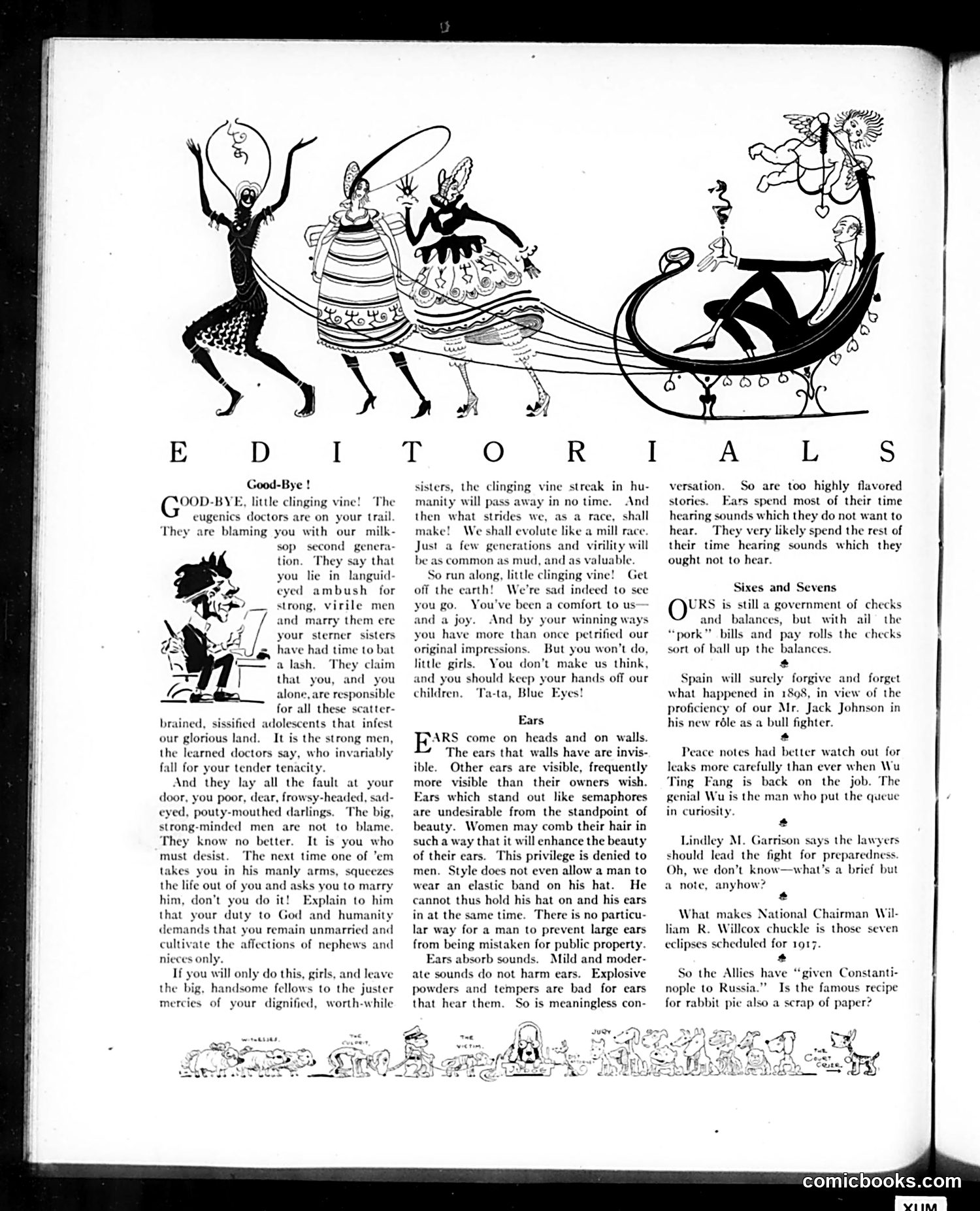
This appears to be an "Editorials" page featuring social commentary rather than political satire. The top illustration depicts figures in an elaborate procession or parade, though the specific reference is unclear from the image alone. The "Good-Bye!" editorial attacks young women's fashion and behavior—specifically criticizing them for wearing clingy garments, being frivolous, and prioritizing appearance over substance. The author sarcastically addresses women as "little clinging vines," mocking their dependence and suggesting they lack intellect. The subsequent sections ("Ears," "Sixes and Sevens") continue criticizing women's fashion choices, particularly regarding hairstyles and ear visibility. The tone is dismissive and patronizing, reflecting early 20th-century gender attitudes that Judge's editors viewed as humorous or justified social commentary.
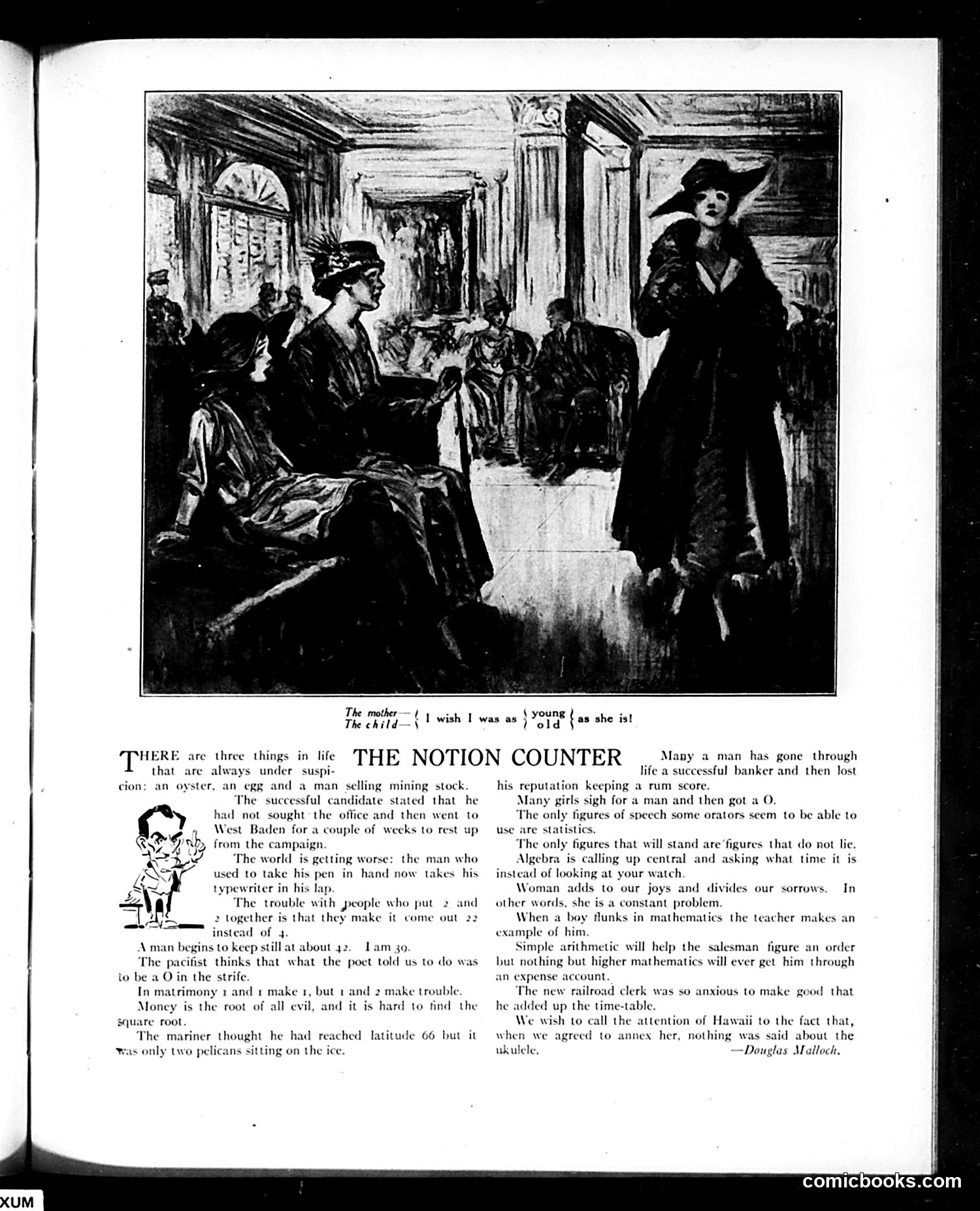
This page satirizes common human flaws and social absurdities through short humorous vignettes. The main illustration depicts what appears to be a social gathering or salon where various characters interact. The text beneath attacks several targets: incompetent politicians ("The successful candidate stated that he had not sought the office"), the abuse of statistics in argument, women as social problems ("Woman adds to our joys and divides our sorrows"), and mathematical ignorance among salesmen. The recurring theme is human irrationality—people who use faulty logic, men seeking office they're unqualified for, and society's tendency to accept nonsensical arguments dressed up as facts or statistics. The small cartoon character illustrates the paradox: "1 and 1 make trouble" while "2 and 2 make 4"—suggesting human nature defies logic.
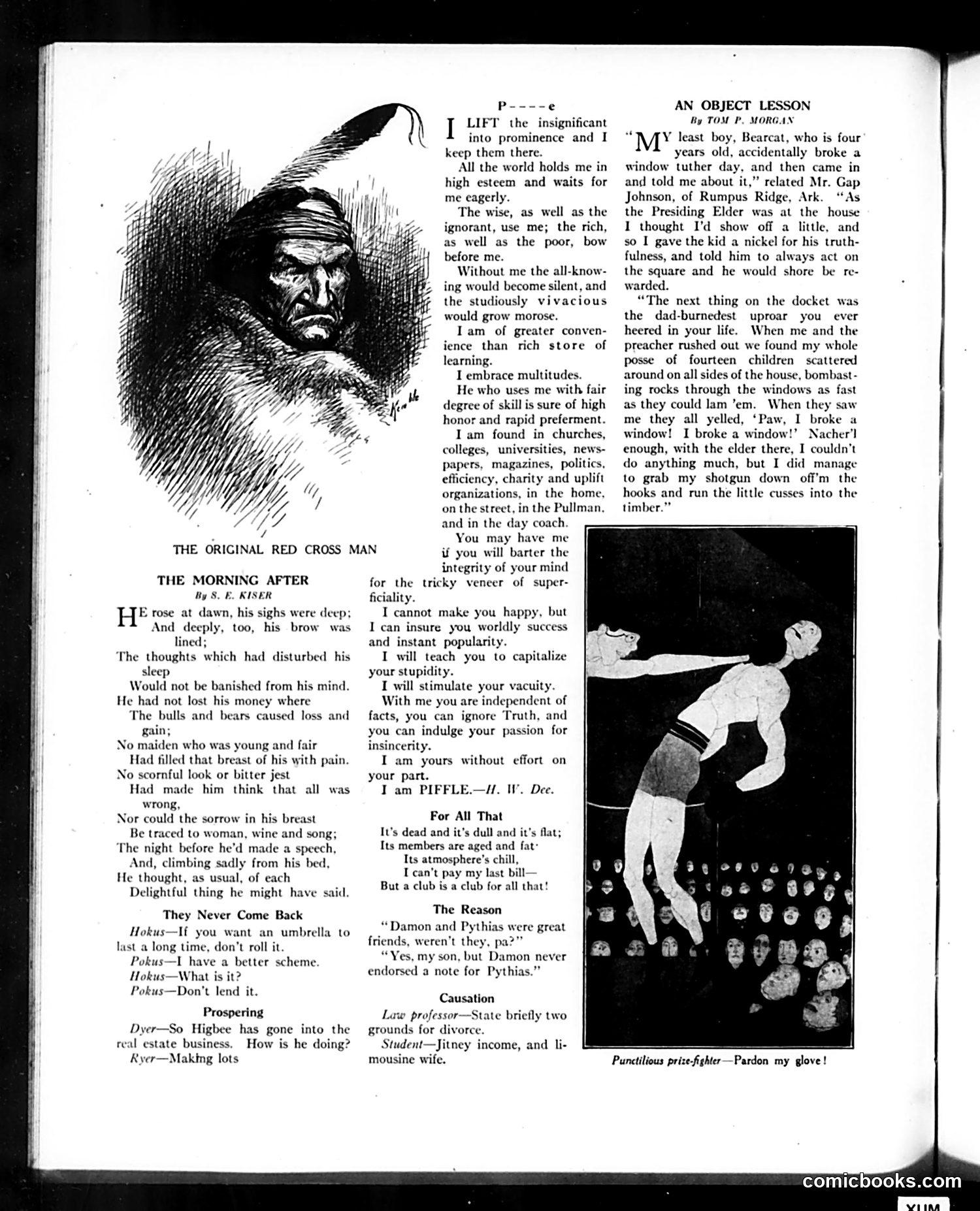
This page contains several distinct pieces: **"The Original Red Cross Man"** - A sketch of a stern, authoritative figure. The accompanying poem "The Morning After" by S.E. Kiser describes someone troubled by thoughts of past actions, suggesting regret over causing harm ("no maiden who was young and fair / Had filled that breast of his with pain"). **"An Object Lesson"** by Tom P. Morgan - A narrative about a preacher correcting a boy named Bearcat for breaking windows, using the incident to teach moral lessons about honesty and consequences. **Lower right**: An illustration labeled "Punctilious prize-fighter—Pardon my glove!" appears to show a boxing scene, likely a humorous commentary on overly polite or affected behavior in sport. The page mixes moralistic fiction with light humor typical of Judge's satirical style, though specific political references remain unclear without additional context.
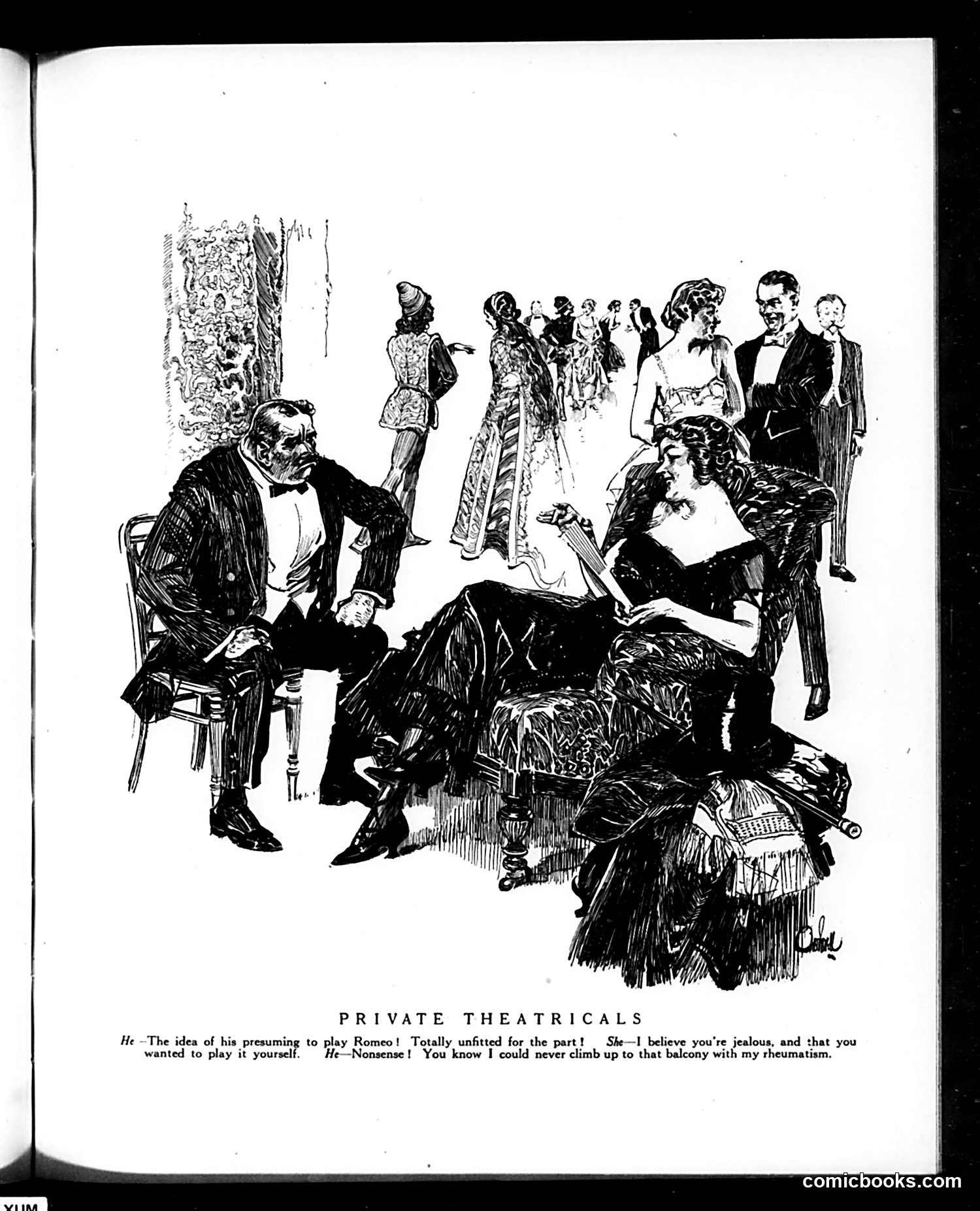
This cartoon satirizes amateur theatrical productions among the wealthy or upper classes. The scene depicts a social gathering where private performances were staged—a popular Victorian-era pastime. The joke hinges on a domestic quarrel: a man dismisses another performer's attempt at playing Romeo as unsuitable, while the woman accuses him of jealousy. His defensive response—claiming he couldn't perform the role himself due to rheumatism (joint pain)—undercuts his criticism and reveals his true impediment. The humor targets both the pretensions of amateur actors and the physical limitations of aging participants attempting romantic roles. The background figures suggest this is a formal drawing-room event. The satire gently mocks upper-class social rituals and the vanity involved in these private performances.
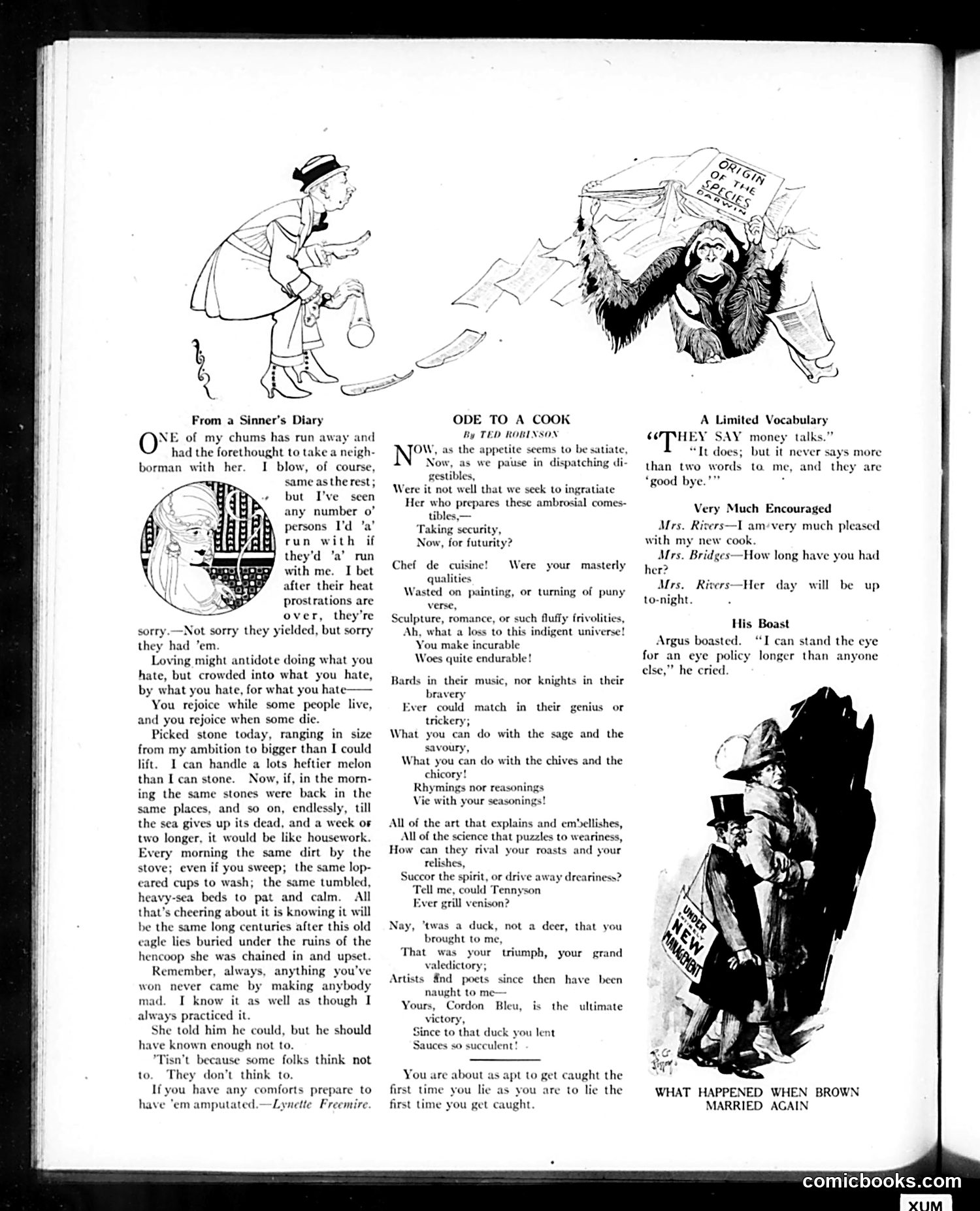
This page contains three satirical pieces reflecting early-20th-century social attitudes: **"From a Sinner's Diary"** presents cynical observations on infidelity and domestic drudgery. The narrator mocks those who regret affairs and compares endless housework to Sisyphean punishment—clearly misogynistic commentary treating women's labor as inherently soul-crushing. **"Ode to a Cook"** humorously elevates a cook's skill above artists and poets, praising her culinary abilities in grandiose language. It's ostensibly flattering but undermines women by suggesting their only value lies in cooking—the poem compares the cook favorably to famous male figures (Tennyson, knights, bards), implying women's achievement is exceptional only within domestic spheres. **"A Limited Vocabulary"** and **"His Boast"** are brief joke fragments about women's speech and male braggadocio. **"What Happened When Brown Married Again"** (bottom right) appears to be a cartoon about remarriage, though details are unclear from this reproduction. The page reflects Judge's satirical but fundamentally misogynistic perspective, mocking women through "witty" commentary on their domestic roles and limitations.
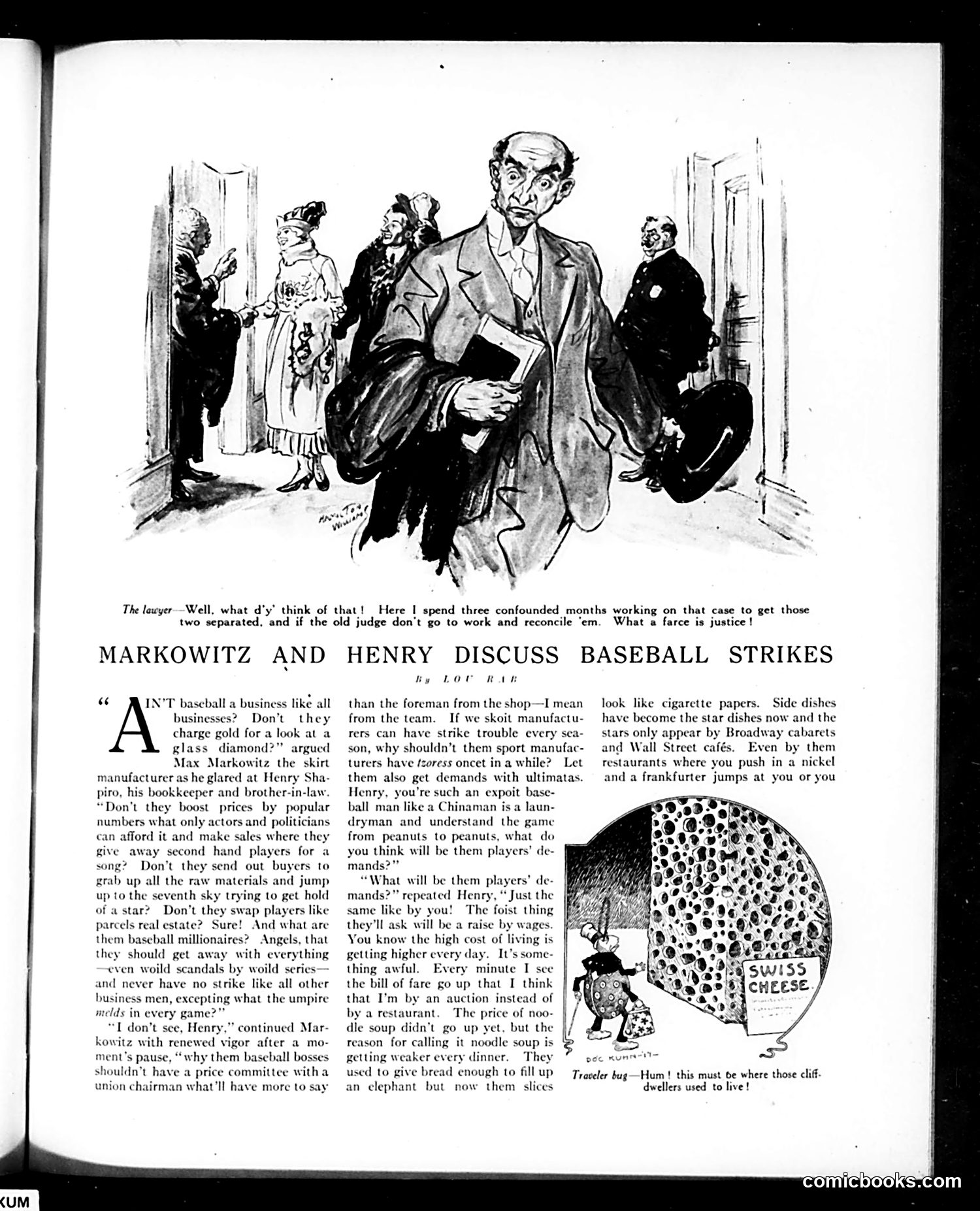
This 1920s Judge magazine piece satirizes labor strikes through a dialogue between Max Markowitz (a skirt manufacturer) and Henry (his bookkeeper). **The Setup:** Markowitz argues that baseball team owners operate like any other business—exploiting labor, controlling markets, manipulating assets. He questions why baseball players shouldn't organize strikes like factory workers do, demanding wage increases and better conditions. **The Satire's Point:** By comparing baseball to garment manufacturing, the piece mocks both sides: wealthy industrialists who exploit workers while claiming special business exemptions, AND the growing labor movement demanding unionization. The humor lies in Markowitz ironically advocating for baseball strikes while himself being a manufacturer who presumably resists his own workers' demands. **Historical Context:** This reflects 1920s labor tensions—factory strikes were common and controversial. The piece uses baseball (America's pastime) as a lens to debate whether workers deserve collective bargaining rights, ultimately suggesting the entire system is hypocritical. **The Lawyer's Lament** (top) reinforces this: legal/social institutions fail to "reconcile" conflicting interests—whether divorced couples or labor-management disputes.
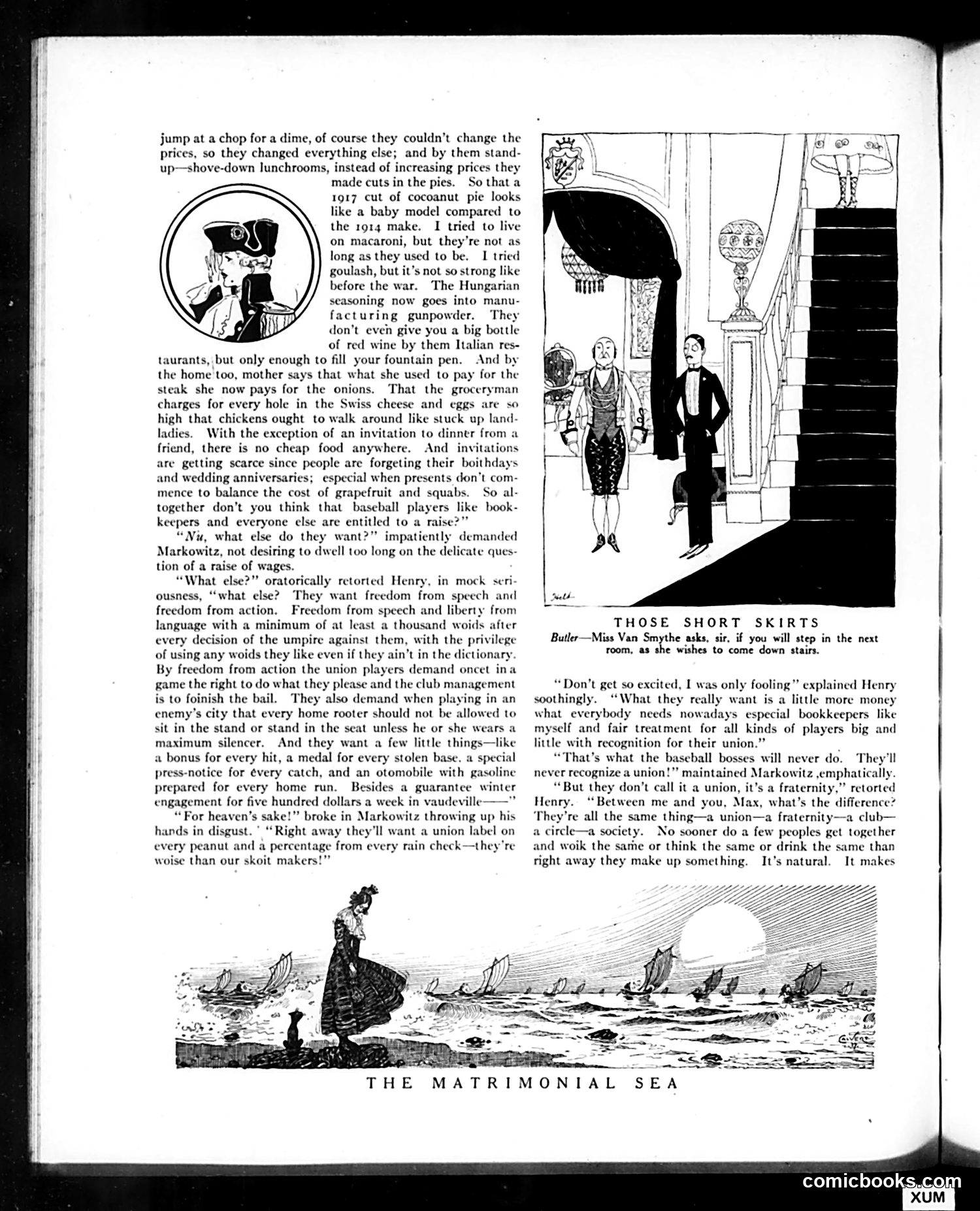
This page satirizes early labor organizing in professional baseball (circa 1917). The dialogue between characters Markowitz and Henry mocks baseball players' demands for unionization, presented as absurdly greedy. The satire works on multiple levels: First, it frames wartime inflation (shortages making food portions smaller, prices rising) as justification for players' wage demands. Second, it ridicules union organizing itself—Henry's exaggerated list of demands (bonuses per hit, medals for stolen bases, automobiles for home runs) is meant to seem preposterous. The cartoonist's sympathies appear anti-union: players are characterized as ungrateful whiners during wartime, while the "fraternity vs. union" debate suggests organized labor threatens social cohesion. The accompanying illustrations—"Those Short Skirts" (fashion commentary) and "The Matrimonial Sea" (romance)—are unrelated filler typical of magazines mixing news satire with lifestyle content.
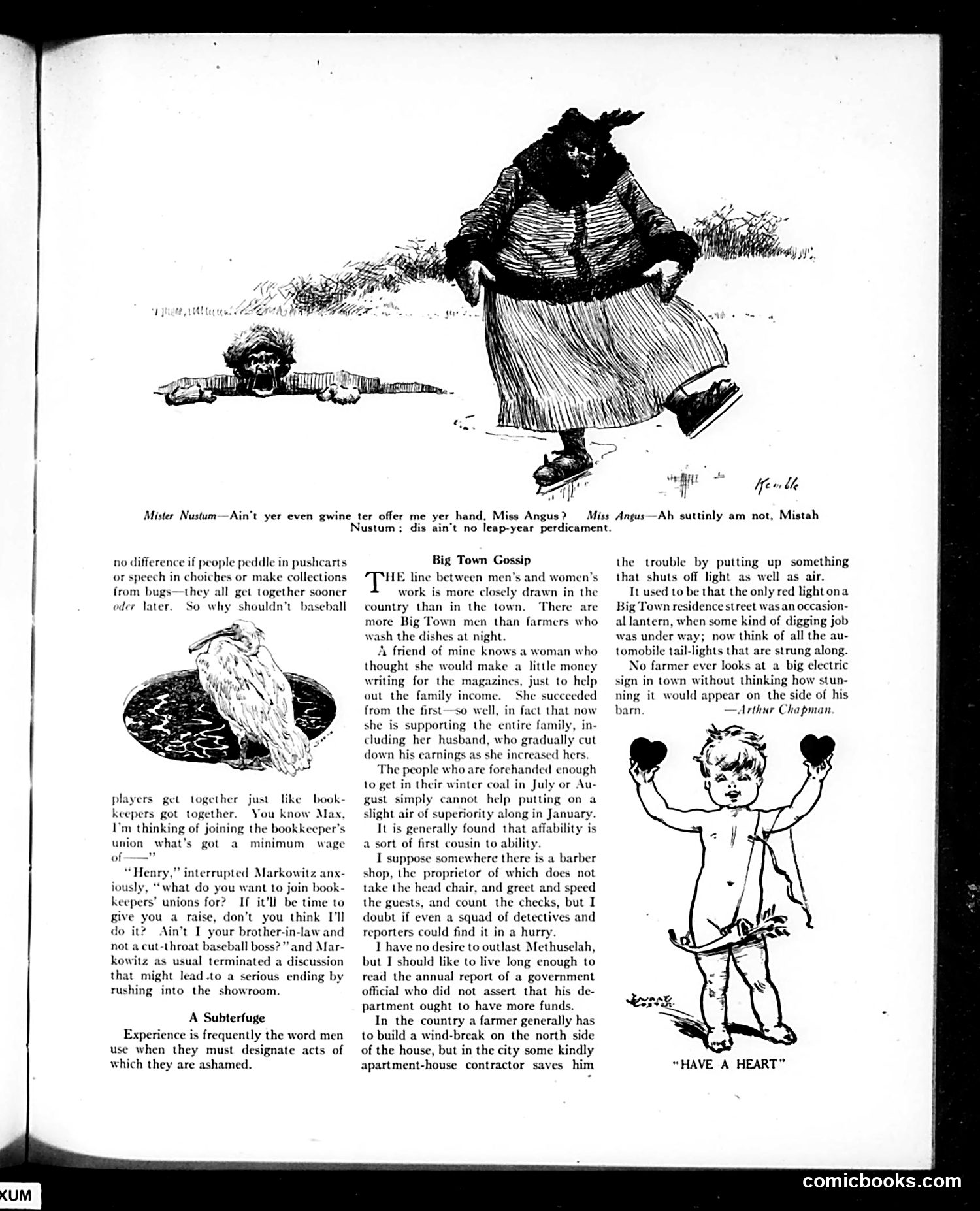
This page contains three separate satirical pieces typical of early 20th-century American humor: **Top cartoon**: A Southern gentleman ("Mister Nustum") asks a woman ("Miss Angus") to offer her hand, but she declines, noting it's not a leap year—when tradition allowed women to propose. The satire mocks both outdated courtship customs and gender role rigidity. **"A Subterfuge"**: A brief quip about euphemism—how people use "experience" to politely describe shameful conduct. **"Big Town Gossip"**: Arthur Chapman's column satirizes urban life, contrasting country and city behavior. Key targets include: a wife supporting her lazy husband through magazine writing (role reversal as comedy); people's pretentiousness about winter coal purchases; government officials always requesting budget increases; and city folk's obsession with electric signs and automobile lights—treating urban excess as aspirational. The bottom cartoon shows a cheerful child with hearts, captioned "Have a Heart"—likely promoting sentiment or charity. The overall tone reflects Progressive-era anxieties about changing gender roles, government waste, and urban materialism.
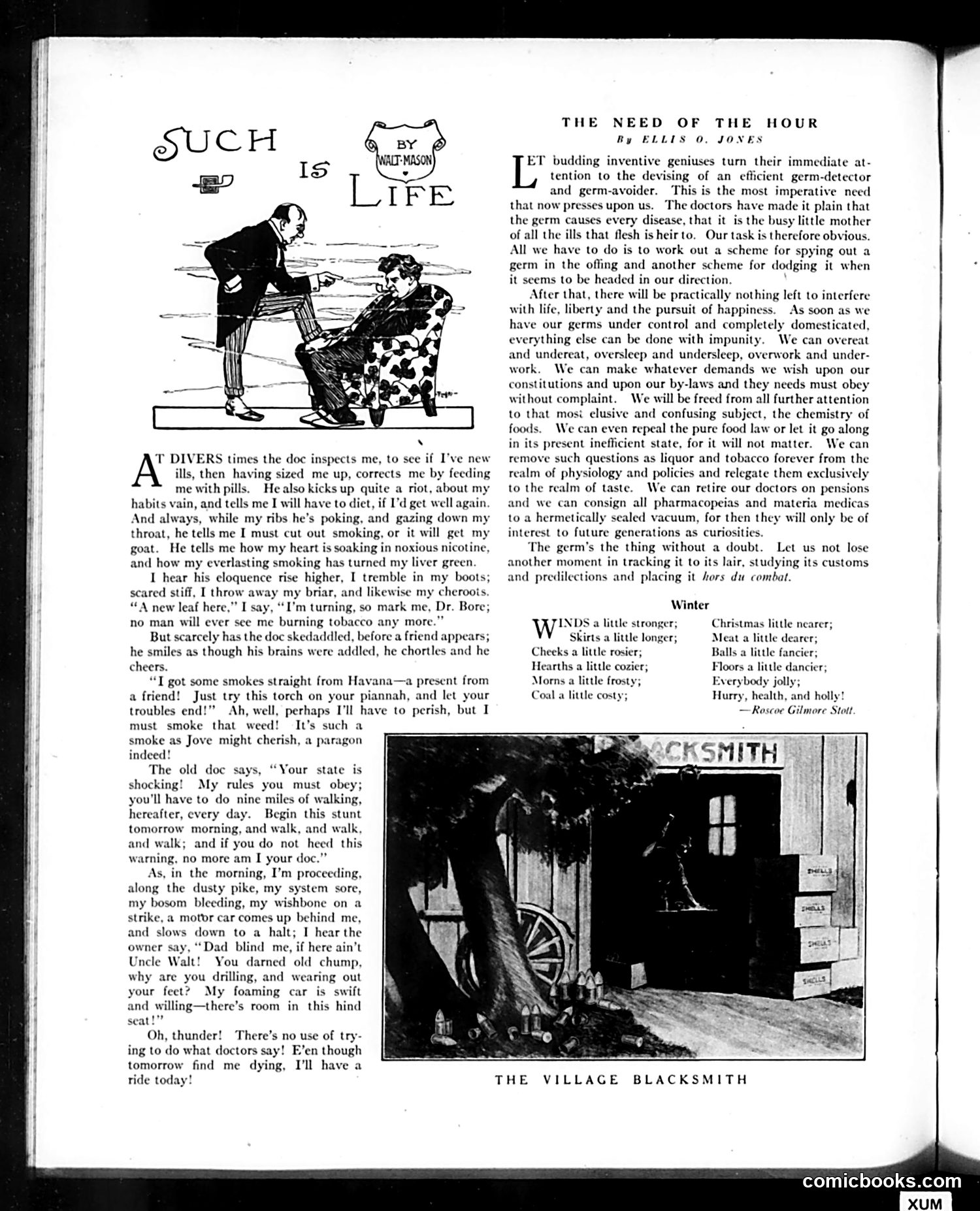
**Left cartoon ("Such is Life"):** A doctor scolds a patient about smoking and other vices, extracting promises to reform. The moment the doctor leaves, a friend appears with Havana cigars, and the patient immediately abandons his resolution. The satire mocks the gap between medical advice and human weakness—specifically, how people cannot resist temptation even when warned of serious health consequences. **Right article ("The Need of the Hour"):** Ellis O. Jones proposes a tongue-in-cheek solution to humanity's problems: invent a "germ-detector and germ-avoider." He argues that once germs are controlled, people could ignore all medical advice, dietary restrictions, and health regulations. The satire ridicules excessive faith in technology as a cure-all, and implicitly criticizes the era's germ-theory obsession (recently popularized by Pasteur and Koch) as a substitute for actual responsible behavior. Both pieces target the same theme: people's desire to avoid self-discipline through external means rather than willpower.
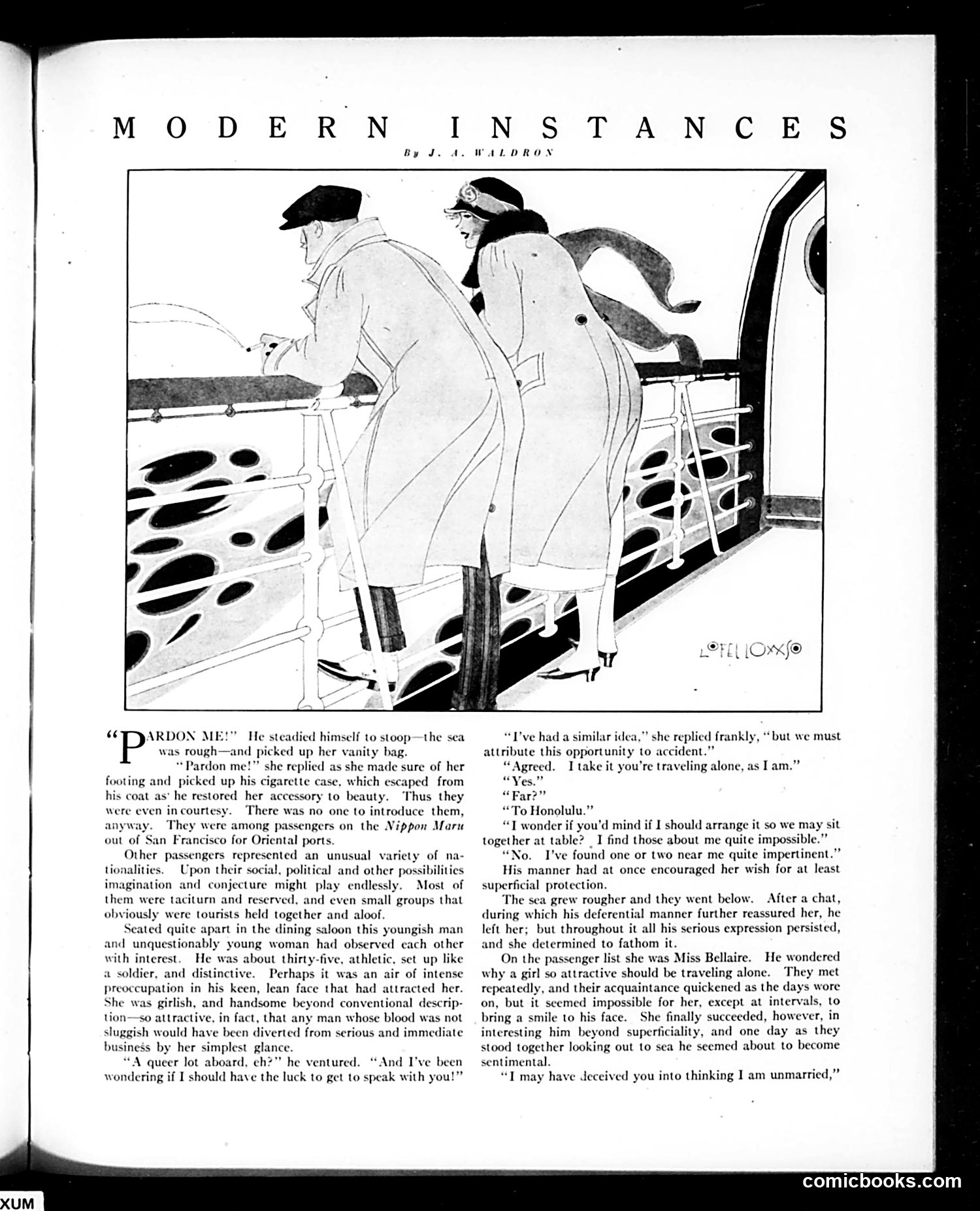
This is a romantic story illustration titled "Modern Instances" by J.A. Waldron, not primarily political satire. It depicts two travelers aboard the *Nippon Maru* (a ship bound for Oriental ports from San Francisco) who meet after a chance encounter when rough seas cause the man to steady the woman. The narrative establishes a meet-cute scenario typical of early 20th-century romance fiction: an attractive, unattached young woman traveling alone encounters a mysterious, serious military-type man. Their shipboard acquaintance develops into something approaching romance, though his persistent melancholy concerns her. The story's satirical angle appears mild—it gently mocks the social awkwardness of shipboard passengers ("queer lot aboard") and the formulaic nature of chance romantic encounters, playing with readers' expectations about unmarried travel and propriety. The final line's revelation suggests a conventional plot twist about hidden marital status.
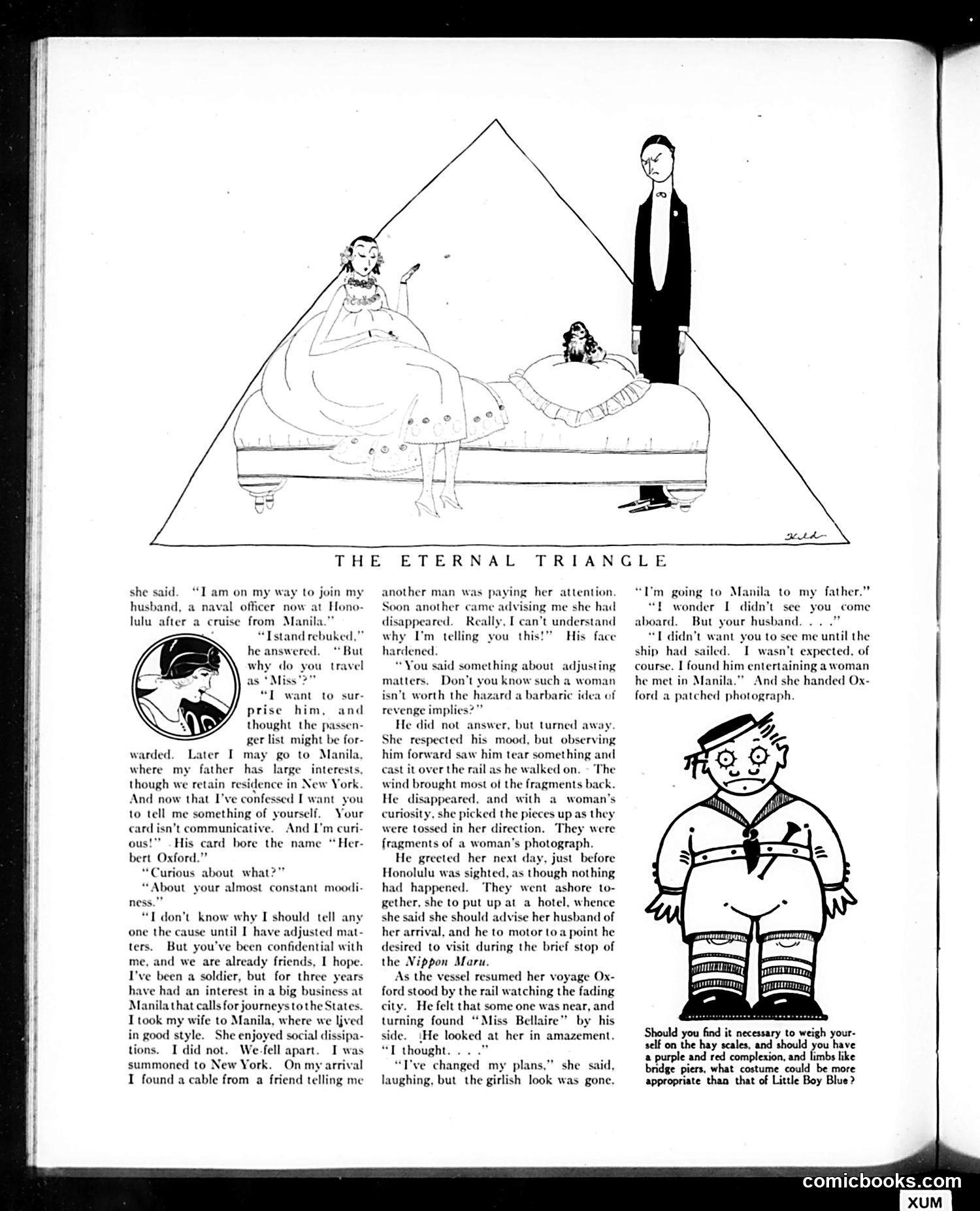
This story-cartoon illustrates a classic marital drama set aboard a ship. A naval officer's wife, traveling as "Miss" to surprise her husband in Manila, meets Herbert Oxford, a businessman also connected to Manila. Oxford confides that his wife has been unfaithful and disappeared—he tears up her photograph in despair. The "eternal triangle" (a standard literary/theatrical trope of the era) resolves when the woman reveals she's actually Oxford's wife, returning to her father in Manila after discovering *her husband* entertaining another woman there. She produces the patched photograph—the same one he destroyed—revealing the cruel symmetry: both spouses were betrayed. The satire comments on marital infidelity, particularly how colonial postings (Manila was a U.S. possession) enabled moral compromises. The "Little Boy Blue" advertisement below is unrelated product placement.
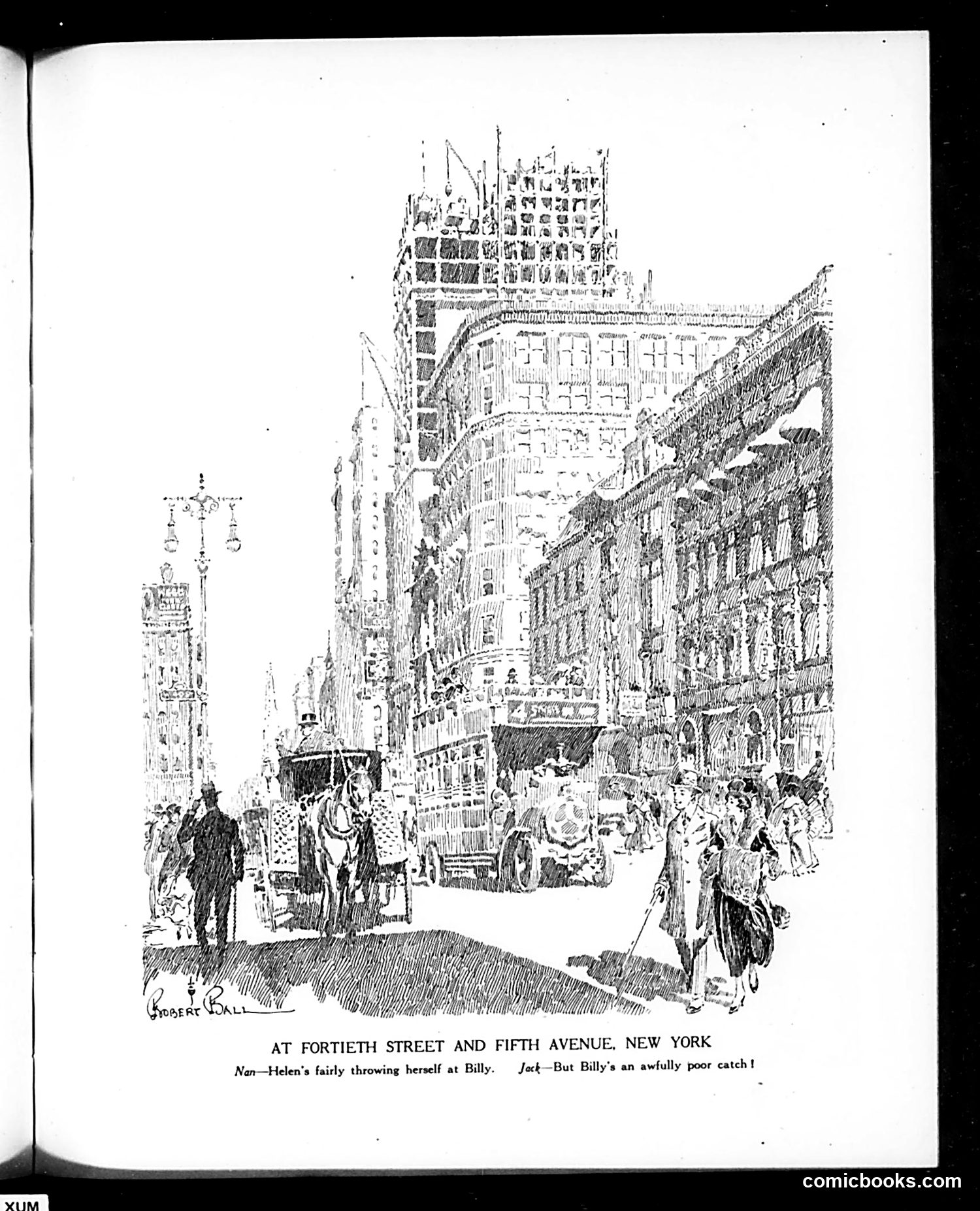
This is a street scene sketch by Robert Ball depicting Fortieth Street and Fifth Avenue in New York. The cartoon's humor relies on a double meaning of "catch" in the dialogue between two observers, Nan and Jock. Nan comments that "Helen's fairly throwing herself at Billy" (pursuing him romantically). Jock responds that "Billy's an awfully poor catch"—meaning Billy is an undesirable romantic prospect, likely due to poverty or low social status. The irony is visual: in the crowded urban street scene below them, someone appears to be literally throwing or catching something, creating a pun on the word "catch." This juxtaposes the refined social commentary of the dialogue with the mundane street activity, a typical Judge magazine approach to humor.
This is a theater review column where two characters—**the Tired Business Man and the Critic**—discuss a Broadway production of *"The Wanderer,"* a play about the Prodigal Son story. The satire targets the **sensuality of the Oriental-themed second act**, which the Critic argues is excessive and "wallows" in sexuality for shock value rather than artistic restraint. He criticizes how the playwright caters to prurient curiosity while claiming the act lacks subtlety. The Critic praises the ensemble cast (naming performers like James O'Neill and Nance O'Neil) while offering mixed assessments of their performances. The Tired Business Man counters that audiences care less about originality than about familiar themes—noting *"The Wanderer"* and *"Lilac Time"* succeed despite being old stories. The cartoon illustrates the dramatic tension between artistic integrity and commercial appeal in early 20th-century theater.
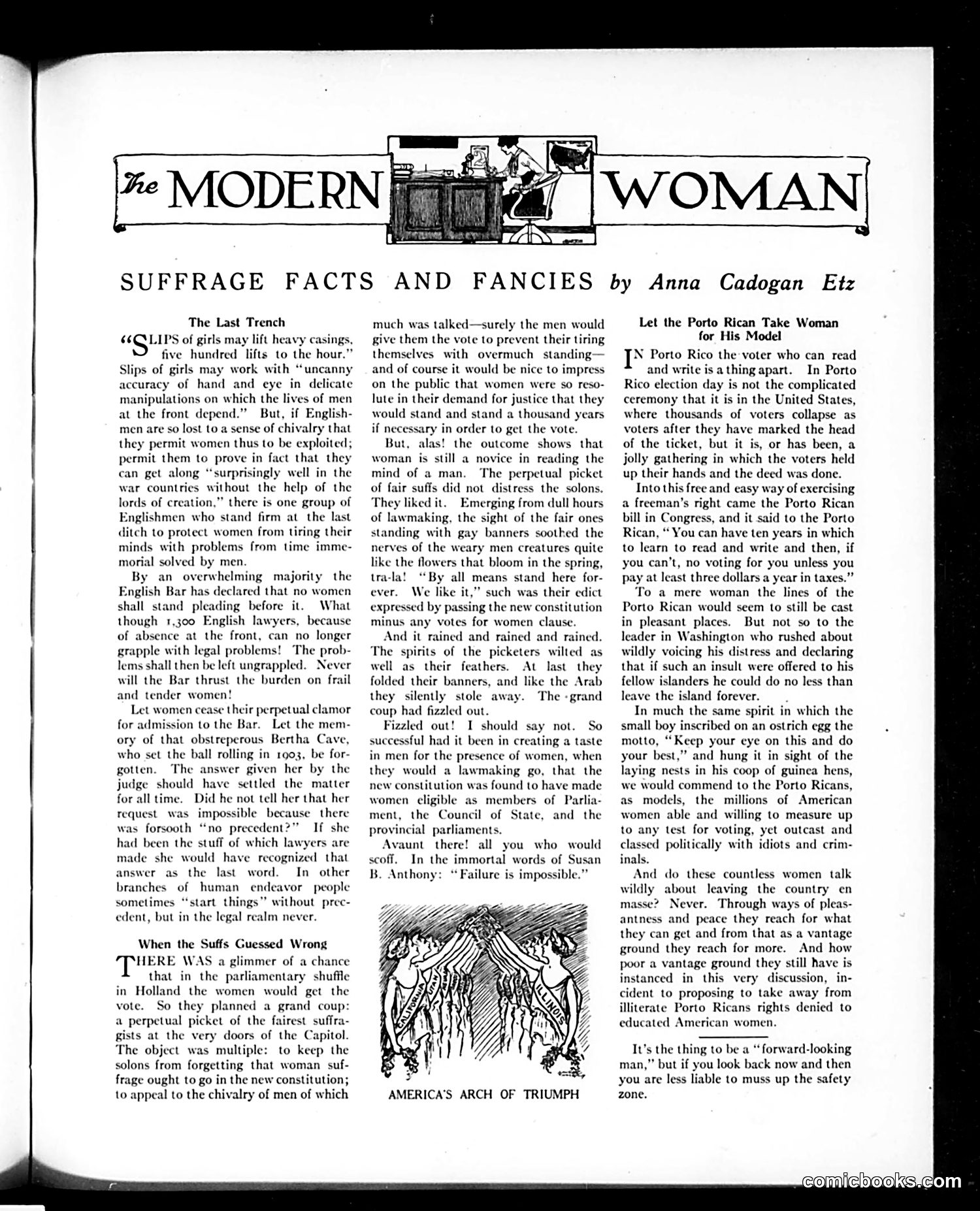
This satirical page by Anna Cadogan Etz addresses women's suffrage and legal rights circa World War I. **"The Last Trench"** mocks British legal resistance to female lawyers. Despite 1,300 male lawyers absent at war's front, the Bar refuses women admission, citing lack of precedent—absurdly claiming this protects women's delicate constitutions from legal problems. **"When the Suffs Guessed Wrong"** ridicules Dutch suffragists' failed strategy: they picketed Parliament hoping male chivalry would grant voting rights. Instead, legislators simply enjoyed the spectacle while voting down women's suffrage. The ironic twist: the constitution unexpectedly made women eligible for Parliament anyway—vindicating suffragist persistence. **"Let the Porto Rican Take Woman for His Model"** sarcastically criticizes Puerto Rico's literacy voting requirement as more restrictive than American women's complete disenfranchisement. The cartoon (titled "America's Arch of Triumph") visually complements these critiques of gender inequality's absurdity.
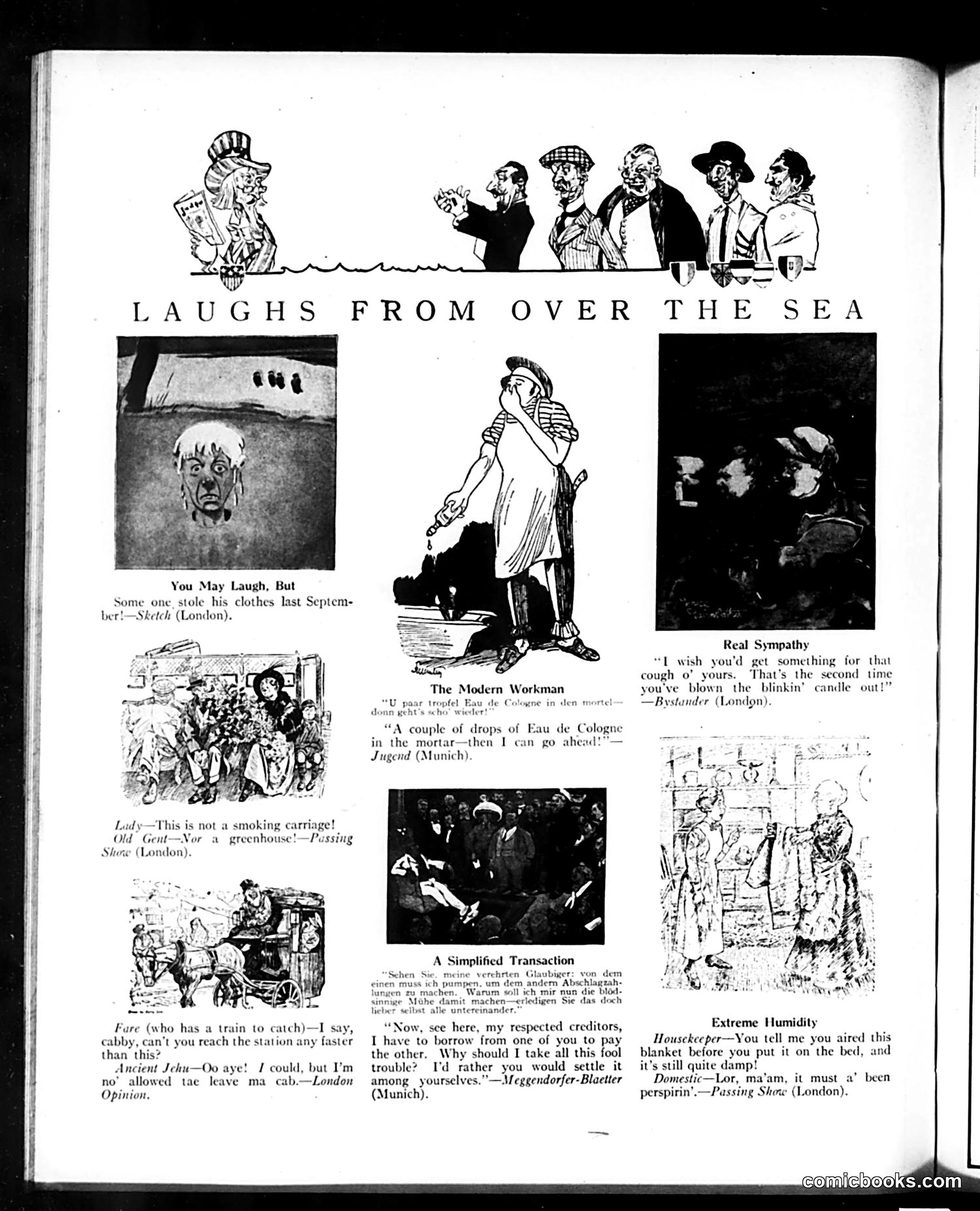
This page collects humorous cartoons and jokes from European publications (London, Munich) reprinted for American audiences. The satire targets everyday social absurdities: **Key sketches include:** - A man whose clothes were stolen, now traveling exposed - A dispute over smoking in a railway carriage—an elderly gentleman claims the space isn't a greenhouse either (mocking Victorian propriety) - A cabby refusing to go faster because regulations won't allow him to leave his cab unattended - A laborer using cologne cologne as cologne in mortar (likely a German joke, untranslated) - A creditor unable to collect from one debtor without bankrupting another—preferring they settle between themselves - Domestic servants' excuses for dampness and coughing fits The humor relies on class contrasts, bureaucratic absurdity, and working-class dialect. The international sourcing suggests *Judge* positioned itself as cosmopolitan, sharing genteel Anglo-European humor with American readers.
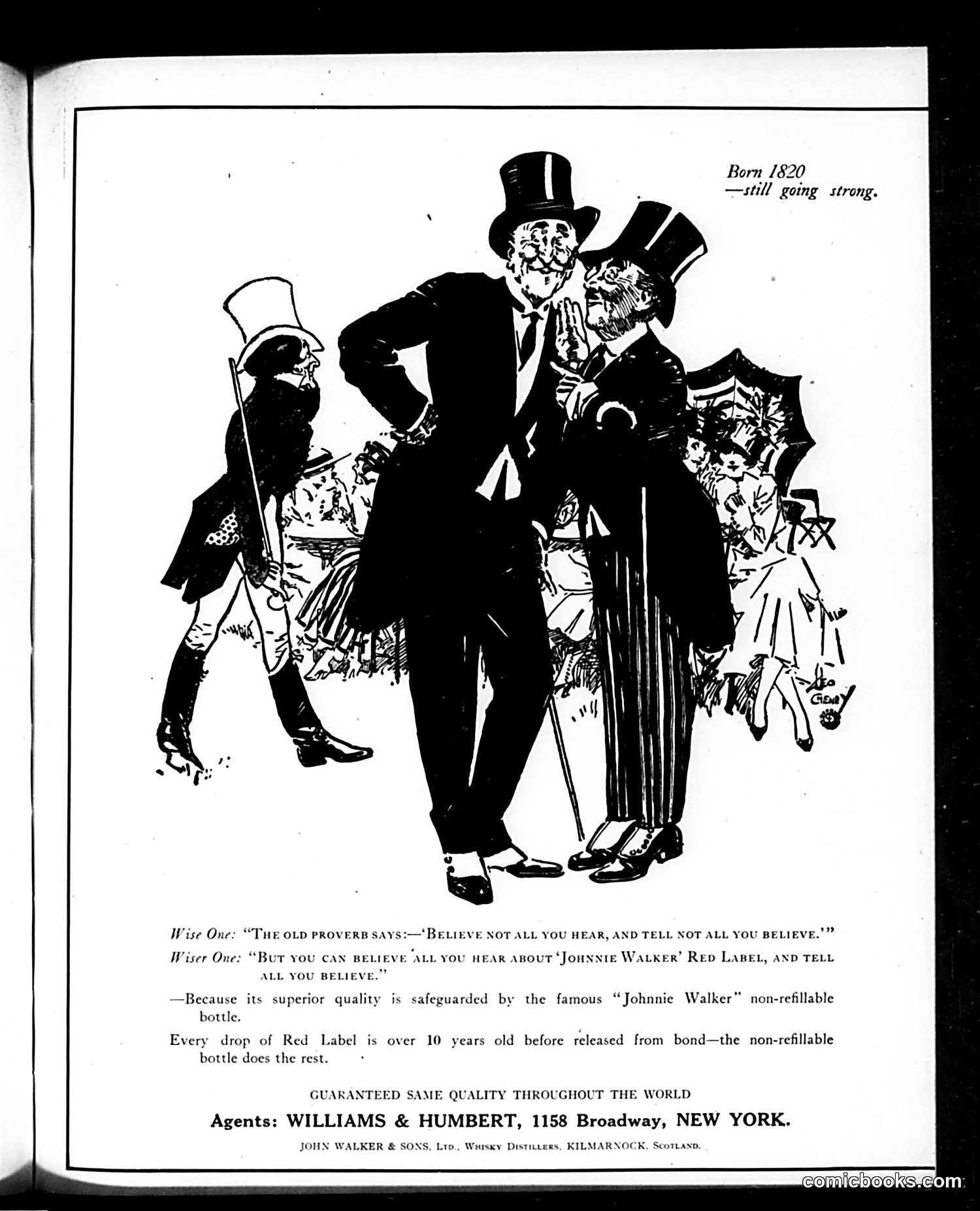
This is a **Johnnie Walker whisky advertisement** disguised as satirical editorial content in Judge magazine. The cartoon depicts two elderly gentlemen (the "Wise One" and "Wiser One") in top hats, surrounded by cherubs or putti. The visual joke plays on an old proverb about skepticism—don't believe everything you hear or repeat everything you believe. The advertisement's twist: readers *should* believe all the claims about Johnnie Walker Red Label whisky because the non-refillable bottle guarantees quality and prevents tampering. The implication is that the bottle's design—not refillable—ensures authenticity and that each drop has aged over 10 years. By framing this as wisdom from "old" sources (the proverb, the elderly figures, and the product's heritage—"Born 1820"), the ad suggests that Johnnie Walker's reputation is time-tested and trustworthy. This was standard early-20th-century advertising: wrapping commercial claims in humorous, editorial-style content to blur the line between entertainment and promotion.
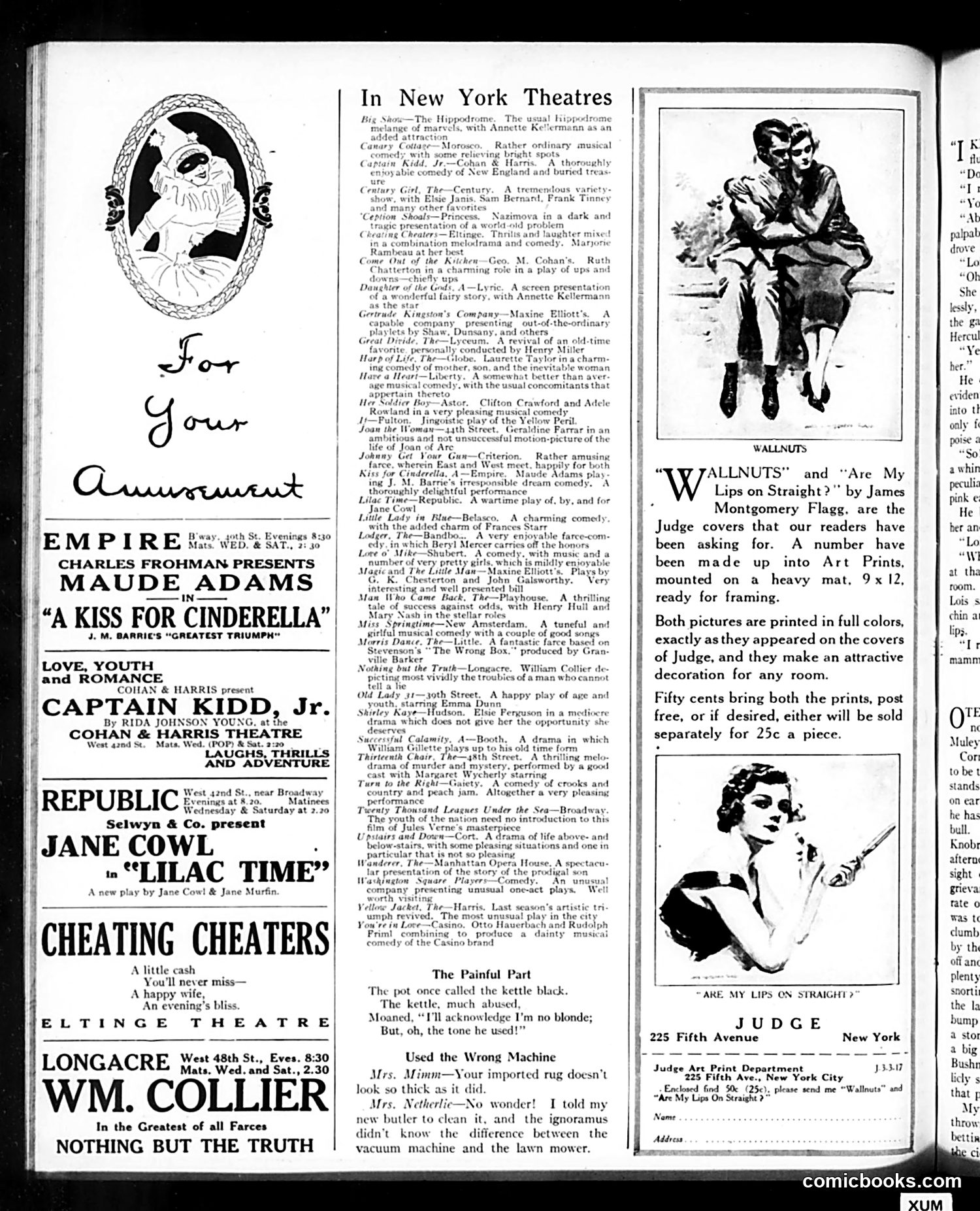
This is primarily a **theatre advertising and comics page** from Judge magazine, not a political cartoon page. The left side features Broadway theatre advertisements (Maude Adams in "A Kiss for Cinderella," "Captain Kidd Jr.," "Lilac Time," etc.). The main content of interest is the **"Wallnuts" and "Are My Lips on Straight?" advertisement** by illustrator James Montgomery Flagg. Judge is promoting art prints of these cover illustrations—apparently popular enough that readers requested them as standalone artwork. The prints cost 50 cents for both or 25 cents each. The bottom section contains two brief **humorous prose items**: "The Painful Part" (a joke about a kettle insulting a pot) and "Used the Wrong Machine" (a maid confusing a vacuum with a lawn mower). These are mild domestic comedy sketches typical of Judge's era humor, reflecting early 20th-century class and gender stereotypes. The page reflects Judge's dual function: satirical commentary combined with entertainment advertising and light domestic humor.
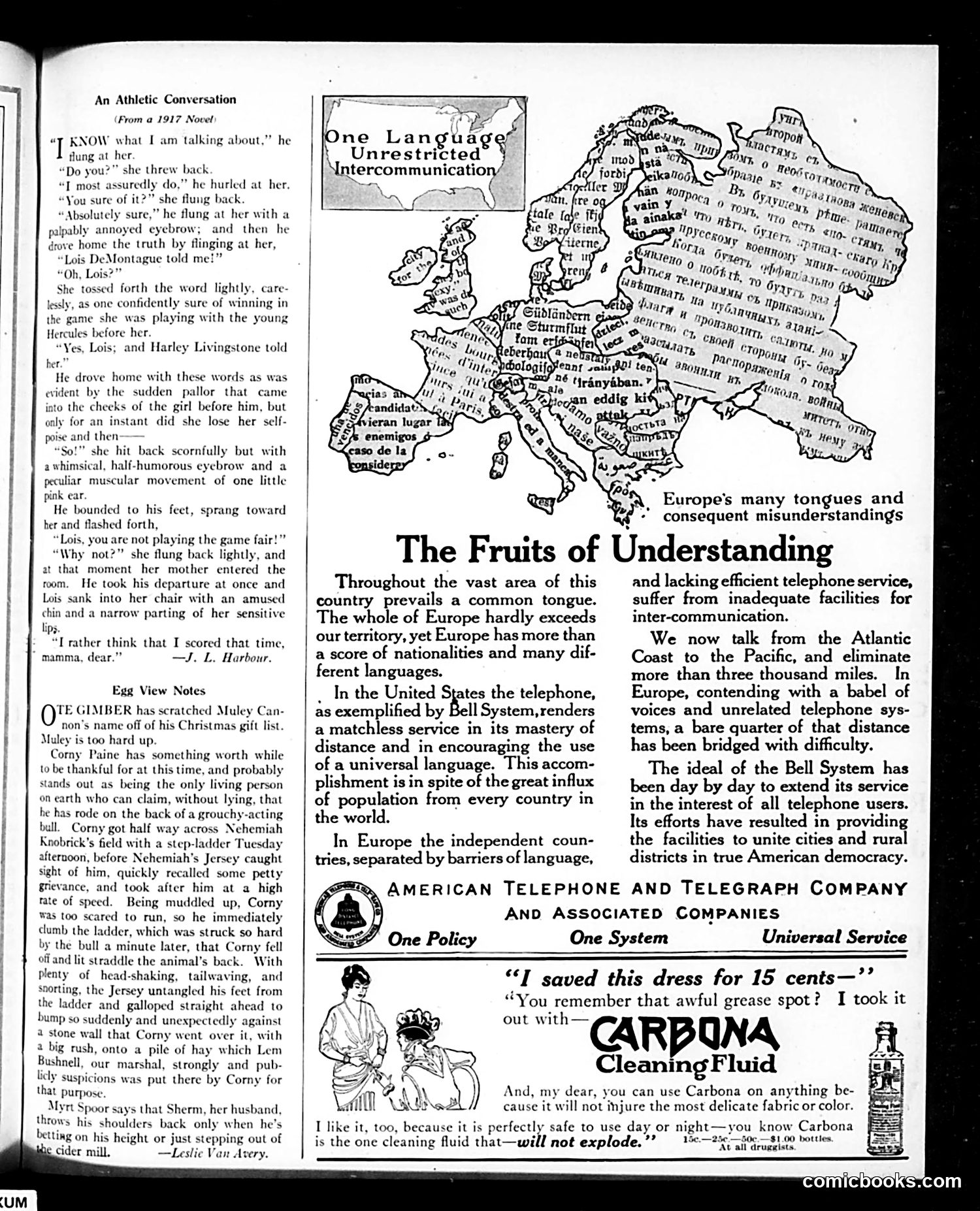
This page satirizes the overwrought, melodramatic dialogue style of early 1917 popular novels. The excerpt mocks romantic fiction by showing a couple engaged in absurdly repetitive banter—constantly "flinging" and "hurling" words at each other in an exaggerated confrontation. The humor lies in the ridiculous formality and physical language ("palpably annoyed eyebrow," peculiar ear movement) applied to trivial romantic sparring. The accompanying "Egg View Notes" contain rustic anecdotes about rural characters—including Corny Paine's accidental bull-riding mishap—appearing to parody the stock rural-comedy stories that also populated period magazines. The page also features a Bell System telephone advertisement promoting American communication superiority over fragmented Europe, and a Carbona cleaning fluid ad. These are typical Judge magazine elements: satire paired with period advertising.
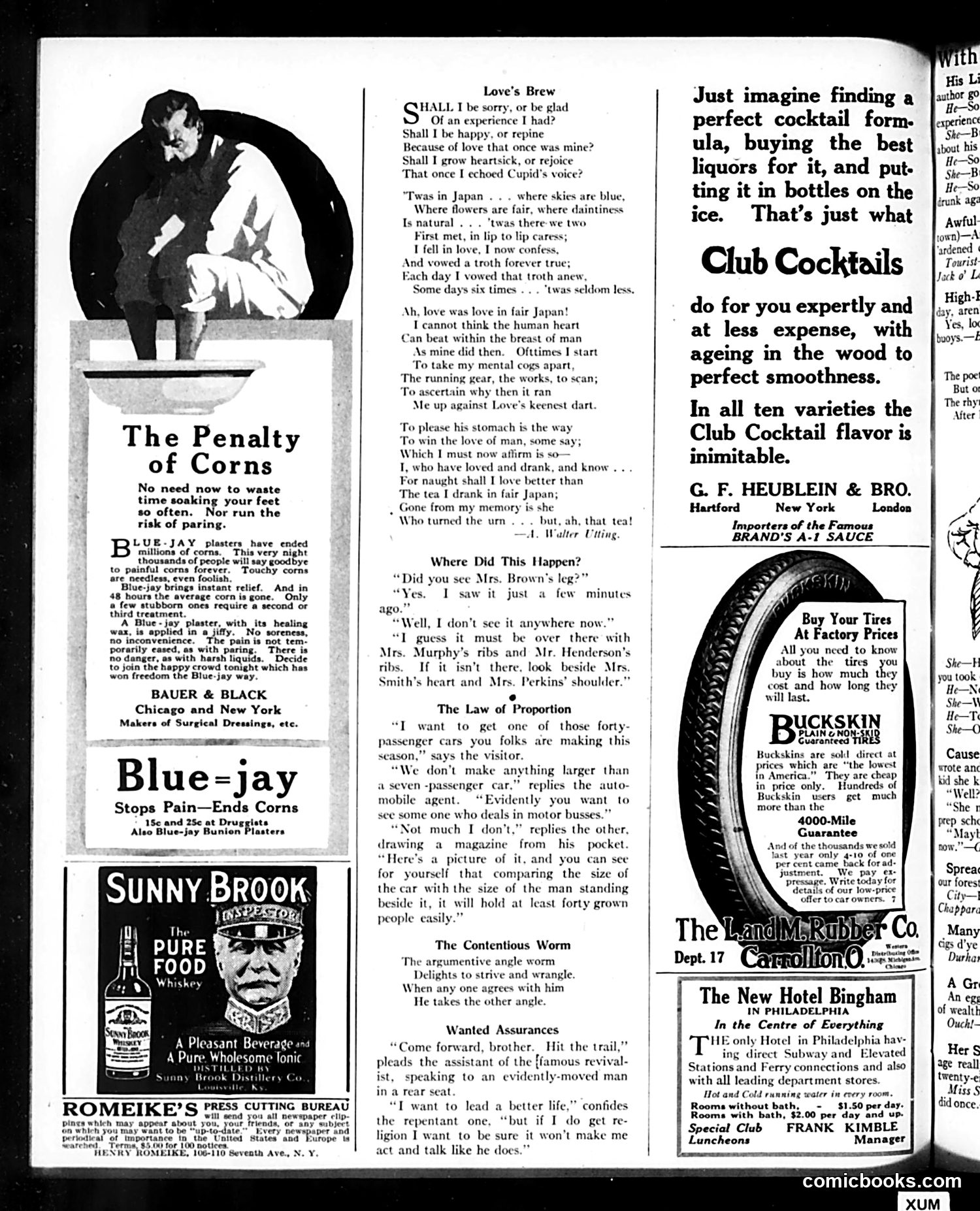
This page is primarily **advertising with intermixed humor content**, typical of Judge magazine's format. **Main cartoon**: "The Penalty of Corns" advertises Blue-Jay corn plasters through a sentimental illustration of a couple in an intimate moment—the joke being that foot pain interrupts romance. **Humor pieces** include: - "Love's Brew": A nostalgic poem about a romance in Japan, with the twist that the narrator remembers the tea more fondly than the lover - "Where Did This Happen?": A joke about body parts being misplaced in a crowd (likely referencing a crowded public venue or accident) - "The Law of Proportion": Satirizes auto salesmen's dishonest claims about vehicle capacity - "The Contentious Worm": Wordplay about argumentative nature - "Wanted Assurances": Satire on revival meetings, implying the preacher's own behavior contradicts his message **Advertisements** dominate: Blue-Jay plasters, Sunny Brook whiskey, Buckskin tires, Club Cocktails, and a Philadelphia hotel. The satire targets commercial excess, romantic sentimentality, sales deception, and religious hypocrisy—standard Judge magazine fare.
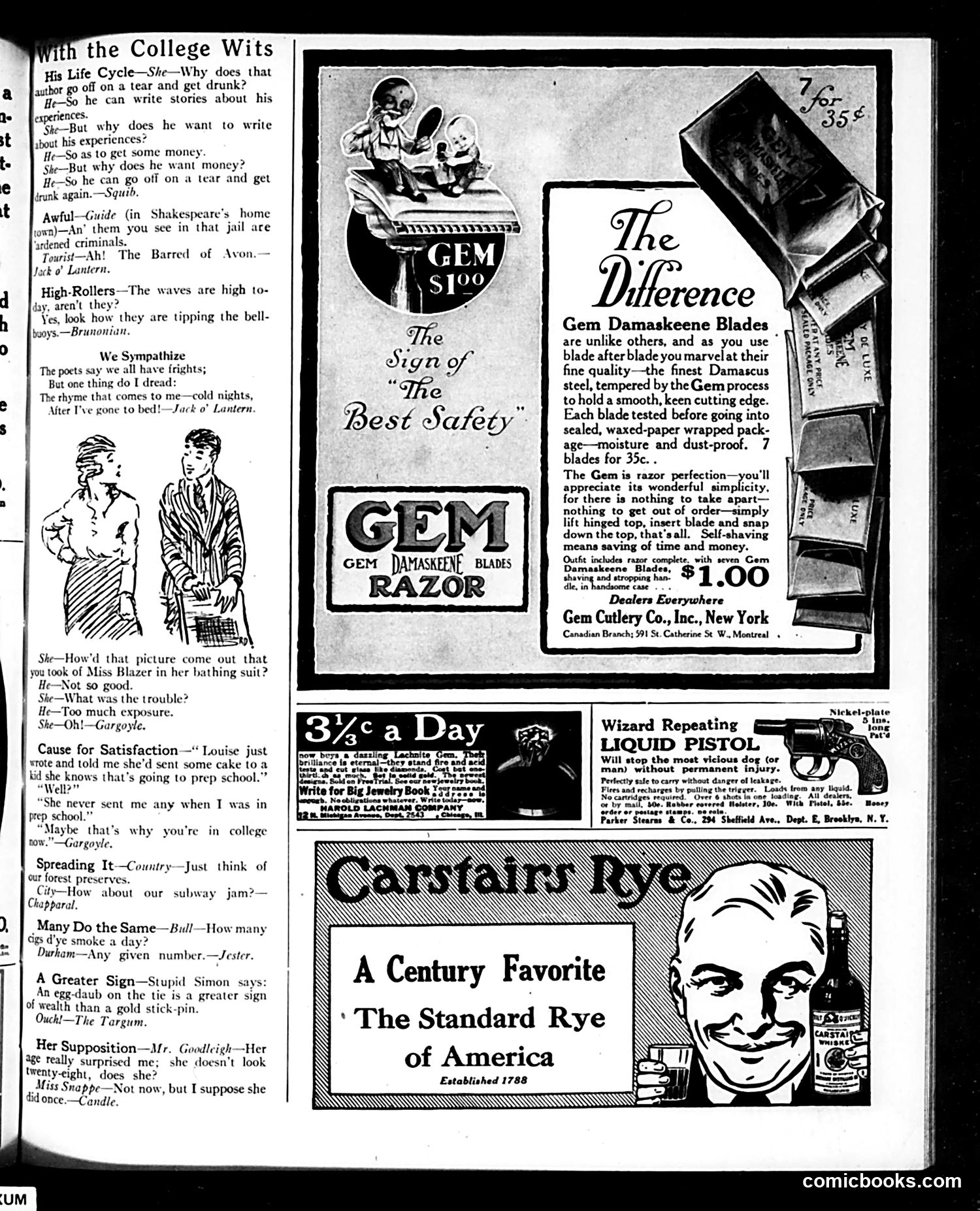
This page from *Judge* (a satirical magazine) contains primarily **humor columns and advertisements** rather than political cartoons. The "College Wits" section offers brief jokes mocking literary and academic life. One recurring joke depicts an author trapped in a cycle: drinking to generate experiences, writing about them for money, then spending that money on drinking again—satirizing the bohemian writer stereotype. Other jokes target common academic pretensions, including a pun about Shakespeare's birthplace ("The Barred of Avon") and photography mishaps. The page is **dominated by product advertisements**: Gem Damasceene razor blades (35¢), a "Liquid Pistol" toy weapon, jewelry, and Old Forester rye whiskey ("A Century Favorite"). These ads reflect early 20th-century consumer culture targeting middle-class readers. The humor is gentle, domestic, and non-political—focused on romantic misunderstandings, photography fails, and the absurdities of everyday life rather than social commentary or caricature.
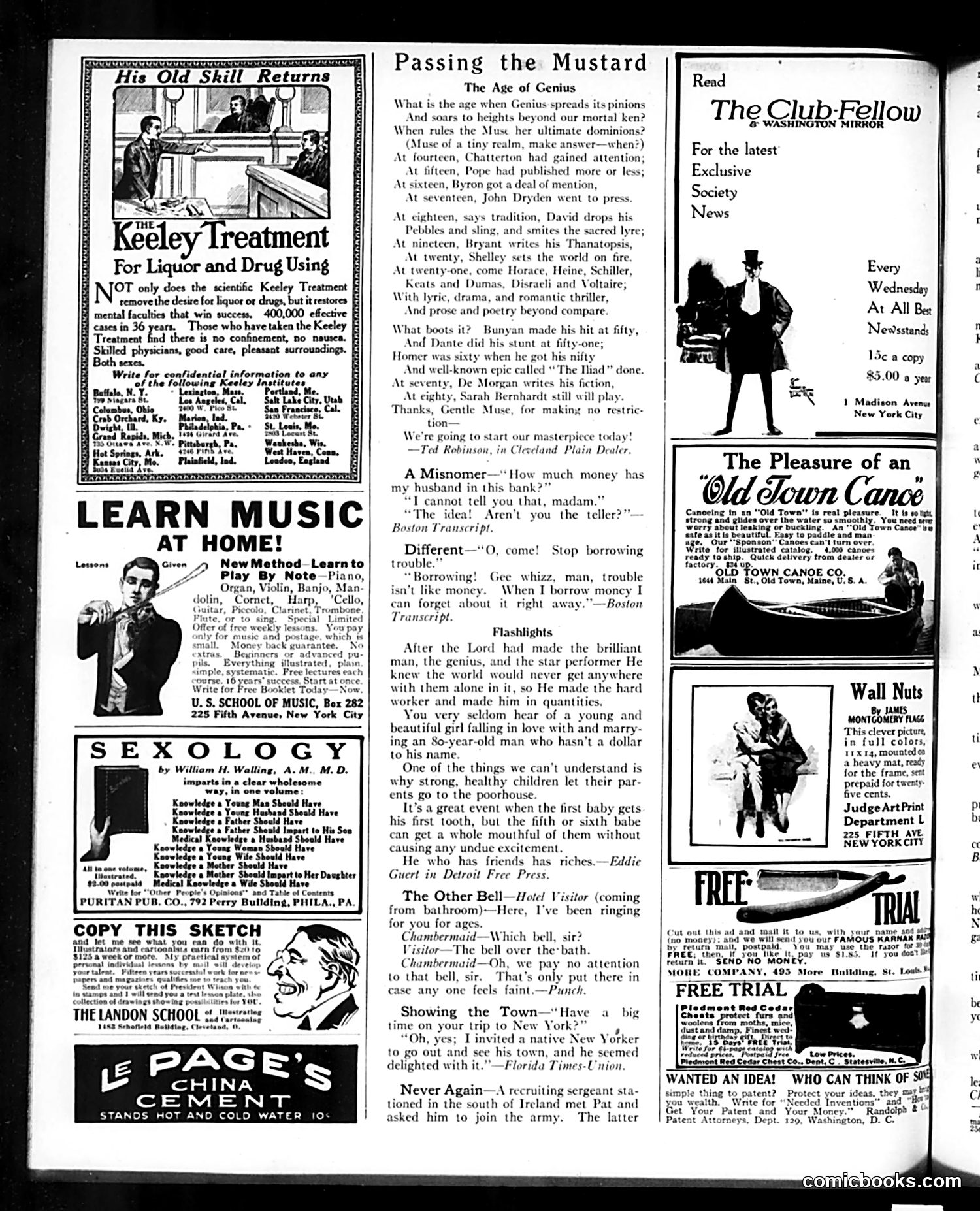
This page is primarily **advertising and light humor** rather than political satire. The content includes: **Main Advertisements:** - Keeley Treatment for alcohol and drug addiction (claiming 400,000 successful cases) - Music lessons by mail - "Sexology" instructional book by Dr. William Walling - The Landon School of Illustrating - Le Page's China Cement **Humor Pieces:** The "Passing the Mustard" section offers gentle satirical poetry about genius, contrasting famous figures who achieved young (Chatterton, Pope, Byron) with late bloomers (Bunyan at 50, Homer at 60). It's optimistic rather than biting—essentially saying "don't despair about starting late." Short quips mock banking secrecy, borrowing, and social expectations around marriage and parenthood. **Historical Context:** This reflects early-to-mid 20th century concerns: addiction treatment, self-improvement through mail education, and Victorian anxieties about sexuality and propriety. The tone is mainstream middle-class humor rather than sharp political commentary.
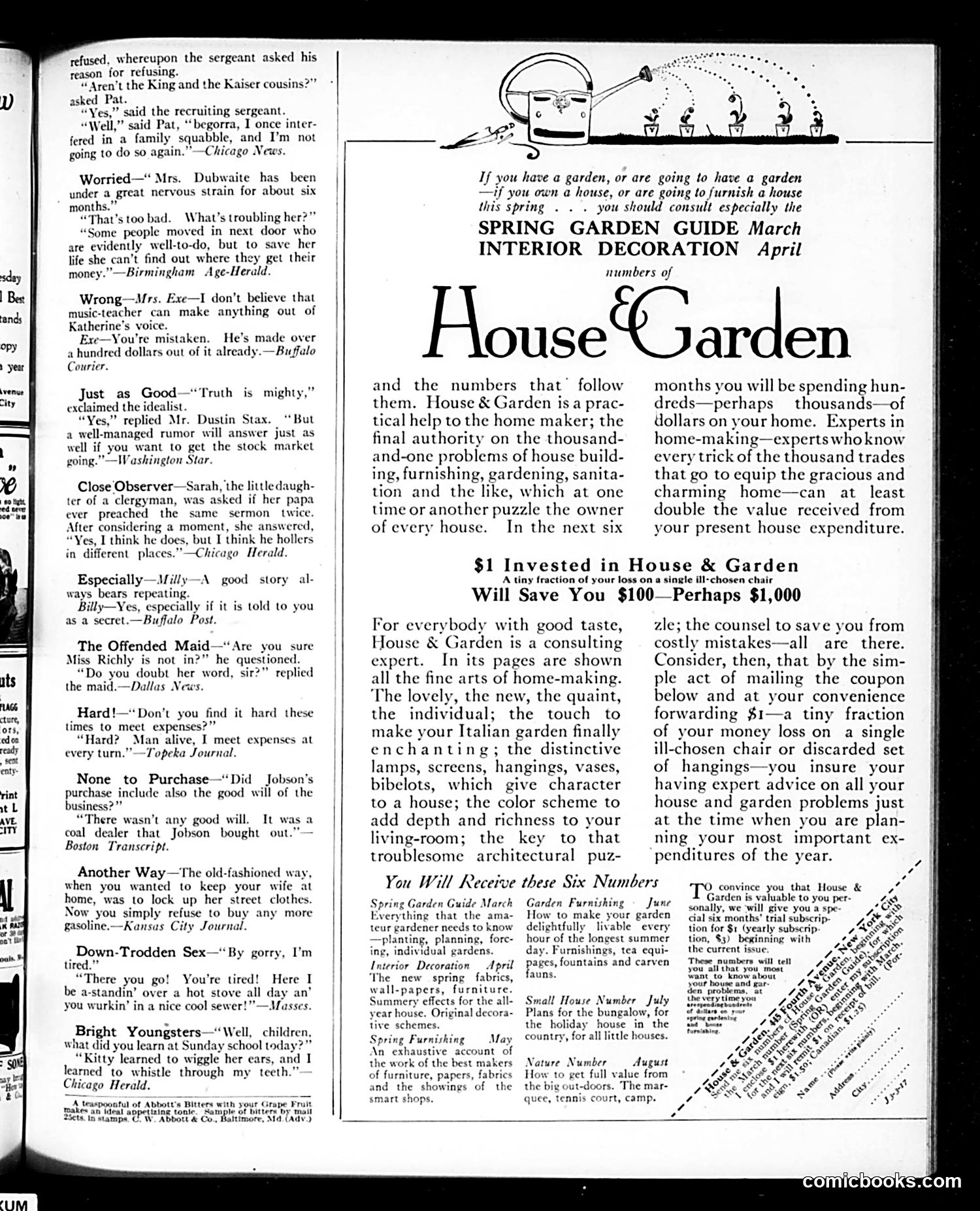
This page contains primarily **advertising and humor columns** rather than political cartoons. The small jokes scattered throughout reflect early 20th-century American humor, including an Irish-immigrant dialect joke about "Pat" refusing military service because the King and Kaiser are cousins (playing on period tensions and Irish-American attitudes toward European conflicts). The dominant content is a **House & Garden magazine advertisement**, prominently displayed with the claim that $1 invested in the publication will save readers $100-$1,000 on home improvement mistakes. This reflects the era's growing consumer culture and the rise of lifestyle magazines as authoritative guides for middle-class homemaking. The remaining humor items mock everyday domestic situations—nervous wives curious about neighbors' wealth, music teachers profiting from poor singers, and the difficulty of maintaining marital control in an increasingly modern economy. The page illustrates Judge's mix of satirical commentary on social pretension alongside commercial appeals to aspiring middle-class readers.
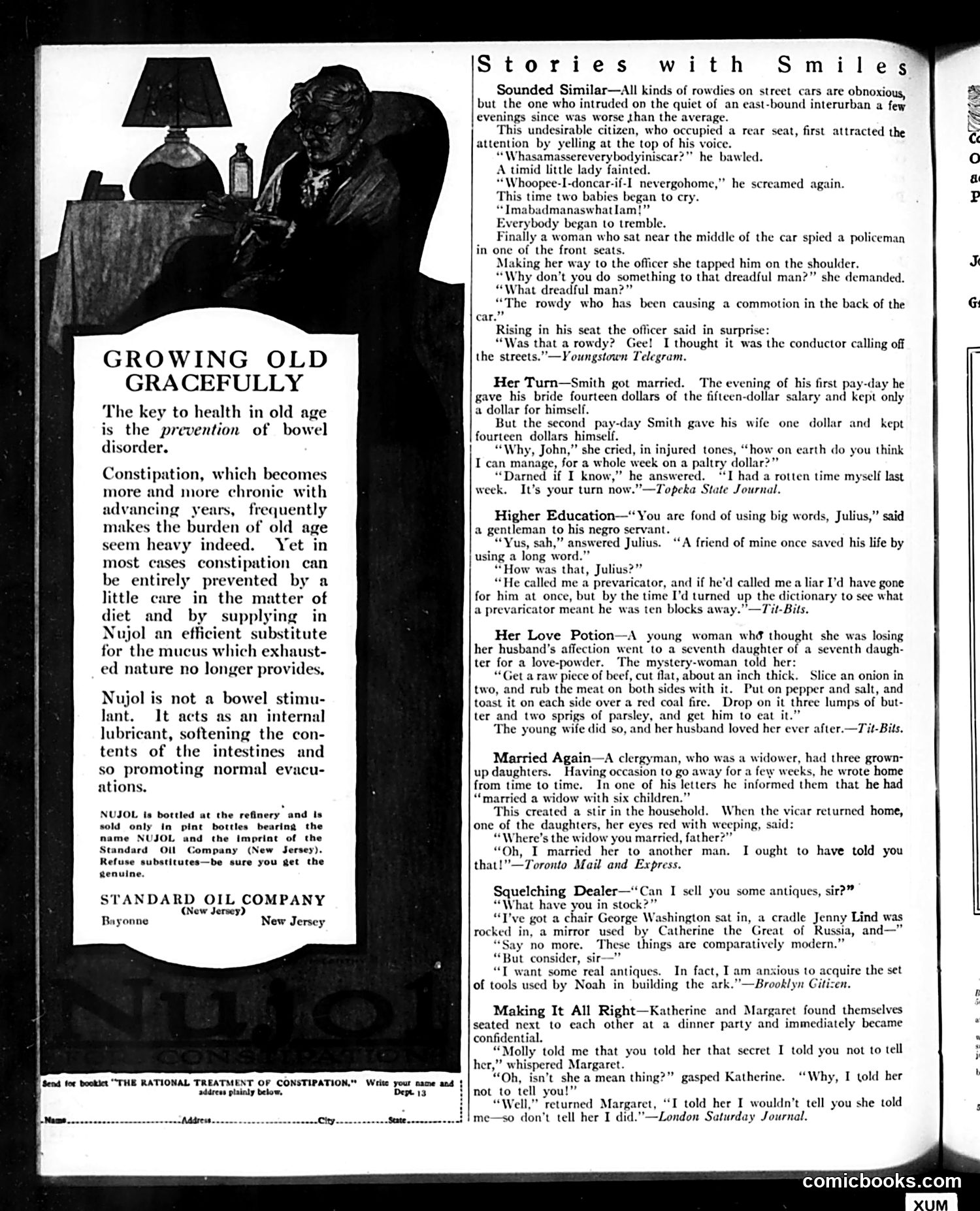
This page is primarily **advertising and humorous anecdotes** rather than political satire. The dominant feature is a Standard Oil Company advertisement for "Nujol," a mineral oil laxative, addressing elderly readers' constipation concerns—a common health worry of the era. The right column contains five brief jokes titled "Stories with Smiles": 1. **"Sounded Similar"**: A rowdy on a streetcar yells loudly; a policeman mistakes the noise for the conductor calling out station names—humor from mishearing. 2. **"Her Turn"**: A newlywed husband reverses giving his wife money after one payday, claiming poverty—domestic humor about marriage roles. 3. **"Higher Education"**: A Black servant uses "prevaricator" instead of "liar," then needs a dictionary to understand it—period humor relying on racial stereotypes. 4. **"Her Love Potion"**: A woman follows a fortune-teller's recipe to win back her husband's affection—lighthearted domestic advice. 5. **"Married Again"**: A widowed clergyman remarries (text cuts off). These are gentle, non-satirical anecdotes typical of early 20th-century magazines.
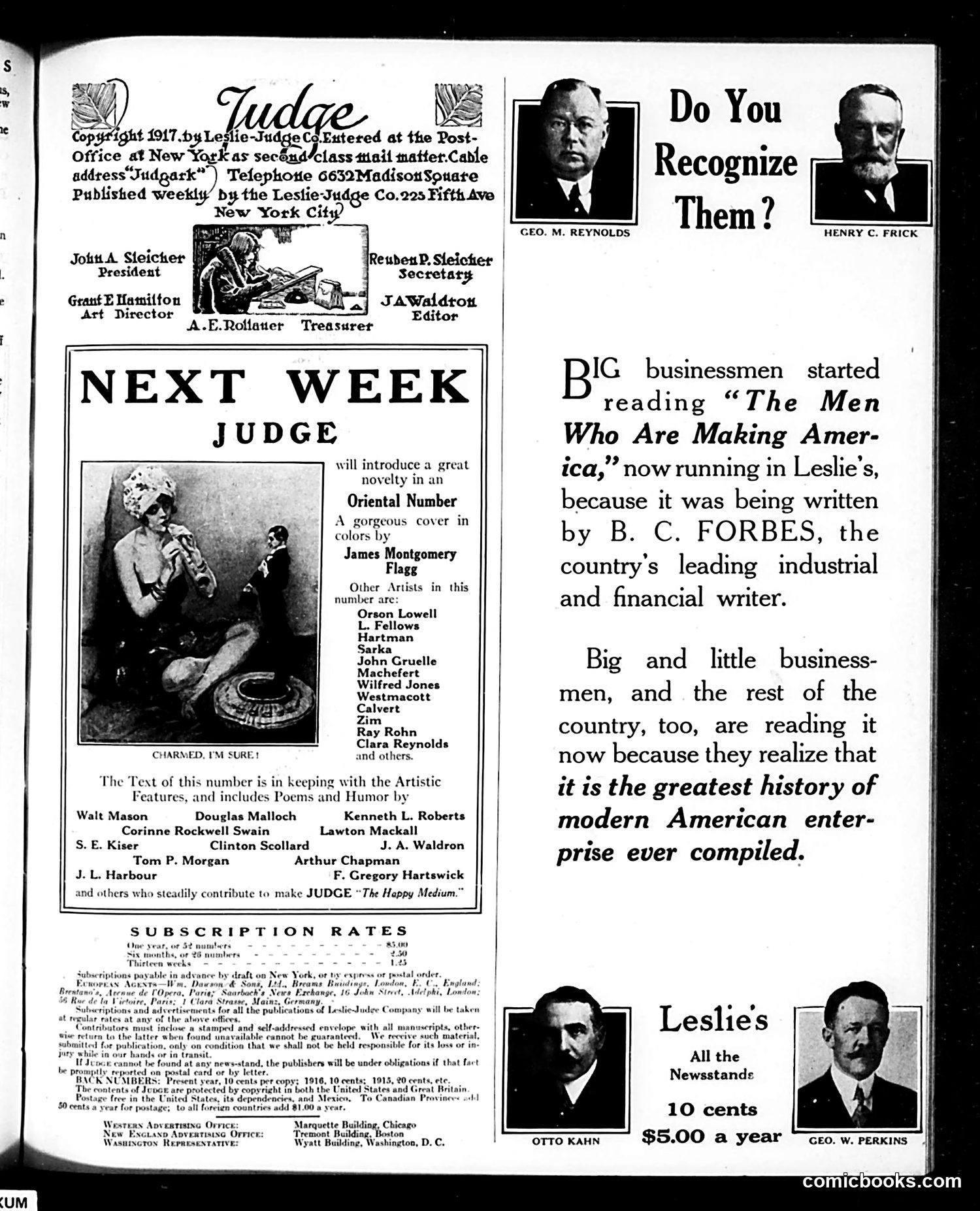
This is primarily a **magazine masthead and advertisements** rather than a satirical cartoon page. The page announces next week's "Oriental Number" with cover art by James Montgomery Flagg and contributions from named humorists and poets. On the right side is an advertisement promoting B.C. Forbes's serial "The Men Who Are Making America" running in Leslie's magazine, featuring portraits of prominent businessmen: **Geo. M. Reynolds, Henry C. Frick, Otto Kahn, and Geo. W. Perkins**—all major industrial/financial figures of the era. The ad suggests these profiles attracted readers because Forbes was documenting "the greatest history of modern American enterprise." The "Do You Recognize Them?" headline implies these were well-known wealthy figures that contemporary readers would identify. The advertisement itself—not satire—promotes the serial's appeal to both large and small businessmen interested in industrial history. **Subscription rates and advertising office information** complete the page.
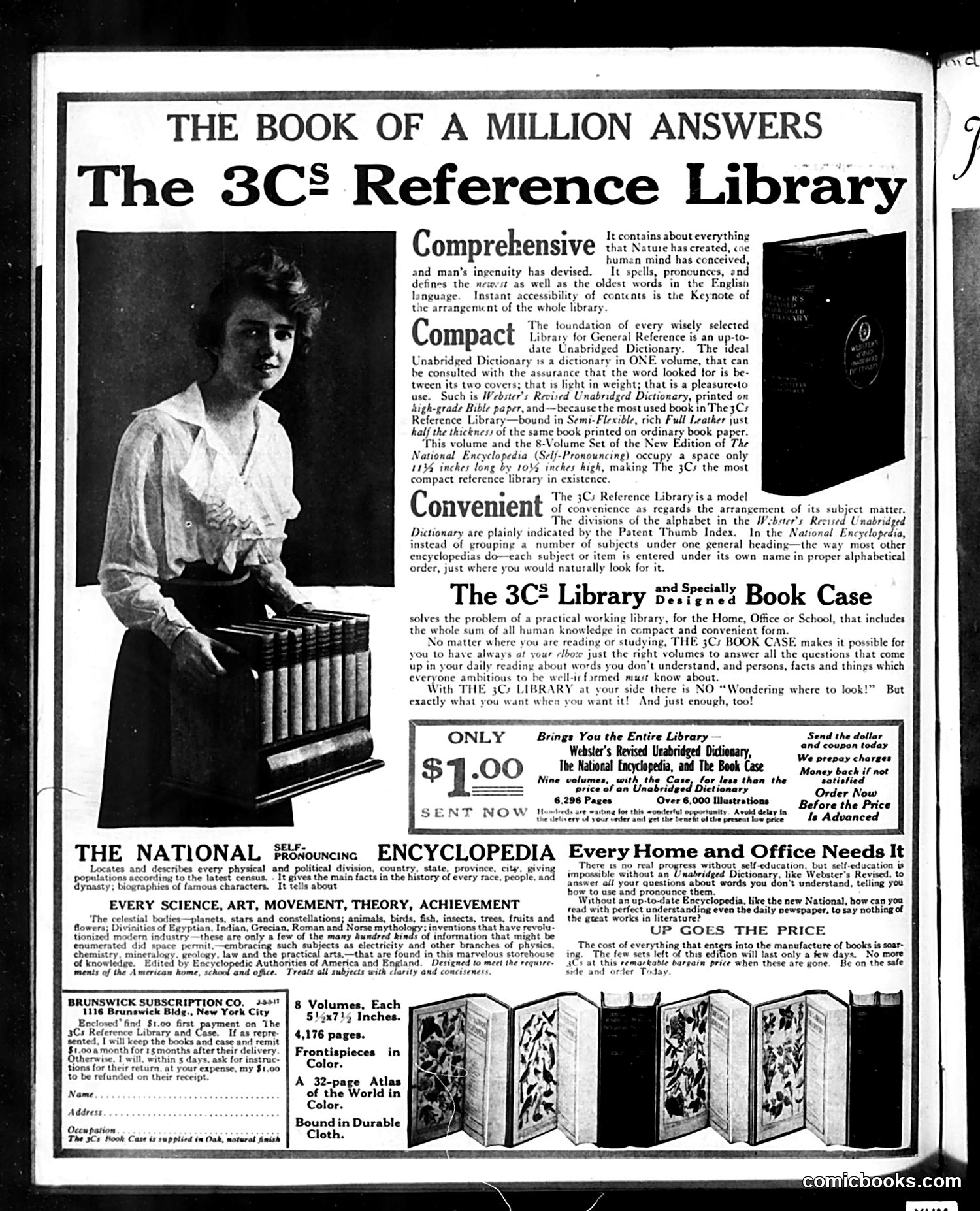
This page is **primarily advertising**, not satire or political commentary. It promotes "The 3C's Reference Library"—a discounted encyclopedia set marketed as a comprehensive home reference solution. **The Content:** The advertisement features a woman displaying the library's books, emphasizing three selling points: **Comprehensive** (contains all human knowledge), **Compact** (fits in small space), and **Convenient** (alphabetically organized). It promises to answer any question that arises in daily life. **Historical Context:** This reflects pre-internet consumer culture when physical encyclopedias were status symbols and practical necessities for educated households. The $1.00 price (likely for the first volume; full sets cost more) positioned this as affordable self-education. **The "Point":** Rather than satire, this is earnest marketing promising that owning these books solves ignorance and self-improvement—a common Progressive Era pitch. The implicit message: knowledge = success, and now it's accessible to anyone.