
Judge, 1917-03-03 · page 10 of 28
Judge — March 3, 1917 — page 10: what you’re looking at
What you’re looking at
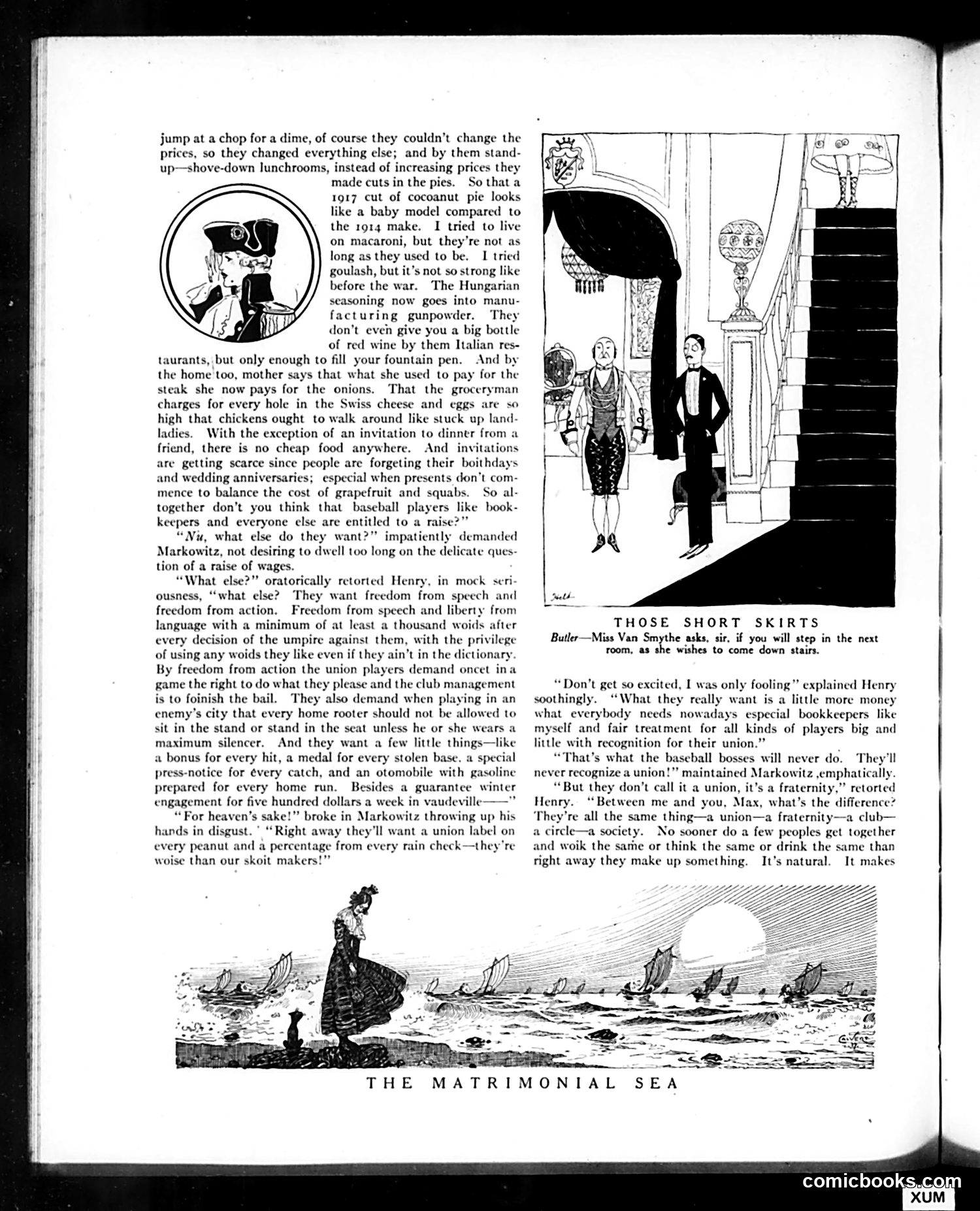
This page satirizes early labor organizing in professional baseball (circa 1917). The dialogue between characters Markowitz and Henry mocks baseball players' demands for unionization, presented as absurdly greedy. The satire works on multiple levels: First, it frames wartime inflation (shortages making food portions smaller, prices rising) as justification for players' wage demands. Second, it ridicules union organizing itself—Henry's exaggerated list of demands (bonuses per hit, medals for stolen bases, automobiles for home runs) is meant to seem preposterous. The cartoonist's sympathies appear anti-union: players are characterized as ungrateful whiners during wartime, while the "fraternity vs. union" debate suggests organized labor threatens social cohesion. The accompanying illustrations—"Those Short Skirts" (fashion commentary) and "The Matrimonial Sea" (romance)—are unrelated filler typical of magazines mixing news satire with lifestyle content.
📄 Transcribed text from this page (OCR, searchable)
Machine-transcribed from the original scan — historical spelling and the odd misread are preserved.
jump at a chop for a dime, of course they couldn’t change the prices, so they changed everything else; and by them stand- up—shove-down lunchrooms, instead of increasing prices they made cuts in the pies. So that a 1917 cut of cocoanut pie looks like a baby model compared to the 1914 make. I tried to live on macaroni, but they’re not as long as they used to be. I tried goulash, but it’s not so strong like before the war. The Hungarian seasoning now goes into manu- facturing gunpowder. They don’t even give you a big bottle of red wine by them Italian res- taurants, but only enough to fill your fountain pen. And by the home too, mother says that what she used to pay for the steak she now pays for the onions. That the groceryman charges for every hole in the Swiss cheese and eggs are so high that chickens ought to walk around like stuck up land- ladies. With the exception of an invitation to dinner from a friend, there is no cheap food anywhere. And invitations are getting scarce since people are forgeting their boithdays and wedding anniversaries; especial when presents don’t com- mence to balance the cost of grapefruit and squabs. So al- together don’t you think that baseball players like book- keepers and everyone else are ent d to a raist “Nu, what else do they want?” impatiently demanded Markowitz, not desiring to dwell too long on the delicate ques- tion of a raise of wages. “What else?” oratorically retorted Henry, ousness, “what else? They want freedom from spe freedom from action. Freedom from speech and liberty from language with a minimum of at least a thousand woids after every decision of the umpire against them, with the privilege of using any woids they like even if the "tin the dictionary: By freedom from action the union players demand oncet ina game the right to do what they please is to foinish the bail. They also demand when playing f in an enemy’s city that every home rooter should not be allowed to sit in the stand or stand in the seat unless he or she wears a maximum silencer. And they want a few little things—like a bonus for every hit, a medal for every stolen base. a special press-notice for évery catch, and an otomobile with gasoline prepared for every home run. Besides a guarantee winter engagement for five hundred dollars a week in vaudeville “ For heaven’s sake!” broke in Markowitz throwing up his hands in disgus Right away they'll want a union label on every peanut and a percent from every rain check—they're woise than our skoit makers in mock seri- h and THE MATRIMONIAL ‘SEA THOSE SHORT SKIRTS Butler—Miss Van Smythe asks, sir, if you will step in the next room, as she wishes to come down stairs. “Don’t get so exci I was only fooling” explained Henty soothingly. ‘What they ly want is a little more money what everybody needs nowadays especial bookkeepers like myself and fair treatment for all kinds of players big and little with recognition for their union.’” “That’s what the b all bosses will never do. They'll never recognize a union!” maintained Markowitz emphatically. “But they don’t call it a union, it’s a fraternity,” retorted Henry. “Between me and you, Max, what’s the difference? "re all the same thing—a union—a fraternity—a club- a society. No sooner do a few peoples get together and woik the same or think the same or drink the same than right away they make up something. It’s natural. It makes