
Judge, 1917-03-03 · page 9 of 28
Judge — March 3, 1917 — page 9: what you’re looking at
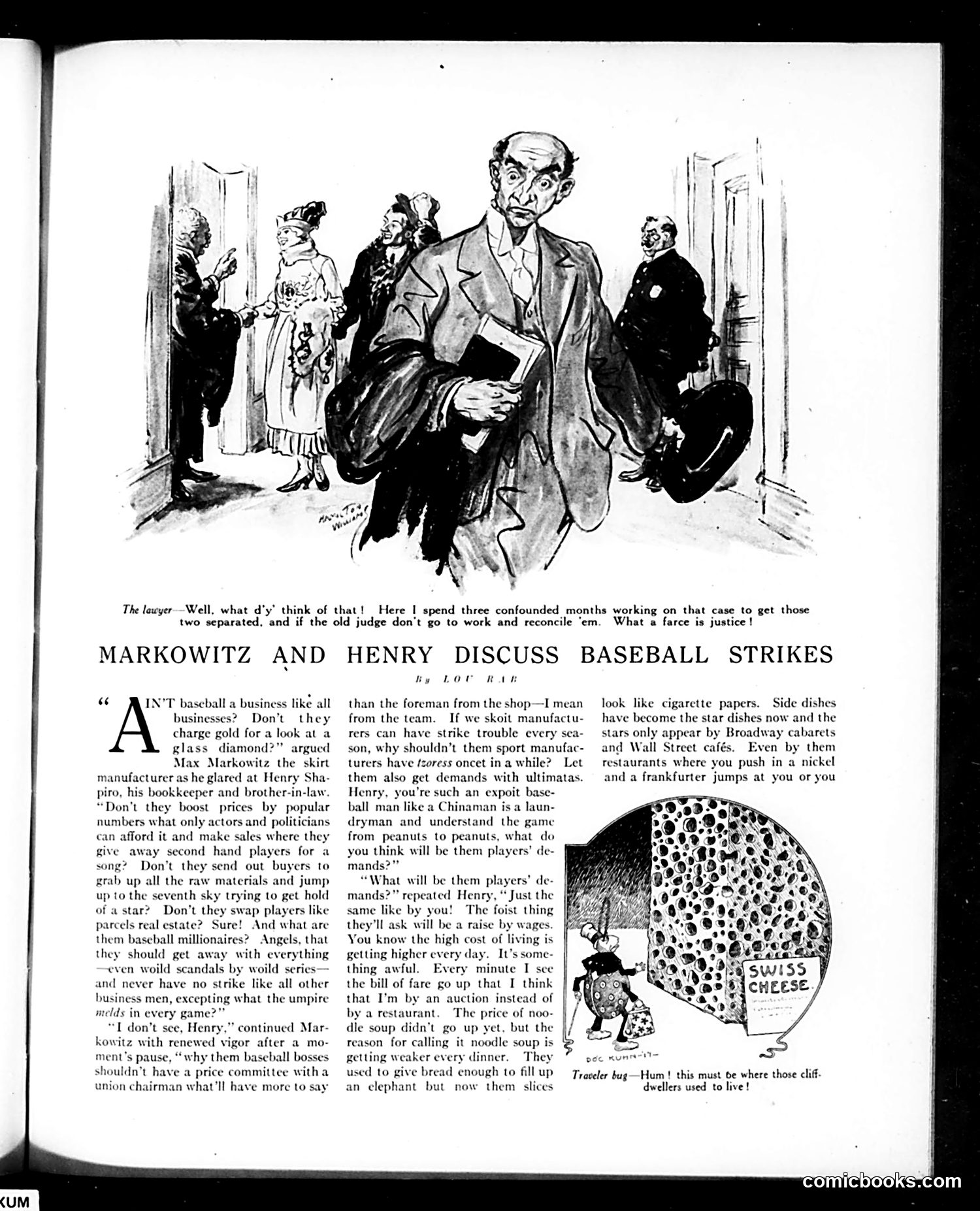
What you’re looking at
This 1920s Judge magazine piece satirizes labor strikes through a dialogue between Max Markowitz (a skirt manufacturer) and Henry (his bookkeeper). **The Setup:** Markowitz argues that baseball team owners operate like any other business—exploiting labor, controlling markets, manipulating assets. He questions why baseball players shouldn't organize strikes like factory workers do, demanding wage increases and better conditions. **The Satire's Point:** By comparing baseball to garment manufacturing, the piece mocks both sides: wealthy industrialists who exploit workers while claiming special business exemptions, AND the growing labor movement demanding unionization. The humor lies in Markowitz ironically advocating for baseball strikes while himself being a manufacturer who presumably resists his own workers' demands. **Historical Context:** This reflects 1920s labor tensions—factory strikes were common and controversial. The piece uses baseball (America's pastime) as a lens to debate whether workers deserve collective bargaining rights, ultimately suggesting the entire system is hypocritical. **The Lawyer's Lament** (top) reinforces this: legal/social institutions fail to "reconcile" conflicting interests—whether divorced couples or labor-management disputes.
📄 Transcribed text from this page (OCR, searchable)
Machine-transcribed from the original scan — historical spelling and the odd misread are preserved.
The lawyer Well, what dy’ think of that! two separated, and if the old judge don’t go to work and reconcile ‘em. HENRY DISCUSS BASEBALL STRIKES MARKOWITZ AND baseball a business like all businesses? Don’t’ they charge gold for a look at a glass diamon argued Max Markowitz the skirt manufacturer as he glared at Henr: piro, his bookkeeper and brother-in-law. “Don’t they boost prices by popular numbers what only actors and politicians can afford it and make sales where they give away second hand players for a song? Don’t they send out buyers to grab up all the raw materials and jump up to the seventh sky trying to get hold of a star? Don’t they swap players like parcels real estate? Sure! And what are them baseball millionaires? Angels, that they should get away with e hing even woild scanda and never have no strike like all other busin cepting what the umpire melds in every ? “TL don’t continued Mar- kowitz with renewed vigor after a mo- ment’s pause, “why them baseball bosses shouldn't have a price committee witha union chairman what'll have more to say “ IN By LOU RAR than the foreman from the shop—I mean from the team. If we skoit manufactu- rers can have strike trouble eve a son, why shouldn’t them sport manufac turers have fcoress oncet ina while? Let them also get demands with ultimatas. Henry, you're such an expoit base- ball man like a Chinaman is a laun- dryman and understand the game from peanuts to peanuts, w do k will be them players’ de- “What will be them players’ de- mands?” repeated Henry, “ Just the same like by you! The foist thing they'll ask will be a raise by wages. You know the high cost of living is getting higher every d. It’s some- thing awful. Every minute I se the bill of fare go up that I think that I’m by an auction instead of | by a restaurant. The price of noo- dle soup didn’t go up yet, but the reason for calling it noodle soup is getting weaker every dinner. They used to give bread enough to fill up an clephant but now them slices cs Traveler bug Here | spend three confounded months working on that case to get those ‘ What a farce is justice! look like cigarette papers. Side dishes have become the star dishes now and the stars only appear by Broadway cabarets and Wall Street cafés. Even by them restaurants where you push in a nickel and a frankfurter jumps at you or you Hum ! this must 6e where those cliff dwellers used to live!