
Judge, 1917-03-03 · page 17 of 28
Judge — March 3, 1917 — page 17: what you’re looking at
What you’re looking at
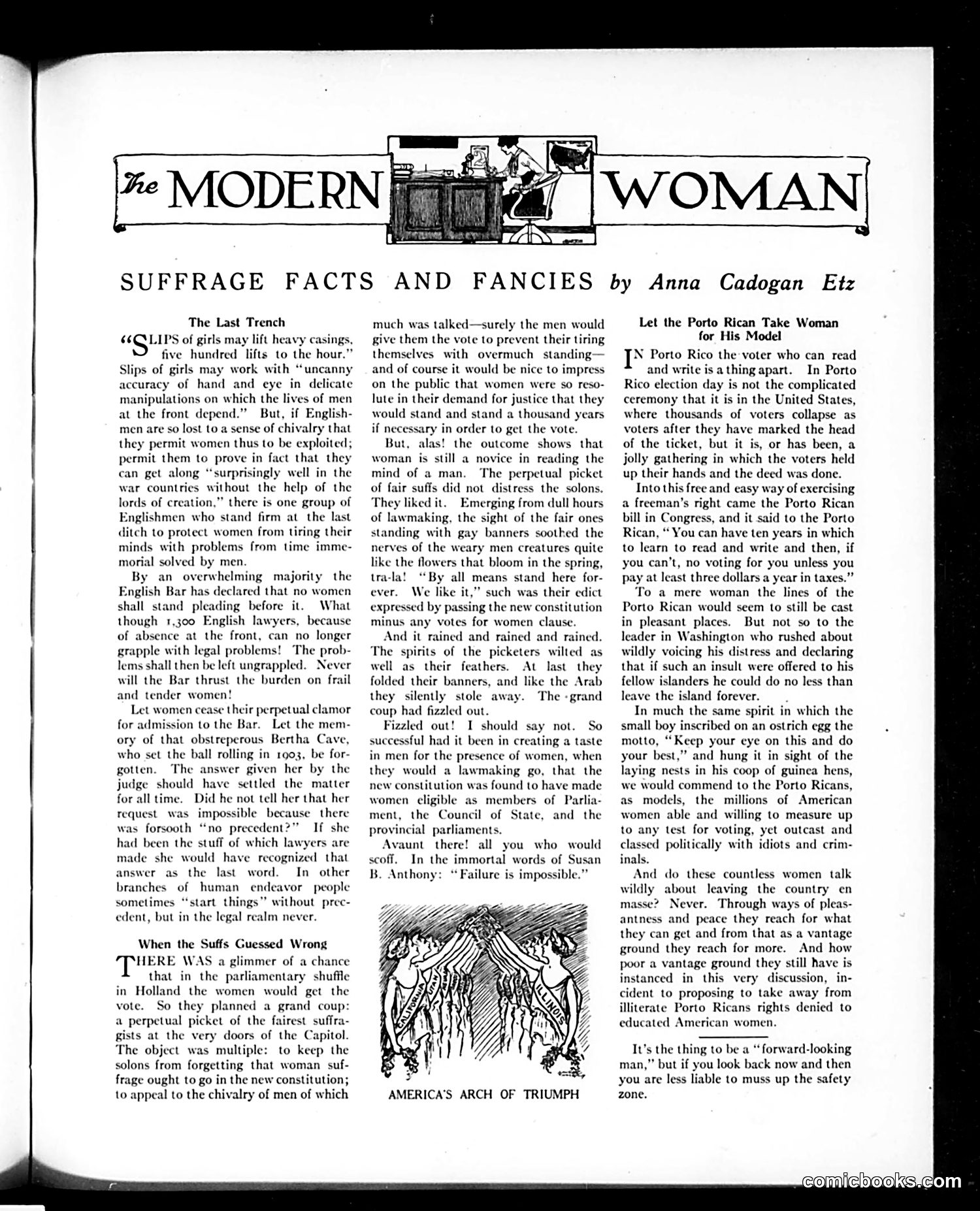
This satirical page by Anna Cadogan Etz addresses women's suffrage and legal rights circa World War I. **"The Last Trench"** mocks British legal resistance to female lawyers. Despite 1,300 male lawyers absent at war's front, the Bar refuses women admission, citing lack of precedent—absurdly claiming this protects women's delicate constitutions from legal problems. **"When the Suffs Guessed Wrong"** ridicules Dutch suffragists' failed strategy: they picketed Parliament hoping male chivalry would grant voting rights. Instead, legislators simply enjoyed the spectacle while voting down women's suffrage. The ironic twist: the constitution unexpectedly made women eligible for Parliament anyway—vindicating suffragist persistence. **"Let the Porto Rican Take Woman for His Model"** sarcastically criticizes Puerto Rico's literacy voting requirement as more restrictive than American women's complete disenfranchisement. The cartoon (titled "America's Arch of Triumph") visually complements these critiques of gender inequality's absurdity.
📄 Transcribed text from this page (OCR, searchable)
Machine-transcribed from the original scan — historical spelling and the odd misread are preserved.
The Last Trench 66QLIPS of girls may lift heavy casings, five hundred lifts to the hour.” Slips of girls may work with “uncanny accuracy of hand and eye in delicate manipulations on which the lives of men at the front depend.” But, if English- men are so lost to a sense of chivalry tha they permit women thus to be exploited permit them to prove in fact that they can get along “surprisingly well in the war countries without the help of the lords of creation,” there is one group of Englishmen who stand firm at the last ditch to protect women from tiring their minds with problems from time imme- morial solved by men. By an overwhelming majority the English Bar has declared that no women shall stand pleading before it. What though 1,300 English lawyers, because of absence at the front, can no longer grapple with legal problems! The prob- lems shall then be left ungrappled. Never will the Bar thrust the burden on frail and tender women! Let women cease their perpetual clamor for admission to the Bar. Let the mem- ory of that obstreperous Bertha Cave, who set the ball rolling in 1903, be for- gotten. The answer given her by the judge should have settled the matter for all time. Did he not tell her that her request was impossible because there was forsooth “no precedent? If she had been the stuff of which la e made she would have recognized that answer as the last word. In other branches of human endeavor people sometimes “start things” without prec- edent, but in the legal realm never. When the Suffs Guessed Wrong HERE WA! glimmer of a chance that in the parliamentary shuffle in Holland the women would get the vote. So they planned a grand coup: a perpetual picket of the fairest suffra- ists at the very doors of the Capitol. The object was multiple: to keep the solons from forgetting that woman suf- frage ought to go in the new constitution; to appcal to the chivalry of men of which SUFFRAGE FACTS AND FANCIES by Anna Cadogan Etz much was talked—surely the men would give them the vote to prevent their tiring themselves with overmuch standing— and of course it would be nice to impress on the public that women were so reso- lute in their demand for justice that they would stand and stand a thousand years ary in order to get the vote. the outcome shows that woman is still a novice in reading the mind of a man. The perpetual picket of fair suffs did not distress the solons. They liked it. Emerging from dull hours of lawmaking, the sight of the fair ones standing with gay banners soothed the nerves of the weary men creatures quite like the flowers that bloom in the spring, tra-la! “By all means stand here for- We like it,” such was their edict ed by passing the new constitution minus any votes for women clause. And it rained and rained and rained. The spirits of the picketers wilted as well as their feathers. At last they folded their banners, and like the Arab they silently stole away. The «grand coup had fizzled out. Fizzled out! I should say not. So successful had it been in creating a taste in men for the presence of women, when they would a lawmaking go, that the new constitution was found to have made women cligible as members of Parlia- ment, the Council of State, and the provincial parliaments. Avaunt there! all you who would scoff. In the immortal words of Susan B. Anthony: “Failure is impossible.” ever. AMERICA’S ARCH OF TRIUMPH Let the Porto Rican Take Woman for His Model N Porto Rico the voter who can read and write is athing apart. In Porto Rico election day is not the complicated ceremony that it is in the United Stat where thousands of voters collapse as voters after they have marked the head of the ticket, but it is, or has been, a jolly gathering in which the voters held up their hands and the deed was done. Into this free and easy way of exercising a freeman’s right came the Porto Rican bill in Congress, and it said to the Porto Rican, “ You can have ten years in which to learn to read and write and then, if you can’t, no voting for you unless you pay at least three dollars a year in taxes.” To a mere woman the lines of the Porto Rican would seem to still be cast in pleasant places. But not so to the leader in Washington who rushed about wildly voicing his distress and declaring that if such an insult were offered to his fellow islanders he could do no less than leave the i In much the same spirit in which the small boy inscribed on an ostrich egg the motto, “Keep your eye on this and do your best,” and hung it in sight of the laying nests in his coop of guinea hens, we would commend to the Porto Ricans, as models, the millions of American women able and willing to measure up to any test for voting, yet outcast and classed politically with idiots and crim- inals. And do these countless women talk wildly about leaving the country en ma: Never. Through ways of pleas antness and peace they reach for what they can get and from that as a vantage ground they reach for more. And how poor a vantage ground they still have is instanced in this very discussion, in- cident to proposing to ta away from illiterate Porto Ricans rights denied to educated American women. It’s the thing to bi jorward-looking man,” but if you look back now and then you are less liable to muss up the safety zone.