
A complete issue · 28 pages · 1916
Judge — December 9, 1916
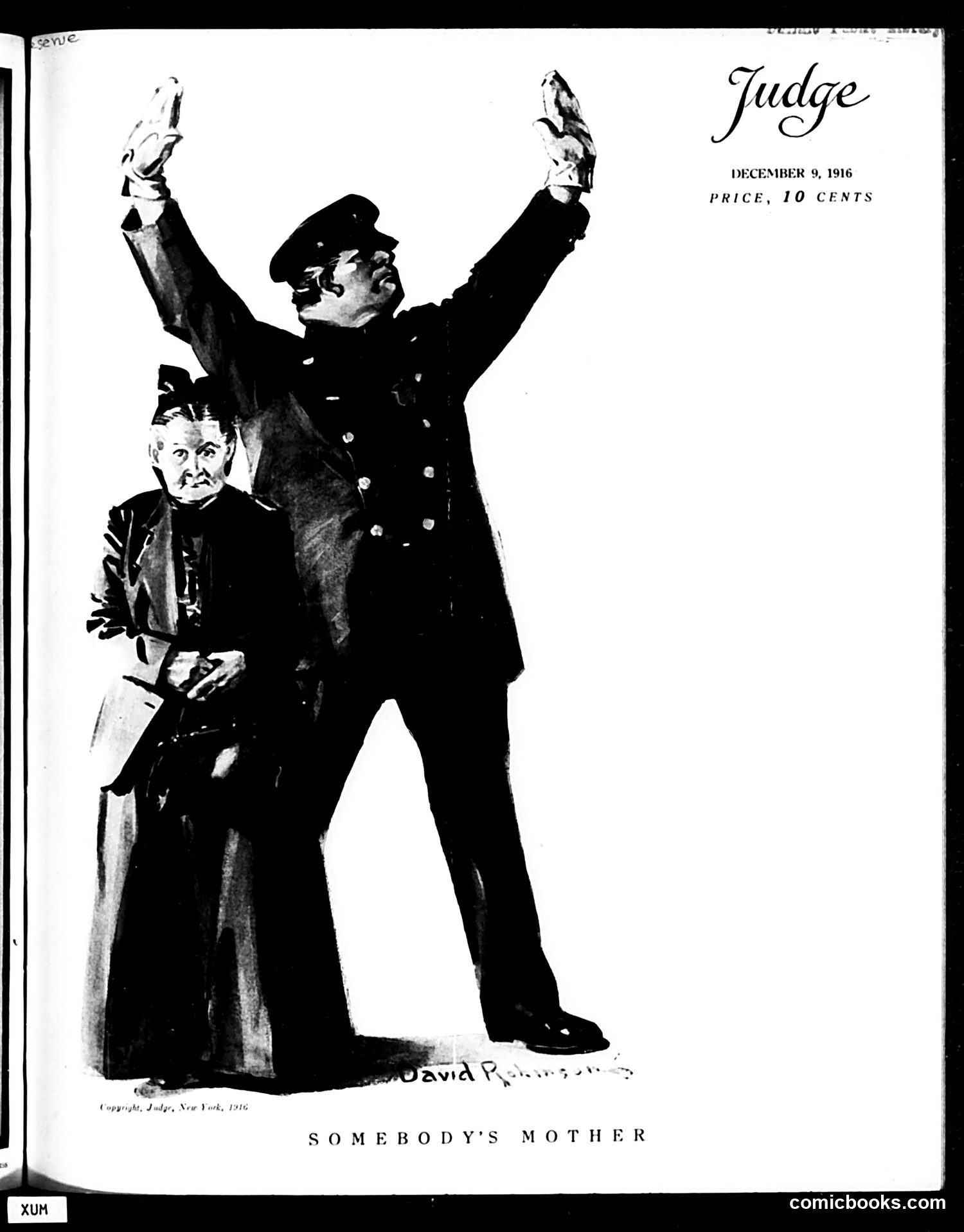
This satirical cartoon titled "Somebody's Mother" depicts two military figures in what appears to be a WWI context. The standing figure with arms raised triumphantly wears a military uniform and cap, while a smaller, older woman in civilian dress is positioned below him. The composition suggests the cartoon critiques warmongering or military enthusiasm by sarcastically juxtaposing aggressive military posturing with an elderly civilian figure—presumably representing mothers or families affected by war. The 1916 date places this during U.S. debates over entry into World War I. The satire likely mocks those promoting military action while ignoring the human cost to families. The stark black-and-white illustration emphasizes this contrast between military bravado and civilian suffering.
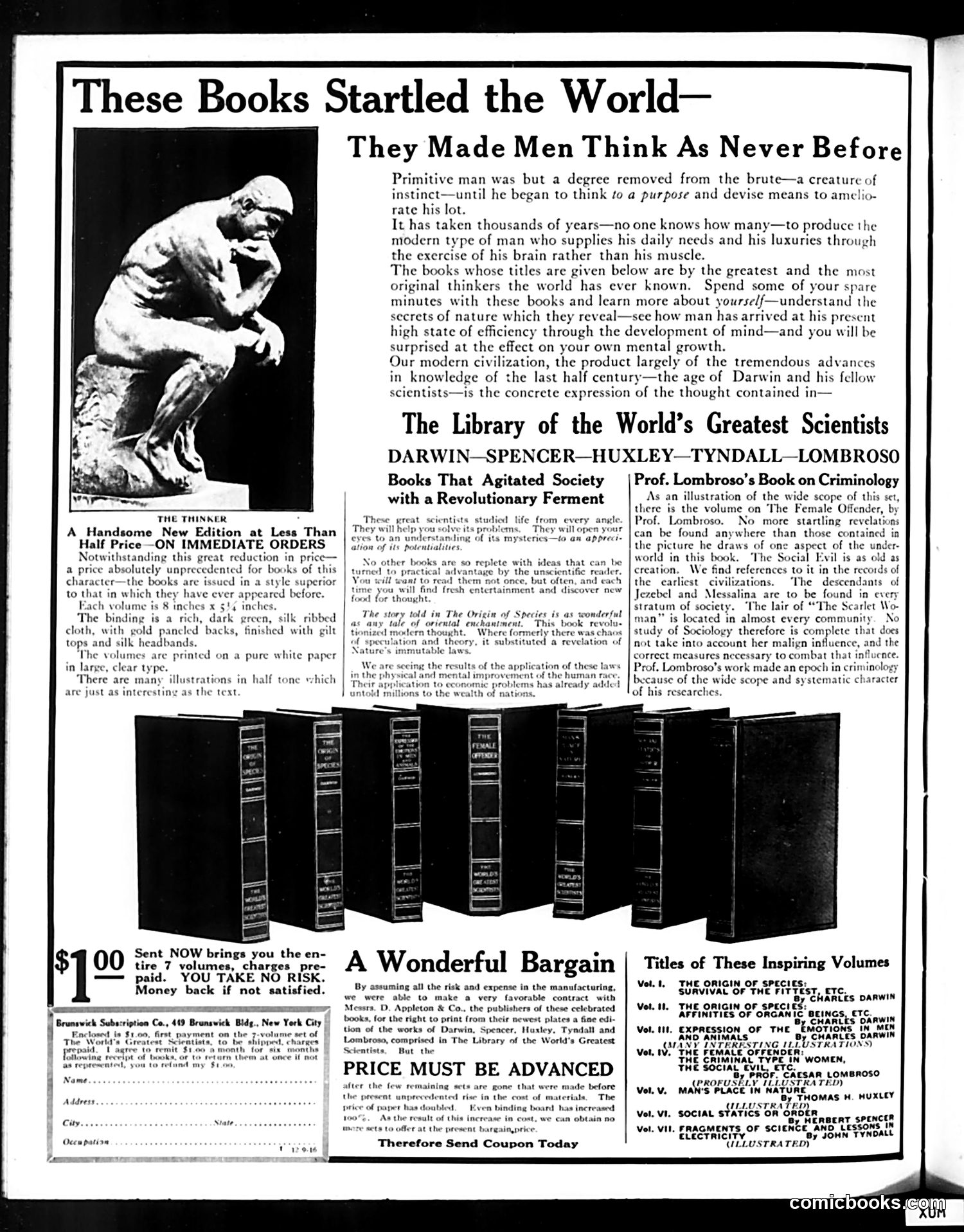
This page is primarily **advertising, not satire or political commentary**. It promotes "The Library of the World's Greatest Scientists"—a multi-volume book set featuring Darwin, Spencer, Huxley, Tyndall, and Lombroso. The only illustration is Rodin's famous sculpture "The Thinker," used here as visual branding to associate the books with intellectual achievement and contemplation. The accompanying text emphasizes how these scientists revolutionized human thought, positioning the collection as essential reading for mental self-improvement. The marketing pitch appeals to early 20th-century faith in scientific progress and self-education. The $1.00 introductory offer and coupon format suggest this was a subscription or mail-order campaign targeting middle-class readers interested in popular science literature.
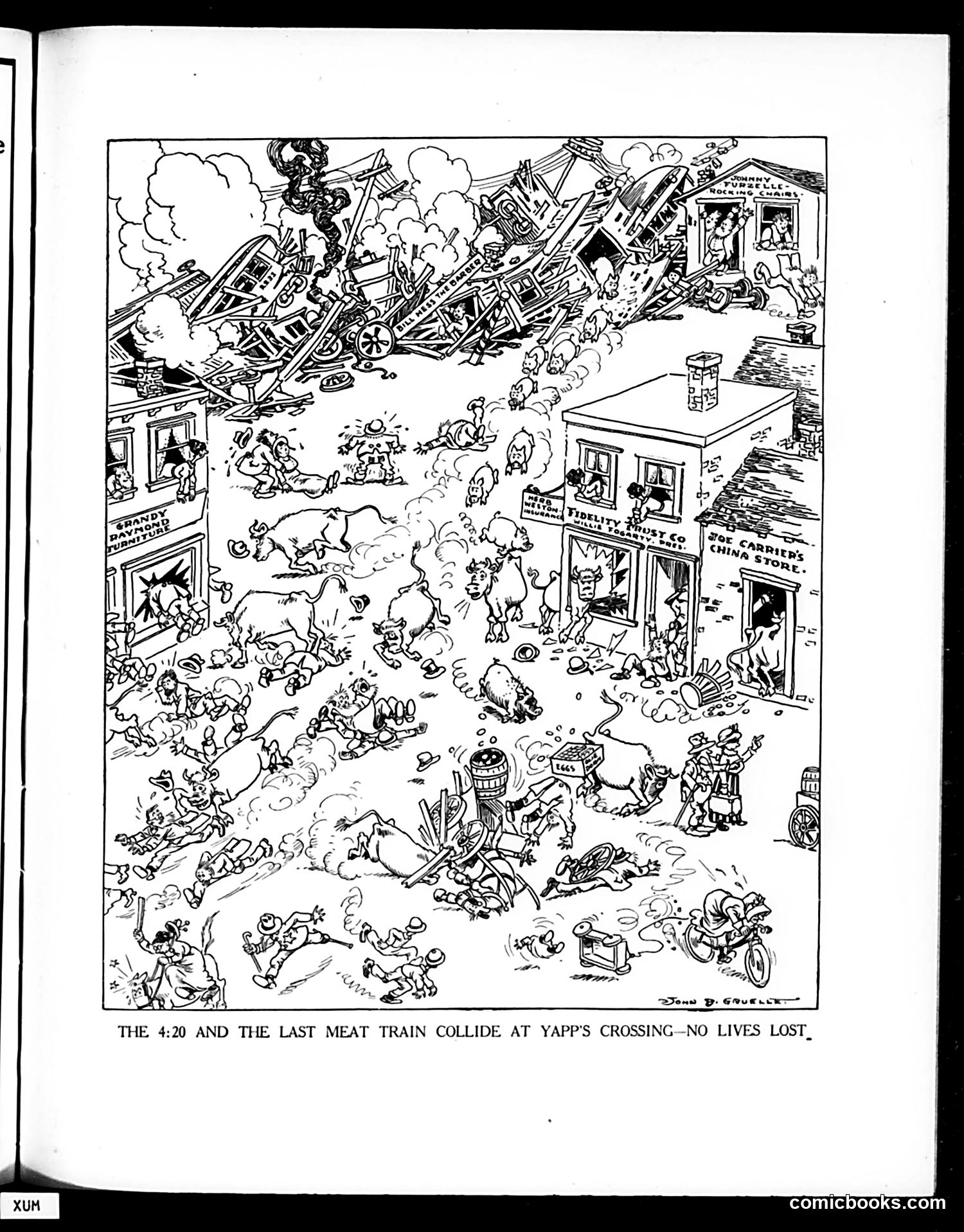
This is a humorous cartoon depicting a catastrophic train collision at "Yapp's Crossing." The caption assures readers "NO LIVES LOST," which undercuts the apparent disaster shown—the image displays complete chaos with derailed trains, debris scattered everywhere, colliding vehicles, people fleeing in panic, and general pandemonium. The satire appears to mock either railroad safety practices or perhaps insurance/liability claims of the era. The visible business signs (Fidelity Trust Co., Joe Carrier's Chinaware Store) suggest this is meant as a local disaster affecting a small town's commercial district. The cartoon's humor derives from the contradiction between the reassuring caption and the evident mayhem depicted. This was likely contemporary satire about a specific incident, though without additional context, the exact event referenced is unclear.
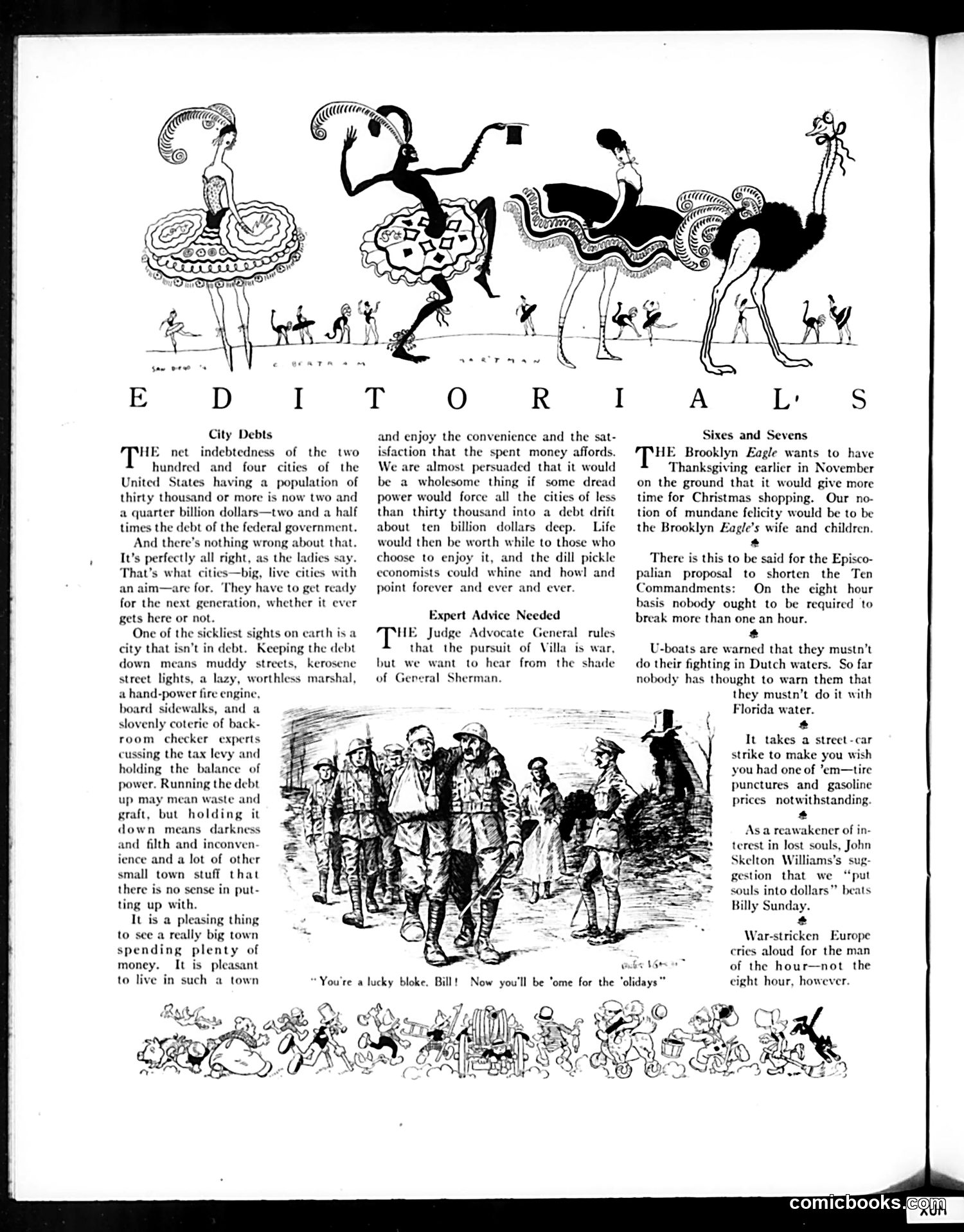
This Judge magazine page contains two satirical sections: **"City Debts"** critiques American municipal overspending. The text argues that while federal debt of $2.5 billion is acceptable, cities should not accumulate similar debts. It mocks cities that maintain expensive infrastructure (street lights, police) while claiming poverty—suggesting fiscal irresponsibility and bloated bureaucracy. **"Sixes and Sevens"** addresses the Brooklyn *Eagle* newspaper's proposal for an eight-hour Thanksgiving day, arguing this reduces shopping time before Christmas. The section also comments on various minor grievances: streetcar strikes, Florida dangers, and European war issues. The decorative header features elongated Art Deco figures, typical of 1920s Judge style. The central illustration depicts soldiers, likely referencing World War I military organization.
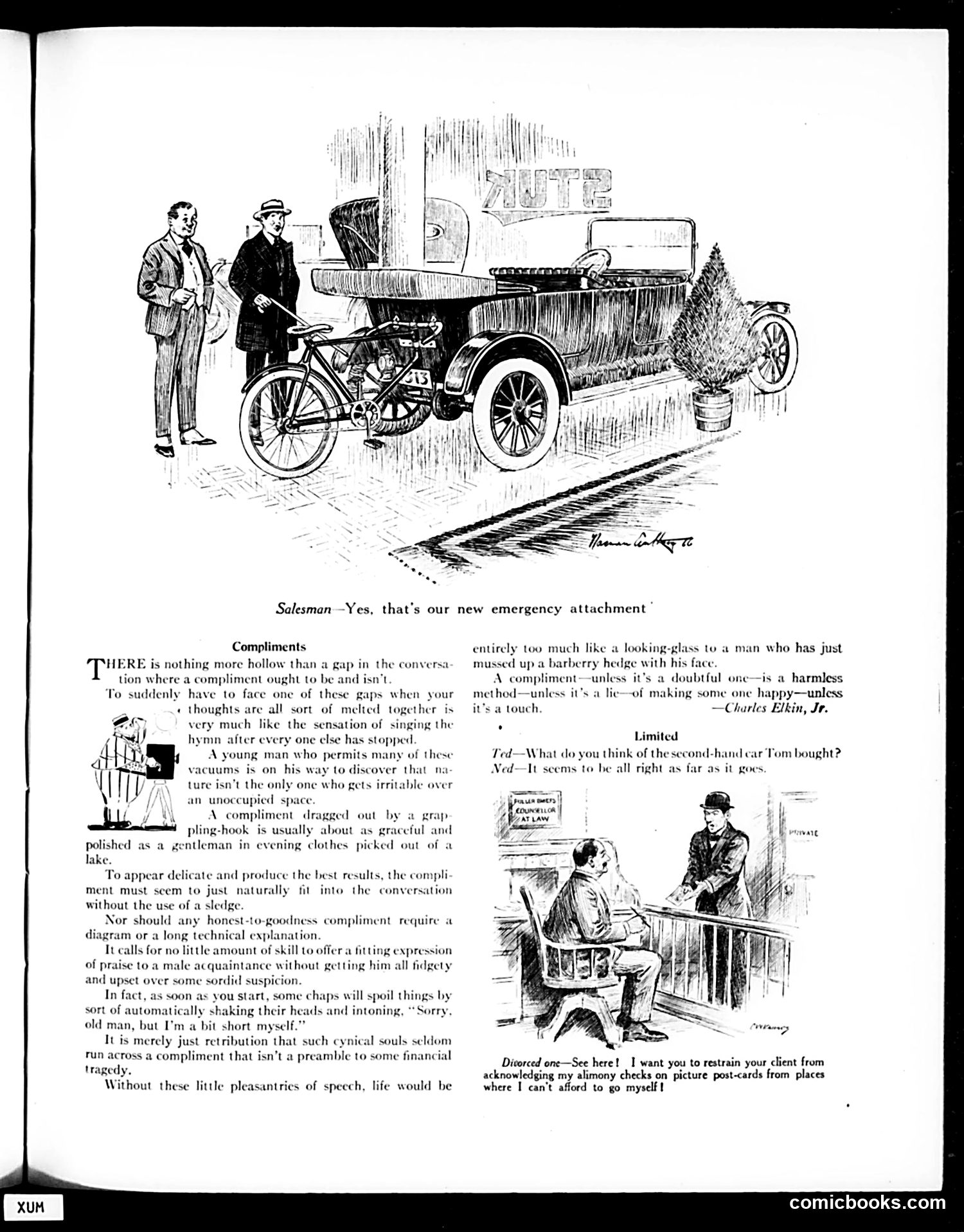
**Top Cartoon:** A salesman demonstrates an "emergency attachment"—a bicycle attached to an automobile. The humor satirizes over-engineered solutions to practical problems. In the early automotive era, this represents the absurdity of combining two vehicles rather than simply fixing car reliability issues. **"Compliments" Article:** This discusses the awkwardness of giving compliments without seeming insincere. The accompanying small cartoon shows a man being complimented while looking uncomfortable—satirizing how forced praise can backfire. **"Limited" Cartoon (bottom right):** A debtor uses excessive flattery ("picture post-cards from places where I can't afford to go myself") to manipulate a creditor into restraint. This satirizes how compliments are weaponized by those in financial desperation. The page connects these pieces thematically around insincere social performance.
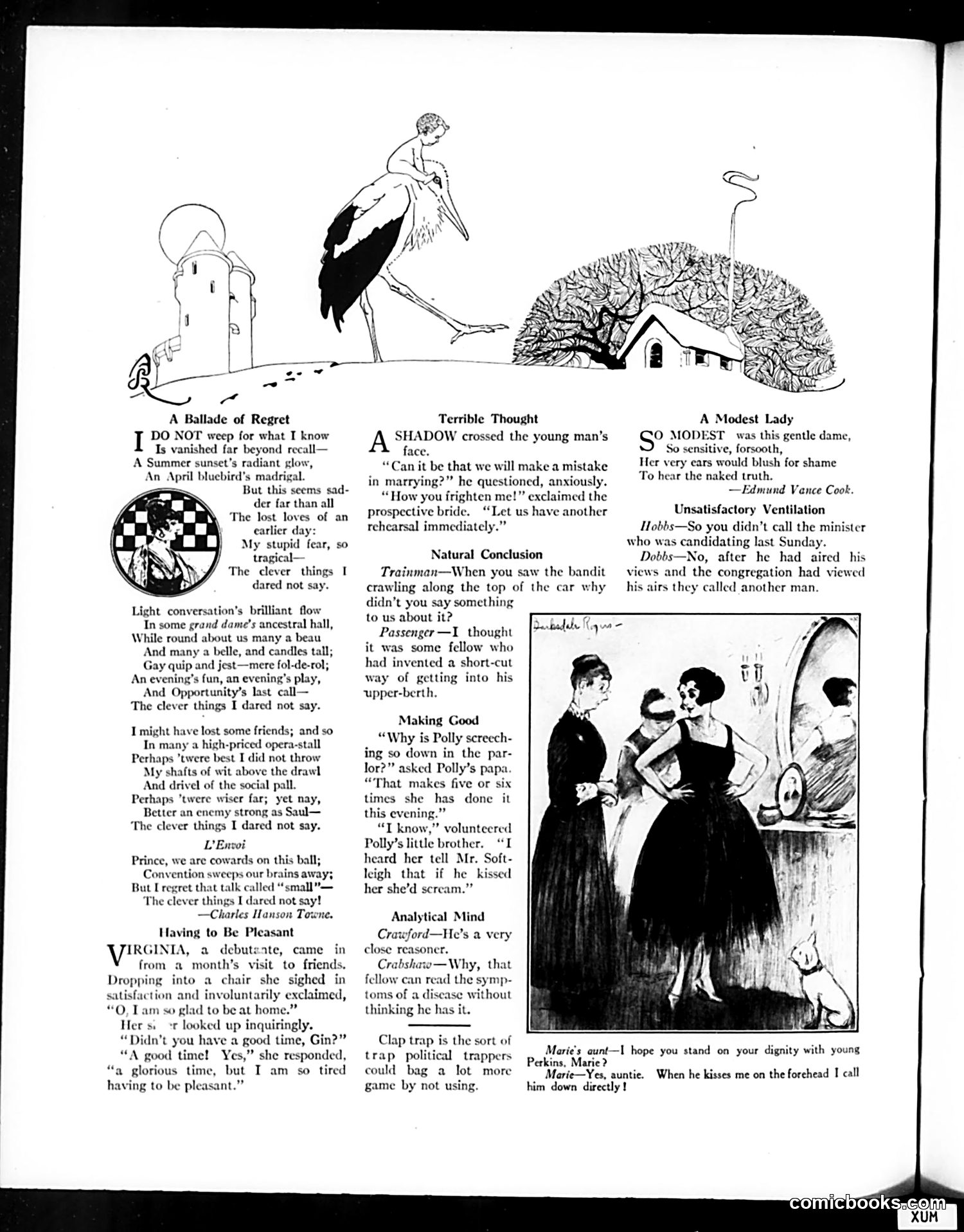
This page contains several short humorous pieces typical of early 20th-century American satire: **"A Ballad of Regret"** is a nostalgic poem lamenting social cowardice—the failure to make witty remarks at parties due to social convention, suggesting that suppressing clever remarks in favor of polite conversation was a genuine source of regret. **"Having to Be Pleasant"** satirizes debutante culture: Virginia complains that despite having a wonderful time visiting friends, she's exhausted from the *obligation* to appear cheerful—mocking both the artificiality of upper-class social performance and the exhausting emotional labor expected of young society women. The remaining pieces are brief comedic anecdotes about courtship, class anxieties, and miscommunication. "Making Good" jokes about a girl screaming when kissed (whether genuine protest or performative modesty is unclear). "Unsatisfactory Ventilation" mocks a boring minister. The stork illustration at top is decorative. Overall, the page satirizes early 20th-century social etiquette, particularly the performative nature of polite society and courtship rituals.
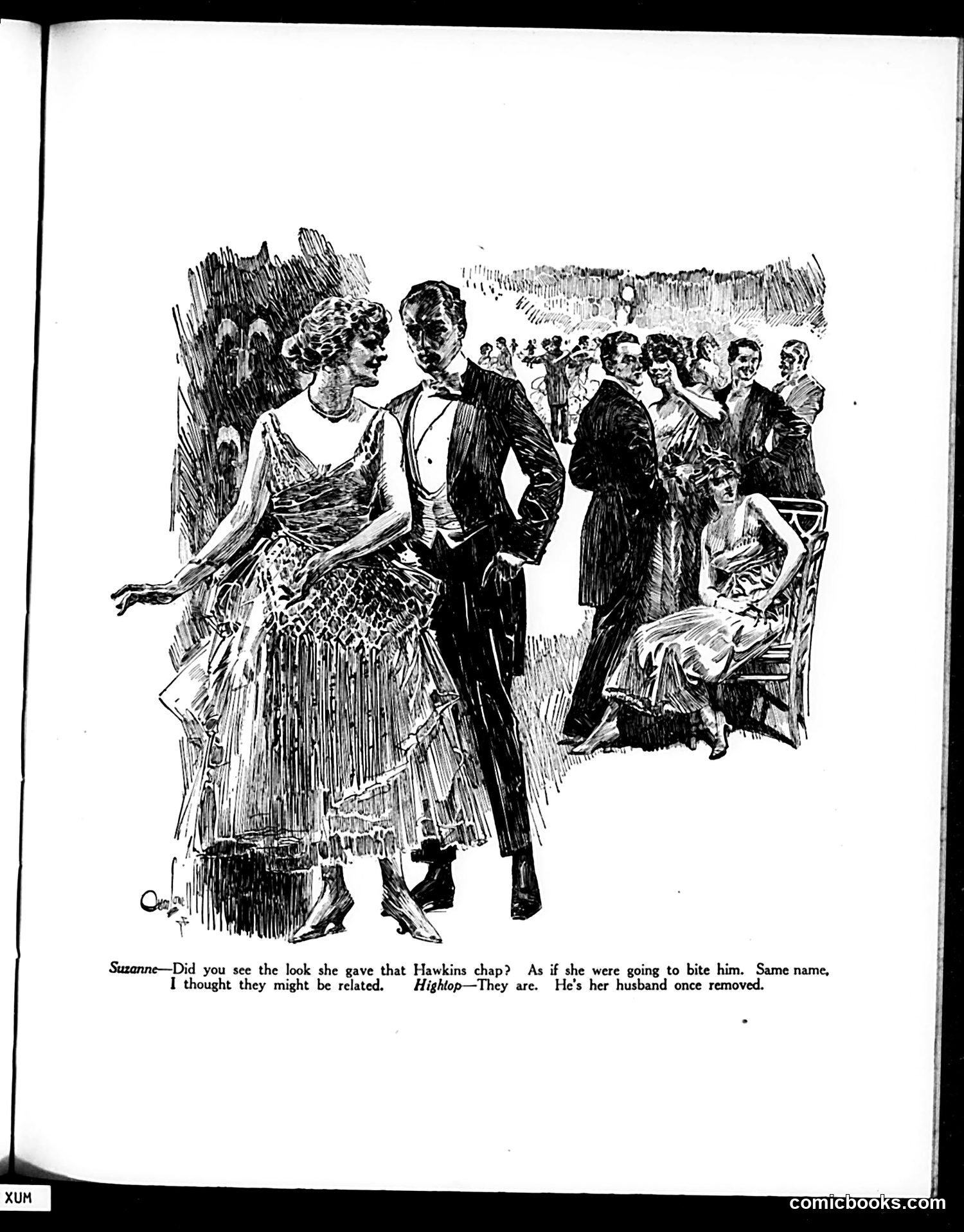
This is a social satire cartoon from *Judge* magazine depicting a formal social gathering. Two observers, Suzanne and Hightop, comment on a woman's hostile expression toward a man named Hawkins. The humor relies on the phrase "husband once removed"—a play on kinship terminology. Rather than literally meaning a relative, it's a witty euphemism suggesting the woman and Hawkins were formerly married. The phrase mimics genealogical language ("cousin once removed") to humorously reference their past romantic/marital relationship. The cartoon satirizes high-society social awkwardness: the tension of encountering an ex-spouse at a formal event, and the observant gossip of attendees noting such uncomfortable encounters. The woman's aggressive demeanor toward her "once removed" husband provides the comedic conflict.
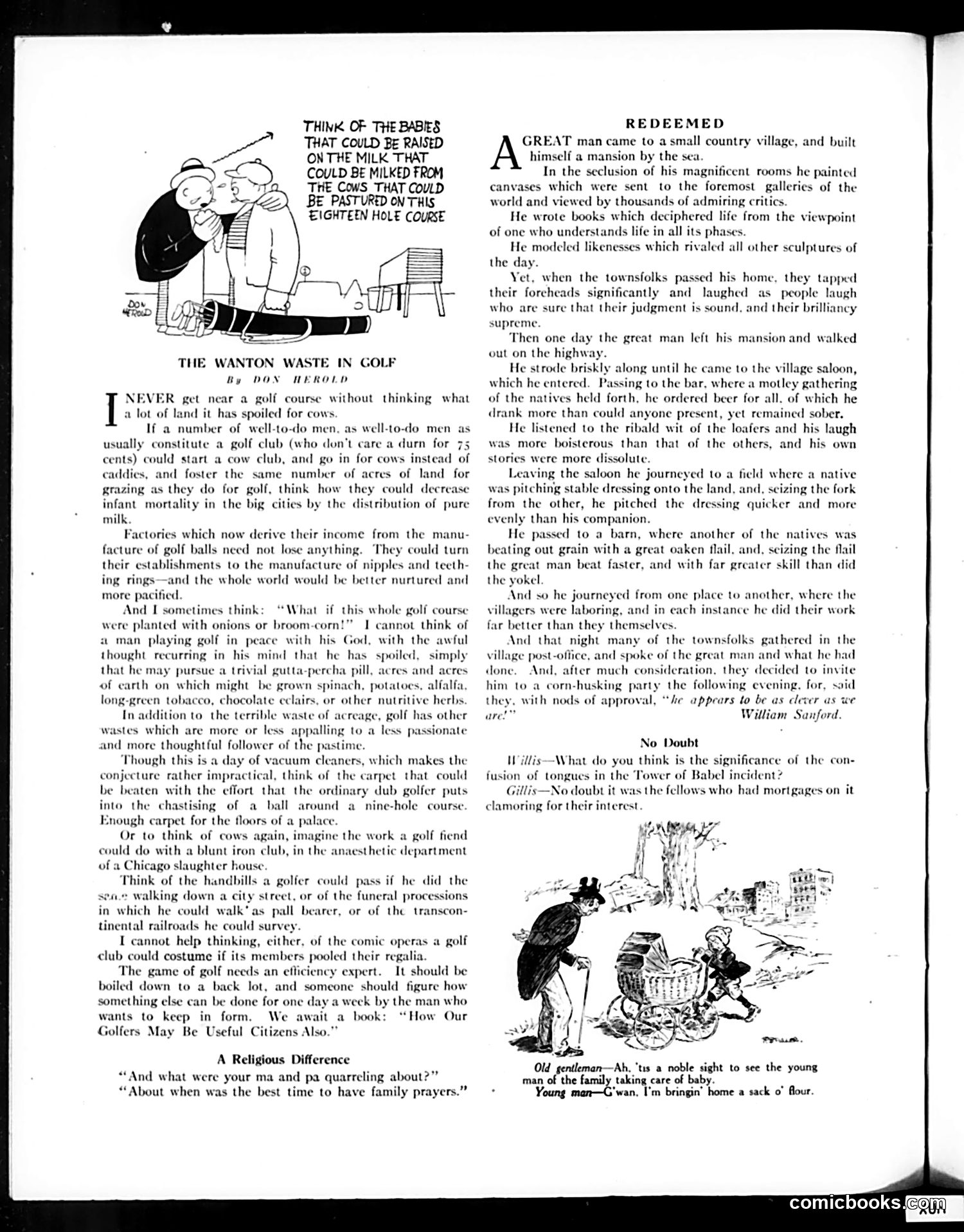
This satirical article by Don Herold critiques golf as frivolous land-use by wealthy men. The cartoon shows a golfer daydreaming about milk production—the central argument: 18-hole golf courses waste productive acreage that could raise dairy cows to supply milk to poor urban families, reducing infant mortality. Herold extends the critique absurdly—suggesting the land could grow spinach, potatoes, or tobacco instead. He mocks the effort wealthy "dub golfers" expend on a "trivial gutta-percha pill" (golf ball) when that same labor could help society. He even suggests repurposing golf clubs for actual work or that golfers' time would benefit cities if used productively. This reflects Progressive-era concerns about inequality, waste, and corporate/leisure-class excess during a period of urban poverty and high child mortality. The satire attacks golf as emblematic of upper-class indulgence disconnected from social responsibility.
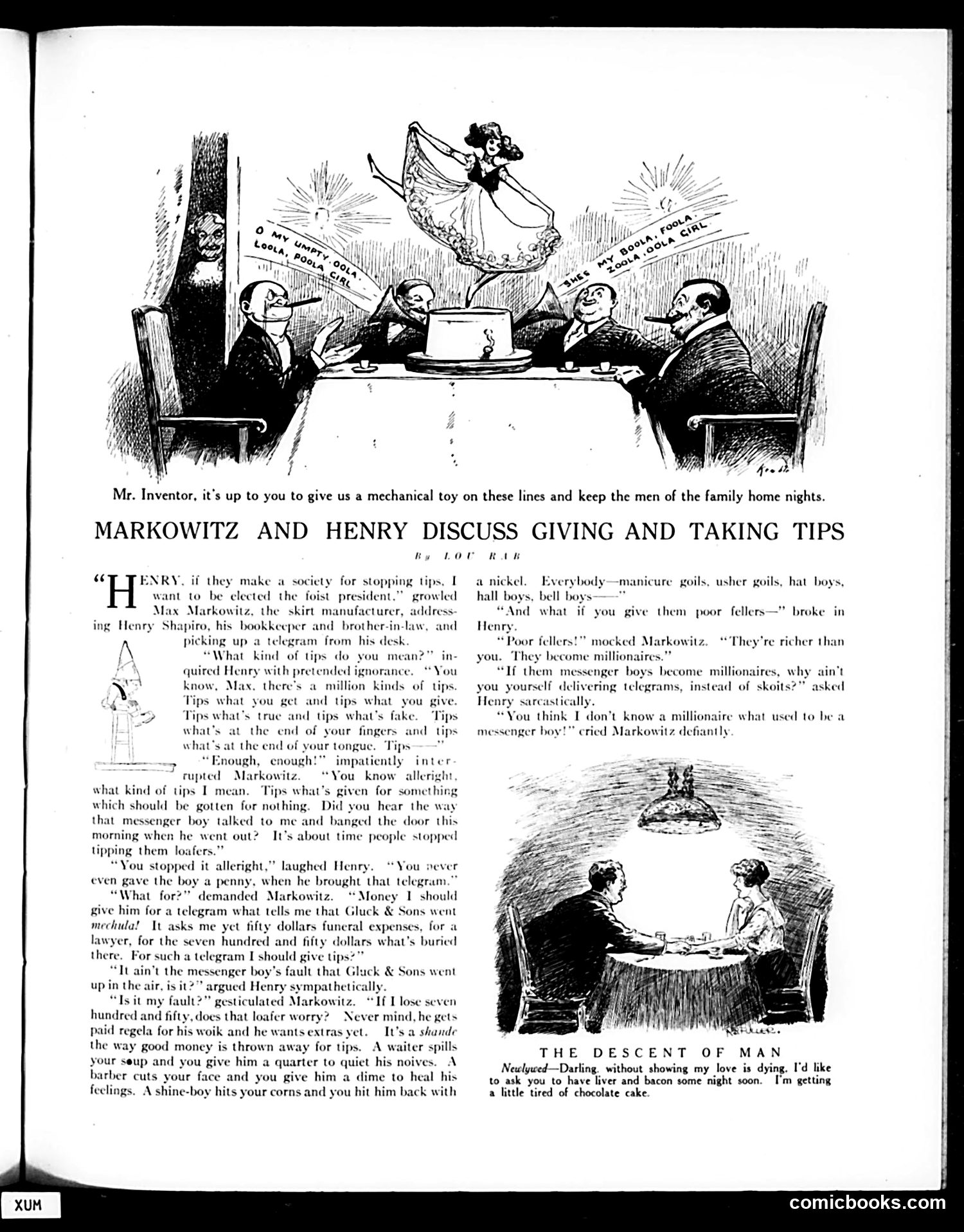
This page satirizes the emerging social custom of **tipping** in early 20th-century America. Two Jewish businessmen—Max Markowitz (a skirt manufacturer) and Henry Shapiro (his bookkeeper)—debate whether tips should be given to service workers. **The satire's point:** Markowitz complains that tipping has become excessive and rewards laziness. He refuses to tip a messenger boy who delivered bad news about a business loss, arguing people should be paid wages for their work without additional gratuities. Henry counters that poor workers deserve sympathy, and even mentions a messenger boy who became a millionaire—implying hard work pays off. **The joke:** Markowitz's absurd logic (why tip for bad news?) exposes the hypocrisy of wealthy employers resisting small tips while paying minimal wages. The cartoon above reinforces this: a mystical female figure (representing the tipping "spirit") hovers over the dinner table, suggesting it's an inescapable social obligation that keeps working men away from home. **Context:** This reflects genuine anxiety among the wealthy about tipping culture's growth in the 1910s-1920s, viewed as either democratic progress or wasteful excess depending on one's perspective.
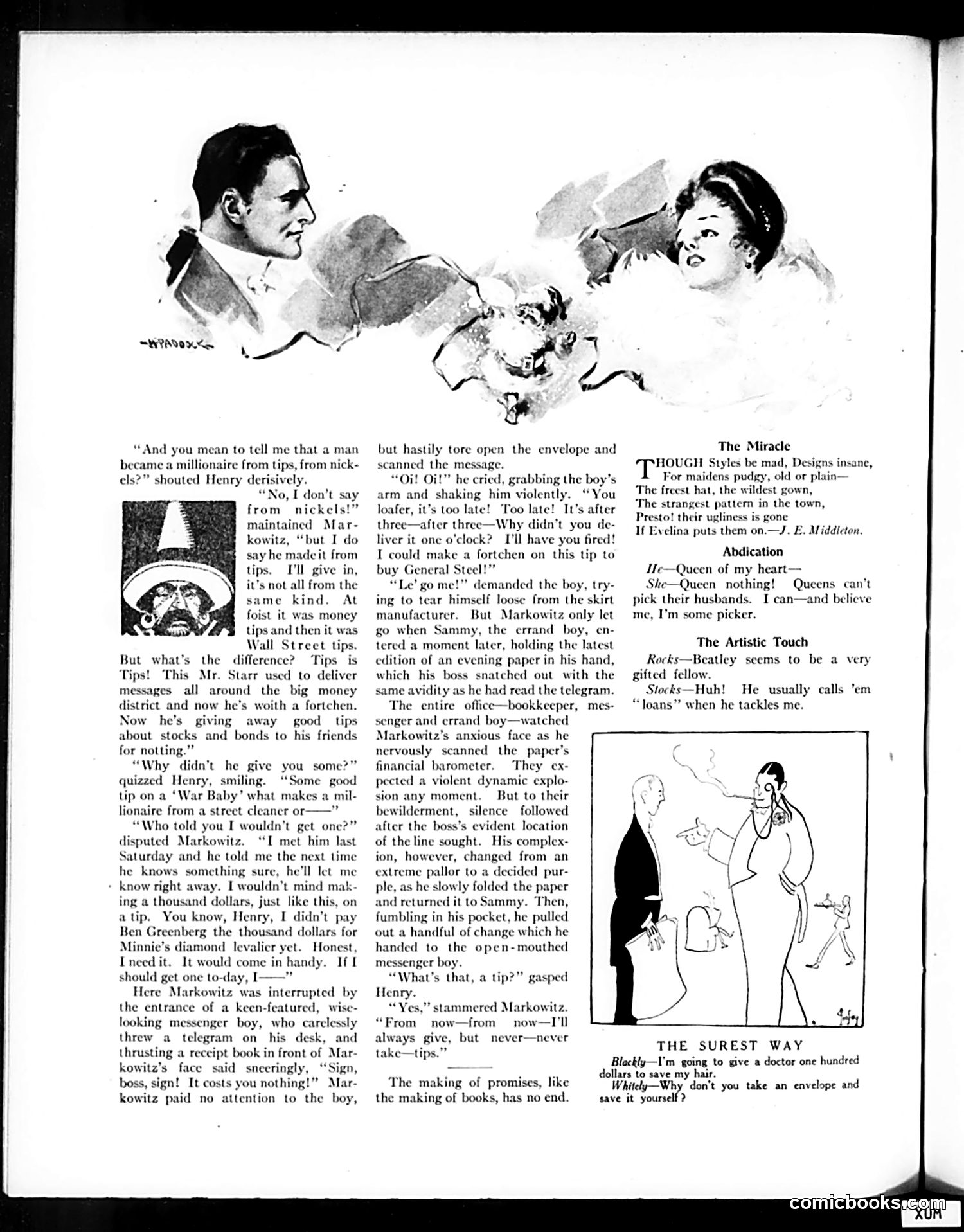
This page satirizes early-20th-century stock-market speculation and get-rich-quick schemes. The main story follows Markowitz, a garment manufacturer who obsesses over a stock tip that arrives too late—missing the 3 p.m. deadline to trade General Steel. His rage at the messenger boy is comical; he blames missing a fortune on poor delivery service. The twist: when he finally reads the evening paper, he discovers the stock crashed. His tip would have ruined him. Chastened, he tips the messenger boy and swears off taking speculative tips entirely. The satire targets the widespread fever for insider stock information during the "War Baby" boom (likely WWI-era profiteering). The joke exposes how most people chasing tips are delusional—they celebrate information that's often worthless or actively harmful. Markowitz's relief at near-disaster underscores how luck, not skill, governs such speculation. The additional short jokes on the page mock vanity and financial delusion generally.
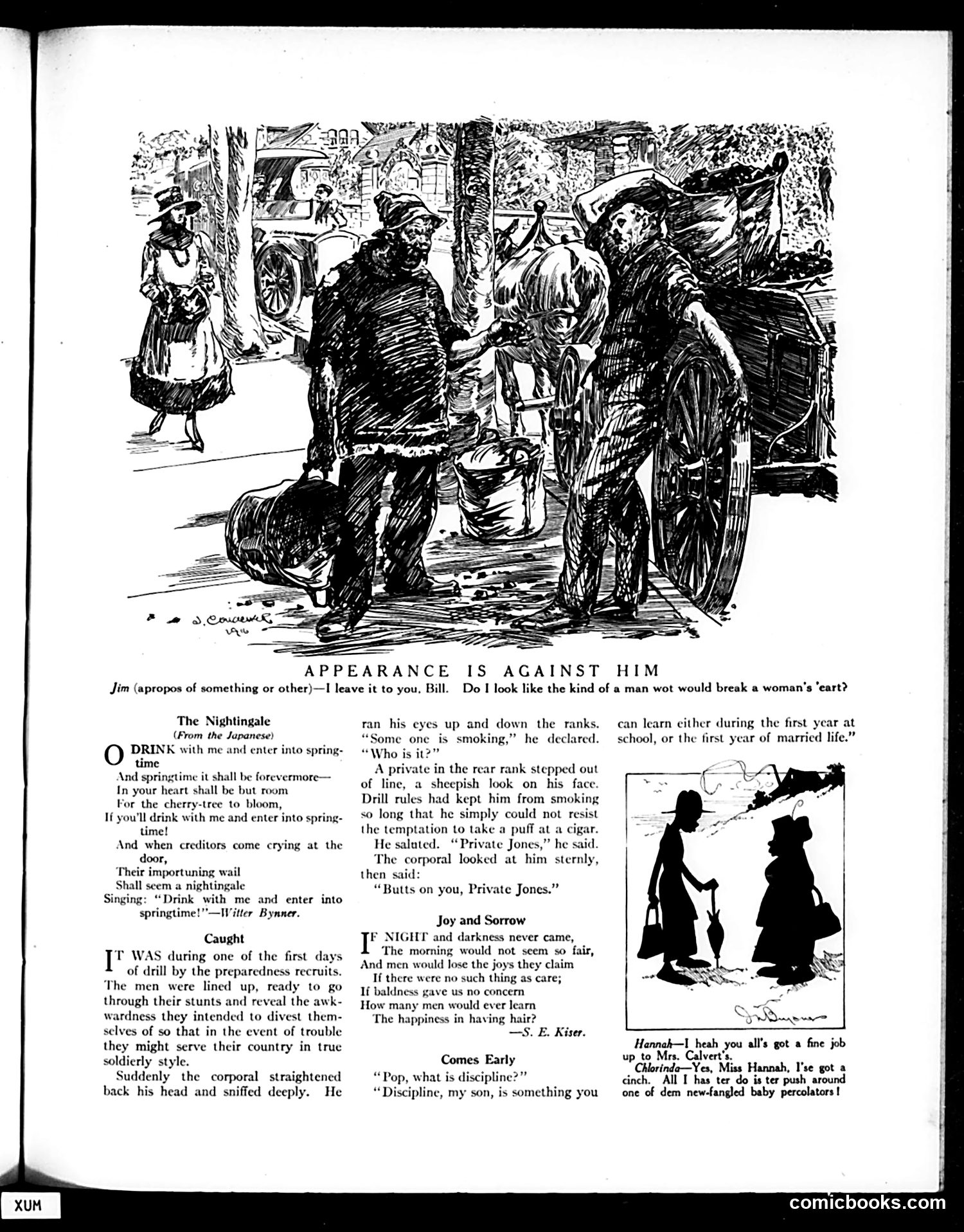
This page contains multiple short satirical pieces typical of early 20th-century American humor magazines. **Top cartoon** ("Appearance Is Against Him"): A street scene where Jim defends himself to Bill about his shabby appearance, asking if he looks like a man who'd break a woman's heart—satirizing how working-class men were judged by their worn clothing. **"The Nightingale"**: A poem (attributed to Witter Bynner) about escapism through drink and cherry blossoms, apparently mocking romantic/poetic avoidance of real problems like debt. **"Caught"**: A preparedness-era military humor piece. A drill sergeant catches Private Jones smoking during training—a violation of strict military discipline. The sergeant's pun ("Butts on you") plays on both cigarette butts and the soldier's transgression. **"Joy and Sorrow"** & **"Comes Early"**: Brief philosophical poems/jokes about life's contrasts and defining discipline. **Bottom right panel**: Dialogue between two Black domestic workers (Hannah and Chlorinda) about a new job, with "baby percolators" (likely an early vacuum cleaner or washing device) as the joke. The page reflects period attitudes toward class, military preparedness, and racial stereotypes.
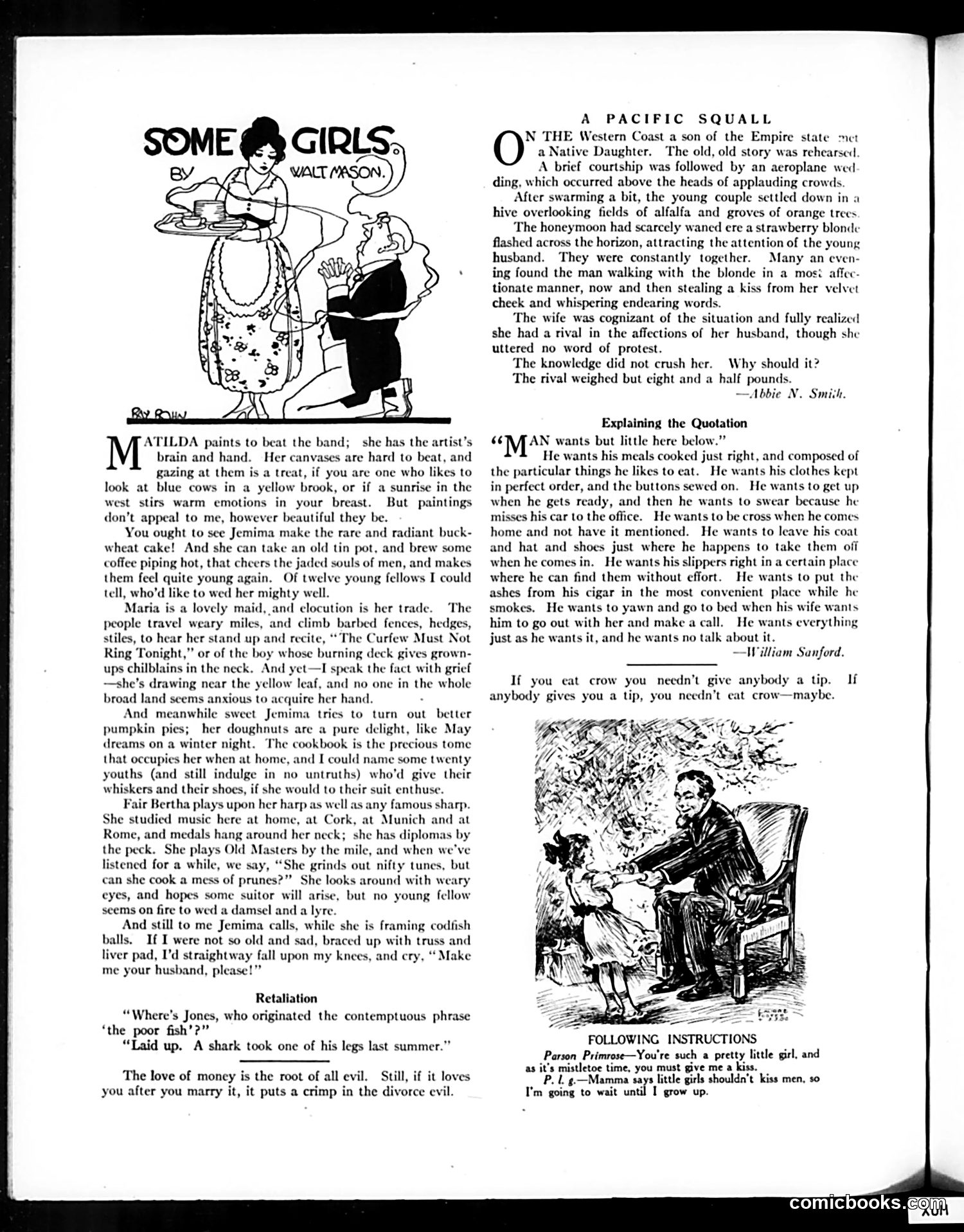
This Judge magazine page contains satirical commentary on gender roles and marriage in early 20th-century America. **"Some Girls"** (left): A humorous piece listing unmarried women with desirable domestic or artistic skills—Matilda (painter), Jemima (excellent cook), Maria (elocutionist), Bertha (accomplished musician). The satire: despite these accomplishments, none attract suitors. The implicit critique is that men value *domestic competence* (cooking, housekeeping) over education or artistic talent, yet ironically, Jemima—who offers only cooking skills—is the only one with marriage prospects. **"A Pacific Squall"** (top right): A brief story about a newlywed couple where the husband becomes infatuated with another woman. The twist ending reveals the "rival" is an 8.5-pound infant—their own child. The satire mocks husbands' jealousy and divided attention. **"Explaining the Quotation"** (bottom right): Satirizes male selfishness in marriage, presenting a husband's endless demands for comfort and service—a critique of male entitlement masquerading as innocent needs. Overall, the page satirizes marriage dynamics and gender expectations of its era.
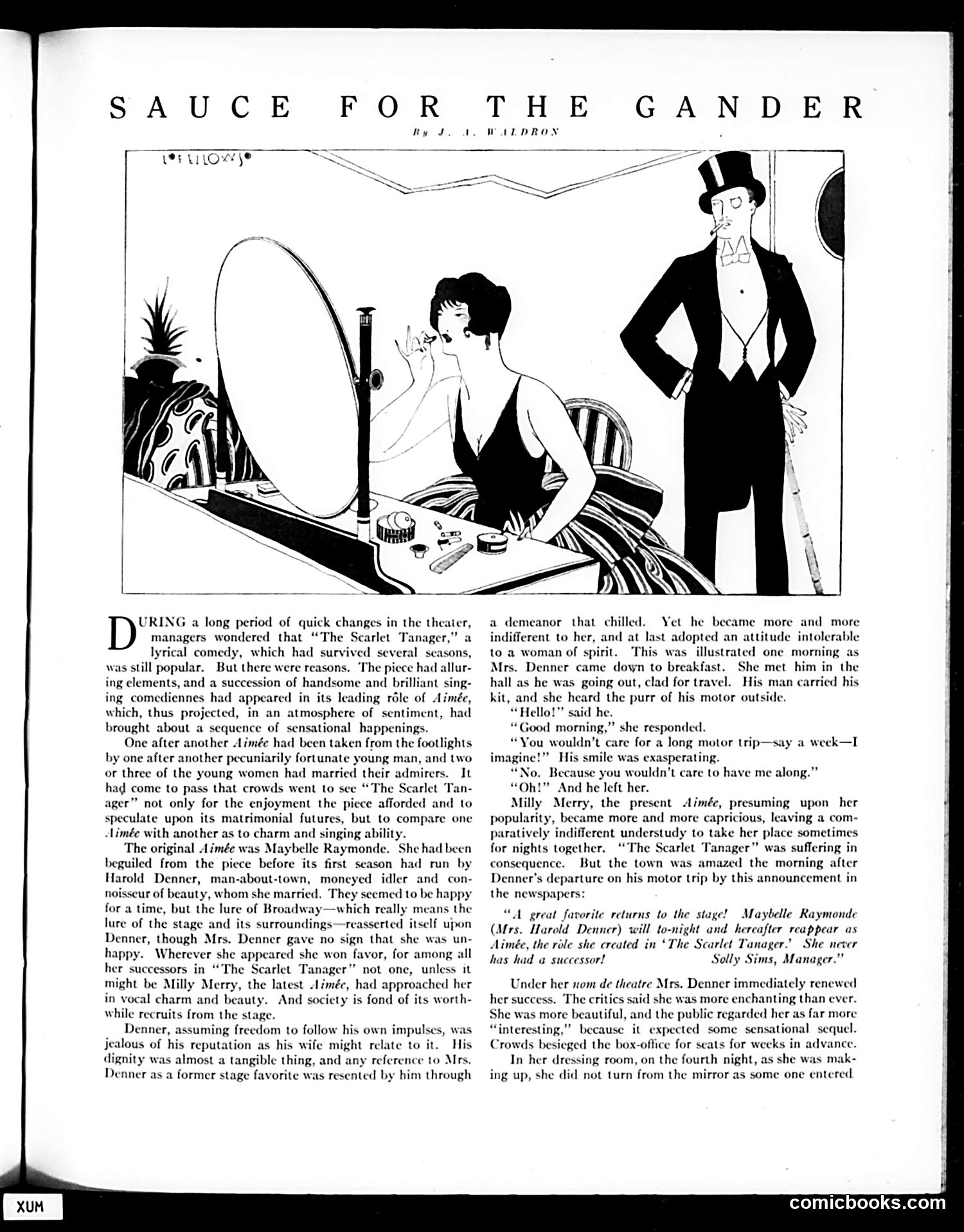
This is a satirical story about marital double standards in the theater world. Harold Denner, a wealthy man, married Maybelle Raymonde, a popular actress in "The Scarlet Tanager." He resented her stage career and became indifferent, eventually abandoning her for a motor trip without inviting her along. The satire's point: When Maybelle returns to perform under her stage name, becoming more celebrated than ever, Denner's hypocrisy is exposed. The title "Sauce for the Gander" (meaning equal treatment) suggests she now enjoys the freedom and admiration he denied her—turning his own neglect back on him. The illustration shows the theatrical setting and the moment before his departure. The story critiques male vanity: Denner could pursue affairs and leisure while resenting his wife's professional success and popularity.
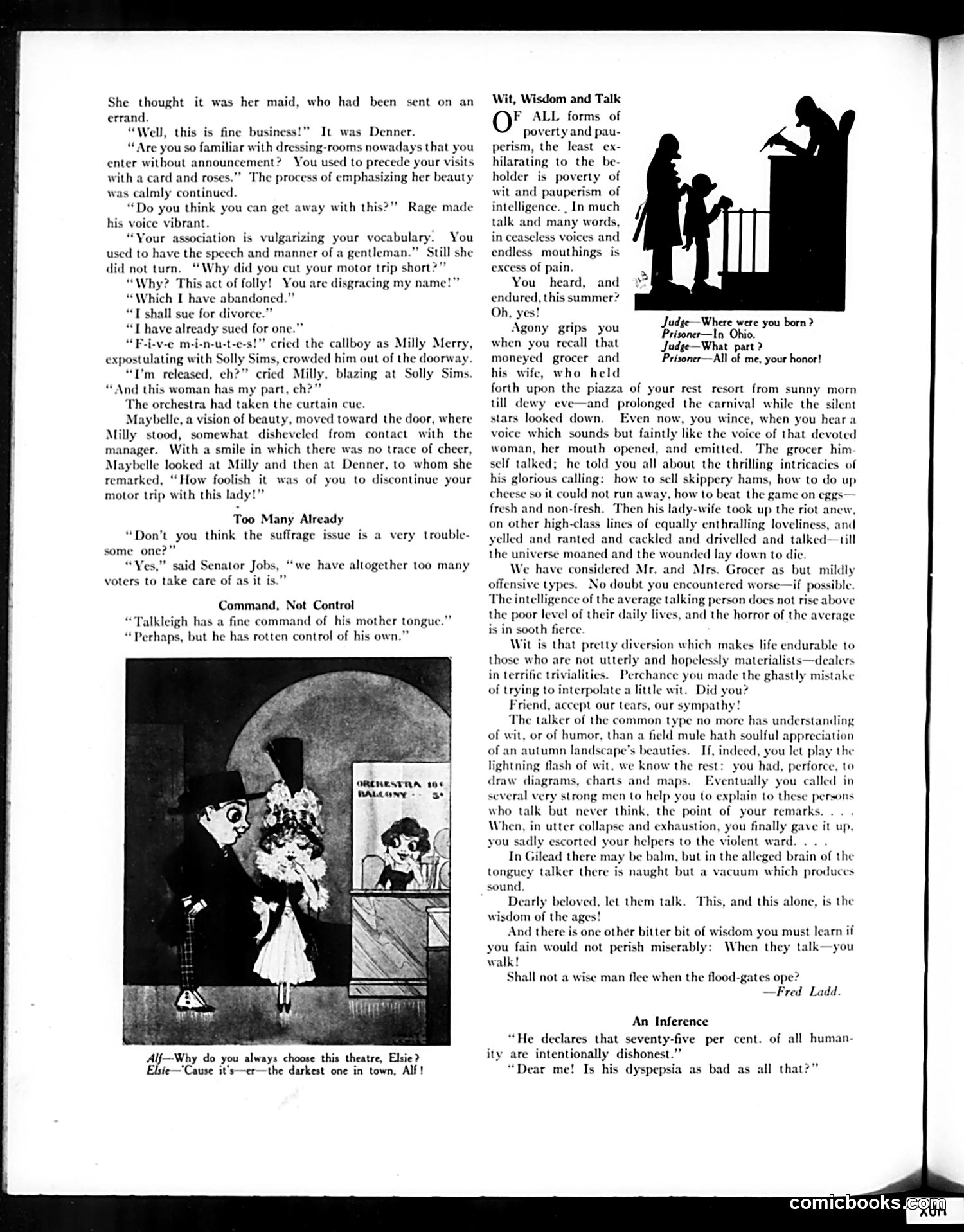
This page contains **three satirical pieces** lampooning social behavior: 1. **The Theater Scene (top)**: A domestic drama where a man (Denner) confronts his estranged wife backstage. She's unmoved by his outrage, having already sued him for divorce. The satire targets both marital discord and theatrical melodrama—her cool dismissal of his histrionics undercuts his performative anger. 2. **"Too Many Already" (middle)**: A brief joke where Senator Jobs claims there are "too many voters to take care of"—satirizing politicians' indifference to their constituents' actual needs. 3. **"Command, Not Control" (bottom)**: A wordplay joke about someone named Talkleigh who speaks well (commands his mother's tongue) but can't control his own speech—mocking verbose people. The large right-hand section is an editorial essay mocking **excessive talkers**, particularly the "moneyed grocer" couple who drone on endlessly at summer resorts. It argues that wit requires intelligence, which talkers typically lack. The bottom cartoon shows a couple choosing the darkest theater—implying romantic activity rather than theatrical appreciation.
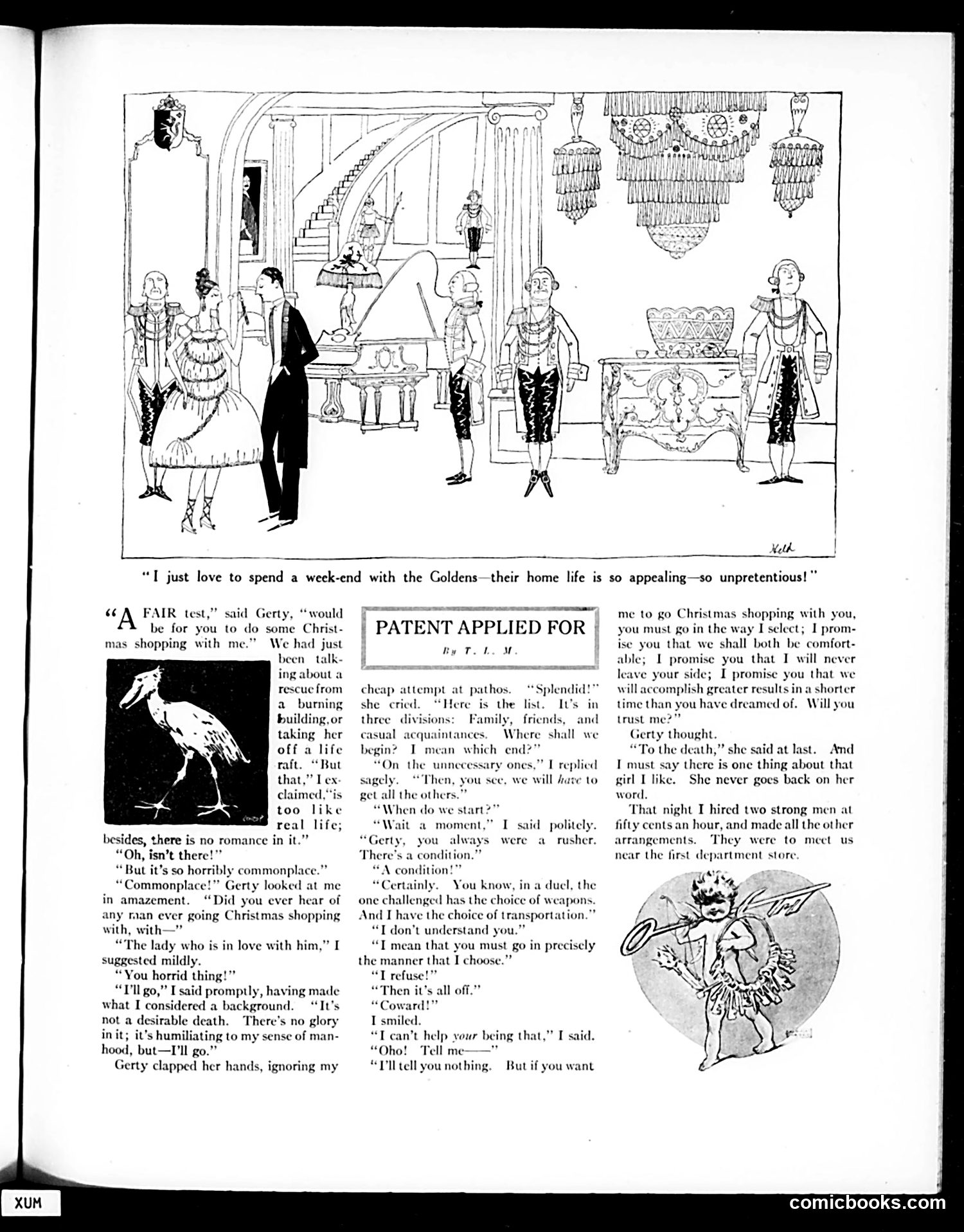
This page satirizes romantic idealization versus mundane domestic reality. Two characters, Gerty and Lex, debate whether Christmas shopping together—presented as unglamorous and "commonplace"—can be romantic compared to dramatic rescue scenarios (burning buildings, life rafts). The satire's point: modern romance is supposed to involve heroic, death-defying acts, yet the real test of devotion is enduring tedious, ordinary tasks like holiday shopping with a loved one. Lex initially refuses, claiming it's "humiliating to my sense of manhood," but eventually agrees—only to hire two men to assist, suggesting he'll still avoid the actual mundane work. The top cartoon illustrates an elegant, wealthy household ("the Goldens"), reinforcing that this is a satire about upper-class attitudes toward romance and domesticity. The joke targets the disconnect between romantic fantasy and the often-boring reality of married/coupled life.
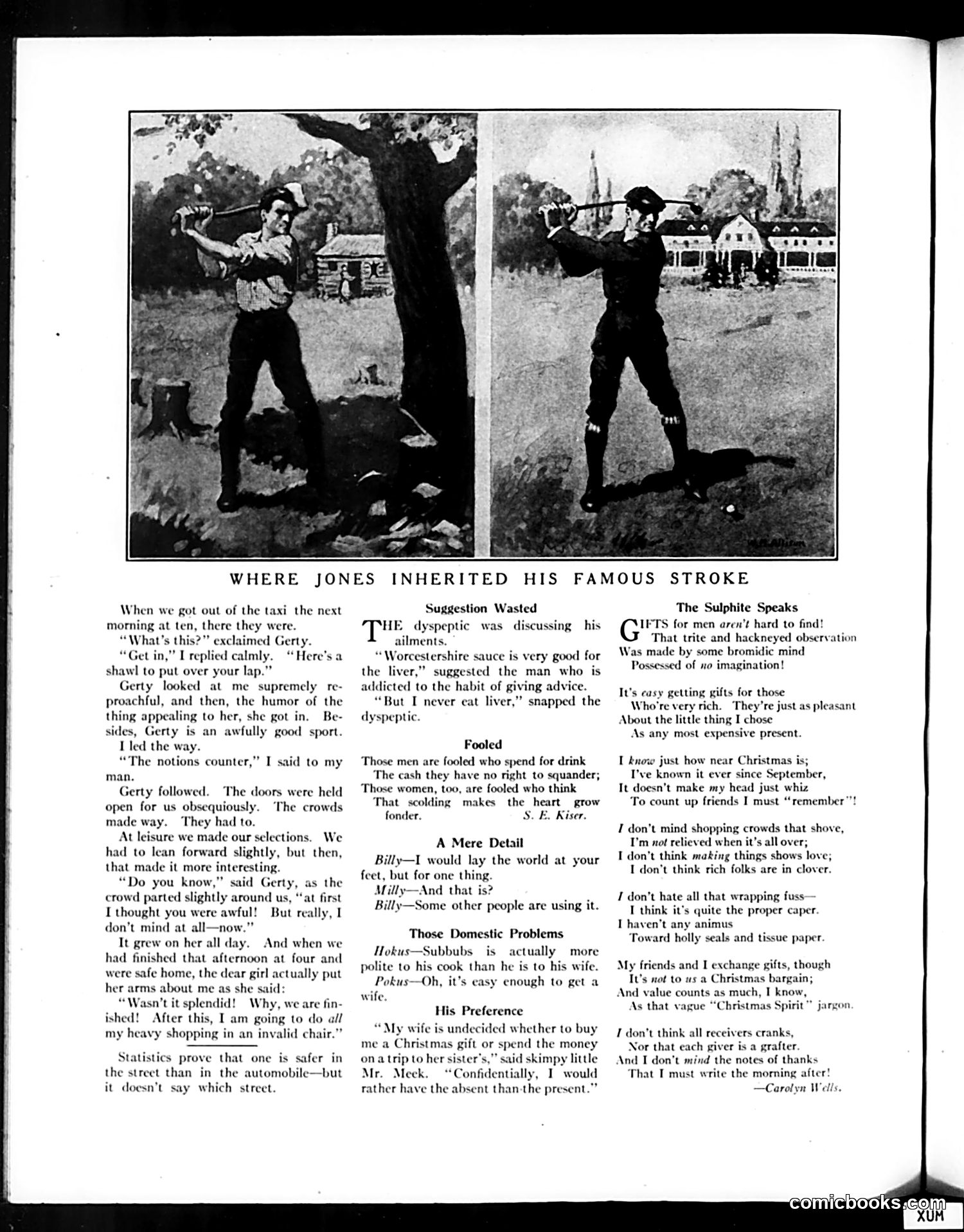
The page contains two distinct elements: **Top Section - "Where Jones Inherited His Famous Stroke":** This is a humorous narrative about a man shopping with a woman named Gerty using an invalid wheelchair in a department store. The joke appears to be that Gerty initially finds this embarrassing ("supremely reproachful"), but gradually finds humor and satisfaction in the experience—treating it as a lark or adventure. The satire mocks both the self-consciousness of public perception and the idea that unconventional shopping methods can become oddly enjoyable. **Bottom Section - Various Short Pieces:** This includes several brief satirical commentary pieces and a poem by Carolyn Wells. These mock domestic life ("Those Domestic Problems"), offering fake wisdom about relationships, gift-giving etiquette, and holiday consumerism. The sulphite poem particularly satirizes excessive Christmas sentimentality and performative gift-giving culture. Overall, the page satirizes early 20th-century middle-class anxieties about propriety, domestic relations, and commercialized holiday customs.
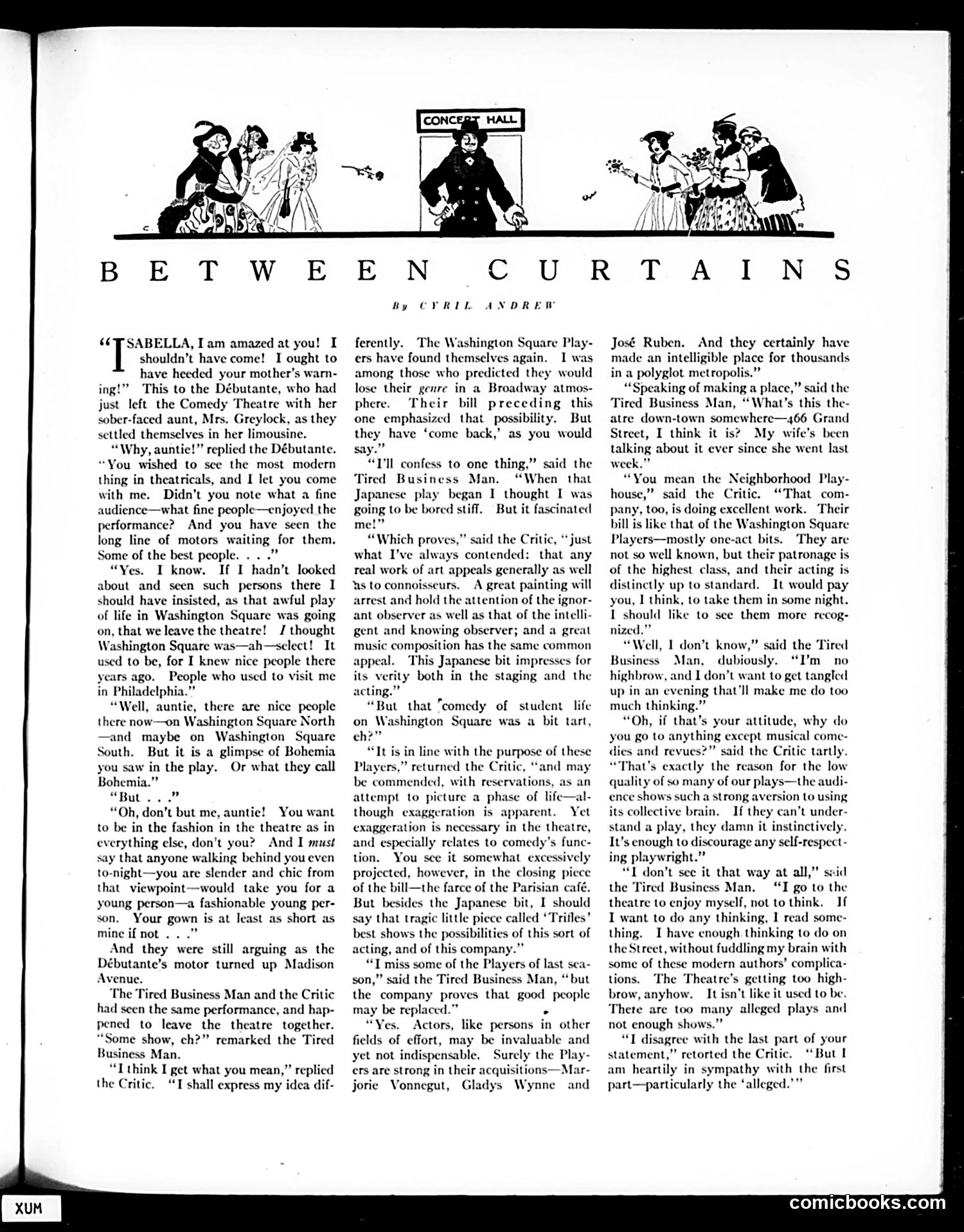
This page features a satirical column by Cyril Andrew discussing the Washington Square Players, a real experimental theater group active in early 20th-century New York. The column uses two separate conversations to critique both theatergoing culture and critical pretension. The first dialogue mocks a débutante and her conservative aunt debating whether Washington Square—once an exclusive neighborhood—remains fashionable. The aunt's snobbery about theater audiences reflects broader anxieties about democratization and changing social hierarchies. The second conversation between a "Tired Business Man" and a "Critic" satirizes theater criticism itself. The critic uses highfalutin language about "real work of art" and universal appeal, while the businessman admits simple enjoyment. The satire suggests critics overcomplicate theater appreciation and use jargon to seem sophisticated. The Players themselves receive mixed praise—the column notes cast changes and questions whether actors are truly irreplaceable, reflecting contemporary theater industry debates.
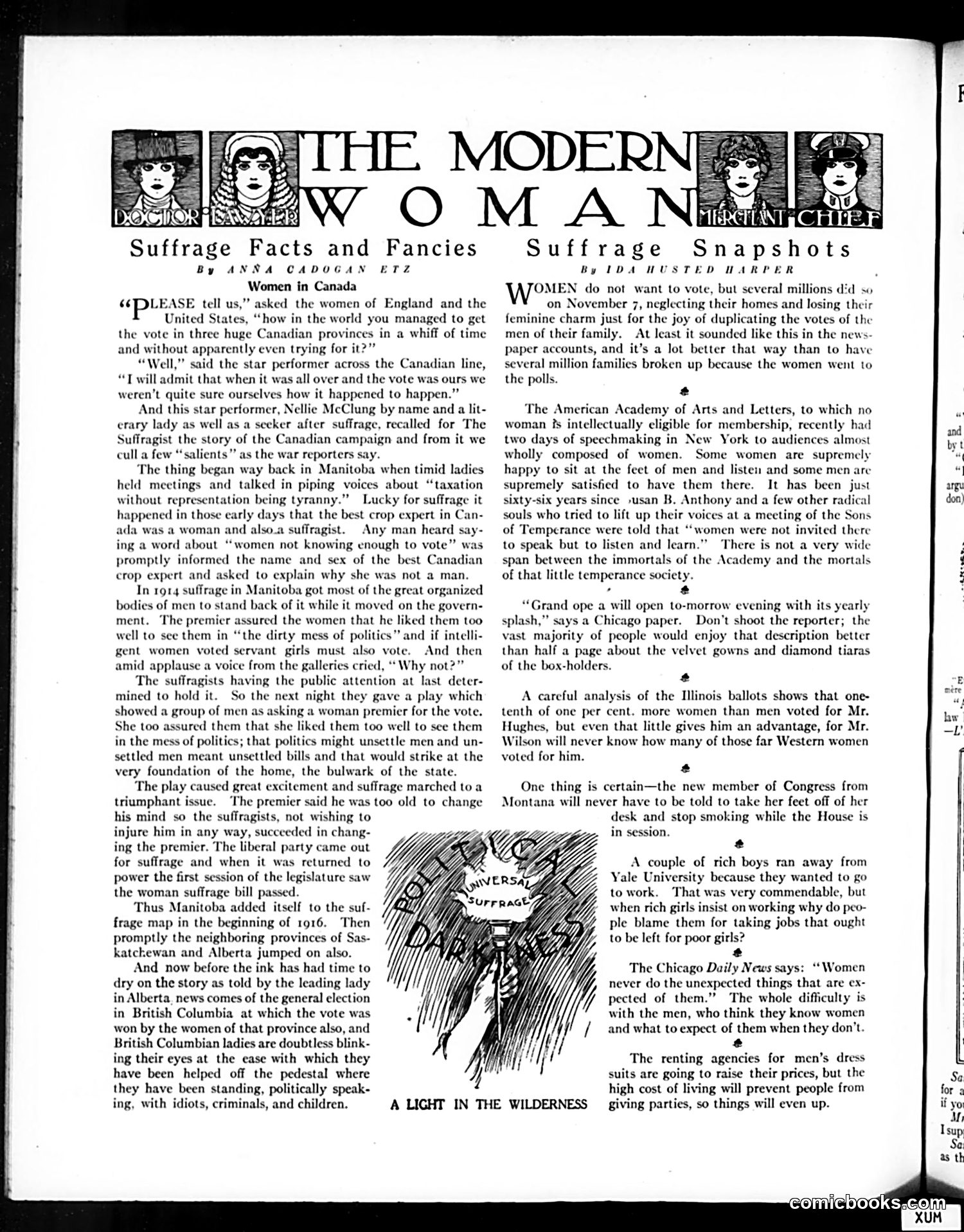
This Judge magazine page satirizes the women's suffrage movement circa 1916. The left column celebrates Canadian women's recent voting victories in Manitoba, Saskatchewan, Alberta, and British Columbia—attributing success to clever political theater and strategic organizing by suffragist Nellie McClung. The piece mocks male politicians' paternalistic excuses (not wanting women in "the dirty mess of politics") while praising women's tactical victory. The right column, titled "Suffrage Snapshots," contains heavy sarcasm. It mocks anti-suffrage arguments: women supposedly neglect homes and "lose feminine charm" by voting, yet newspapers admit this causes "several million families" problems. It ridicules the all-male American Academy of Arts and Letters for excluding women while claiming intellectual superiority. The cartoon "A Light in the Wilderness" (center) remains unclear without caption detail, but appears to reference suffrage activism. Overall, the page presents suffrage sympathetically while satirizing opponents' illogical reasoning.
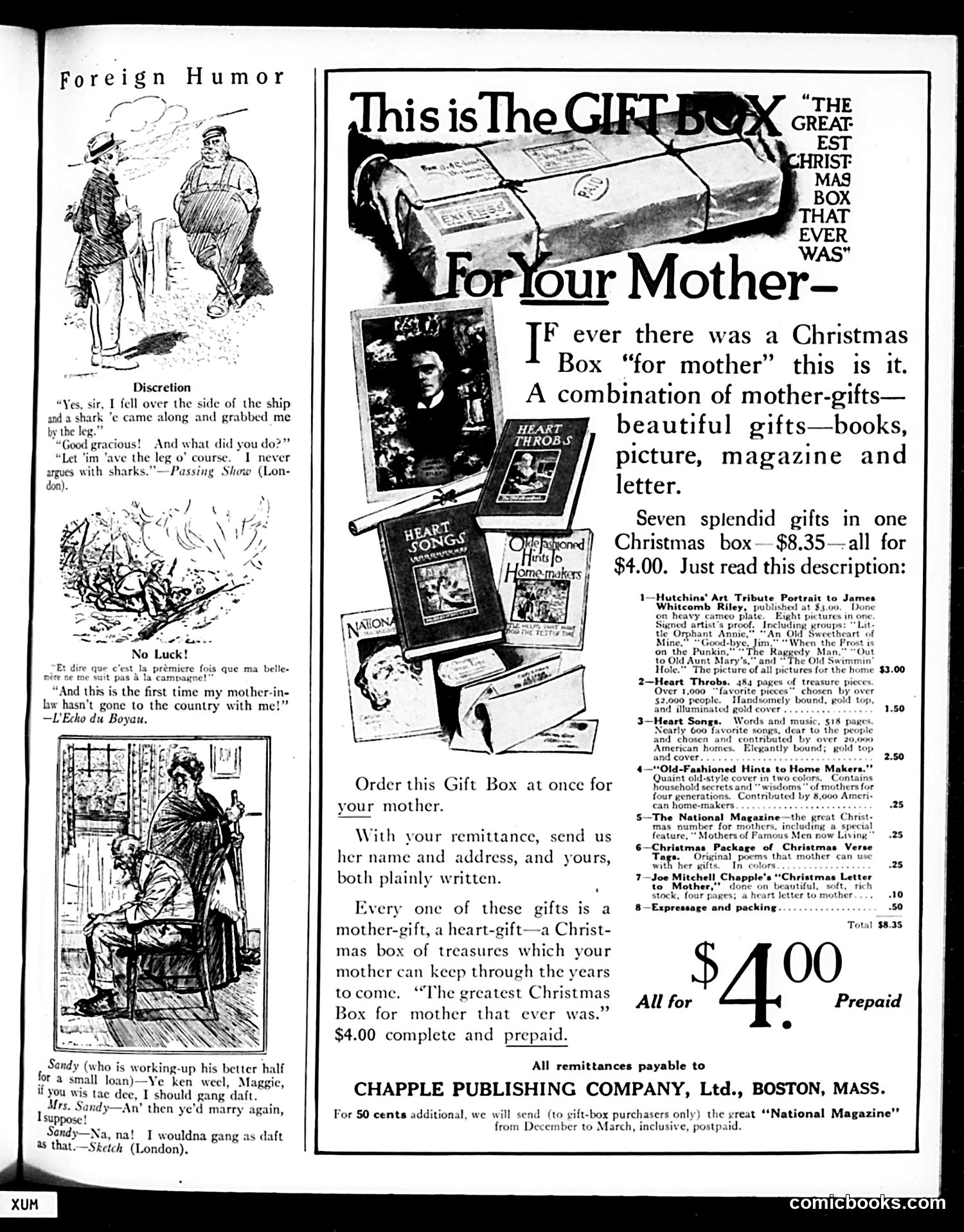
This Judge page combines two elements: **Left side ("Foreign Humor"):** Three short jokes translated from European publications, illustrating national stereotypes. The first depicts British understatement (a man grabbed by a shark, claims he "never argues with sharks"). The second shows French romantic desperation (a man scheming to borrow money by threatening suicide). The third presents Scottish thriftiness (a man unwilling to marry because it costs money). These represent period stereotypes about British restraint, French passion, and Scottish frugality—humor based on exaggerated national character traits. **Right side:** An advertisement for Chapple Publishing Company's Christmas gift box for mothers ($4.00), featuring seven items: art books, poetry collections, magazines, and greeting verse. This reflects early 1900s consumer culture and the commercialization of gift-giving, particularly marketed toward sons sending gifts to distant mothers. The page represents Judge's mix of satirical commentary on foreign cultures and contemporary advertising.
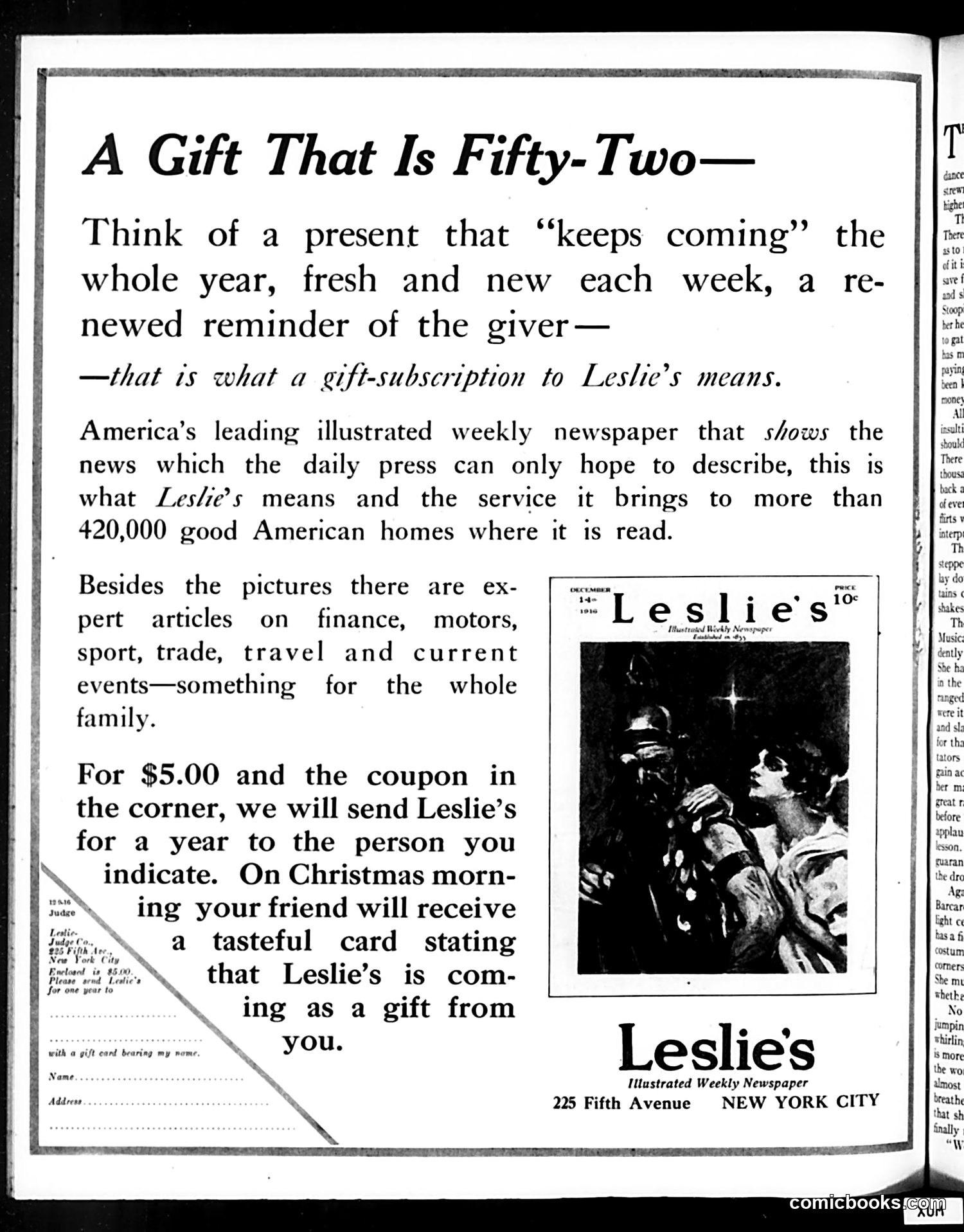
This is primarily a **gift subscription advertisement** for *Leslie's*, an illustrated weekly newspaper, rather than a satirical cartoon page. The ad promotes a year-long subscription (52 weekly issues—hence "Fifty-Two") as an ideal Christmas gift. The appeal is that it provides a "renewed reminder" of the giver throughout the year, arriving fresh each week. The publication is pitched as "America's leading illustrated weekly newspaper" covering news, finance, motors, sports, travel, and current events—content for the whole family. The small illustration shows what appears to be a domestic scene, likely emphasizing the family appeal of the publication. For $5.00 and the included coupon, readers could arrange delivery to a recipient, who would receive a card on Christmas morning announcing the gift. This reflects early 20th-century direct-mail marketing before modern subscription services became standard.
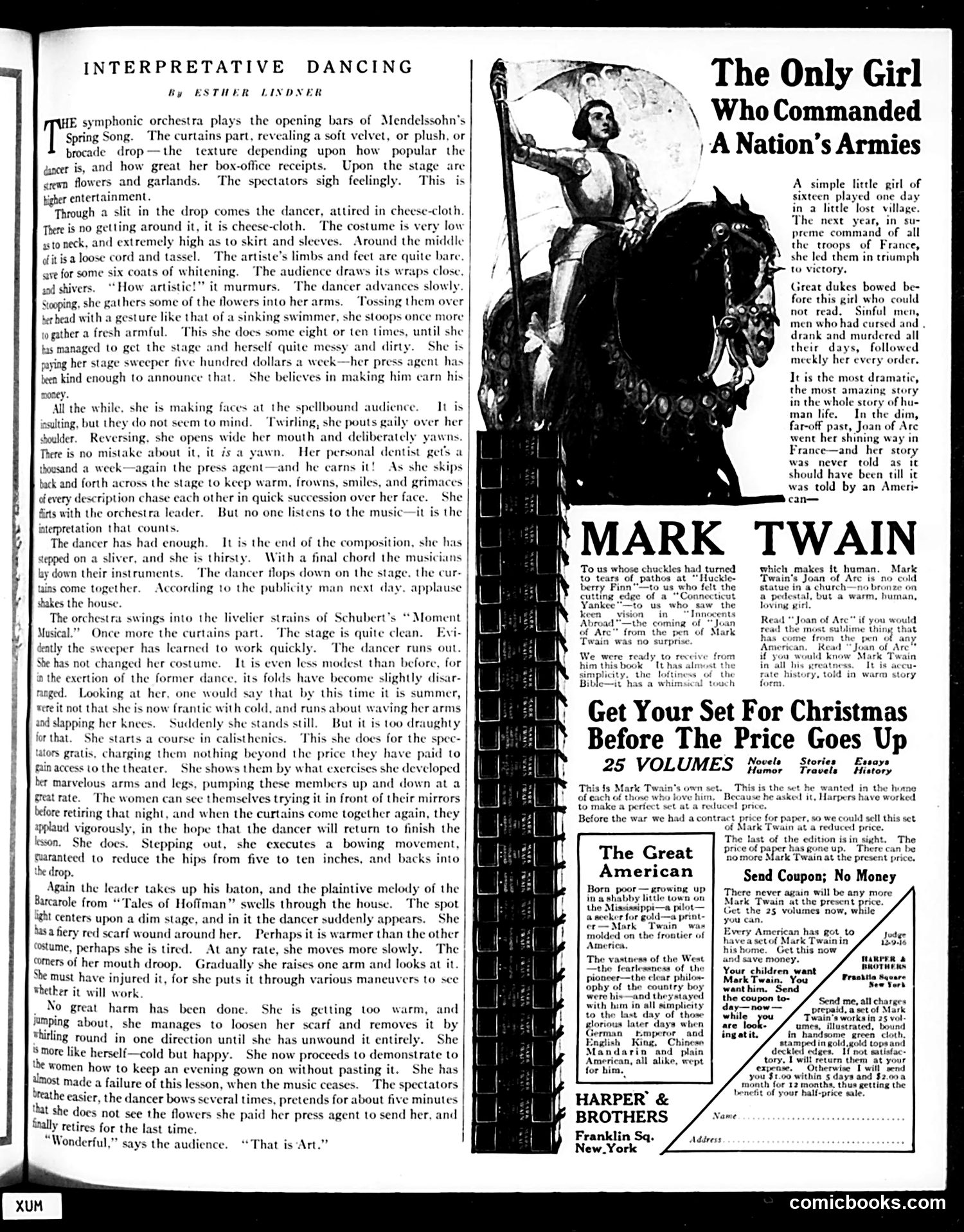
This page contains two distinct pieces of content: **Left side:** "Interpretative Dancing" by Esther Lindner is a satirical critique of modern dance performance and its pretensions. The author mocks the interpretative dancer—her minimalist cheese-cloth costume, exaggerated emotional gestures, and contrived "artistic" movements (picking up flowers, yawning, shivering). The satire targets both the performer's obvious artificiality and the audience's gullible appreciation of nonsensical movement presented as high art. The joke is that the dancer earns substantial money ($500/week for her stage sweeper alone) while essentially doing nothing meaningful. **Right side:** An advertisement featuring Mark Twain promoting a 25-volume collection of his complete works, marketed as a Christmas gift. The ad emphasizes Twain's reputation and includes a coupon for ordering at a pre-price-increase rate through Harper & Brothers publishers. The page represents Judge's characteristic blend of social satire and commercial advertising typical of early 20th-century magazines.
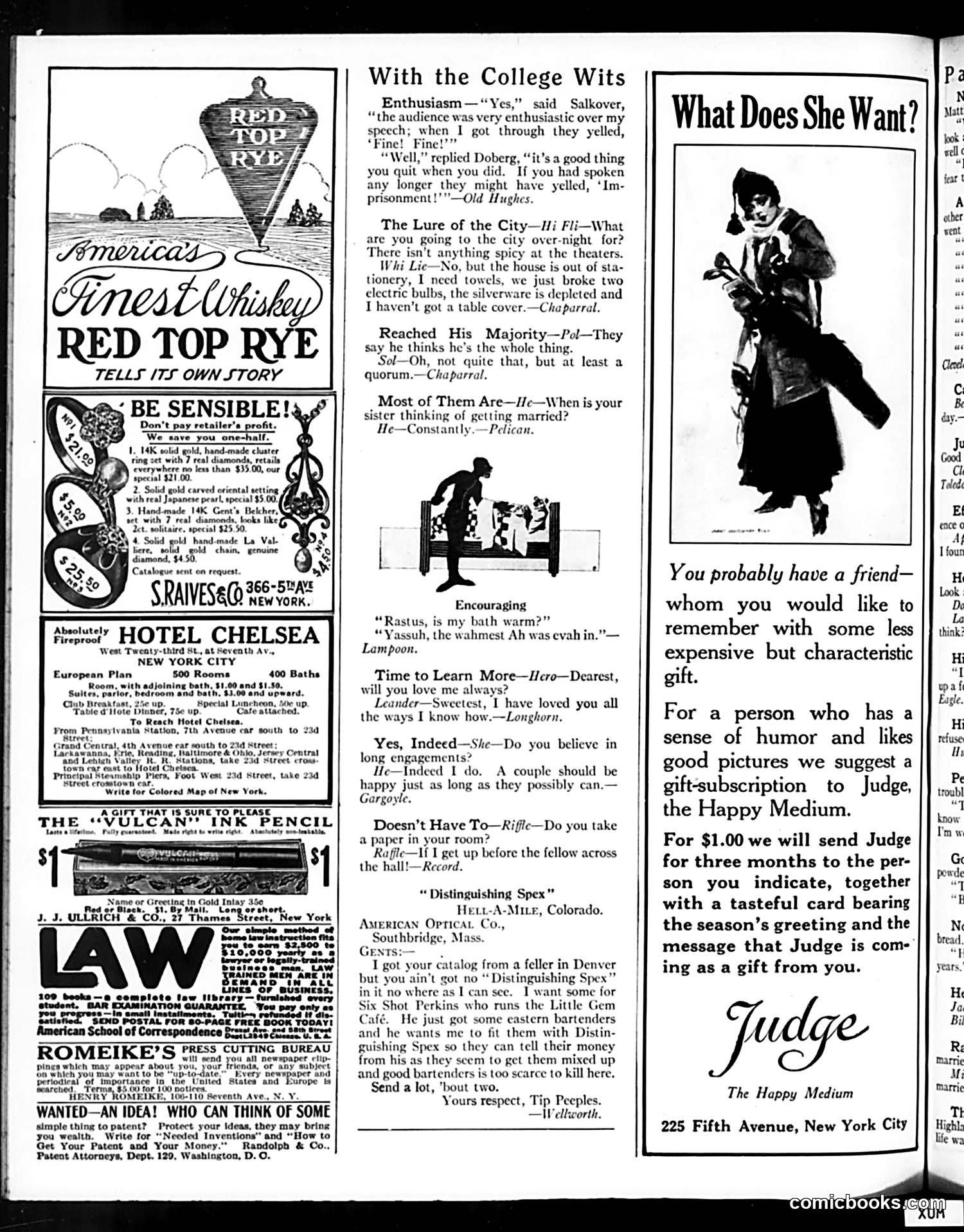
This is primarily a **magazine humor and advertising page** from Judge magazine. The "With the College Wits" section contains short joke exchanges—typical of early 20th-century humor magazines—mocking college students, romantic couples, and racial stereotypes (including a dialect joke about a Black servant). The humor relies on wordplay and situation comedy: a speaker's audience switches from enthusiastic applause to demands for imprisonment; a husband learns his wife needs household supplies, not entertainment; a young man reaches adulthood but remains "quorum" (partial, not whole). The **advertisements** dominate the page: jewelry retailers, hotels, ink pencils, and patent attorneys—standard commercial appeals for the magazine's readers. The cartoon labeled "Encouraging" shows a bathtub scene, likely playing on bathroom humor. Nothing here addresses specific political events or figures—it's general social satire and consumer advertising typical of Judge's format during the 1910s-1920s era.
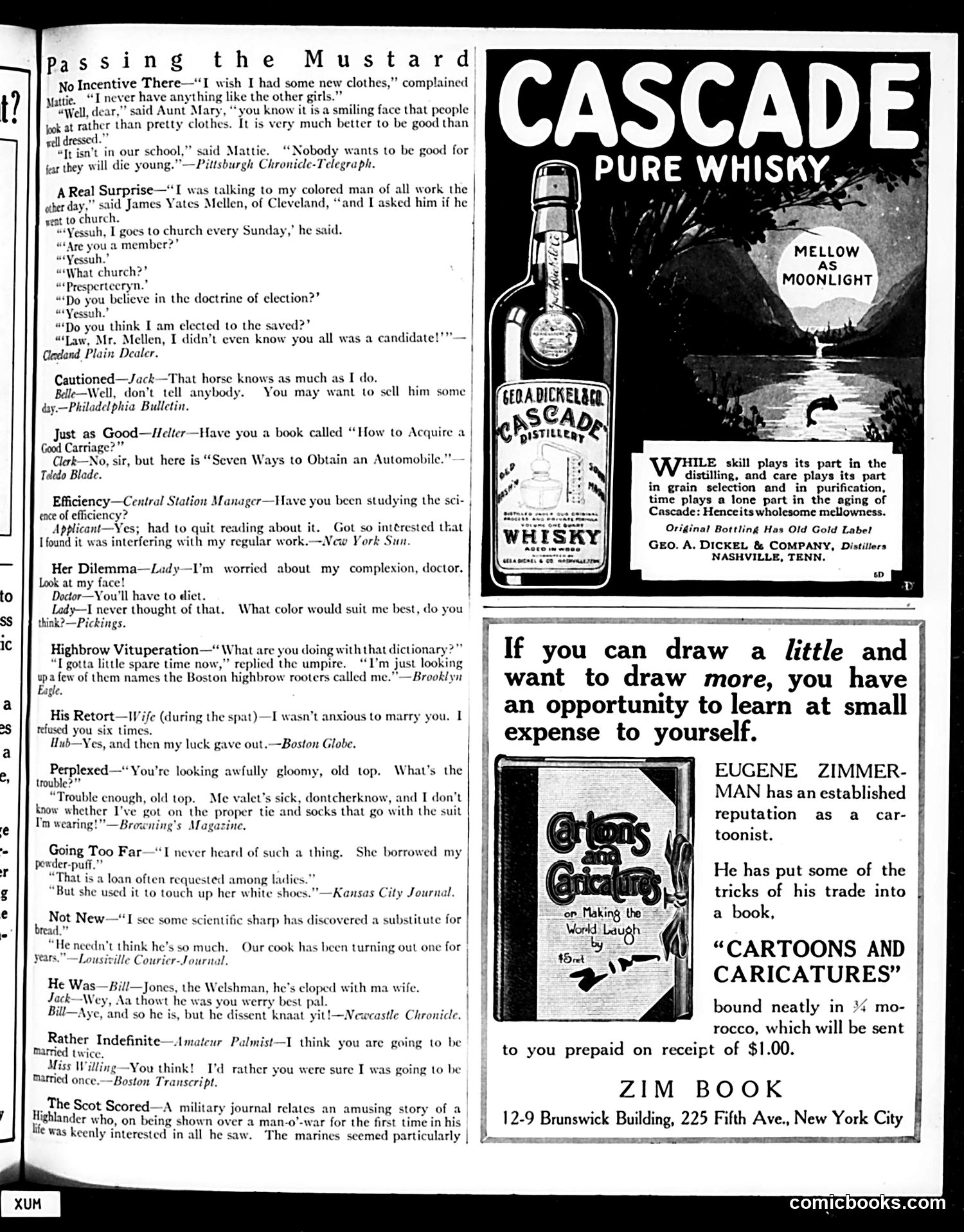
This page from Judge magazine is primarily **humorous anecdotes and advertisements** rather than political cartoons. The left column contains short joke pieces titled "Passing the Mustard"—a collection of brief, satirical vignettes mocking everyday American life. They target pretension and social hypocrisy: a girl who values appearance over virtue; an employer surprised his Black worker attends "Presbyterteryn" church; inefficient workers; vain socialites worried about complexion; and class-conscious wealthy men fussing over proper attire. The humor relies on period stereotypes and working-class dialect. The right side features two advertisements: a Cascade Pure Whisky ad with romantic moonlit imagery, and a Eugene Zimmerman cartooning instruction book. **Context for modern readers**: These jokes assume readers find humor in mocking materialism, social climbing, racial caricature, and class differences—reflecting early 20th-century Judge magazine's satirical approach to American manners and pretension.
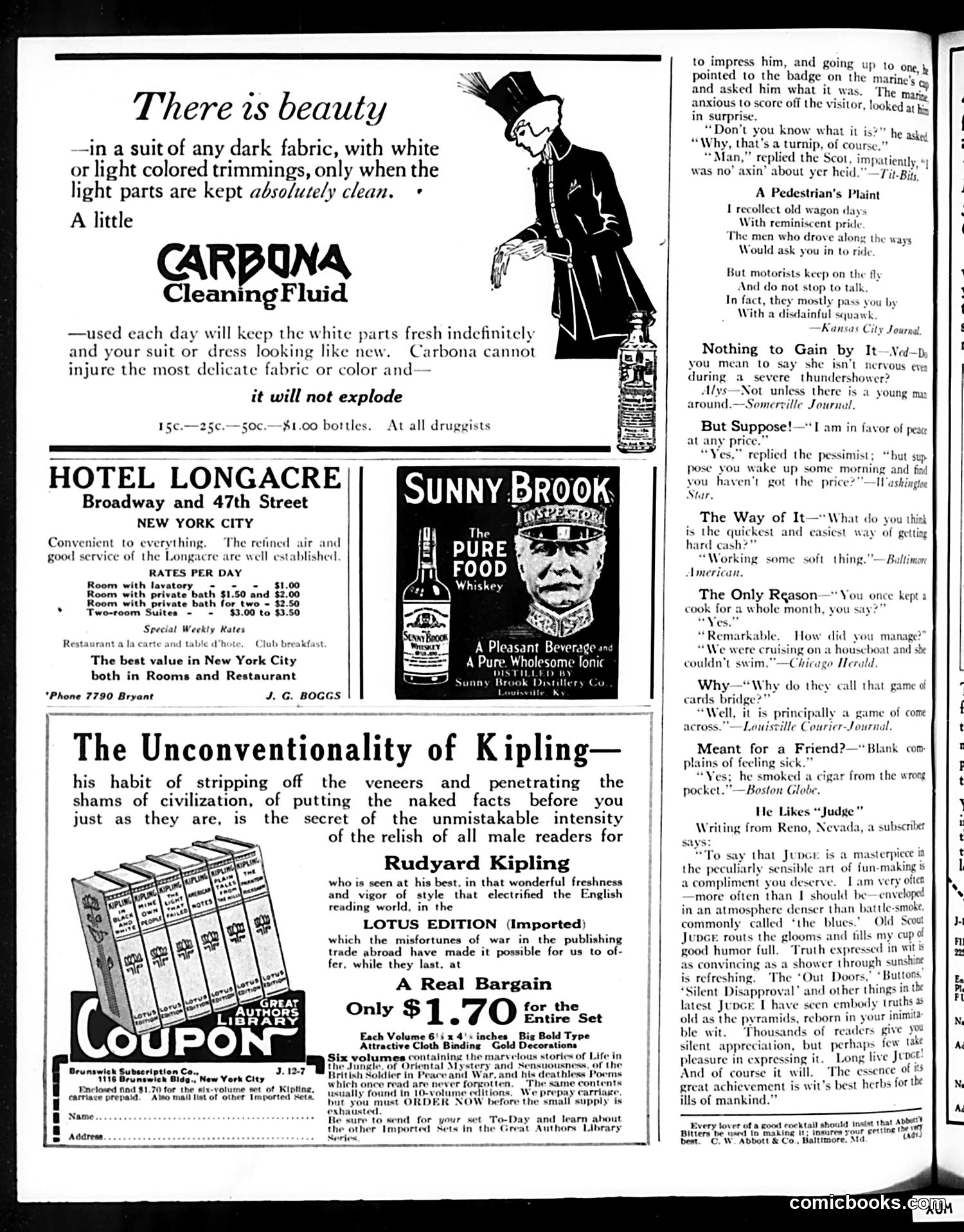
This page is primarily **advertising and humor fillers** rather than political satire. The main content includes: **Advertisements**: Carbona cleaning fluid, Hotel Longacre, Sunny Brook whiskey, and a Rudyard Kipling book set via coupon. **Humor Section**: The right side contains brief jokes and anecdotes typical of Judge's format—short comic pieces with punchy punchlines on everyday topics: - A Scot confused about a badge - Complaints about motorists versus old wagon drivers - Various social observations (nervousness, cooking on houseboats, card games) **Notable**: One piece praises Judge magazine itself, claiming it provides relief from depression ("the blues"). The page reflects early 20th-century concerns: automobile culture replacing horses, gender dynamics, courtship, and social proprieties. There's **no identifiable political cartoon or significant satire**—just light domestic humor and period advertising typical of Judge's commercial content.
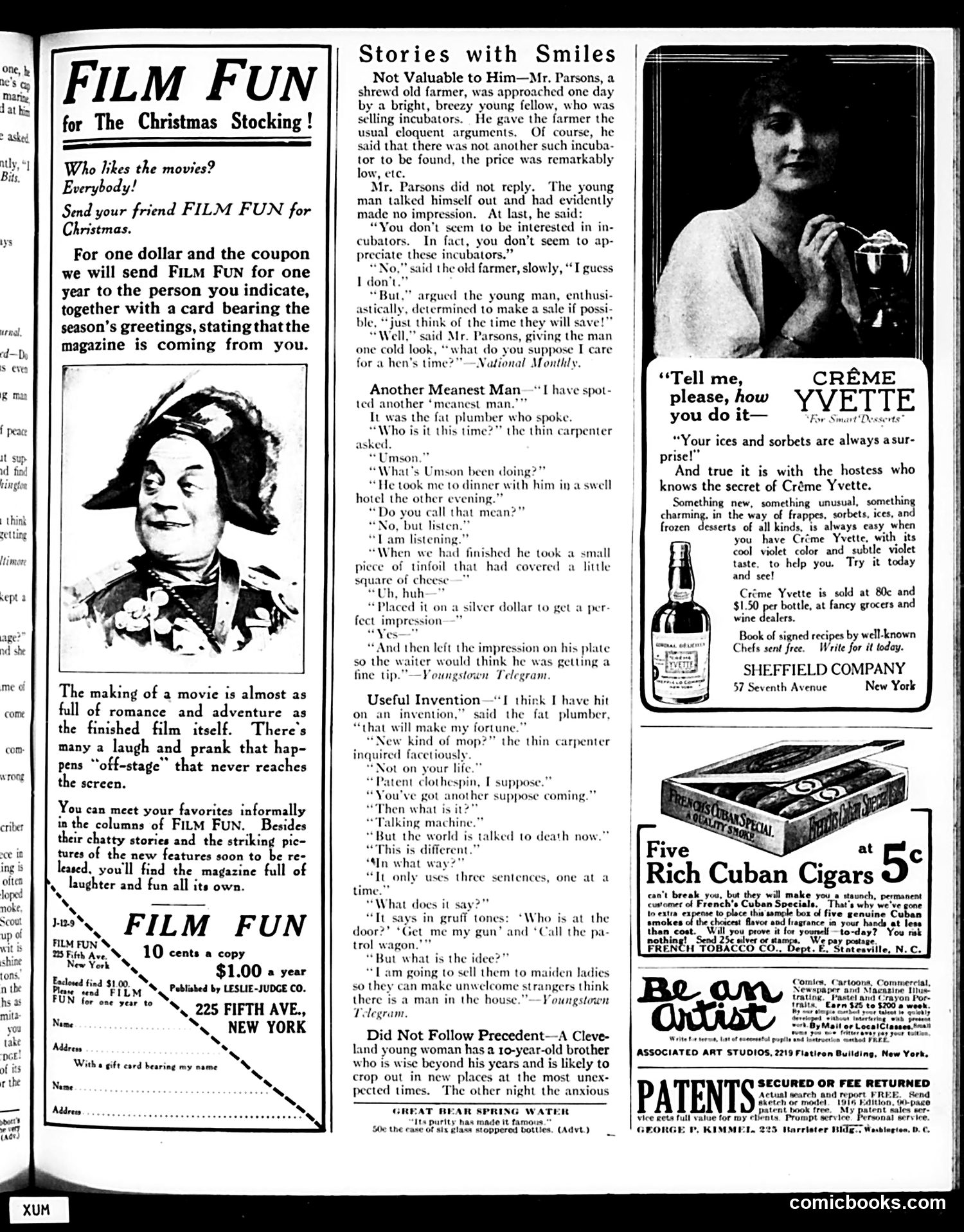
This page from *Judge* magazine contains primarily **advertisements and light humor columns**, not political satire. The "Film Fun" section promotes a sister magazine as a Christmas gift subscription ($1/year). The accompanying illustration shows a comedic character—likely from silent film comedies of the era—in exaggerated dress, appealing to readers who enjoyed movie humor. The humor columns ("Stories with Smiles") present three anecdotes: a farmer resisting an incubator salesman's pitch, a plumber's cheap trick impressing a dinner bill as a tip with tinfoil, and another about a "talking machine" for scaring intruders. These represent gentle, domestic humor typical of the period—no sophisticated satire intended. The remaining content consists of product advertisements (Crème Yvette liqueur, Cuban cigars, patents). This is essentially a **magazine issue page mixing ads with light entertainment**—representative of early 20th-century humor publications aimed at middle-class readers seeking wholesome laughs.
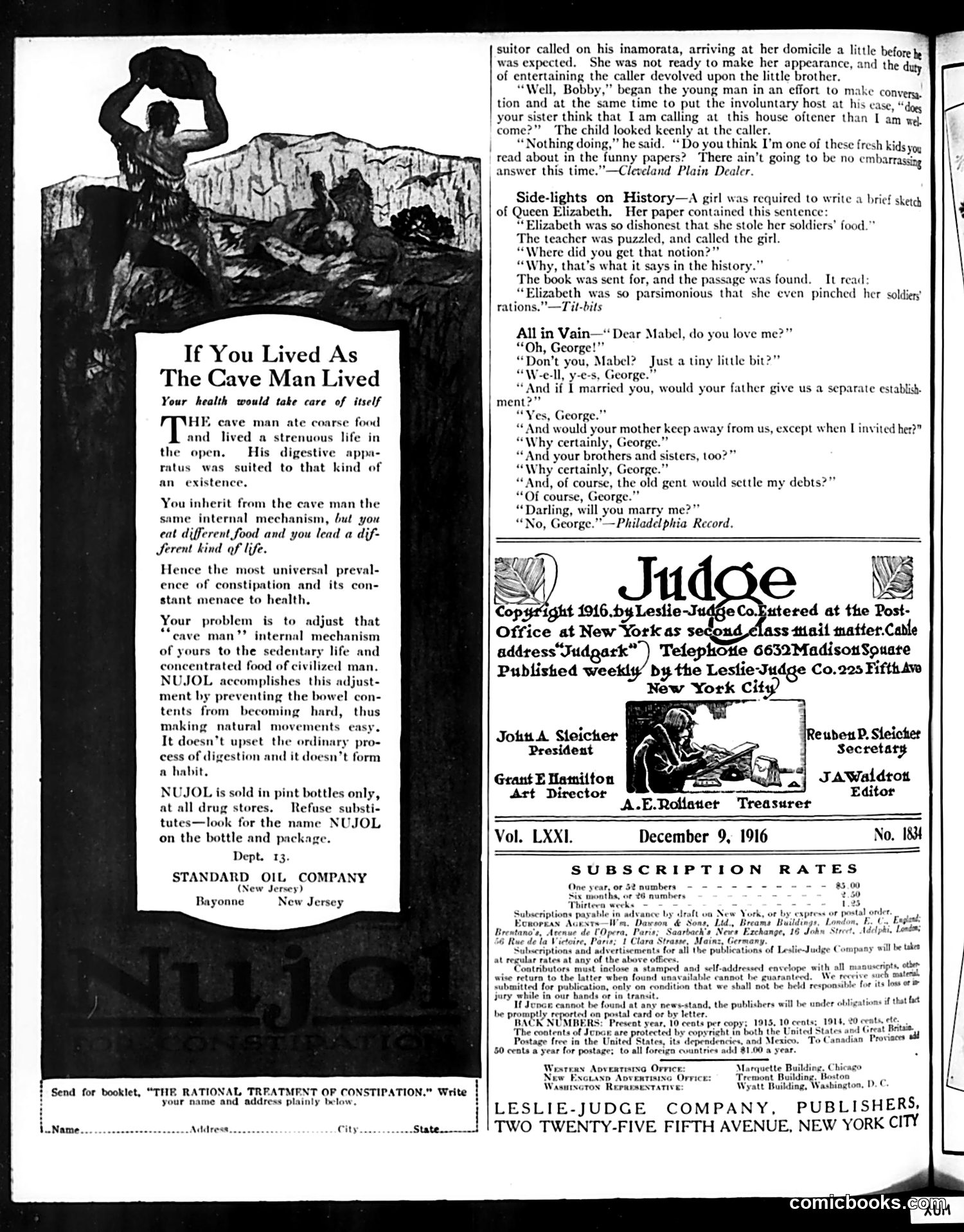
This page from Judge magazine (December 9, 1916) contains an advertisement and several humor pieces rather than political cartoons. **The Advertisement:** Standard Oil Company promotes "NUJOL," a laxative, using pseudo-scientific reasoning: modern sedentary life and refined food have made our inherited "cave man" digestive systems obsolete, causing constipation. NUJOL supposedly restores natural bowel function without forming habits. **The Humor Pieces:** Three short jokes appear: 1. A child refuses to embarrass a suitor by answering whether he visits too often—a reference to common "funny papers" scenarios 2. A girl misreads "parsimonious" (stingy) as "dishonest" when describing Queen Elizabeth stealing soldiers' rations 3. A woman agrees to all marriage conditions (separate house, mother's distance, father settling debts) but refuses the proposal itself—the joke being her inconsistent logic The page is primarily **advertising and light comedy filler**, not satirical commentary on contemporary politics or social issues.
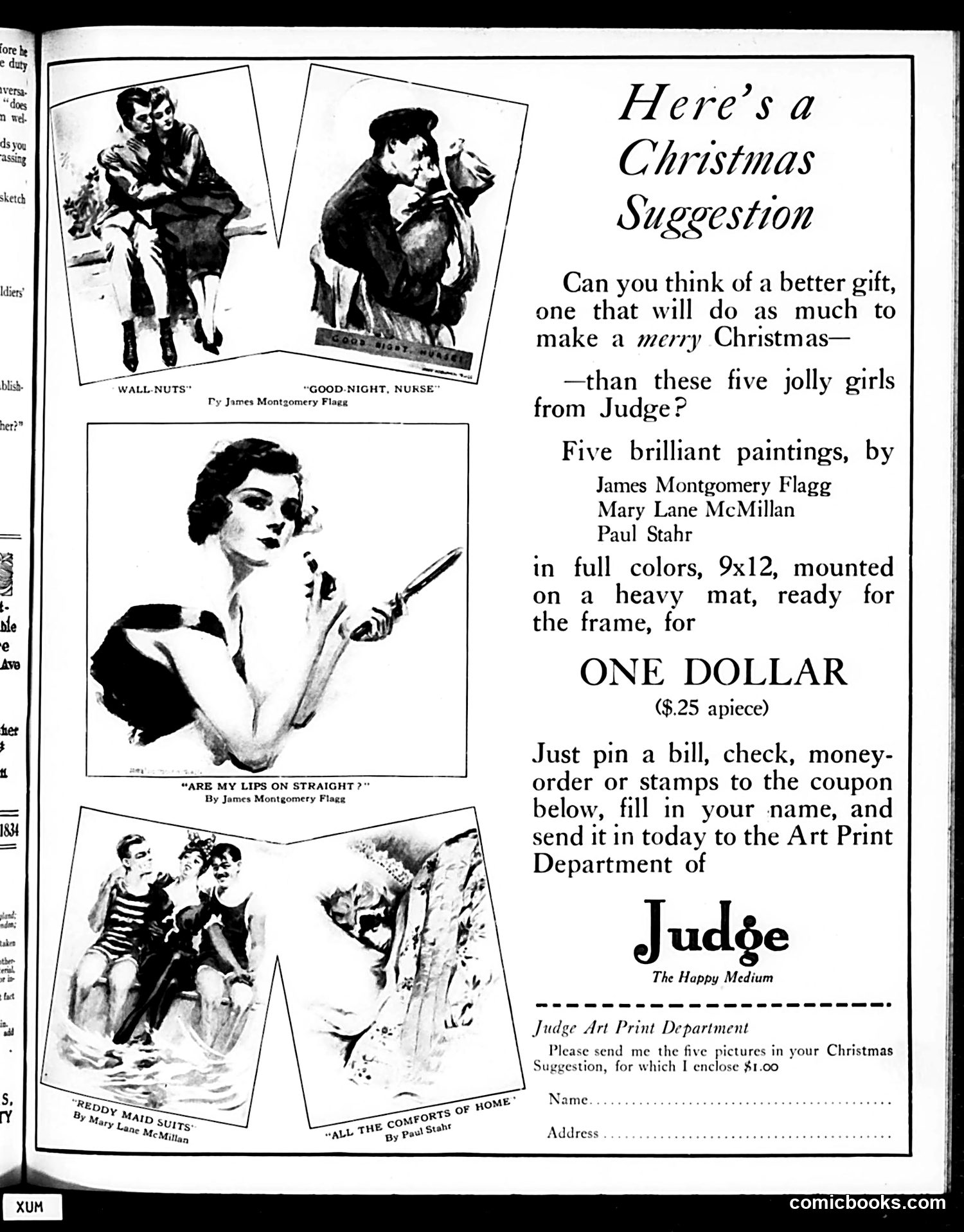
This page is primarily a **mail-order advertisement** for art prints, not political satire. Judge magazine is promoting five paintings by well-known illustrators (Flagg, McMillan, and Stahr) as Christmas gifts. The five black-and-white images show attractive young women in various situations—titled "Wall Nuts," "Good Night Nurse," "Are My Lips on Straight?," "Teddy Maid Suits," and "All the Comforts of Home." These appear to be **pin-up style illustrations** typical of early 20th-century popular art. The advertisement pitches these as ideal Christmas presents: five full-color mounted prints for one dollar total (25 cents each), available by mail-order. Readers could send payment via bill, check, money-order, or stamps. This reflects the era's commercial use of attractive female imagery in advertising and popular magazines, and the common practice of selling art prints as affordable home décor gifts.
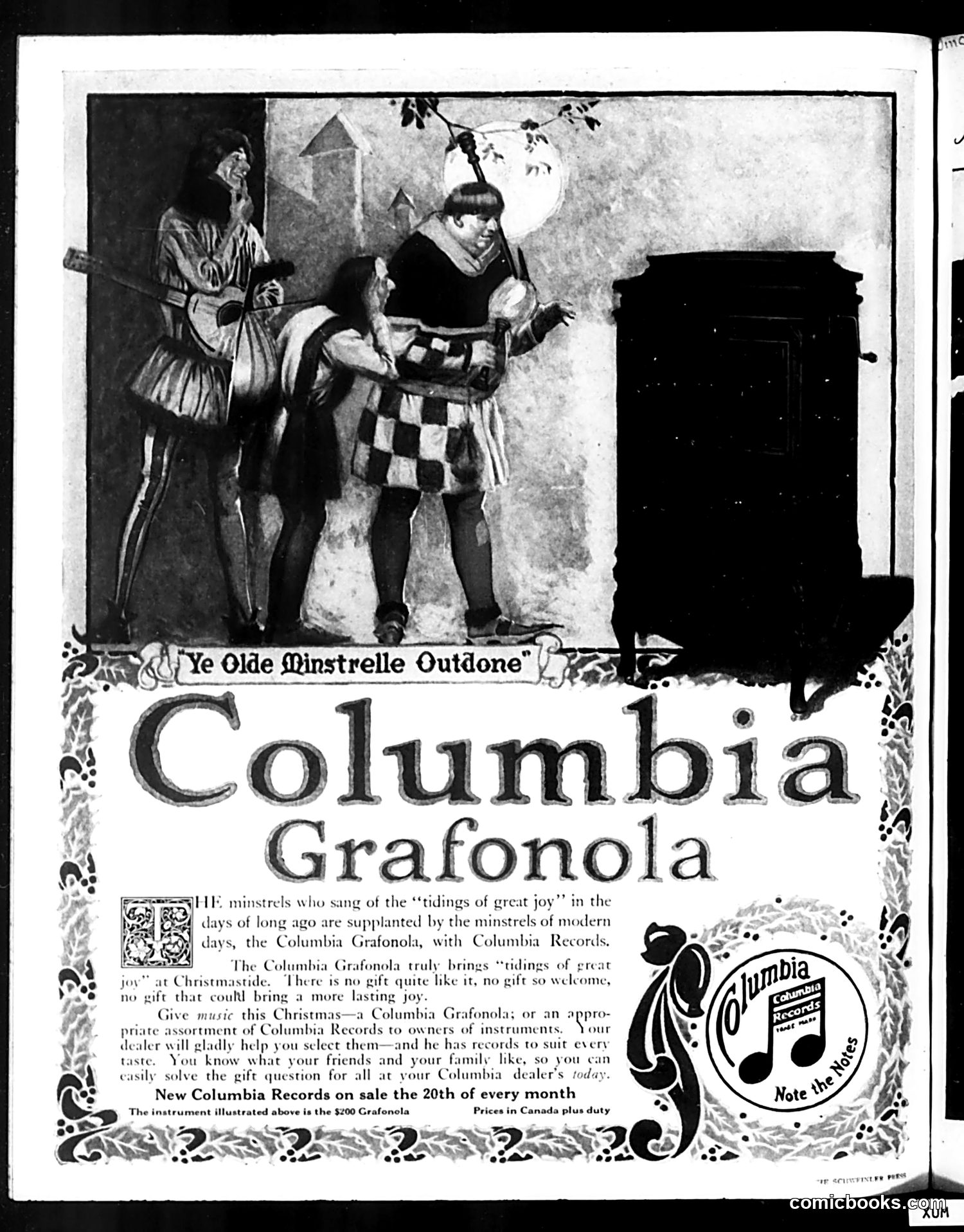
This is primarily a **Christmas advertisement** for Columbia Records' gramophones, not political satire. The title "Ye Olde Minstrelle Outdone" compares medieval minstrels (who brought "tidings of great joy" at Christmas) to modern phonographs as gift-givers. The illustration shows three figures in medieval/Renaissance costume—likely representing traditional minstrels—beside a large gramophone, humorously suggesting the machine has replaced live musicians as the era's premier entertainment and gift. The advertisement pitches the Columbia Grafonola as an ideal Christmas present because it offers recorded music for all tastes, solving gift-giving challenges. It emphasizes the emotional appeal: music brings lasting joy, and the graphone offers variety to please different family members. This reflects early 20th-century marketing of recorded music technology as a luxury consumer good.