
Judge, 1916-12-09 · page 14 of 28
Judge — December 9, 1916 — page 14: what you’re looking at
What you’re looking at
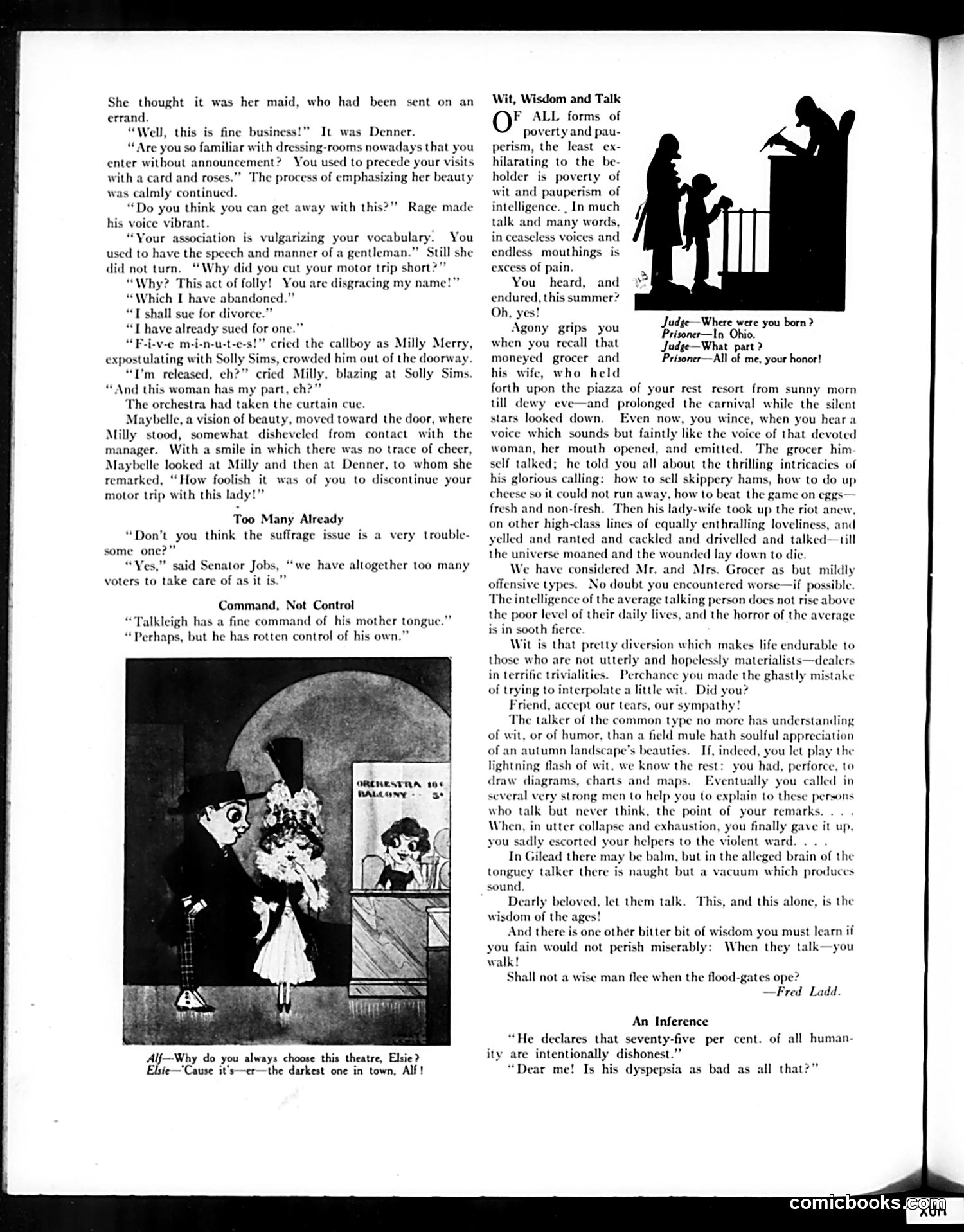
This page contains **three satirical pieces** lampooning social behavior: 1. **The Theater Scene (top)**: A domestic drama where a man (Denner) confronts his estranged wife backstage. She's unmoved by his outrage, having already sued him for divorce. The satire targets both marital discord and theatrical melodrama—her cool dismissal of his histrionics undercuts his performative anger. 2. **"Too Many Already" (middle)**: A brief joke where Senator Jobs claims there are "too many voters to take care of"—satirizing politicians' indifference to their constituents' actual needs. 3. **"Command, Not Control" (bottom)**: A wordplay joke about someone named Talkleigh who speaks well (commands his mother's tongue) but can't control his own speech—mocking verbose people. The large right-hand section is an editorial essay mocking **excessive talkers**, particularly the "moneyed grocer" couple who drone on endlessly at summer resorts. It argues that wit requires intelligence, which talkers typically lack. The bottom cartoon shows a couple choosing the darkest theater—implying romantic activity rather than theatrical appreciation.
📄 Transcribed text from this page (OCR, searchable)
Machine-transcribed from the original scan — historical spelling and the odd misread are preserved.
She thought it was her maid, who had been sent on an errand. “Well, this is fine business!” It was Denner. “Are you so familiar with dressing-rooms nowa' ou enter without announcement? You used to pre with a card and roses.” The process of emphasi was calmly continued. “Do you think you can get away with this?” Rage made his voice vibrant. “Your association is vulgarizing your vocabulary. You used to have the speech and manner of a gentleman.”” Still she did not turn. “Why did you cut your motor trip short?” “Why? This act of folly! You are disgracing my name!” “Which I have ndoned.”” “T shall sue for divorce.” already sued for one.” cried the callboy as Milly Merry, ims, crowded him out of the doorway blazing at Solly Sims. ng her beauty expostulating with “I'm released, ch?” cried Milly, “And this woman has my The orchestra had taken the curtain cue. Maybelle, a vision of beauty, moved toward the door, where Milly stood, somewhat disheveled from contact with the manager. Maybelle looked at Milly remarked, ‘‘How foolish motor trip with this lady With a smile in which there was no trace of cheer, nd then at Denner, to whom she was of you to discontinue your Too Many Already “Don’t you think the suffrage issue is a very trouble- some one?” “Yes,” said Senator Jobs, voters to take care of as it i: “we have altogether too many Command, Not Control Talkleigh has a fine command of his mother tongue.” “Perhaps, but he has rotten control of his own.” ORCHESTRA 10¢ os ‘Why do you always choose this theatre, Elsie? ‘Cause it's—er—the darkest one in town, Alf! , Wisdom and Talk F ALL forms of poverty and pau- perism, the least: ex- hilarating to the be- holder is poverty of wit and pauperism of intelligence. _ In much 4 talk and many words, in ceaseless voices and endless mouthings is excess of pain. You heard, and ed, this summer? Judge—Where were you born ? Prisoner—In Ohio. Judge—What part ? Prisoner—All of me, your honor! Agony grips you when you recall that moneyed grocer and his wife, who held forth upon the piazza of your rest resort from sunny morn till dewy eve—and prolonged the carnival while the silent stars looked down. Even now, you wince, when you hear a voice which sounds but faintly like the voice of that devoted woman, her mouth opened, and emitted. The grocer him self talked; he told you all about the thrilling intricacies of his glorious calling: how to sell skippery hams, how to do up cheese so it could not run a’ how to beat the game on eggs— fresh and non-fresh. Then his lady-wife took up the riot anew, on other high-class lines of equally enthralling loveliness, and yelled and ranted and cackled and drivelled and talked—till the universe moaned and the wounded lay down to dic. We have considered Mr. and Mrs. Grocer as but mildly offensive types. No doubt you encountered worse—if possible. The intelli, : of the average talking person does not rise above the poor level of their daily lives, and the horror of the averd is in sooth fierce. Wit is that pretty diversion which makes life endurable to those who are not utterly and hopelessly materialists—dealers in terrific trivialities. Perchance you made the ghastly mistake of trying to interpolate a little wit. Did you? Friend, accept our tears, our sympathy The talker of the common type no more has understanding of wit, or of humor, than a field mule hath soulful appr of an autumn landscape’s beauties. If, indeed, you let play lightning flash of wit, we know the rest: you had, perforc draw diagrams, charts and maps. Eventually you called in several very strong men to help you to explain to these persons who talk but never think, the point of your remarks. . When, in utter collapse and exhaustion, you finally gave it up, you sadly escorted your helpers to the violent ward. . . In Gilead there may be balm, but in the alleged brain of the tonguey talker there is naught but a vacuum which produces sound Dearly beloved, let them talk. wisdom of the age And there is one other bitter bit of wisdom you must learn if ‘ain would not perish miserably: When they talk—you This, and this alone, is the you walk! Shall not a wise man flee when the flood-gates ope? —Fred Ladd. An Inference “He declares that seventy-five per cent. of all human- ity are intentionally dishonest.” “Dear me! Is his dyspepsia as bad as all that?” comicbooks: