
Judge, 1916-12-09 · page 13 of 28
Judge — December 9, 1916 — page 13: what you’re looking at
What you’re looking at
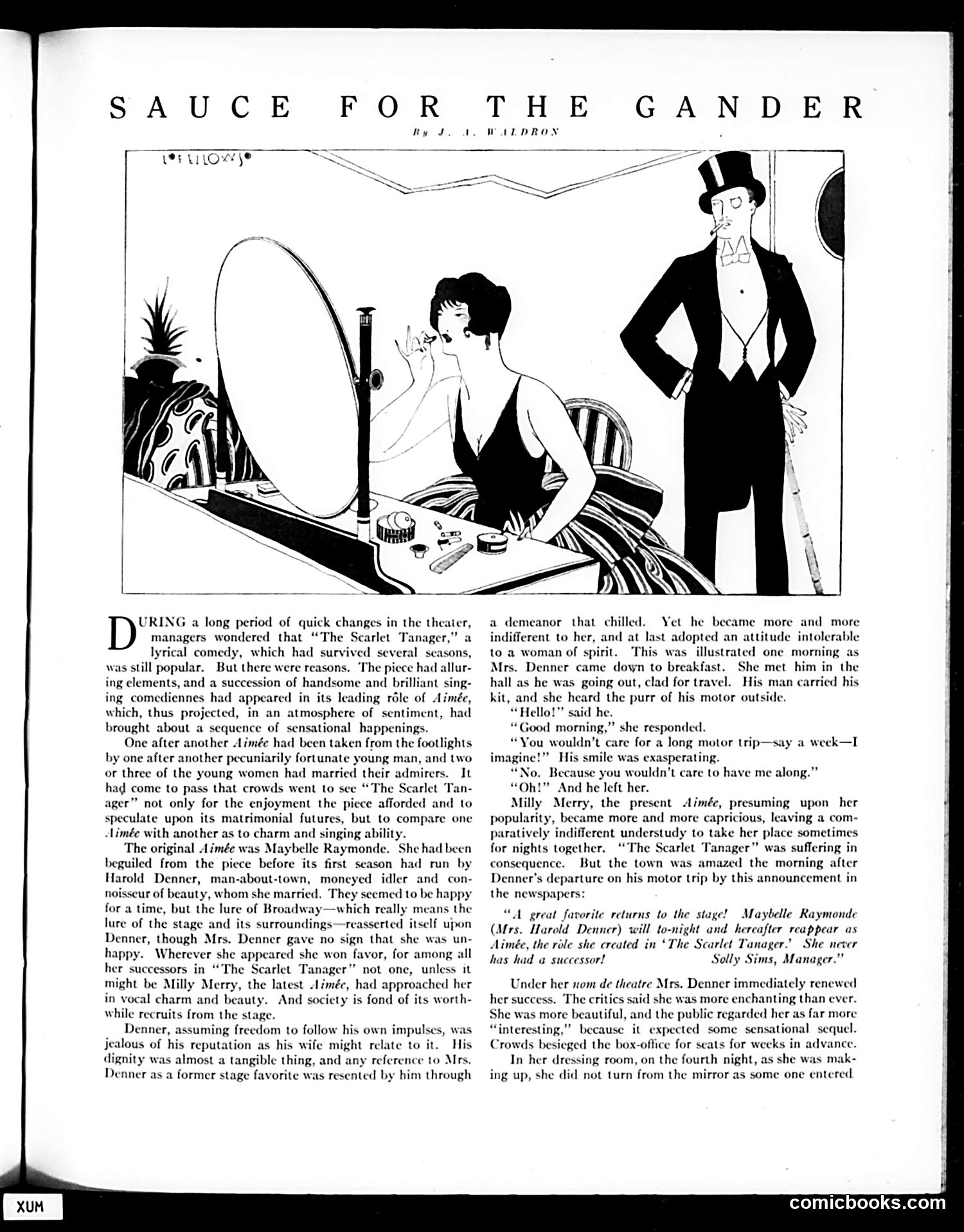
This is a satirical story about marital double standards in the theater world. Harold Denner, a wealthy man, married Maybelle Raymonde, a popular actress in "The Scarlet Tanager." He resented her stage career and became indifferent, eventually abandoning her for a motor trip without inviting her along. The satire's point: When Maybelle returns to perform under her stage name, becoming more celebrated than ever, Denner's hypocrisy is exposed. The title "Sauce for the Gander" (meaning equal treatment) suggests she now enjoys the freedom and admiration he denied her—turning his own neglect back on him. The illustration shows the theatrical setting and the moment before his departure. The story critiques male vanity: Denner could pursue affairs and leisure while resenting his wife's professional success and popularity.
📄 Transcribed text from this page (OCR, searchable)
Machine-transcribed from the original scan — historical spelling and the odd misread are preserved.
SAUCE FOR a long period of quick changes in the the: managers wondered that “The Scarlet Tanager, lyrical comedy, which had survived several seasons, was still popular. But there were reasons. ‘The piece had allur- ing elements, and a succession of handsome and brilliant sing- ing comediennes had appeared in its leading réle of Aimée, which, thus projected, in an atmosphere of sentiment, had brought about a sequence of sensational happenings. One after another Aimée had been taken from the footlights by one after another pecuniarily fortunate young man, and two or three of the young women had married their admirers. It had come to pass that crowds went to see “The Scarlet Tan- ager” not only for the enjoyment the piece afforded and to speculate upon its matrimonial futures, but to compare one limée with another as to charm and singing abilit The original Aimée was Maybelle Raymonde. She had been beguiled from the piece before its first season had run by Harold Denner, man-about-town, moneyed idler and con- noisseur of beauty, whom she married. They seemed to be happy for a time, but the lure of Broadway—which really means the lure of the stage and its surroundings—reasserted itself upon Denner, though Mrs. Denner gave no sign that she was un- happy. Wherever she appeared she won favor, for among all her successors in “The Scarlet Tanager” not one, unless it might be Milly Merry, the latest Aimée, had approached her in vocal charm and beauty. And society is fond of its worth- while recruits from the stage. Denner, assuming freedom to follow his own impulses, was jealous of his reputation his wife might relate to it. His dignity was almost a tangible thing, anc reference to Mrs. Denner as a former stage favorite was resented by him through THE tLPRON GANDER demeanor that chilled. Yet he became more and more indifferent to her, and at last adopted an attitude intolerable to a woman of spirit. This was illustrated one morning as Mrs. Denner came down to breakfast. She met him in the hall as he was going out, clad for travel. His man carried his kit, and she heard the purr of his motor outside. “Hello!” said he. ood morning,” she responded. You wouldn’t care for a long motor trip—say imagine!” His smile was exasperating. “No. Because you wouldn't care to have me along.” “Oh!” And he left her. Milly Merry, the present Aimée, presuming upon her popularity, became more and more capricious, leaving a com- paratively indifferent understudy to take her place sometimes for nights together. ‘The Scarlet Tanager” was suffering in consequence. But the town was amazed the morning after Denner’s departure on his motor trip by this announcement in the newspapers: week—I “A. great favorite returns to the stage! Maybelle Raymonde (Mrs. Harold Denner) will to-night and hereafter reappear as Aimée, the rile she created in ‘The Scarlet Tanager.’ She never has had a successor! Solly Sims, Manager. Under her nom de theatre Mrs. Denner immediately renewe her success. The critics said she was more enchanting than ever. She was more beautiful, and the public regarded her as far more “interesting,” because it expected some sensational sequel. Crowds besieged the box-oflice for seats for weeks in advance. In her dressing room, on the fourth night, as she was mak- ing up, she did not turn from the mirror as some one entered comicbooks.com