
Judge, 1916-12-09 · page 18 of 28
Judge — December 9, 1916 — page 18: what you’re looking at
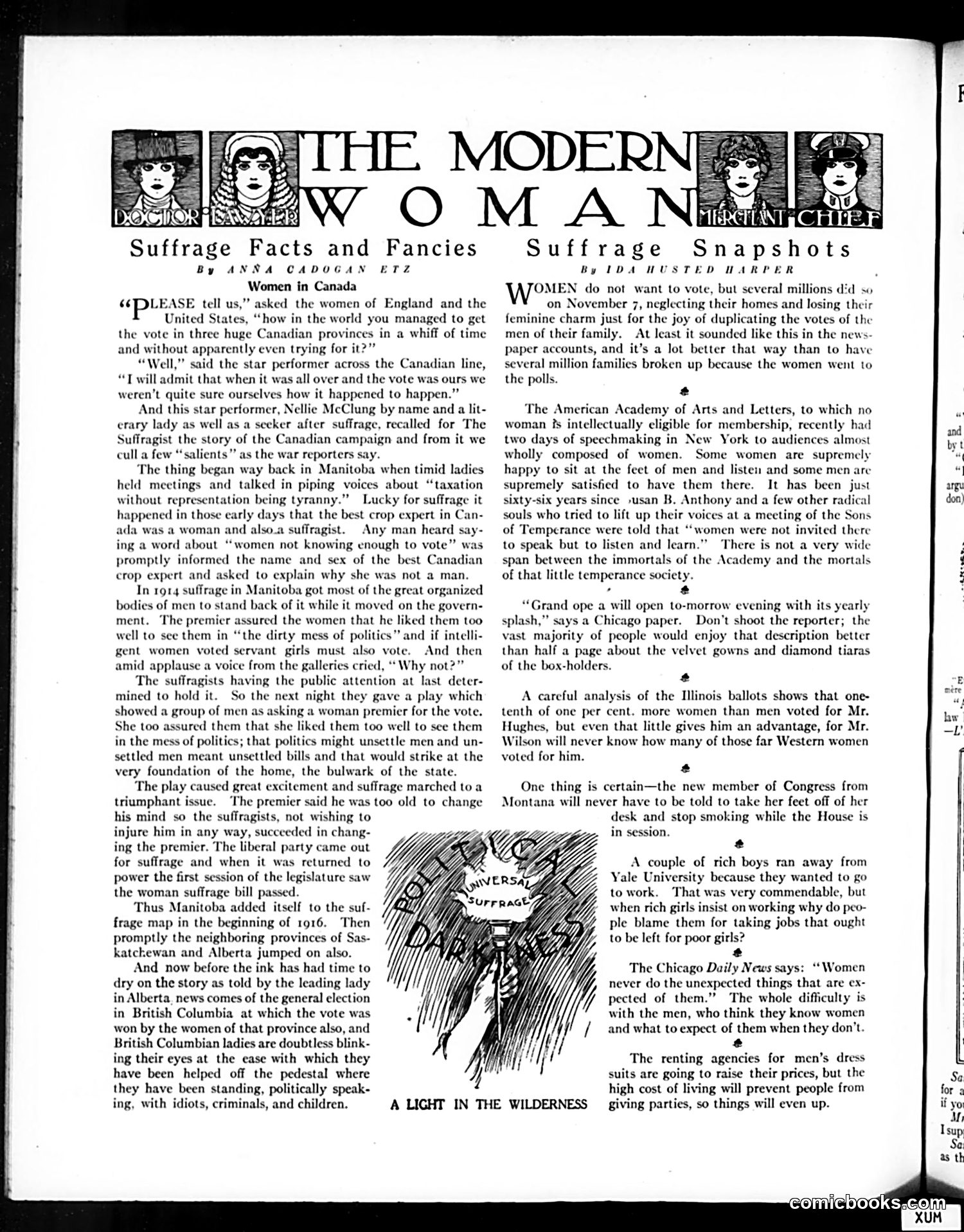
What you’re looking at
This Judge magazine page satirizes the women's suffrage movement circa 1916. The left column celebrates Canadian women's recent voting victories in Manitoba, Saskatchewan, Alberta, and British Columbia—attributing success to clever political theater and strategic organizing by suffragist Nellie McClung. The piece mocks male politicians' paternalistic excuses (not wanting women in "the dirty mess of politics") while praising women's tactical victory. The right column, titled "Suffrage Snapshots," contains heavy sarcasm. It mocks anti-suffrage arguments: women supposedly neglect homes and "lose feminine charm" by voting, yet newspapers admit this causes "several million families" problems. It ridicules the all-male American Academy of Arts and Letters for excluding women while claiming intellectual superiority. The cartoon "A Light in the Wilderness" (center) remains unclear without caption detail, but appears to reference suffrage activism. Overall, the page presents suffrage sympathetically while satirizing opponents' illogical reasoning.
📄 Transcribed text from this page (OCR, searchable)
Machine-transcribed from the original scan — historical spelling and the odd misread are preserved.
Suffrage Facts and Fancies By ANNA CADOGAN ETZ Women in Canada (PLEASE tell us,” asked the women of England and the United S how in the world you managed to get the vote in three huge Canadian provinces in a whiff of time and without apparently even trying for it?” “Well,” said the star performer across the Canadian line, “T will admit that when it was all over and the vote was ours we weren't quite sure ourselves how it happened to happen.” And this star performer, Nellie McClung by name and a lit- erary lady as well as a seeker after suffrage, recalled for The Suffragist the story of the Canadian campaign and from it we cull a few “salients” as the war reporters say. The thing began back in Manitoba when timid ladies held meetings and talked in piping voices about “taxation without representation being tyranny.” Lucky for suffrage it happened in those early ¢ that the best crop expert in C: ada was a woman and also.a suffragist. Any heard ing a word about “women not knowing enough to vote” w promptly informed the name and sex of the best Canadian crop expert and asked to explain why she was not a man, In 1914 suffrage in Manitoba got most of the great organized bodies of men to stand back of it while it moved on the govern- ment. The premier assured the women that he liked them too well to see them in “the dirty mess of politics” and if intelli- gent women voted servant girls must also vote. And then amid applause a voice from the galleries cried, “* Why not?” The suffragists having the public attention at last deter- mined to hold it. So the next night they gave a play which showed a group of men as asking a woman premier for the vote. She too assured them that she liked them too well to see them in the mess of politics; that politics might unsettle men and un- settled men meant unsettled bills and that would strike at the very foundation of the home, the bulwark of the state. The play caused great excitement and suffrage marched to a triumphant issue. The premier said he was too old to change his mind so the suffragists, not wishing to injure him in any way, succeeded in chang- ing the premier. The liberal party came out for suffrage and when it returned to power the first session of the legislature saw the woman suffrage bill passed. Thus Manitoba added itself to the suf- frage map in the beginning of 1916. Then promptly the neighboring provinces of Sas- katckewan and Alberta jumped on also. And_now before the ink has had time to dry on the story as told by the leading lady in Alberta, news comes of the general election in British Columbia at which the vote was won by the women of that province also, and British Columbian ladies are doubtless blink- ing their eyes at the ease with which they have been helped off the pedestal where they have been standing, politically speak- ing, with idiots, criminals, and children. A LIGHT IN THE WILDERNESS Snapshots HARPER Suffrage By IDA HUSTED OMEN do not want to vote, but several millions did so on November 7, neglecting their homes and losing their feminine charm just for the joy of duplicating the votes of the men of their family. At t it sounded like this in the news- paper accounts, and it’s a lot better that way than to have several million families broken up because the women went to the polls. 2 The American Academy of Arts and Letters, to which no woman ?s intellectually eligible for membership, recently had two days of speechmaking in New York to audiences almost wholly composed of women. Some women are supremely happy to sit at the feet of men and listen and some men are supremely satisfied to have them there. It has been just sixty-six years since »usan B. Anthony and a few other radical souls who tried to lift up their voices at a meeting of the Sons of Temperance were told that “women were not invited there to speak but to listen and learn.” There is not a very wide span between the immortals of the Academy and the mortals of that little temperance society. , ¢ “Grand ope a will open to-morrow evening with its yearly splash,” says a Chicago paper. Don’t shoot the reporter; the vast majority of people would enjoy that description better than half a page about the velvet gowns and diamond tiaras of the box-holders. # A careful analysis of the Illinois ballots shows that one- tenth of one per cent. more women than men voted for Mr. Hughes, but even that little gives him an advantage, for Mr. Wilson will never know how many of those far Western women voted for him. 2 One thing is certain—the new member of Congress from Montana will never have to be told to take her feet off of her desk and stop smoking while the House is in session. 2 A couple of rich boys ran away from Yale University because they wanted to go to work. That was very commendable, but when rich girls insist on working why do peo- ple blame them for taking jobs that ought to be left for poor girls? 2 The Chicago Daily News says: ‘Women never do the unexpected things that are ex- pected of them.” The whole difficulty with the men, who think they know women and what to expect of them when they don’t. # The renting agencies for men’s dress suits are going to raise their prices, but the high cost of living will prevent people from giving parties, so things will even up.