
Judge, 1916-12-09 · page 6 of 28
Judge — December 9, 1916 — page 6: what you’re looking at
What you’re looking at
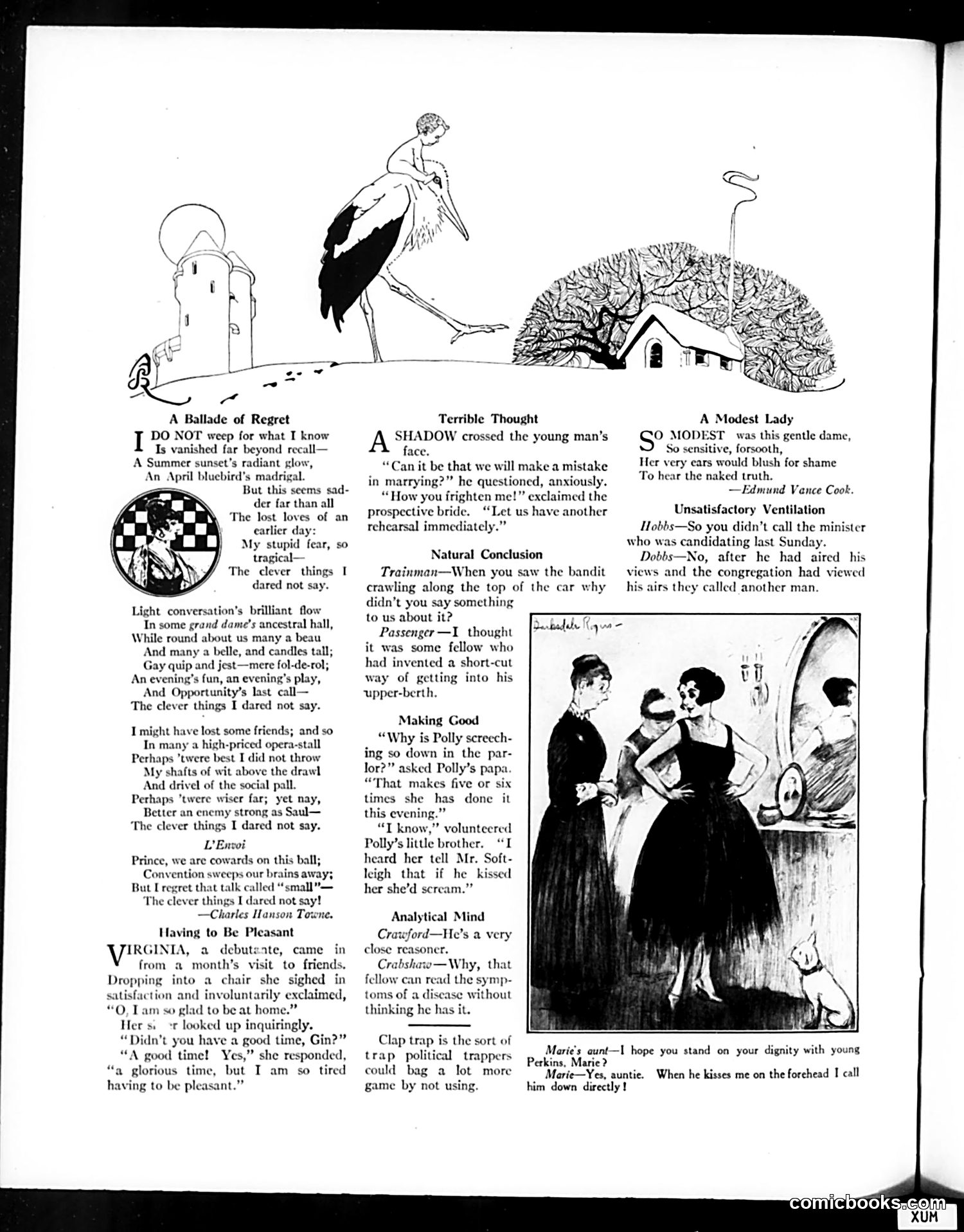
This page contains several short humorous pieces typical of early 20th-century American satire: **"A Ballad of Regret"** is a nostalgic poem lamenting social cowardice—the failure to make witty remarks at parties due to social convention, suggesting that suppressing clever remarks in favor of polite conversation was a genuine source of regret. **"Having to Be Pleasant"** satirizes debutante culture: Virginia complains that despite having a wonderful time visiting friends, she's exhausted from the *obligation* to appear cheerful—mocking both the artificiality of upper-class social performance and the exhausting emotional labor expected of young society women. The remaining pieces are brief comedic anecdotes about courtship, class anxieties, and miscommunication. "Making Good" jokes about a girl screaming when kissed (whether genuine protest or performative modesty is unclear). "Unsatisfactory Ventilation" mocks a boring minister. The stork illustration at top is decorative. Overall, the page satirizes early 20th-century social etiquette, particularly the performative nature of polite society and courtship rituals.
📄 Transcribed text from this page (OCR, searchable)
Machine-transcribed from the original scan — historical spelling and the odd misread are preserved.
A Ballade of Regret DO NOT weep for what I know Is vanished far beyond recall— A Summer sunset’s radiant glow, An April bluebird’s madrigal. But this seems sad- der far than all The lost loves of an earlier day: My stupid fear, so tragical— The clever things I dared not say. Light conversation’s brilliant flow In some grand dame’s ancestral hall, While round about us many a beau And many a belle, and candles tall; Gay quip and jest—mere fol-de-rol; An evening's fun, an evening's play, And Opportunity’s last call— The clever things I dared not say. I might have lost some friends; and so In many a high-priced opera-stall Perhaps ’twere best I did not throw My shafts of wit above the drawl And drivel of the social pall. Perhaps ‘twere wiser far; yet nay, Better an enemy strong as Saul— ‘The clever things I dared not say. L'Envoi Prince, we are cowards on this ball; Convention sweeps our brains away; But I regret that talk called “small"— The clever things I dared not say! —Charles Hanson Towne. Having to Be Pleasant IRGINIA, a debutzate, came in from a month’s visit to friends. Dropping into a chair she sighed in satisfaction and involuntarily exclaimed, “O, Lam so glad to be at home.” Hers: r looked up inquiringly. “Didn't you have a good time, Gin?” “A good time! Yes,” she responded, “a glorious time, but I am so tired having to be pleasant.” Terrible Thought A SHADOW crossed the young man’s face. “Can it be that we will make a mistake in marrying?” he questioned, anxiously. “How you frighten me!” exclaimed the prospective bride. ‘Let us have another rehearsal immediately.” Natural Conclusion Trainman—When you saw the bandit crawling along the top of the car why didn’t you say something to us about it? Passenger —1 thought it was some fellow who had invented a short-cut way of getting into his upper-berth, Making Good “Why is Polly screech- ing so down in the par- lor?” asked Polly’s papa “That makes five or six times she has done it this evening.” “T know,” volunteered Polly’s litle brother. “I heard her tell Mr. Soft- leigh that if he kissed her she’d scream.” Analytical Mind Crawford—He’s a very close reasoner. Crabshaw—Why, that fellow can read the symp- toms of a disease without thinking he has Clap trap is the sort of trap political trappers could bag a lot more game by not using. A Modest Lady ‘O MODEST was this gentle dame, So sensitive, forsooth, Her very ears would blush for shame To hear the naked truth. —Edmund Vance Cook. Unsatisfactory Ventilation Hobbs—So you didn’t call the minister who was candidating last Sunday. Dobbs—No, after he had aired his views and the congregation had viewed his airs they called another man. Marie's aunt—I hope you stand on your dignity with young Perkins, Marie? Marie—Yes, auntie. him down directly ! When he kisses me on the forehead I call cpooksseataa