
Judge, 1916-12-09 · page 12 of 28
Judge — December 9, 1916 — page 12: what you’re looking at
What you’re looking at
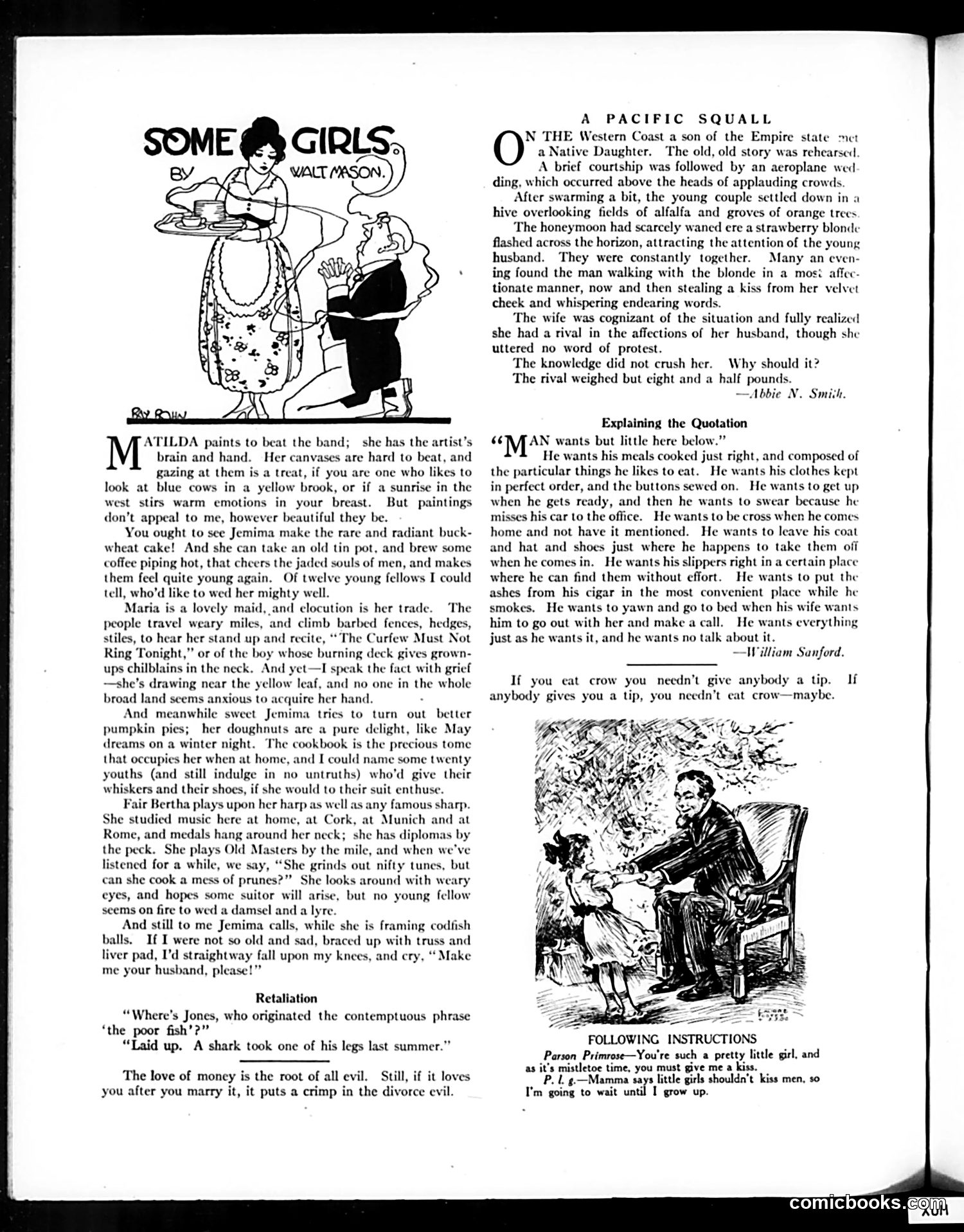
This Judge magazine page contains satirical commentary on gender roles and marriage in early 20th-century America. **"Some Girls"** (left): A humorous piece listing unmarried women with desirable domestic or artistic skills—Matilda (painter), Jemima (excellent cook), Maria (elocutionist), Bertha (accomplished musician). The satire: despite these accomplishments, none attract suitors. The implicit critique is that men value *domestic competence* (cooking, housekeeping) over education or artistic talent, yet ironically, Jemima—who offers only cooking skills—is the only one with marriage prospects. **"A Pacific Squall"** (top right): A brief story about a newlywed couple where the husband becomes infatuated with another woman. The twist ending reveals the "rival" is an 8.5-pound infant—their own child. The satire mocks husbands' jealousy and divided attention. **"Explaining the Quotation"** (bottom right): Satirizes male selfishness in marriage, presenting a husband's endless demands for comfort and service—a critique of male entitlement masquerading as innocent needs. Overall, the page satirizes marriage dynamics and gender expectations of its era.
📄 Transcribed text from this page (OCR, searchable)
Machine-transcribed from the original scan — historical spelling and the odd misread are preserved.
brain and hand. Her canvases are hard to beat, and gazing at them is a treat, if you are one who likes to look at blue cows in a yellow brook, or if a sunrise in the west stirs warm emotions in your breast. But paintings don’t appeal to me, however beautiful they be. M teins paints to beat the band; she has the artist’s You ought to see Jemima make the rare and radiant buck- wheat cake! And she can take an old tin pot, and brew some coffee piping hot, that cheers the jaded souls of men, and makes ¢ young fellows I could them feel quite young ag: tell, who'd like to wed her mighty well. Maria is a lovely maid, and eclocution is her trade. The people travel weary miles, and climb barbed fences, hedges, stiles, to hear her stand up and recite, “The Curfew Must Not Ring Tonight,” or of the boy whose burning deck gives grow! ups chilblains in the neck. And yet—I speak the fact with grief —she’s drawing near the yellow leaf, and no one in the whole broad land seems anxious to acquire her hand. And meanwhile swect Jemima tries to turn out better pumpkin pies; her doughnuts are a pure delight, like May dreams on a winter night. The cookbook is the precious tome that occupies her when at home, and I could name some twenty youths (and still indulge in no untruths) who'd give their whiskers and their shoes, if she would to their suit enthuse. Fair Bertha plays upon her harp as well as any famous sharp. She studied music here at home, at Cork, at Munich and at Rome, and medals hang around her neck; she has diplomas by the peck. She plays Old Masters by the mile, and when we've listened for a while, we say he grinds out nifty tunes, but can she cook a mess of prunes?” She looks around with weary ¢ and hopes some suitor will arise, but no young fellow seems on fire to wed a damsel and a lyre. And still to me Jemima calls, while she is framing codfish balls. If I were not so old and sad, braced up with truss and liver pad, I'd straightway fall upon my knees, and cry, “ Make me your husband, please! Retaliation “Where's Jones, who originated the contemptuous phrase ‘the poor fish’?” “Laid up. A shark took one of his legs last summer.” The love of moncy is the root of all evil. Still, if it loves you after you marry it, it puts a crimp in the divorce evil. A PACIFIC SQUALL N THE Western Coast a son of the Empire state met O a Native Daughter. The old, old story was rehearsed A brief courtship was followed by an aeroplane wed ding, which occurred above the heads of applauding crowds After swarming a bit, the young couple settled down in a hive overlooking ficlds of alfalfa and groves of orange trees The honeymoon had scarcely waned ere a strawberry blonde flashed across the horizon, attracting the attention of the young husband. They were constantly together. Many an even- ing found the man walking with the blonde in a mosi affce- tionate manner, now and then stealing a kiss from her velvet cheek and whispering endearing words. The wife was cognizant of the situation and fully realized she had a rival in the affections of her husband, though she uttered no word of protest. The knowledge did not crush her. Why should it? The rival weighed but eight and a half pounds. —Abbie N. Smith. Explaining the Quotation “MSS wants but little here below.” He wants his meals cooked just right, and composed of the particular things he likes to eat. He wants his clothes kept in perfect order, and the buttons sewed on. He wants to get up when he gets ready, and then he wants to swear because he misses his car to the office. He wants to be cross when he comes home and not have it mentioned. He wants to leave his coat and hat and shoes just where he happens to take them off when he comes He wants his slippers right in a certain place where he can find them without effort. He wants to put the ashes from his cigar in the most convenient place while he smokes. He wants to yawn and go to bed when his wife wants him to go out with her and make a call. He wants everything just as he wants it, and he wants no talk about i —William Sanford. If you eat crow you needn’t give anybody a tip. If anybody gives you a tip, you needn't cat crow—maybe. FOLLOWING INSTRUCTIONS Parson Primrose—You're such a pretty little girl, and as it's mistletoe time, you must give me a kiss. P. L. ¢.—Mamma says little girls shouldn't kiss men, so I'm going to wait until I grow up. comicbooks.