
A complete issue · 28 pages · 1916
Judge — September 30, 1916
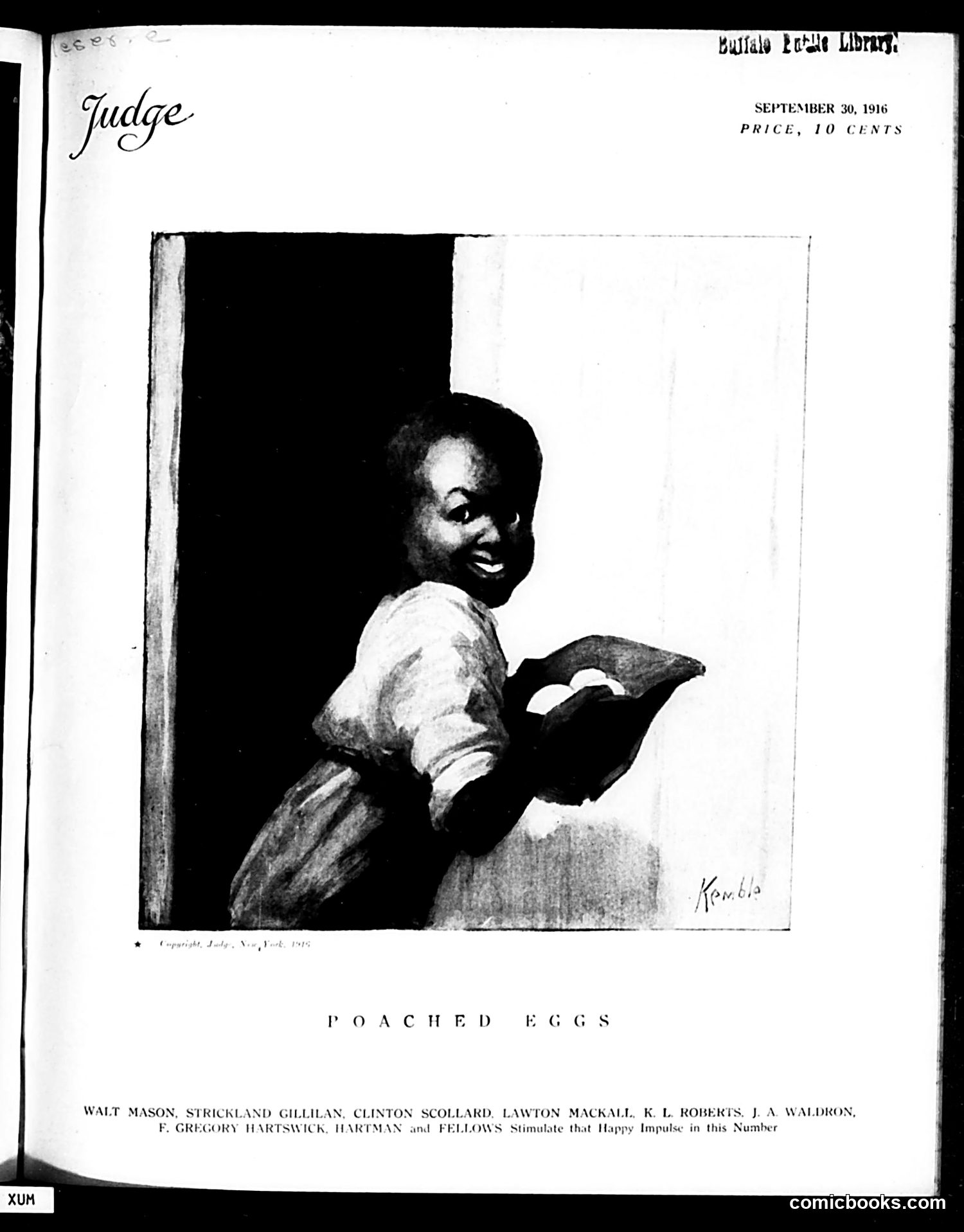
This cartoon's title "Poached Eggs" appears to be a pun on "poached" (stolen/plagiarized) rather than the cooking method. The illustration shows a figure in period dress holding what appears to be eggs or stolen goods, glancing back over their shoulder in a guilty manner. The credited contributors listed below—Walt Mason, Strickland Gilliland, Clinton Scolland, and others—"stimulate that Happy Impulse in this Number," suggesting this is a humorous collection piece. Without clearer context about the 1916 political moment, the specific satirical target remains unclear, though the guilty expression and title suggest commentary on theft, plagiarism, or appropriation of some kind relevant to that era's public figures or events.
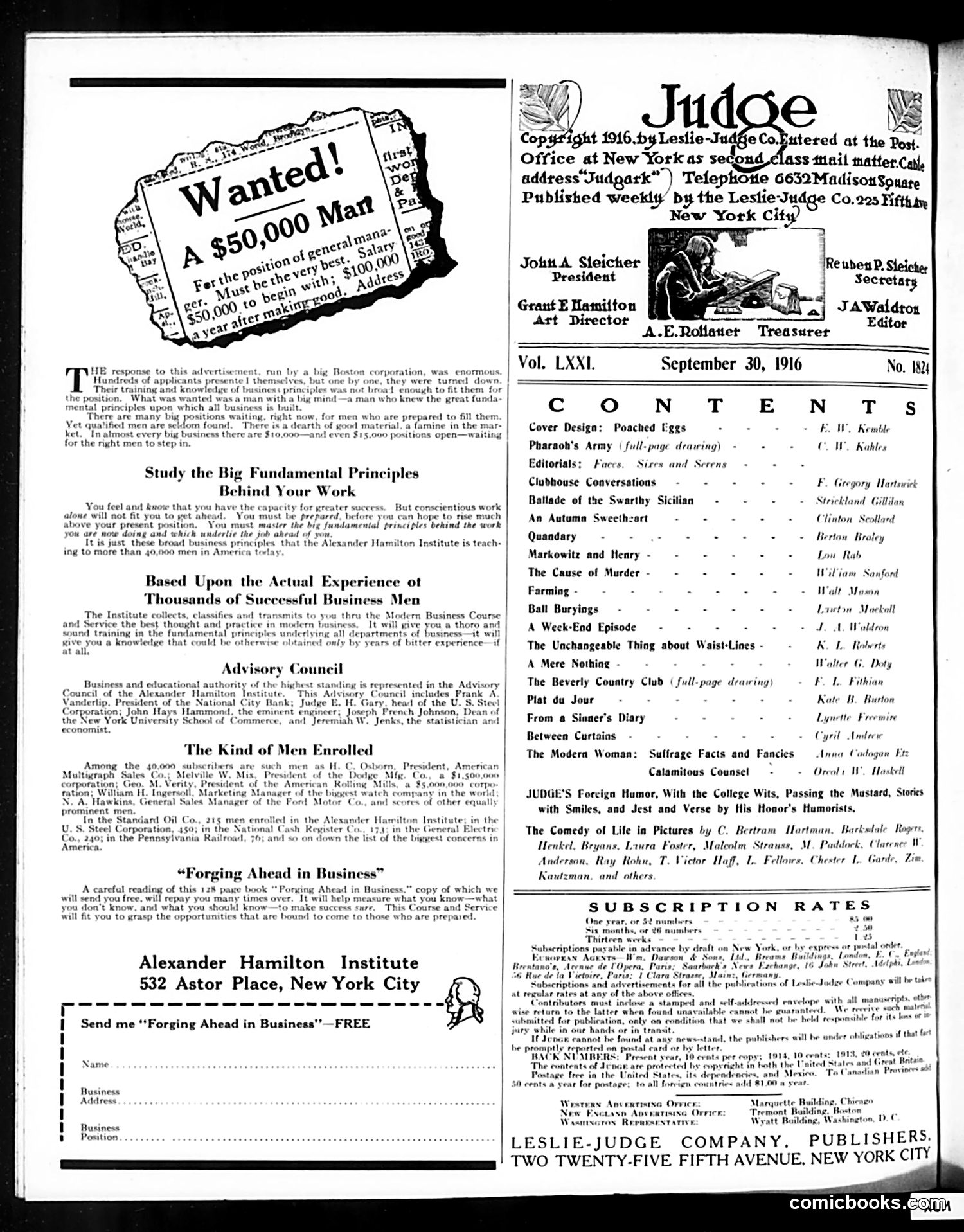
This page is primarily **advertising and editorial content** rather than political satire. The dominant feature is a "Wanted" advertisement for a $50,000 general manager position, highlighting the magazine's business focus. The masthead identifies Judge's leadership and the contents listing shows this issue includes articles on topics like "Pharaoh's Army," "The Cause of Murder," and "The Modern Woman: Suffrage Facts and Fancies"—suggesting Judge addressed contemporary social debates, particularly women's suffrage, which was active during this 1916 period. The page otherwise features standard magazine business: subscription rates, publication details, and promotional material for the Alexander Hamilton Institute's business course. No specific political cartoons are clearly visible or described in the OCR text.
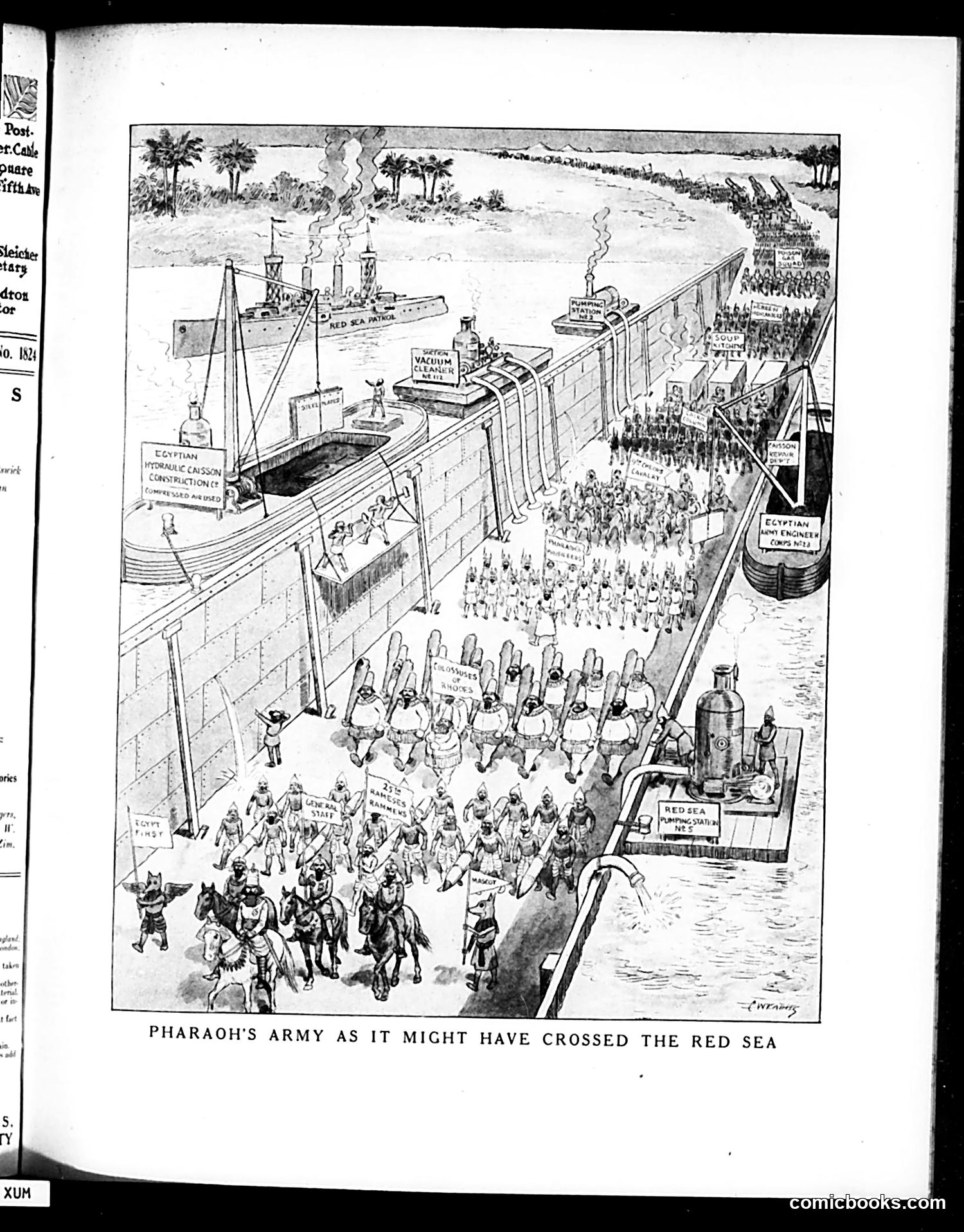
This is a whimsical historical illustration imagining ancient Egypt's pharaonic army using modern early-20th-century transportation and infrastructure. The cartoon satirizes contemporary engineering and military logistics by anachronistically placing soldiers, chariots, and ancient Egyptian forces alongside modern ships, docks, and construction equipment labeled "Egyptian" and "Egyptian Hydraulic Construction Co." The humor derives from this absurd collision of ancient and modern worlds—showing how contemporary technology might have been deployed in biblical times. The crowded dock scene with organized troops and industrial machinery creates a comedic juxtaposition, poking fun at both modern engineering ambitions and historical imagination. The precise caption emphasizes the satirical "what-if" scenario.
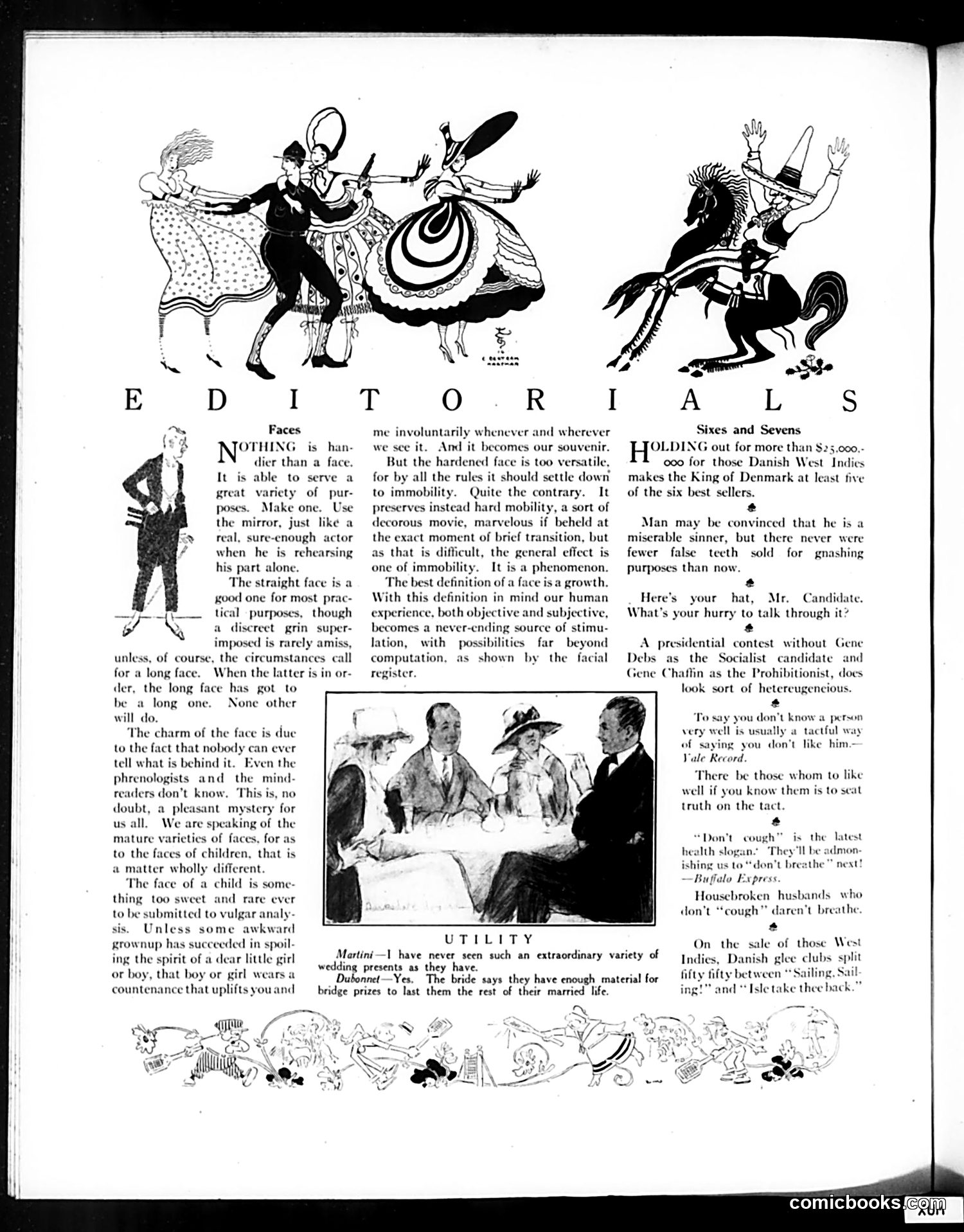
This page contains three distinct sections: **"Editorials" (top):** Satirical illustrations of figures in exaggerated costumes and poses, likely caricaturing contemporary political or social figures, though specific identities are unclear from the image alone. **"Nothing is handsomer than a face" (left column):** An essay about facial expressions and character, discussing how faces reveal personality. This appears to be general commentary rather than political satire. **"Utility" (bottom):** A brief comedic exchange between characters named Martini and Desmond about wedding presents and married life, presented as humorous social observation rather than political commentary. The page mixes satirical illustrations with general humor and social commentary typical of Judge magazine's blend of political and lifestyle content. Without clearer identification of the figures or publication date, specific political references remain unclear.
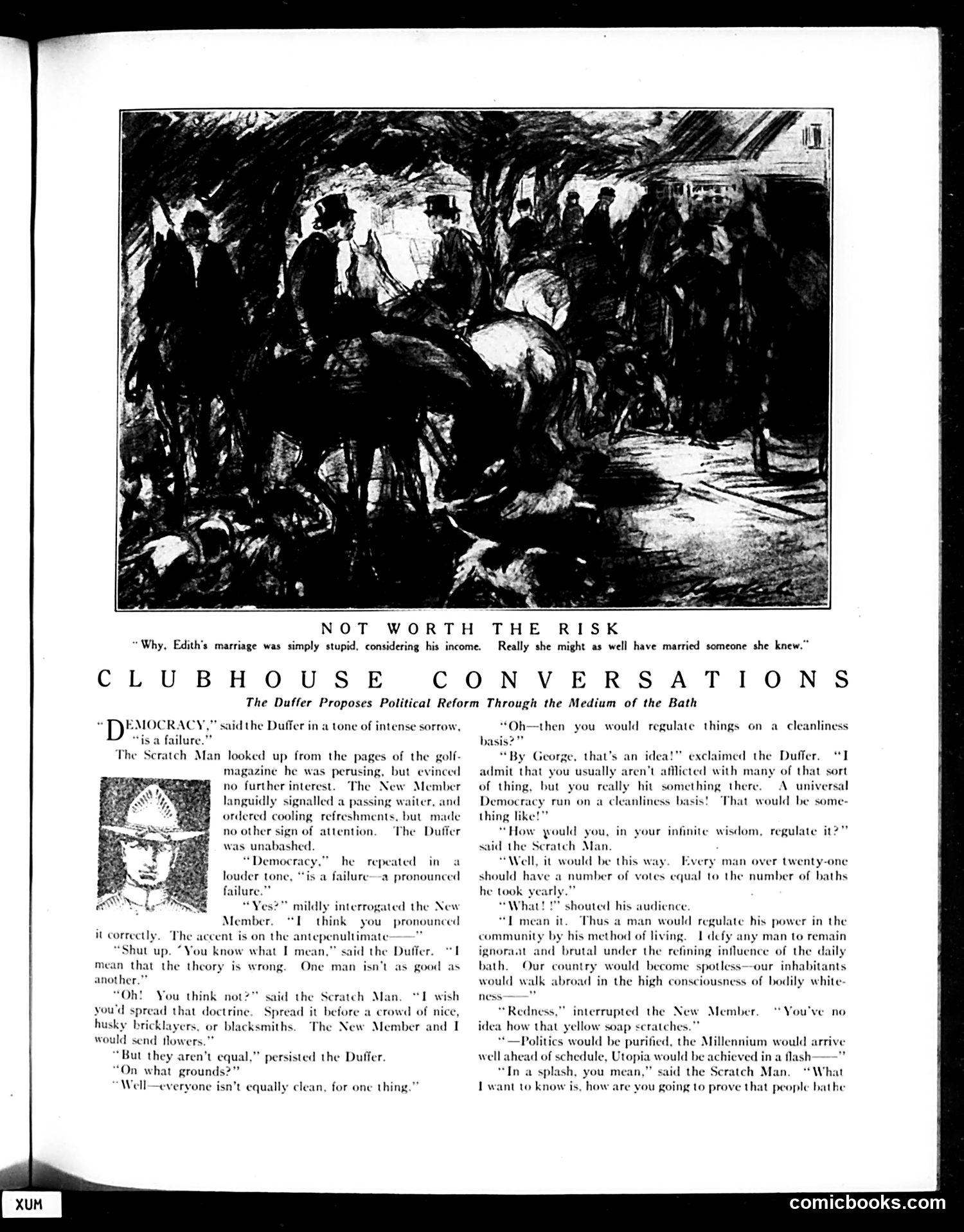
This page from *Judge* magazine features "Clubhouse Conversations," a satirical dialogue about political reform. The sketch depicts well-dressed men debating democratic governance in what appears to be a gentlemen's club setting. The "Duffer" proposes regulating society through bathing habits—a absurdist critique of overly simplistic reform ideas. The "Scratch Man" counters with another impractical scheme: giving every adult male votes equal to his annual baths, implying poor hygiene correlates with poor citizenship. The satire mocks naive reformers who believe mechanical solutions (voting adjustments, cleanliness standards) can fix complex political and social problems. The dialogue suggests that progressive-era reform proposals often lacked practical grounding, reducing serious democratic questions to ridiculous formulas. The cartoon ridicules both utopian thinking and class-based assumptions about who deserves political participation.
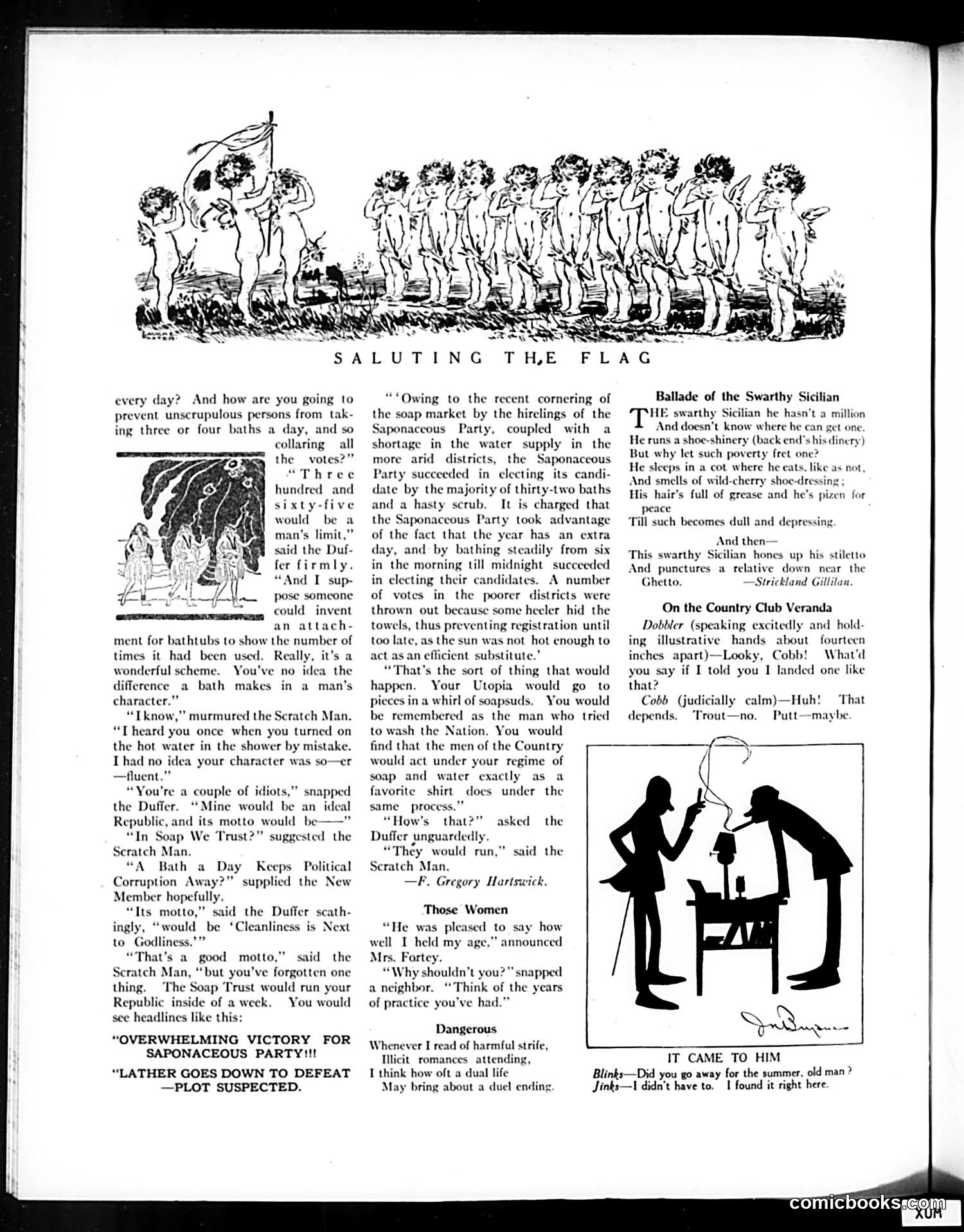
This 1910s-era Judge page satirizes Progressive Era reformers' naive optimism. The main cartoon mocks a "Duffer" proposing that linking voting rights to daily bathing would improve the electorate's character and reduce corruption. His interlocutor (the "Scratch Man," likely representing cynical realism) counters that such a scheme would inevitably be corrupted by a "Soap Trust"—parodying real Progressive anxieties about monopolies controlling essential services. The satire targets two targets: first, reformers who believed mechanical solutions (bathing = better citizenship) could fix systemic problems; second, the actual power of corporate trusts to subvert democratic processes. The page's other content—brief poems and jokes about ethnic stereotypes, fishing stories, and romantic entanglements—represents typical magazine filler of the era, reflecting period attitudes now considered offensive.
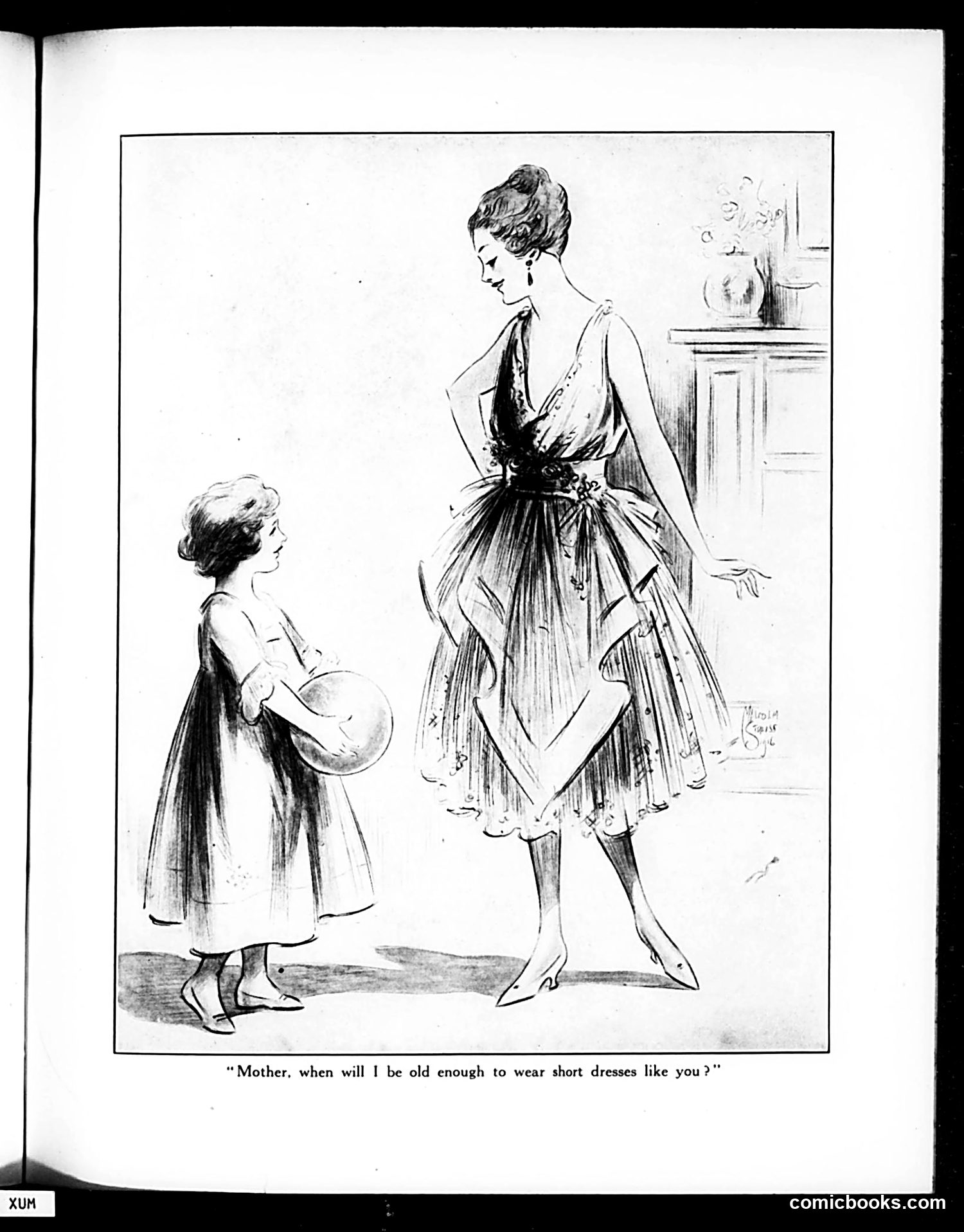
This is a humorous domestic scene from *Judge* magazine depicting a young girl asking her mother when she'll be old enough to wear short dresses. The satire targets **early 20th-century fashion norms**, specifically the controversy over hemlines. The joke relies on generational irony: the mother wears a fashionably short dress (likely knee-length or slightly above, which was considered daring for the era), while the daughter wears a longer, more conservative children's dress. The child's innocent question highlights the absurdity of restrictive dress codes—the mother enjoys the fashion freedom the daughter must wait years to achieve. This reflects broader cultural debates about women's clothing becoming shorter and less restrictive during this period, seen as both modern and morally questionable by conservative society.
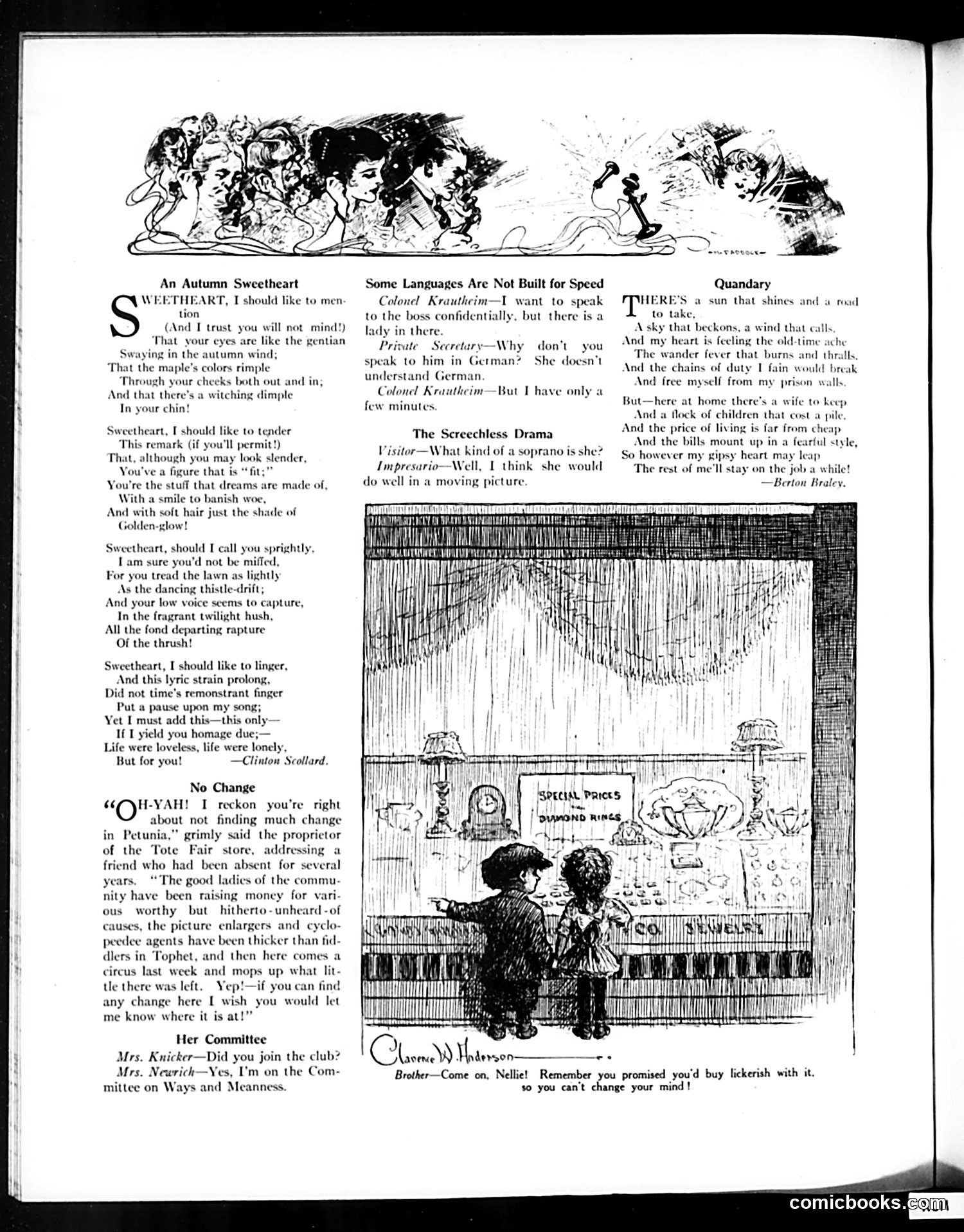
This page contains several satirical pieces typical of early 20th-century American humor: **"An Autumn Sweetheart"** is a sentimental romantic poem—likely included for contrast or gentle mockery of flowery Victorian courtship language. **"No Change"** satirizes small-town life, where a store proprietor complains that fundraising schemes, traveling entertainers (picture enlargers, circus acts), have drained the community of actual money. The joke: rural towns remain perpetually unchanged despite constant activity. **"Some Languages Are Not Built for Speed"** is a German-language joke where a Colonel assumes a lady won't understand German, mocking both German's reputation as harsh-sounding and stereotyping women's linguistic abilities. **"The Screechless Drama"** jokes that a mediocre soprano would be better suited to silent films (moving pictures)—where audiences wouldn't hear her voice. **"Her Committee"** puns on "Ways and Means" (a legislative committee) versus "Ways and Meanness," suggesting wealthy women's clubs were cattily gossipy. The cartoon depicts a child at a shop window, promised candy but reminded he can't change his mind—illustrating commitment's burdens.
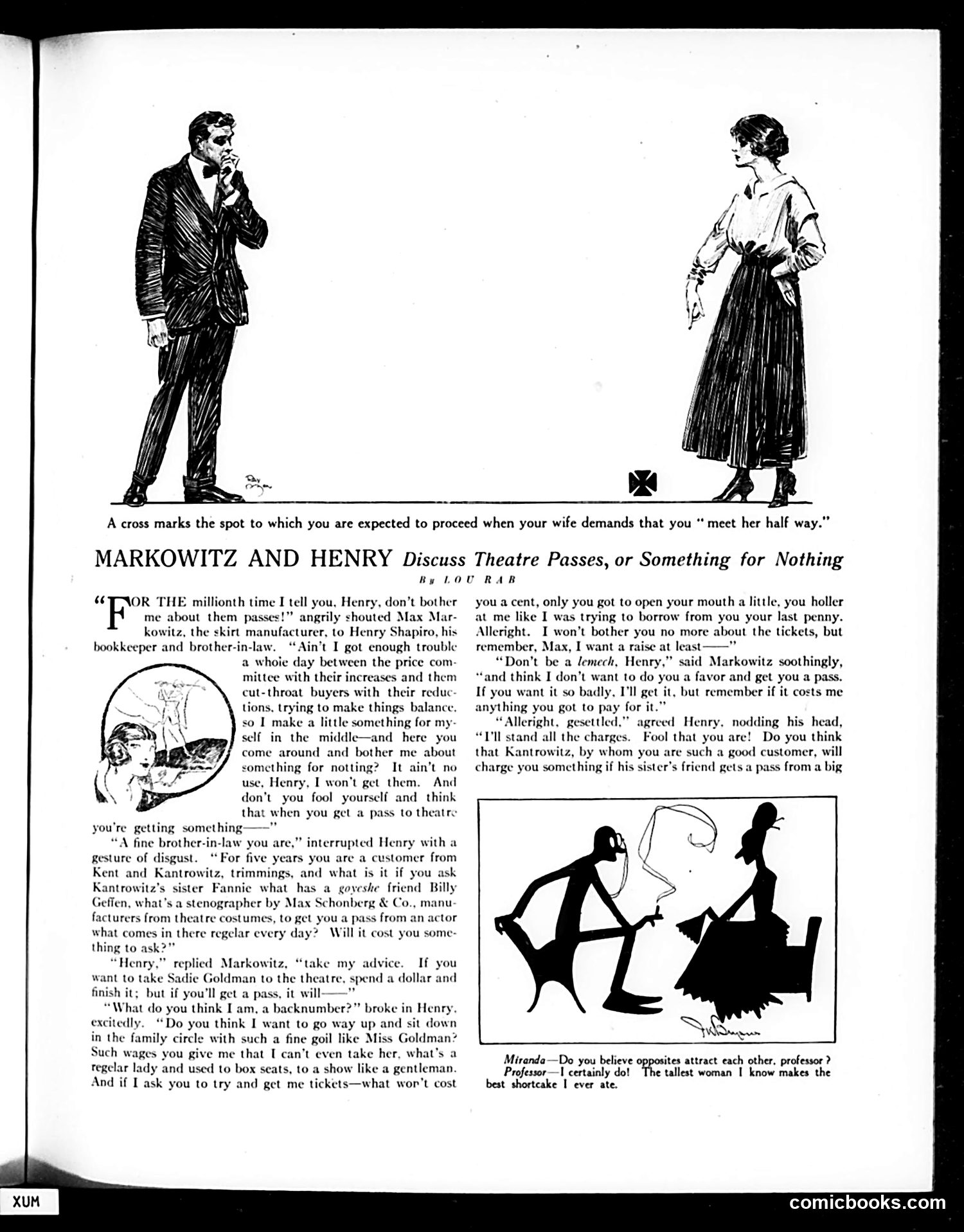
This is a comedic dialogue between Max Markowitz (a skirt manufacturer) and Henry Shapiro (his bookkeeper and brother-in-law), both appearing to be Jewish immigrants based on their Yiddish-inflected English and names. **The satire's point:** Henry repeatedly asks Markowitz for free theatre passes to impress his girlfriend Sadie Goldman. Markowitz refuses, lecturing that free things aren't truly valuable. The humor derives from their bargaining and emotional manipulation—Henry guilt-trips Markowitz about past favors, Markowitz claims poverty despite his business success, and both ultimately capitulate. **Social context:** The piece satirizes early 20th-century Jewish immigrant workplace dynamics, ethnic business networks (Kantrowitz, Schonberg & Co.), and courtship customs. The "meet her half way" caption jokes about marital compromise. The bottom panel's Miranda/Professor exchange appears unrelated—a separate gag about opposites attracting.
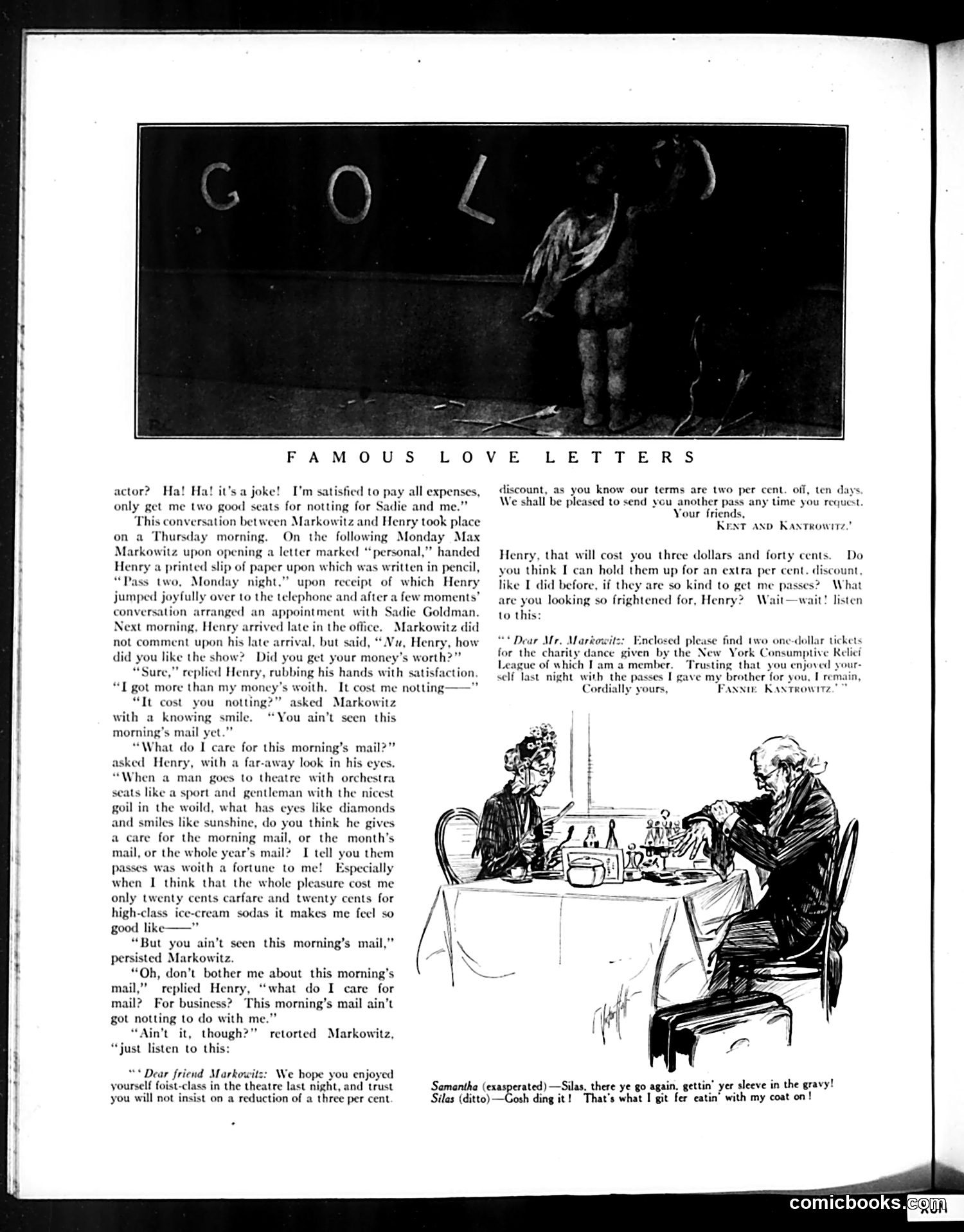
This page from *Judge* satirizes Jewish immigrant business culture through the characters Markowitz (employer) and Henry (employee). **The main narrative:** Henry receives free theater passes from Markowitz and goes on a date, thinking they cost nothing. However, the "morning mail" reveals consequences: the supplier (Kent and Kantrowitz) who gave passes now won't grant Markowitz his usual 3% discount, and a charity organization similarly exploited his goodwill by sending dance tickets, expecting reciprocal donations. **The satire's point:** Henry's naive joy over "free" entertainment blinds him to business reality—suppliers use passes as leverage to extract concessions. Markowitz must now spend money (three dollars forty cents) to maintain relationships. **The ethnic humor:** The exaggerated Yiddish-inflected dialect ("woith," "ain't," "foist-class") and names target turn-of-the-century Jewish merchants. The bottom cartoon appears unrelated domestic humor. The piece mocks both immigrant business naiveté and the calculating nature of commercial relationships disguised as generosity.
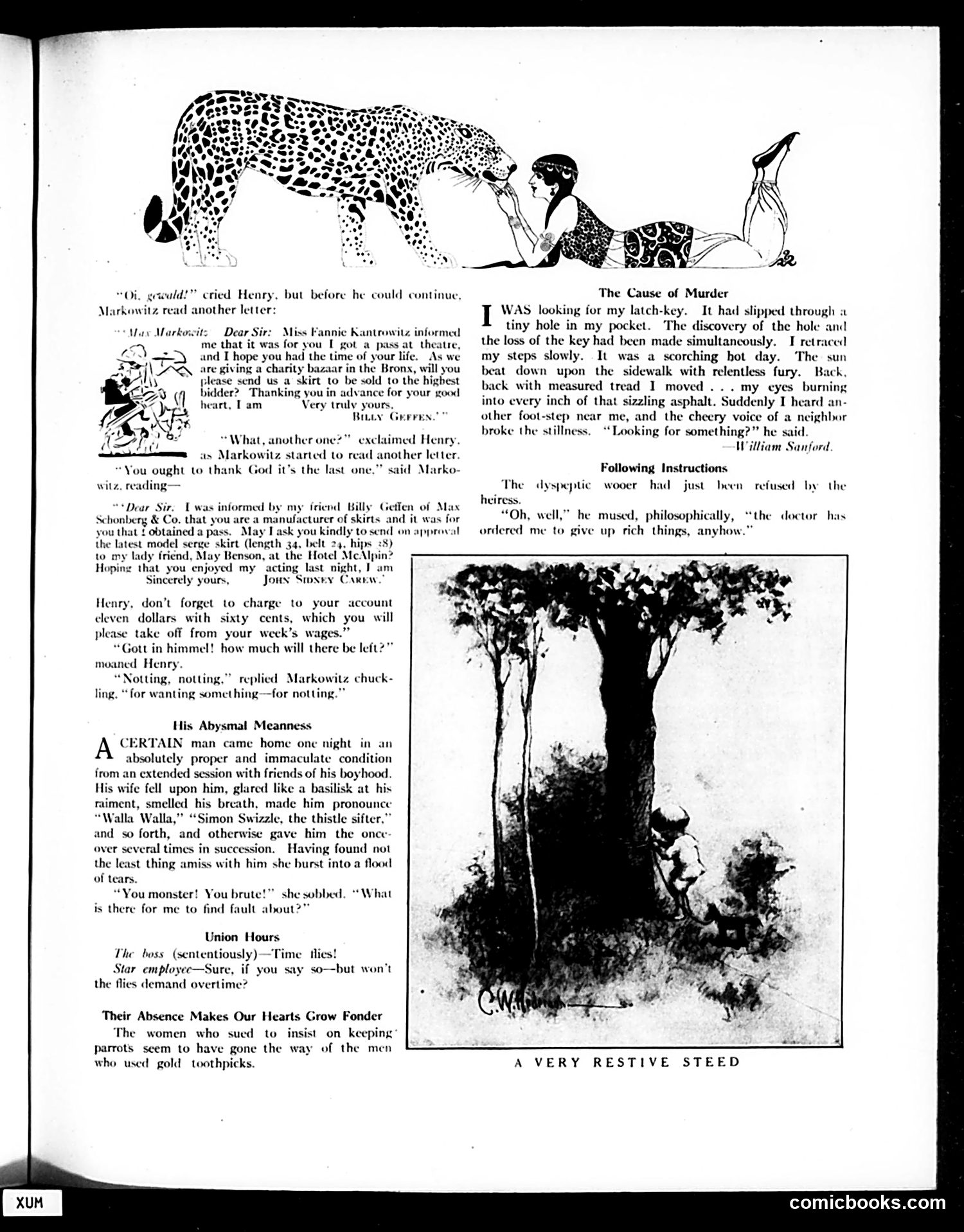
This page contains multiple satirical pieces typical of early 20th-century humor: **Top cartoon**: Shows a man (likely Jewish, based on the name Markowitz) receiving letters from people requesting theater passes he distributed. Each correspondent seeks favors in return—skirts for charity, theater passes, etc. The satire targets social obligation and manipulation: people feign gratitude while making escalating demands. The joke is that Markowitz's generosity becomes a liability. **"His Abysmal Meanness"**: A wife examines her drunk husband exhaustively, finding nothing wrong, then cries anyway. The satire mocks female irrationality and nagging—a common trope of the era. **Other brief pieces** mock workplace dynamics ("Union Hours"), changing social customs (women no longer keeping parrots), and romantic predicament. The page reflects period attitudes toward immigration, gender, and workplace relations. The ethnic humor relies on stereotyping common in Judge's satirical approach.
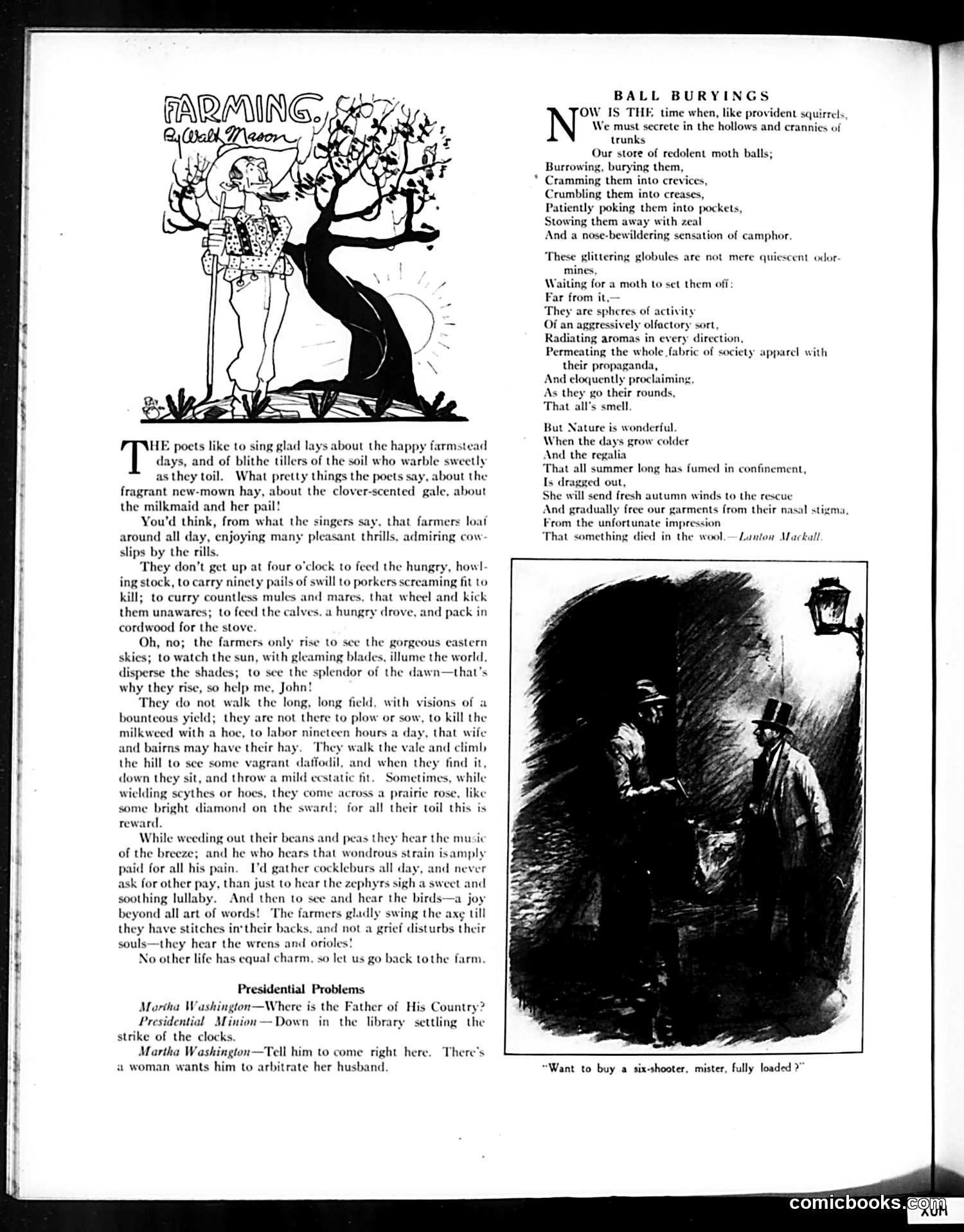
This Judge magazine page contains three distinct satirical pieces: **"Farming"** mocks Romantic poetry's idealization of farm life. The text sarcastically contrasts poets' sentimental verses about pastoral beauty with the harsh reality: farmers wake at 4 a.m. for grueling physical labor—feeding livestock, hauling swill, working nineteen-hour days. The satire exposes how literature romanticizes agricultural work while ignoring its brutal drudgery. **"Ball Buryings"** humorously describes storing mothballs for winter—their aggressive odor permeating clothing and furniture. The joke plays on the unpleasant reality versus the poetic notion of seasonal preparation. **"Presidential Problems"** (a brief comic exchange) appears to reference President Washington arbitrating labor disputes. Martha Washington seeks him to settle a marital disagreement, suggesting the president is busy mediating even domestic conflicts—likely commentary on labor unrest or political intervention during this period. The illustration shows a figure in dark clothing with a lantern, possibly relating to one of these pieces, though its specific connection is unclear.
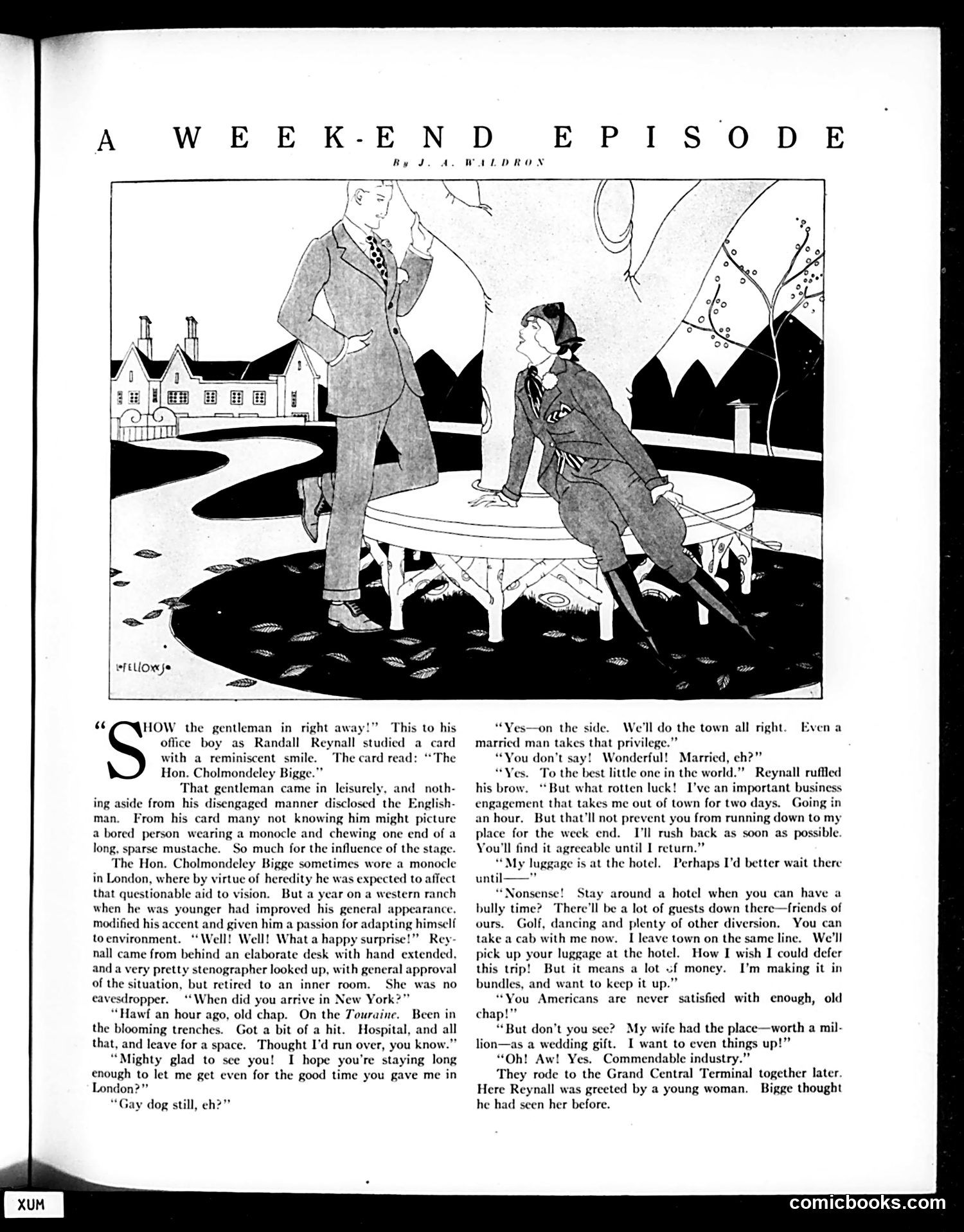
This satirical story depicts the meeting between Randall Reynall, an American businessman, and the Hon. Cholmondeley Bigge, a British aristocrat recently returned from WWI service ("the blooming trenches"). The humor centers on contrasting national stereotypes: Bigge represents the traditional English gentleman (monocle, sparse mustache, leisurely manner), while Reynall embodies the hustling American capitalist obsessed with wealth and status. When Reynall boasts about his wife's million-dollar wedding gift and his drive to "even things up" through relentless moneymaking, Bigge's dry response—"You Americans are never satisfied with enough"—captures the satirical critique: American materialism and social climbing versus English aristocratic composure. The final line hints at intrigue: Reynall is mysteriously greeted by a young woman at the train station, foreshadowing dramatic complications for the weekend ahead.
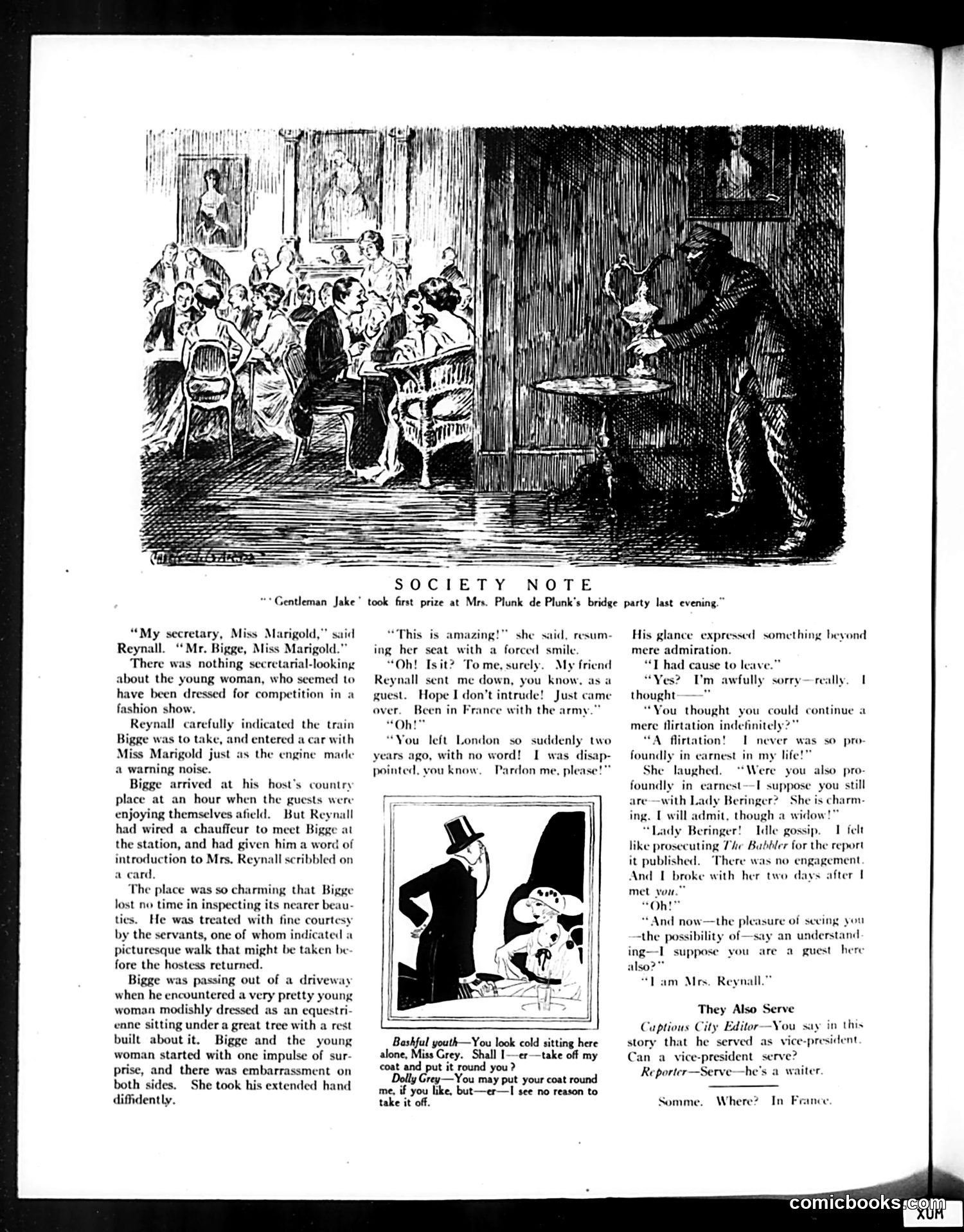
This is a satirical society story about social embarrassment and infidelity. A man named Reynall invites his friend Bigge to a country house party, where Bigge encounters a woman he knew years ago in London—a woman he apparently abandoned suddenly. The twist: the woman is now **Mrs. Reynall**, Bigge's host's wife. Their awkward reunion reveals Bigge's history of romantic entanglements (he's also been linked to "Lady Beringer" and was apparently investigated by a gossip columnist called "The Bubbler"). The humor targets the hypocrisy of high society—people maintaining respectable facades while engaging in affairs and romantic scandals. The inserted joke at bottom about serving "in France" as "president" of Somme appears to be separate wordplay about WWI service. The embedded cartoon about "Bashful youth" and "Dolly Grey" humorously plays on romantic pretense and female agency regarding physical intimacy.
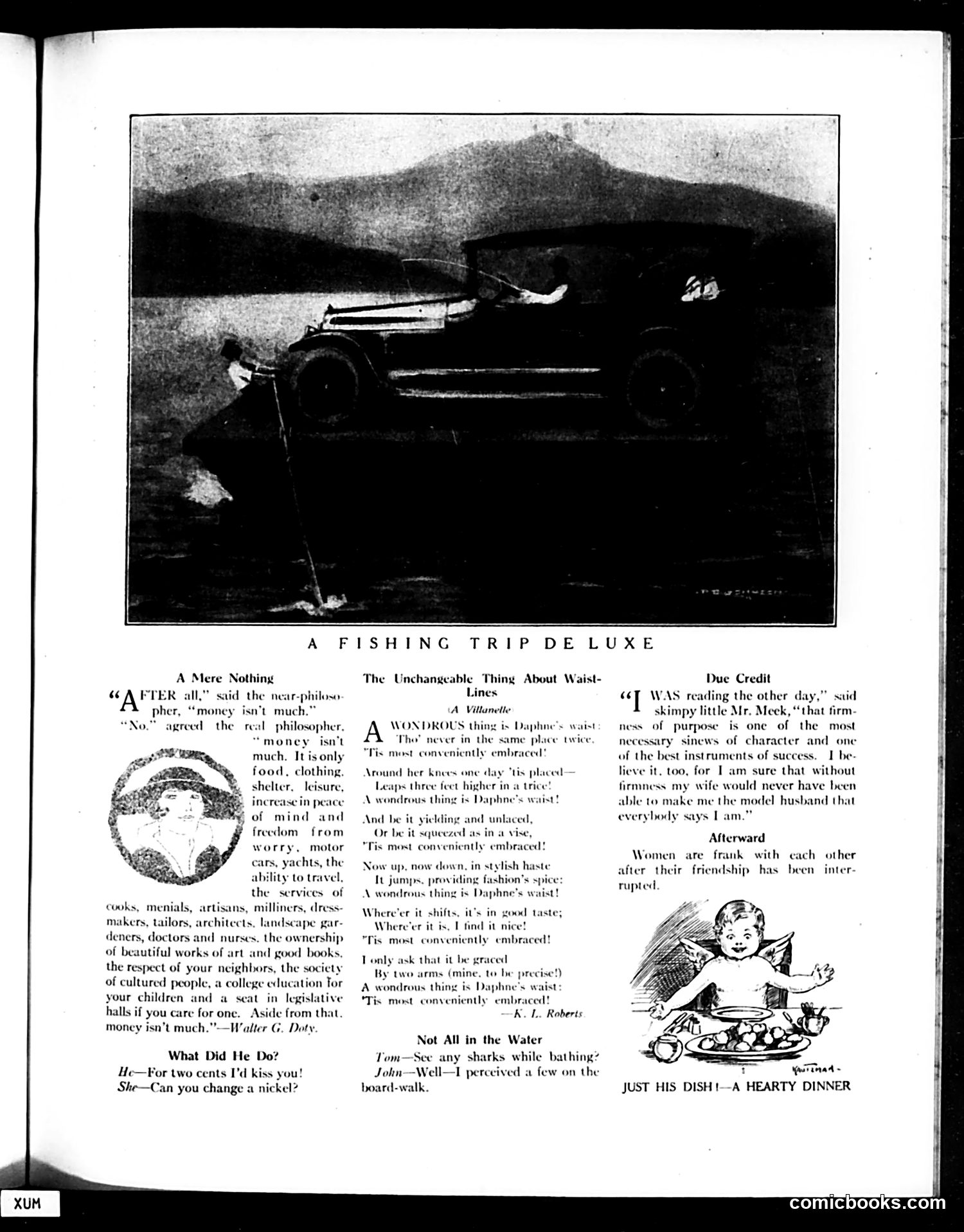
This page contains multiple satirical pieces mocking early 20th-century wealth and social pretension. **Top image**: Shows an automobile beside a lake with mountains—illustrating the "deluxe" fishing trip, emphasizing how wealthy leisure requires elaborate transportation and equipment. **Main satire**: "A Mere Nothing" presents two philosophers debating whether money matters. The "real philosopher" ironically lists everything money actually provides—servants, art, education, political office—before claiming "money isn't much." The joke mocks wealthy people's false modesty about their privilege. **Other pieces**: - "What Did He Do?" is a brief joke about negotiating kisses for coins - "The Unchangeable Thing About Waist-Lines" satirizes women's fashion obsession with constantly changing waistline positions - "Not All in the Water" makes a shark pun about dangerous people on the beach - "Just His Dish" shows a henpecked husband crediting his wife with his success The page satirizes consumerism, class pretension, fashion vanity, and gender dynamics typical of early 1900s American life.
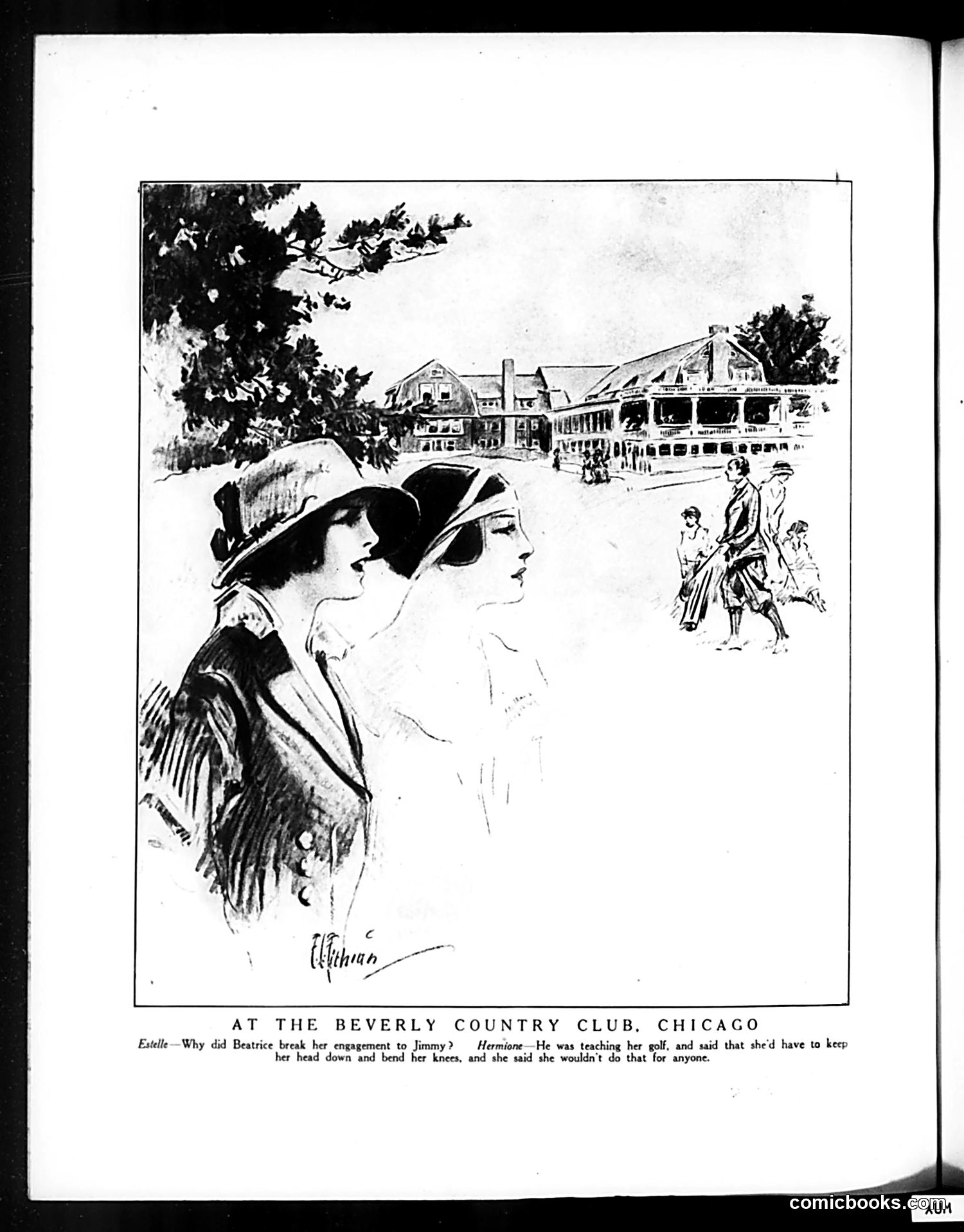
This is a single-panel joke cartoon from Judge magazine, set at the Beverly Country Club in Chicago. Two women (Estelle and Hermione) discuss why their friend Beatrice ended her engagement to Jimmy. The humor relies on a double entendre: Jimmy, while giving Beatrice golf instruction, told her to "keep her head down and bend her knees"—standard golf technique. However, Beatrice's refusal to do this "for anyone" suggests she interpreted (or pretended to interpret) his instruction as overly demanding or controlling behavior in their relationship, using the innocent golf advice as a pretext to break the engagement. The joke satirizes both the literal awkwardness of golf instruction between romantic partners and, more broadly, the social dynamics and marital expectations of the era. The cartoon mocks both Beatrice's apparent oversensitivity and the complications that arise when instruction mingles with courtship.
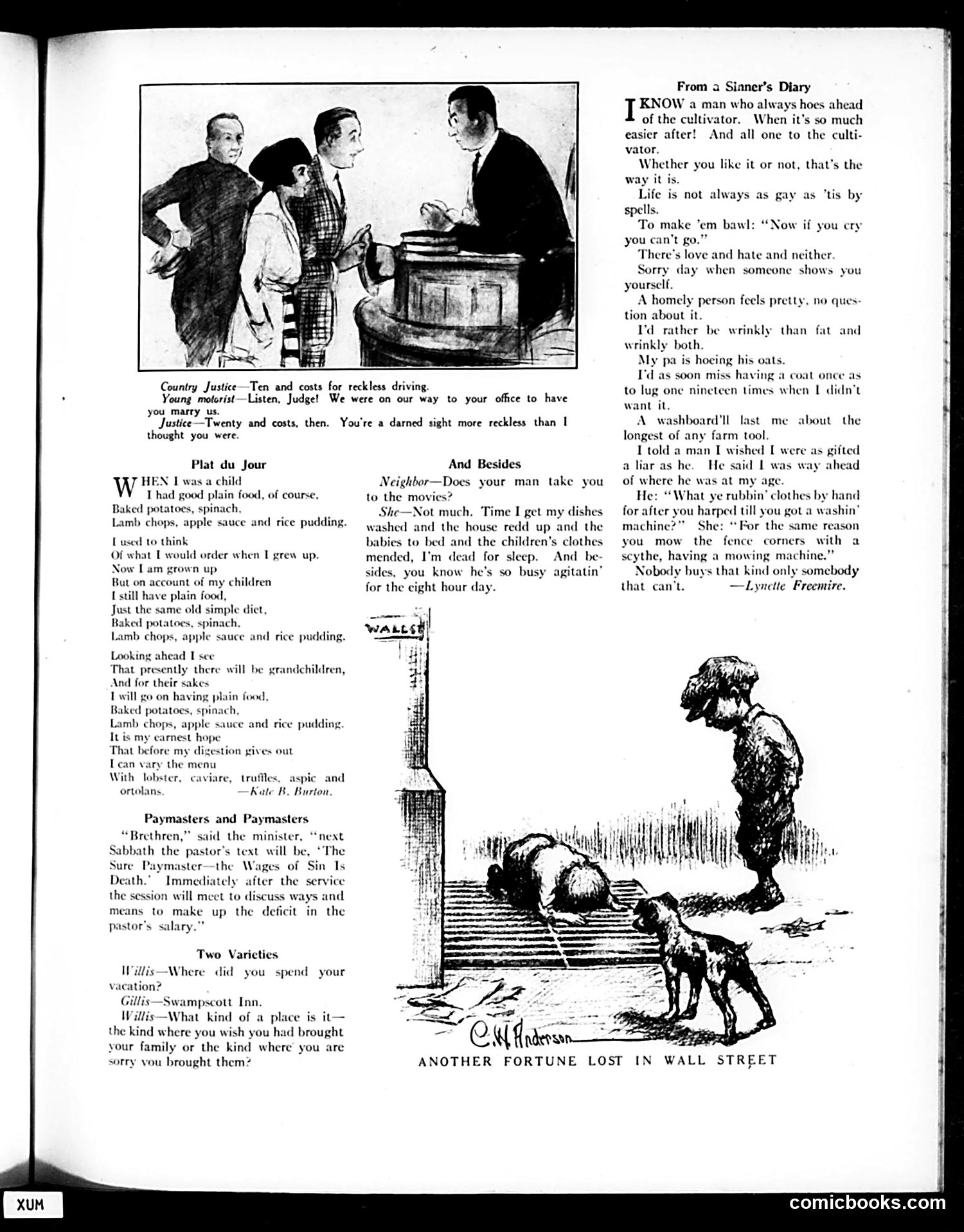
**Top Cartoon ("Country Justice"):** A judge sentences a young motorist to "ten and cents for reckless driving," then doubles the fine to twenty cents when the motorist reveals he was heading to the judge's office to get married. The satire mocks judicial inconsistency—the judge considers marrying recklessly a worse offense than reckless driving, punishing the couple for presumed moral laxity. **"Plat du Jour" poem:** Satirizes domestic sacrifice across generations. An adult reflects that despite childhood dreams of fancy dining, they're still eating plain food (baked potatoes, spinach, lamb chops) because of children—and expects this to continue through grandchildren. The humor lies in resignation: life's pleasures are perpetually deferred by family obligation. **Bottom Cartoon ("Another Fortune Lost in Wall Street"):** A disheveled man lies on the ground while a boy watches. The title suggests financial ruin from stock market speculation, with the fallen figure representing a Wall Street investor reduced to poverty. The remaining items are brief humorous anecdotes about marital logistics, pastor salary deficits, and farm life.
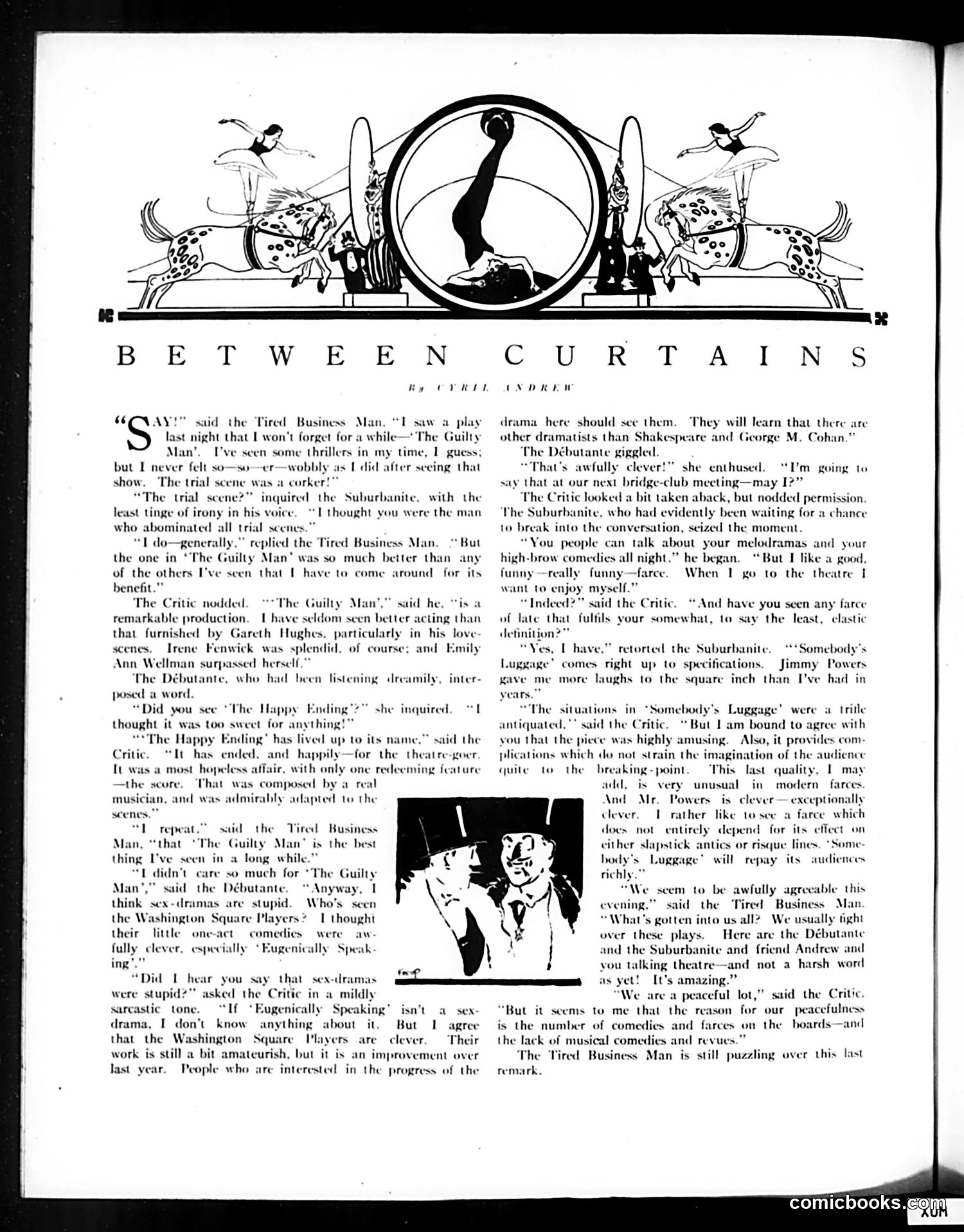
This page presents a humorous dialogue between four theater-goers debating recent Broadway productions. The "Tired Business Man," "Critic," "Débutante," and "Suburbanite" discuss plays including *The Guilty Man*, *The Happy Ending*, and *Somebody's Luggage*. The satire mocks pretentious theater criticism and social posturing. The Débutante eagerly appropriates the Critic's sophisticated observations to impress her bridge-club friends, exposing superficial cultural consumption. The Suburbanite defends lowbrow farce against high-minded drama, while the Critic condescends throughout. The small illustration (appearing mid-text) likely depicts characters from one discussed play. The joke is that despite their disagreements, all parties claim to enjoy the evening—revealing hypocrisy about taste and the social performance of cultural refinement among early 20th-century theater audiences.
This page satirizes a psychologist's patronizing analysis of why women kiss departing soldiers during WWI. The author (Anna Cadogan Etz) mocks his pseudo-scientific condescension toward women's behavior, noting he views them as "weird freaks of nature" rather than ordinary humans. The satire's core: the psychologist condemns women's mob kissing instinct as irrational, yet ignores that men's mobs commit lynching—similarly driven by collective emotion. Etz further exposes hypocrisy by invoking Richard Pearson Hobson, a celebrated war hero who faced public ridicule when women kissed him en masse, proving society celebrates soldier-kissing until it becomes undeniable. The piece implicitly argues for women's suffrage by demonstrating how women are judged irrationally by "experts" while denied equal standing as citizens. Women's wartime support is simultaneously demanded and despised.
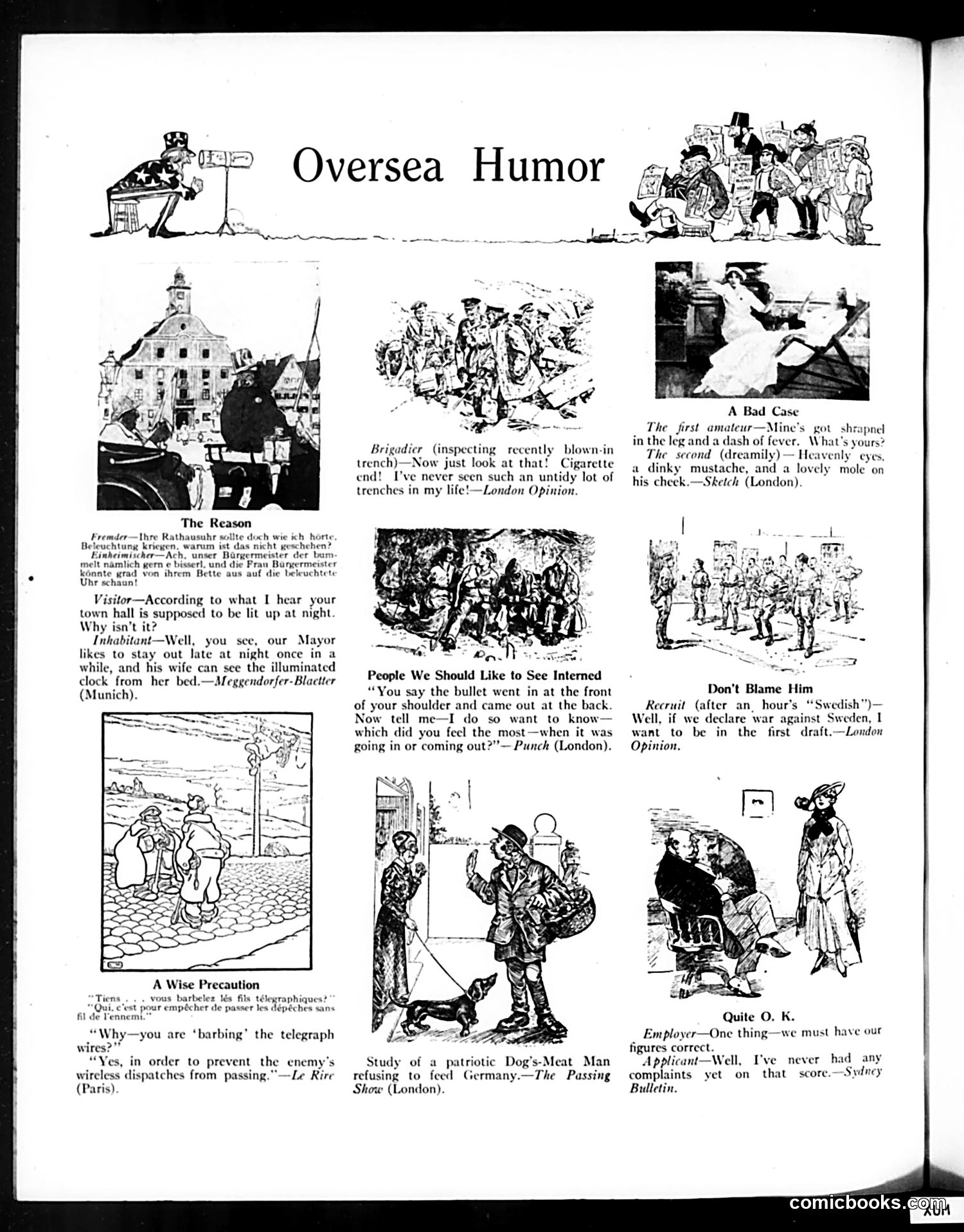
This page collects humorous cartoons and jokes from European and British publications during World War I, translated for American readers. The cartoons mock wartime absurdities: a German town official won't illuminate the town hall clock because his wife enjoys seeing it from bed at night; French soldiers absurdly barb telegraph wires to block "enemy wireless" (a confused conflation of technologies); a pompous British brigadier obsesses over cigarette butts in trenches while ignoring actual combat conditions. Other items satirize military incompetence—a doctor's oddly clinical question about bullet wounds, and a recruit so traumatized by Swedish calisthenics that he prefers declaring war on Sweden to enduring more exercise. The final cartoon depicts a patriotic German meat-seller refusing to feed Germany (unclear intent—possibly anti-German sentiment or meat rationing commentary). These represent typical WWI-era satirical humor: mocking bureaucratic incompetence, military pretension, and wartime absurdity across allied nations.
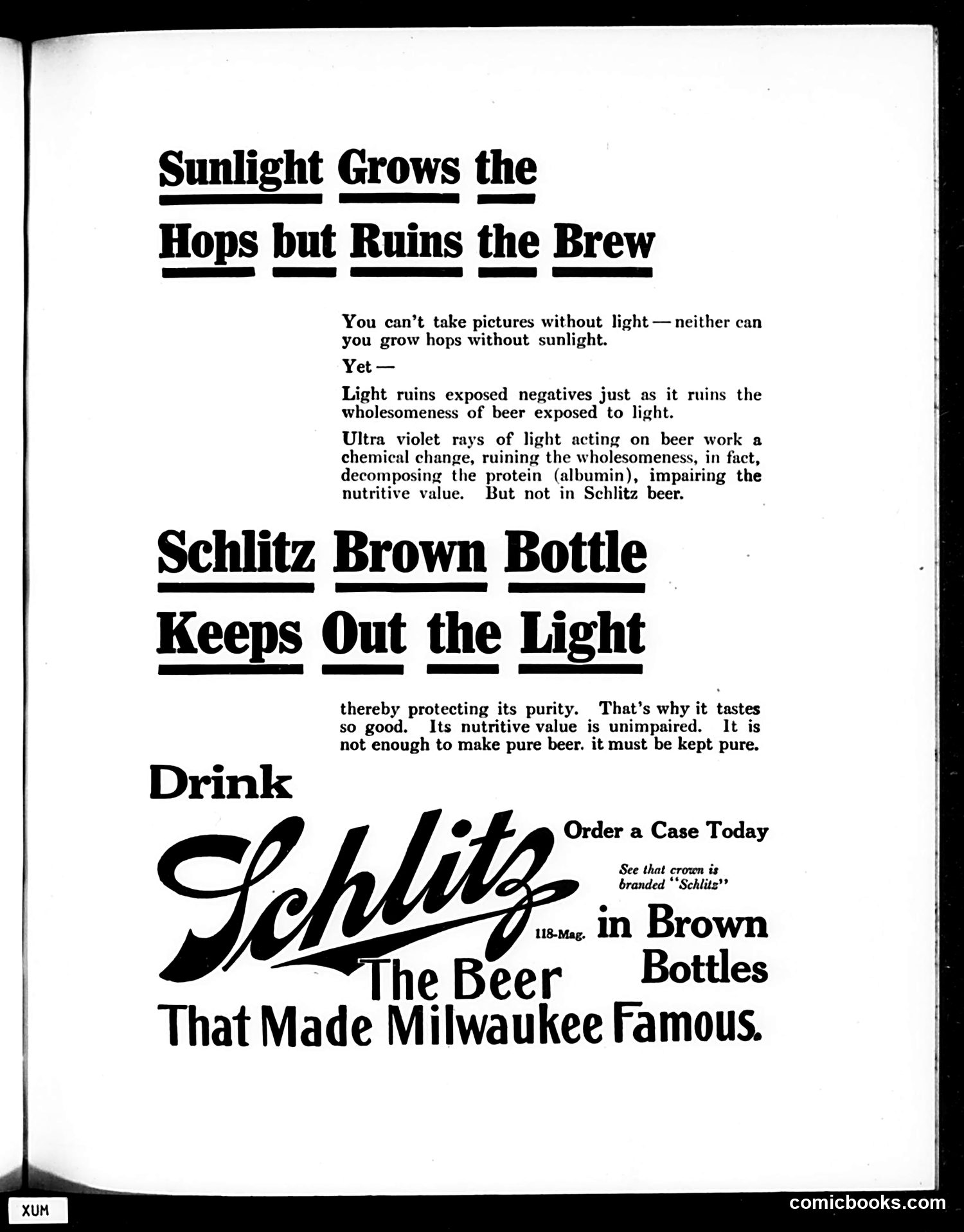
This is an advertisement, not a political cartoon. It promotes Schlitz beer's distinctive brown bottle as a scientific innovation. The ad exploits contemporary understanding of UV light damage to explain why Schlitz uses brown glass: ultraviolet rays chemically degrade beer's proteins and nutritional value, similar to how light ruins photographic negatives. The argument is that while sunlight is necessary to grow hops, it ruins the finished product—*unless* protected by brown bottles. The tagline "The Beer That Made Milwaukee Famous" references Milwaukee's dominance in American beer production during the early 20th century. For modern readers, this highlights how brewers marketed scientific rationales for packaging choices, and how "purity" was a key selling point in beer advertising before modern food safety regulations.
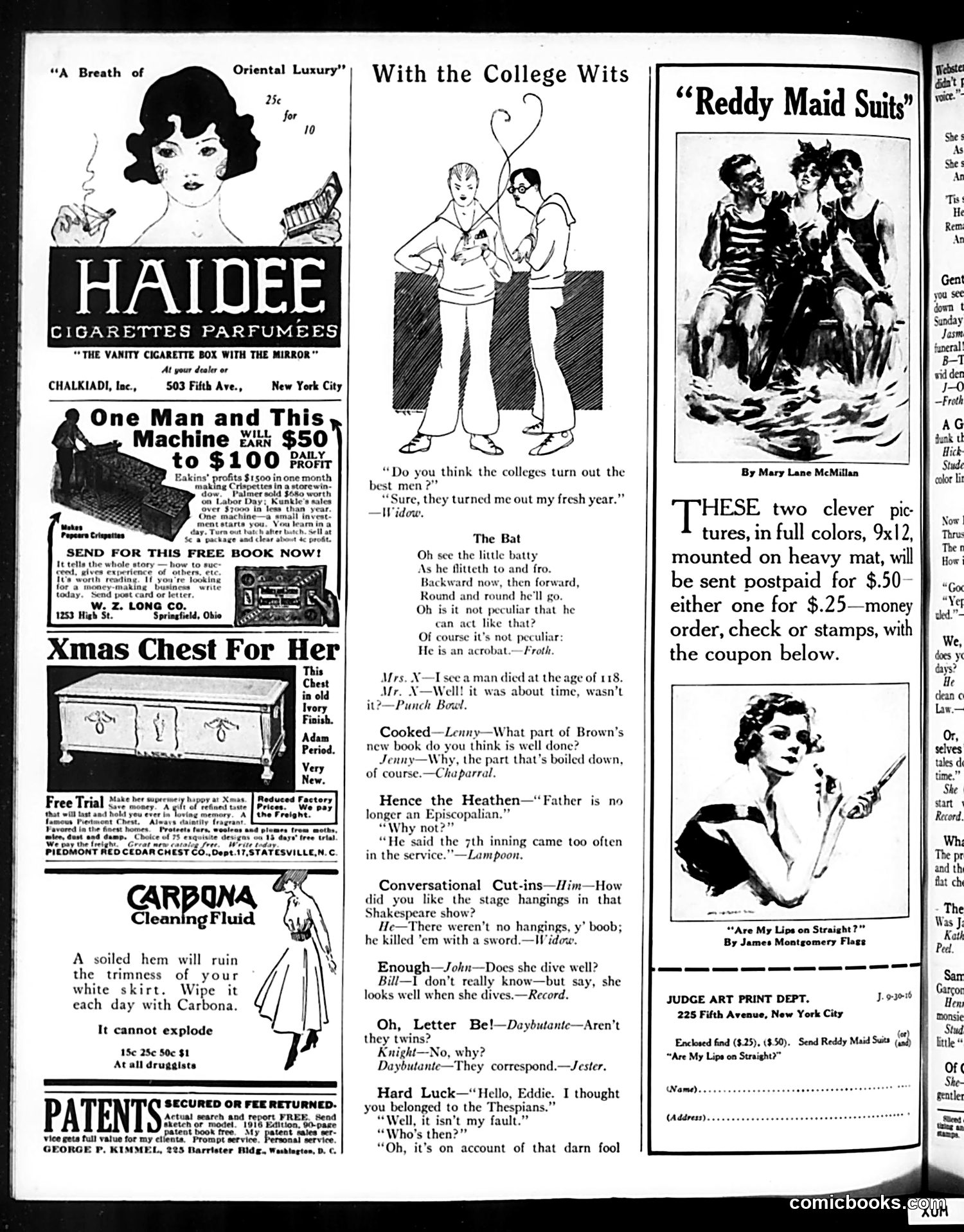
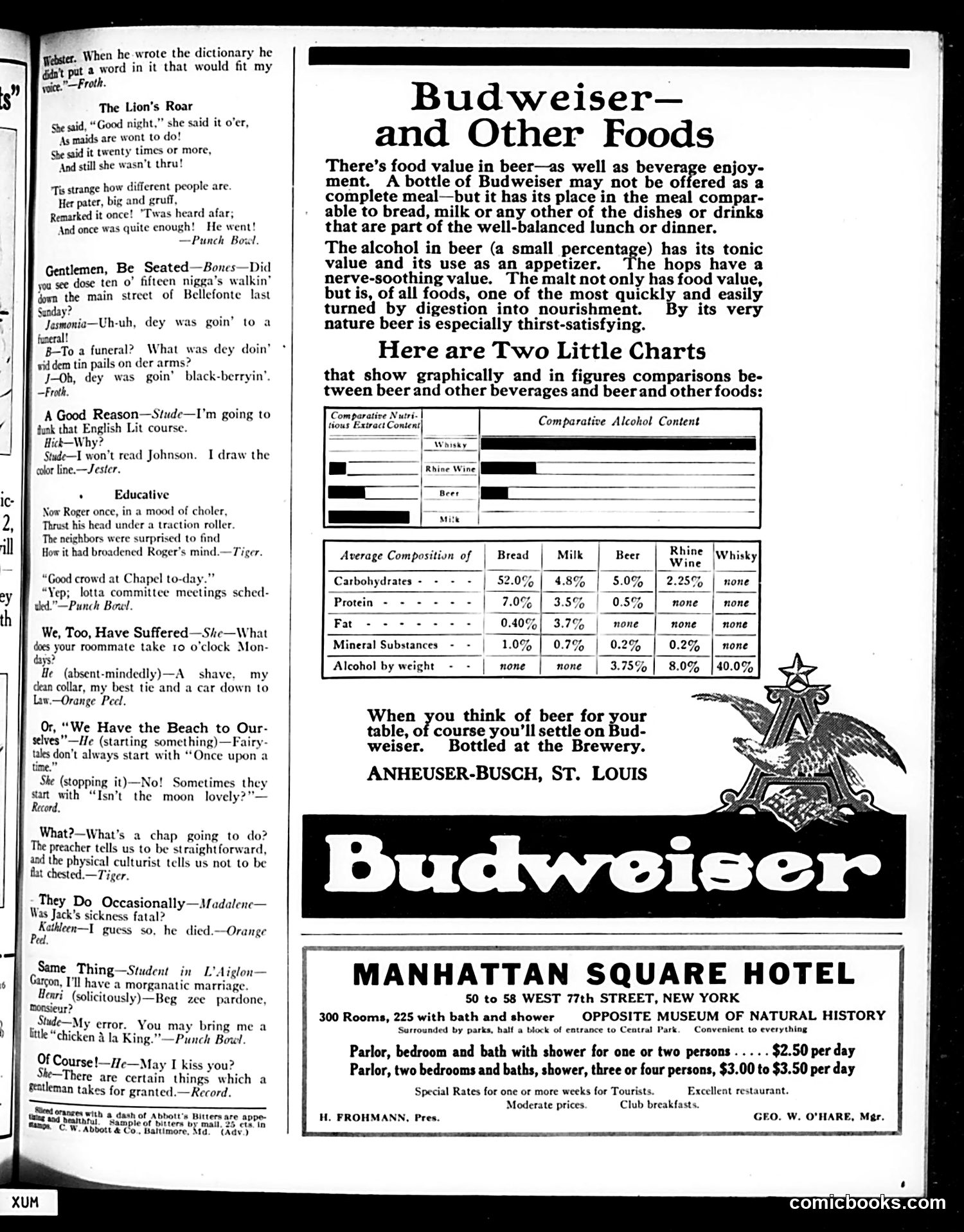
This page contains primarily **advertising content** rather than political satire. The dominant feature is a full-page **Budweiser advertisement** from Anheuser-Busch, St. Louis. The ad argues that beer has legitimate nutritional and health value—a claim that appears designed to counter Prohibition sentiment. It includes comparative charts showing beer's alcohol content versus whisky and wine, and its nutritional composition compared to bread and milk, positioning beer as part of a "well-balanced lunch or dinner." The ad emphasizes beer's "tonic value," "nerve-soothing" properties, and digestibility. The left column contains humor pieces (jokes and short comedic sketches) typical of Judge magazine, though these are unrelated to the advertisement. **Historical Context**: This advertisement likely dates to the pre-Prohibition era (before 1920) or possibly the early 1930s, when the beverage industry promoted beer's health benefits to defend against temperance movements that ultimately led to Prohibition.
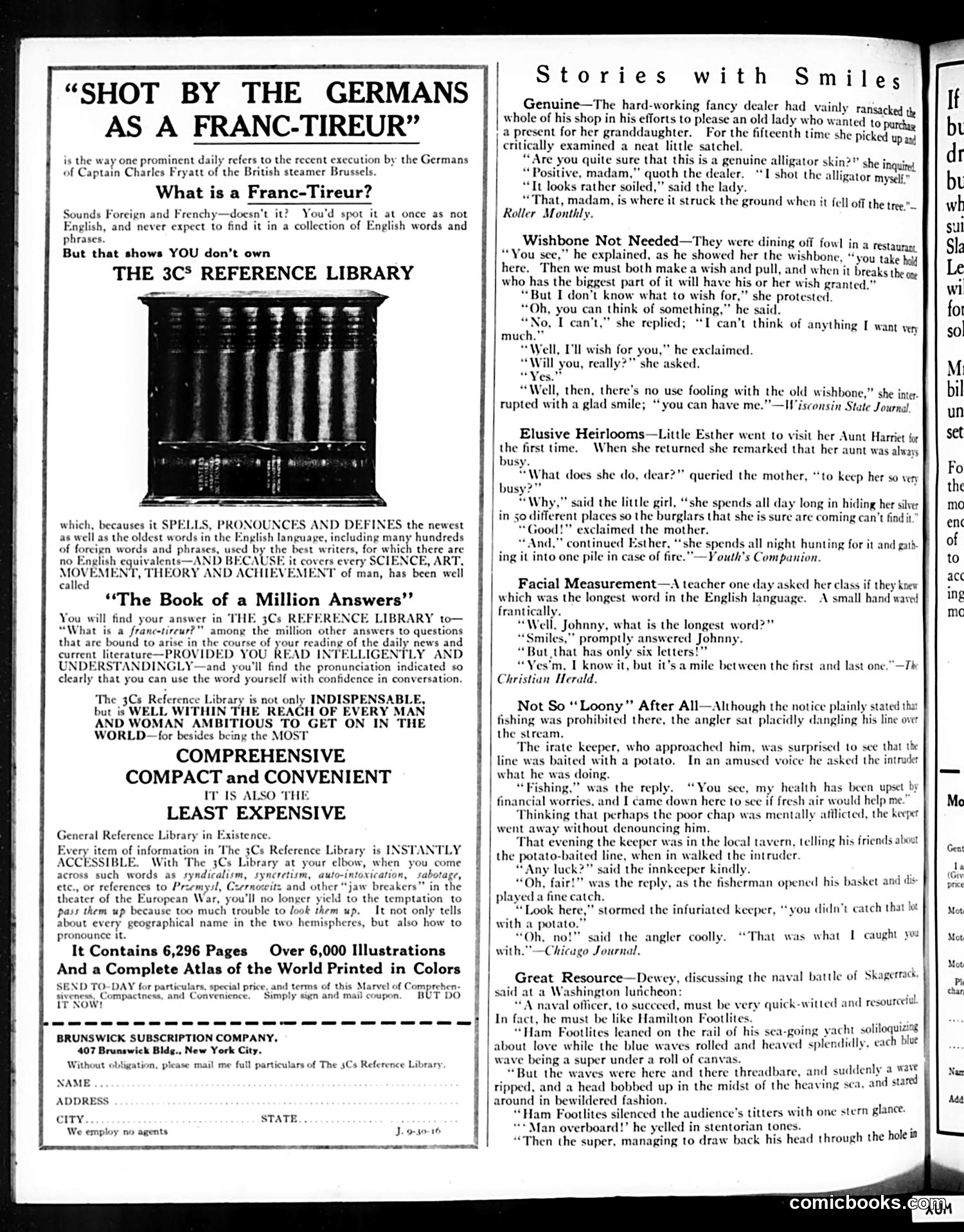
This page is primarily **advertising** for the 3C's Reference Library, a comprehensive encyclopedia-style reference work. The headline "Shot by the Germans as a Franc-Tireur" references a then-current WWI controversy: Captain Charles Fryatt's execution by Germans, who accused him of acting as a civilian combatant ("franc-tireur"—a French term for irregular fighter). The advertisement uses this topical news event as a hook: readers encountering unfamiliar foreign terms or war references in newspapers need this reference book to understand current events. The appeal is to educated, ambitious readers wanting to keep up with daily news and appear knowledgeable. The page also includes light humorous anecdotes ("Stories with Smiles") about retail transactions and courtship—typical filler content for magazines of this era. These are unrelated to the main advertising pitch but provided entertainment value. The overall message: this reference work makes you informed and confident in conversation about contemporary world events.
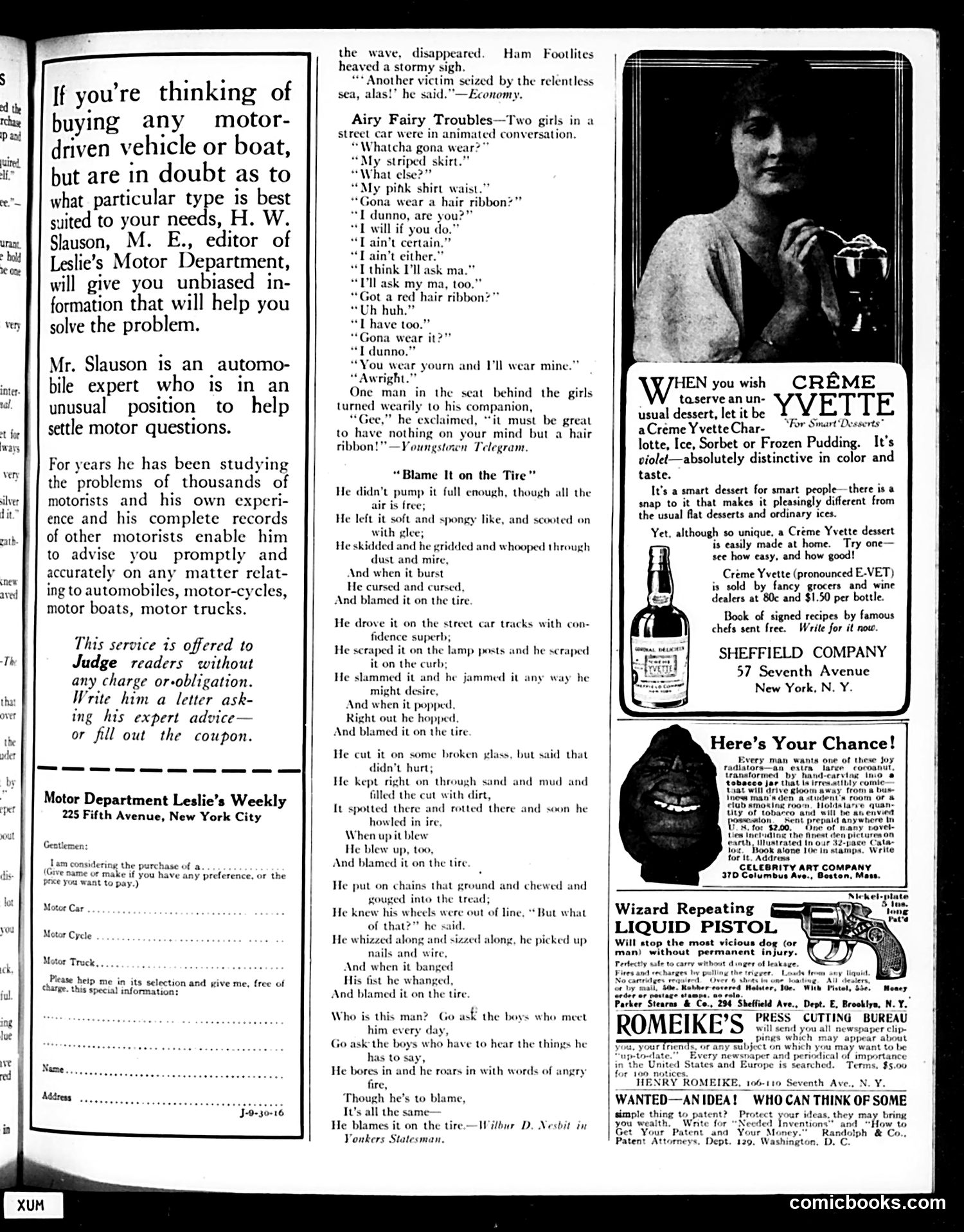
This page contains **primarily advertisements and humorous poetry**, not political cartoons. The main satirical content is a poem titled **"Blame It on the Tire"** by Wilbur D. Nesbit. It mocks a negligent motorist who mistreats his automobile—underinflating tires, driving recklessly, hitting obstacles, and accumulating damage—then blames the tire itself when it inevitably fails. The joke is the man's refusal to accept personal responsibility; he abuses the equipment then complaints about its "defects." The poem satirizes **common excuses and poor judgment** among early automobile owners, poking fun at drivers who lack mechanical knowledge or care. The left column advertises H.W. Slauson's expert automotive advice service through Leslie's Motor Department—a genuine service offering, not satire. The remaining content consists of product advertisements (Crème Yvette dessert, patent services, etc.).
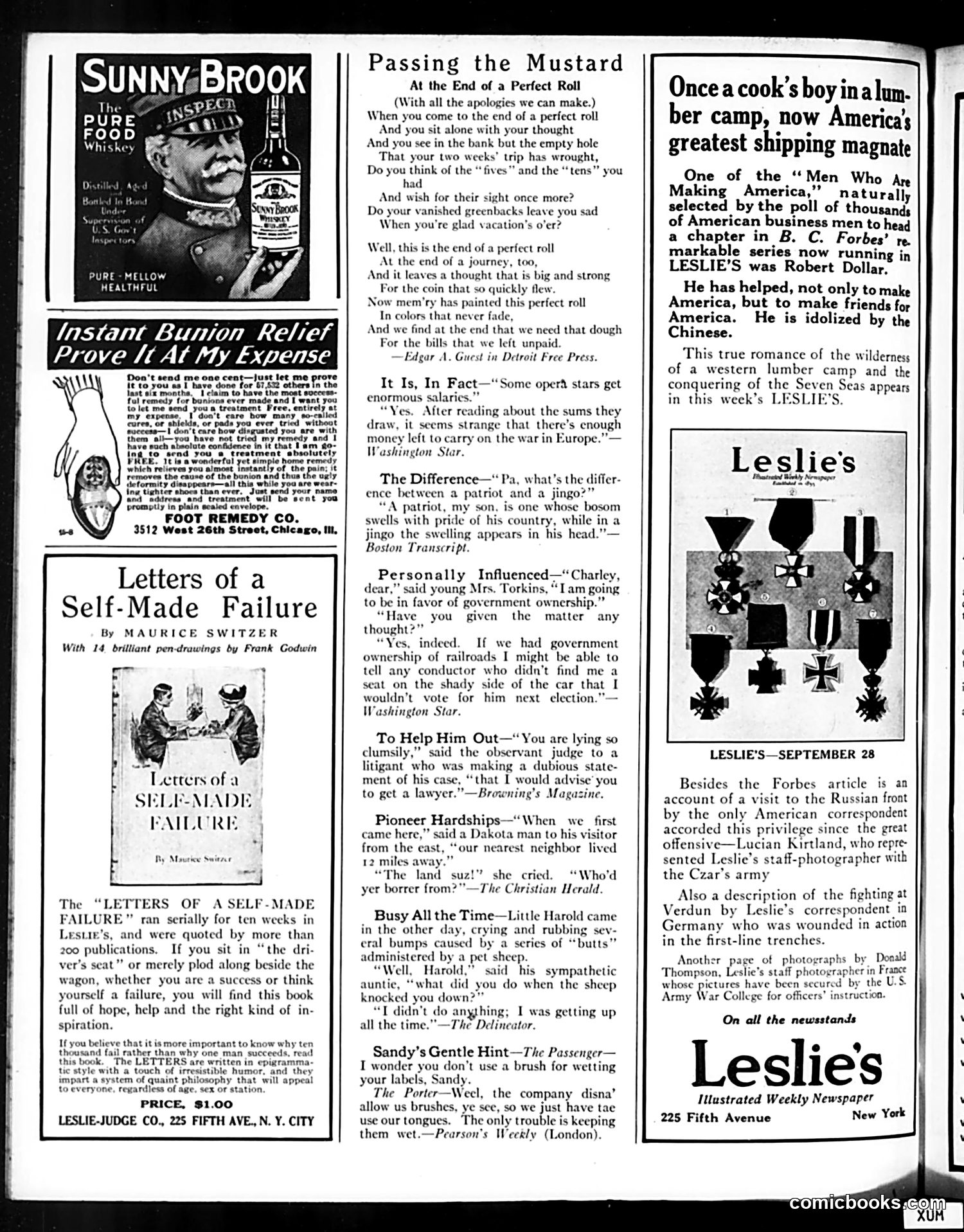
This page is primarily **advertising and filler content** from Leslie's Illustrated Weekly Newspaper, not a political cartoon page. The visible content includes: 1. **Advertisements** for Sunny Brook Whiskey, a bunion remedy, and a self-help book ("Letters of a Self-Made Failure") 2. **Humorous short jokes and anecdotes** under headings like "Passing the Mustard" and "It Is, In Fact"—these are light satirical commentary on contemporary life (vacation spending, opera star salaries, patriotism vs. jingoism, government railroad ownership) 3. A **Leslie's Magazine advertisement** featuring military medals and honors The jokes reference WWI-era concerns ("enough money left to carry on the war in Europe") and early 20th-century social issues. The humor is mild and domestic rather than sharply political. This appears to be a typical potpourri page mixing advertisements with brief satirical quips—common filler in period magazines.
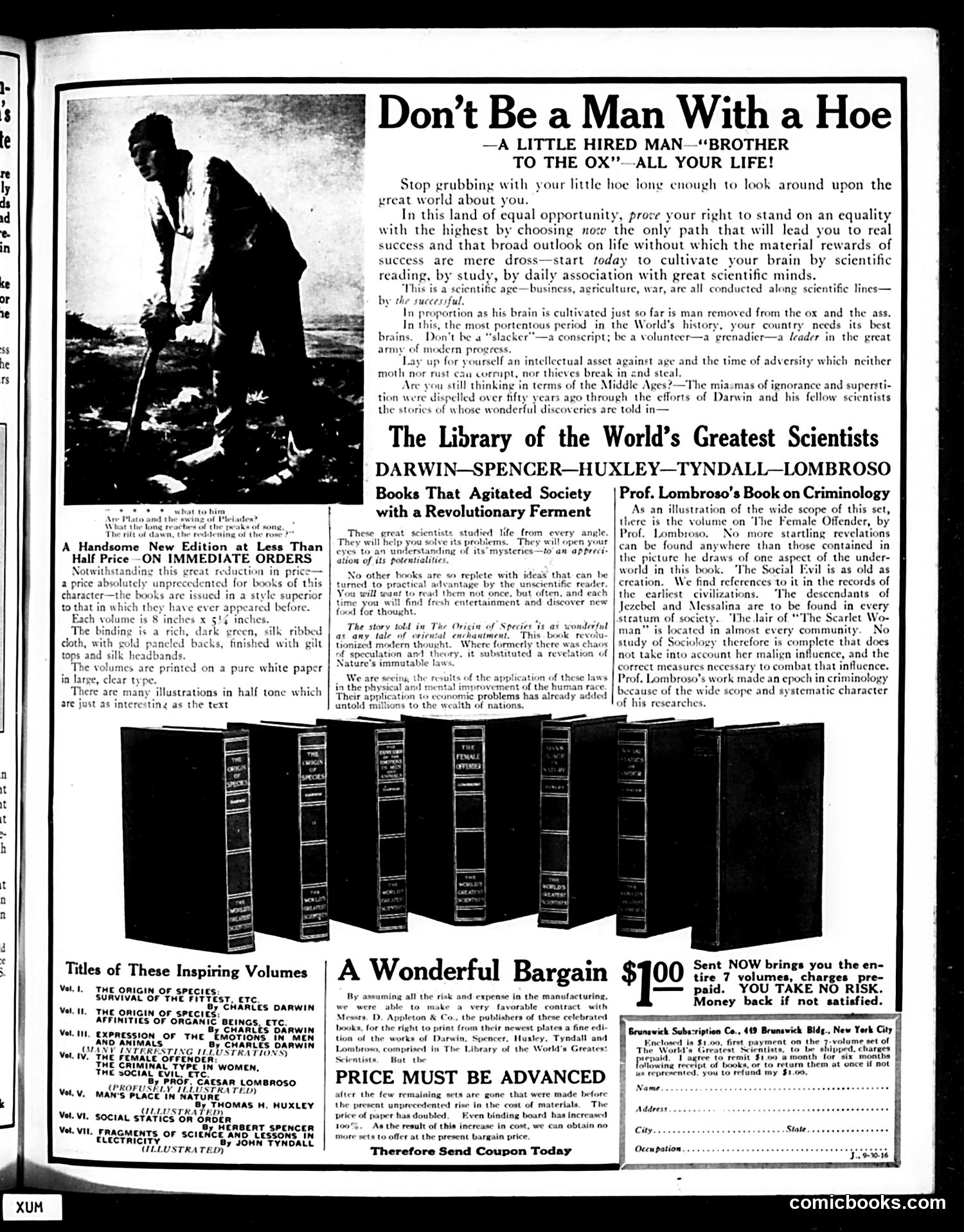
This page combines a social commentary cartoon with advertising for a book series. The headline "Don't Be a Man With a Hoe" references a famous 1885 poem by Edwin Markham critiquing agricultural labor and exploitation. The accompanying image shows a laborer bent over his work. The satirical message exhorts working-class men to educate themselves through reading scientific works rather than remaining trapped in manual labor. It promotes the "Library of the World's Greatest Scientists"—featuring Darwin, Spencer, Huxley, and Lombroso—as the path to social mobility and intellectual advancement. The rhetoric appeals to Progressive Era values (early 1900s): faith in science as liberating, self-improvement through education, and intellectual cultivation as a means to escape poverty. The phrase "don't be a 'slacker'" uses contemporary WWI-era language. This is primarily an advertisement disguised as social commentary, selling expensive books to aspirational readers by framing ignorance as a form of servitude and education as the route to equality and success.
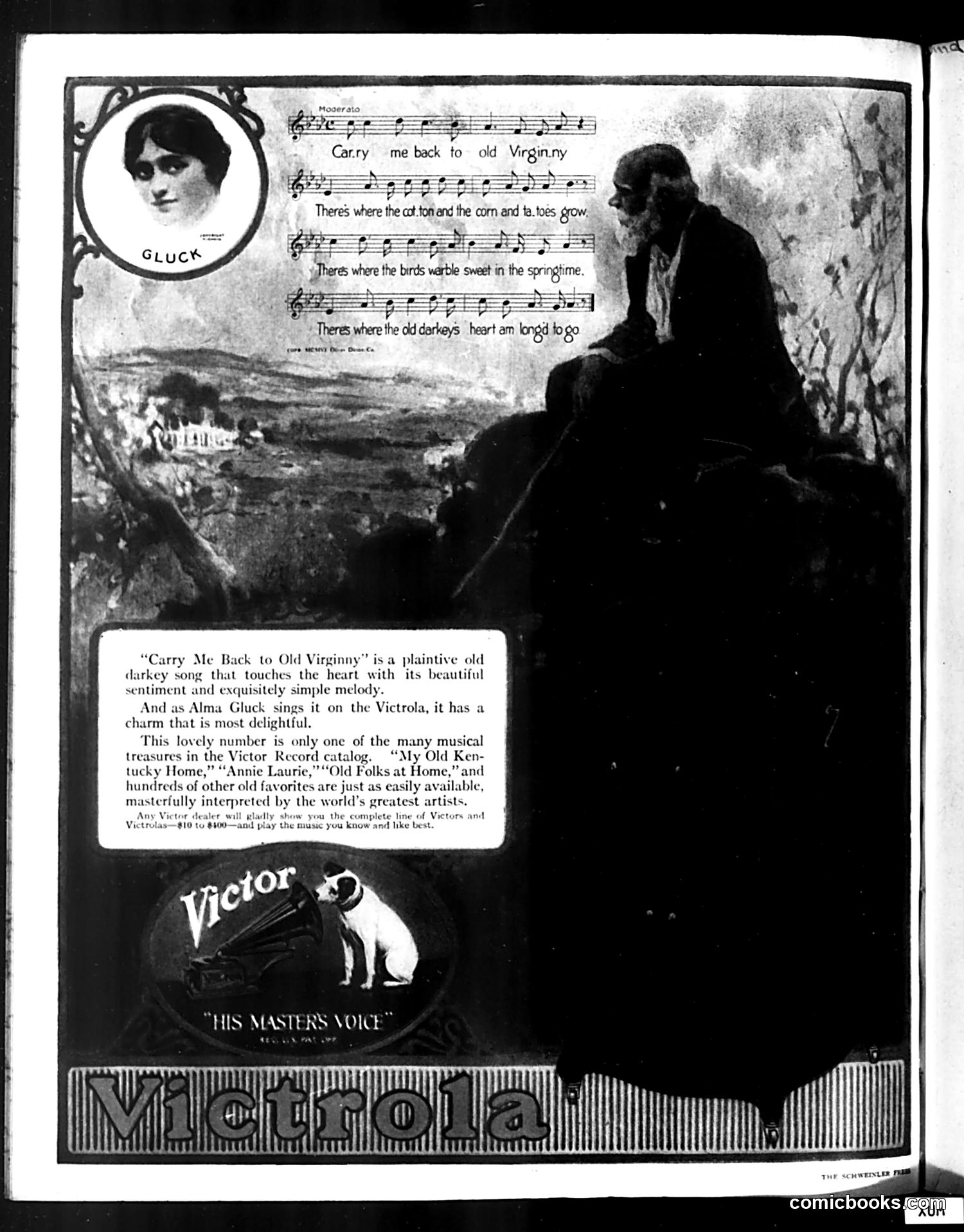
This is a **Victor Victrola phonograph advertisement** disguised as editorial content in *Judge* magazine. The page features singer Alma Gluck (identified in the circular portrait) performing "Carry Me Back to Old Virginny." The advertisement uses sentimental nostalgia to market records, claiming the song is a "plaintive old darkey song" that touches hearts. The text emphasizes Victor's catalog of "old favorites" performed by "the world's greatest artists." This reflects early 20th-century marketing that exploited minstrelsy-era songs and racial stereotypes ("darkey") to sell products. The image shows a man gazing wistfully at a Virginia landscape—visualizing the song's sentimental appeal about the antebellum South. For modern readers: this represents how mainstream media and advertising normalized racist language and romanticized the pre-Civil War South through popular music, treating exploitative entertainment as wholesome nostalgia worthy of commercial promotion.