
Judge, 1916-09-30 · page 19 of 28
Judge — September 30, 1916 — page 19: what you’re looking at
What you’re looking at
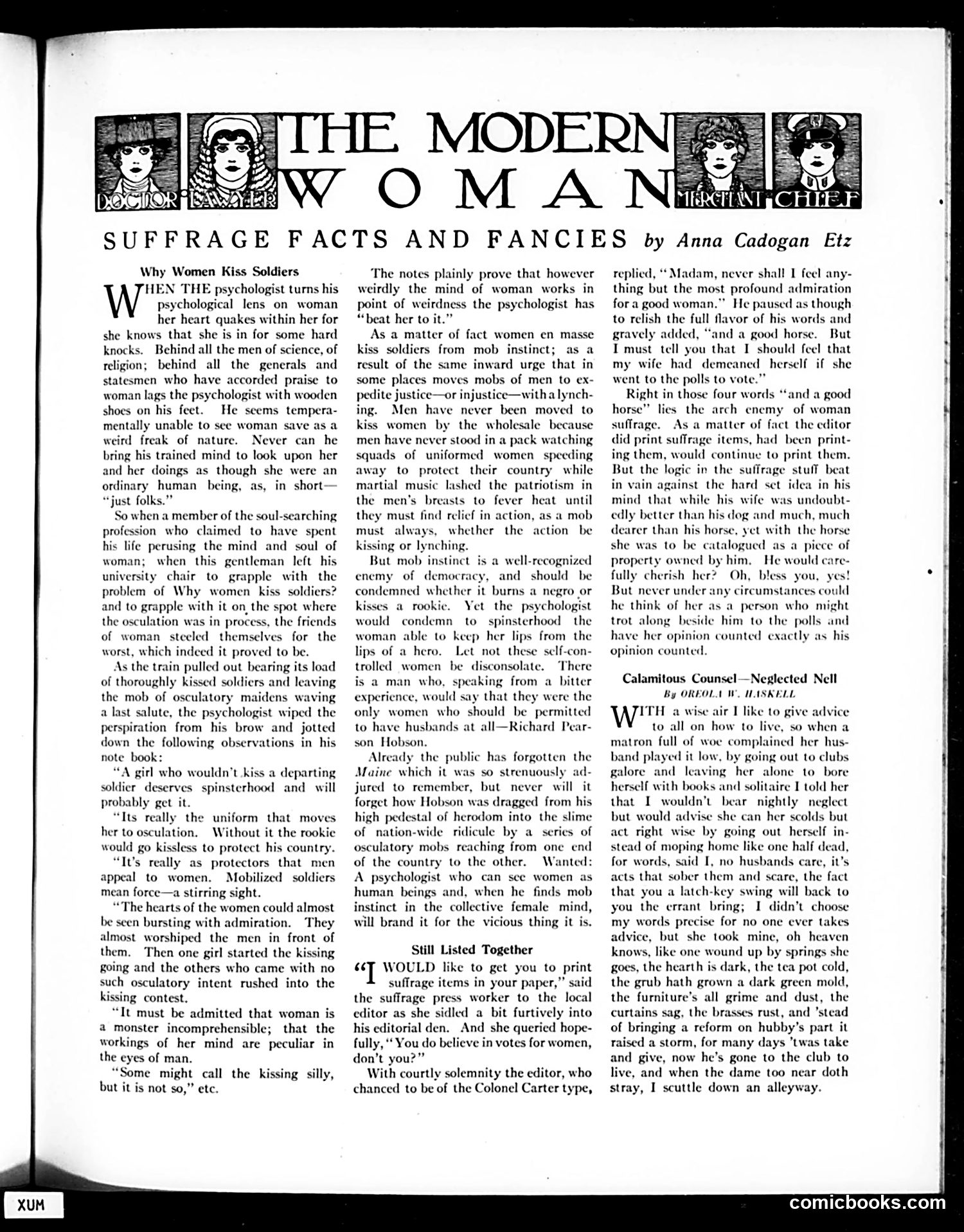
This page satirizes a psychologist's patronizing analysis of why women kiss departing soldiers during WWI. The author (Anna Cadogan Etz) mocks his pseudo-scientific condescension toward women's behavior, noting he views them as "weird freaks of nature" rather than ordinary humans. The satire's core: the psychologist condemns women's mob kissing instinct as irrational, yet ignores that men's mobs commit lynching—similarly driven by collective emotion. Etz further exposes hypocrisy by invoking Richard Pearson Hobson, a celebrated war hero who faced public ridicule when women kissed him en masse, proving society celebrates soldier-kissing until it becomes undeniable. The piece implicitly argues for women's suffrage by demonstrating how women are judged irrationally by "experts" while denied equal standing as citizens. Women's wartime support is simultaneously demanded and despised.
📄 Transcribed text from this page (OCR, searchable)
Machine-transcribed from the original scan — historical spelling and the odd misread are preserved.
VW OMA SUFFRAGE FACTS AND FANCIES by Anna Cadogan Etz Why Women Kiss Soldiers HEN THE psychologist turns his psychological lens on woman her heart quakes within her for she knows that she is in for some hard knocks. Behind all the men of science, of religion; behind all the generals and statesmen who have accorded praise to woman lags ist with wooden shoes on his feet. He seems tempera- mentally unable to see woman save as a weird freak of nature. Never can he bring his trained mind to look upon her and her doings as though she were an ordinary human being, as, in short “just folks.” So when a member of the soul-searching profession who claimed to have spent his life perusing the mind and soul of woman; when this gentleman left his university chair to grapple with the problem of Why women. kiss soldiers? and to grapple with it on, the spot where the osculation was in process, the friends of woman steeled themselves for the worst, which indeed it proved to be. As the train pulled out bearing its load of thoroughly kissed soldici nd leaving the mob of osculatory maidens waving a last salute, the psychologist wiped the perspiration from his brow and jotted down the following observations in his note book: “A girl who wouldn’t kiss a departing soldier deserves spinsterhood and will probably get it. “Its really the uniform that moves her to osculation. Without it the rooki would go kissless to protect his country. “It’s really as protectors that men appeal to women. Mobilized soldiers mean force—a stirring sight. “The hearts of the women could almost be seen bursting with admiration. They almost worshiped the men in front of them. Then one girl started the kissing going and the others who came with no such osculatory intent rushed into the kissing contest. “It must be admitted that woman is a monster incomprehensible; that the workings of her mind are peculiar in yes “Some might call the kissing silly, but it is not so,” ete. The notes plainly prove that however weirdly the mind of woman works in point of weirdness the psycholo; “beat her to it.” As a matter of fact women en masse kiss soldiers from mob instinct; a result of the same inward urge that in some places moves mobs of men to ex- pedite justice—or injustice—with a lynch- Men have never been moved to women by the wholesale because men have never stood in a pack watching squads of uniformed women speeding away to protect their country while martial music lashed the patriotism in the men’s breasts to fever heat until they must find relief in action, as a mob must always, whether the action be kissing or lynching. But mob instinct is a well-recognized enemy of democracy, and should be condemned whether it burns a negro or kisses a rookie. Yet the psychologist would condemn to spinsterhood the woman able to keep her lips from the lips of a hero. Let not these self-con- trolled women be disconsolate. There is a man who, speaking from a bitter experience, would say that they were the only women who should be permitted to have husbands at all—Richard Pear- son Hobson. Already the public has forgotten the Maine which it was so strenuously ad- jured to remember, but never will it forget how Hobson was dragged from his high pedestal of herodom into the slime of nation-wide ridicule by a series of osculatory mobs reaching from one end of the country to the other. Wanted: A psychologist who can sce women as human beings and, when he finds mob instinct in the collective female mind, will brand it for the vicious thing it is. Still Listed Together 667] WOULD like to get you to print suffrage items in your paper,” said the suffrage press worker to the local editor as she sidled a bit furtively into his editorial den, And she queried hope- fully, “ You do believe in votes for women, don’t you?” With courtly solemnity the editor, who chanced to be of the Colonel Carter type, *Madam, never shall I feel any- Imiration replied, thing but the most profound fora good woman.” He s to relish the full flavor of his words and gravely added, “and a good horse. But I must tell you that I should feel that my wife had demeaned herself if she went to the polls to vote.”” Right in those four words ‘and a good horse” lies the arch enemy of woman suffrage. matter of fact the editor did print suffrage items, had been print- ing them, would continue to print them. But the logic in the suffrage stuff beat in vain against the hard set idea in his mind that while his wife was undoubt- edly better than his dog and much, much dearer than his horse, yet with the horse she was to be catalogued as a piece of property owned by him, He would care- fully cherish her? Oh, bless you, yes! But never under any circumstances could he think of her as a person who might trot along beside him to the polls and have her opinion counted exactly as his opinion counted. Calamitous Counsel—Neglected Nell By OREOLA W. HASKELL ITH a wise air I like to give advice to all on how to live, so when a matron full of woe complained her hus- band played it low, by going out to clubs galore and leaving her alone to. bore herself with books and solitaire I told her that I wouldn’t bear nightly neglect but would advise she can her scolds but act right wise by going out herself in- stead of moping home like one half dead, for words, said I, no husbands care, it’s acts that sober them and scare, the fz that you a latch-ke i you the errant bring; I didn’t choose my words precise for no one ever takes advice, but she took mine, oh heaven knows, like one wound up by springs she goes, the hearth is dark, the tea pot cold, the grub hath grown a dark green mold, the furniture’s all grime and dust, the curtains sag, the brasses rust, and ’stead of bringing a reform on hubby’s part it raised a storm, for many days ‘twas take and give, now he’s gone to the club to live, and when the dame too near doth stray, I scuttle down an alleyway. comicbooks.com