
Judge, 1916-09-30 · page 12 of 28
Judge — September 30, 1916 — page 12: what you’re looking at
What you’re looking at
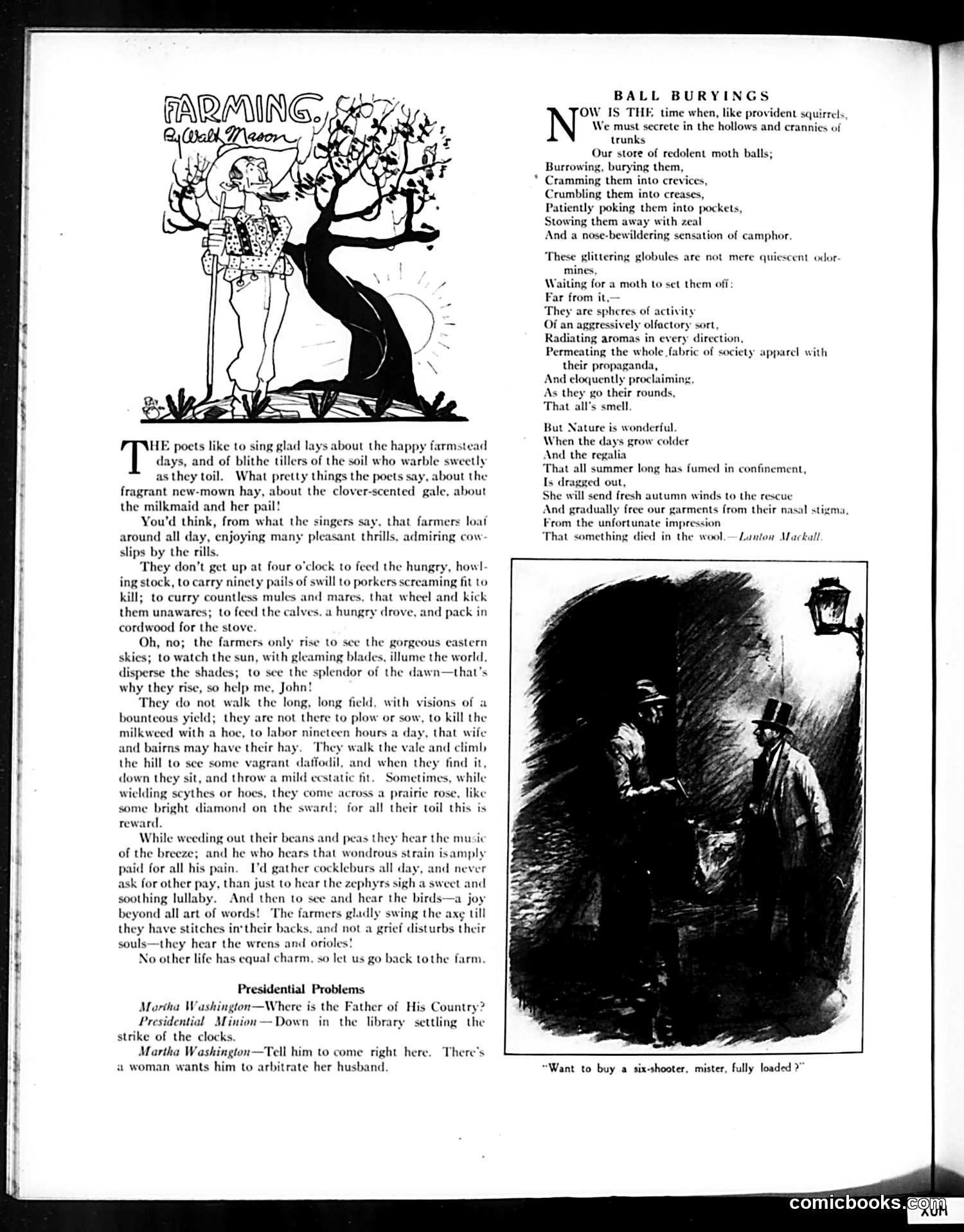
This Judge magazine page contains three distinct satirical pieces: **"Farming"** mocks Romantic poetry's idealization of farm life. The text sarcastically contrasts poets' sentimental verses about pastoral beauty with the harsh reality: farmers wake at 4 a.m. for grueling physical labor—feeding livestock, hauling swill, working nineteen-hour days. The satire exposes how literature romanticizes agricultural work while ignoring its brutal drudgery. **"Ball Buryings"** humorously describes storing mothballs for winter—their aggressive odor permeating clothing and furniture. The joke plays on the unpleasant reality versus the poetic notion of seasonal preparation. **"Presidential Problems"** (a brief comic exchange) appears to reference President Washington arbitrating labor disputes. Martha Washington seeks him to settle a marital disagreement, suggesting the president is busy mediating even domestic conflicts—likely commentary on labor unrest or political intervention during this period. The illustration shows a figure in dark clothing with a lantern, possibly relating to one of these pieces, though its specific connection is unclear.
📄 Transcribed text from this page (OCR, searchable)
Machine-transcribed from the original scan — historical spelling and the odd misread are preserved.
days, and of blithe tillers of the soil who warble sweetly as they toil. What pretty things the poets say, about the fragrant new-mown hay, about the clover-scented gale, about the milkmaid and her p You'd think, from what the singers say, that farmers loaf around all day, enjoying many pleasant thrills, admiring cow slips by the rills. They don’t get up at four o'clock to feed the hungry, how! ing stock, to carry ninety pails of swill to porkers screaming fit to kill; to curry countless mules and mares, that wheel and kick them unawares; to feed the calves. a hungry drove, and pack in cordwood for the stove. Oh, no; the farmers only rise to see the gorgeous eastern skies; to watch the sun, with gleaming blades, illume the world, disperse the shades; to see the splendor of the dawn—that why they rise, so help me, John! They do not walk the long, long field, with visions of bounteous yield; they are not there to plow or sow, to kill the milkweed with a hoe, to labor nineteen hours a day, that wife and bairns may have their hay. They walk the vale and climb the hill to see some vagrant daffodil, and when they find it, down they sit, and throw a mild ecstatic fit. Sometimes, while wiclding scythes or hoes, they come across a prairie rose, like some bright diamond on the sward; for all their toil this is reward. While weeding out their beans and peas they hear the music of the breeze; and he who hears that wondrous strain isamply paid for all his pain. I'd gather cockleburs all day, and never ask for other pay, than just to hear the zephyrs sigh a sweet and soothing lullaby. And then to see and hear the birds—a joy beyond all art of words! The farmers gladly swing the axe till they have stitches in their backs, and not a grief disturbs their souls—they hear the wrens and orioles! No other life has equal charm, so let us go back tothe farm. Presidential Problems Mortha Washington—Where is the Father of His Country? Presidential Minion—Down in the library settling the strike of the clocks. Martha Washington—Tell him to come right here. There's a woman wants him to arbitrate her husband. BALL BURYINGS N* IS THE time when, like provident squirrels We must secrete in the hollows and crannies of trunks Our store of redolent moth balls; Burrowing, burying them, Cramming them into cri . Crumbling them into creases, Patiently poking them into pockets, Stowing them away with zea And a nose-bewildering sensation of camphor. These glittering globules are not mere quiescent odor- mines Waiting for a moth to set them off Far from it, They are spheres of activity Of an aggressively olfactory sort, Radiating aromas in every: direction, Permeating the whole fabric of society apparel with their propa And eloquently proc As the their rounds, That all's smell But Nature is wonderful. When the days grow colder And the regalia That all summer long has fumed in confinement, Is dragged out, She will send fresh autumn winds to the rescue And gradually free our garments from their nasal stigma, From the unfortunate impression That something died in the wool.—Lanton Mackall “Want to buy a six-shooter, mister, fully loaded >” comicbooks.