
A complete issue · 28 pages · 1916
Judge — June 17, 1916
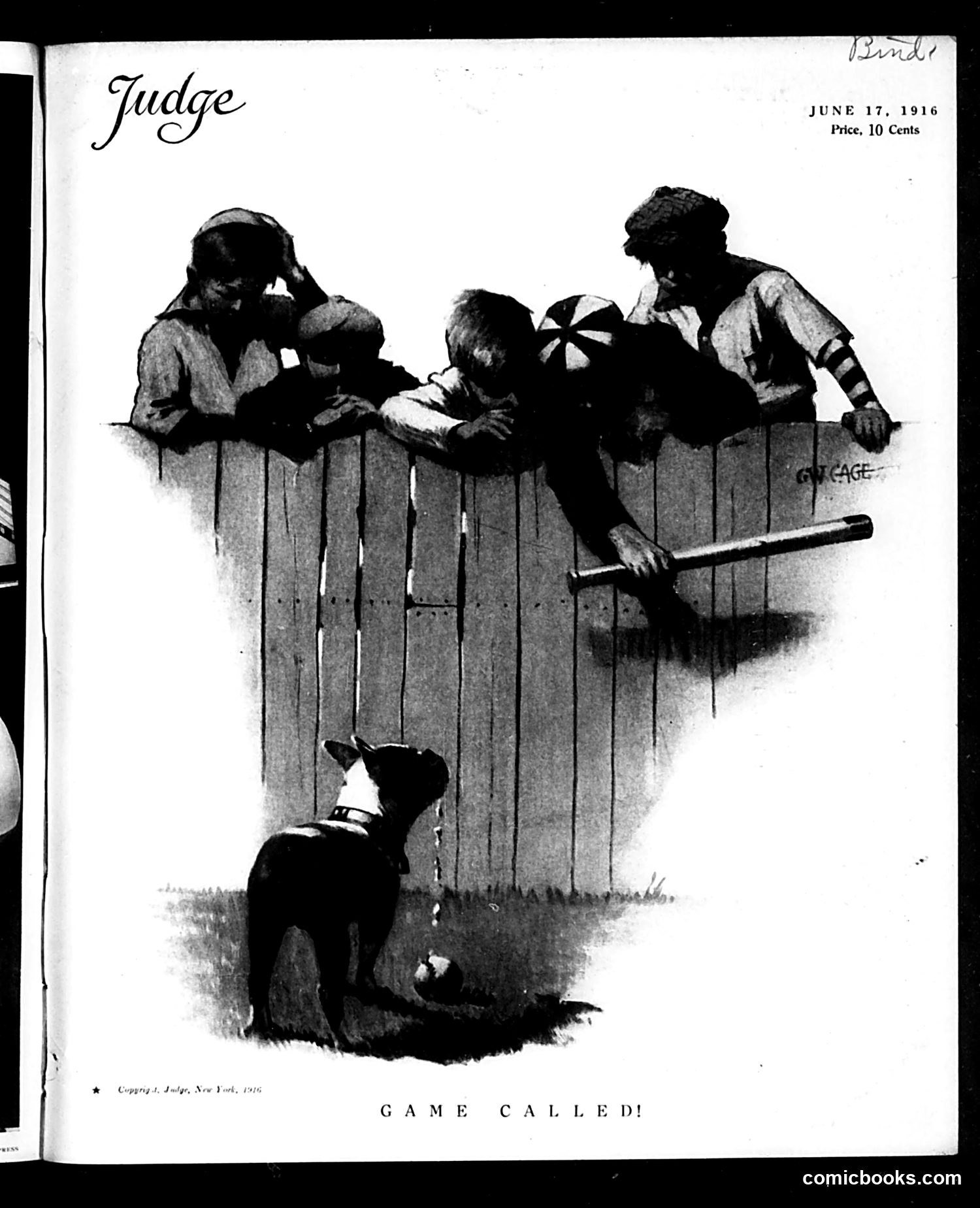
This cartoon depicts children playing baseball behind a wooden fence, with a dog below appearing to disrupt the game. The title "Game Called!" suggests the game has been interrupted or stopped. The image likely comments on childhood play or leisure, though without additional context from the magazine's text, the specific political or social reference is unclear. It may satirize interruptions to American pastimes, or possibly reference contemporary events of 1916. The dog's presence suggests an external disruption to an otherwise orderly activity. The illustration style and composition are typical of Judge's satirical approach, using everyday scenes to comment on broader social conditions, but the exact target of satire remains uncertain without accompanying article text.
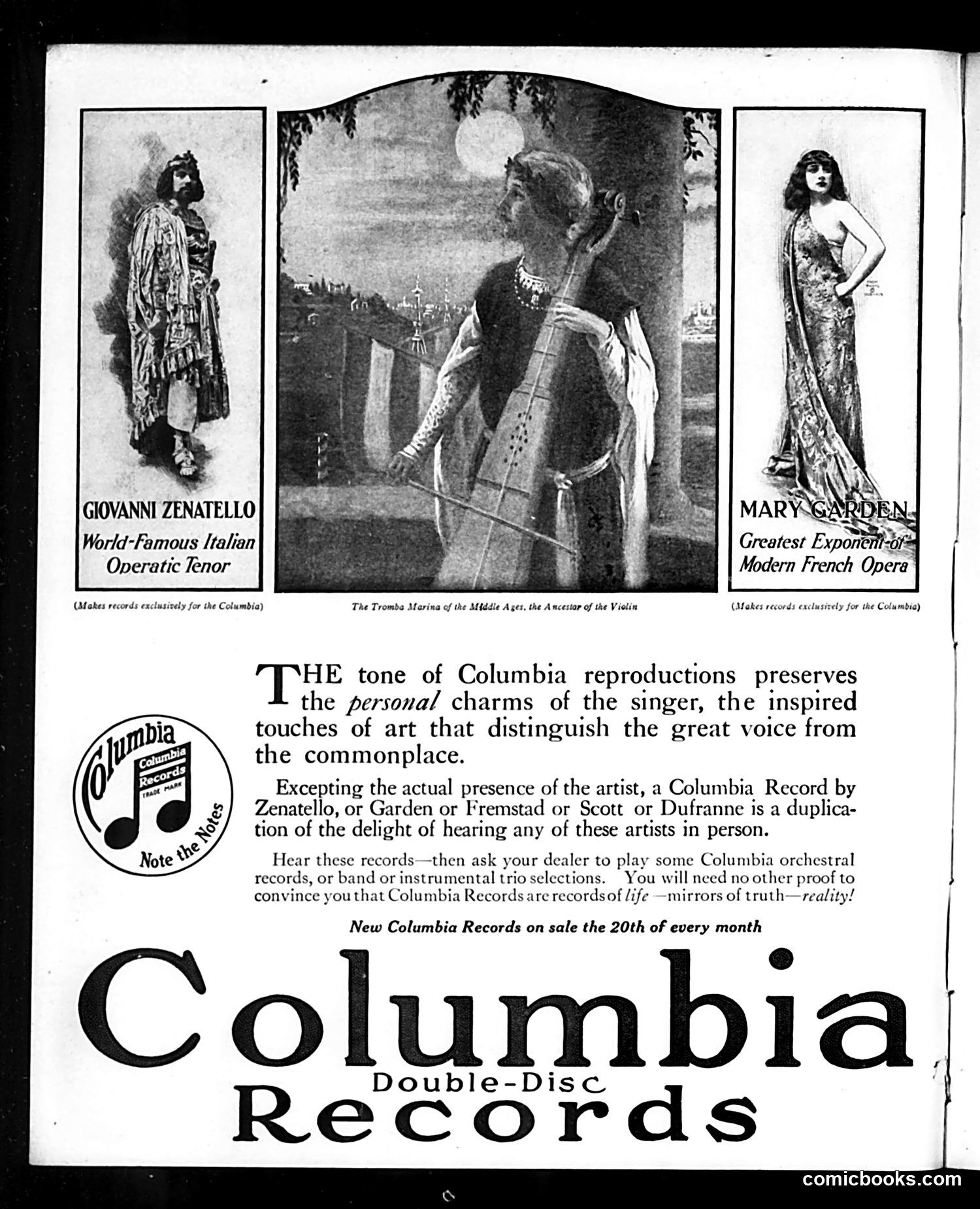
This is primarily a **commercial advertisement**, not satire or political commentary. It promotes Columbia's "Double-Disc Records" featuring three opera singers: Giovanni Zenatello (Italian tenor), an unnamed performer in the center image (playing cello, depicted in a medieval scene), and Mary Garden (identified as "Greatest Exponent of Modern French Opera"). The ad's appeal is straightforward: Columbia claims their recordings capture artists' "personal charms" and "inspired touches of art" better than competitors. The text argues that hearing these records is nearly equivalent to experiencing live performances. The only potentially satirical element is the phrase "records of life—mirrors of truth—reality," which somewhat grandly overstates the fidelity of early phonograph technology. Otherwise, this is direct product marketing to affluent consumers interested in opera.
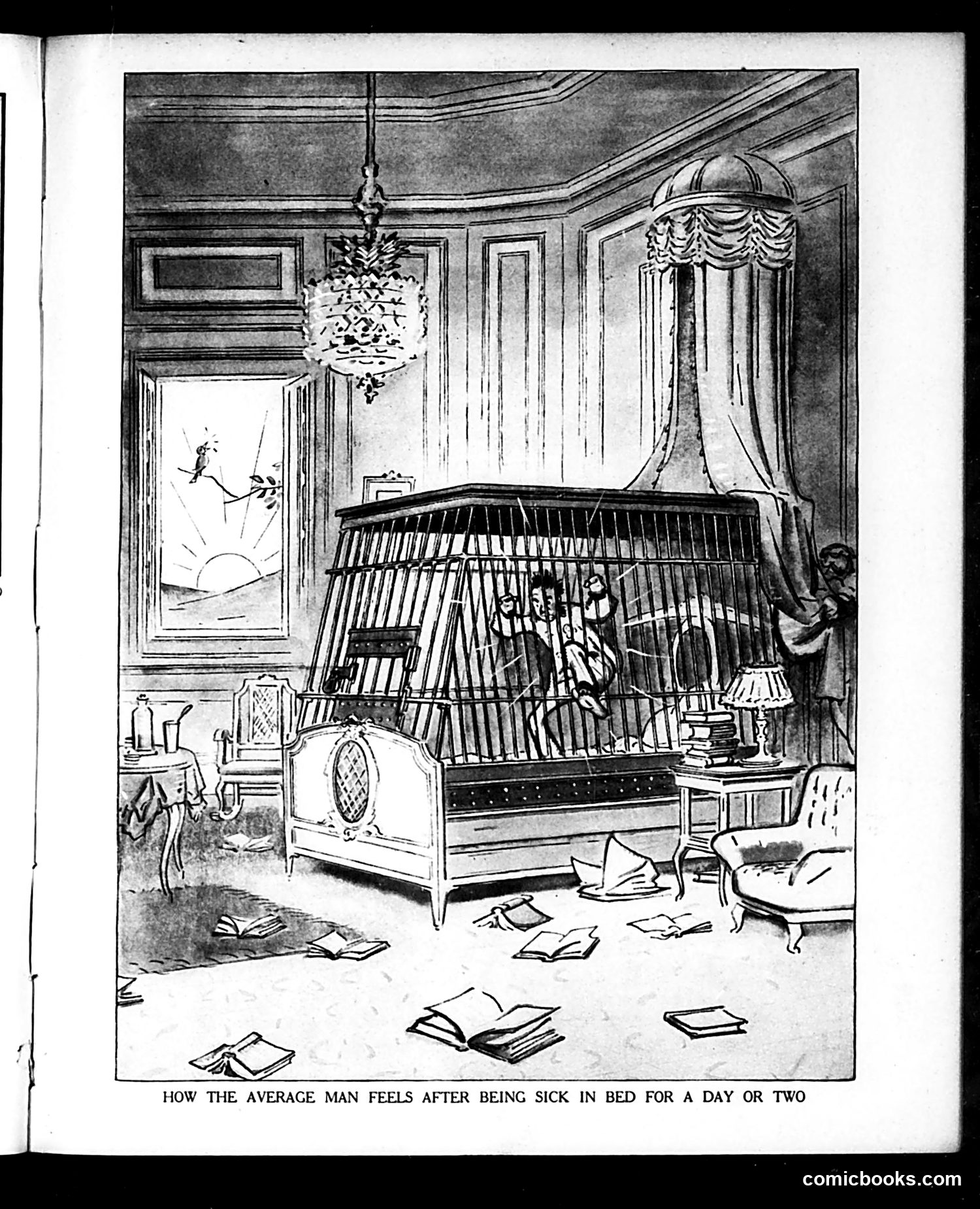
This is a humorous domestic cartoon depicting a man's restless confinement during illness. The bedroom scene shows the patient enclosed in a large, cage-like bed with heavy drapery, suggesting both physical constraint and isolation. Books are scattered across the floor—suggesting he's trying to occupy himself mentally while bedridden. The ornate bedroom furnishings and hanging pendant lamp indicate a reasonably well-to-do household. The satire lies in the visual metaphor: the bed resembles a prison or animal cage, capturing the psychological experience of enforced bed rest—the frustration and claustrophobia of confinement, even in comfortable circumstances. The scattered reading material emphasizes desperate attempts at distraction. The cartoon humorously exaggerates the average man's impatience with illness and recovery.
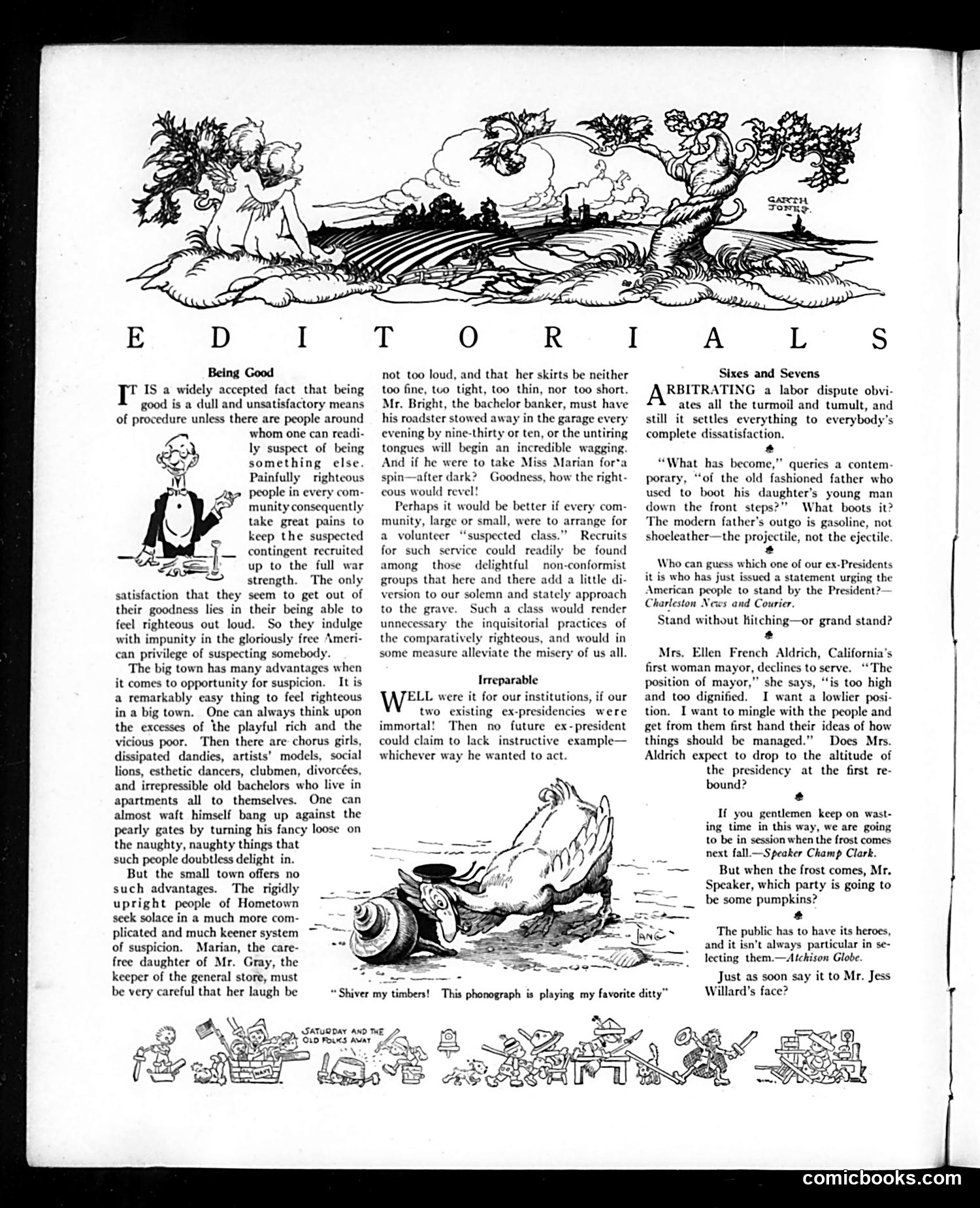
This page contains three satirical pieces critiquing American social attitudes: **"Being Good"** mocks the hypocrisy of respectable people who feel righteous suspecting others of misconduct while ignoring actual wrongdoing around them. It satirizes how communities use suspicion as a moral substitute for genuine virtue. **"Sixes and Sevens"** references a contemporary labor dispute, suggesting arbitration settles disputes by avoiding real solutions. The quoted dialogue about an "ex-President" and "shoeleather" appears to reference political figures involved in labor controversies, though specific identities are unclear from context alone. **"Irreparable"** discusses whether ex-Presidents should hold office again, suggesting that having multiple former presidents available would be instructive—apparently satirizing concerns about political leadership and precedent-setting. The magazine uses humor to critique American pretension and political inconsistency.
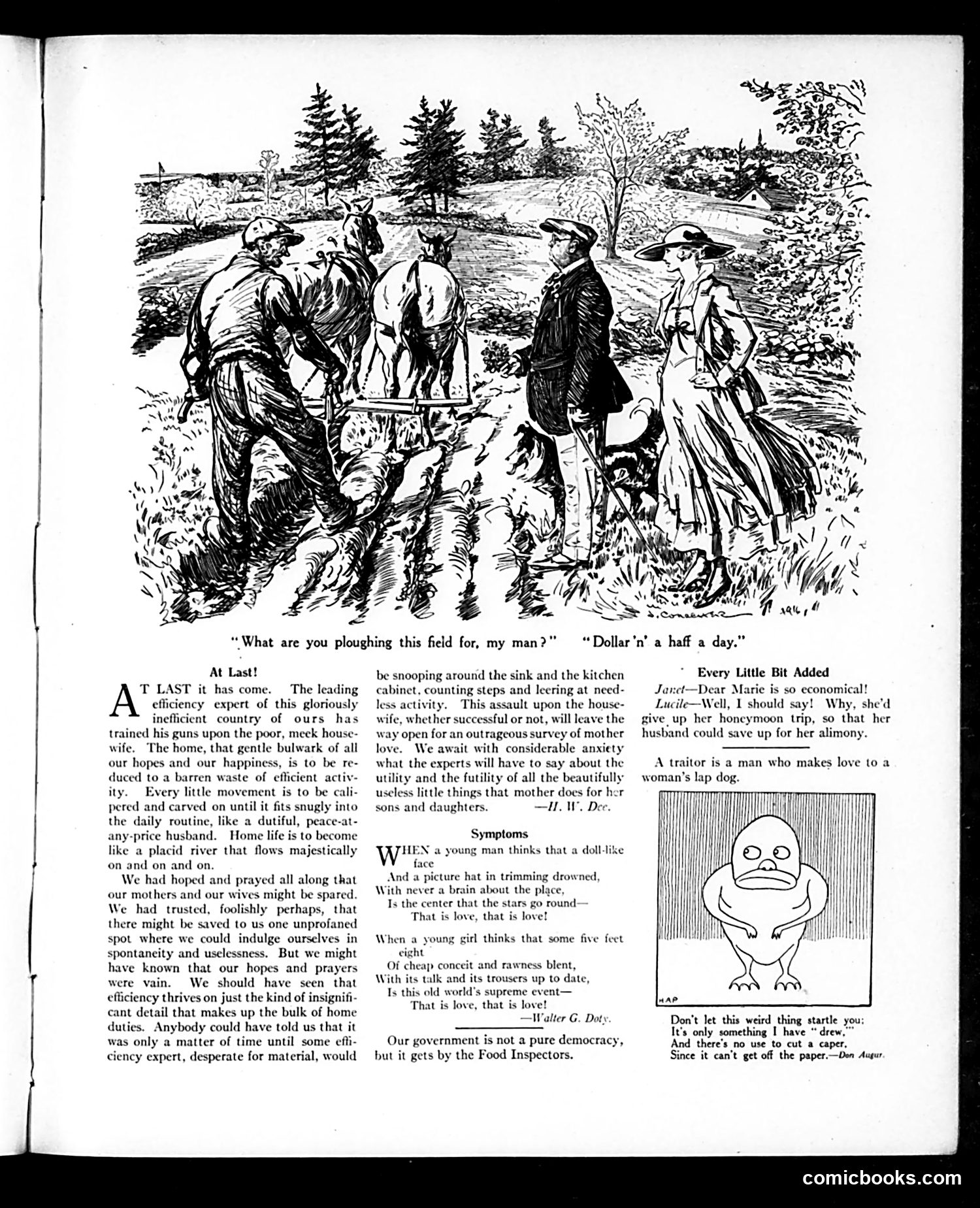
The top cartoon satirizes rural inefficiency. A farmer ploughs a field while well-dressed visitors observe, asking "What are you ploughing this field for, my man?" The farmer replies "Dollar'n' a half a day"—suggesting he's working inefficiently for minimal wage. The piece criticizes how agricultural practices waste resources and labor, likely reflecting Progressive Era concerns about modernizing farming methods. Below, the text "At Last!" argues that efficiency experts should reform rural domestic life, which the author views as stagnant and wasteful. The surrounding poetry and commentary mock romantic notions of love while promoting practical, economical living. The small cartoon shows an absurd creature, captioning skepticism toward pseudoscientific ideas popular in the era.
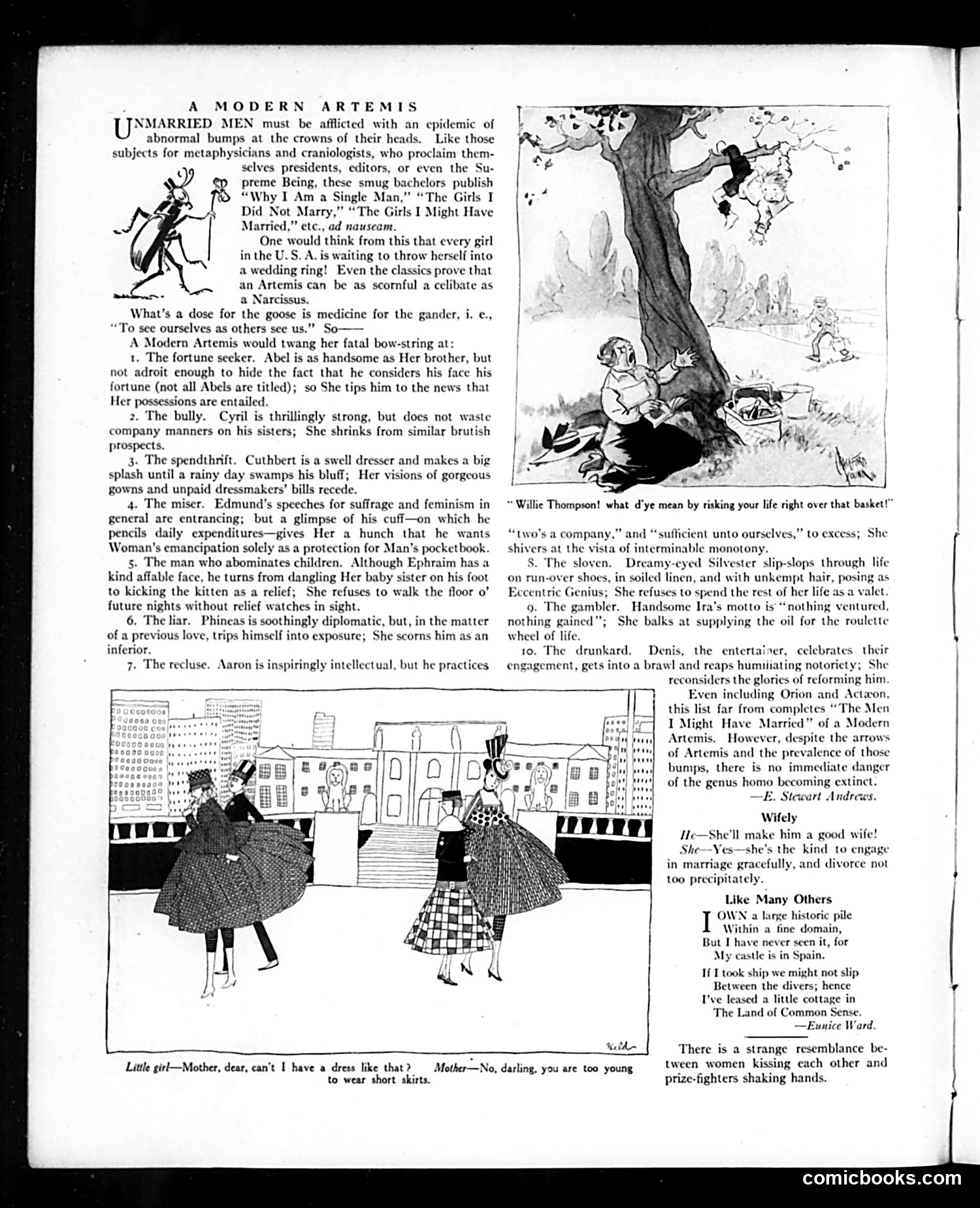
This page satirizes unmarried women who reject unsuitable men, using the classical huntress Artemis as the model. The main article lists ten types of men a discerning woman should reject: fortune-seekers, bullies, spendthrifts, misers, feminists motivated by greed, men who dislike children, recluses, slovenly men, gamblers, and drunkards. The satire targets bachelor articles ("Why I Am a Single Man") that suggest all American women want marriage. Here, the author flips this—declaring that intelligent women are just as selective and independent as Artemis, who famously rejected marriage. The cartoon shows a mother refusing her daughter a short skirt, illustrating generational attitudes toward propriety. The page mocks both overeager bachelors and societal pressure on women to marry, while paradoxically suggesting that women's independence depends on scrutinizing men's character and financial status—a pointed commentary on women's economic dependence in this era.
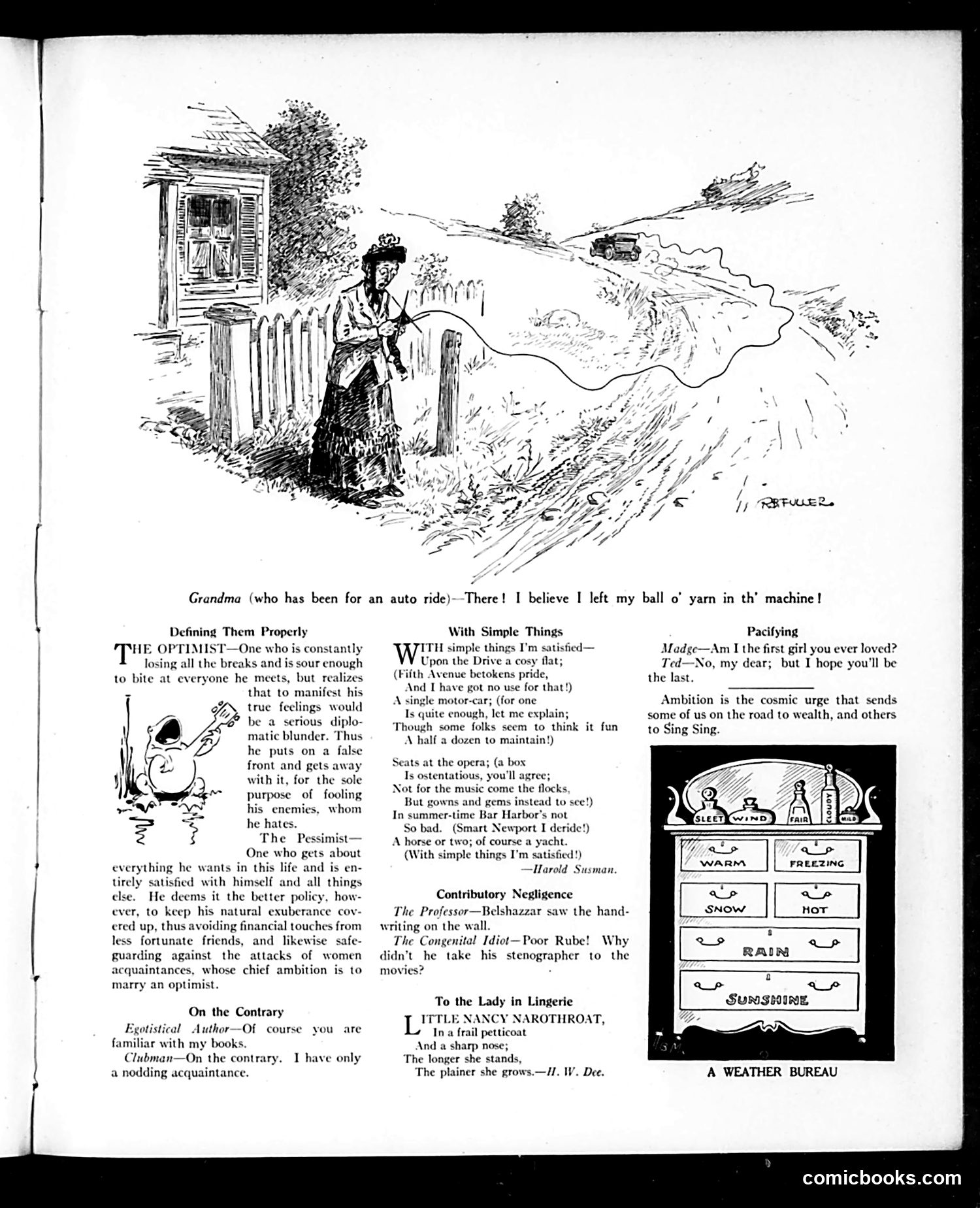
This page contains primarily **humorous short pieces and light satire** rather than political cartoons. The main cartoon shows a grandmother who recently rode in an automobile for the first time, worried she left her knitting in the car—a joke about elderly people adapting to new technology. The text pieces mock **social pretension and hypocrisy**. "With Simple Things" satirizes wealthy people who claim modesty while listing luxuries (Fifth Avenue flats, yachts, opera boxes). "Defining Them Properly" inverts the meanings of "optimist" and "pessimist" to criticize people's false social performances. Other pieces include wordplay jokes: a professor's student misses the "handwriting on the wall" biblical reference; a young man's romantic excuse to his girlfriend. The **Weather Bureau** comic shows standard meteorological symbols. Overall, this reflects **1920s-era satirical humor** targeting upper-class affectation and the gap between stated values and actual behavior—common Judge magazine territory. The humor relies on social observation rather than political commentary.
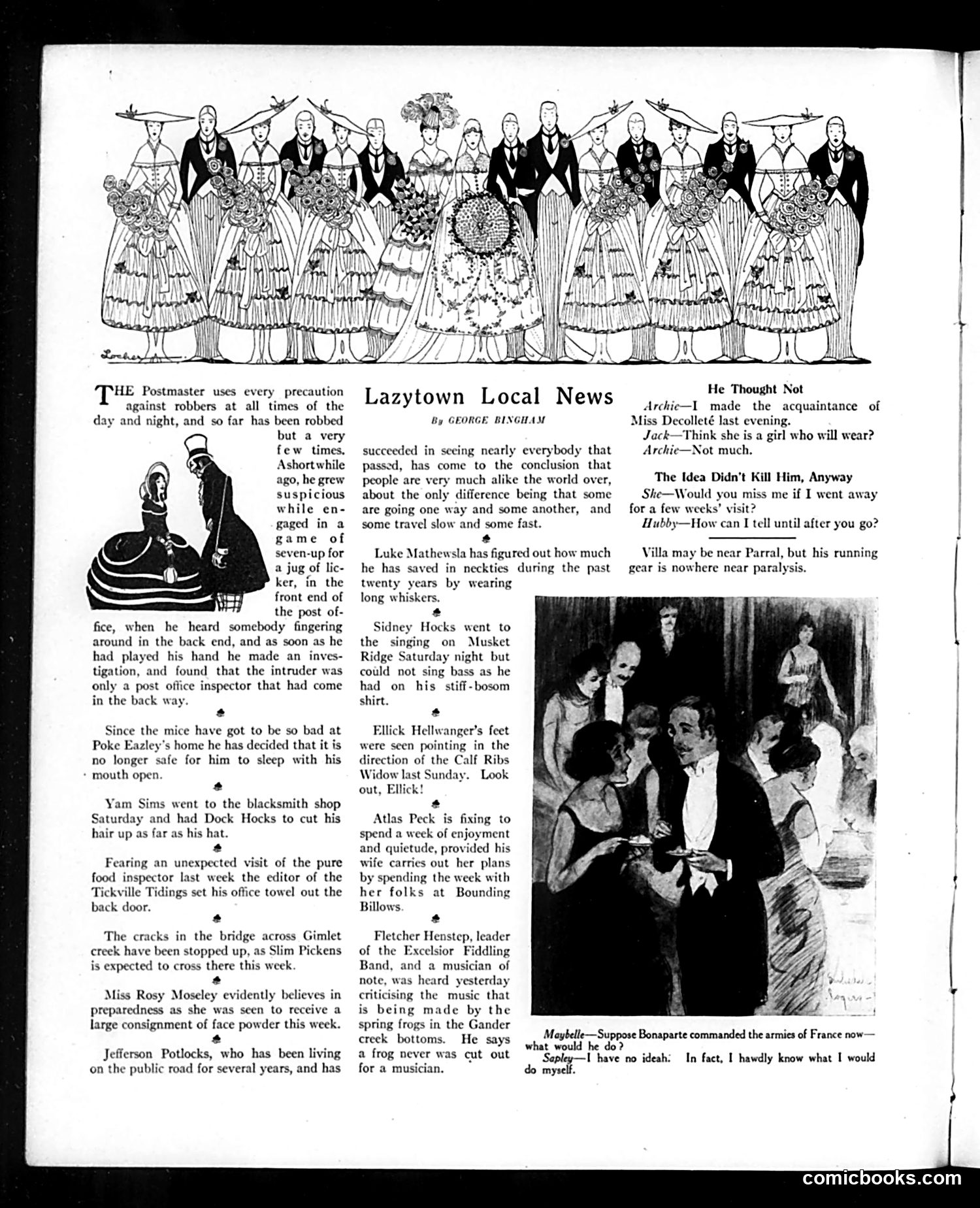
This is a rural gossip column presented as humorous local news from a fictional small town called "Lazytown." The satire targets small-town life and its petty concerns through absurdist anecdotes: **Key jokes:** - A postmaster playing cards during work hours mistakes a government inspector for a robber - Residents obsess over trivial matters: mice in homes, haircuts, mice again, towel-cleaning before food inspections - Rural dialect and names ("Slim Pickens," "Poke Eazley") mock rustic stereotypes - A woman stockpiling face powder suggests vanity/preparedness anxiety - Sidebar jokes include a man's stiff shirt preventing singing and a woman asking if her boyfriend will miss her (he won't know until she's gone) **The satire's point:** Small-town life consists of meaningless gossip, petty concerns, and absurd logic. The exaggerated earnestness of reporting these non-events as "news" ridicules both rural communities and small-town newspapers that printed such content. The illustration of formally-dressed townspeople reinforces the contrast between their pretensions and their trivial preoccupations.
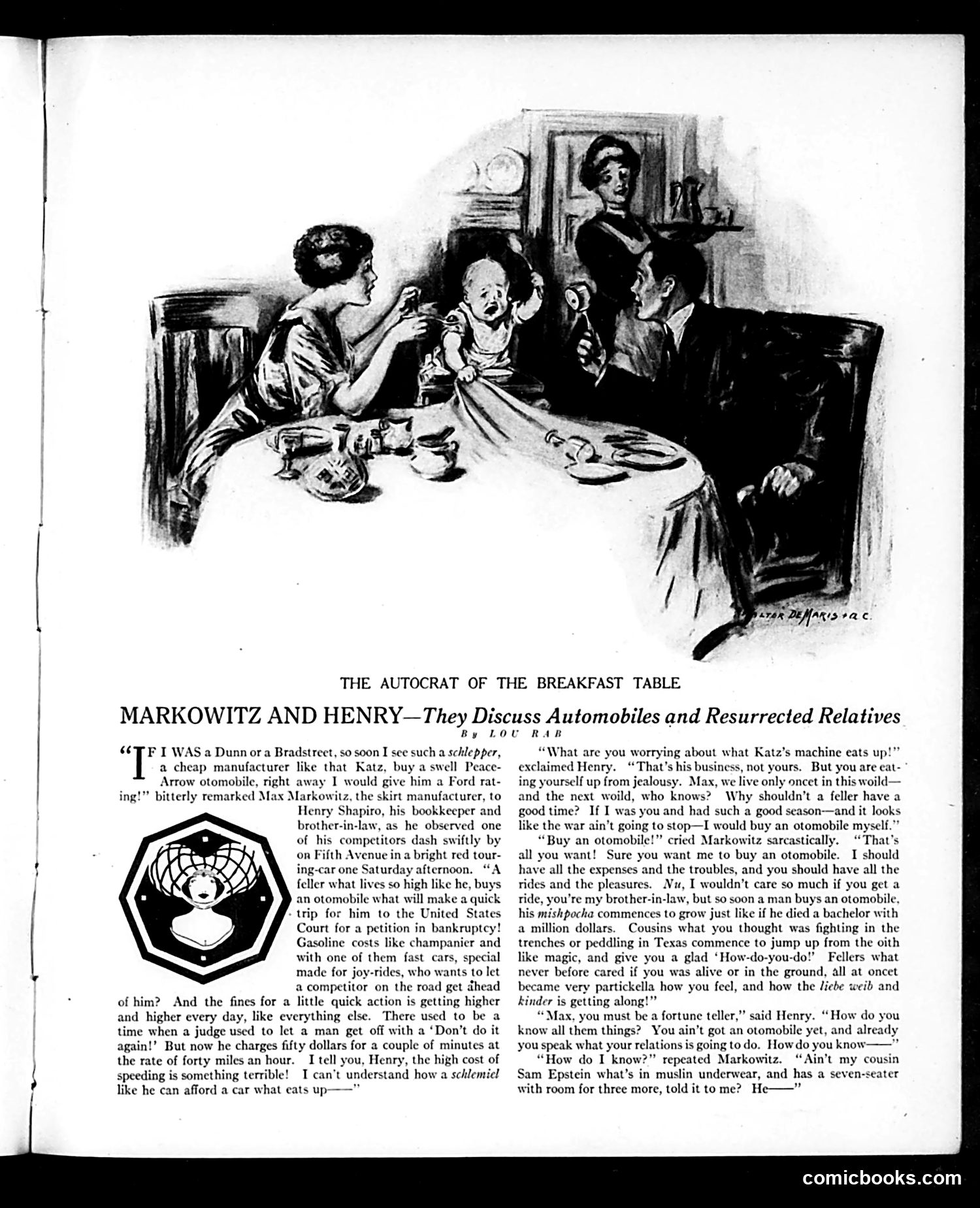
This is a humorous dialogue between two Jewish-American characters—Max Markowitz, a skirt manufacturer, and Henry Shapiro, his bookkeeper and brother-in-law—debating whether to buy an automobile. **The satire targets:** 1. **Class anxiety and consumer culture**: Max envies his competitor Katz's fancy touring car but resents the expense and social pressure to keep up appearances. 2. **The cost of living**: Max complains about automobile expenses, gasoline costs, and increasingly steep speeding fines—reflecting post-WWI economic anxieties. 3. **Jewish family dynamics**: Max fears that buying a car will unleash distant relatives ("mishpocha") suddenly claiming connection and demanding rides, a satirical jab at familial obligation in immigrant communities. The humor relies on Yiddish-inflected English dialogue ("schlemiel," "otomobile," "woild") and the relatable tension between desire for status symbols and practical financial worry. The 1910s-20s setting makes automobiles still novel luxury items, intensifying the social competition.
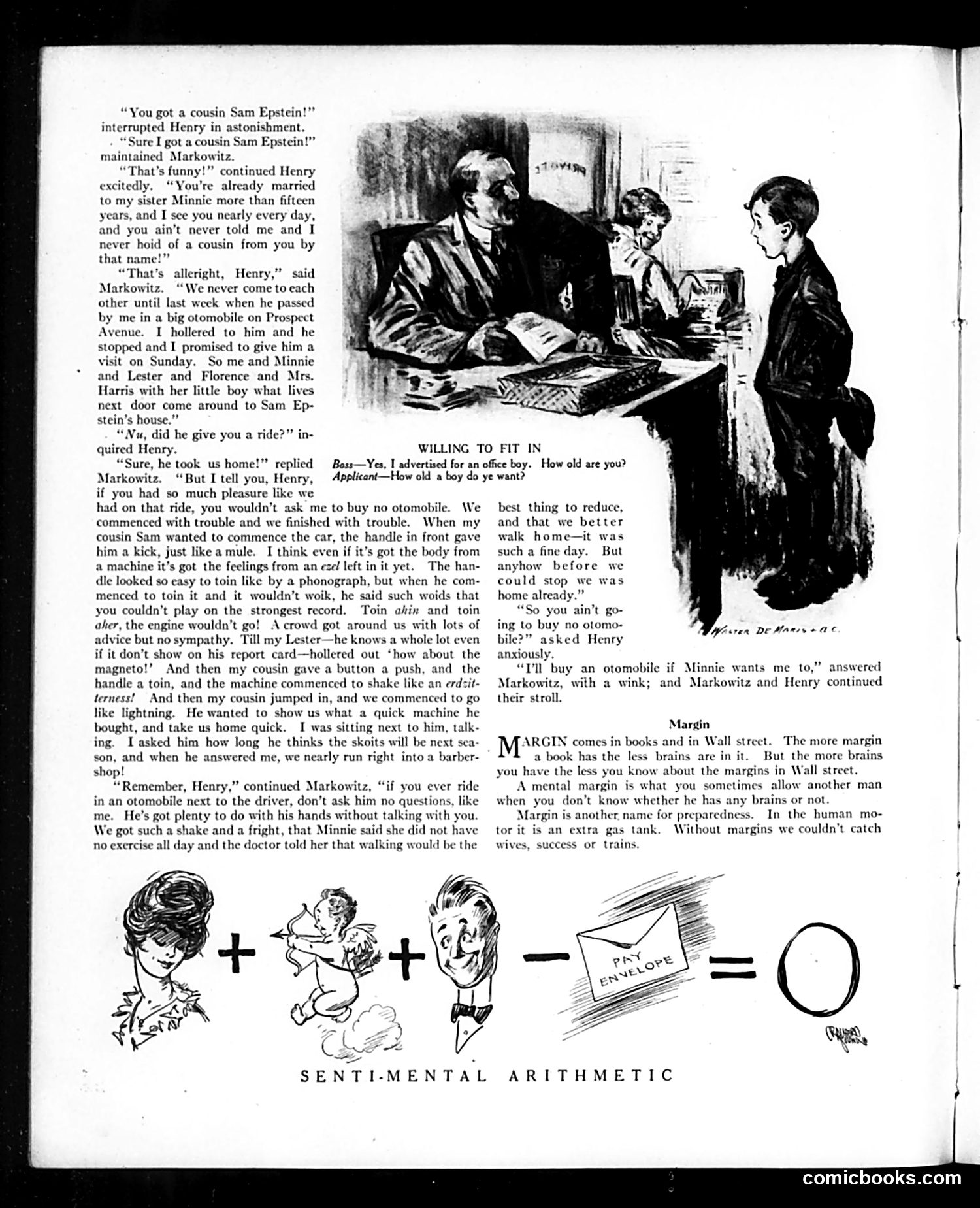
This Judge magazine page contains ethnic humor typical of early 20th-century American satire. The main story features Markowitz and Henry (appearing to be Jewish-American characters, identifiable by names and Yiddish-inflected English dialogue) discussing an automobile ride that went comically wrong—the car's crank starter kicked like a mule, the engine wouldn't start, and once running, the driver's recklessness nearly caused a crash into a barber shop. The satire mocks both the newfangled automobile technology and immigrant characters' unfamiliarity with it, while poking fun at their malapropisms ("otomobile," "ezel"). A separate small cartoon ("Willing to Fit In") shows a job applicant asking the boss what age boy he wants—a joke about flexibility or desperation in the job market. The bottom "Senti-mental Arithmetic" is a visual pun equation: woman + cupid + man - pay envelope = zero/nothing, cynically suggesting romance collapses without money.
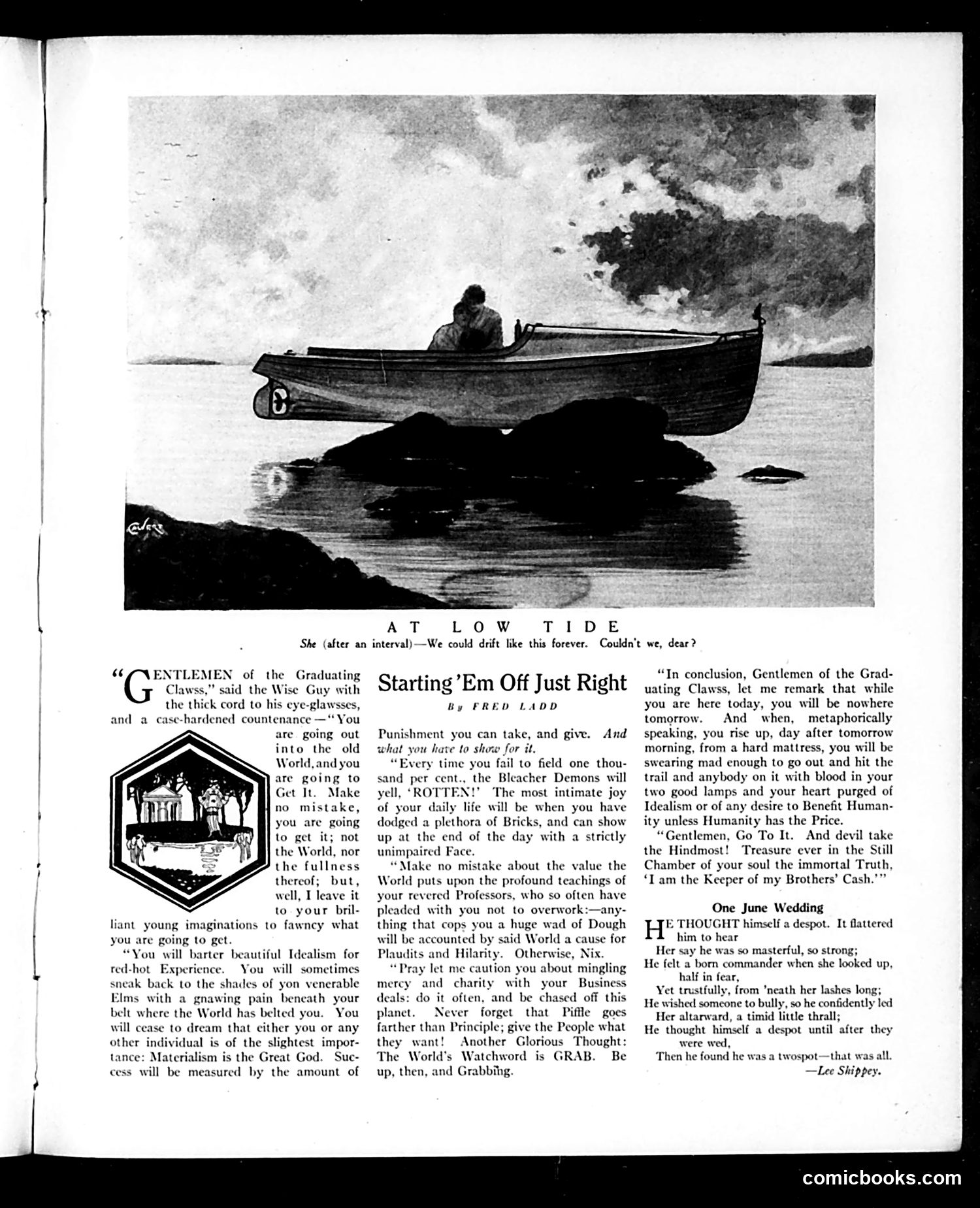
This page contains two satirical pieces from *Judge* magazine: **Top cartoon ("At Low Tide"):** A romantic couple in a rowboat, illustrating the caption "We could drift like this forever." The satire is gentle—capturing the timeless romantic fantasy of escaping the world's demands. **"Starting 'Em Off Just Right":** A cynical commencement speech addressing graduating students. The speaker (drawn as a hardened older man) warns graduates that idealism will be crushed by harsh reality. Key satirical points: the world rewards money over principles ("Piffle goes farther than Principle"), success means enduring punishment, and failure brings mockery ("Bleacher Demons"). The final line—"I am the Keeper of my Brothers' Cash"—mocks materialism as the era's true religion. This critiques both the brutal capitalism graduates will enter and the hypocrisy of institutions (schools/professors) that preach idealism while the world operates on greed. **"One June Wedding":** A poem satirizing masculine posturing. A man imagines himself a "despot" commanding his timid bride, only to discover after marriage he's actually a "twospot"—powerless. The joke: his imagined dominance was fantasy.
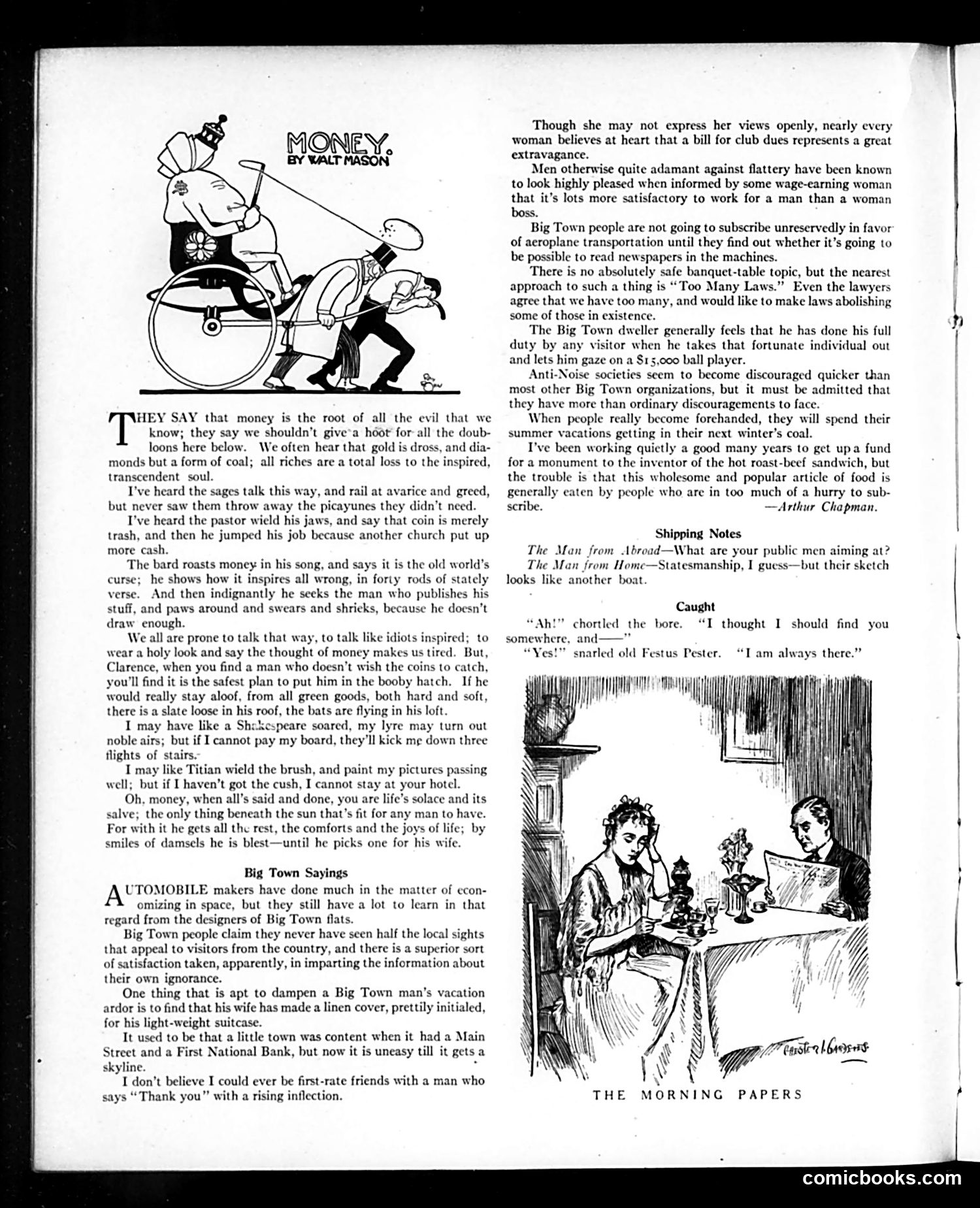
This page from *Judge* magazine contains satirical commentary on American attitudes toward money and urban life. The main cartoon "Money" by Ralph Barton depicts the hypocrisy of preaching against materialism while pursuing wealth. The accompanying essay mocks religious leaders, artists, and philosophers who publicly denounce money as evil yet desperately chase it—priests who demand higher salaries, poets complaining about insufficient payment, and those claiming poverty would make them mad. The "Big Town Sayings" section satirizes urban pretension: wealthy city dwellers boasting ignorance of local attractions, obsession with skylines as status symbols, and debates over frivolous regulations. It also mocks gendered attitudes—women viewing club fees as wasteful, and workplace dynamics where employees prefer male bosses. The humor relies on exposing gap between stated values and actual behavior—a classic satirical technique. The targets are hypocrisy, social climbing, and materialism among America's middle and upper classes during the early 20th century.
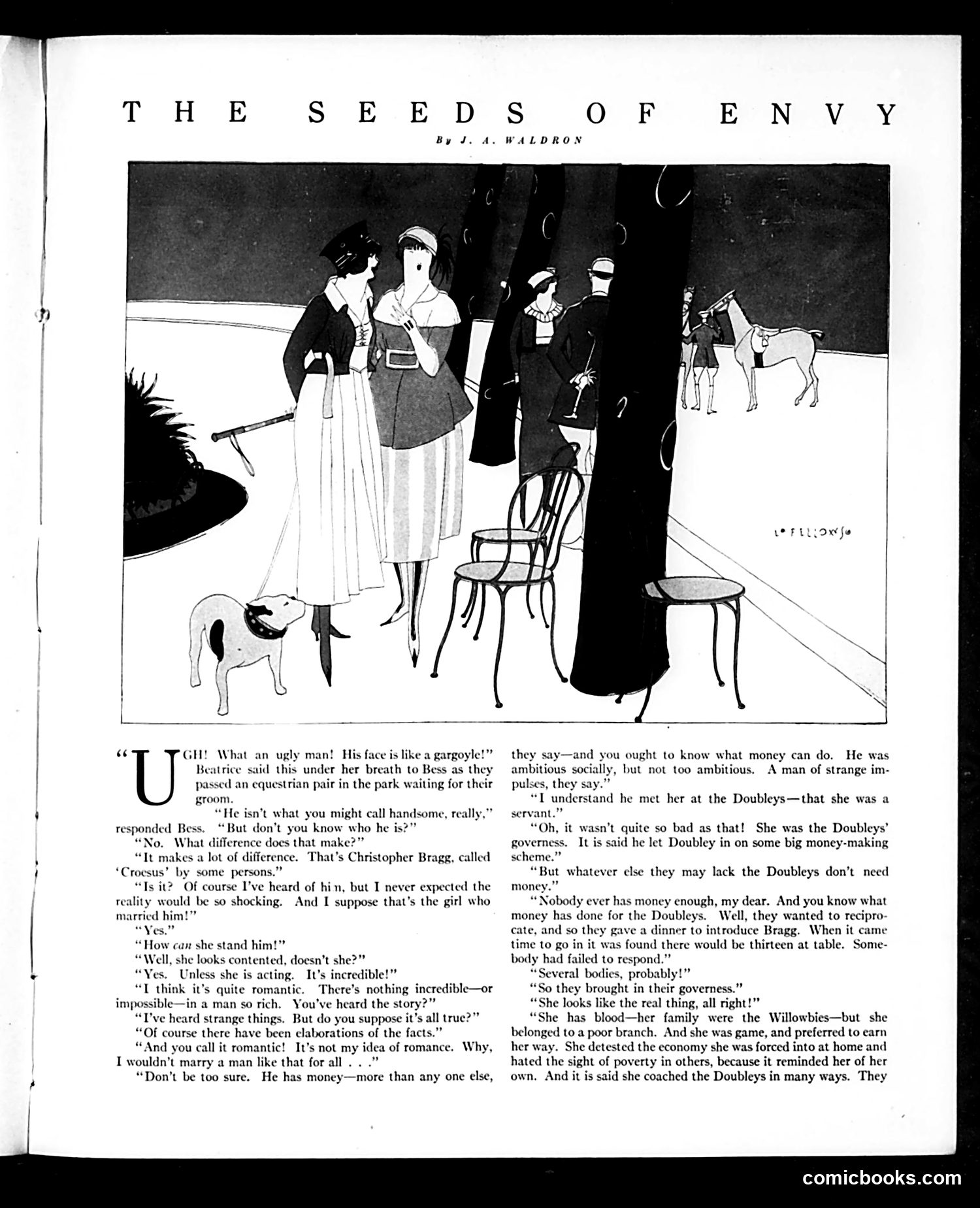
This story-cartoon satirizes how wealth overcomes social class and physical appearance in matrimonial prospects. Christopher Bragg, nicknamed "Croesus" (ancient symbol of extreme wealth), is physically ugly—described as gargoyle-like—yet marries a woman of good lineage (a Willowbie) who works as the Doubleys' governess. The satire targets Gilded Age social climbing: the governess accepts Bragg not from romance but pragmatism, preferring to "earn her way" upward rather than remain poor. The Doubleys reciprocate Bragg's financial favors by introducing the couple socially (even solving a thirteen-at-table superstition problem by recruiting the governess as dinner guest). The joke condemns both the wealthy man's assumption that money buys a wife and the governess's mercenary calculation that wealth justifies marrying an ugly man. The "seeds of envy" are planted in observers who recognize money's corrupting power over romantic ideals.
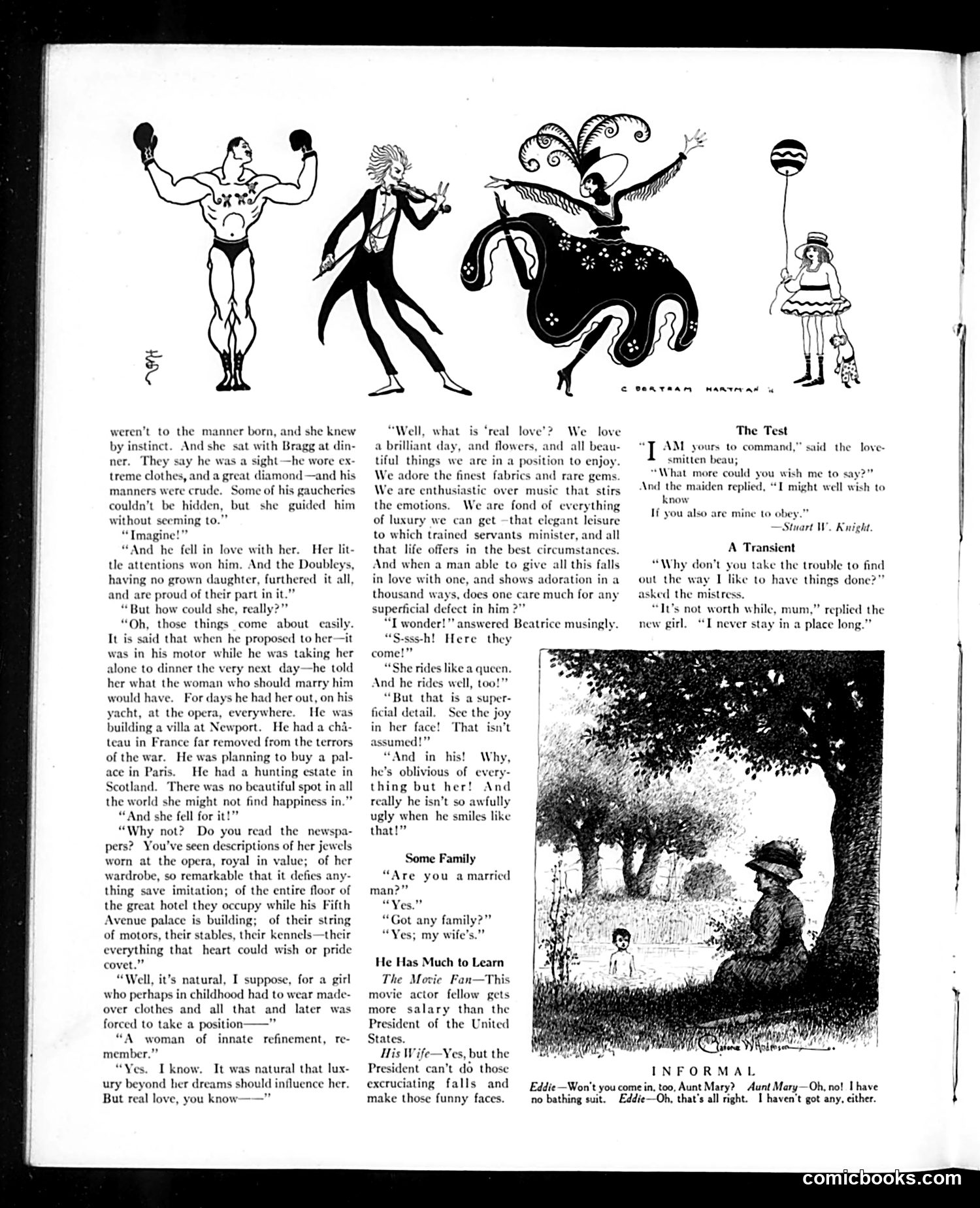
This page contains satirical fiction and humor pieces typical of early 20th-century Judge magazine. The top illustrations depict circus/vaudeville performers—a strongman, acrobat, and elephant rider—establishing a comedic visual tone. The main text satirizes wealthy industrialists and social climbers. A narrative describes how a refined woman of modest background married a crude, newly-rich man through calculated courtship. The satire targets the superficiality of the wealthy elite: the man's wealth (yachts, estates, jewels, motors) compensates for his poor manners and appearance. The woman's acceptance of luxury over "real love" reflects satirical commentary on American materialism and the transactional nature of upper-class marriage. Accompanying shorter pieces ("The Test," "A Transient," "Some Family," "He Has Much to Learn," and "Informal") offer brief jokes about love, servitude, marriage, and social pretense—consistent Judge themes mocking pretension and hypocrisy among the wealthy and socially ambitious.
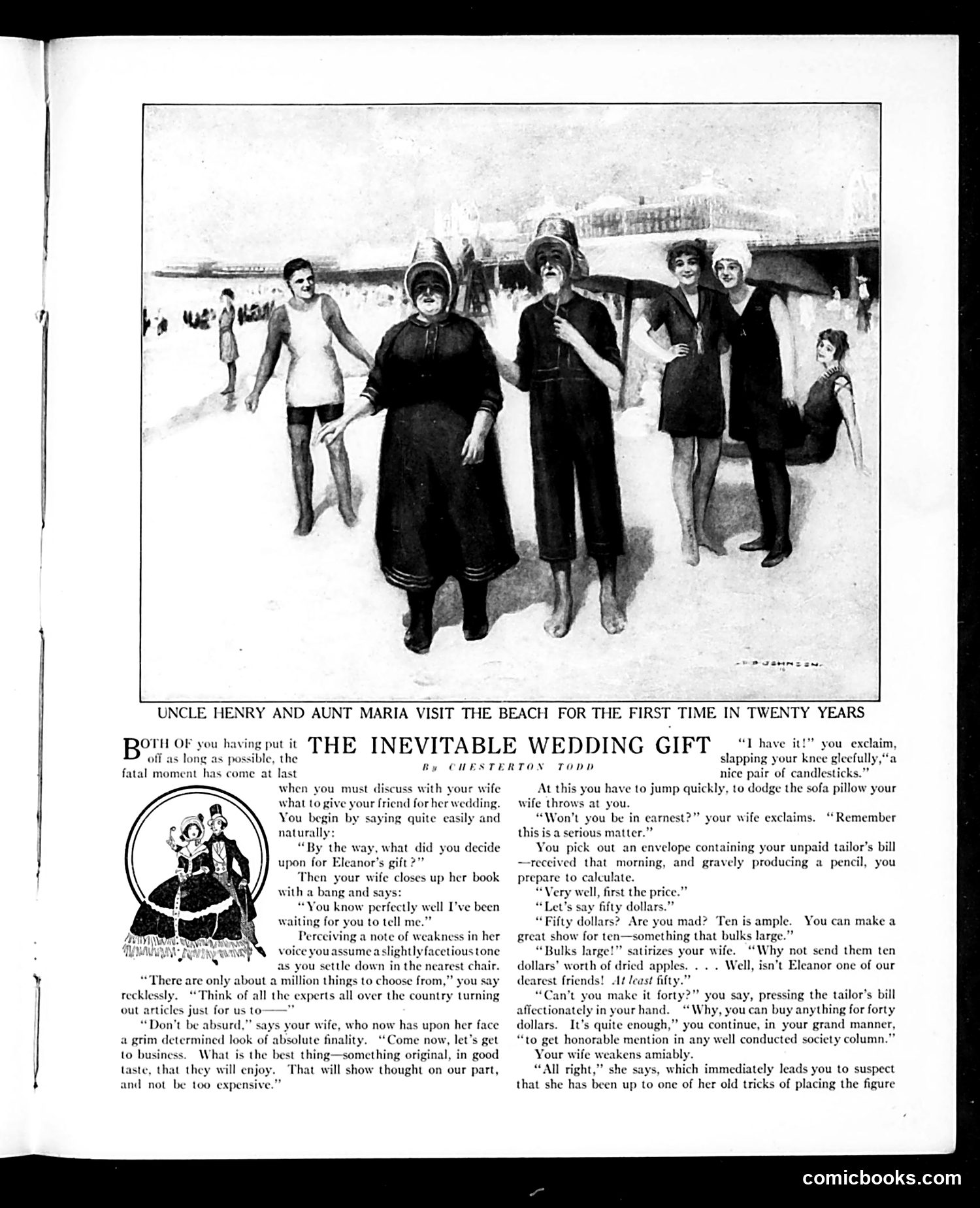
This is a humorous domestic satire by Chesterton Todd depicting a married couple negotiating what wedding gift to buy for a friend named Eleanor. The accompanying illustration shows a beach scene with people in early-20th-century bathing attire. The joke satirizes the predictable marital conflict over wedding gift-giving: the husband procrastinates, makes silly suggestions (candlesticks), tries to dodge the discussion, and attempts to negotiate the price downward—partly because he has an unpaid tailor's bill he's anxious about. The wife responds with exasperation, insisting the gift reflect genuine regard for their "dearest friend." The humor derives from depicting this minor domestic disagreement as a serious negotiation where both parties employ strategic tactics—the wife eventually "weakens" on the budget, which the husband immediately suspects is another trick. It's gentle satire of middle-class married life and consumer anxieties around gift-giving etiquette.
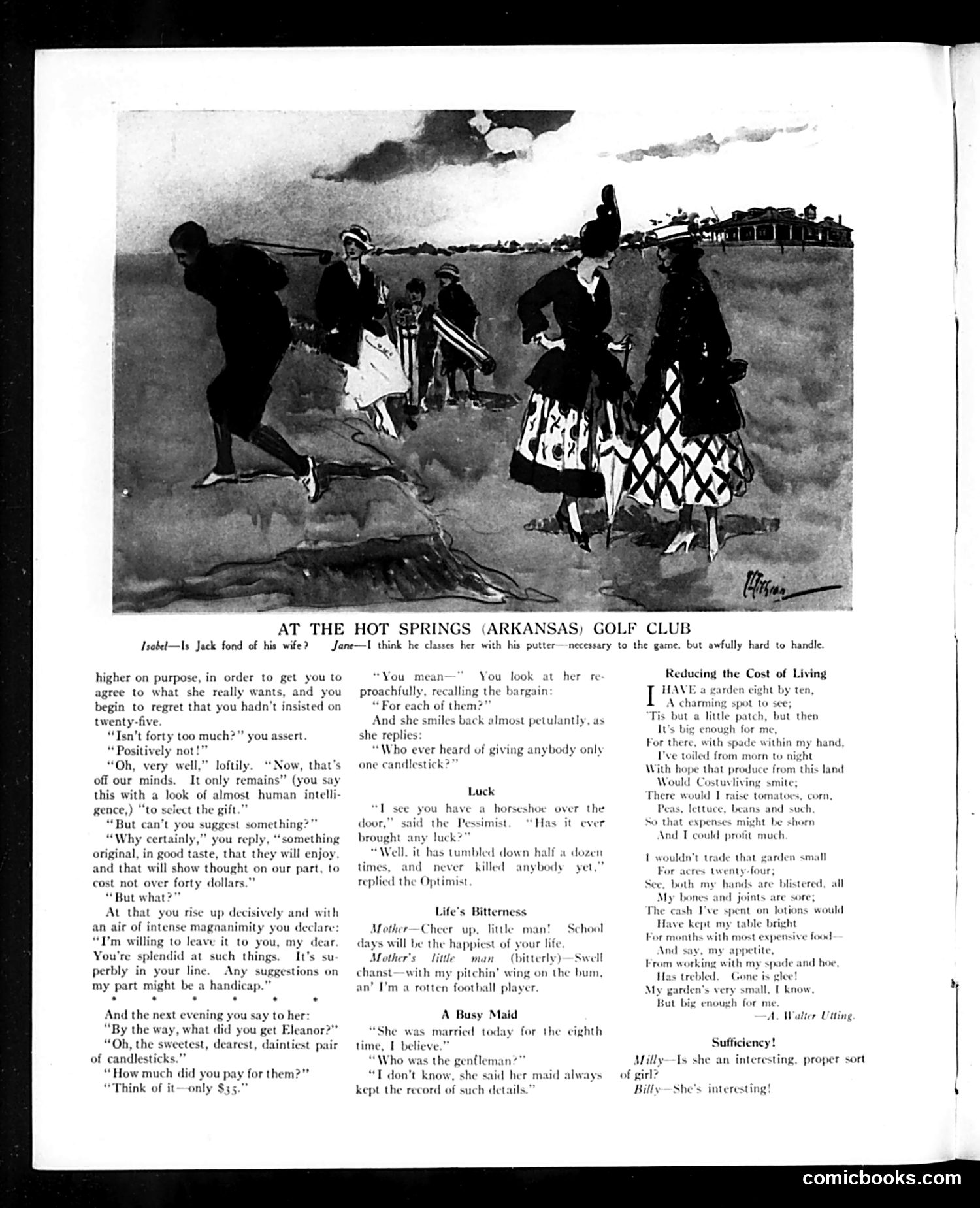
This page contains several brief satirical pieces mocking early 20th-century social conventions and relationships. The main cartoon depicts a golf outing at Hot Springs, Arkansas. The caption's joke hinges on a husband viewing his wife as equipment—"necessary to the game, but awfully hard to handle"—like a golf putter. The accompanying dialogue satirizes marital gift-giving: a wife pressures her husband for an expensive gift, he reluctantly agrees to a $40 budget, then she spends $35 on candlesticks anyway, claiming nobody gives single items as gifts. Other brief pieces mock: - **"Luck"**: A pessimist's horseshoe that's caused disasters, not fortune - **"Life's Bitterness"**: A schoolboy's cynicism about childhood being life's "happiest days" - **"A Busy Maid"**: A woman married eight times whose maid tracks her husbands - **"Reducing the Cost of Living"**: A poem about gardening's false economy—the labor costs more than savings - **"Sufficiency"**: A cryptic joke about finding girls "interesting" The satire targets marriages, consumerism, and self-deception.
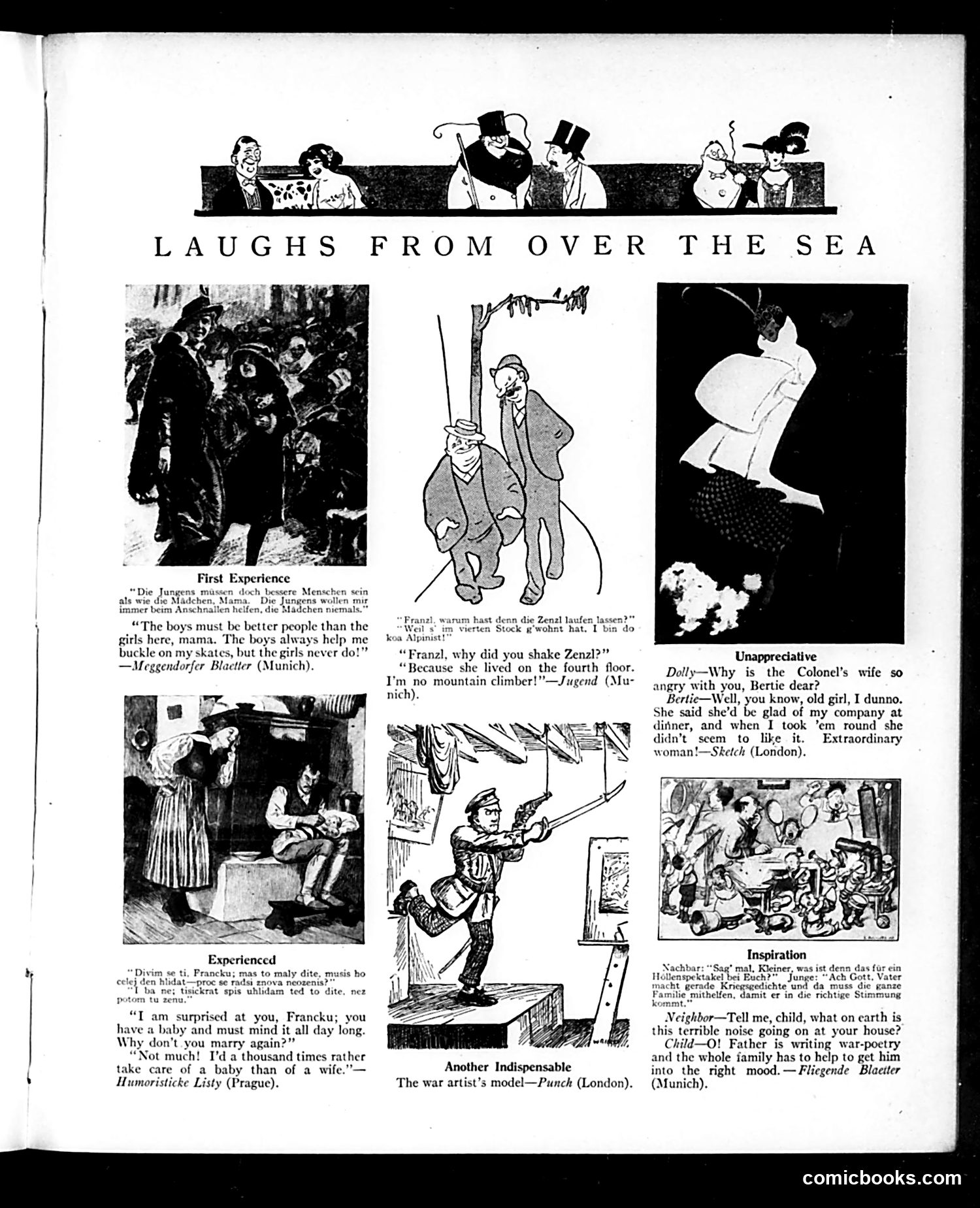
This page collects humorous anecdotes reprinted from European satirical magazines (Munich, Prague, London) during what appears to be World War I, given references to "war artist's model" and "writing war-poetry." The jokes reflect early 20th-century social attitudes: gender dynamics (boys helping girls with skates; girls refusing reciprocal help), marriage and parenthood (a widower preferring baby care to remarriage), domestic life (a wife annoyed by her husband's social awkwardness), and wartime domestic disruption (a father so consumed by composing war poetry that his family must assist his emotional state). These are gentle domestic comedies rather than political satire—aimed at readers amused by marital misunderstandings, child logic, and the absurdities of everyday life. The international sourcing suggests Judge magazine's editors selected humor that transcended national boundaries while reflecting shared bourgeois concerns.
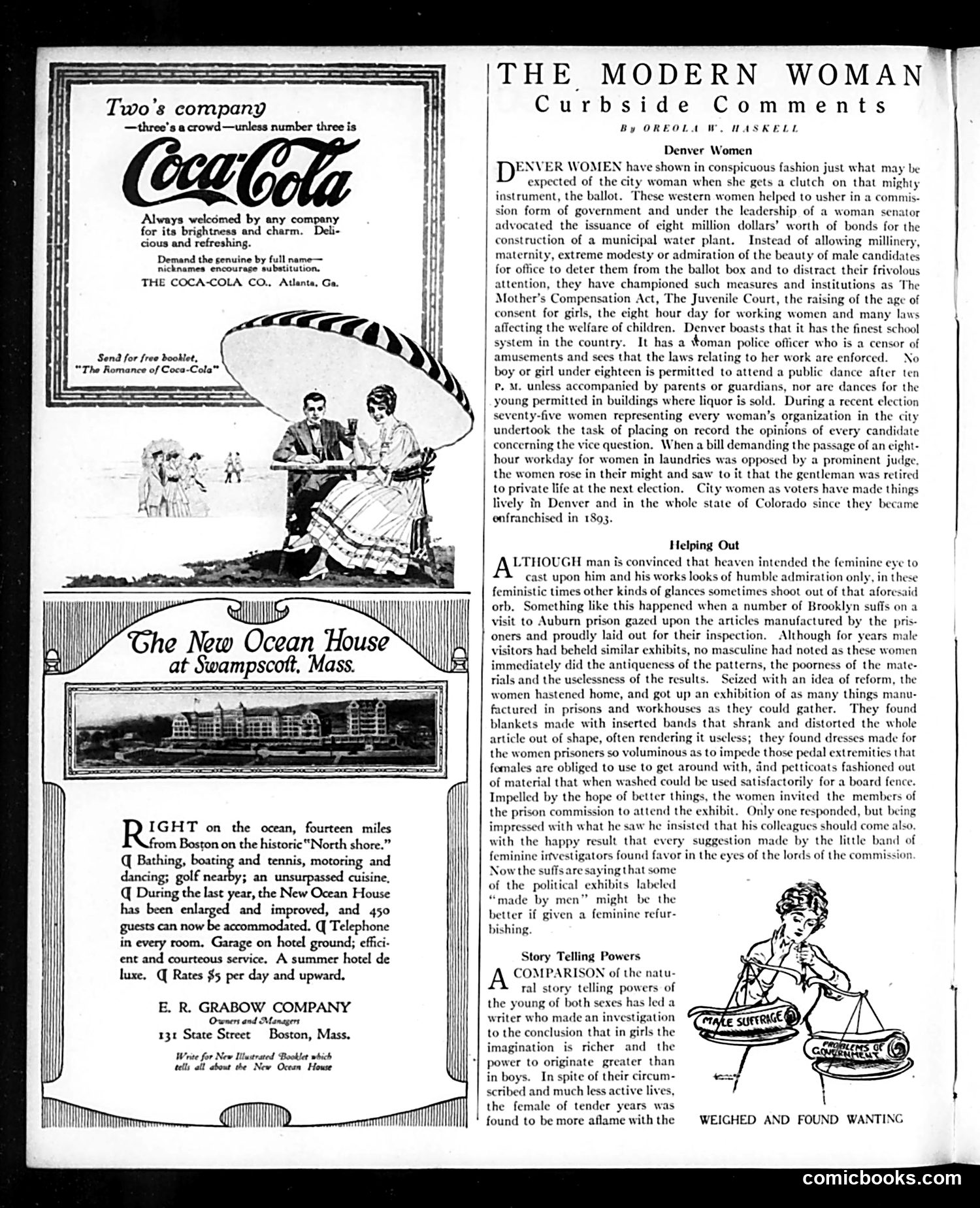
This page showcases early 20th-century attitudes toward female suffrage and activism. The main article praises Denver women voters, highlighting their 1893 enfranchisement and subsequent political achievements: securing bonds for water infrastructure, establishing the Mother's Compensation Act, raising age-of-consent laws, and enforcing the eight-hour workday. The tone is notably **approving**—unusual for Judge's typically satirical stance—suggesting the article genuinely celebrates women's pragmatic governance focused on social welfare rather than frivolous concerns. The final section, "Helping Out," describes female prison reformers (likely suffragists, given the Brooklyn reference) who identified manufacturing inefficiencies in Auburn prison that male visitors had overlooked for years. The implication: women bring fresh, practical perspectives to civic problems. The accompanying illustration labeled "WEIGHED AND FOUND WANTING" appears to satirize this reform impulse itself, though the specific cartoon's point remains unclear from the image quality provided. The page balances genuine approval of women's political participation with subtle mockery of reform activism's earnestness.
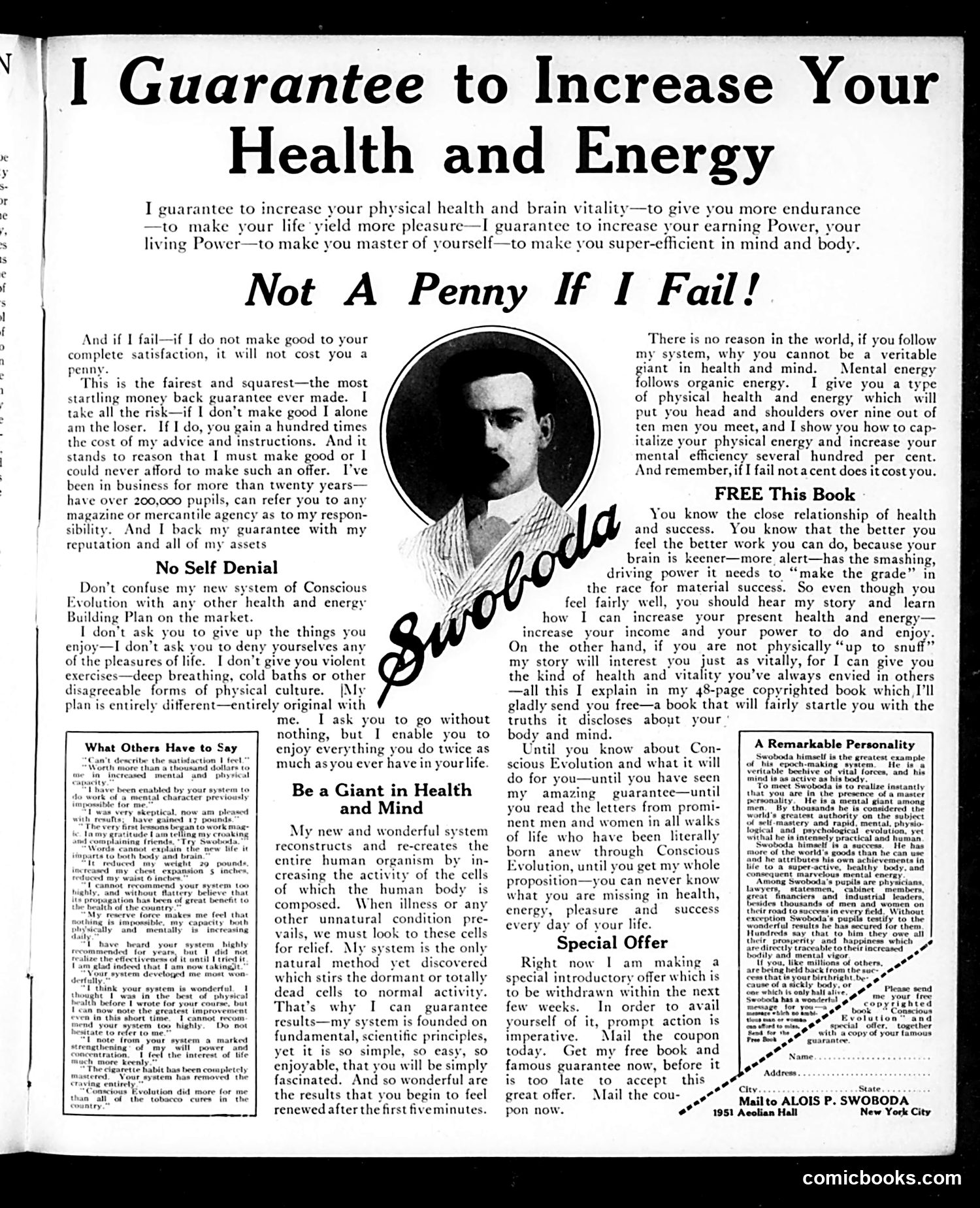
This is a full-page advertisement—not satire—promoting a mail-order health system called "Conscious Evolution" by Alois P. Swoboda (address given as 1921 Aeolian Hall, New York City). The page exemplifies early 20th-century health fraud: Swoboda promises to increase vitality, earning power, and mental efficiency through an unspecified system requiring no exercise, diet restrictions, or "self-denial." He offers a money-back guarantee and free book, common tactics of the era. The testimonial section ("What Others Have to Say") provides manufactured social proof. The portrait and signature lend false authority. **For modern readers:** This represents pre-FDA regulation when such grandiose health claims were legal. The pseudoscientific language ("stirs dormant cells to normal activity") and refusal to specify actual methods are red flags for quackery. Judge magazine's publication of this suggests either advertising revenue dependency or contemporary acceptance of such dubious claims.
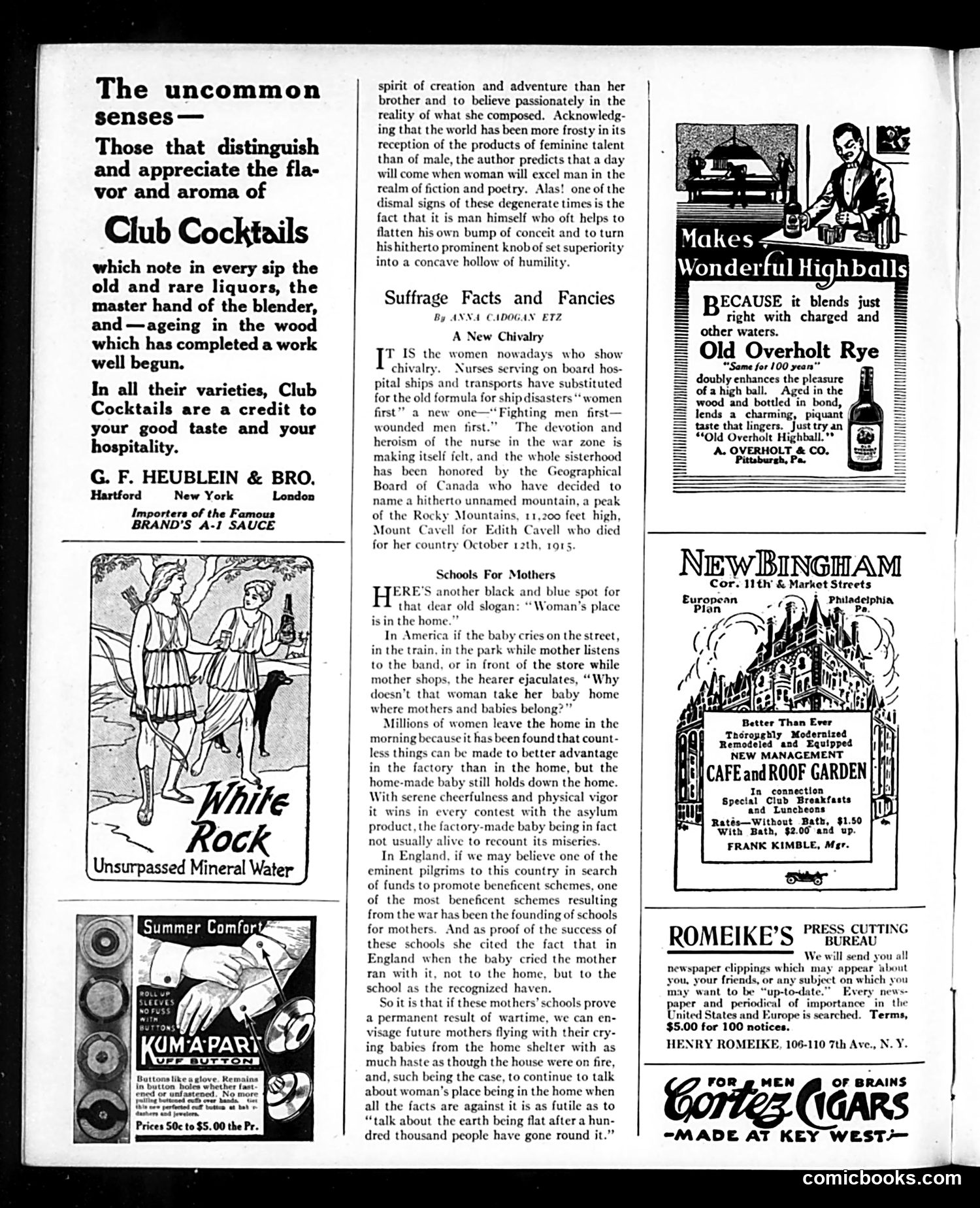
This page is primarily **advertising** interspersed with an article on women's issues. The main content is "Suffrage Facts and Fancies" by Anna Cadogan Etz, which discusses women's expanding roles beyond the home. The article's central argument challenges the traditional slogan "woman's place is in the home" by citing wartime examples: nurses serving on hospital ships, and the Canadian Geographic Board naming Mount Cavell after nurse Edith Cavell (who died in 1915). It also describes emerging "schools for mothers" in England, suggesting women increasingly seek expert guidance outside the home. The satire is gentle: the author notes that objecting to women working outside the home is "as futile as to talk about the earth being flat after a hundred thousand people have gone round it"—mocking those clinging to outdated domestic ideology. The surrounding advertisements (Club Cocktails, White Rock mineral water, Kum-A-Part corsets) represent contemporary consumer products unrelated to the editorial content.
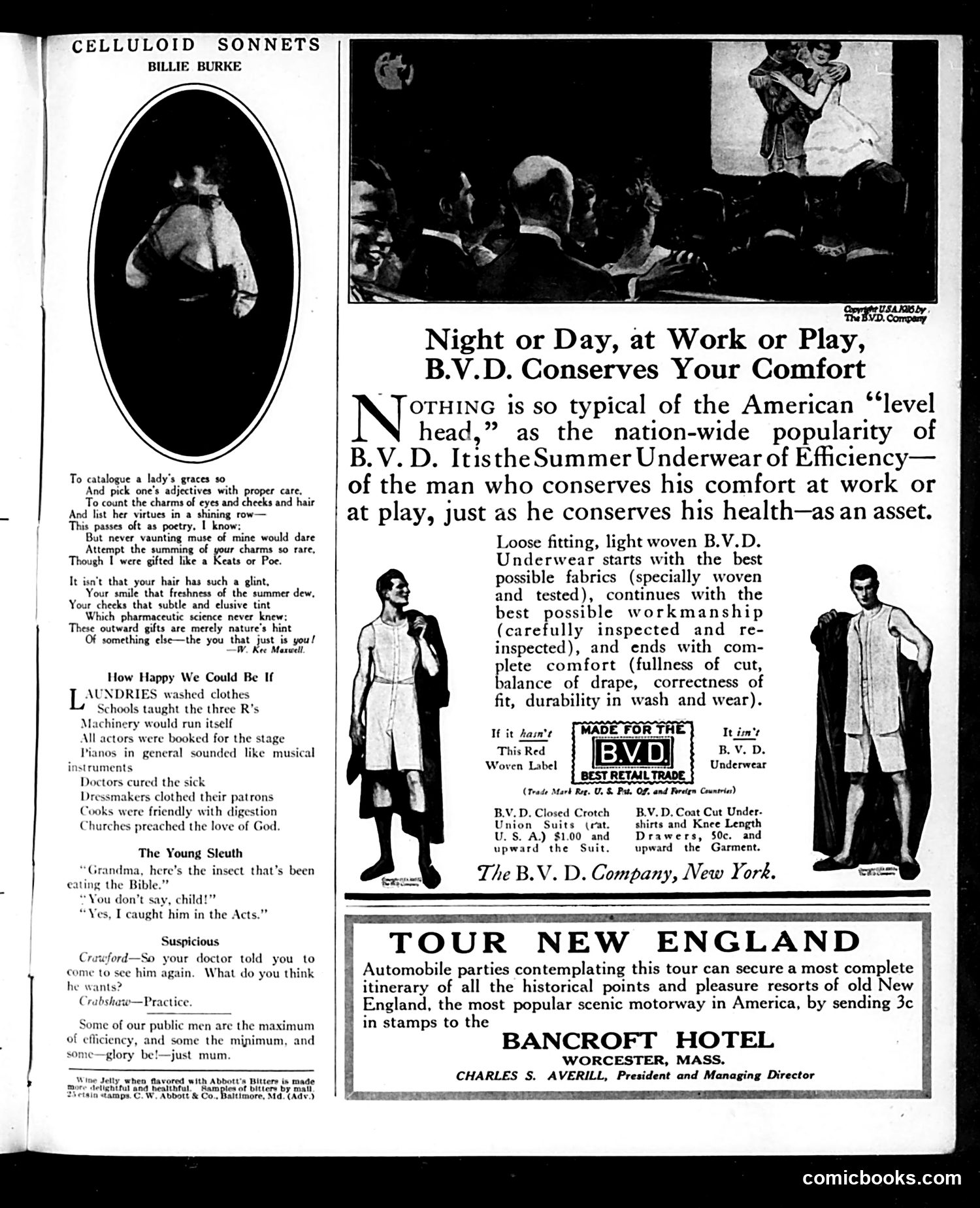
This page contains **primarily advertisements and light humor** rather than political satire. The "Celluloid Sonnets" section features **Billie Burke**, a famous actress of the era, with a flattering poem praising her beauty beyond description. The accompanying jokes are gentle domestic humor—puns about laundries, insect pests in Bibles, and doctors' motives—typical of mainstream magazine comedy. The dominant content is a **B.V.D. underwear advertisement** targeting businessmen and professionals, emphasizing comfort and efficiency as American values. The ad suggests that wearing quality underwear reflects good judgment and practical self-care—appealing to the "level head" of the American worker. The final advertisement promotes **New England tourism**, encouraging automobile travel to historical sites. This page reflects early 20th-century consumer culture and light entertainment rather than substantive political commentary or sharp satire.
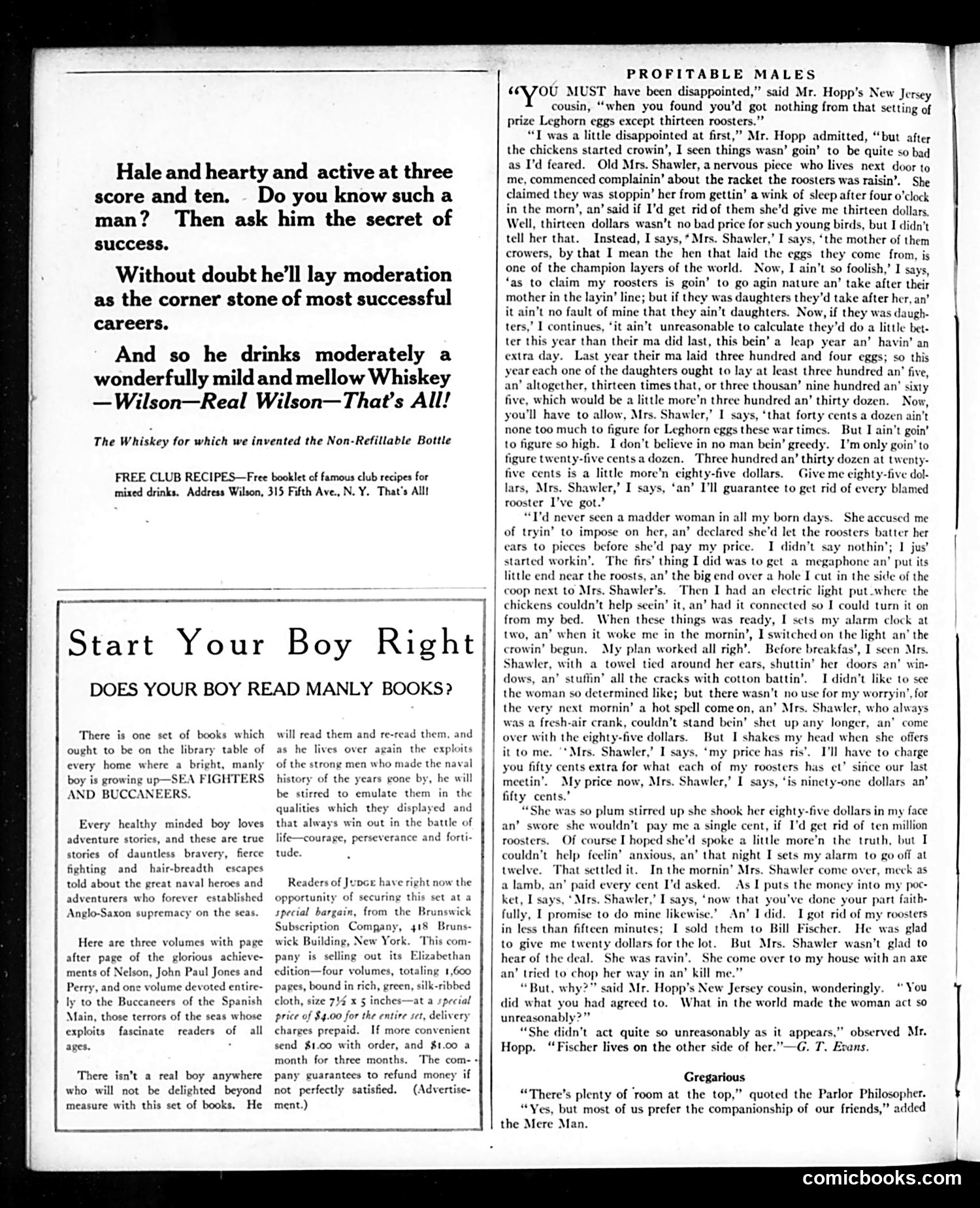
This page contains two advertisements disguised as editorial content, typical of early 20th-century magazines. **Wilson Whiskey Ad (top):** Promotes moderate drinking of Wilson brand whiskey as the "secret" to successful careers and longevity. The pitch exploits contemporary health anxieties by framing moderation as virtuous while selling alcohol. The "Non-Refillable Bottle" was a marketing innovation. **"Start Your Boy Right" Ad (bottom):** The Brunswick Subscription Company promotes a four-volume set of naval adventure stories (Nelson, John Paul Jones, Perry, and Spanish Main buccaneers) to develop "manly" boys. This reflects turn-of-the-century ideology linking adventure narratives, imperial conquest, and masculine character-building. The books celebrate "Anglo-Saxon supremacy on the seas." **"Profitable Males" (right column):** A humorous anecdote about Mr. Hopp negotiating payment from an annoyed neighbor for roosters from his prize-egg hatching scheme. The neighbor wants to pay him to remove the noisy birds; Hopp calculates their value based on the hen's laying capacity and negotiates higher payment.
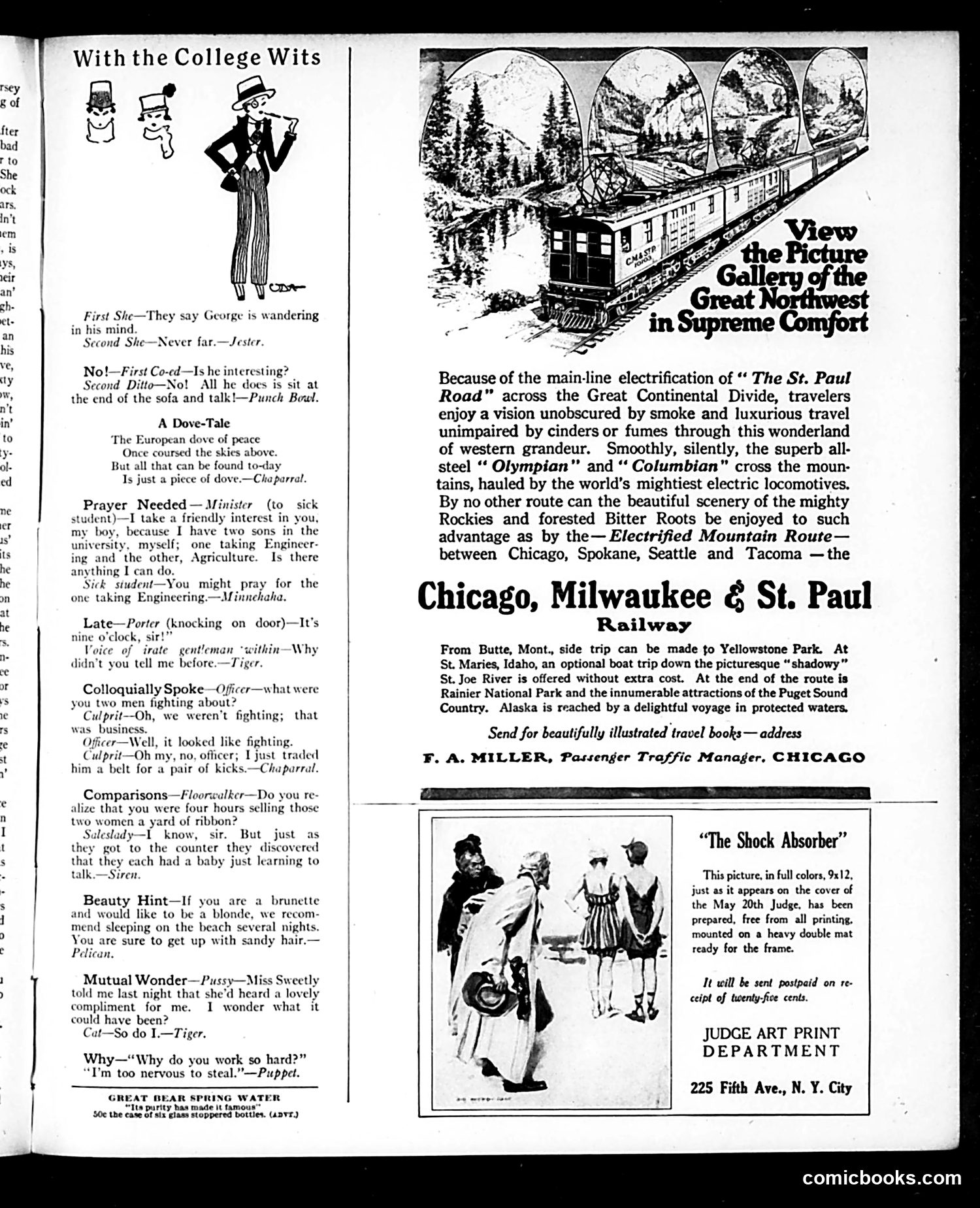
This page combines humor sections with advertising. The "College Wits" section features brief jokes about university students and young people—typical of Judge magazine's satirical humor. The jokes mock absent-minded behavior ("George is wandering in his mind"), romantic entanglements at social gatherings, and the practical challenges of college life (prayer for engineering students). The dominant content is a large advertisement for the Chicago, Milwaukee & St. Paul Railway, promoting their "Electrified Mountain Route" across the Rocky Mountains. This highlights early-20th-century pride in railroad electrification technology and scenic western travel. The bottom features "The Shock Absorber," promoting a Judge magazine art print available for purchase—a common feature in Judge that monetized popular cartoon illustrations from the current issue. The page reflects Judge's dual nature: satirical commentary on contemporary life mixed with commercial advertising.
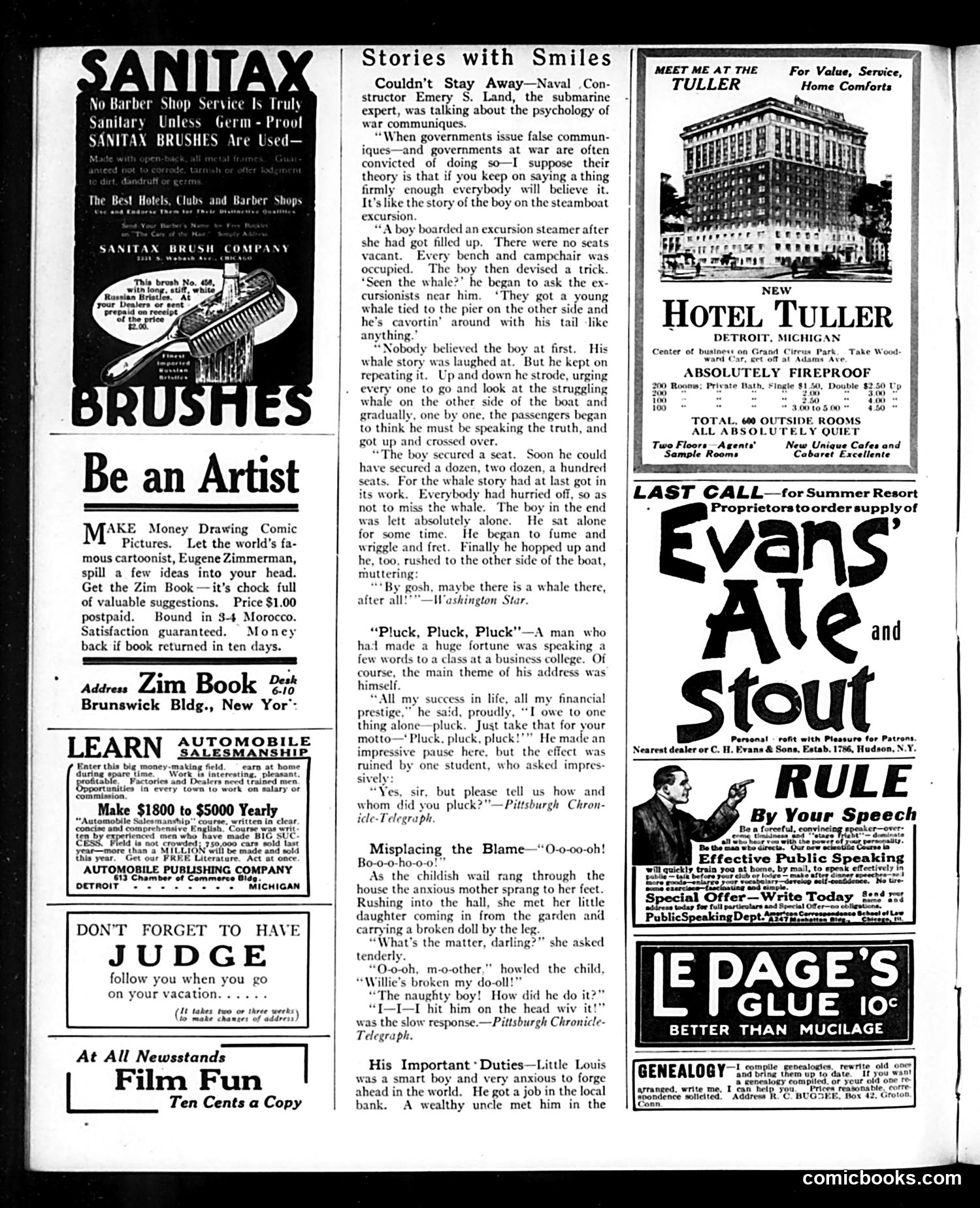
This page is primarily **advertising and light humor**, not political satire. The content includes: **Main Stories ("Stories with Smiles"):** Three anecdotes illustrating human nature: Naval Constructor Emery S. Land tells a story about a boy who repeatedly claims to see a whale, convincing passengers through repetition—a parable about how repeated falsehoods gain credibility in wartime propaganda. Two shorter jokes follow about a businessman crediting his success solely to "pluck" (which a student humorously suggests means literally plucking/stealing from others), and a child blaming a boy for breaking her doll when she actually broke it hitting him. **Advertisements:** The page is dominated by commercial ads—Sanitax brushes, cartooning instruction, automobile sales training, hotel promotions, Evans' Ale, and genealogy services. These reflect early 20th-century consumer goods and vocational opportunities. **Tone:** Light, moralistic humor aimed at middle-class readers. No specific political figures or events are referenced. The satire targets universal human foibles: gullibility, vanity, and dishonesty.
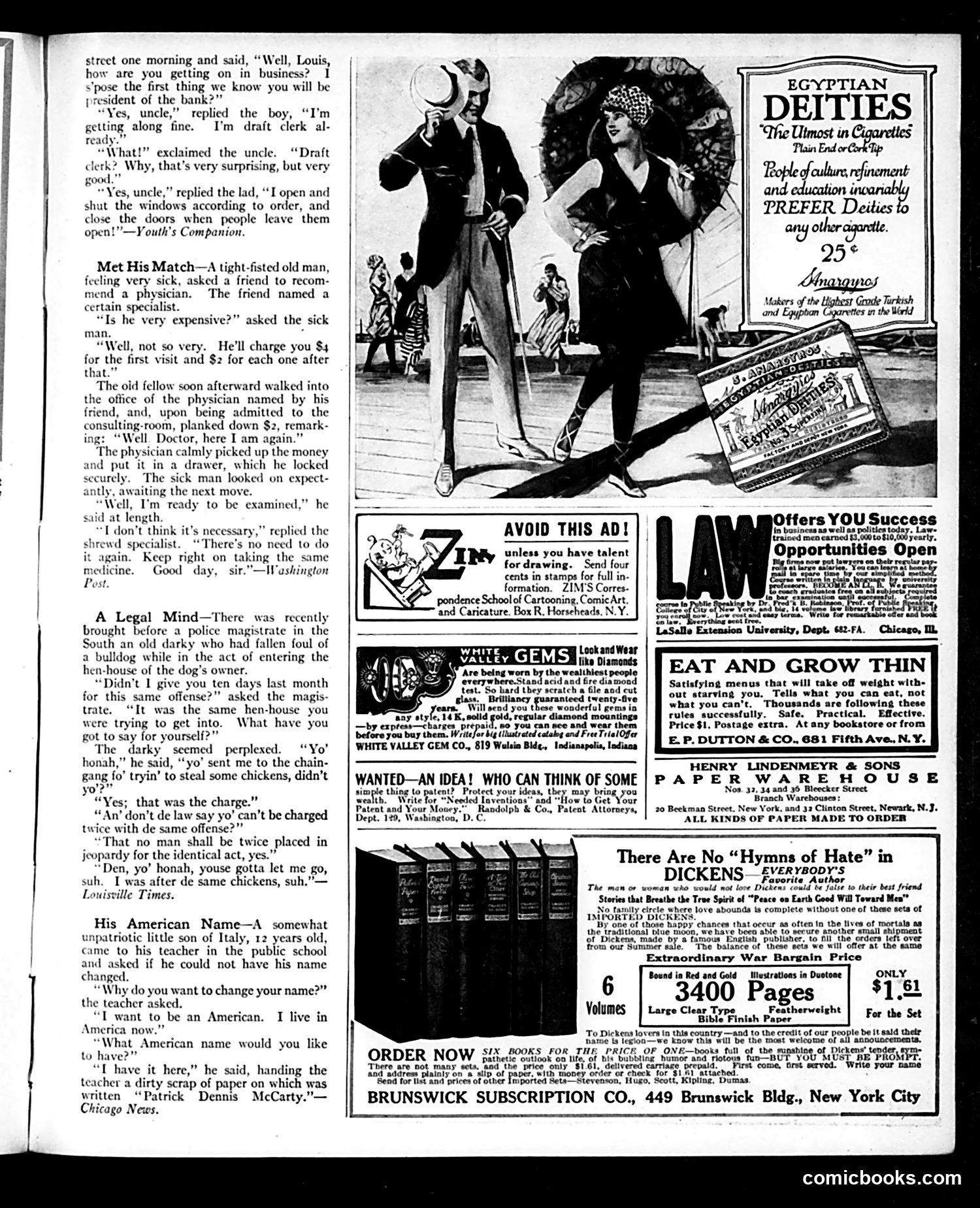
This page is primarily **advertisements and humorous anecdotes** rather than political cartoons. The text stories mock: 1. **"Draft Clerk"** — A boy claims advancement by merely opening/closing windows, satirizing meaningless job titles and false prestige. 2. **"Met His Match"** — A miserly patient outsmarts a doctor by paying only $2 for repeat visits, playing on the doctor's greed against his own stinginess. 3. **"A Legal Mind"** — A Black man cites the legal principle of double jeopardy to argue he shouldn't face charges for the same crime twice. The humor relies on racist stereotyping ("darky," dialect) while ironically crediting him with knowing constitutional law. The advertisements include Egyptian cigarettes, correspondence school cartooning courses, and weight-loss guides. The "Avoid This Ad!" section humorously warns readers not to fall for correspondence school scams. This reflects early 20th-century American humor conventions: working-class cleverness, professional incompetence, and deeply offensive racial humor presented as lighthearted.
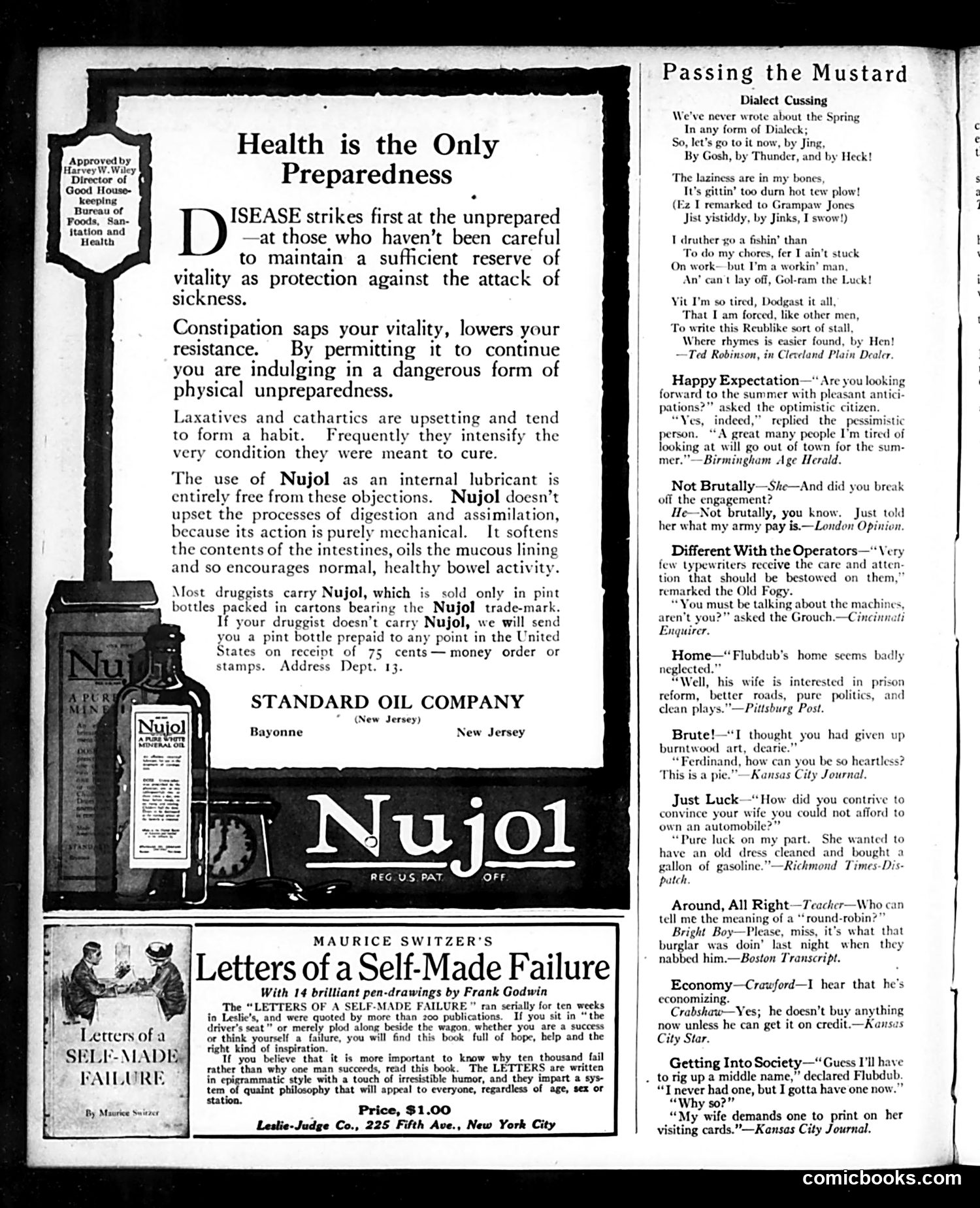
This page combines advertising with humor content typical of early 20th-century Judge magazine. **Main Advertisement:** The dominant content is a Nujol (mineral oil) advertisement by Standard Oil Company, framed as health advice. It uses "preparedness" rhetoric—likely referencing World War I-era American military readiness debates—to sell constipation treatment as patriotic duty. The ad positions laxative use as physical unpreparedness, a clever marketing angle linking bodily health to national security concerns of the era. **Satirical Content:** The right column contains "Passing the Mustard," a humor section featuring dialect humor and brief jokes about everyday life (marriage, employment, typewriters). These represent typical Judge magazine fare: short, punchy observations on social life with intentional rustic dialect ("gol-ram," "Reublike") that appealed to contemporary readers but now reads as condescending. **Overall:** This is primarily a **commercial page**—advertising dominates while humor fills remaining space.
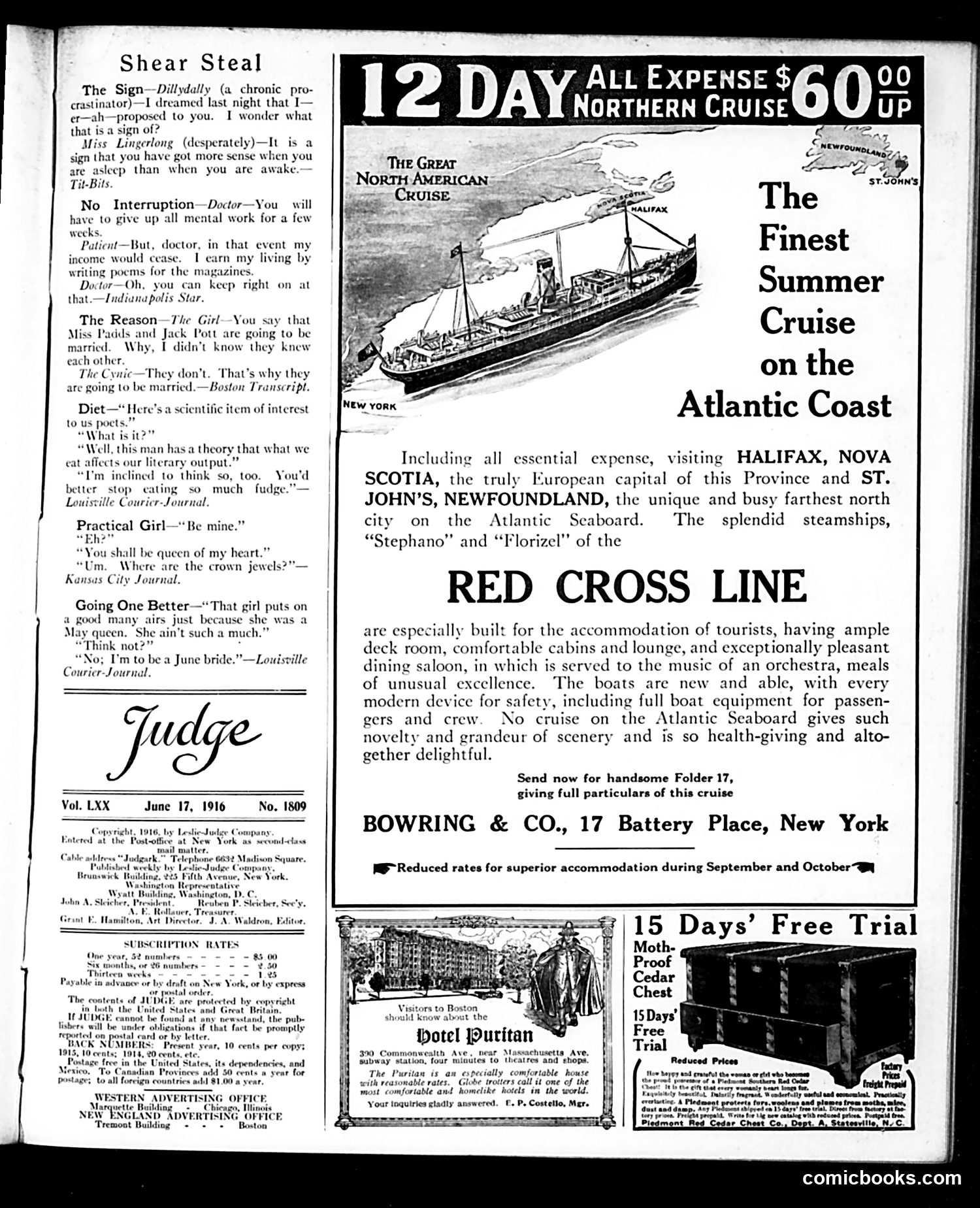
This page is primarily **advertising and light humor**, not political satire. The main content consists of: **Left column:** A series of brief jokes titled "Shear Steal" — puns and one-liners about procrastination, doctors, marriage, and poetry. These are gentle, domestic humor pieces typical of early 20th-century magazines, playing on wordplay and situational irony (e.g., a poet who can continue working despite needing mental rest). **Right side:** Large advertisements for luxury travel services — a 12-day Northern cruise on the Red Cross Line visiting Halifax, Nova Scotia, and Newfoundland, plus a hotel ad for the Puritan and a Cedar Chest trial offer. **No political figures or caricatures are present.** The page reflects 1916 consumer culture and middle-class leisure aspirations, with advertising dominating the space typically allocated to editorial content. The humor is apolitical, focusing on courtship, marriage, and professional life anxieties common to contemporary audiences.

This is a **Grape-Nuts cereal advertisement**, not satire or political commentary. The page features smiling children's faces arranged in a circle around a Grape-Nuts box and bowl, designed to promote the product. The ad employs early 20th-century advertising logic: it connects a health concern (children's dental health) to nutritional science, claiming Grape-Nuts contains "mineral salts" essential for strong teeth. The catchphrase "There's a Reason" was Grape-Nuts' actual advertising slogan. The circular arrangement of wholesome-looking children serves as visual testimony to the product's claimed benefits. This represents typical early advertising strategy—using emotional appeals and pseudo-scientific health claims rather than substantive evidence. Modern readers would recognize this as classic marketing that exploits parental anxieties about child health to sell breakfast cereal.