
Judge, 1916-06-17 · page 13 of 28
Judge — June 17, 1916 — page 13: what you’re looking at
What you’re looking at
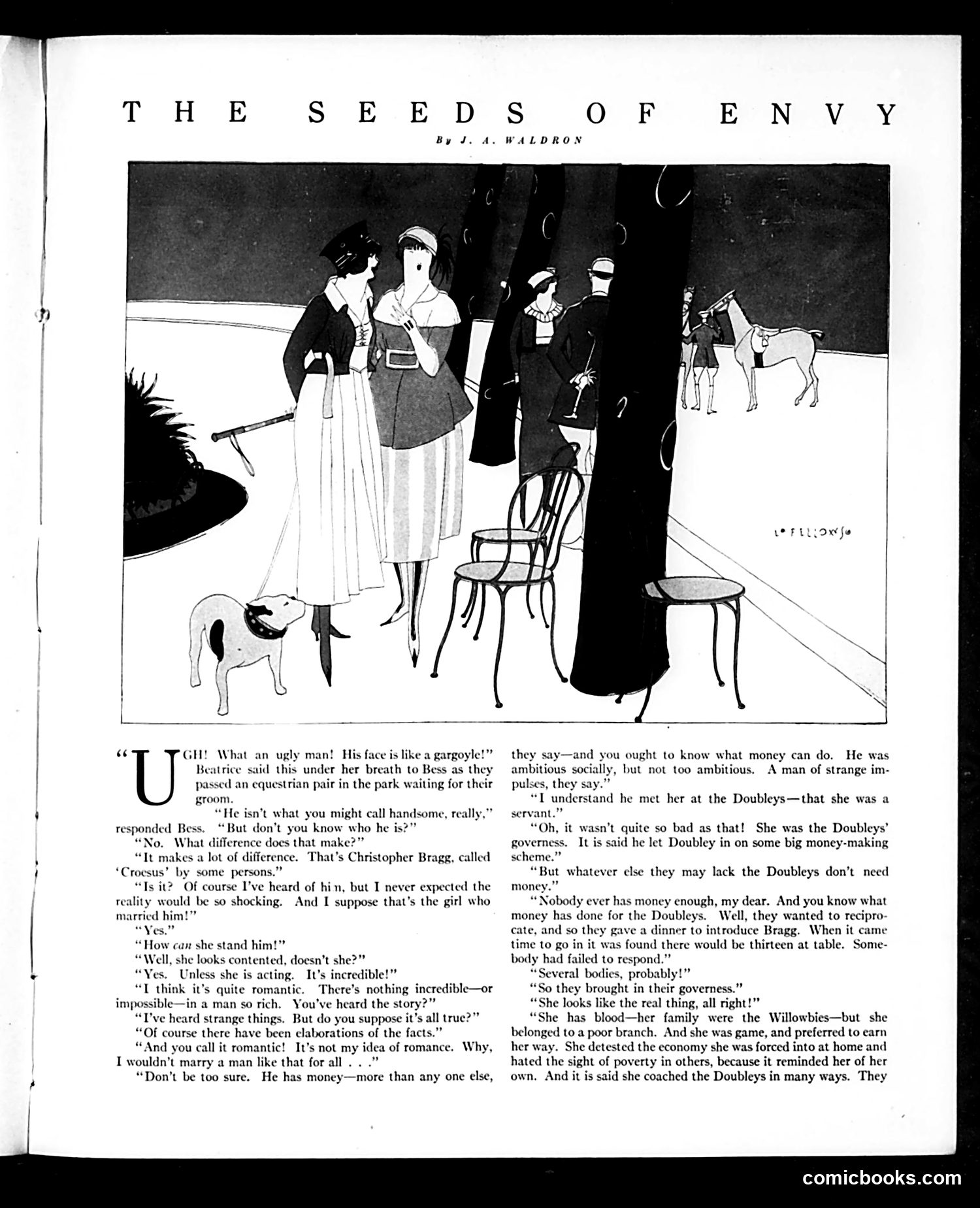
This story-cartoon satirizes how wealth overcomes social class and physical appearance in matrimonial prospects. Christopher Bragg, nicknamed "Croesus" (ancient symbol of extreme wealth), is physically ugly—described as gargoyle-like—yet marries a woman of good lineage (a Willowbie) who works as the Doubleys' governess. The satire targets Gilded Age social climbing: the governess accepts Bragg not from romance but pragmatism, preferring to "earn her way" upward rather than remain poor. The Doubleys reciprocate Bragg's financial favors by introducing the couple socially (even solving a thirteen-at-table superstition problem by recruiting the governess as dinner guest). The joke condemns both the wealthy man's assumption that money buys a wife and the governess's mercenary calculation that wealth justifies marrying an ugly man. The "seeds of envy" are planted in observers who recognize money's corrupting power over romantic ideals.
📄 Transcribed text from this page (OCR, searchable)
Machine-transcribed from the original scan — historical spelling and the odd misread are preserved.
E S E ED By J. A. S WALDRON GH! What an ugly man! His face is like a gargoyle Beatrice said this under her breath to Bess as they passed an equestrian pair in the park waiting for their groom. “He isn’t what you might call handsome, really,” responded Bess. ‘But don’t you know who he is?” “No. What difference does that make?” “It makes a lot of difference. That’s Christopher Bragg, called ‘Croesus’ by some persons.” “Is it? Of course I’ve heard of hin, but I never expected the reality would be so shocking. And I suppose that’s the girl who married him!” “Yes.” “How can she stand him “Well, she looks contented, doesn’t she?” “Yes, Unless she is acting. It’s incredible!” “TL think it’s quite romantic. There’s nothing incredible—or impossible—in a man so rich. You've heard the story?” “T’ve heard strange things. But do you suppose it’s all true?” “Of course there have been claborations of the facts.” “And you call it romantic! It’s not my idea of romance. Why, I wouldn't marry a man like that for all...” “Don’t be too sure. He has money—more than any one else, He was A man of strange im- they —and you ought to know what money can do. ambitious socially, but not too ambitious. pulses, they say. “LT understand he met her at the Doubleys—that she was servant.”” “Oh, it wasn’t quite so bad as that! She was the Doubleys’ governess. It is said he let Doubley in on some big money-making scheme.” “But whatever clse they may lack the Doubleys don’t need money.” “ Nobody ever has money enough, my dear. And you know what money has done for the Double Well, they wanted to recipro- cate, and so they gave a dinner to introduce Bragg. When it came time to go in it was found there would be thirteen at table. Some- body had failed to respond.” everal bodies, probably!” “So they brought in their governess.” “She looks like the real thing, all right!” “She has blood—her family were the Willowbies—but she belonged to a poor branch. And she was game, and preferred to earn her way. She detested the economy she was forced into at home and hated the sight of poverty in others, because it reminded her of her own, And it is said she coached the Doubleys in many ways. They comicbooks.com