
Judge, 1916-06-17 · page 12 of 28
Judge — June 17, 1916 — page 12: what you’re looking at
What you’re looking at
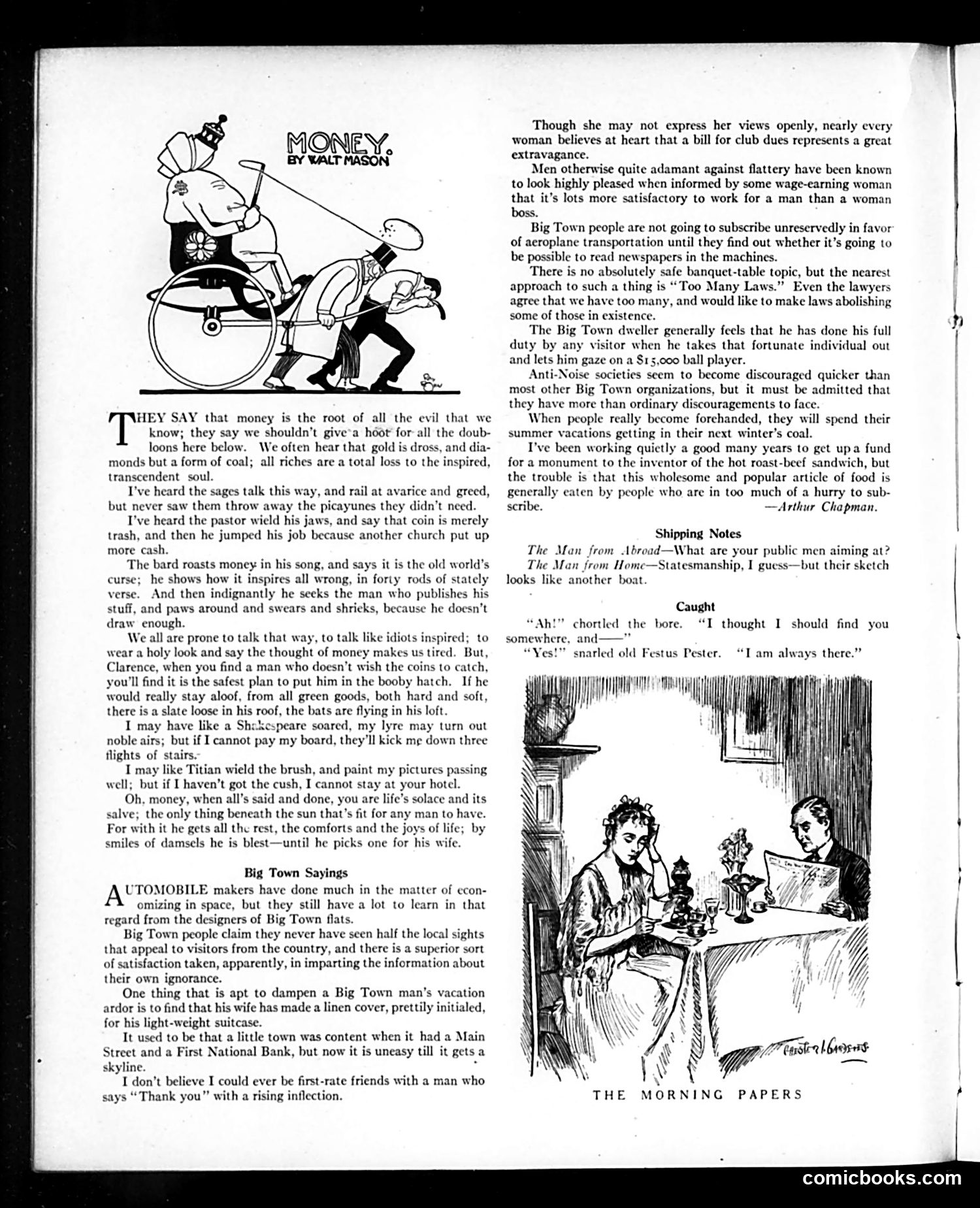
This page from *Judge* magazine contains satirical commentary on American attitudes toward money and urban life. The main cartoon "Money" by Ralph Barton depicts the hypocrisy of preaching against materialism while pursuing wealth. The accompanying essay mocks religious leaders, artists, and philosophers who publicly denounce money as evil yet desperately chase it—priests who demand higher salaries, poets complaining about insufficient payment, and those claiming poverty would make them mad. The "Big Town Sayings" section satirizes urban pretension: wealthy city dwellers boasting ignorance of local attractions, obsession with skylines as status symbols, and debates over frivolous regulations. It also mocks gendered attitudes—women viewing club fees as wasteful, and workplace dynamics where employees prefer male bosses. The humor relies on exposing gap between stated values and actual behavior—a classic satirical technique. The targets are hypocrisy, social climbing, and materialism among America's middle and upper classes during the early 20th century.
📄 Transcribed text from this page (OCR, searchable)
Machine-transcribed from the original scan — historical spelling and the odd misread are preserved.
know; they say we shouldn’t give’a héot for all the doub- loons here below. We often hear that gold is dross, and dia- monds but a form of coal; all riches are a total loss to the inspired, transcendent soul. I've heard the sages talk this way, and rail at avarice and greed, but never saw them throw away the picayunes they didn’t need I’ve heard the pastor wield his jaws, and say that coin is merely trash, and then he jumped his job because another church put up more ¢ The bard roasts money in his song, and says it is the old world’s he shows how it inspires all wrong, in forty rods of stately And then indignantly he seeks the man who publishes his stuff, and paws around and swears and shrieks, because he doesn’t draw enough. We all are prone to talk that way, to talk like idiots inspired; to wear a holy look and say the thought of money makes us tired. But, Clarence, when you find a man who doesn’t wish the coins to catch, you'll find it is the safest plan to put him in the booby hatch. If he would really stay aloof, from all green goods, both hard and soft, there is a slate loose in his roof, the bats are flying in his loft. I may have like a Shokcspeare soared, my lyre may turn out noble airs; but if I cannot pay my board, they'll kick me down three irs. e Titian wield the brush, and paint my pictures passing well; but if I haven’t got the cush, I cannot stay at your hotel. Oh, money, when all’s said and done, you are life’s solace and its salve; the only thing beneath the sun that’s fit for any man to have. For with it he gets all the rest, the comforts and the joys of life; by smiles of damsels he is blest—until he picks one for his wife. (hes SAY that money is the root of all the evil that we Big Town Sayings A TOMOBILE makers have done much in the matter of econ- omizing in space, but they still have a lot to learn in that regard from the designers of Big Town flats. Big Town people claim they never have seen half the local sights that appeal to ors from the country, and there is a superior sort of satisfaction taken, apparently, in imparting the information about their own ignorance. One thing that is apt to dampen a Big Town man’s vacation ardor is to find that his wife has made a linen cover, prettily initialed, for his light-weight suitcase. It used to be that a little town was content when it had a Main Street and a First National Bank, but now it is uneasy till it Bets: a skyline. I don’t believe I could ever be first-rate friends with a man who says “Thank you” with a rising inflection. Though she may not express her views openly, nearly every woman believes at heart that a bill for club dues represents a great extravagance. Men otherwise quite adamant against flattery have been known to look highly pleased when informed by some wage-earning woman that it’s lots more satisfactory to work for a man than a woman boss. Big Town people are not going to subscribe unreservedly in favor of aeroplane transportation until they find out whether it’s going to be possible to read newspapers in the machines. There is no absolutely safe banquet-table topic, but the nearest approach to such a thing i is “Too Many Laws.”” Even the law agree that we have too many, and would like to make laws abolishing some of those in existence. The Big Town dweller generally feels that he has done his full duty by any visitor when he takes that fortunate individual out and lets him gaze on a $15,000 ball player. Anti-Noise societies seem to become discouraged quicker than most other Big Town organizations, but it must be admitted that they have more than ordinary discouragements to face. When people really become forehanded, they will spend their summer vacations getting in their next winter’s coal. I've been working quietly a good many years to get upa fund for a monument to the inventor of the hot roast-beef sandwich, but the trouble is that this wholesome and popular article of food is generally eaten by people who are in too much of a hurry to sub- scribe. —Arthur Chapman. Shipping Notes The Man from Abroad—What are your public men aiming at? The Man from Home—Statesmanship, I guess—but their sketch looks like another boat Caught chortled the bore. “I thought I should find you and. snarled old Festus Pester. pn gy “Ah! somewhet “Tam always there.” ly THE MORNING PAPERS comicbooks.com