
Judge, 1916-06-17 · page 9 of 28
Judge — June 17, 1916 — page 9: what you’re looking at
What you’re looking at
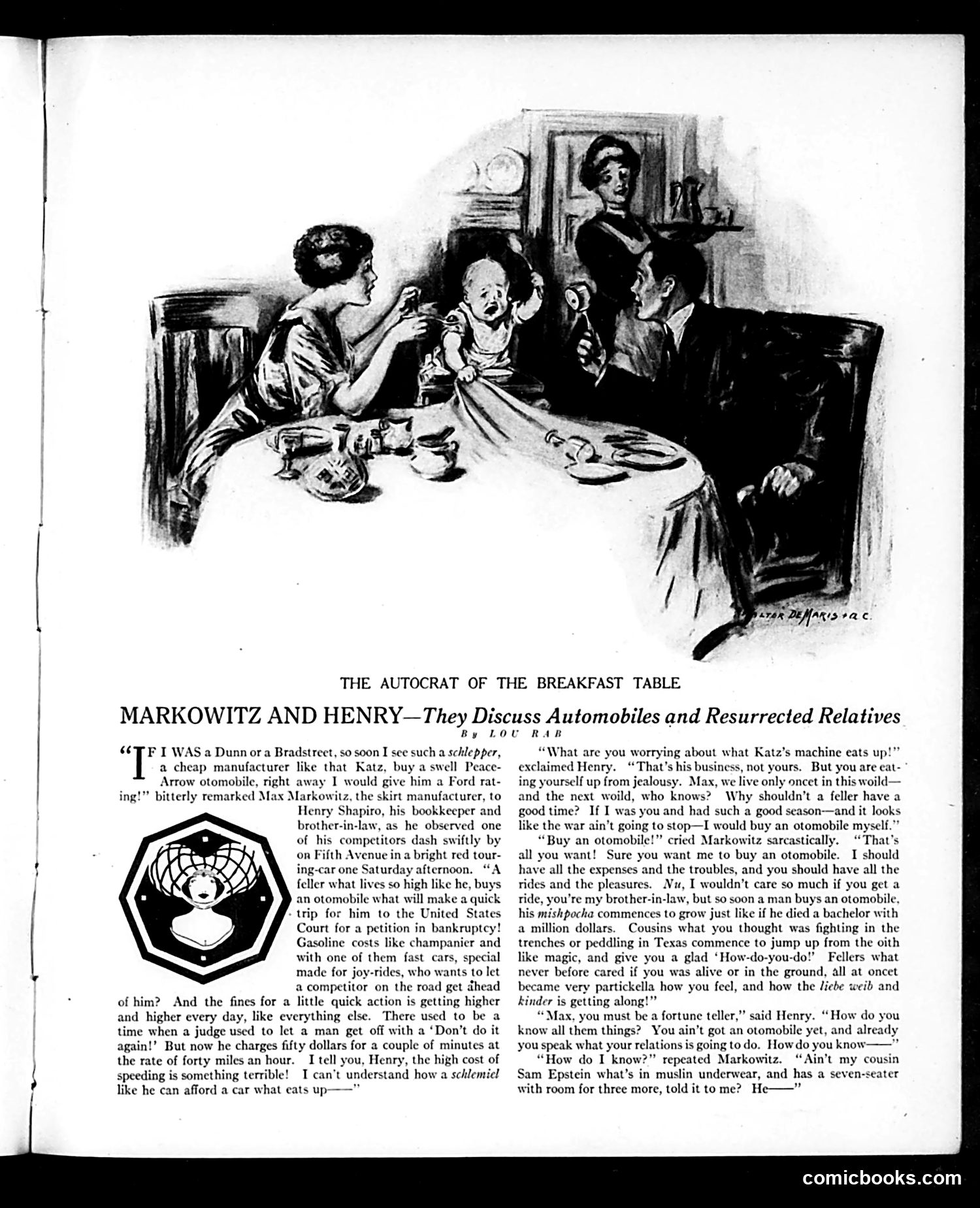
This is a humorous dialogue between two Jewish-American characters—Max Markowitz, a skirt manufacturer, and Henry Shapiro, his bookkeeper and brother-in-law—debating whether to buy an automobile. **The satire targets:** 1. **Class anxiety and consumer culture**: Max envies his competitor Katz's fancy touring car but resents the expense and social pressure to keep up appearances. 2. **The cost of living**: Max complains about automobile expenses, gasoline costs, and increasingly steep speeding fines—reflecting post-WWI economic anxieties. 3. **Jewish family dynamics**: Max fears that buying a car will unleash distant relatives ("mishpocha") suddenly claiming connection and demanding rides, a satirical jab at familial obligation in immigrant communities. The humor relies on Yiddish-inflected English dialogue ("schlemiel," "otomobile," "woild") and the relatable tension between desire for status symbols and practical financial worry. The 1910s-20s setting makes automobiles still novel luxury items, intensifying the social competition.
📄 Transcribed text from this page (OCR, searchable)
Machine-transcribed from the original scan — historical spelling and the odd misread are preserved.
a THE AUTOCRAT OF THE BREAKFAST TABLE MARKOWITZ AND HENRY—They Discuss Automobiles and Resurrected Relatives By LOU RAB a cheap manufacturer like that Katz, buy a swell Peace- Arrow otomobile, right away I would give him a Ford rat- ing!” bitterly remarked Max Markowitz, the skirt manufacturer, to Henry Shapiro, his bookkeeper and brothe w, as he observed one of his competitors dash swiftly by on Fifth Avenue in a bright red tour- ing-car one Saturday afternoon. “A feller what lives so high like he, buys an otomobile what will make a quick trip for him to the United States Court for a petition in bankruptcy! Gasoline costs like champanier and with one of them fast cars, special made for joy-rides, who a competitor on the road get dhead of him? And the fines for a little quick action is getting higher and higher every day, like everything else. There used to be a time when a judge used to let a man get off with a ‘Don’t do it again!’ But now he charges fifty dollars for a couple of minutes at the rate of forty miles an hour. I tell you, Henry, the high cost of speeding is something terrible! I can’t understand how a schlemiel like he can afford a car what eats up——" a | F I WAS a Dunn ora Bradstreet, so soon I see such a schlepper, “What are you worrying about what Katz’s machine eats up!”” exclaimed Henry. “That’s his business, not yours. But you are eat- ing yourself up from jealousy. Max, we live only oncet in this woild— and the next woild, who knows? Why shouldn’t a feller have a good time? If I was you and had such a good season—and it looks like the war ain’t going to stop—I would buy an otomobile myself.”” “Buy an otomobile!” cried Markowitz sarcastically. “That's all you want! Sure you want me to buy an otomobile. I should have all the expenses and the troubles, and you should have all the rides and the pleasures. Nu, I wouldn’t care so much if you get a ride, you're my brother-in-law, but so soon a man buys an otomobile, his mishpocha commences to grow just like if he died a bachelor with a million dollars. Cousins what you thought was fighting in the trenches or peddling in Texas commence to jump up from the oith like magic, and give you a glad ‘How-do-you-do!’ Fellers what never before cared if you was alive or in the ground, all at oncet became artickella how you feel, and how the /iebe weib and kinder is getting along!” “Max, you must be a fortune teller,” said Henry. “How do you know all them things? You ain’t got an otomobile yet, and already you speak what your relations is going to do. Howdo you know 3 “How do I know?” repeated Markowitz. “Ain’t my cousin Sam Epstein what’s in muslin underwear, and has a seven-seater with room for three more, told it to me?) He——” comicbooks.com