
Judge, 1916-06-17 · page 10 of 28
Judge — June 17, 1916 — page 10: what you’re looking at
What you’re looking at
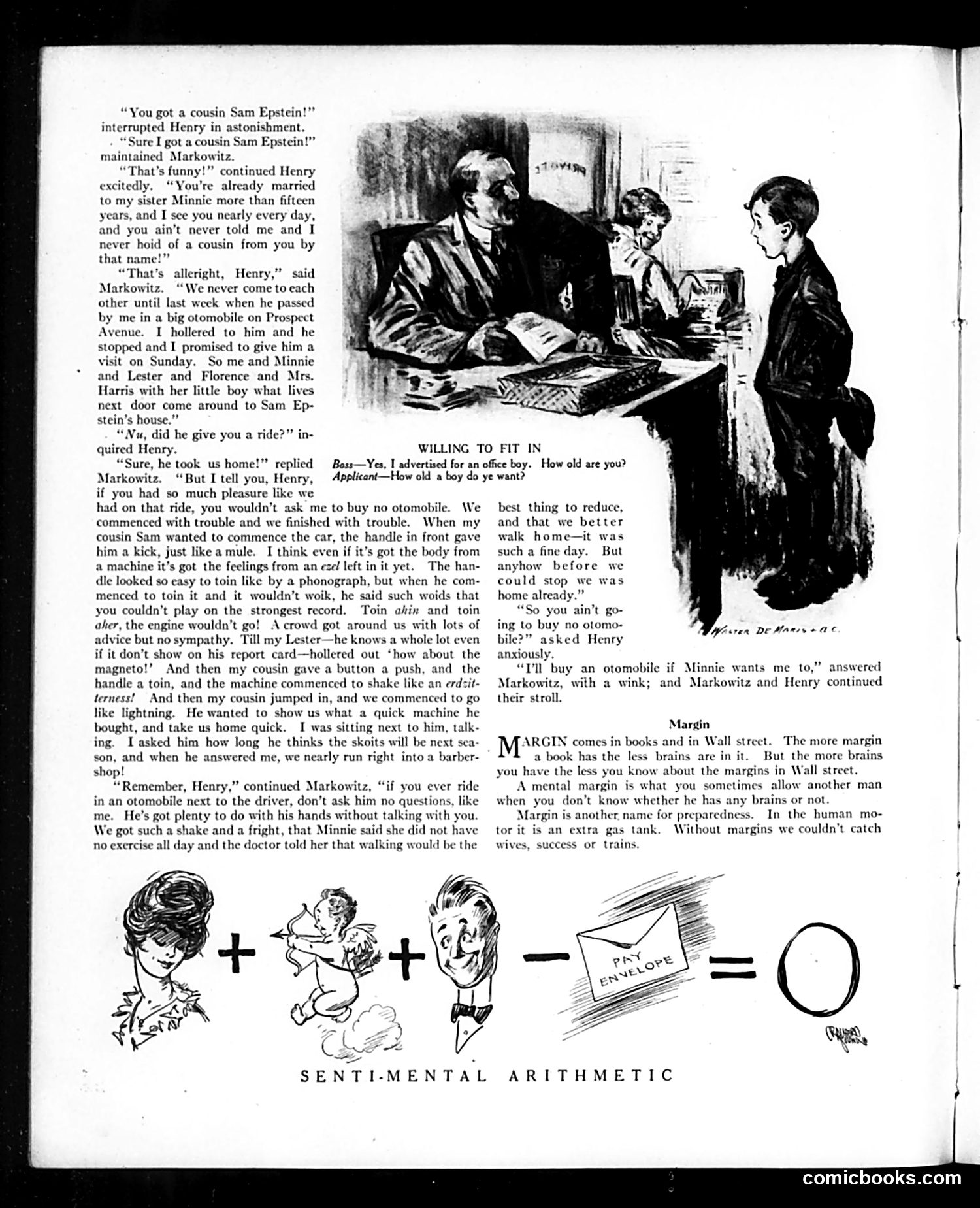
This Judge magazine page contains ethnic humor typical of early 20th-century American satire. The main story features Markowitz and Henry (appearing to be Jewish-American characters, identifiable by names and Yiddish-inflected English dialogue) discussing an automobile ride that went comically wrong—the car's crank starter kicked like a mule, the engine wouldn't start, and once running, the driver's recklessness nearly caused a crash into a barber shop. The satire mocks both the newfangled automobile technology and immigrant characters' unfamiliarity with it, while poking fun at their malapropisms ("otomobile," "ezel"). A separate small cartoon ("Willing to Fit In") shows a job applicant asking the boss what age boy he wants—a joke about flexibility or desperation in the job market. The bottom "Senti-mental Arithmetic" is a visual pun equation: woman + cupid + man - pay envelope = zero/nothing, cynically suggesting romance collapses without money.
📄 Transcribed text from this page (OCR, searchable)
Machine-transcribed from the original scan — historical spelling and the odd misread are preserved.
“You got a cousin Sam E interrupted Henry in astonishment. “Sure I got a cousin Sam Epstein!” maintained Markowitz. That’s funny!” continued Henry excitedly. “You're already married to my sister Minnie more than fifteen years, and I see you nearly every day, and you ain’t never told me and I never hoid of a cousin from you by that name!” “That's alleright Markowitz. “We never come to each other until last week when he passed by me in a big otomobile on Prospect Avenue. I hollered to him and he stopped and I promised to give him a visit on Sunday. So me and Minnie and Lester and Florence and Mrs. Harris with her little boy what lives next door come around to Sam Ep- stein’s house.” Nu, did he give you a ride?” in- quired Henry. “Sure, he took us home!’ replied Marko “But I tell you, Henry, if you had so much pleasure like we had on that ride, you wouldn’t ask me to buy no otomobile. We commenced with trouble and we finished with trouble. When my cousin Sam wanted to commence the car, the handle in front gave him a kick, just like a mule. I think even if it’s got the body from a machine it’s got the feelings from an ezel left in it yet. The han- dle looked so easy to toin like by a phonograph, but when he com- menced to toin it and it wouldn’t woik, he said such woids that you couldn’t play on the strongest record. Toin alin and toin aher, the engine wouldn’t go! A crowd got around us with lots of advice but no sympathy. Till my Lester—he knows a whole lot even if it don’t show on his report card—hollered out ‘how about the magneto!’ And then my cousin gave a button a push, and the handle a toin, and the machine commenced to shake like an erd: terness! And then my cousin jumped in, and we commenced to go like lightning. He wanted to show us what a quick machine he bought, and take us home quick. I was sitting next to him, talk- ing. I asked him how long he thinks the skoits will be next s son, and when he answered me, we nearly run right into a barber- shop! “Remember, Henry,” continued Markowitz, “if you ever ride in an otomobile next to the driver, don’t ask him no questions, like me. He’s got plenty to do with his hands without talking with you. We got such a shake and a fright, that Minnie said she did not have no exercise all day and the doctor told her that walking would be the Henry,” said C by az) A we WILLING TO FIT IN Boss—Yes, | advertised for an office boy. How old are you? Applicant—How old a boy do ye want? SENTI-MENTAL ARITHMETIC best thing to reduce, and that we better walk home—it was such a fine day. But anyhow before we could stop we was home already “So you ain’t go- ing to buy no otomo- bile?” asked Henry anxiously. “Tl buy an otomobile if Minnie wants me to,” Markowitz, with a wink; and Markowitz and Henry continued their stroll. Wo sven De Many +A ” answered Margin ARGIN comes in books and in Wall street. The more margin a book has the less brains are in it. But the more brains uu have the less you know about the margins in Wall street. A mental margin is what you sometimes allow another man when you don’t know whether he has any brains or not. Margin is another. name for preparedness. In the human mo- tor it is an extra gas tank. Without margins we couldn't catch wives, success or trains comicbooks.com