
Judge, 1916-06-17 · page 15 of 28
Judge — June 17, 1916 — page 15: what you’re looking at
What you’re looking at
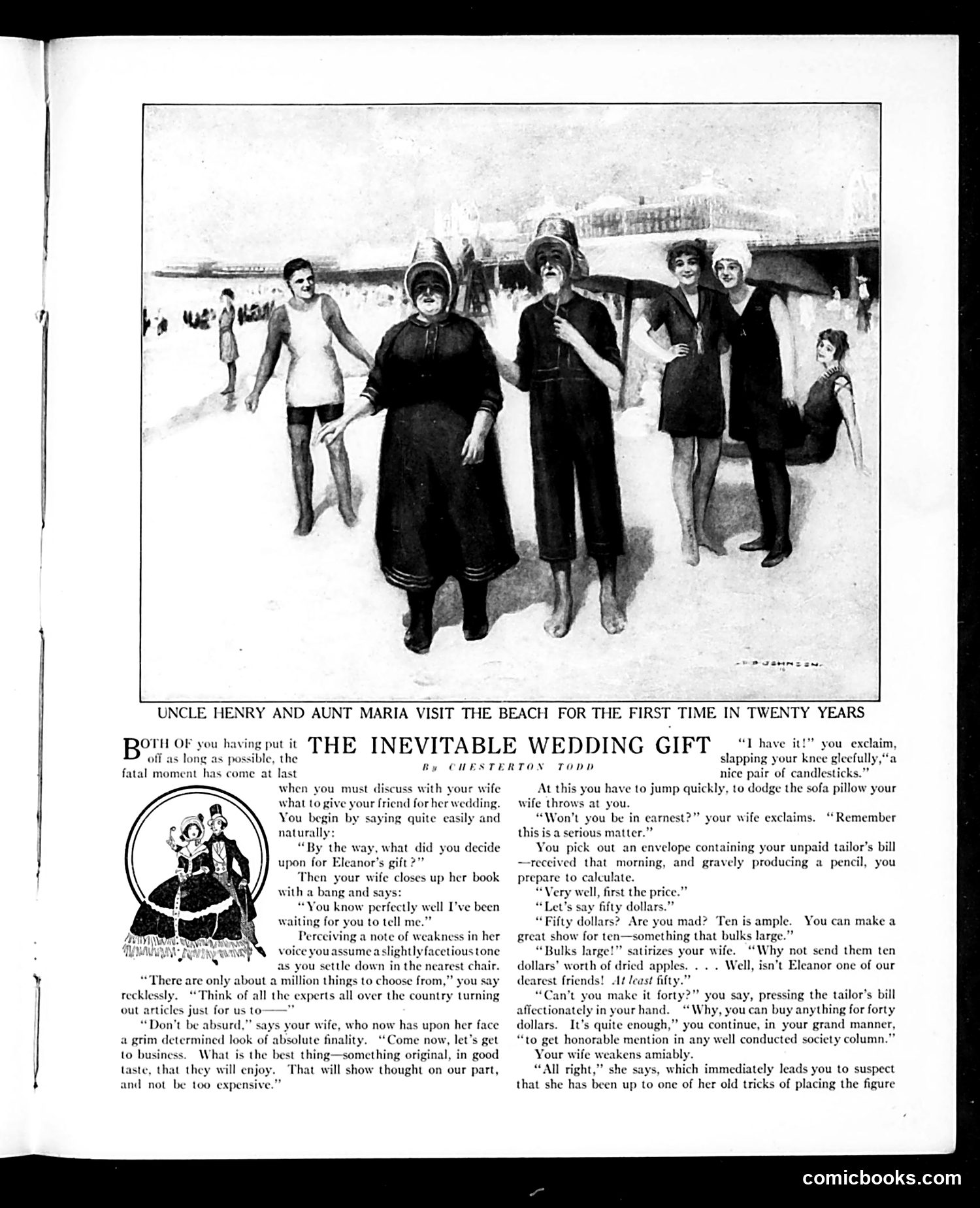
This is a humorous domestic satire by Chesterton Todd depicting a married couple negotiating what wedding gift to buy for a friend named Eleanor. The accompanying illustration shows a beach scene with people in early-20th-century bathing attire. The joke satirizes the predictable marital conflict over wedding gift-giving: the husband procrastinates, makes silly suggestions (candlesticks), tries to dodge the discussion, and attempts to negotiate the price downward—partly because he has an unpaid tailor's bill he's anxious about. The wife responds with exasperation, insisting the gift reflect genuine regard for their "dearest friend." The humor derives from depicting this minor domestic disagreement as a serious negotiation where both parties employ strategic tactics—the wife eventually "weakens" on the budget, which the husband immediately suspects is another trick. It's gentle satire of middle-class married life and consumer anxieties around gift-giving etiquette.
📄 Transcribed text from this page (OCR, searchable)
Machine-transcribed from the original scan — historical spelling and the odd misread are preserved.
UNCLE HENRY AND AUNT MARIA VISIT THE BEACH FOR THE FIRST TIME IN TWENTY YEARS OTH OF you having put it THE INEVITABLE WEDDING GIFT By CHESTERTON TODD off as long as possible, the fatal moment has come at last when you must discuss with your wife what to give your friend for her wedding. You begin by saying quite easily and naturall By the way, what did you decide upon for Eleanor’s gift ?” Then your wife closes up her book with a bang and says: “You know perfectly well I’ve been waiting for you to tell me. Perceiving a note of weakness in her voice youassume a slightly facetious tone as you settle down in the nearest chair. “There are only about a million things to choose from,” you say recklessly. “Think of all the experts all over the country turning out articles just for us to— “Don't be absurd,” says your wife, who now has upon her face a grim determined look of absolute finality. ‘Come now, let’s get to business. What is the best thing—somcething original, in good taste, that they will enjoy, That will show thought on our part, and not be too expensive “LT have it!” you exclaim, slapping your knee g y nice pair of candlesticks.” At this you have to jump quickly, to dodge the sofa pillow your wife throws at you. “Won't you be in earnest?” your wife exclaims. ‘Remember this is a serious matter.” You pick out an envelope containing your unpaid tailor’s bill —received that morning, and gravely producing a pencil, you prepare to calculate. “Very well, first the price.” “Let's say fifty dollars. “Fifty dollars? Are you mad? Ten is ample. You can make great show for ten—something that bulks large.” “Bulks large!” satirizes your wife. ‘Why not send them ten dollars’ worth of dried apples. . . . Well, isn’t Eleanor one of our dearest friends! At least fifty.” “Can't you make it forty?” you say, pressing the tailor’s bill affectionately in your hand. “Why, you can buy anything for forty dollars. It’s quite enough,” you continue, in your grand manner, “to get honorable mention in any well conducted society column.” Your wife weakens amiably. “All right,” she says, which immediately leads you to suspect that she has been up to one of her old tricks of placing the figure comicbooks.com