
A complete issue · 28 pages · 1916
Judge — June 10, 1916
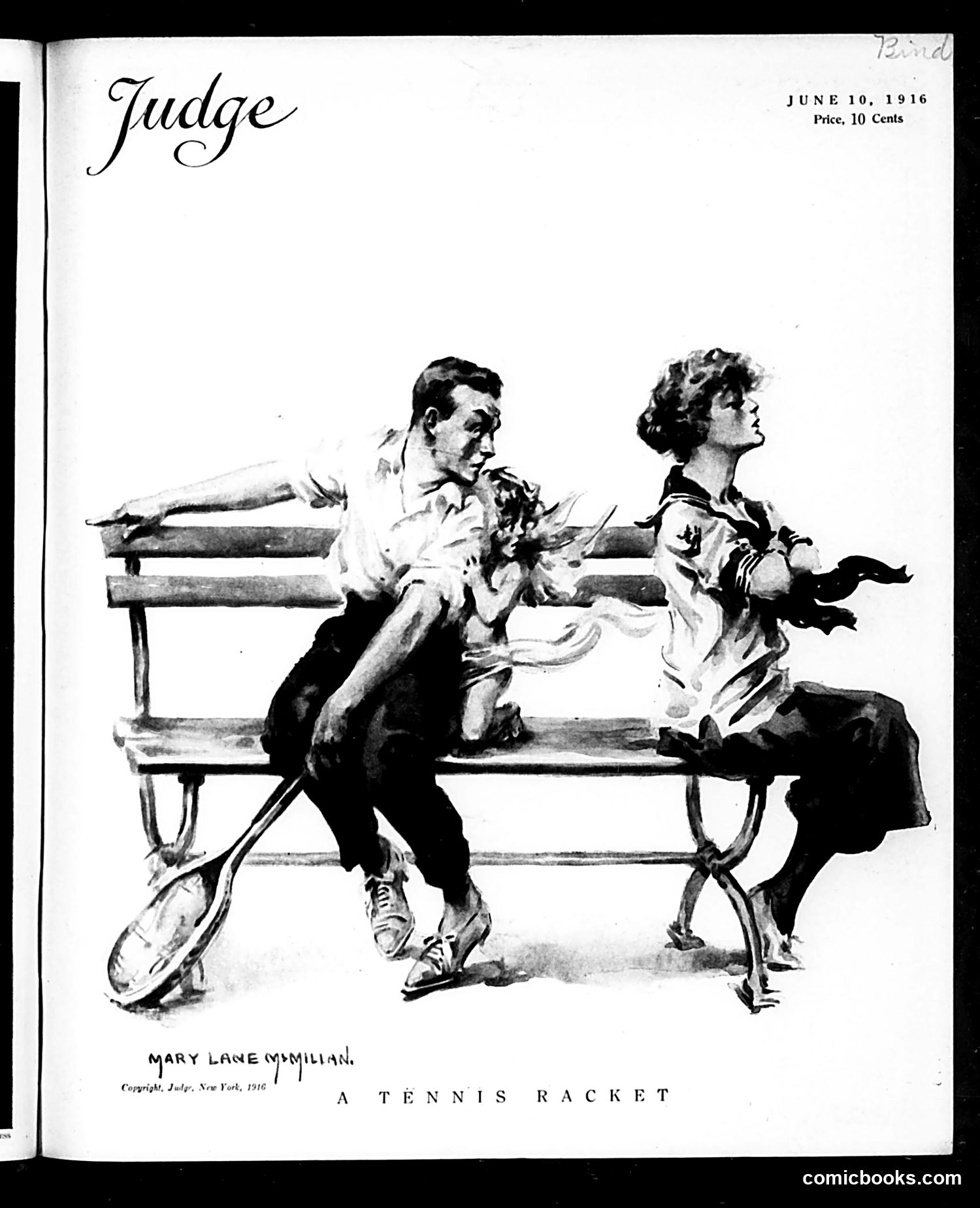
This illustration by Mary Lane McMillan depicts a couple on a park bench with a small dog between them. The title "A Tennis Racket" is a pun—rather than discussing the sport, it refers to a romantic or domestic "racket" (commotion/situation). The cartoon appears to satirize early 20th-century courtship dynamics. The man and woman's body language suggests tension or awkwardness, with the woman looking away while the man gazes toward her. The small dog serves as an awkward third party, possibly commenting on the complications of romance or the intrusion of domestic life into courtship. The humor targets contemporary social attitudes about relationships and public displays of affection during the Progressive Era.
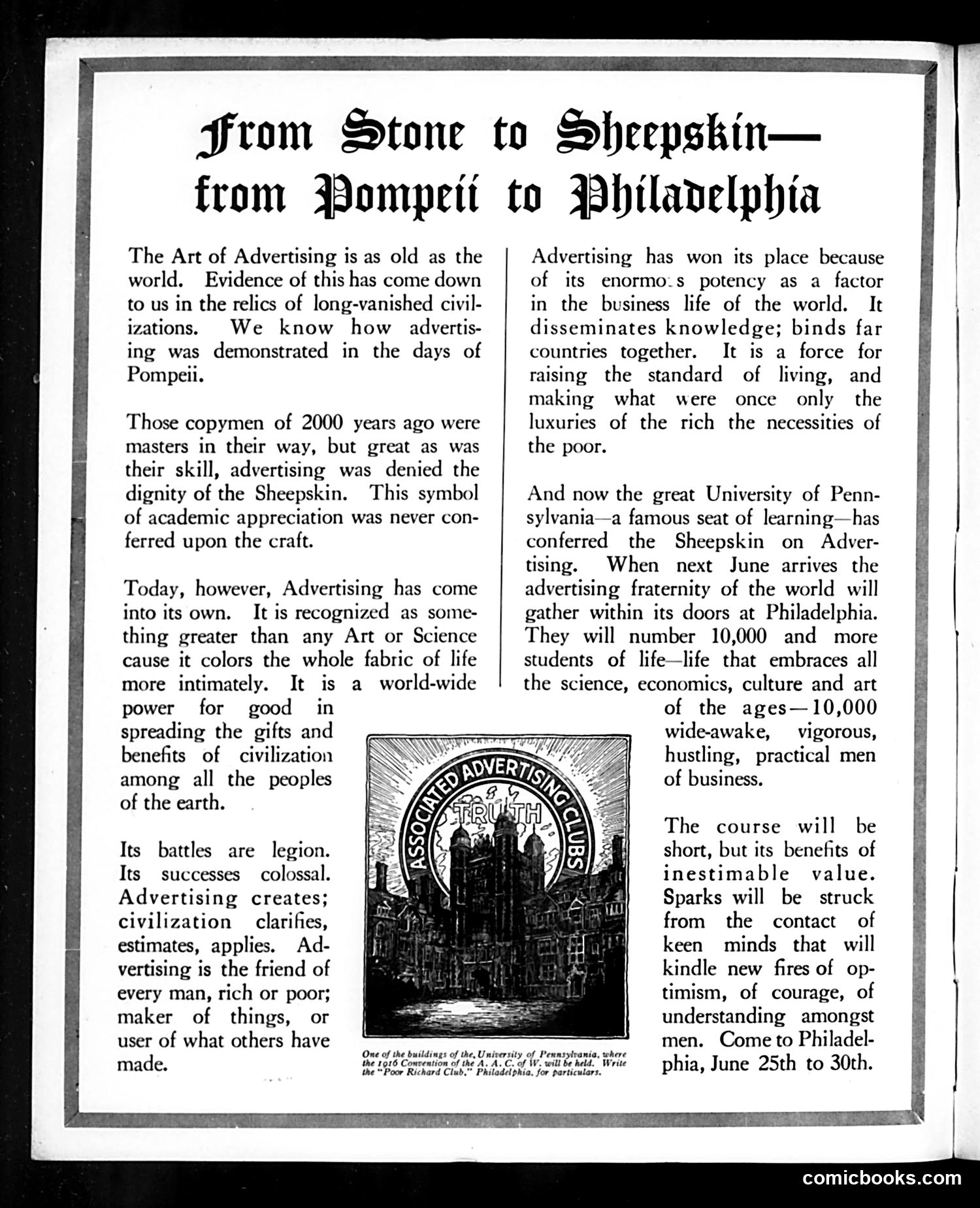
This appears to be **advertising content rather than satire or cartoon commentary**. The page promotes the University of Pennsylvania's newly established advertising course, celebrating advertising as a legitimate academic discipline worthy of scholarly recognition—comparable to receiving a "Sheepskin" (diploma). The text uses grandiose historical framing, comparing modern advertising to ancient promotional practices in Pompeii, to elevate the profession's status. The central image shows a University of Pennsylvania building. The message targets business professionals: advertising has evolved from craft to respected science deserving academic credentials. The June 25-30 conference will gather "10,000 and more students" for networking and intellectual exchange. This reflects early 20th-century efforts to professionalize advertising and establish it as legitimate business education.
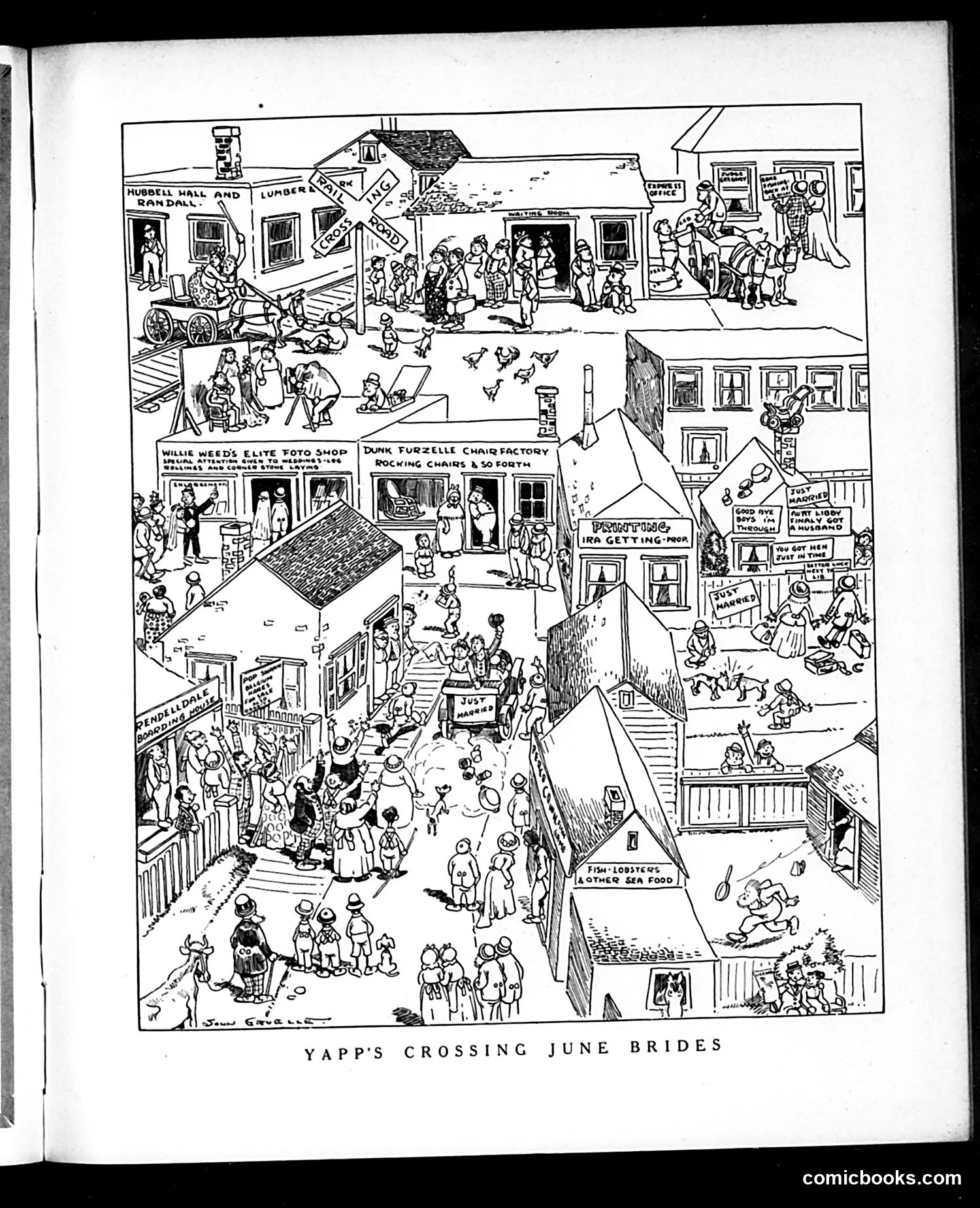
This is a crowded street scene depicting a bustling commercial district, likely titled "Yapp's Crossing" (an identifiable neighborhood or intersection). The cartoon satirizes the social phenomenon of June weddings—traditionally the most popular wedding month in America. The scene shows numerous storefronts including "Hubbell and Lumber," "Willie Weeds Elite Photo Shop," and "Dunk Furzelle Chairs Factory." Multiple businesses advertise services relevant to weddings: photographers, furniture makers, and other merchants. The point of the satire appears to be how commercial interests profit from the June bride tradition—local businesses capitalize on the seasonal rush of weddings by promoting their goods and services to engaged couples. The crowded, chaotic street scene emphasizes the commercialization and frenzy surrounding this social custom.
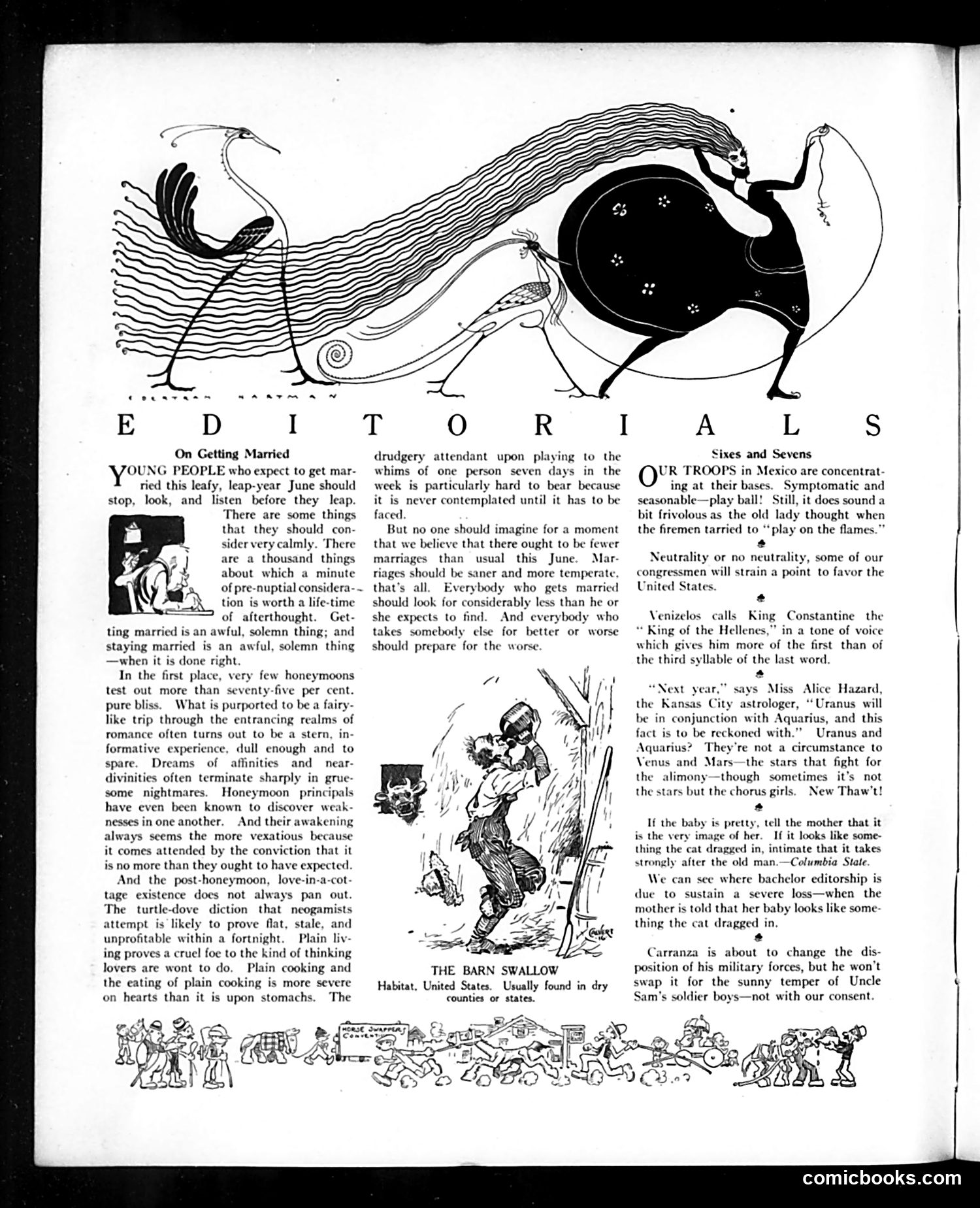
This page contains satirical commentary on contemporary social topics rather than political cartoons targeting specific figures. **"On Getting Married"** critiques honeymoon expectations and marital realities. The text argues that newly married couples often experience disappointment rather than "fairy-like" bliss, warning that those unprepared for marriage's difficulties will suffer worse outcomes. **"The Barn Swallow"** illustration accompanies a natural history entry about the bird species, seemingly unrelated to the social commentary. **"Sixes and Sevens"** and other brief items offer miscellaneous observations on contemporary life, including astrology predictions by "Miss Alice Hazard" and commentary on bachelor editorship and infant appearance. The page represents Judge's blend of humor, social observation, and general-interest content typical of early 20th-century satirical magazines.
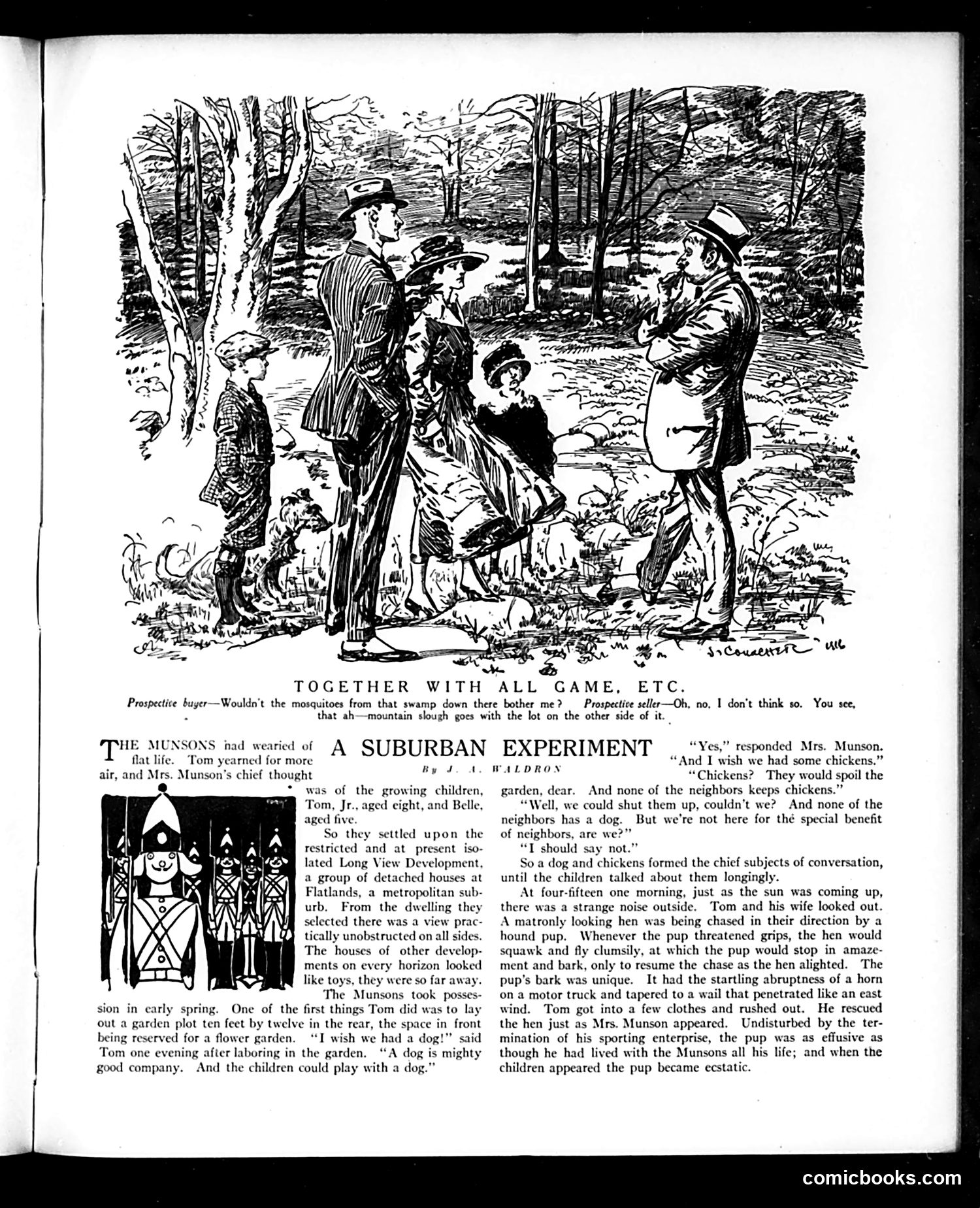
This page contains a short story titled "A Suburban Experiment" by J.A. Waldron, not political satire. The narrative describes the Munson family's move to suburban life at "Flatlands," where they attempt to start a garden and acquire chickens and a dog. The top cartoon illustrates the story's opening premise: a real estate agent (right) discussing property with prospective buyers. The dialogue reveals the agent's sales pitch versus reality—he downplays mosquito concerns from nearby swamps, a common contrast between suburban advertising promises and actual conditions. The story depicts early 20th-century suburban aspiration: middle-class families seeking country life benefits while maintaining proximity to urban centers. The humor derives from their naive optimism about rural ventures like farming.
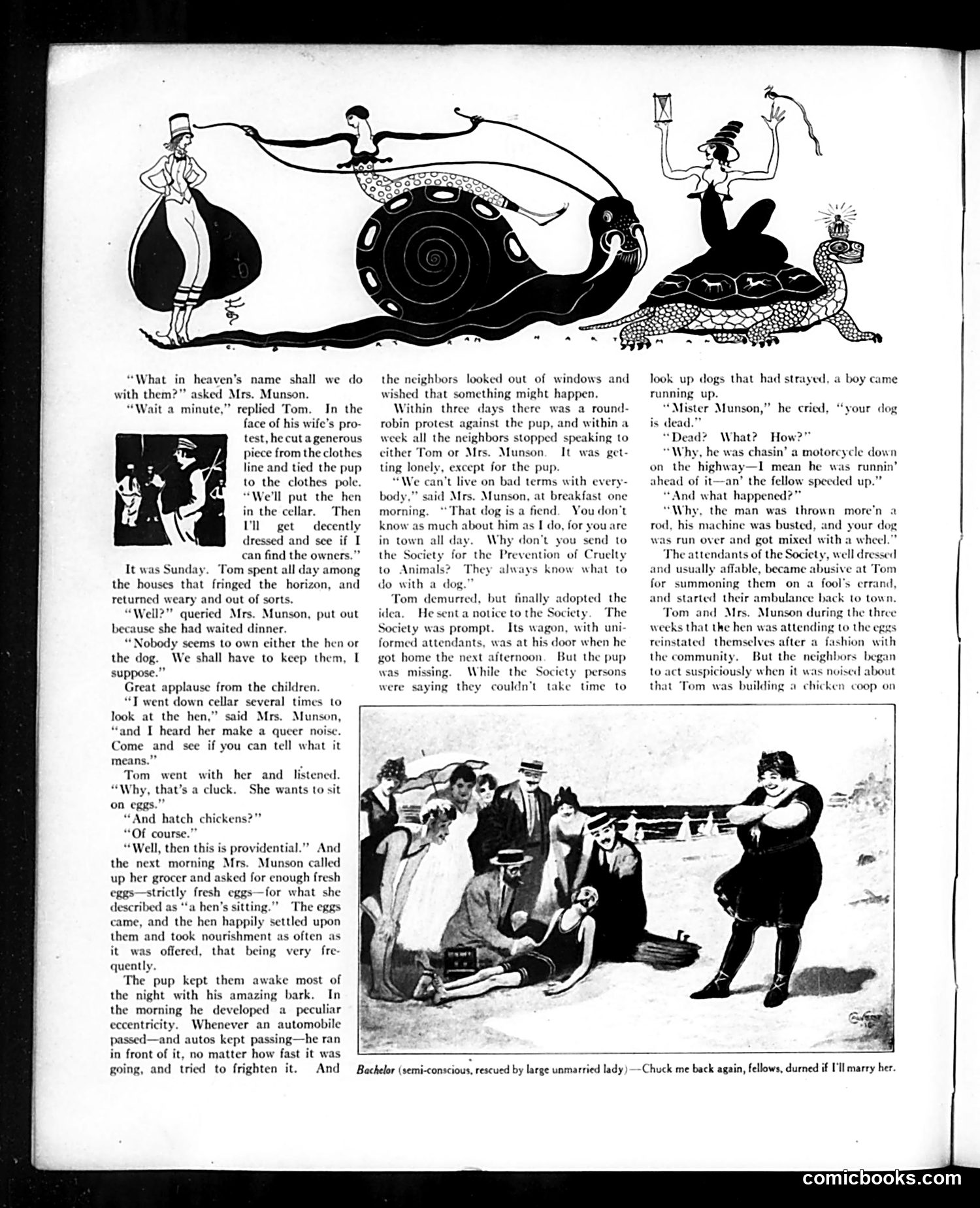
This humorous story satirizes early 20th-century suburban neighbors and their peculiar social dynamics. Tom and Mrs. Munson adopt a stray dog and hen, becoming neighborhood pariahs when the dog proves disruptive—barking constantly and dangerously chasing automobiles (then novel and frightening). The satire targets several targets: the rigid, judgmental conformity of suburban communities who shun neighbors over minor nuisances; the fashionable use of animal welfare organizations (the "Society for the Prevention of Cruelty to Animals") as social solutions; and the irony that the couple regains acceptance only after the dog dies in a motorcycle accident—tragic circumstances proving more socially acceptable than neighborly charity. The automobile subplot adds period detail: cars were still exotic enough to inspire fear and hostility in animals and people alike. The bottom cartoon (unrelated) appears to be a separate joke about an unwilling bachelor.
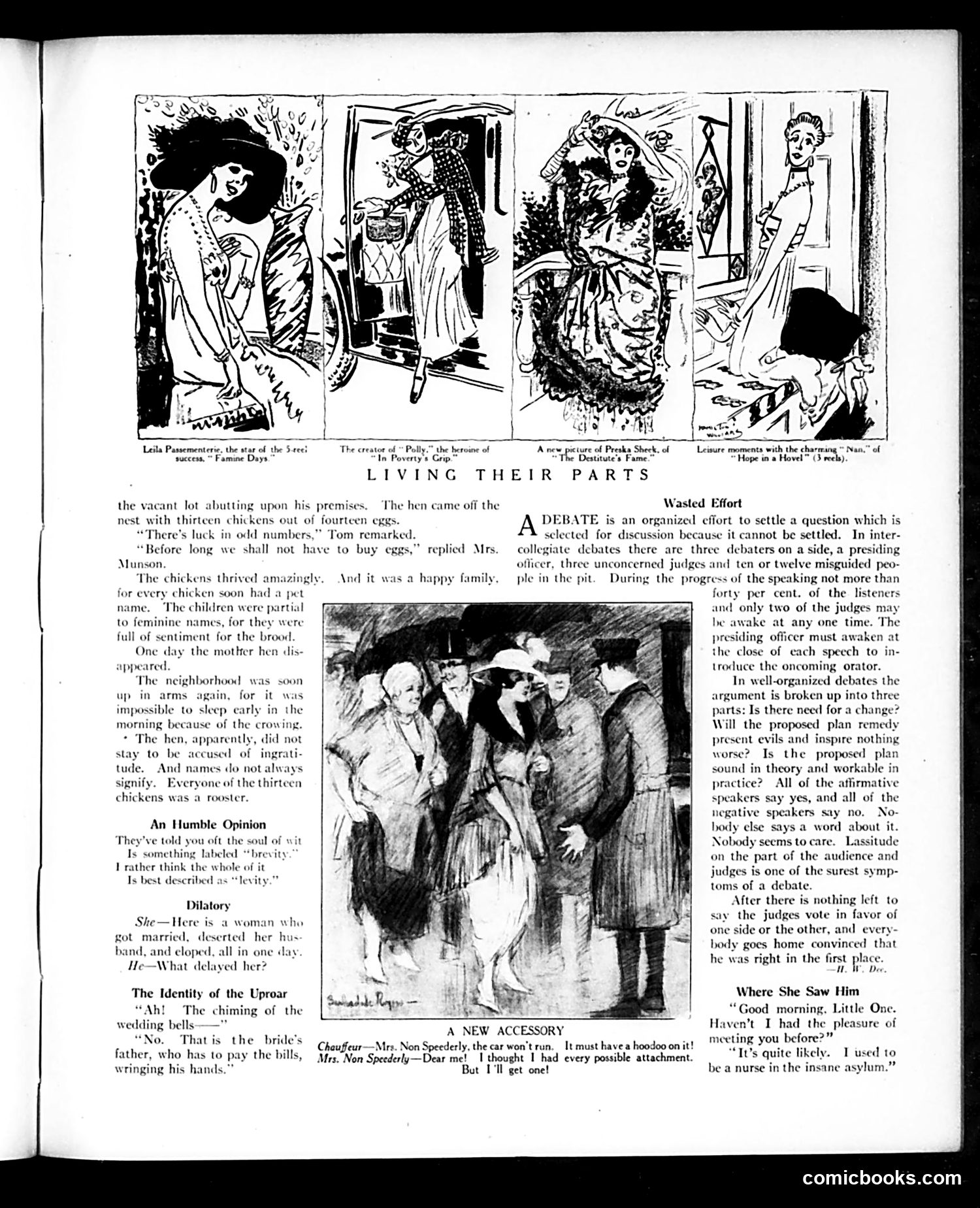
This page contains three distinct humor pieces: **"Living Their Parts"** (top): A domestic comedy about a family whose hen lays thirteen eggs but all hatch into roosters instead of the expected hens. The joke plays on the phrase "there's luck in odd numbers"—they expected one rooster among thirteen eggs, but got the opposite. The irony is that the noisy roosters make the neighborhood unbearable, and the mother hen abandons them out of apparent shame. **"Wasted Effort"** (right column): Social commentary on collegiate debate competitions. The satire mocks how debates are structured theater—judges sleep through speeches, audiences ignore the arguments, and participants leave convinced they were right regardless of the outcome. It suggests debates settle nothing despite their formal organization. **"A New Accessory"** (bottom): A brief joke about an automobile owner seeking a "hoodoo" (bad luck charm) as an accessory, playing on the period's obsession with car attachments and gadgets. The page is primarily humorous domestic and social satire typical of Judge magazine's early 20th-century output, with no apparent political figures or events referenced.
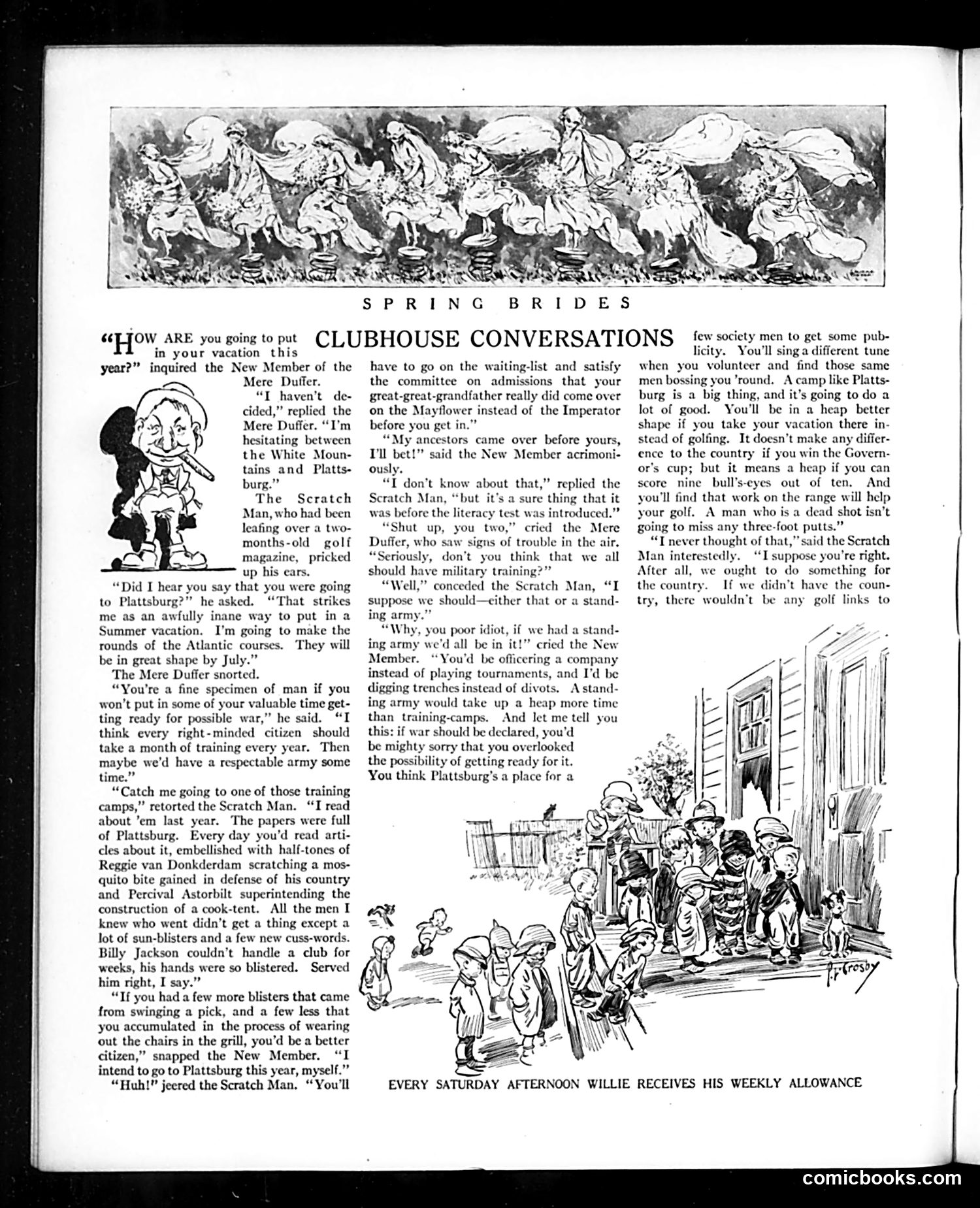
This page satirizes the pre-World War I debate over military preparedness through a conversation between three golfers. The "Scratch Man" represents leisure-focused wealth who dismisses Plattsburg training camps as pointless hardship that ruins golf games. The "New Member" argues every citizen should train for possible war, citing patriotic duty. The satire targets the Scratch Man's self-centered indifference to national defense and his dismissive attitude toward those who attended Plattsburg camps (referenced mockingly as populated by wealthy dilettantes like "Reggie van Donkderdam" and "Percival Astorbilt"). The "Mere Duffer" mediates, eventually persuading the Scratch Man that military training matters more than tournaments. The cartoon at bottom shows soldiers in formation outside a building, illustrating the actual training being discussed. The satire criticizes American elites prioritizing golf and comfort over military readiness, reflecting 1910s anxieties about preparedness before U.S. entry into WWI.
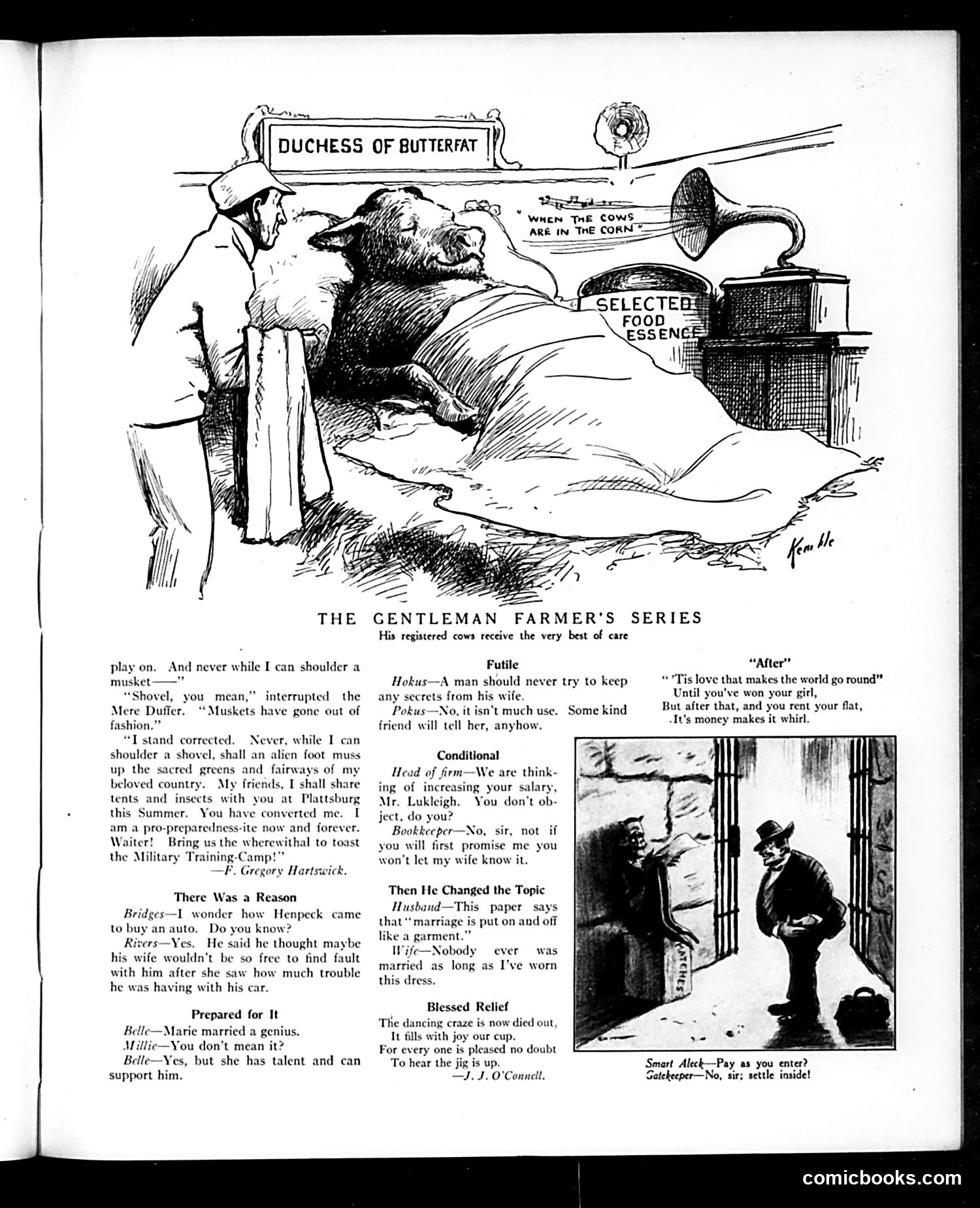
This page contains multiple unrelated satirical pieces typical of Judge magazine's format. **Main cartoon:** "Duchess of Butterfat" depicts a dairy farmer with his prized cow receiving "selected food essence"—satirizing the genteel pretension of treating livestock like aristocracy. The title mocks both the cow's fanciness and agricultural marketing. **Text content:** Brief humorous dialogues on contemporary themes: - A man's pro-preparedness patriotic speech (referencing Plattsburg military training camps, pre-WWI) - Marital dynamics: wives discovering secrets, husbands hiding salary increases - A commentary on marriage as transactional ("love makes it go round" until financial reality sets in) **Bottom photograph:** Shows two men at what appears to be a venue entrance, with a joke about payment timing. The overall satirical thrust targets middle-class anxieties: marital power dynamics, male financial anxiety, agricultural vanity, and pre-war patriotism. These reflect early 20th-century American concerns.
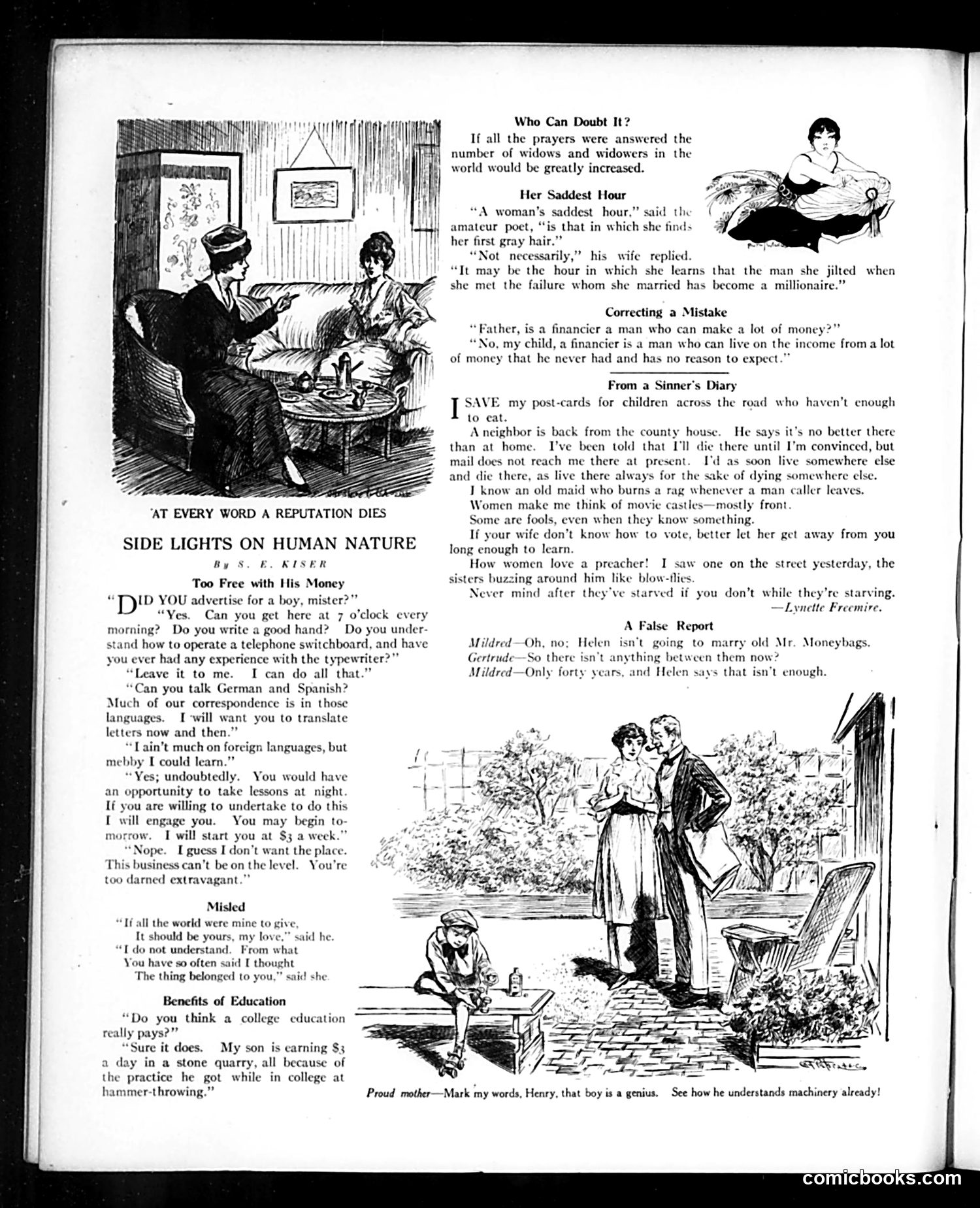
This page from Judge magazine (date unclear) collects humorous short pieces satirizing American social attitudes of the early-to-mid 20th century. **Main cartoons:** 1. **"At Every Word a Reputation Dies"** depicts a job interview where a boy claims unlimited skills (languages, switchboard operation, typing) for $3/week. The humor: the employer's low-ball wage offer seems suspiciously generous for someone with such abilities—the boy correctly suspects he's being conned. 2. **Bottom cartoon** shows a proud mother praising her son's "mechanical genius" as he plays in dirt with machinery. The satire: she mistakes childish play-destruction for intelligence, a common parental delusion. **Text pieces** mock various social conventions: women's vanity about aging, naive definitions of "financiers," marital regrets, and voting ignorance. The "Sinner's Diary" particularly criticizes social hypocrisy—charity toward starving neighbors while ignoring systemic poverty. Overall, the page satirizes American materialism, class pretension, marital dissatisfaction, and self-deception across social classes.
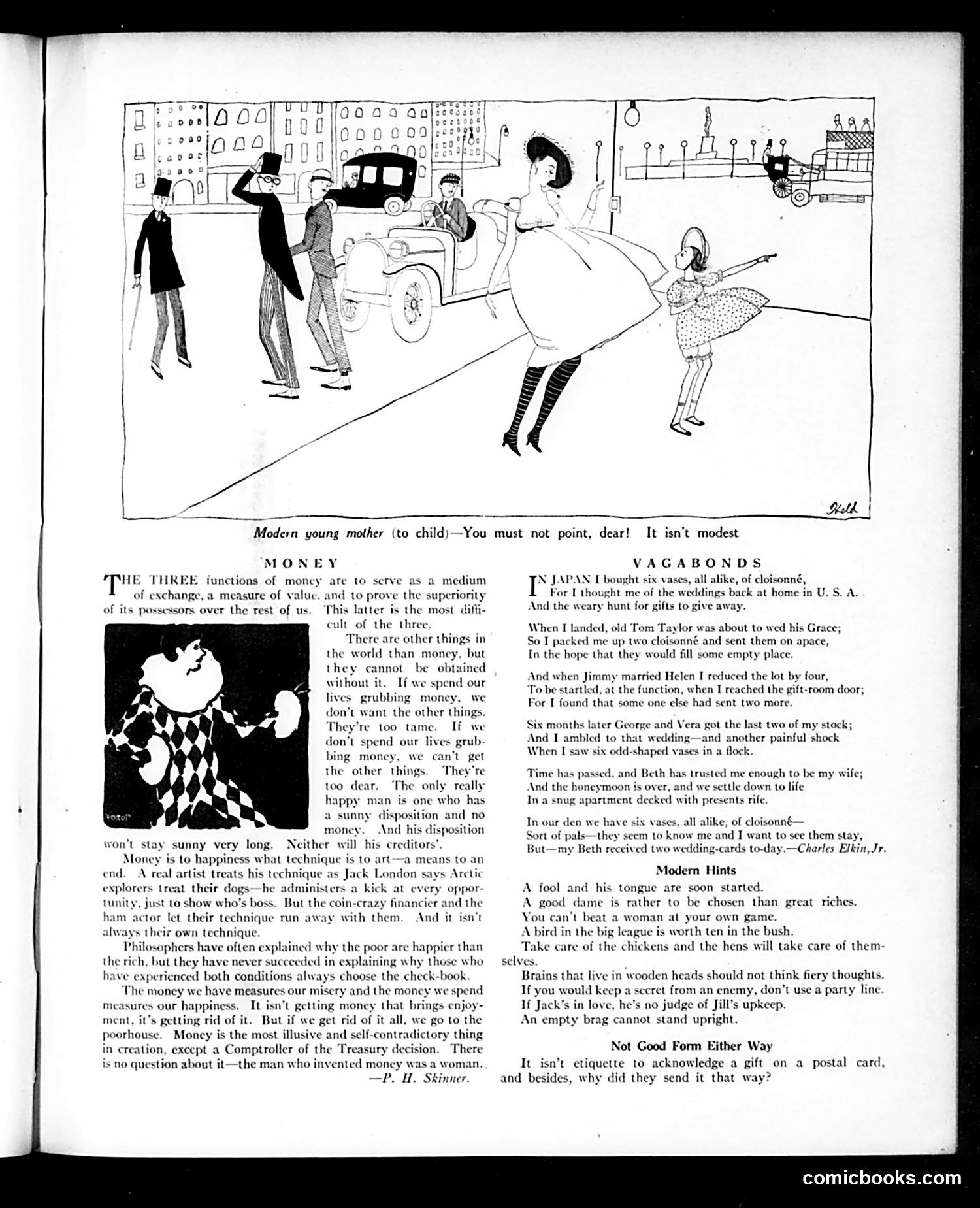
**Top Cartoon:** A satirical illustration of a "modern young mother" pointing at something in public while her child watches. The caption criticizes this as immodest behavior—a social commentary on changing manners. The cartoon mocks what the era considered improper maternal conduct. **"Money" Essay:** A philosophical satire by P. H. Skinner attacking money's contradictions. It argues money serves three functions, with the most important being displaying superiority over others. The piece uses irony to expose how people chase money obsessively yet find it creates misery. The final jab—"the man who invented money was a woman"—is a period-typical sexist joke. **"Vagabonds":** A humorous poem about an American who bought six identical Japanese cloisonné vases as wedding gifts, only to keep receiving them back as duplicate gifts from other guests at subsequent weddings. It satirizes the burden of wedding gift-giving and the absurdity of receiving identical presents repeatedly. **"Modern Hints":** Brief aphorisms parodying wisdom literature, mixing crude observations with mild social satire about gender relations and propriety.
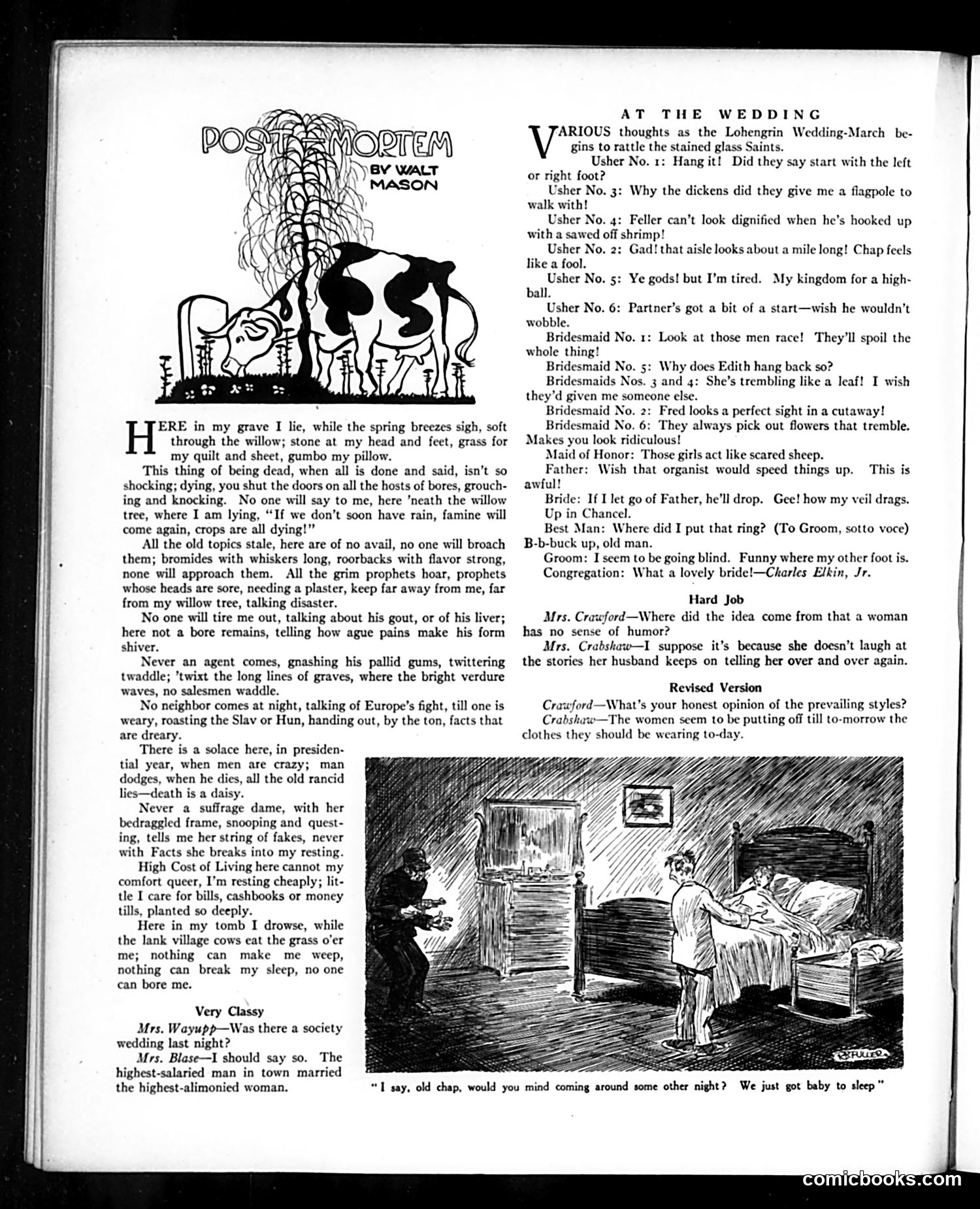
This page features satirical observations on a wedding ceremony, with three distinct pieces poking fun at early 20th-century social rituals. **"At the Wedding"** presents the thoughts of various wedding participants during a Lohengrin ceremony. The satire reveals the gap between formal propriety and actual thoughts: ushers worry about logistics and appearance ("hooked up with a sawed off shrimp"), bridesmaids nervously compete with each other, the groom admits near-blindness from anxiety, and the bride fears her veil will drag. The joke is that weddings present an elaborate performance that participants find tedious, uncomfortable, or chaotic—contradicting the romantic ideal. **"Post Mortem"** (upper left) presents death as relief from social bores and life's mundane complaints—a darkly humorous escape from nagging neighbors, salesmen, political arguments, and the "high cost of living." **"Hard Job"** satirizes women's supposed lack of humor as actually reflecting exhaustion with husbands' repetitive jokes. Together, these pieces reflect Judge magazine's cynical view of marriage, death, and domestic relations as fundamentally unpleasant—typical of early 20th-century satirical humor.
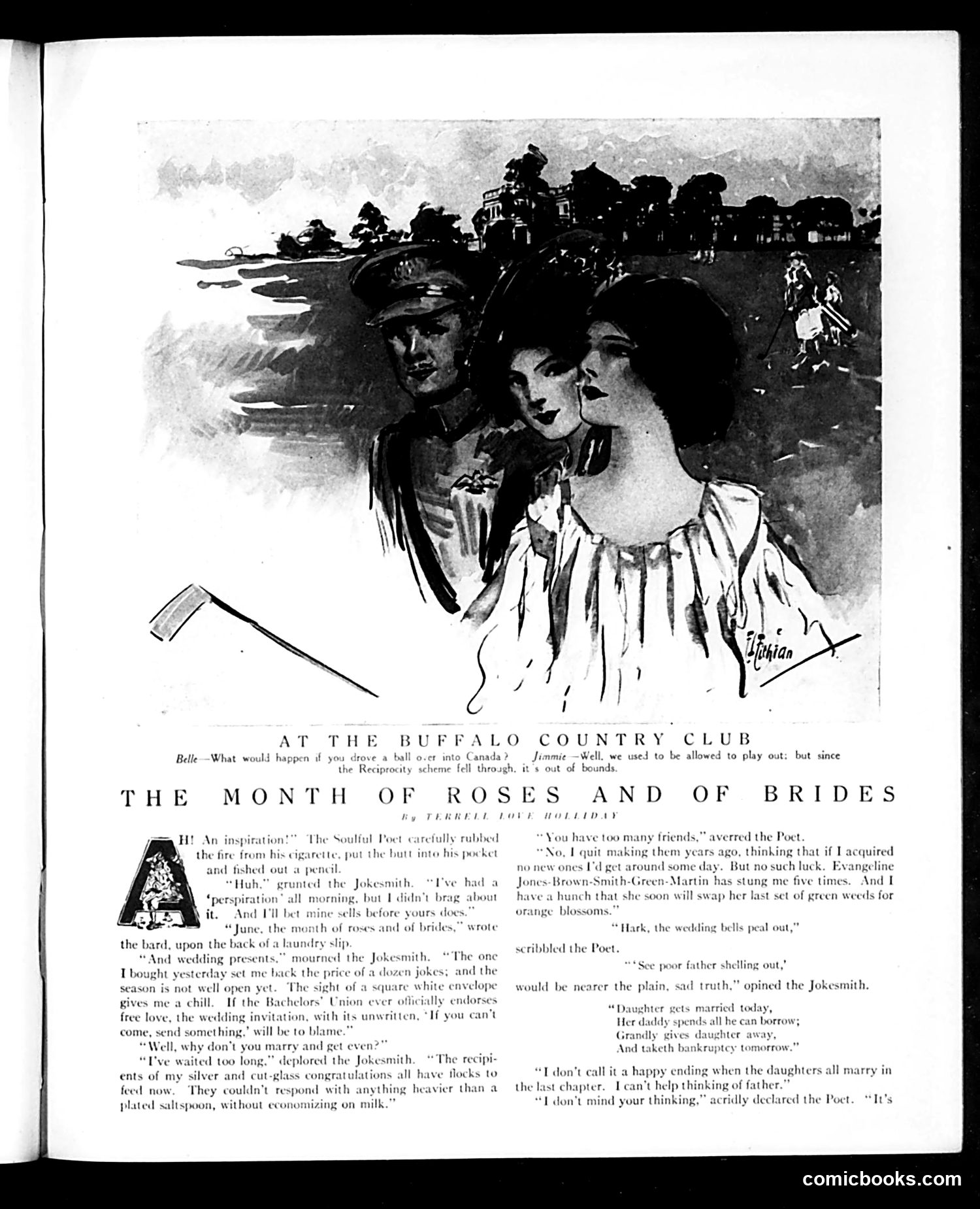
This satirical piece from *Judge* presents a dialogue between two characters—"the Soulful Poet" and "the Jokesmith"—debating the romantic sentimentality of June weddings versus their financial realities. **The satire targets:** - **Romantic idealization vs. economic hardship**: The Poet romanticizes June as "the month of roses and of brides," while the Jokesmith cynically catalogs the expenses—silver gifts, cut-glass congratulations, and mounting wedding invitations. - **The bride-as-expense trope**: The Jokesmith laments repeatedly acquiring wedding gifts, while the Poet quips that the Jokesmith has "too many friends" getting married. The implication is that weddings are financial obligations disguised as celebrations. - **Fathers' financial ruin**: The closing verses mock the father of the bride, who "spends all he can borrow" and faces "bankruptcy tomorrow." The illustration shows well-dressed figures at the Buffalo Country Club, suggesting upper-class anxiety about maintaining social status through expensive wedding customs. The satire mocks both the commercialization of weddings and the genteel pretense that conceals economic strain.
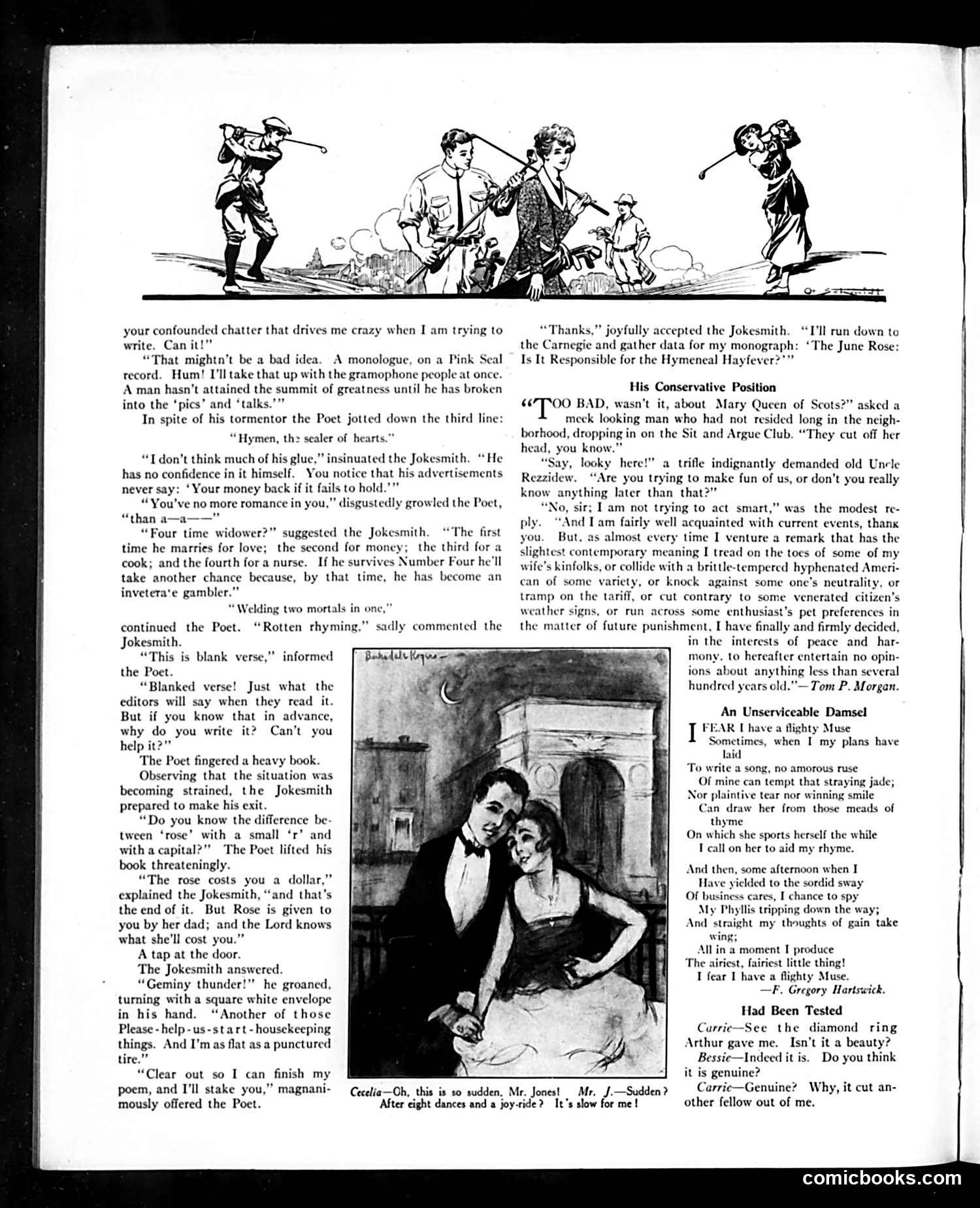
This page contains two satirical pieces typical of early 20th-century American humor. The upper section depicts a **Poet and a Jokesmith** quarreling over writing a wedding poem ("Hymen, the sealer of hearts"). The Jokesmith mocks the Poet's romantic language and makes jokes about marriage—including a dark quip about a "four time widower" who keeps remarrying. The humor satirizes both overwrought sentimental poetry and cynical attitudes toward matrimony and divorce, which were becoming more common and socially visible in this era. The lower section, "His Conservative Position," mocks a timid man at a "Sit and Argue Club" who avoids all contemporary opinions to keep peace—he's been burned so many times by accidentally offending hyphenated Americans, tariff debaters, and superstitious neighbors that he only discusses history over 300 years old. This satirizes the increasing cultural anxiety and political polarization of American life, where casual remarks trigger heated arguments among various factions. Both pieces reveal contemporary concerns about changing social values around marriage, immigration ("hyphenated Americans"), and political divisiveness.
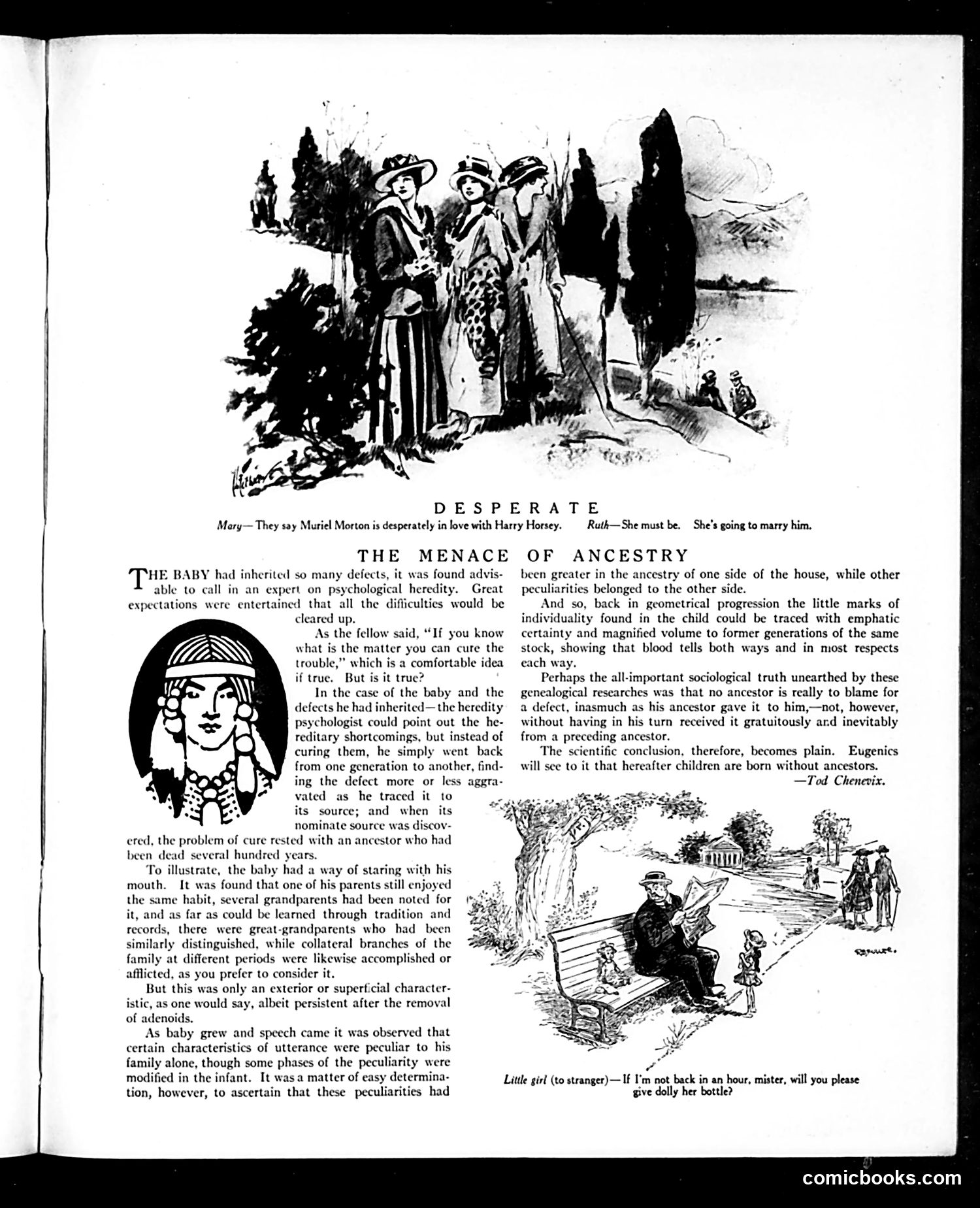
This page satirizes early 20th-century **eugenics ideology**—the pseudoscientific movement claiming heredity determines human defects and worth. The article mocks experts who trace a baby's flaws (mouth-breathing, speech quirks) obsessively backward through generations, finding each ancestor equally "responsible." The satire culminates in absurdist logic: the author concludes eugenics will eventually ensure "children are born without ancestors"—highlighting the movement's fundamental illogic. By tracing blame infinitely backward, no one is actually responsible, yet eugenicists proposed controlling reproduction anyway. The top cartoon's joke about "Muriel Morton" marrying "Harry Horsey" despite desperation plays on similar themes—surface judgments about matrimonial "breeding." The bottom illustration shows a lost child asking a stranger to babysit her doll, innocently illustrating how society entrusts its future to random circumstances—undercutting eugenics' obsession with "scientific" control of heredity.
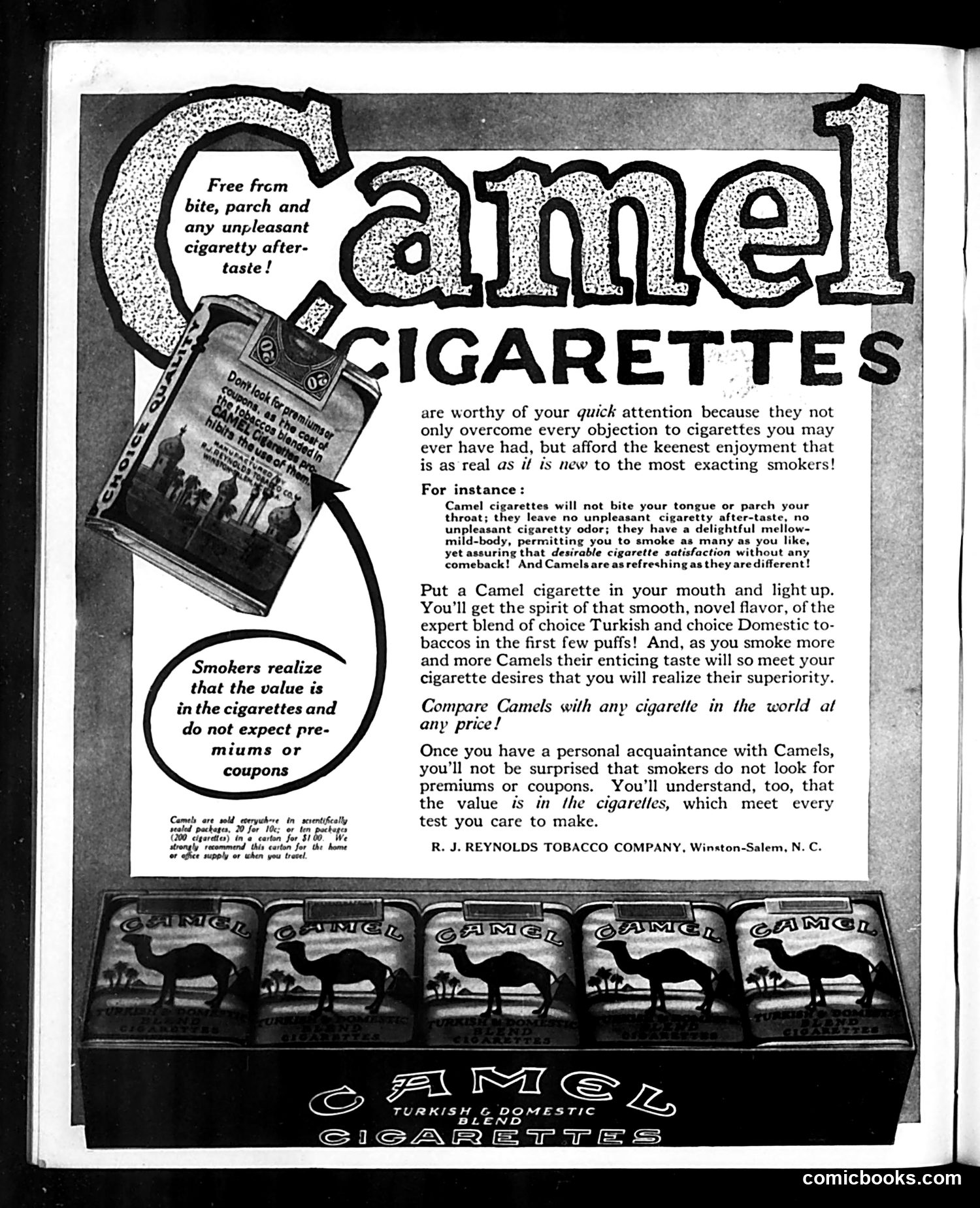
This is a **full-page cigarette advertisement**, not satire or editorial content. It appeared in *Judge* magazine, which accepted paid advertising despite its satirical focus. The ad promotes Camel cigarettes by positioning them as superior through claims that modern readers would recognize as misleading marketing: - **"No bite, parch, or unpleasant after-taste"** — health reassurances now understood as false - **Turkish and Domestic blend** — presented as a mark of quality - **"Value is in the cigarettes"** — dismissing competitor giveaways (premiums/coupons) as inferior, while implying Camels' quality justifies premium pricing The image shows a Camel cigarette pack prominently displayed. The "cartoon" elements (speech bubbles, casual tone) are merely advertising style devices, not editorial commentary. This reflects pre-regulation tobacco marketing (likely 1920s), when such health claims were legal and common in mainstream publications.
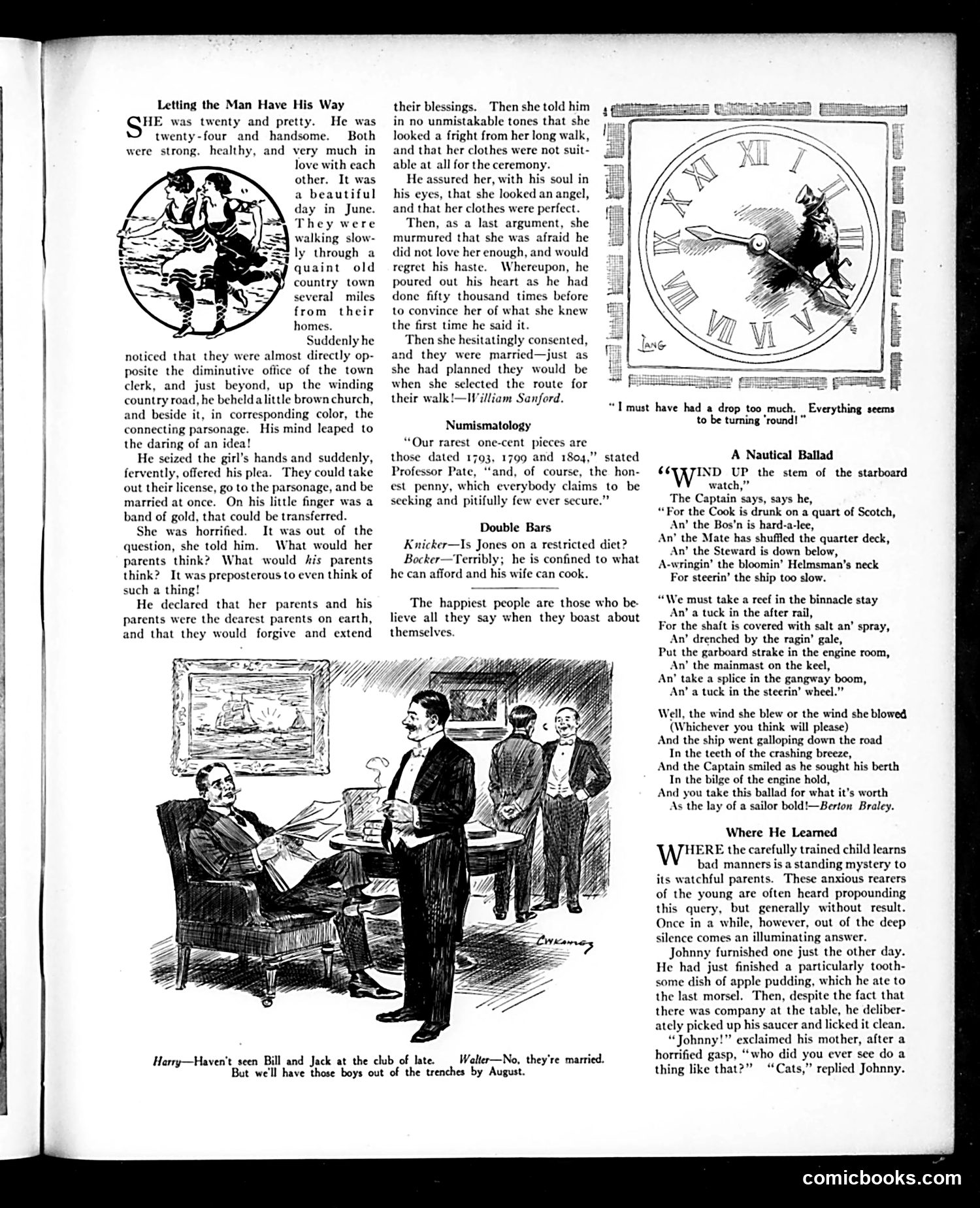
This page contains three distinct pieces of humor: **"Letting the Man Have His Way"** (main story with illustrations): A romantic satire about a young couple on a country walk. The man impulsively proposes an immediate elopement at the local church, offering progressively romantic arguments. The joke's twist: the woman had actually *planned* this entire route and outcome beforehand—she manipulated him into the spontaneous proposal she wanted. It satirizes courtship dynamics and female agency disguised as male romantic initiative. **"Numismatology"** and **"Double Bars"** (brief jokes): Quick satirical quips about rare coins and restricted diets. **"A Nautical Ballad"** (right column): A humorous nonsense poem mocking incompetent sailors and absurd nautical jargon. The ship's entire crew is incapacitated (drunk captain, sleeping bosun, fighting mate), yet the ship somehow functions—pure comedic absurdity. **"Where He Learned"** (bottom right): Begins discussing how well-behaved children mysteriously develop bad manners despite careful parenting. The page blends romantic satire with naval comedy and domestic observation—typical Judge magazine fare from the early 20th century.
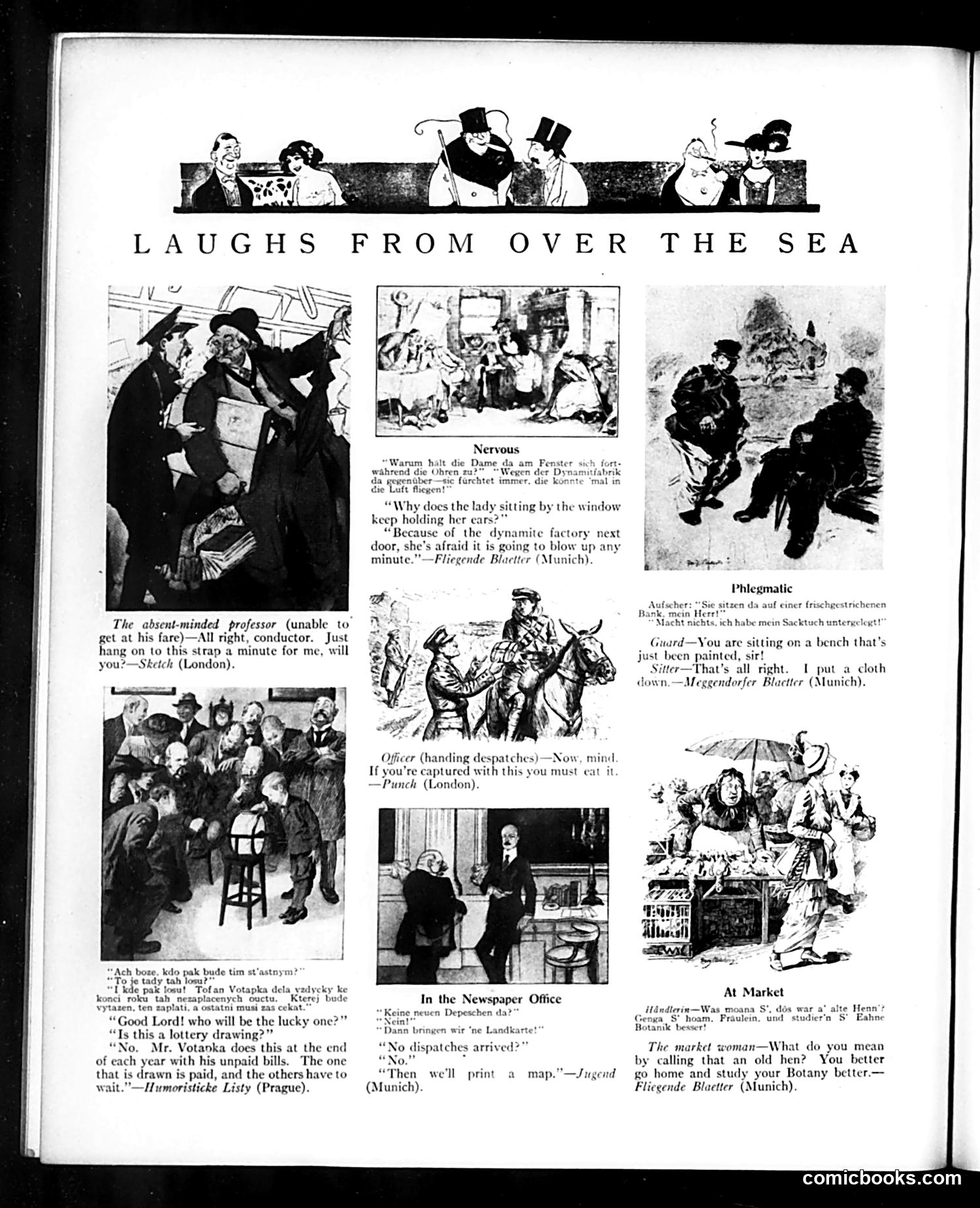
This page collects humorous comics and jokes translated from European publications (Munich, London, Prague). The cartoons are brief, often one-panel gags depicting everyday absurdities: **Key examples**: A woman holds her ears near a dynamite factory (nervous anxiety); a professor can't pay his fare and asks the conductor to hold his strap; a guard scolds someone for sitting on wet paint; an officer warns a messenger to eat secret dispatches if captured. **The satire/humor**: These aren't political cartoons but rather gentle domestic comedy—awkward social situations, absent-mindedness, and everyday mishaps. The "over the sea" framing suggests *Judge* magazine was showcasing that European humor shared similar themes with American audiences, emphasizing common human follies across cultures rather than national differences. The page demonstrates early 20th-century international popular humor's universality.

This is primarily a **Schlitz beer advertisement**, not political satire. It presents itself as scientific education to justify a marketing claim. The "joke" or selling point: For years, breweries couldn't explain why light-exposed beer tasted bad. Now "science" (claims the ad) has revealed ultraviolet rays damage the beer's protein. The solution? Schlitz's brown bottles provide protection. This is **pseudo-scientific marketing**—using the authority of "science" to justify why their product works better. The ad assumes readers will find it clever that the mystery is finally solved, making brown bottles seem like the rational choice. No identifiable figures or political references appear. This is straightforward commercial persuasion dressed up as educational content, typical of early 20th-century advertising in magazines like *Judge*.
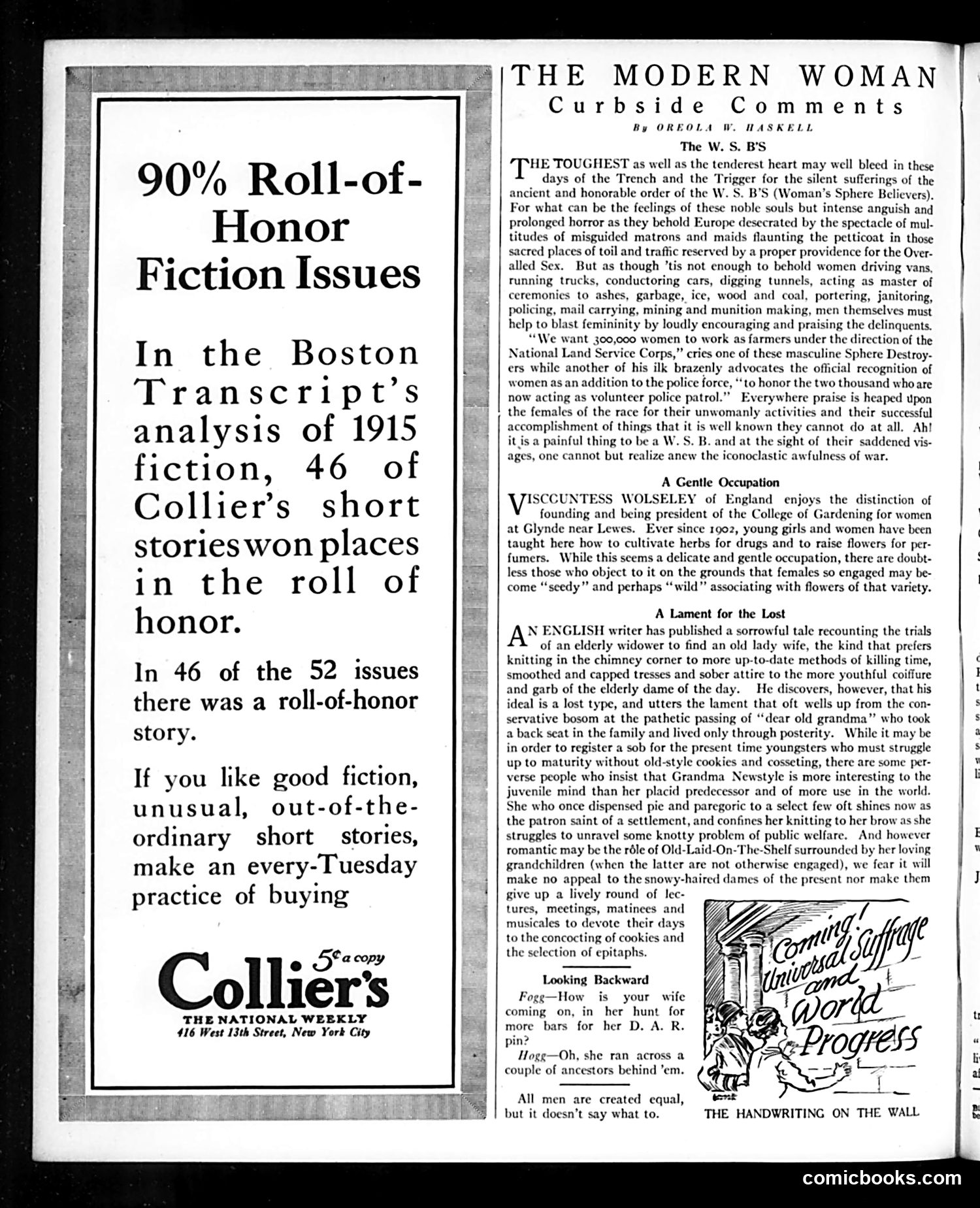
This page combines a **Collier's magazine advertisement** (left) with **"The Modern Woman: Curbside Comments"** (right)—a satirical column by Oreola W. Haskell mocking social conservatives' anxieties about women's changing roles during World War I. The column ridicules the "W.S.B.'s" (Woman's Sphere Believers)—those clinging to traditional gender boundaries. It sarcastically laments women working as truck drivers, tunnel diggers, police, and farmers during wartime, while praising men who encouraged this work. Three brief pieces follow: praising an English aristocrat's gardening college for women; mocking a widower mourning "old-fashioned" elderly wives; and suggesting modern grandmothers are actually more useful than their predecessors. The satire's point: conservative gender roles are outdated and somewhat ridiculous when tested against wartime necessity and practical utility. The column advocates for expanded female roles while appearing to sympathize with traditionalists' fictional "suffering."
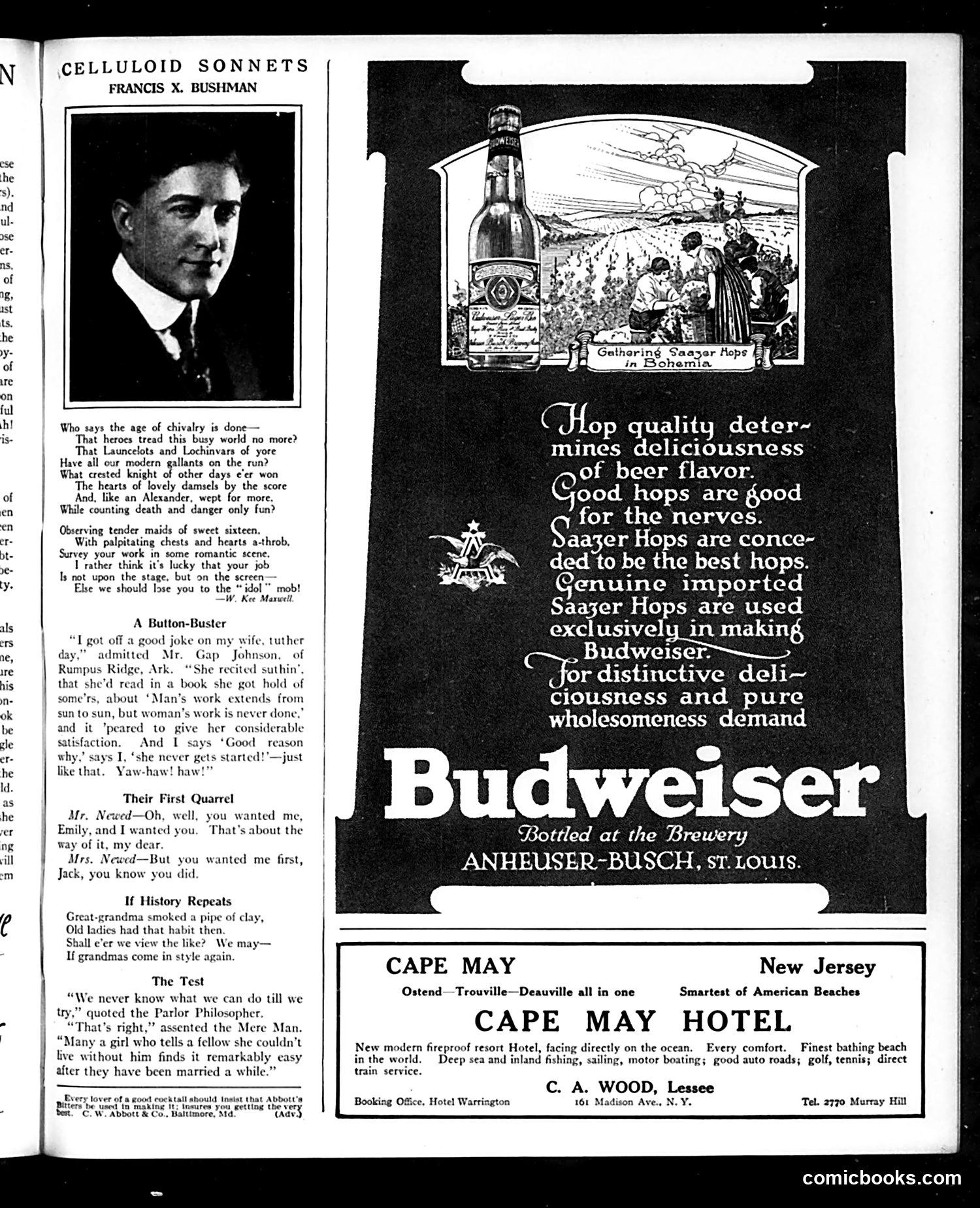
This page features "Celluloid Sonnets" by Francis X. Bushman, a silent-film actor whose photograph appears at top left. The sonnets are romantic/satirical verses mocking outdated chivalric ideals—contrasting medieval knights and heroes with modern men who lack their gallantry. The actual cartoons/jokes below the sonnets are brief domestic humor pieces: "A Button-Buster" mocks a wife reciting feminist platitudes; "Their First Quarrel" jokes about newlyweds bickering over who wanted whom first; "If History Repeats" satirizes fashion cycles; and "The Test" presents mild gender-based wordplay. The page is primarily **advertising**, with large Budweiser and Cape May Hotel ads dominating. The satirical content is light and formulaic—typical Judge magazine filler combining mild social observation with product placement.
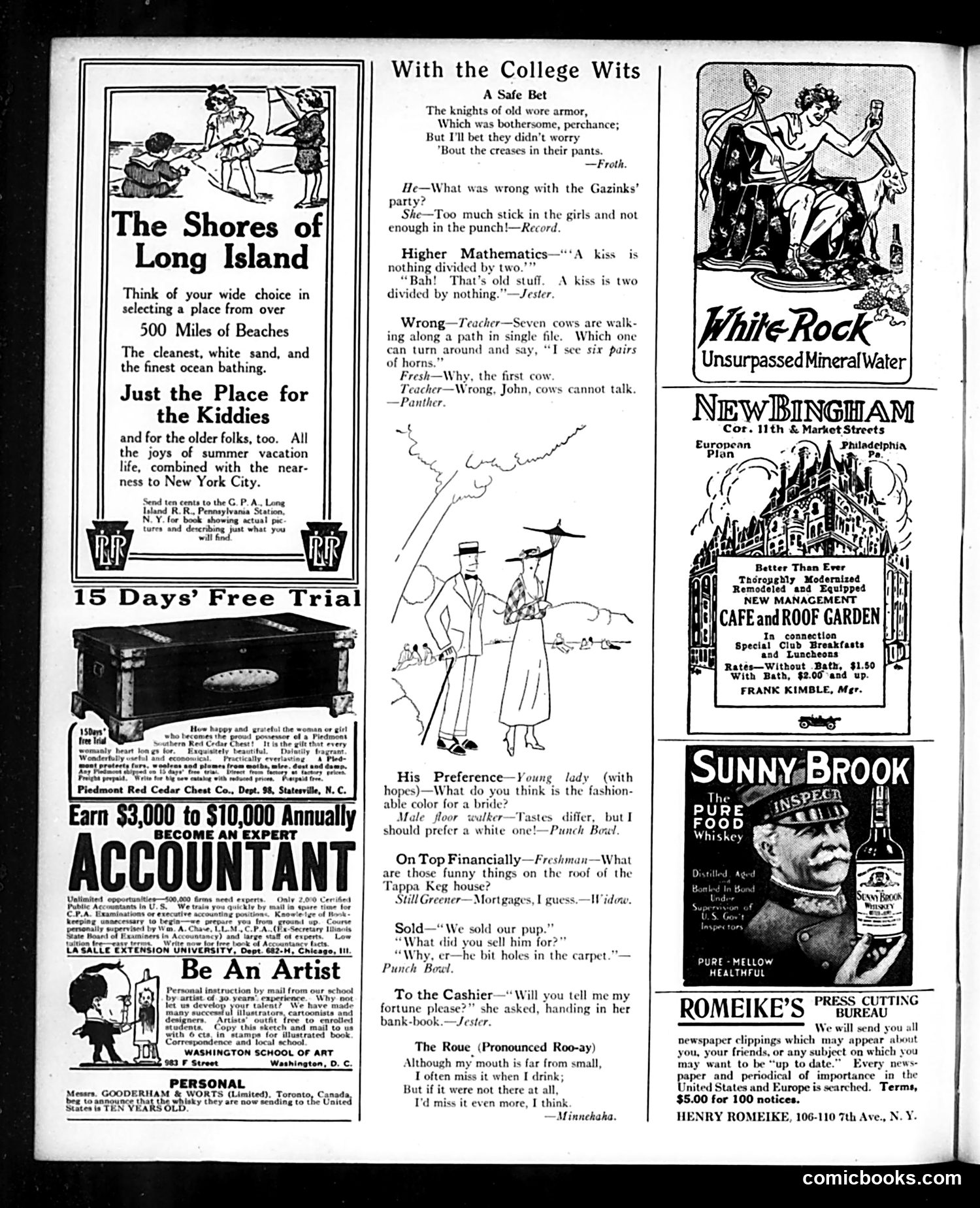
This page is primarily **advertising and humor filler** rather than political satire. It contains: **Advertisements:** Long Island beaches, accountant training, art school, cedar chests, whisky, and hotel/restaurant services dominate the layout. **"With the College Wits" Section:** A collection of brief jokes reprinted from college humor magazines (Froth, Record, Jester, Punch Bowl, etc.). These are mild, wholesome puns and wordplay typical of 1920s college humor: - Knights' armor and creased pants - A failed party (weak punch/weak girls) - Mathematical riddles about kisses and cows - A joke about a dog that chewed carpet **The humor** relies on innocent double-meanings and logical puzzles—nothing scandalous. The college magazine attributions suggest Judge is showcasing campus wit for general audiences. **No political content is visible.** This appears to be a light entertainment/advertising page from the magazine's interior, lacking the satirical edge associated with Judge's editorial cartoons.
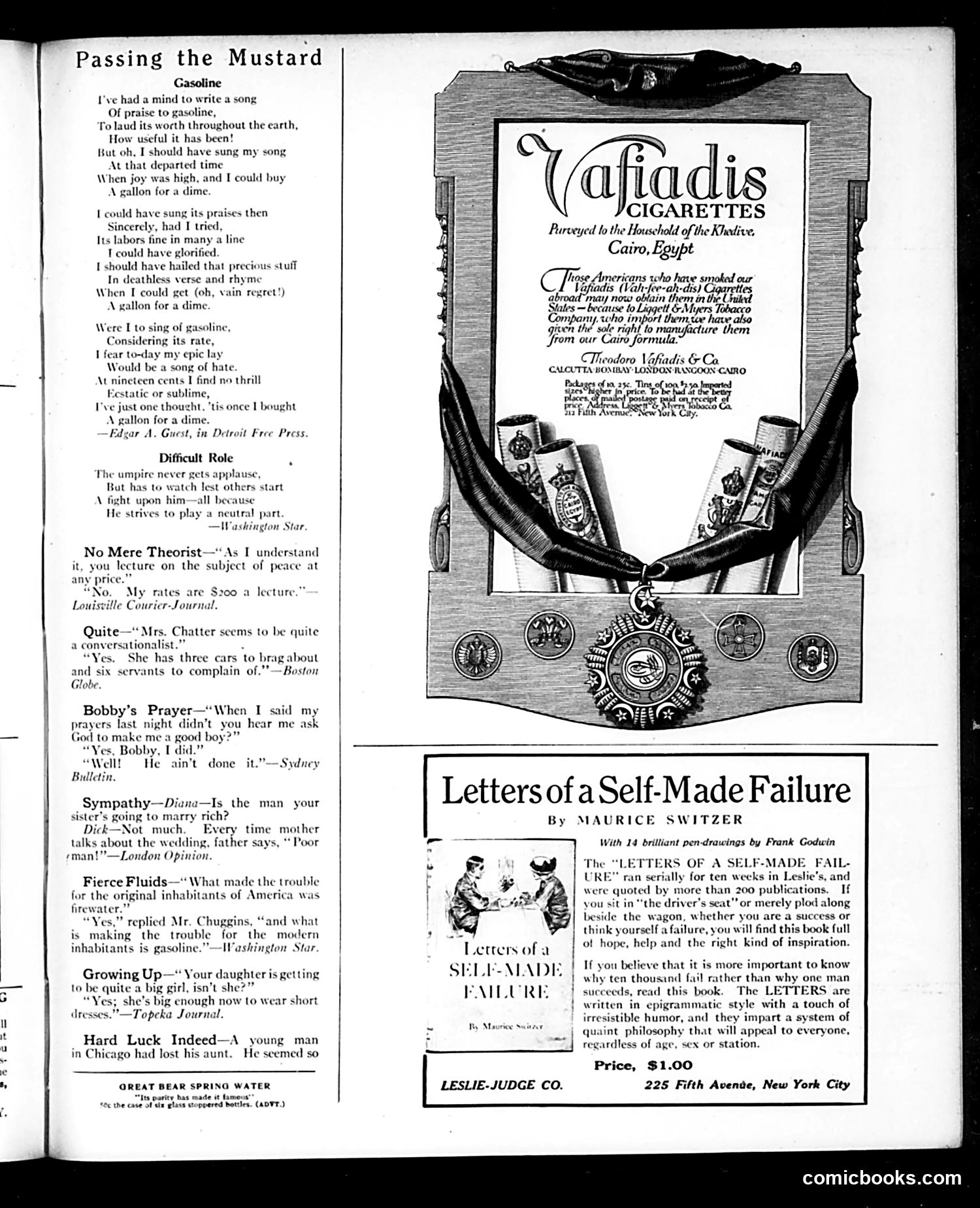
This page contains primarily **short humorous anecdotes** and **advertisements** rather than political cartoons. The main content is satirical commentary on everyday life. The opening poem "Gasoline" by Edgar A. Guest laments rising fuel prices—nostalgia for when "a gallon for a dime" was possible, now costing nineteen cents. This reflects **post-WWI inflation concerns** affecting ordinary Americans. Other jokes mock common social situations: an umpire's thankless role, a charlatan peace lecturer charging $200, a gossipy woman with servants, and a child's failed prayer for goodness. The humor is gentle, observational satire about American life. The prominent **advertisement for Vafiadis Cigarettes** emphasizes the product's Egyptian origin and prestige, marketed to wealthy households. A secondary ad for "Letters of a Self-Made Failure" by Maurice Switzer promotes an inspirational book. This page reflects Judge magazine's typical format: mixing light social satire with advertising, targeting middle-class readers concerned with contemporary costs and social pretension.
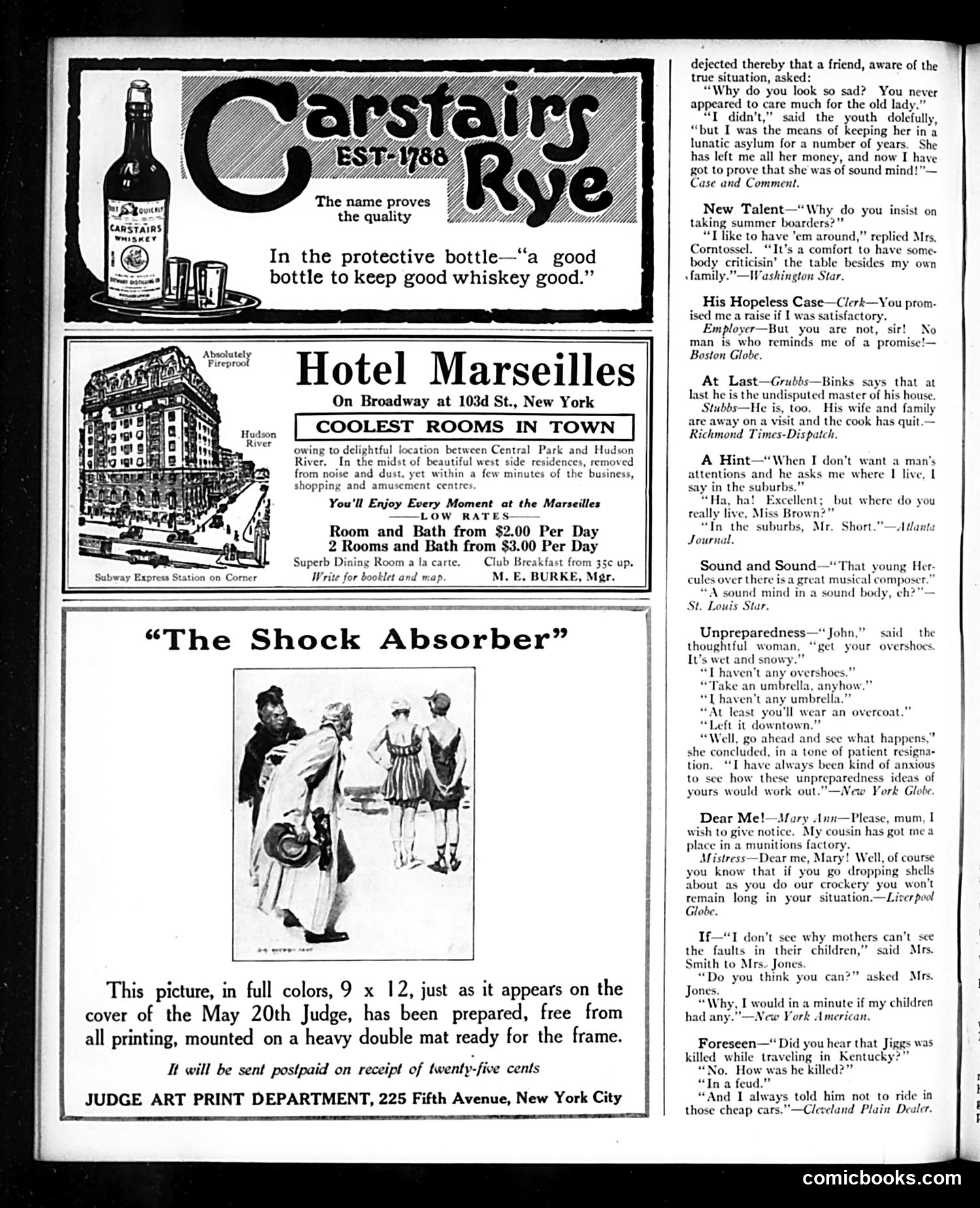
This page is primarily **advertisements and humorous short anecdotes**, not political cartoons. The main content includes: **Advertisements:** - Carstairs Rye Whiskey (top) - Hotel Marseilles, Broadway NYC (middle) - Judge Art Print Department offering a color reproduction **"The Shock Absorber" cartoon** shows a woman being jostled by a vehicle while onlookers watch—likely depicting early automotive safety hazards, with the title suggesting her resilience. **Right column:** Brief satirical humor pieces mocking social conventions: a woman who kept her elderly mother institutionalized for inheritance; complaints about summer boarders criticizing food; workplace frustrations; domestic unpreparedness. These reflect early 20th-century class anxieties, servant-employer dynamics, and gender roles. The page reflects Judge's typical format: mixing commercial advertisements with light social satire targeting middle-class readers' everyday frustrations rather than major political issues.
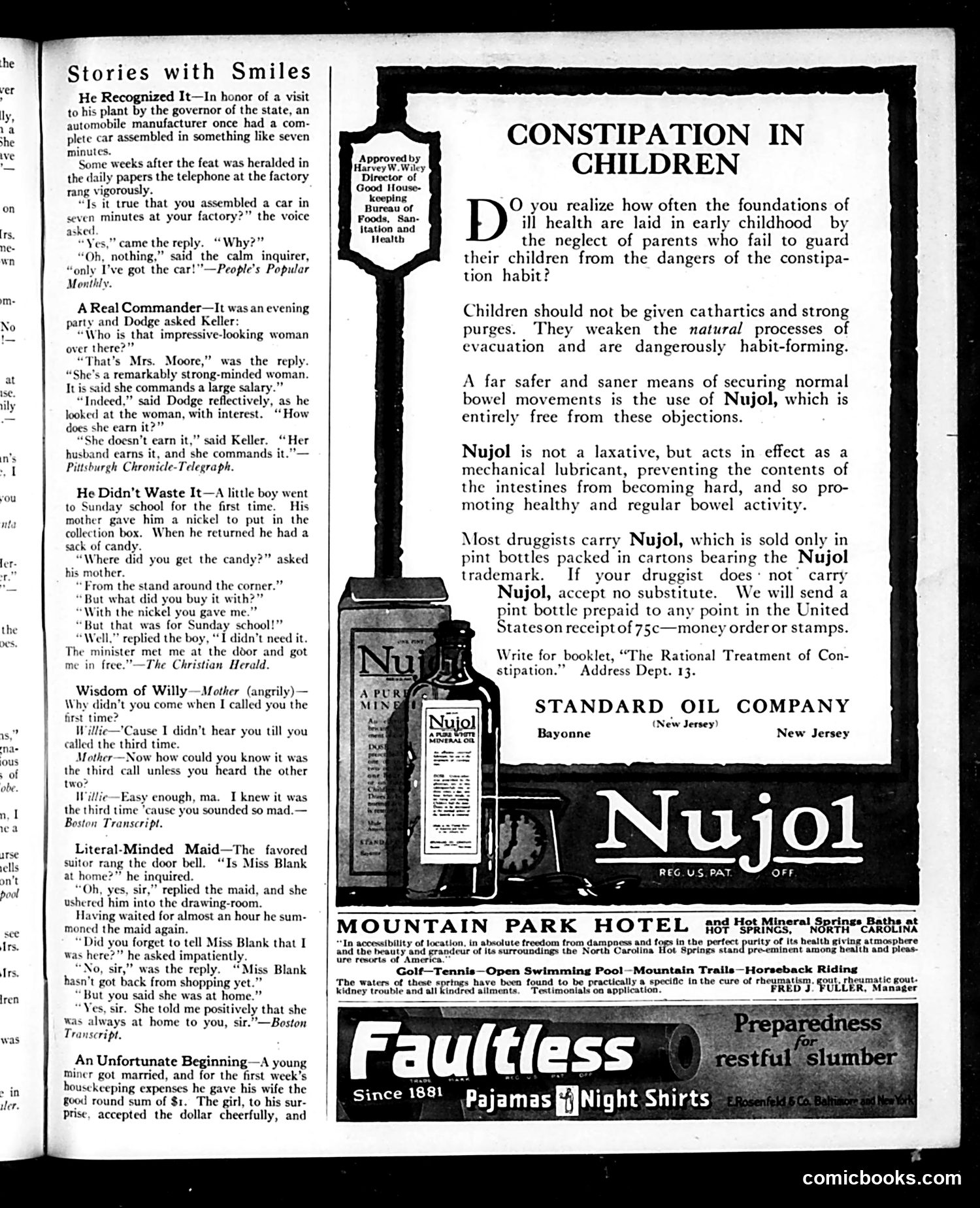
This page contains primarily **short humorous anecdotes** in the "Stories with Smiles" column—light jokes about everyday situations (a car assembly feat, a domineering wife, a child's logic, a maid's literal-mindedness). These reflect early 20th-century domestic humor with no political satire. The page's dominant content is **advertising**: a full-page Nujol advertisement about constipation in children, leveraging the endorsement of Harvey W. Wiley (a real Pure Food and Drug Act reformer) to market a mineral oil product as safer than cathartics. This reflects contemporary concerns about children's health and the patent medicine era. Below are ads for Mountain Park Hotel (North Carolina springs) and Faultless Pajamas. **No political cartoons or caricatures appear on this page.** It's primarily filler content and advertising typical of Judge's commercial nature during this period.
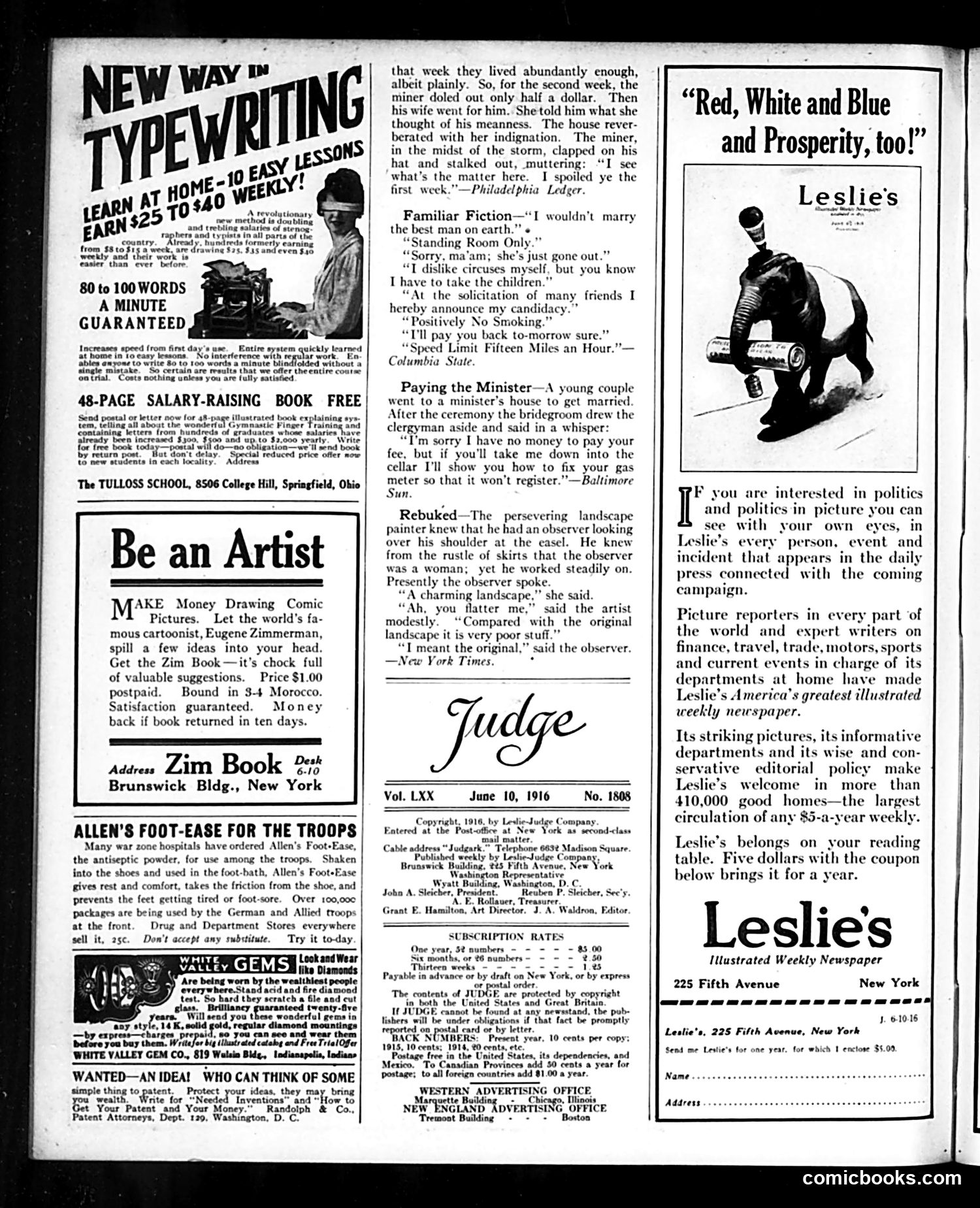
This page is primarily **advertising and filler content** rather than political satire. The masthead identifies it as *Judge*, Vol. LXX, No. 1505—a satirical weekly newspaper. The small humor sections ("Familiar Fiction," "Paying the Minister," "Rebuked") are brief, **non-political jokes** about domestic life and social situations—a miner's wife complaining about meager wages, a couple's cheap wedding gift to a minister, an artist being observed. These reflect **working-class and genteel anxieties** typical of 1916 but lack topical bite. The majority of the page features **commercial advertisements**: typewriter lessons, art instruction books, foot powder (marketed to WWI troops), and patent services. The war reference to "German and Allied troops" dates this to **active World War I**, though America wouldn't enter until 1917. **No significant political cartoons or caricatures appear on this visible page**—it's a typical mixed advertising/humor format common in early 20th-century periodicals before the magazine focused primarily on satirical illustration.
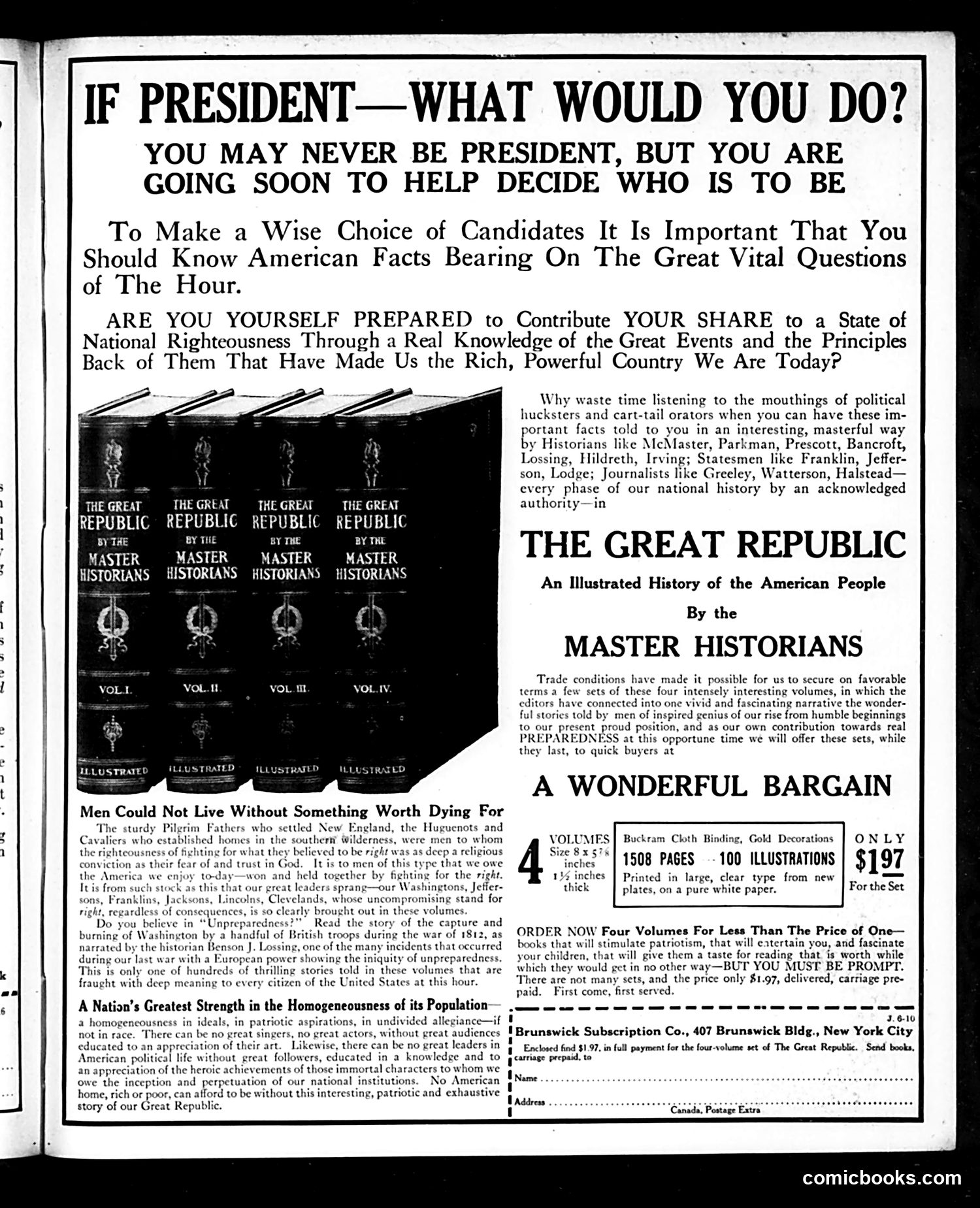
This page is primarily **advertising rather than satire**—it's a sales pitch for a four-volume history book set titled "The Great Republic by the Master Historians." The opening rhetorical question ("If President—What Would You Do?") frames the sales appeal: voters need historical knowledge to make wise electoral choices. The ad then sells this knowledge by name-dropping respected historians (McMaster, Parkman, Prescott, Bancroft) and statesmen (Franklin, Jefferson) as authors. The text emphasizes American exceptionalism and patriotic homogeneity—"a Nation's Greatest Strength...in the Homogeneousness of its Population"—reflecting early-20th-century nativist ideology. The ad targets middle-class families concerned about civic preparedness and children's education. The "wonderful bargain" price ($1.97 for four volumes) uses scarcity tactics ("not many sets") and urgency ("first come, first served"). This appears to be a judge magazine advertisement, using the publication's editorial voice to promote an educational product aligned with its patriotic messaging.
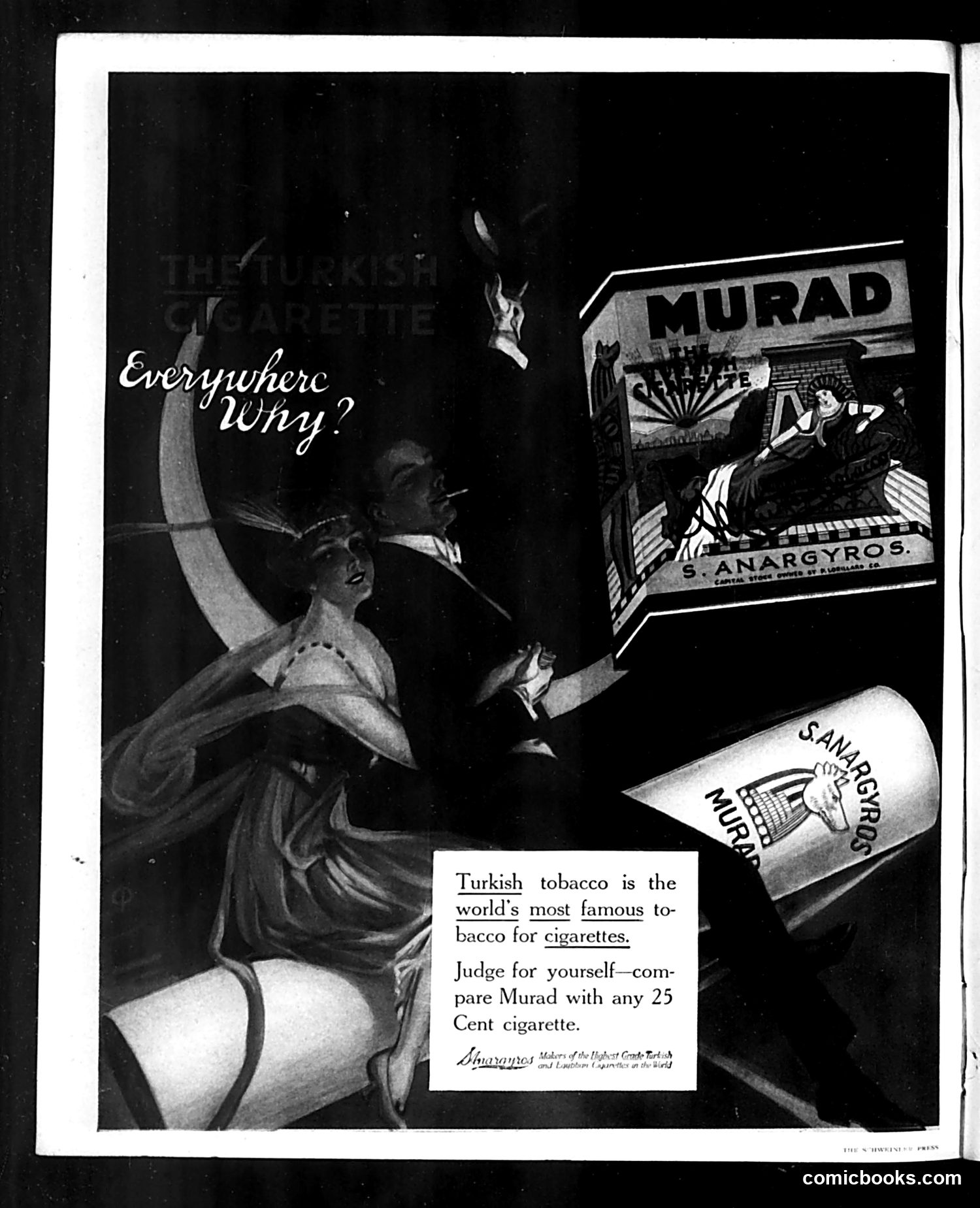
This is a **cigarette advertisement**, not political satire. The image shows a classical female figure (likely representing Turkish culture or sophistication) asking "Everywhere Why?" — presumably questioning why Murad cigarettes aren't universally chosen. The ad claims Turkish tobacco is "the world's most famous tobacco for cigarettes" and challenges readers to compare Murad with any 25-cent cigarette, implying superior quality at a competitive price. This reflects early 20th-century advertising practices that associated cigarettes with refinement, exoticism (Turkish imagery was fashionable), and classical beauty. The "Judge for yourself" language uses a direct consumer-comparison approach typical of that era's marketing, before modern advertising regulations restricted such claims.