
Judge, 1916-06-10 · page 14 of 28
Judge — June 10, 1916 — page 14: what you’re looking at
What you’re looking at
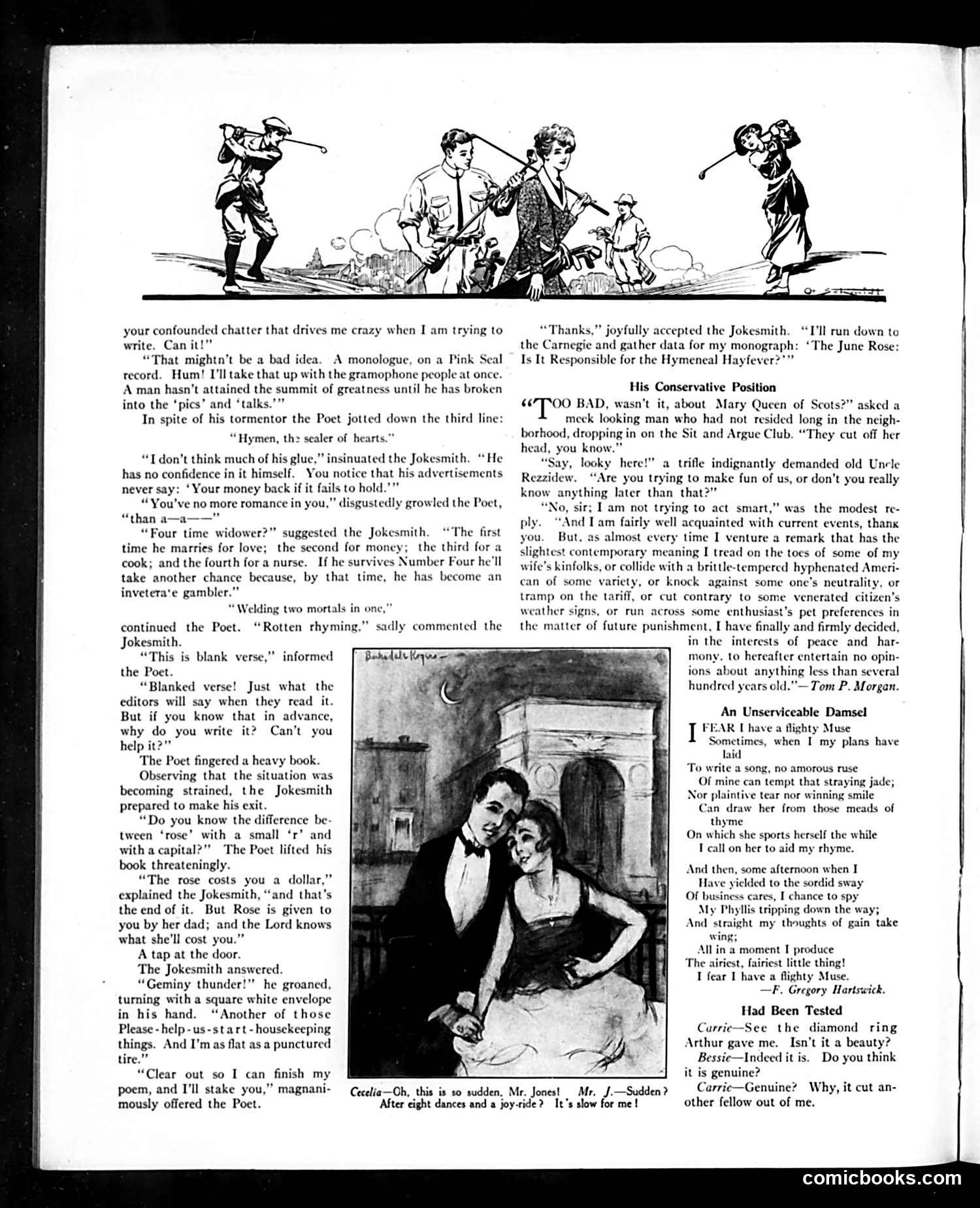
This page contains two satirical pieces typical of early 20th-century American humor. The upper section depicts a **Poet and a Jokesmith** quarreling over writing a wedding poem ("Hymen, the sealer of hearts"). The Jokesmith mocks the Poet's romantic language and makes jokes about marriage—including a dark quip about a "four time widower" who keeps remarrying. The humor satirizes both overwrought sentimental poetry and cynical attitudes toward matrimony and divorce, which were becoming more common and socially visible in this era. The lower section, "His Conservative Position," mocks a timid man at a "Sit and Argue Club" who avoids all contemporary opinions to keep peace—he's been burned so many times by accidentally offending hyphenated Americans, tariff debaters, and superstitious neighbors that he only discusses history over 300 years old. This satirizes the increasing cultural anxiety and political polarization of American life, where casual remarks trigger heated arguments among various factions. Both pieces reveal contemporary concerns about changing social values around marriage, immigration ("hyphenated Americans"), and political divisiveness.
📄 Transcribed text from this page (OCR, searchable)
Machine-transcribed from the original scan — historical spelling and the odd misread are preserved.
your confounded chatter that drives me crazy when I am trying to write. Can it!” “That mightn’t be a bad idea. A monologue, on a Pink Seal record. Hum! I'll take that up with the gramophone people at once. A man hasn’t attained the summit of greatness until he has broken into the ‘pics’ and ‘talks. In spite of his tormentor the Poet jotted down the third line: “Hymen, the sealer of hearts.” “T don’t think much of his glue. ‘ed the Jokesmith. “He has no confidence in it himself. You notice that his advertisements never say: ‘Your money back if it fails to hold “You've no more romance in you,” disgustedly growled the Poet, “than a—a——" Four time widower?” suggested the Jokesmith. “The first time he marries for love; the second for money; the third for a cook; and the fourth fora nurse. If he survives Number Four he'll take another chance because, by that time, he has become an invetera‘e gambler.” “Welding two mortals in one,” “Rotten rhyming,” sadly commented the continued the Poet. Jokesmith. “Thi the Poet. “Blanked verse! Just what the editors will say when they read it. But if you know that in advance, why do you write it? Can’t you help it?” The Poet fingered a heavy book. Observing that the situation was becoming strained, the Jokesmith prepared to make his exit. “Do you know the difference be- tween ‘rose ith a small ‘r’ and with a capital The Poet lifted his book threateningly. “The rose costs you a dollar, explained the Jokesmith, “‘and that’s the end of it. But Rose is given to you by her dad; and the Lord knows what she'll cost you.”” A tap at the door. The Jokesmith answered. “Geminy thunde: he groaned, turning with a square white envelope in his hand. “Another of those Please - help-us-start- housekeeping things. And I’mas flat as a punctured tire. “Clear out so I can finish my poem, and I'll stake you,” magnani- mously offered the Poet. is blank verse,” informed Cecelia—Oh, this is so sudden, Mr. Jones! After eight dances and a joy-ride ? “Thanks,” joyfully accepted the Jokesmith. “I'll run down to the Carnegie and gather data for my monograph: ‘The June Rose: Is It Responsible for the Hymeneal Hayfever: His Conservative Position 667T00 BAD, wasn’t it, about Mary Queen of Scots?” asked a meek looking man who had not resided long in the neigh- borhood, dropping in on the Sit and Argue Club. “They cut off her head, you know.” ay, looky here!” a trifle indignantly demanded old Uncle Rezzidew. ‘Are you trying to make fun of us, or don’t you really know anything later than that?” “No, sir; Tam not trying to act smart,” was the modest re- ply. “And Tam fairly well acquainted with current events, thank you. But, as almost every time I venture a remark that has the slightest contemporary meaning I tread on the toes of some of my wife's kinfolks, or collide with a brittle-tempered hyphenated Ameri- can of some variety, or knock against some one’s neutralit tramp on the tariff, or cut contrary to some venerated citiz weather signs, or run across some enthusiast’s pet preferences in the matter of future punishment, I finally and firmly decided, in the interests of peace and_har- mony, to hereafter entertain no opin- ions about anything less than several hundred years old.”"— Tom P. Morgan. An Unserviceable Damsel J i R [have a flighty Muse ometimes, when I my plans have laid ‘To write a song, no amorous ruse Of mine can tempt that straying jade; Nor plaintive tear nor winning smile Can draw her from those meads of thyme On which she sports herself the while T call on her to aid my rhyme. And then, some afternoon when I Have yielded to the sordid sway Of business cares, I chance to spy My Phyllis tripping down the way; And straight my thoughts of gain take wing; All in a moment I produce The airiest, fairiest little thing! I fear I have a flighty Muse. —F. Gregory Hartswick. Had Been Tested Carrie—See the diamond ring Arthur gave me. Isn't it a beauty? Bessie—Indeed it is. Do you think it is genuine? Carrie—Genuine? Why, it cut an- Mr, J.—Sudden ? other fellow out of me. It's slow for me! comicbooks.com