
Judge, 1916-06-10 · page 15 of 28
Judge — June 10, 1916 — page 15: what you’re looking at
What you’re looking at
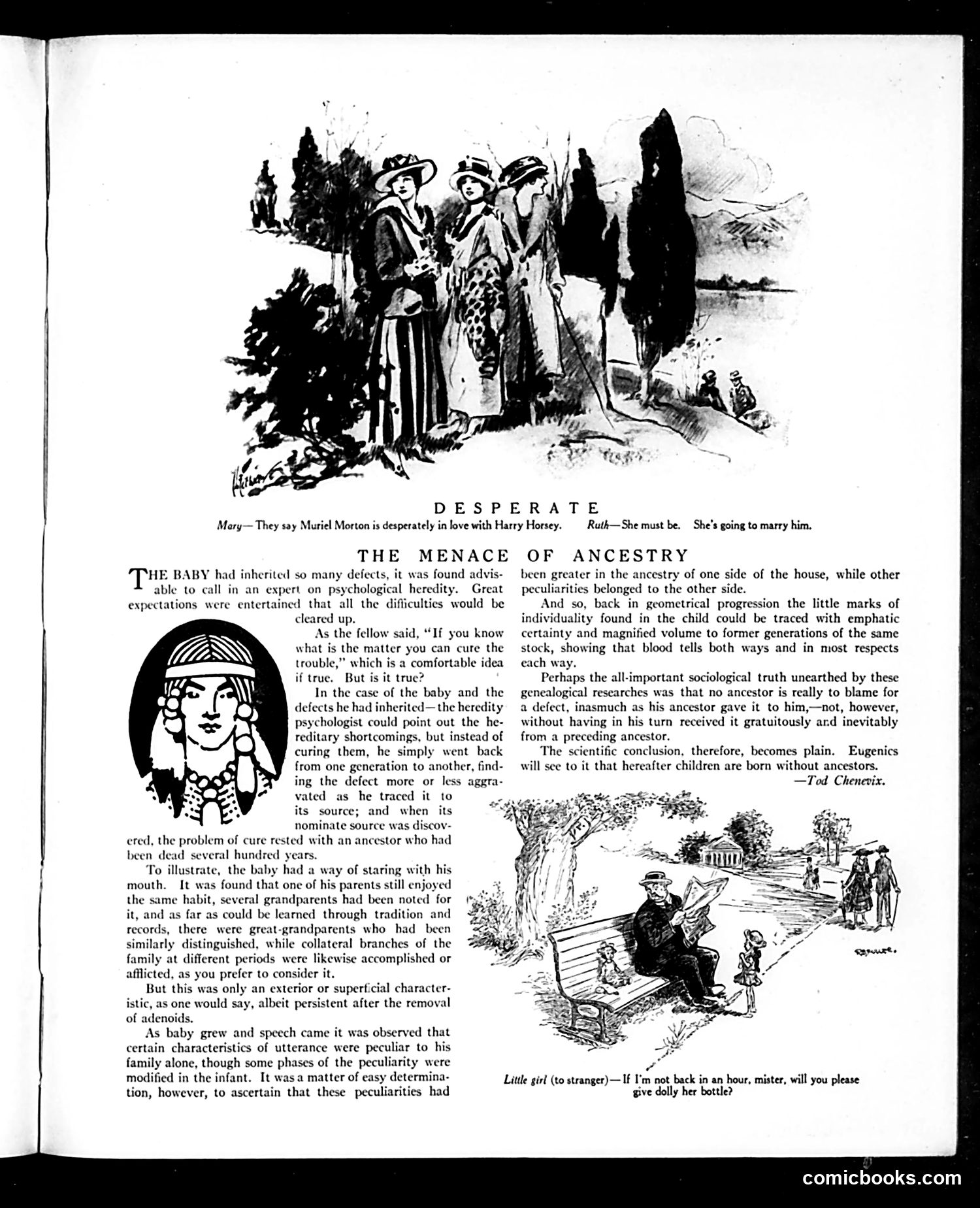
This page satirizes early 20th-century **eugenics ideology**—the pseudoscientific movement claiming heredity determines human defects and worth. The article mocks experts who trace a baby's flaws (mouth-breathing, speech quirks) obsessively backward through generations, finding each ancestor equally "responsible." The satire culminates in absurdist logic: the author concludes eugenics will eventually ensure "children are born without ancestors"—highlighting the movement's fundamental illogic. By tracing blame infinitely backward, no one is actually responsible, yet eugenicists proposed controlling reproduction anyway. The top cartoon's joke about "Muriel Morton" marrying "Harry Horsey" despite desperation plays on similar themes—surface judgments about matrimonial "breeding." The bottom illustration shows a lost child asking a stranger to babysit her doll, innocently illustrating how society entrusts its future to random circumstances—undercutting eugenics' obsession with "scientific" control of heredity.
📄 Transcribed text from this page (OCR, searchable)
Machine-transcribed from the original scan — historical spelling and the odd misread are preserved.
DESP Mary— They say Muriel Morton is desperately in love with Harry Horsey. ERATE Ruth—She must be. She's going to marry him. THE MENACE OF ANCESTRY TH BABY had inherited so many defects, it was found advis- able to call in an expert on psychological heredity. Great expectations were entertained that all the difliculties would be cleared up. As the fellow said, “If you know what is the matter you can cure the trouble,” which is a comfortable idea if true, But is it true? In the case of the baby and the d inherited—the heredity could point out the he- reditary shortcomings, but instead of curing them, he simply went back from one generation to another, find- ing the defect more or less aggra- vated as he traced it to its source; and when its nominate source was discov- cred, the problem of cure rested with an ancestor who had been dead several hundred years. To illustrate, the baby had a way of staring with his mouth. It was found that one of his parents still enjoyed the same habit, several grandparents had been noted for it, and as far as could be learned through tradition and records, there were great-grandparents who had been similarly distinguished, while collateral branches of the family different periods were likewise accomplished or afflicted, as you prefer to consider it. But this was only an exterior or superficial character- istic, as one would say, albeit persistent after the removal of adenoids. As baby grew and speech came it was observed that certain characteristics of utterance were peculiar to his family alone, though some phases of the peculiarity were modified in the infant. It wasa matter of easy determina- tion, however, to ascertain that these peculiarities had been greater in the ancestry of one side of the house, while other peculiarities belonged to the other side. And so, back in geometrical progression the little marks of individuality found in the child could be traced with emphatic certainty and magnified volume to former generations of the same stock, showing that blood tells both ways and in most respects each way, Perhaps the all-important sociological truth unearthed by these genealogical researches was that no ancestor is really to blame for a ct, inasmuch as his ancestor gave it to him,—not, however, without having in his turn received it gratuitously and inevitably from a preceding ancestor. The scientific conclusion, therefore, becomes plain. Eugenics will sce to it that hereafter children are born without ancestors. —Tod Chenevix. ? Little girl (to stranger)— If I'm not back in an hour, mister, will you please give dolly her bottle? comicbooks.com