
Judge, 1916-06-10 · page 5 of 28
Judge — June 10, 1916 — page 5: what you’re looking at
What you’re looking at
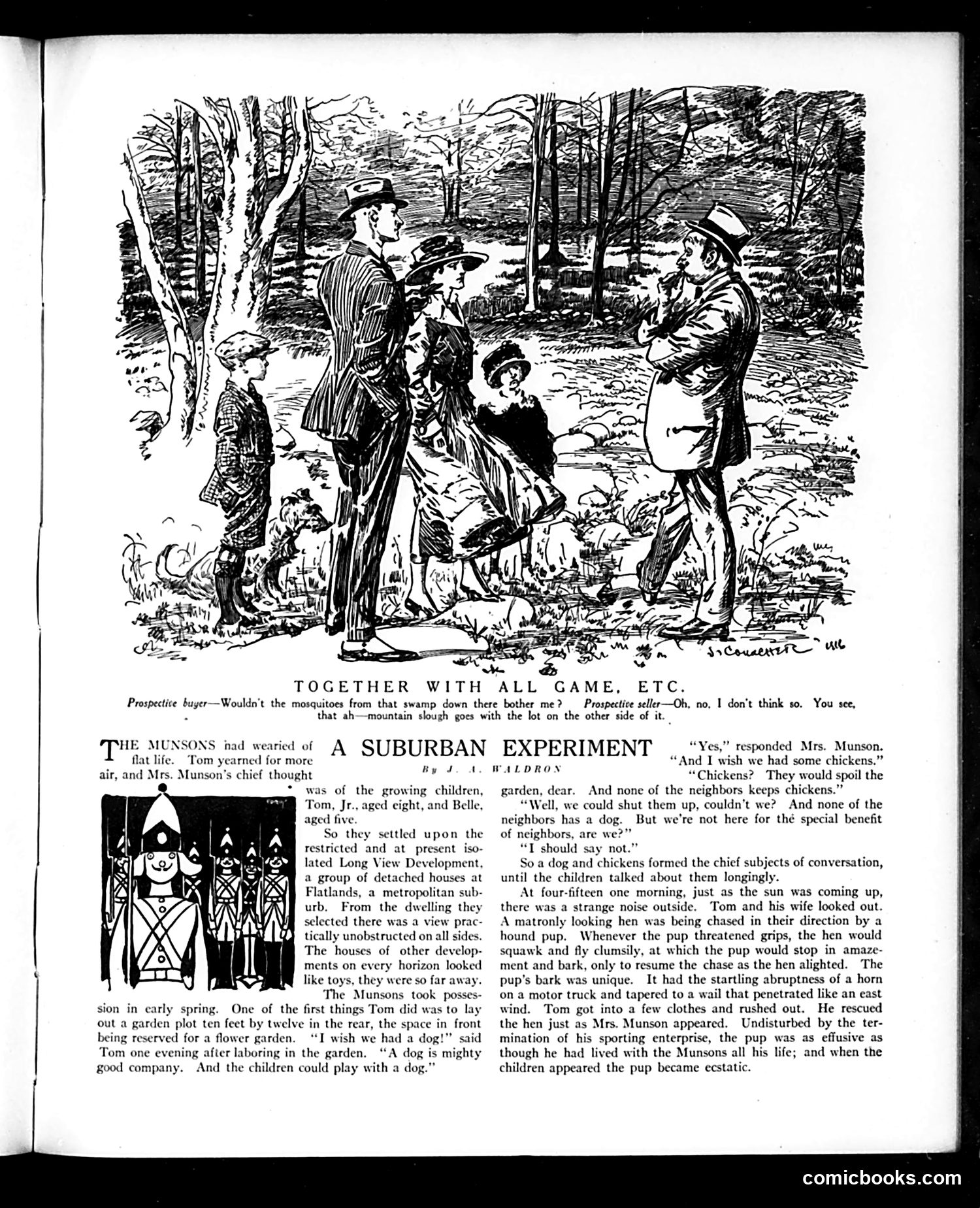
This page contains a short story titled "A Suburban Experiment" by J.A. Waldron, not political satire. The narrative describes the Munson family's move to suburban life at "Flatlands," where they attempt to start a garden and acquire chickens and a dog. The top cartoon illustrates the story's opening premise: a real estate agent (right) discussing property with prospective buyers. The dialogue reveals the agent's sales pitch versus reality—he downplays mosquito concerns from nearby swamps, a common contrast between suburban advertising promises and actual conditions. The story depicts early 20th-century suburban aspiration: middle-class families seeking country life benefits while maintaining proximity to urban centers. The humor derives from their naive optimism about rural ventures like farming.
📄 Transcribed text from this page (OCR, searchable)
Machine-transcribed from the original scan — historical spelling and the odd misread are preserved.
TOGETHER WITH Prospectite buyer—Wouldn't the mosquitoes from that swamp down there bother me? ALL GAME, ETC. Prospectice seller—Oh, no, 1 don’t think so. You see, that ah—mountain slough goes with the lot on the other side of it. THe MUNSONS had wearied of flat life. Tom yearned for more air, and Mrs. Munson’s chief thought was of the growing children, Tom, Jr., aged eight, and Belle, aged five. So they settled upon the restricted and at present is lated Long View Development, a group of detached houses at Flatlands, a metropolitan sub- urb. From the dwelling th selected there was a view prac- tically unobstructed on all sides. The houses of other develop- ments on every horizon looked like toys, they were so far away. The Munsons took posse sion in carly spring. One of the first things Tom did was to lay out a garden plot ten feet by twelve in the rear, the space in front being re ed for a flower garden. ‘I wish we had a dog!” said Tom one evening after laboring in the garden. ‘A dog is mighty good company. And the children could play with a dog. By Joa A SUBURBAN EXPERIMENT WALDRON “Yes,” responded Mrs. Munson. “And I wish we had some chickens.” “Chickens? They would spoil the garden, dear. And none of the neighbors keeps chickens.” “Well, we could shut them up, couldn't we? And none of the neighbors has a dog. But we're not here for thé special benefit of neighbors, are we?” “T should say not.” So a dog and c ns formed the chief subjects of conversation, until the children talked about them longingly. At four-fifteen one morning, just as the sun was coming up, there was a strange noise outside. Tom and his wife looked out. A matronly looking hen was being chased in their direction by a hound pup. Whenever the pup threatened grips, the hen would squawk and fly clumsily, at which the pup would stop in amaze- ment and bark, only to resume the chase as the hen alighted. The pup’s bark was unique. It had the startling abruptness of a horn on a motor truck and tapered to a wail that penetrated like an east wind. Tom got into a few clothes and rushed out. He rescued the hen just as Mrs. Munson appeared. Undisturbed by the ter- mination of his sporting enterprise, the pup was as effusive as though he had lived with the Munsons all his life; and when the children appeared the pup became ecstatic. comicbooks.com