
Judge, 1916-06-10 · page 7 of 28
Judge — June 10, 1916 — page 7: what you’re looking at
What you’re looking at
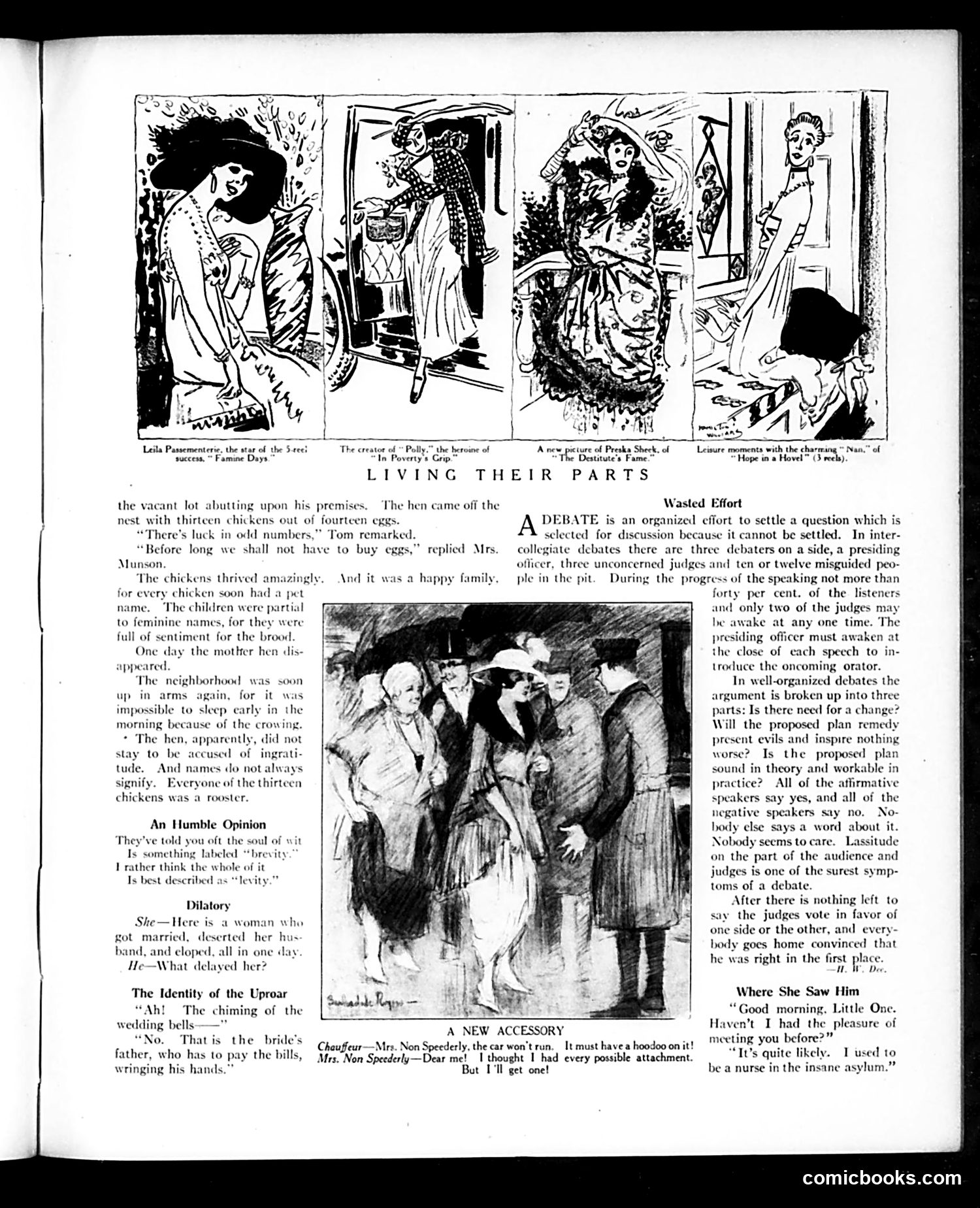
This page contains three distinct humor pieces: **"Living Their Parts"** (top): A domestic comedy about a family whose hen lays thirteen eggs but all hatch into roosters instead of the expected hens. The joke plays on the phrase "there's luck in odd numbers"—they expected one rooster among thirteen eggs, but got the opposite. The irony is that the noisy roosters make the neighborhood unbearable, and the mother hen abandons them out of apparent shame. **"Wasted Effort"** (right column): Social commentary on collegiate debate competitions. The satire mocks how debates are structured theater—judges sleep through speeches, audiences ignore the arguments, and participants leave convinced they were right regardless of the outcome. It suggests debates settle nothing despite their formal organization. **"A New Accessory"** (bottom): A brief joke about an automobile owner seeking a "hoodoo" (bad luck charm) as an accessory, playing on the period's obsession with car attachments and gadgets. The page is primarily humorous domestic and social satire typical of Judge magazine's early 20th-century output, with no apparent political figures or events referenced.
📄 Transcribed text from this page (OCR, searchable)
Machine-transcribed from the original scan — historical spelling and the odd misread are preserved.
success, ~ Famine Days the vacant lot abutting upon his premises. nest with thirteen chickens out of fourteen eggs. “Before long we shall not have to buy eg Munson, The chickens thrived amazingly. for every chicken soon had a pet name. The children were partial to feminine names, for they were full of sentiment for the brood. One day the mother hen dis- appeared. The neighborhood was soon up in arms again, for it was impossible to sleep early in the morning because of the crowing. * The hen, apparently, did not stay to be accused of ingrati- tude. And names do not always signify. Everyone of the thirteen chickens was a rooster. An Humble Opinion They've told you ¢ ul of wit Is something Ia I rather think the whole of it Is best described as “levity.” Dilatory She—Here is a woman who got married, deserted her hus band, and eloped, all in one day He—What delayed her? The Identity of the Uproar “Ah! The chiming of the wedding bells——" No. Thatis the bride's father, who has to pay the bills, wringing his hands.” Leila Passementerie, the star of the S-teet here’s luck in odd numbers,” Tom remarked. sel The creator of “Polly.” the heroine of A new picture of Preska Sheek. In Poverty's Grip.” the Destitute’s Fame LIVING THEIR PARTS The hen came off the DEBATE is an organized * replied Mrs. colle; cted for discussion bec: ate debates there are three debaters on a side, a presiding Leisure moments with the charming“ Nan.” of Hope in a Hovel ” (3 reels) Wasted Effort effort to settle a question which is ‘ause it cannot be settled. In inter- officer, three unconcerned judges and ten or twelve misguided peo- And it was a happy family, ple in the pit. During the pre A NEW ACCESSORY Chauffeur—Mrs. Non Speederly, the car won't run. It must have a hoodoo on it! Mrs. Non Speederly—Dear me! | thought I had every possible attachment. But I'll get one! ogress of the speaking not more than forty per cent. of the listeners and only two of the judges may he awake at any one time. The presiding officer must awaken at the close of each speech to in- troduce the oncoming orator. In well-organized debates the argument is broken up into three parts: Is there need for a change? Will the proposed plan remedy present evils and inspire nothing worse? Is the proposed plan sound in theory and workable in practice? All of the affirmative say yes, and all of the negative speakers say no. No- body el: ys a word about it. Nobody seems to care. Lassitude on the part of the audience and judges is one of the surest symp- toms of a del After there is nothing left to say the judges vote in favor of one side or the other, and every- body goes home convinced t he was right in the first place. HOW, Dee Where She Saw Him “Good morning. Little One. Haven't I had the pleasure of meeting you before?” “Te’s quite like be a nurse in the insan T used to lum.” comicbooks.com