
Judge, 1916-06-10 · page 17 of 28
Judge — June 10, 1916 — page 17: what you’re looking at
What you’re looking at
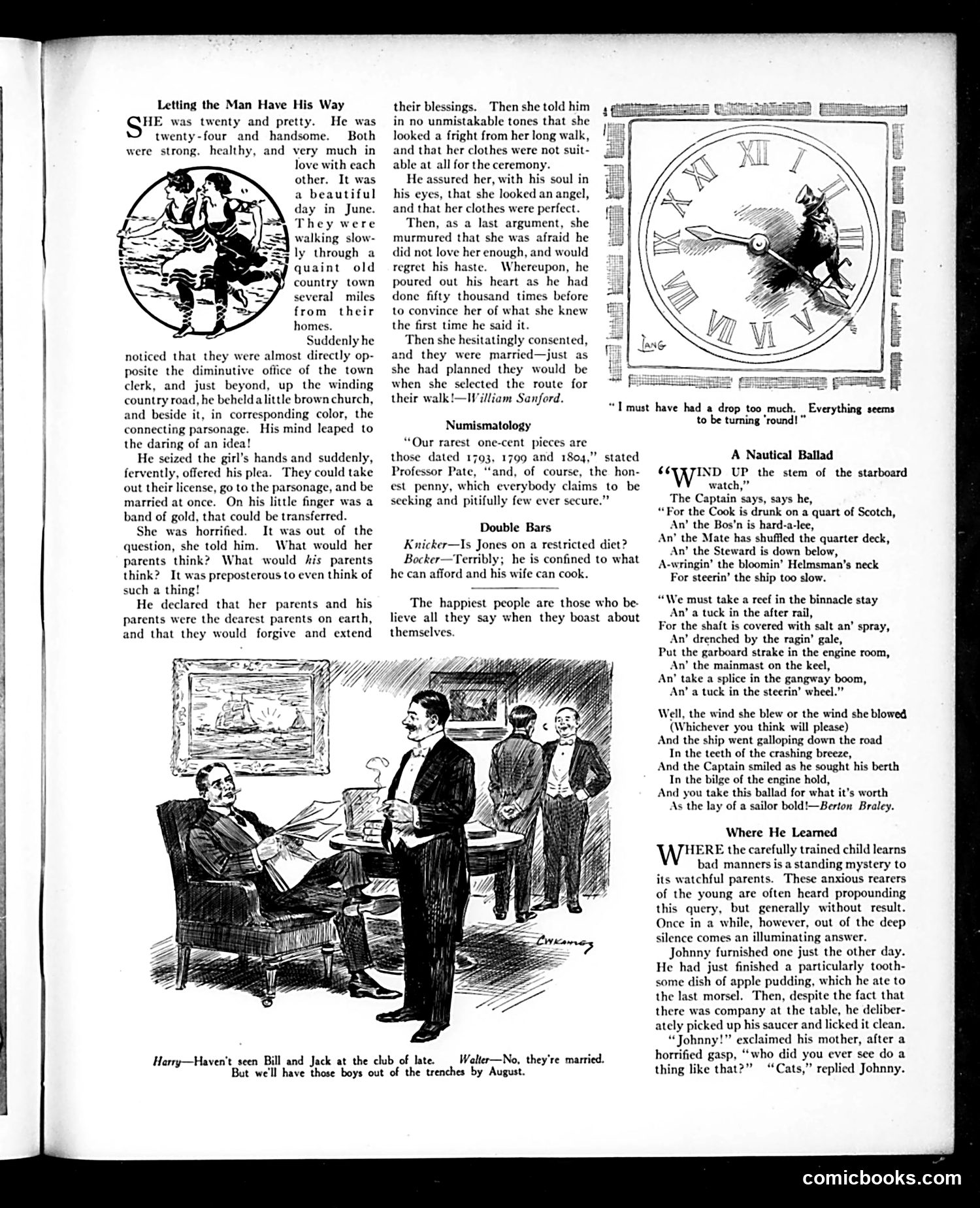
This page contains three distinct pieces of humor: **"Letting the Man Have His Way"** (main story with illustrations): A romantic satire about a young couple on a country walk. The man impulsively proposes an immediate elopement at the local church, offering progressively romantic arguments. The joke's twist: the woman had actually *planned* this entire route and outcome beforehand—she manipulated him into the spontaneous proposal she wanted. It satirizes courtship dynamics and female agency disguised as male romantic initiative. **"Numismatology"** and **"Double Bars"** (brief jokes): Quick satirical quips about rare coins and restricted diets. **"A Nautical Ballad"** (right column): A humorous nonsense poem mocking incompetent sailors and absurd nautical jargon. The ship's entire crew is incapacitated (drunk captain, sleeping bosun, fighting mate), yet the ship somehow functions—pure comedic absurdity. **"Where He Learned"** (bottom right): Begins discussing how well-behaved children mysteriously develop bad manners despite careful parenting. The page blends romantic satire with naval comedy and domestic observation—typical Judge magazine fare from the early 20th century.
📄 Transcribed text from this page (OCR, searchable)
Machine-transcribed from the original scan — historical spelling and the odd misread are preserved.
Letting the Man Have His Way HE was twenty and pretty. He was twenty-four and handsome. Both were strong, healthy, and very much in love with each other. It was a beautiful day in June. They were walking slow- ly through a quaint old country town several miles from their homes. Suddenly he noticed that they were almost directly op- posite the diminutive office of the town clerk, and just beyond, up the winding country road, he behelda little brown church, and beside it, in corresponding color, the connecting parsonage. His mind leaped to the daring of an idea! He seized the girl’s hands and suddenly, fervently, offered his plea. They could take out their license, go to the parsonage, and be married at once. On his little finger was a band of gold, that could be transferred. She was horrified. It was out of the question, she told him. What would her parents think? What would Ais parents think? It was preposterous to even think of such a thing! He declared that her parents and his parents were the dearest parents on earth, and that they would forgive and extend their blessings. Then she told him in no unmistakable tones that she looked a fright from her long w and that her clothes were not s able at all for the ceremony. He assured her, with his soul in his eyes, that she looked an angel, and that her clothes were perfect. Then, as a last argument, she murmured that she was afraid he did not love her enough, and would regret his haste. Whereupon, he poured out his heart as he had done fifty thousand times before to convince her of what she knew the first time he said it. Then she hesitatingly consented, and they were married—just as she had planned they would be when she selected the route for their walk!—IVilliam Sanford. Numismatology “Our rarest one-cent pieces are those dated 1793, 1799 and 1804,” stated Professor Pate, “and, of course, the hon- est penny, which everybody claims to be seeking and pitifully few ever secure.” Double Bars Knicker—Is Jones on a restricted diet? Bocker—Terribly; he is confined to what he can afford and his wife can cook. The happiest people are those who be- lieve all they say when they boast about themselves. Harry—Haven't seen Bill and Jack at the club of late. Welter—No, they're married. But we'll have those boys out of the trenches by August. “I must have had a drop too much. Everything seems to be turning ‘round! ” A Nautical Ballad 66 IND UP the stem of the starboard watch,” The Captain says, says he, “For the Cook is drunk on a quart of Scotch, An’ the Bos'n is hard-a-lee, An’ the Mate has shuffled the quarter deck, An’ the Steward is down below, A-wringin’ the bloomin’ Helmsman’s neck For steerin’ the ship too slow. “We must take a reef in the binnacle stay An’ a tuck in the after rail, For the shaft is covered with salt an’ spray, ‘An’ drenched by the ragin’ gale, Put the garboard strake in the engine room, An’ the mainmast on the keel, An’ take a splice in the gangway boom, An’ a tuck in the steerin’ wheel.” Well, the wind she blew or the wind she blowed (Whichever you think will please) And the ship went galloping down the road In the teeth of the crashing breeze, And the Captain smiled as he sought his berth In the bilge of the engine hold, And you take this ballad for what it’s worth As the lay of a sailor bold!—Berton Braley. Where He Learned HERE the carefully trained child learns bad manners is a standing mystery to its watchful parents. These anxious rearers of the young are often heard propounding this query, but generally without result. Once in a while, however, out of the deep silence comes an illuminating answer. Johnny furnished one just the other day. He had just finished a particularly tooth- some dish of apple pudding, which he ate to the last morsel. Then, despite the fact that there was company at the table, he deliber- ately picked up his saucer and licked it clean. “Johnny!” exclaimed his mother, after a horrified gasp, “who did you ever see do a thing like that?” “Cats,” replied Johnny. comicbooks.com