
Judge, 1916-06-10 · page 20 of 28
Judge — June 10, 1916 — page 20: what you’re looking at
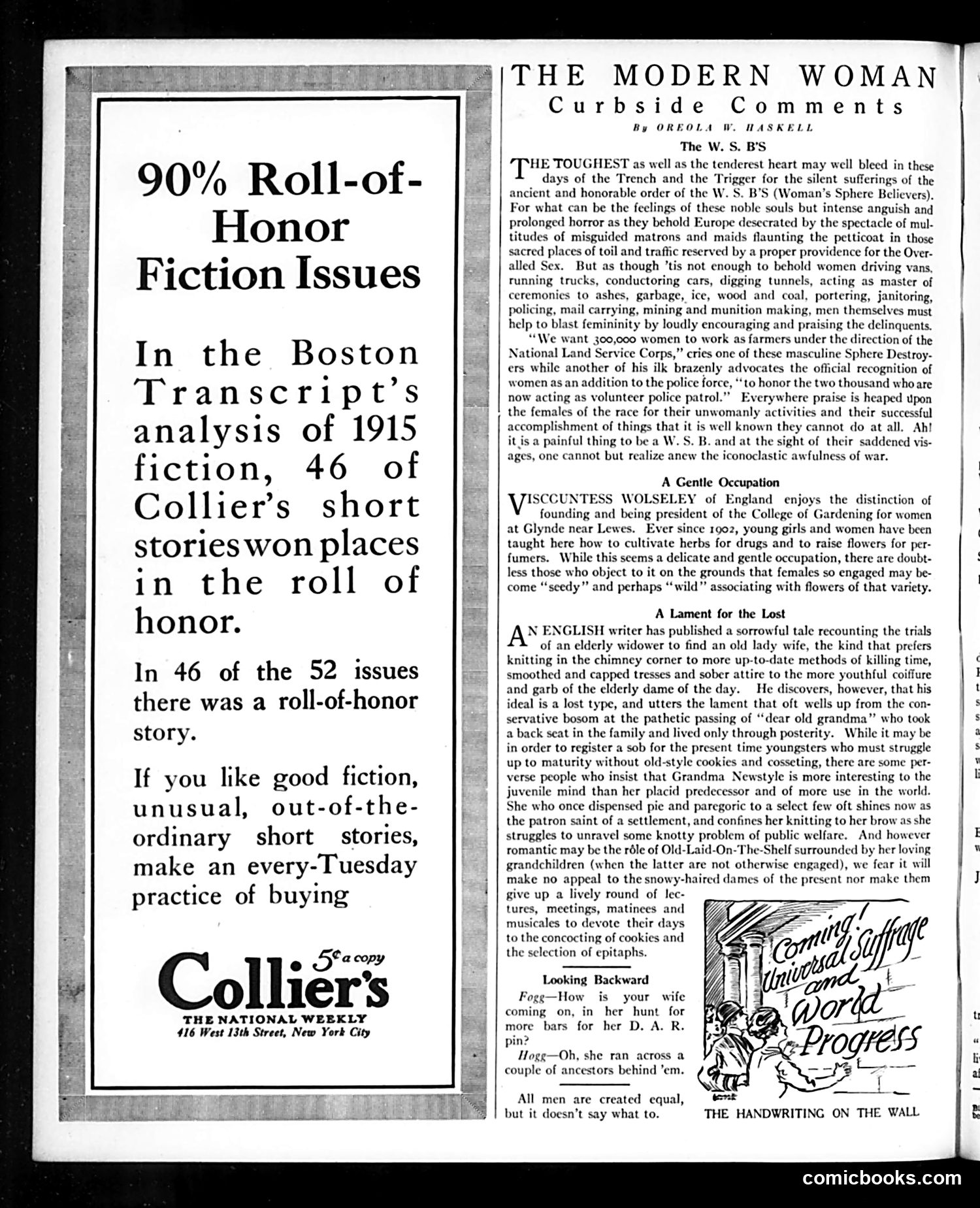
What you’re looking at
This page combines a **Collier's magazine advertisement** (left) with **"The Modern Woman: Curbside Comments"** (right)—a satirical column by Oreola W. Haskell mocking social conservatives' anxieties about women's changing roles during World War I. The column ridicules the "W.S.B.'s" (Woman's Sphere Believers)—those clinging to traditional gender boundaries. It sarcastically laments women working as truck drivers, tunnel diggers, police, and farmers during wartime, while praising men who encouraged this work. Three brief pieces follow: praising an English aristocrat's gardening college for women; mocking a widower mourning "old-fashioned" elderly wives; and suggesting modern grandmothers are actually more useful than their predecessors. The satire's point: conservative gender roles are outdated and somewhat ridiculous when tested against wartime necessity and practical utility. The column advocates for expanded female roles while appearing to sympathize with traditionalists' fictional "suffering."
📄 Transcribed text from this page (OCR, searchable)
Machine-transcribed from the original scan — historical spelling and the odd misread are preserved.
90% Roll-of- Honor Fiction Issues In the Boston Transcript’s analysis of 1915 fiction, 46 of Collier’s short stories won places in the roll of honor. In 46 of the 52 issues there was a roll-of-honor story. If you like good fiction, unusual, out-of-the- ordinary short _ stories, make an every-Tuesday practice of buying Collier's THE NATIONAL WEEKLY 416 West 13th Street, New York City THE MODERN WOMAN Curbside Comments By OREOLA W. HASKELL The W. S. B'S HE TOUGHEST as well as the tenderest heart may well bleed in these days of the Trench and the Trigger for the silent sufferings of the ancient and honorable order of the W. S. B’S (Woman’s Sphere Believers). For what can be the feelings of these noble souls but intense anguish and prolonged horror as they behold Europe desecrated by the spectacle of mul- titudes of misguided matrons and maids flaunting the petticoat in those sacred places of toil and traffic reserved by a proper providence for the Over- alled Sex. But as though ’tis not enough to behold women driving vans, running trucks, conductoring cars, digging tunnels, acting as master of ceremonies to ashes, garbage, ice, wood and coal, portering, janitoring, policing, mail carrying, mining and munition making, men themselves must help to blast femininity by loudly encouraging and praising the delinquents. “We want 300,000 women to work as farmers under the direction of the National Land Service Corps,” cries one of these masculine Sphere Destroy- ers while another of his ilk brazenly advocates the official recognition of women as an addition to the police force, “to honor the two thousand who are now acting as volunteer police patrol.” E: 's heaped upon the females of the race for their unwomanl id their successful accomplishment of things that it is well known they cannot do at all. Ah! it is a painful thing to be a W. S. B. and at the sight of their saddened vis- ages, one cannot but realize anew the iconoclastic awfulness of war. A Gentle Occupation ISCCUNTESS WOLSELEY of England founding and being president of the College of Gardening for women at Glynde near Lewes. Ever since 1902, young girls and women have been { taught here how to cultivate herbs for drugs and to raise flowers for per- | | enjoys the distinction of fumers. While this scems a delicate and gentle occupation, there are doubt- less those who object to it on the grounds that females so engaged may be- come “seedy” and perhaps “wild” associating with flowers of that variety. A Lament for the Lost A* ENGLISH writer has published a sorrowful tale recounting the trials of an elderly widower to find an old lady wife, the kind that prefers knitting in the chimncy corner to more up-to-date methods of killing time, ‘ smoothed and capped tresses and sober attire to the more youthful coiffure ] and garb of the elderly dame of the day. He discovers, however, that his t ideal is a lost type, and utters the lament that oft wells up from the con- s servative bosom at the pathetic passing of ‘dear old grandma” who took s a back seat in the family and lived only through posterity. While it may be a in order to register a sob for the present time youngsters who must struggle s up to maturity without old-style cookies and cosseting, there are some per- y verse people who insist that Grandma Newstyle is more interesting to the li juvenile mind than her placid predecessor and of more use in the world. She who once dispensed pie and paregoric to a select few oft shines now as the patron saint of a settlement, and confines her knitting to her brow as she struggles to unravel some knotty problem of public welfare. And however I romantic may be the réle of Old-Laid-On-The-Shelf surrounded by her loving y grandchildren (when the latter are not otherwise engaged), we fear it will make no appeal to the snowy-haired dames of the present nor make them J give up a lively round of lec- tures, meetings, matinces and musicales to devote their days to the concocting of cookies and the selection of epitaphs. Looking Backward Foge—How is your wife coming on, in her hunt for t more bars for her D. A. R. pin? “ Hogg—Oh, she ran across a li couple of ancestors behind ’em. - All men are created equal, but it doesn’t say what to. THE HANDWRITING ON THE WALL g comicbooks.com