
Judge, 1916-06-10 · page 11 of 28
Judge — June 10, 1916 — page 11: what you’re looking at
What you’re looking at
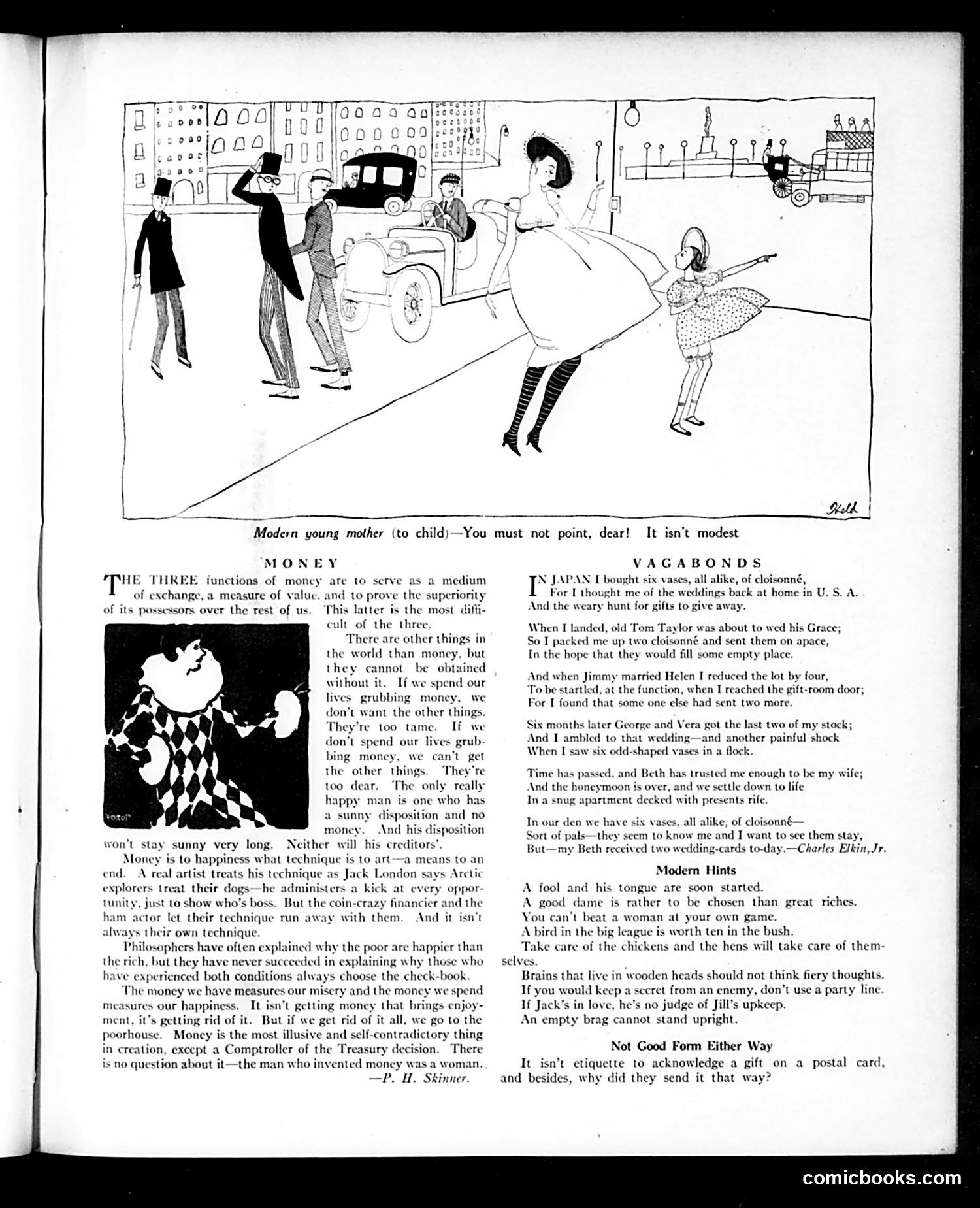
**Top Cartoon:** A satirical illustration of a "modern young mother" pointing at something in public while her child watches. The caption criticizes this as immodest behavior—a social commentary on changing manners. The cartoon mocks what the era considered improper maternal conduct. **"Money" Essay:** A philosophical satire by P. H. Skinner attacking money's contradictions. It argues money serves three functions, with the most important being displaying superiority over others. The piece uses irony to expose how people chase money obsessively yet find it creates misery. The final jab—"the man who invented money was a woman"—is a period-typical sexist joke. **"Vagabonds":** A humorous poem about an American who bought six identical Japanese cloisonné vases as wedding gifts, only to keep receiving them back as duplicate gifts from other guests at subsequent weddings. It satirizes the burden of wedding gift-giving and the absurdity of receiving identical presents repeatedly. **"Modern Hints":** Brief aphorisms parodying wisdom literature, mixing crude observations with mild social satire about gender relations and propriety.
📄 Transcribed text from this page (OCR, searchable)
Machine-transcribed from the original scan — historical spelling and the odd misread are preserved.
Modern young mother (to child)—You MONEY HE THREE junctions of moncy are to serve as a medium of exchange, a measure of value. and to prove the superiority of its possessors over the rest of us. This latter is the most di cult of the three There are other things in the world than money, but they cannot be obtained without it. If we spend our lives grubbing money, we don’t want the other lage They're too tame. If we don’t spend our lives grub- bing moncy, we can’t get the other things. They're too dear. The only: really happy man is one who has a sunny disposition and no mone; And his disposition won't stay sunny very long. Neither will his creditors’. Money is to happiness what technique is to art—a means to an end. A real artist treats his technique as Jack London says Arctic explorers treat their dogs—he administers a kick at every oppor- tunity, just to show who's boss. But the coin-crazy financier and the ham actor let their technique run away with them. And it isn’t always their own technique. Philosophers have often explained why the poor are happier than the rich, but they have never succeeded in explaining why those who have experienced both conditions always choose the che The money we have measures our misery and the mone measures our happiness. It isn’t getting money that brings enjoy- ment, it’s getting rid of it. But if we get rid of it all, we go to the poorhouse. Moncy is the most illusive and self-contradictory thing in creation, except a Comptroller of the Treasury decision. There is no question about it—the man who invented money was a woman. —P. H. Skinner. must not point, dear! It isn’t modest VAGABONDS N JAPAN L bought six vases, all alike, of cloisonné, For I thought me of the weddings back at home in U. And the weary hunt for gifts to give away. When I landed, old Tom Taylor was about to wed his Grace; So I packed me up two cloisonné and sent them on apace, In the hope that they would fill some empty place. And when Jimmy married Helen I reduced the lot by four, To be startled, at the function, when I reached the gift-room door; For I found that some one else had sent two more. Six months later Geor; nd Vera got the last two of my stoc! And I ambled to that weddin; id another painful shock When I saw six odd-shaped vases in a flock. Time has passed, and Beth has trusted me enough to be my wife; And the honeymoon is over, and we settle down to life Ina snug apartment decked with presents rife In our den we have six vases, all alike, of cloisonné— Sort of pals—they seem to know me and I want to sce them stay, But—my Beth received two wedding-cards to-day.—Charles Elkin, Jr. Modern Hints A fool and his tongue are soon started. A good dame is rather to be chosen than great riches. You can’t beat a woman at your own game. A bird in the big league is worth ten in the bush. ke care of the chickens and the hens will take care of them- Brains that live in wooden heads should not think fiery thoughts. If you would keep a secret from an enemy, don’t use a party line. If Jack’s in love, he’s no judge of Jill’s upkeep. An empty brag cannot stand upright. Not Good Form Either Way It isn’t etiquette to acknowledge a gift on a postal card, and besides, why did they send it that wa: comicbooks.com