
A complete issue · 28 pages · 1916
Judge — March 11, 1916
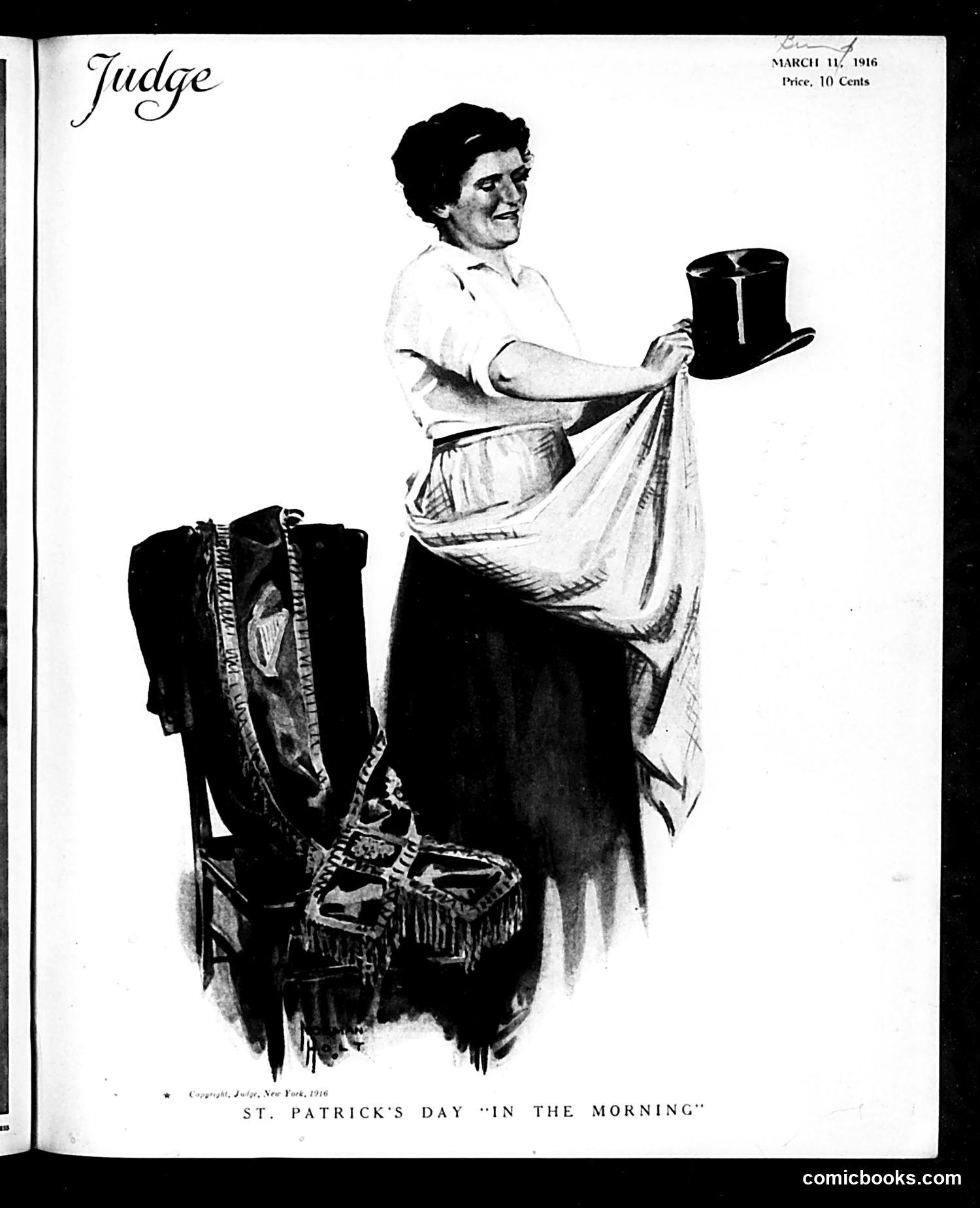
This is a Judge magazine cover from March 11, 1916, depicting St. Patrick's Day celebrations. The illustration shows a woman the morning after festivities, surrounded by evidence of revelry—a decorative chair and scattered items. She holds a top hat and fabric, appearing disheveled, with a somewhat weary expression. The cartoon's title "In the Morning" is a play on the aftermath of St. Patrick's Day partying. It satirizes the contrast between the festive evening celebrations and the sobering reality of the next day—a common theme in satirical magazines of this era. The woman's exhausted demeanor and the scattered objects humorously emphasize the excess and consequences of the holiday's revelries, likely mocking both the Irish-American community's celebration practices and broader American drinking culture around this holiday.
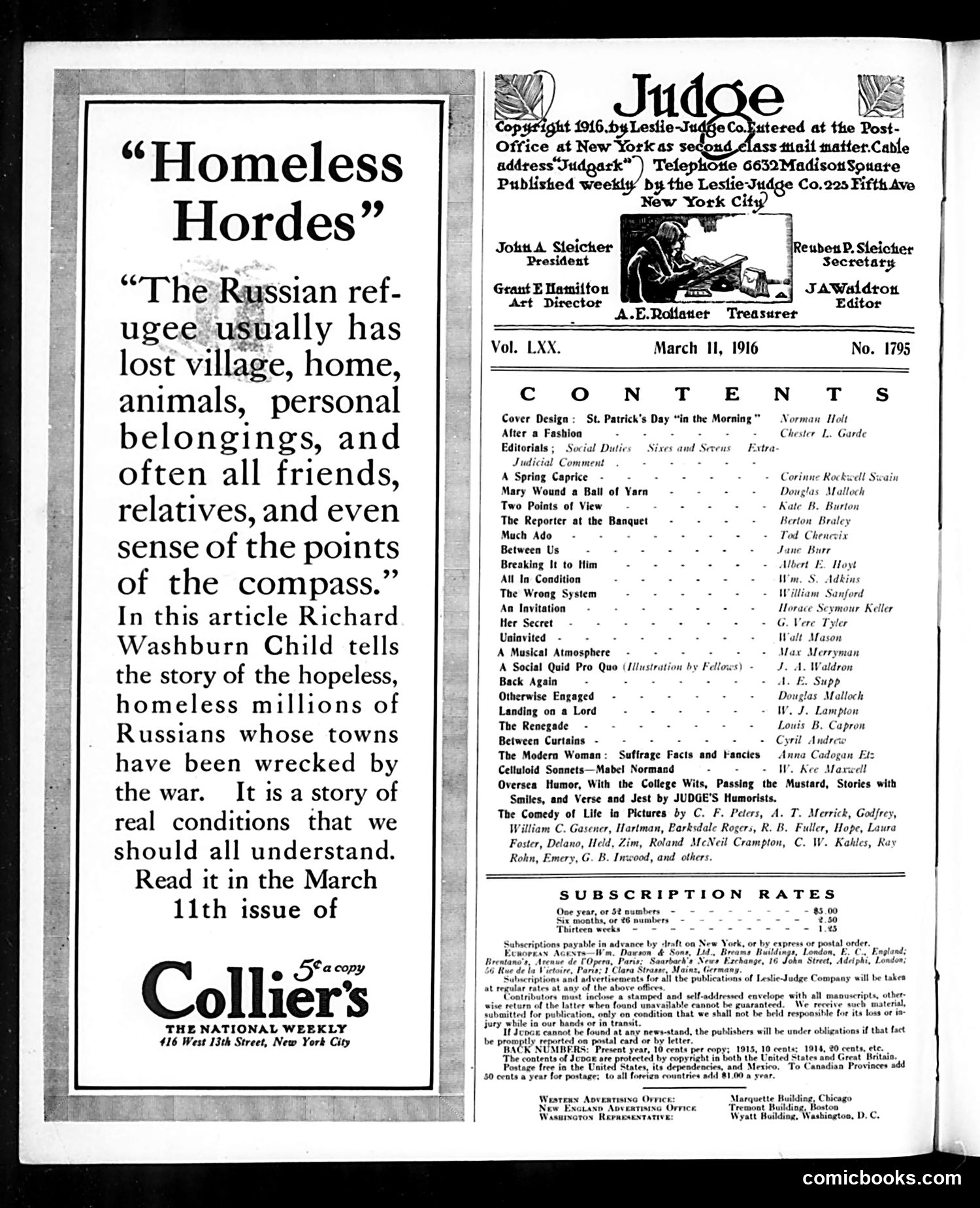
This page is primarily an **advertisement for Collier's magazine**, not a cartoon. The ad promotes an article by Richard Washburn Child titled "Homeless Hordes," about Russian refugees displaced by World War I. The ad emphasizes the human tragedy: refugees have "lost village, home, animals, personal belongings, and often all friends, relatives, and even sense of the points of the compass." The accompanying **Judge masthead and contents page** show this is a satirical weekly. While the contents list various stories and illustrations (political cartoons, humor pieces, and social commentary typical of the era), the specific cartoons themselves are not visible on this reproduced page—only the table of contents is shown. The page primarily documents early WWI-era humanitarian concerns and contemporary magazine publishing.
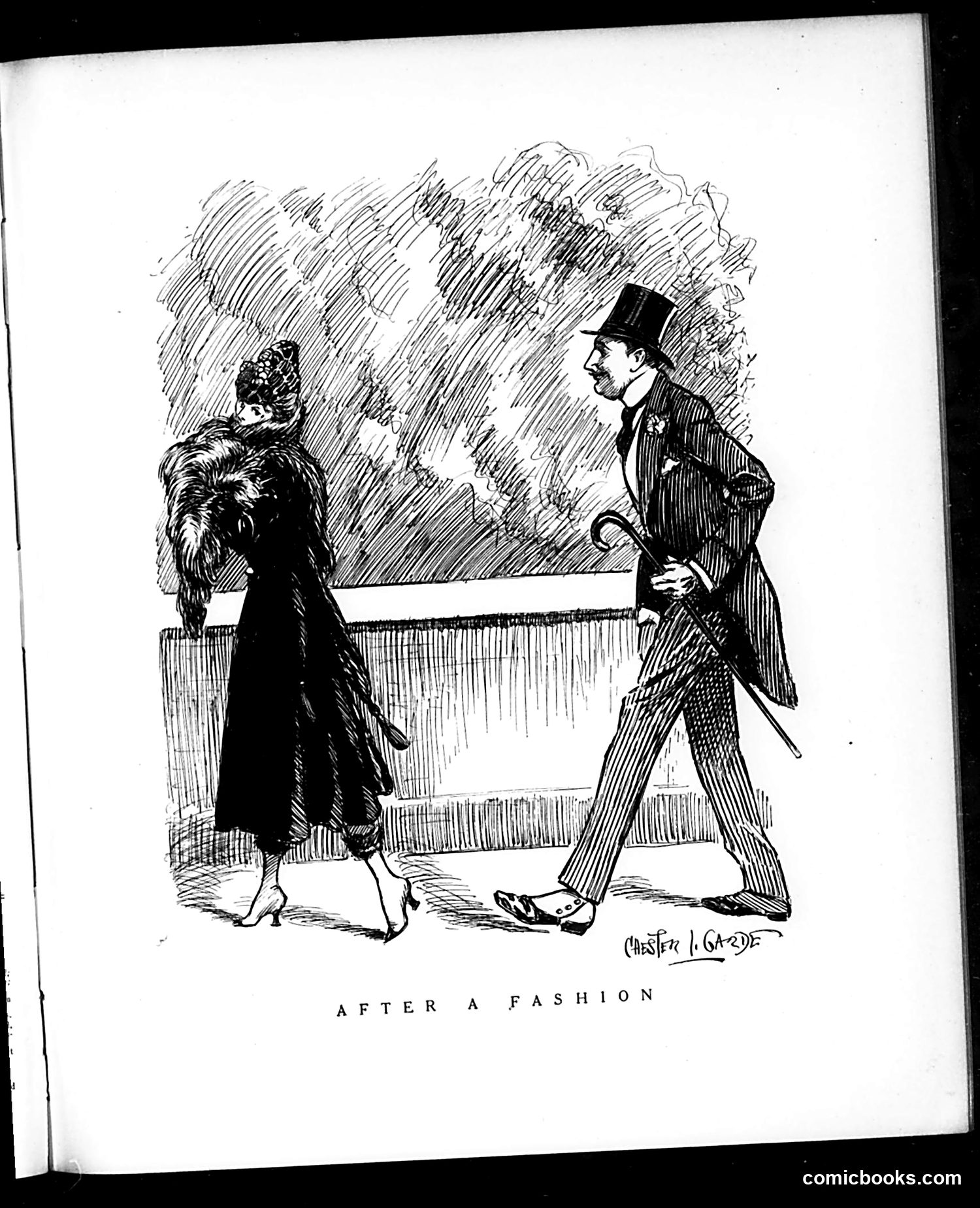
This cartoon by Chester Gould depicts a well-dressed gentleman in a top hat conversing with a fashionably-dressed woman wearing an elaborate fur coat and feathered hat. The title "After a Fashion" appears to be a satirical commentary on social pretense or superficial adherence to fashion and etiquette among the upper classes. The woman's ostentatious clothing—particularly the large fur and elaborate millinery—suggests wealth or aspirations to wealth. The man's formal attire and cane indicate similar social standing. The cartoon likely mocks either empty social interactions, pretentious fashion following, or the hollowness of upper-class "polite society." Without additional context, the specific social critique remains somewhat ambiguous, though it clearly targets fashionable society's vanities.
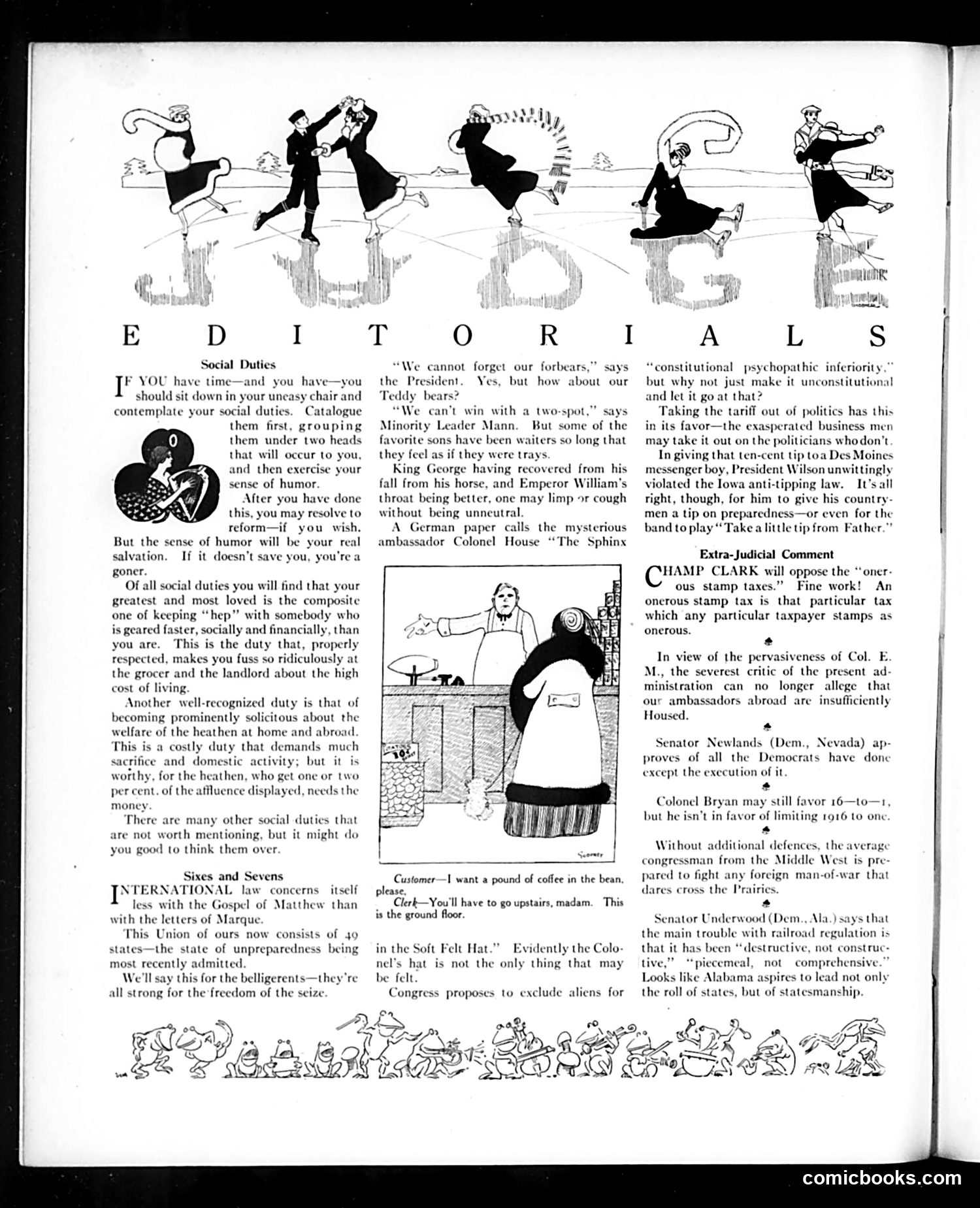
This Judge magazine page features political commentary from the early 20th century. The top illustration spells "EDITORIALS" with figures performing acrobatic stunts, humorously suggesting editorial writing involves balancing acts. The text discusses several political figures and issues: **Referenced figures:** President Wilson, Teddy Roosevelt (mentioned as "bears"), Minority Leader Mann, Colonel E.M. (criticizing ambassador appointments), Champ Clark (opposing "onerous stamp taxes"), Senator Newlands (Nevada Democrat), Colonel Bryan, and Senator Underwood (Alabama Democrat). **Main topics:** social duties, tariffs, railroad regulation, and congressional debates about military preparedness and alien exclusion. The cartoon of the customer and clerk discusses coffee pricing—likely reflecting inflation concerns. The overall tone is satirical commentary on contemporary political dysfunction and policy debates.
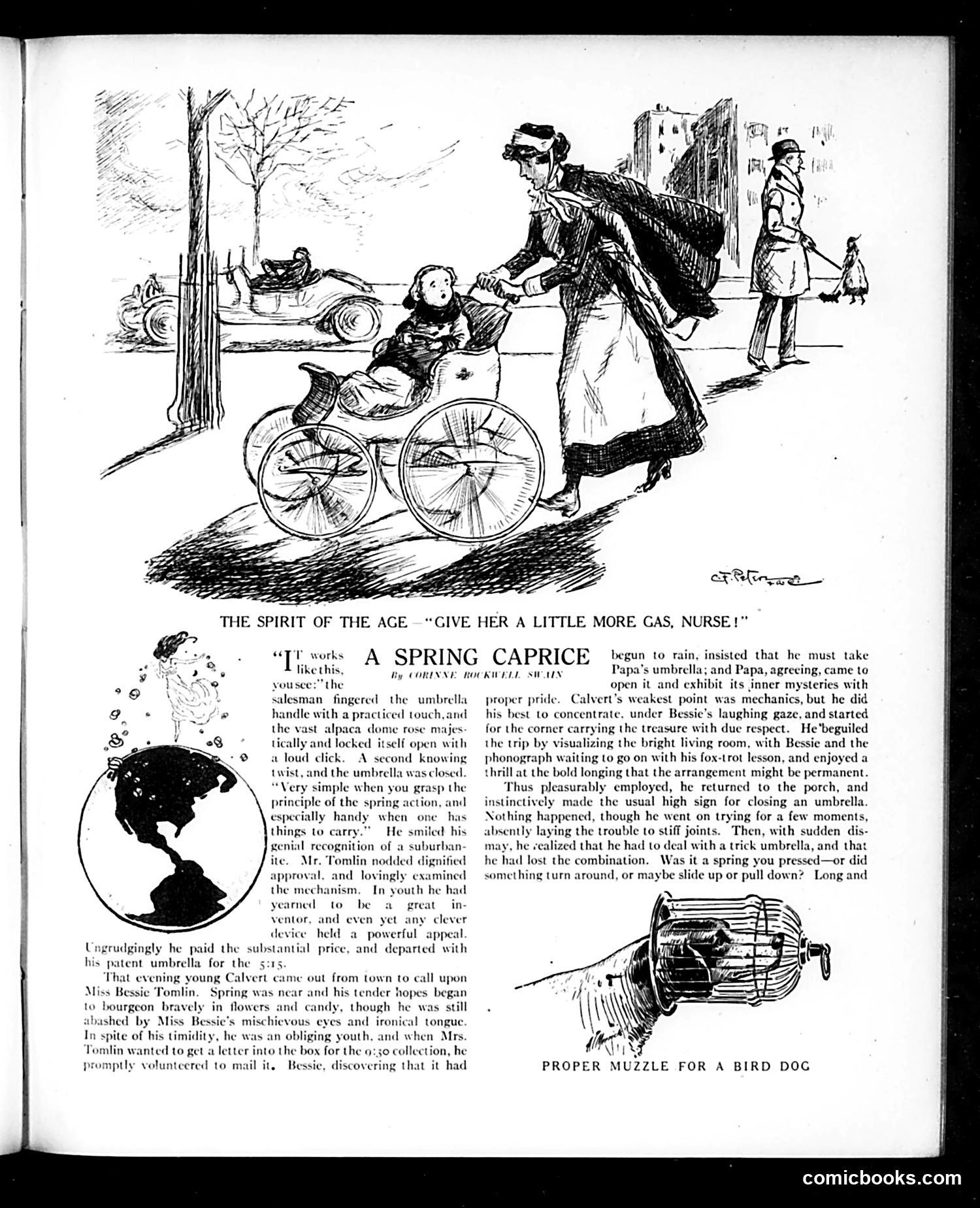
The top cartoon titled "The Spirit of the Age—'Give Her a Little More Gas, Nurse!'" shows a woman pushing a baby carriage while a man encourages her to go faster. This satirizes the "modern woman" and new automobile culture—the "gas" reference jokes about motorized vehicles. The caption suggests women are being pressured toward faster, more dangerous lifestyles in this newly mechanized age. Below is a short story titled "A Spring Caprice" by Corinne Rockwell Shaw, featuring character names like Calvert and Miss Tomlin. The illustration shows an umbrella-focused plot device. At bottom right is an unrelated technical drawing labeled "Proper Muzzle for a Bird Dog." The page mixes satirical social commentary with fiction and practical illustrations typical of Judge's format.
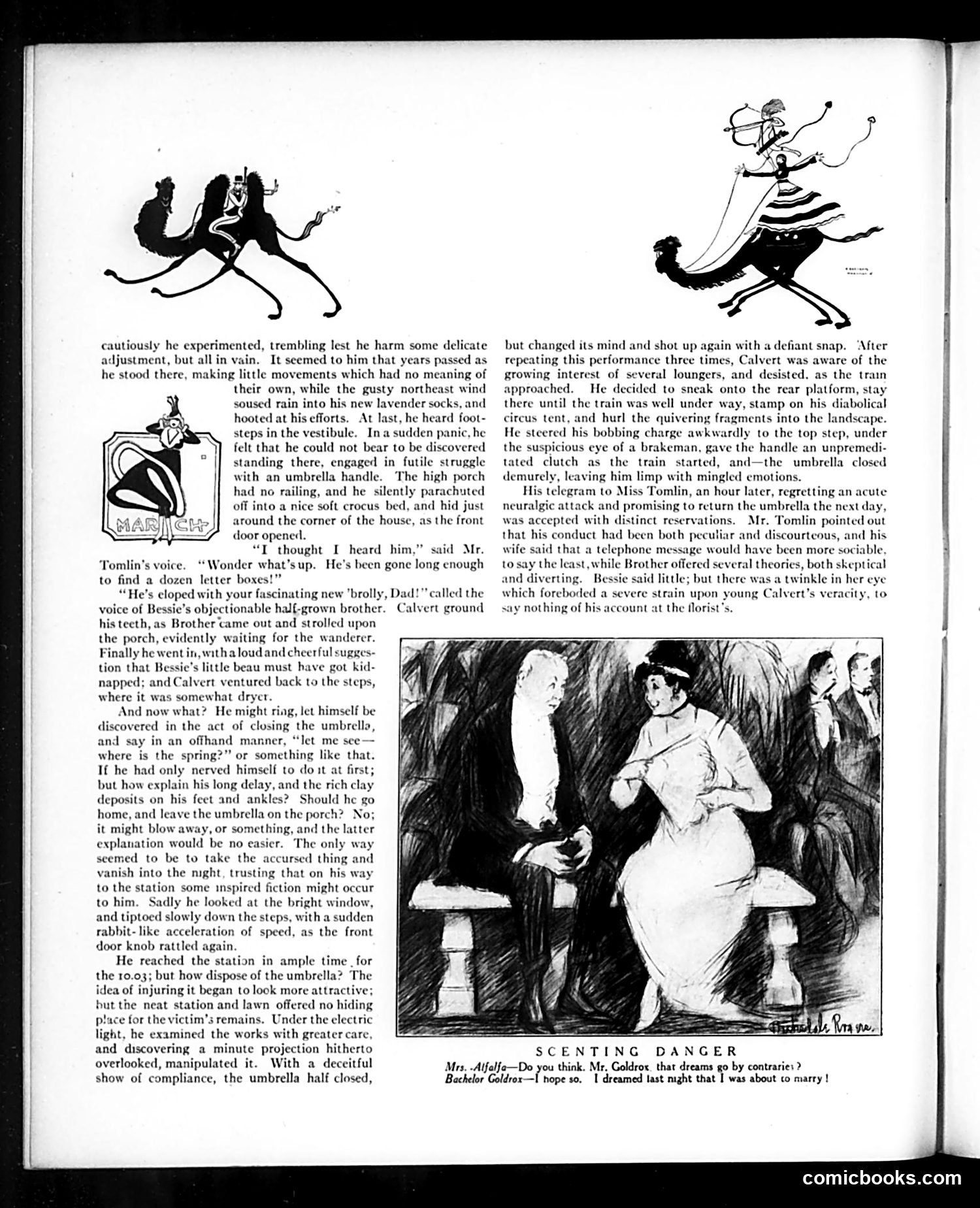
This illustrated story concerns a young man named Calvert attempting to return a borrowed umbrella to his sweetheart Miss Tomlin. The narrative humor derives from his escalating embarrassment and the umbrella's defiant malfunctioning—it refuses to close properly, forcing him into increasingly awkward situations. The accompanying illustration shows Miss Tomlin and a Bachelor Goldrose (likely her chaperone or family friend) discussing dreams and marriage prospects, establishing the romantic stakes. The satire targets Victorian courtship conventions: Calvert's elaborate attempts to preserve his dignity while struggling with a mechanical object, his transparent lie about neuralgic illness to excuse his strange behavior, and the knowing skepticism of those around him. The "danger" is social embarrassment threatening his romantic prospects—a gentle parody of how seriously the era took such social missteps among the courting classes.
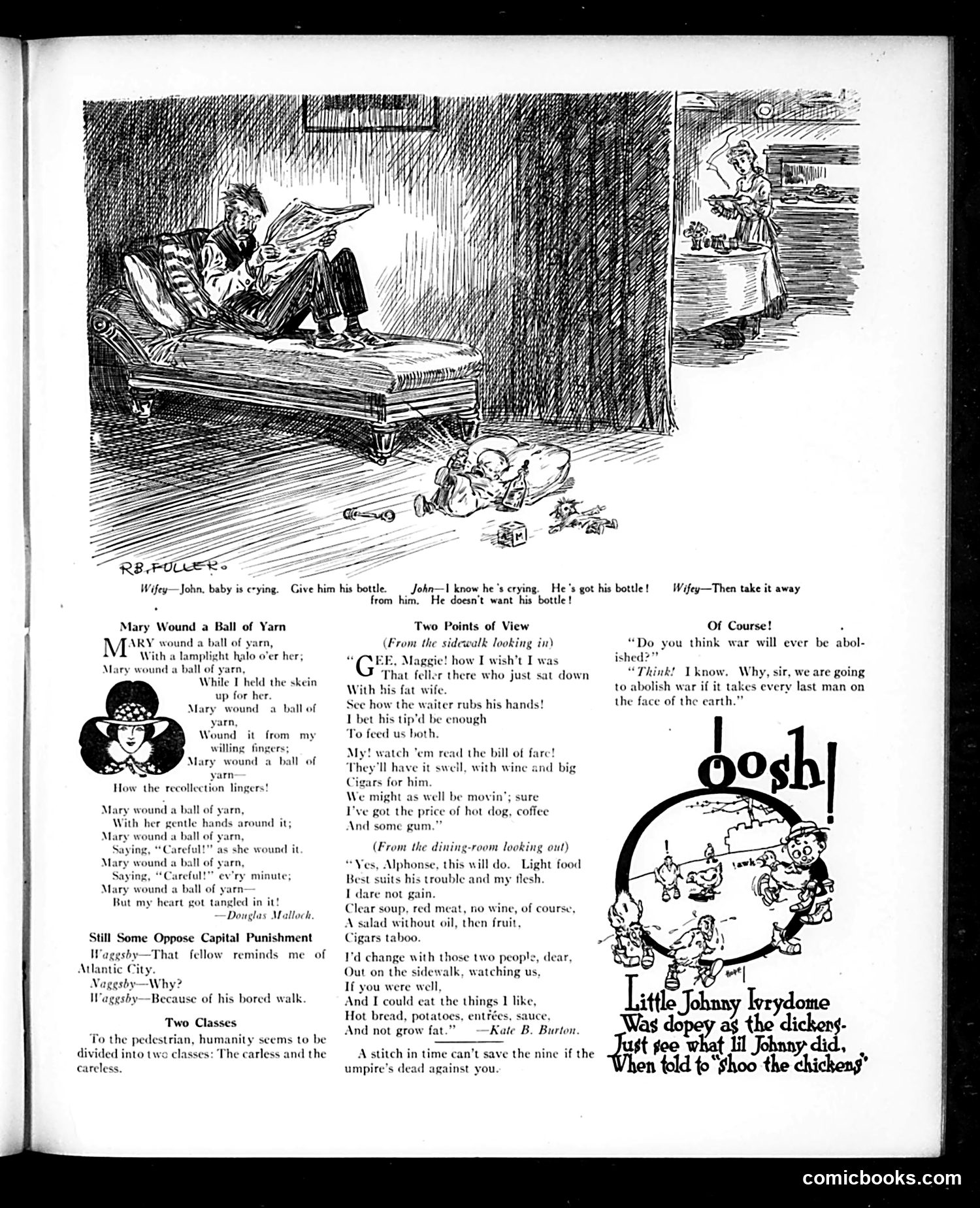
This page contains several satirical pieces reflecting early 20th-century concerns: **Top cartoon**: Shows a domestic scene where a husband on a sofa ignores a crying baby while reading, and the wife must remind him to provide the bottle. The satire mocks paternal irresponsibility and gender dynamics—the implication being fathers were expected to help but often shirked duties. **"Two Points of View"**: Contrasts the perspectives of poor people outside a restaurant (envying the diners' apparent affluence and food) with the wealthy diners inside (who actually eat sparingly due to health/vanity concerns). The satire critiques both class inequality and the irony that money doesn't guarantee happiness or satisfaction. **"Of Course!"**: A brief exchange mocking militaristic fervor, suggesting war will be "abolished" only when every man is dead—cynical commentary on warfare and jingoism. The page also includes sentimental poetry ("Mary Wound a Ball of Yarn") and lighter humor pieces. Overall, it reflects Judge's trademark blend of domestic comedy, class commentary, and antiwar sentiment typical of the era.
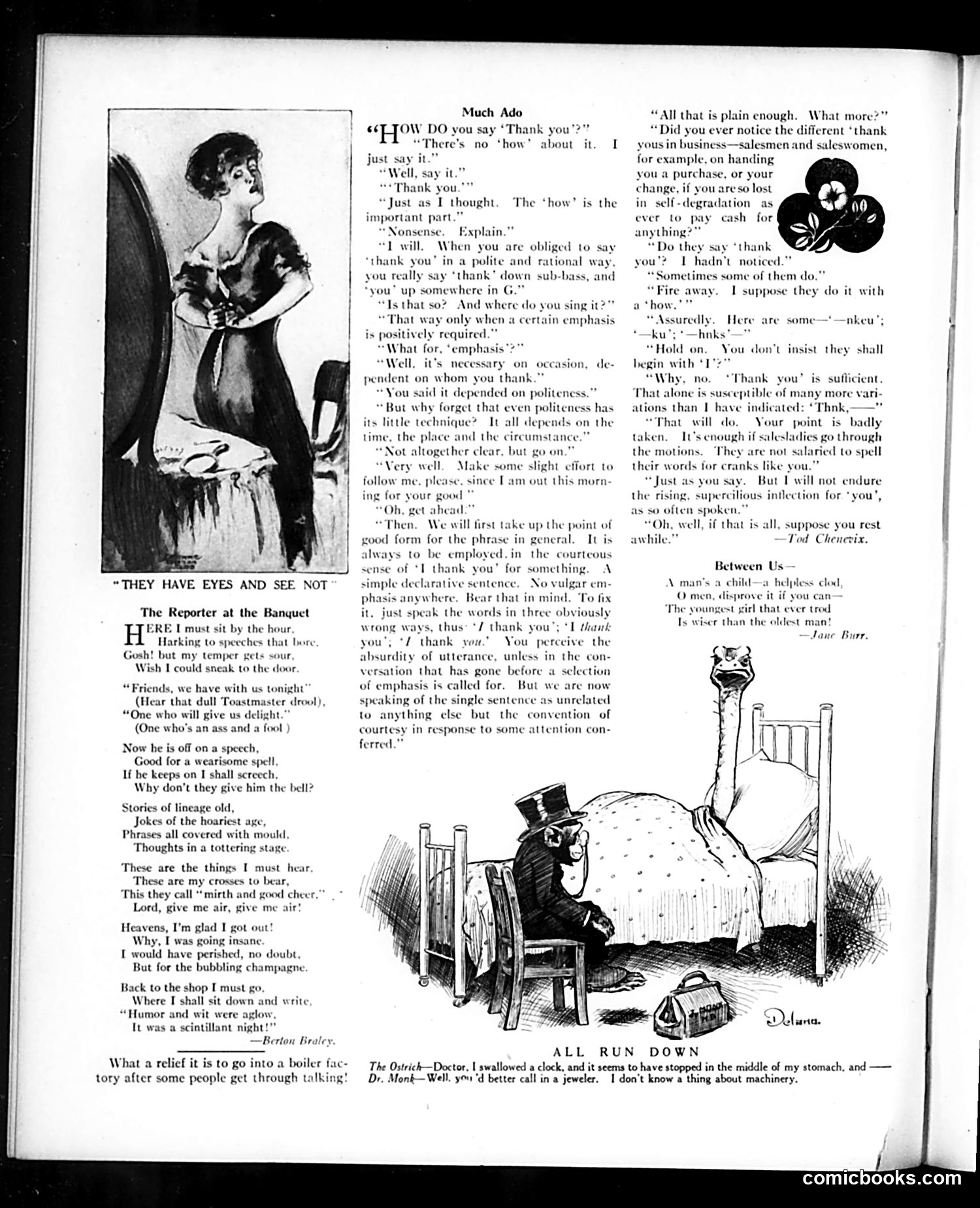
This page satirizes **tedious public speaking and social pretense** through two pieces: **"The Reporter at the Banquet"** (poem by Berton Braley): A journalist is trapped enduring an interminable banquet speech full of tired clichés and stale jokes. He fantasizes about escaping, then must return to write glowing coverage anyway—satirizing the hypocrisy of professional obligation and the gap between private suffering and public praise. **"Much Ado"** (dialogue): Two characters debate the proper technique for saying "thank you"—obsessing over pitch, emphasis, and pronunciation as markers of politeness. The exchange mocks overly pedantic instruction and artificial social conventions. When the instructor criticizes salespeople's intonation, the other character dismisses the concern as irrelevant to actual service, puncturing the pretension. Both pieces target **American upper-class social rituals**—obligatory attendance at boring events and excessive concern with etiquette minutiae—as absurd exercises in maintaining appearances rather than genuine courtesy or meaning.
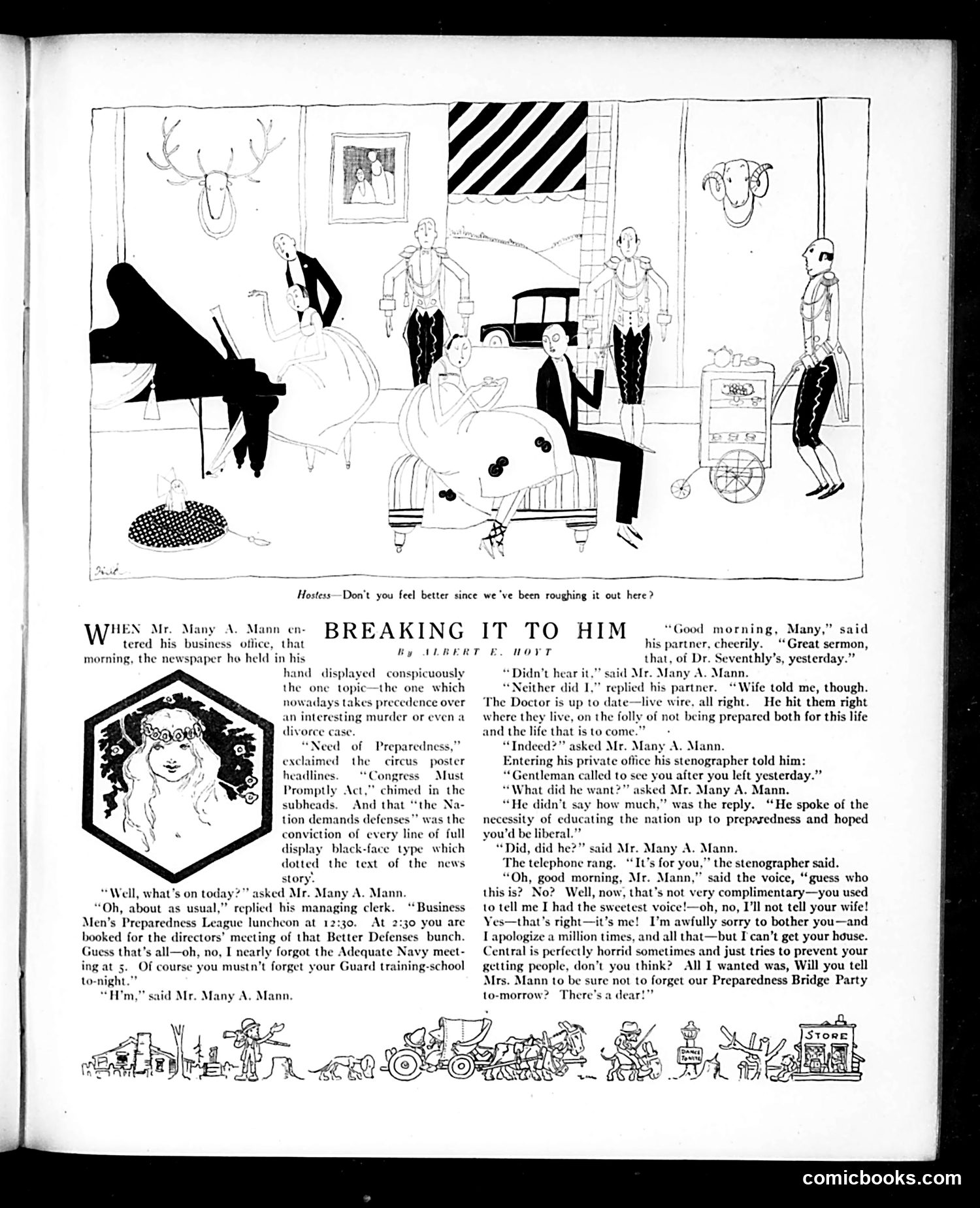
This story satirizes the obsessive "preparedness" movement sweeping America (likely pre-WWI, circa 1915-1916). Mr. Many A. Mann's entire day is consumed by preparedness-related obligations: Business Men's Preparedness League lunch, Better Defenses meetings, National Guard training. The satire works through ironic contrast: Mann claims not to have heard a sermon *about* preparedness, yet that message dominates his schedule anyway. A caller solicits donations "for the nation's preparedness." Even his wife's bridge party is rebranded a "Preparedness Bridge Party." The joke is that "preparedness" has become a catch-all justification for every social and civic activity—it's simultaneously everywhere and nowhere, a fashionable cause that obscures rather than clarifies actual concerns. The cartoon critiques how Americans invoke national defense rhetoric to organize their social lives, suggesting the movement had become more about social conformity than genuine strategy.
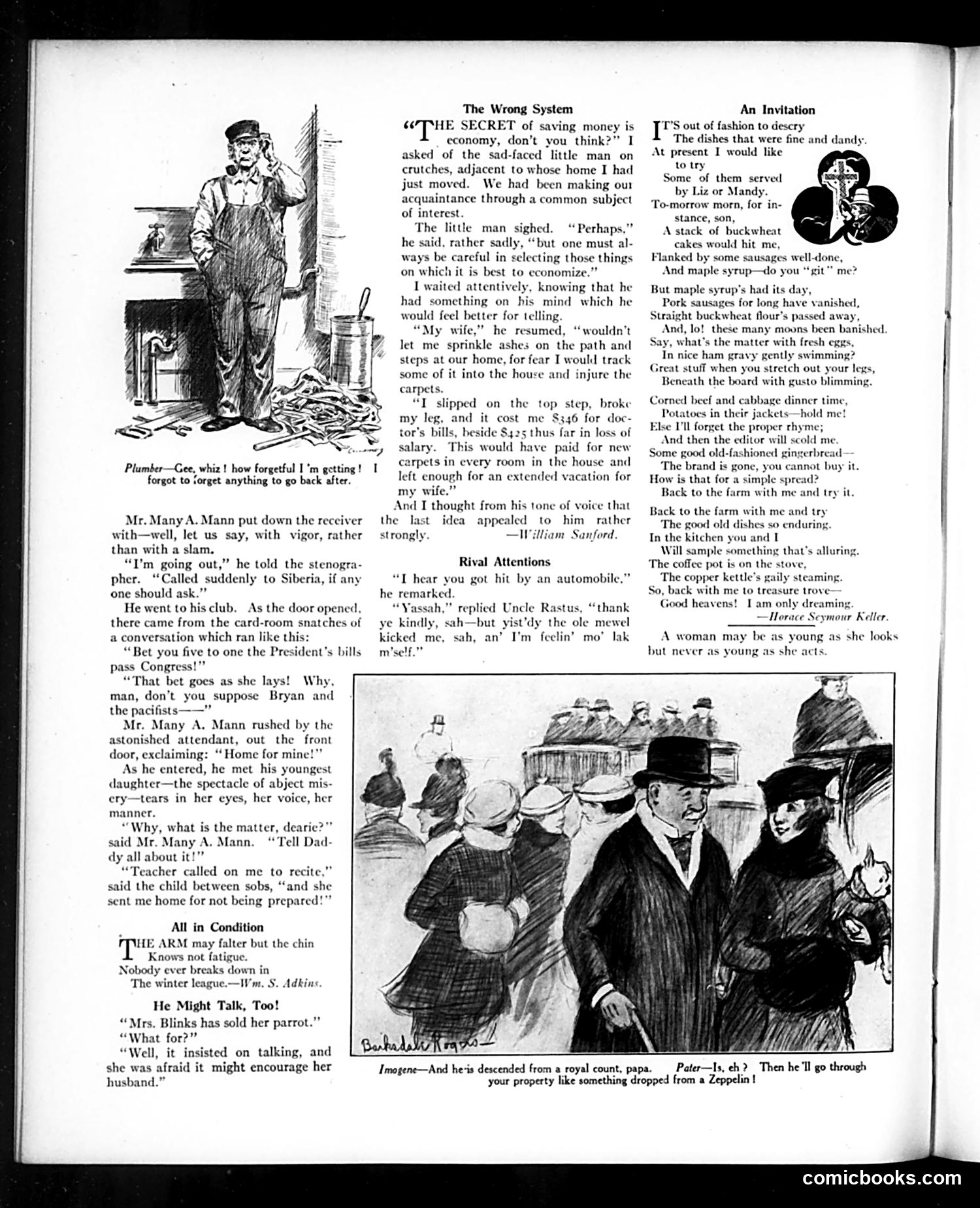
**The Main Cartoon** (bottom illustration by Cesare Maccari): This depicts a scene at what appears to be a train station or public venue. The caption references "Imogene" descending from "a royal count, papa" and "Peter" asking if "he'll go through your property like something dropped from a Zeppelin!" This is a satirical jab at European nobility visiting America—likely mocking both the pretensions of American hosts eager to entertain titled foreigners and anxieties about foreign extravagance. The Zeppelin reference suggests this is post-WWI, when German airships symbolized both technological marvel and destructive warfare. **The Left Cartoon** (plumber sketch): A simple visual gag about forgetfulness—a plumber leaving his tools behind while rushing off. **Overall Context:** The page mixes social commentary (economy, class anxiety, foreign relations) with domestic humor. The satirical tone reflects Judge magazine's early-20th-century focus on American manners, wealth disparities, and cultural pretension.
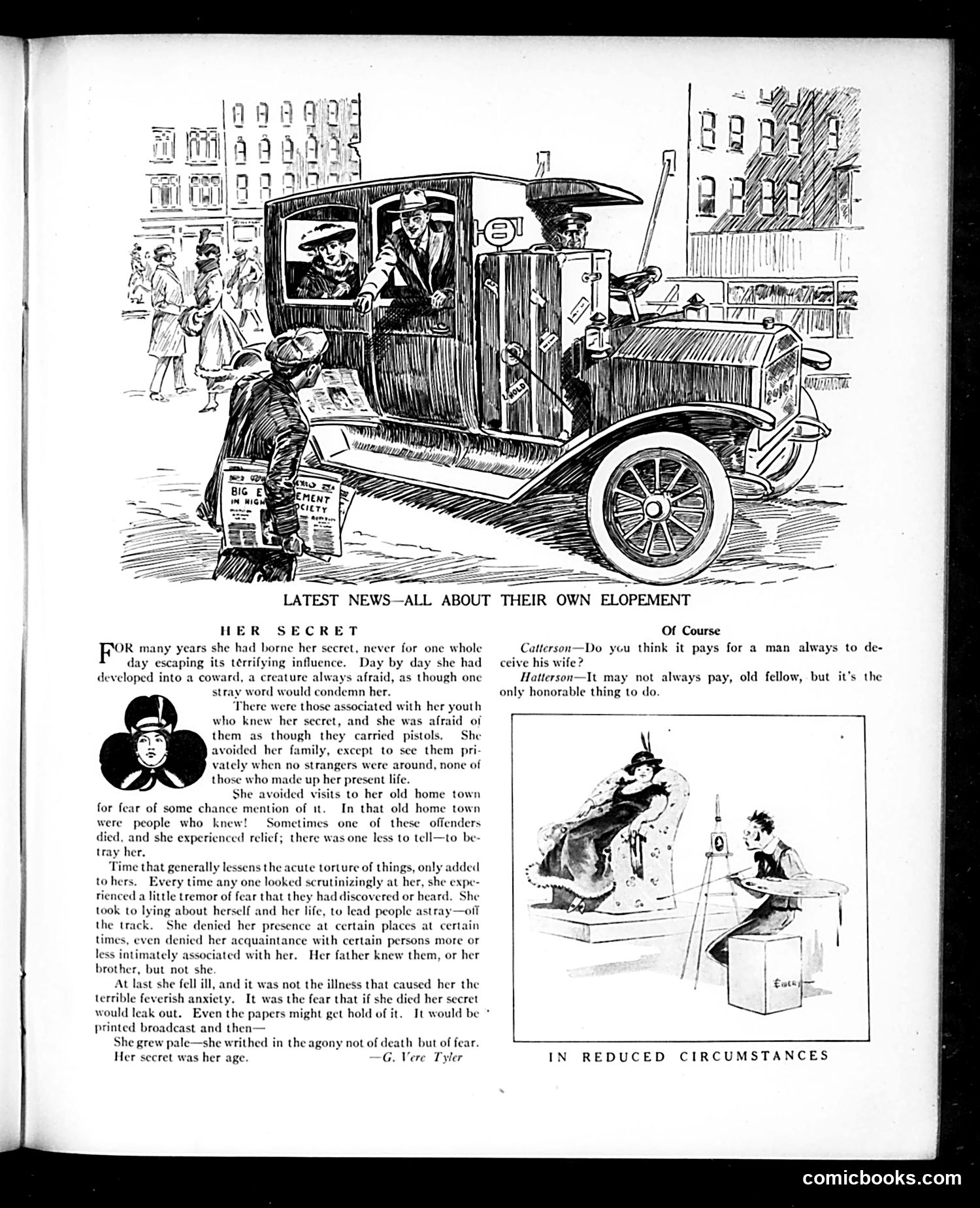
**Top Cartoon ("Latest News"):** Shows a couple in an old automobile with a newsboy below. The satire mocks sensationalist journalism—the couple is reading about their own elopement in the papers, suggesting the media broadcasts private scandals with exaggerated drama. **Main Story ("Her Secret"):** A darkly ironic tale by G. Vere Tyler about a woman tormented for years by a secret she guards obsessively. The punchline—revealed only at the end—is that her secret is simply **her age**. This satirizes vanity and society's pressure on women regarding aging, particularly in the early 20th century when women's social value was closely tied to youth and marriageability. **Bottom Cartoon ("In Reduced Circumstances"):** A brief dialogue joke about marital deception, playing on the era's attitudes about husbands deceiving wives as socially acceptable. The page's humor relies on exaggerated anxiety about secrets that seem trivial by modern standards, reflecting period obsessions with propriety, gossip, and women's appearance.
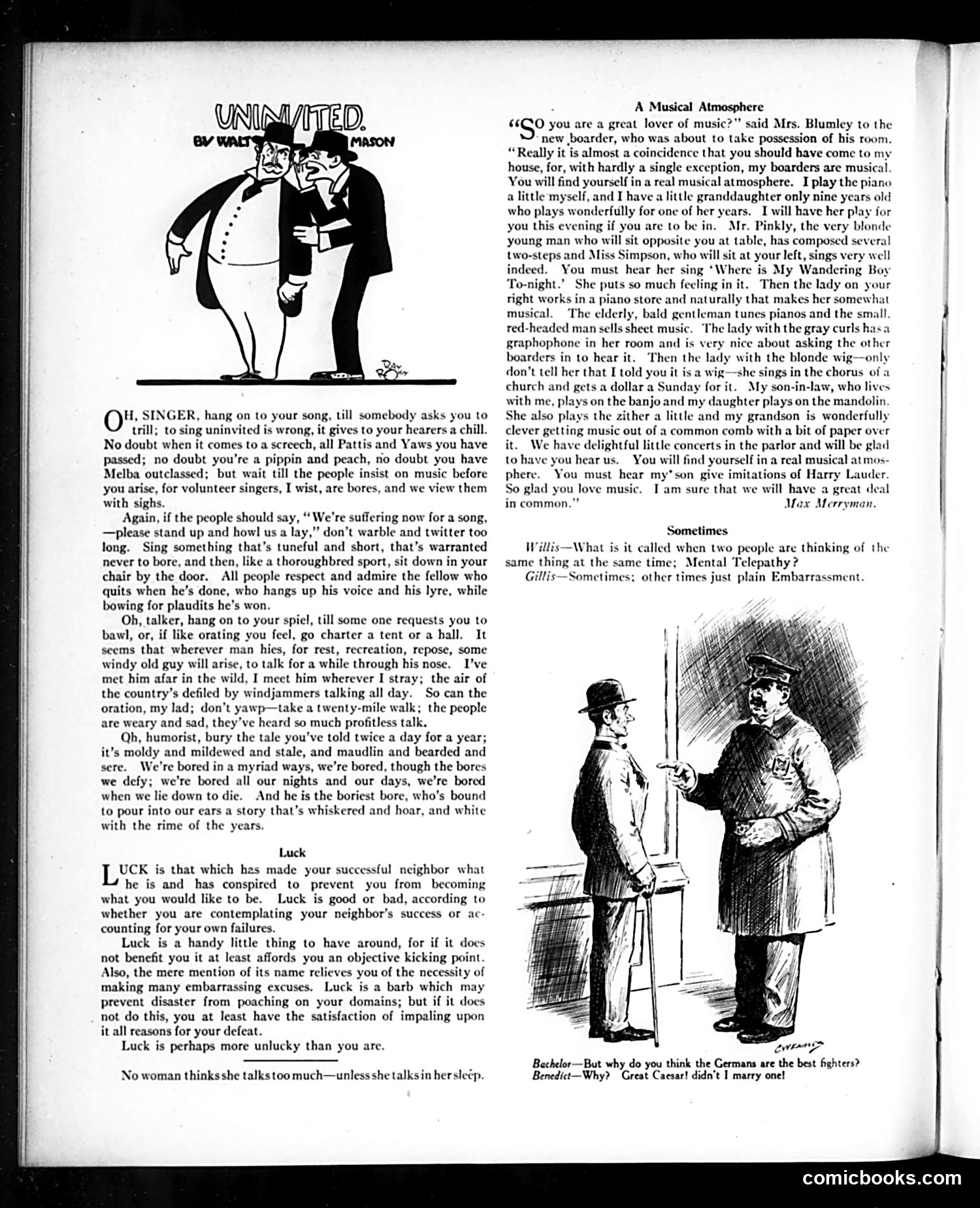
This Judge magazine page contains social satire targeting annoying social behaviors. The main articles mock uninvited singers, long-winded talkers, and repetitive jokesters who bore their audiences—advising them to know when to quit. The humor warns against imposing unwanted entertainment on captive audiences ("All people respect and admire the fellow who quits when he's done"). The cartoon titled "A Musical Atmosphere" satirizes a landlady who boasts that virtually all her boarders are musicians, describing their various musical roles (piano player, composer, singer, piano-store worker, piano tuner, sheet-music seller). The joke is that she's created an inescapably music-saturated boarding house—illustrating the article's theme about forced, unwanted entertainment. The accompanying illustration shows two men, with one asking why Germans make the best fighters, implying a separate joke about military prowess, likely reflecting early 20th-century attitudes.
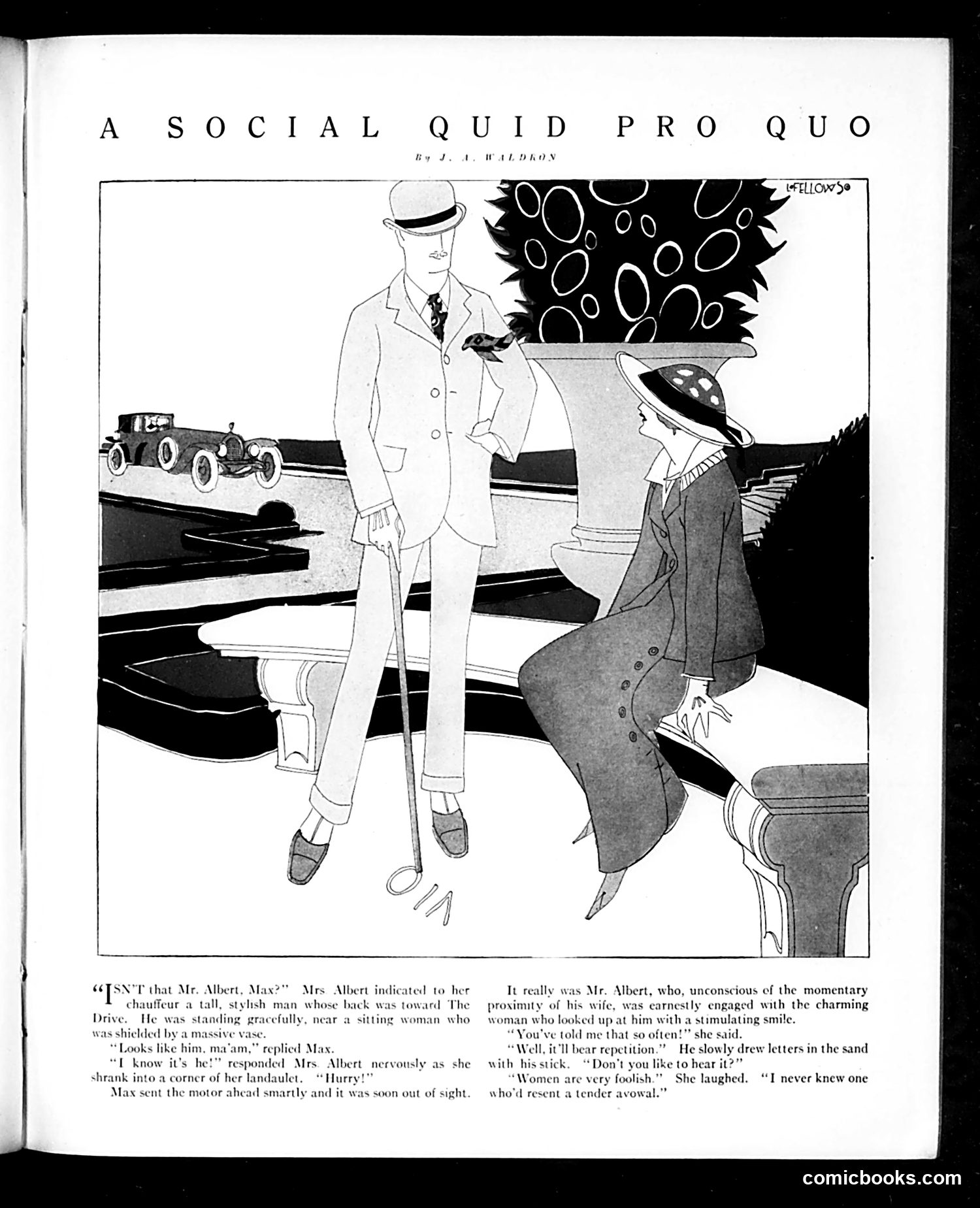
This satirical cartoon mocks marital infidelity and the social hypocrisy of the wealthy. Mrs. Albert spots her husband (Mr. Albert) flirting with another woman near "The Drive"—likely a fashionable public promenade. She orders her chauffeur Max to speed away, avoiding confrontation. The irony is explicit in the title "Quid Pro Quo" (an exchange of favors): Mr. Albert charms his companion by repeatedly telling her "I love you," drawing romantic declarations in sand. She feigns modest resistance ("Women are very foolish"), but accepts his advances—a transactional social dance where flattery and romance are bartered goods. The cartoon satirizes both parties: the husband's casual infidelity, the woman's calculated flirtation, and the wife's complicit silence. It reflects Jazz Age anxieties about morality, gender, and whether romantic declarations held genuine meaning or were merely social currency.
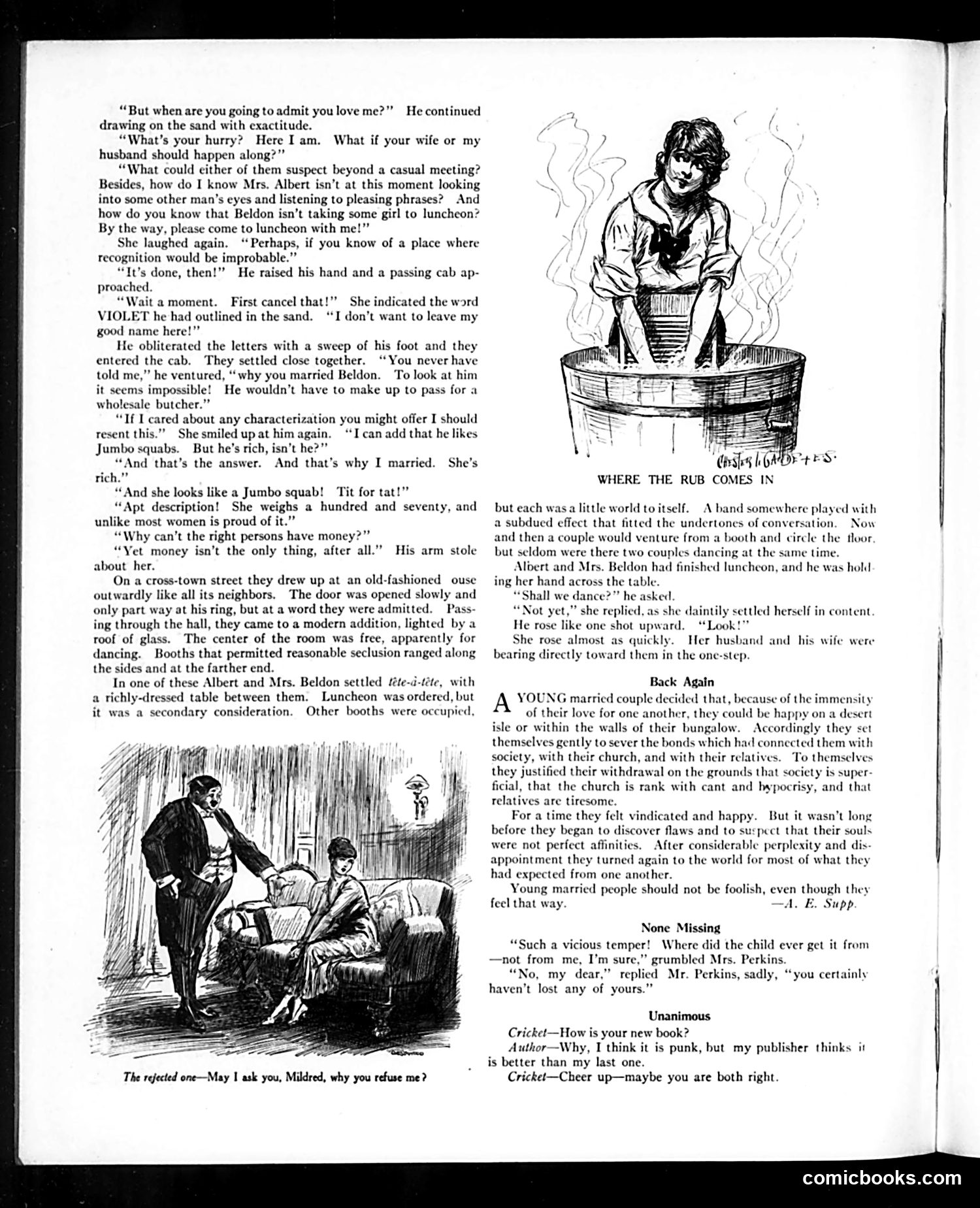
This page satirizes marital infidelity and hypocrisy among the wealthy. The main narrative follows two married people (Albert and Mrs. Beldon) conducting a clandestine affair. The satire centers on their self-deception: they justify meeting secretly by assuming their spouses are similarly unfaithful, then arrange a rendezvous at a discreet establishment designed for such encounters—booths providing "reasonable seclusion" where couples conduct affairs away from society's eyes. The humor lies in their narrow escape when their spouses nearly discover them dancing together. The accompanying story "Back Again" extends the critique, mocking newlyweds who righteously reject society and church as "superficial" and "hypocritical," only to discover their own marriage is flawed. Judge attacks upper-class moral pretense: whether through infidelity or sanctimonious withdrawal from society, the wealthy expose themselves as dishonest and self-serving.
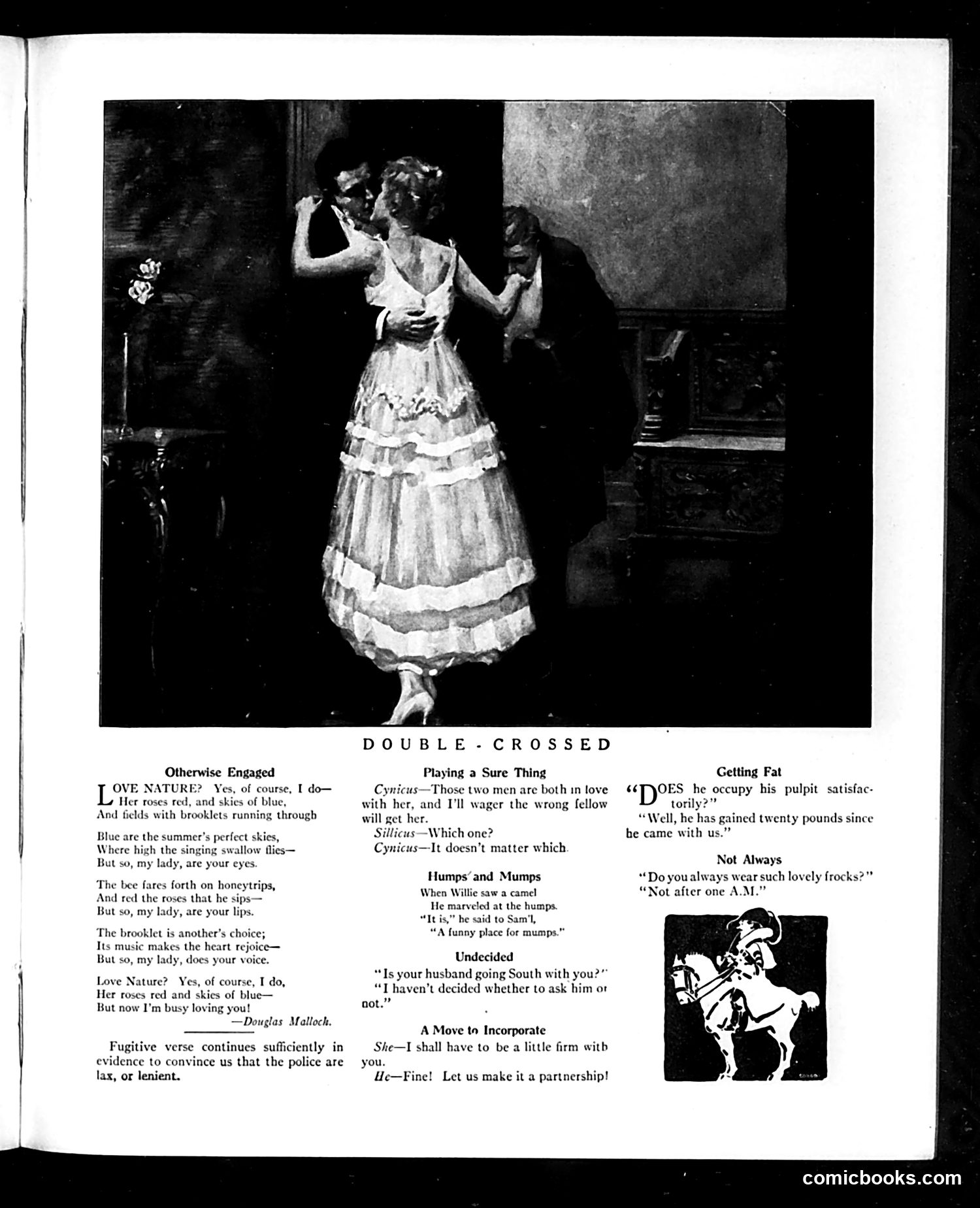
This page contains several brief satirical pieces typical of early 20th-century American humor magazines. **"Otherwise Engaged"** is a romantic poem by Douglas Malloch playfully comparing a woman's features to natural beauty, concluding the speaker prefers loving her to nature itself. **"Double-Crossed"** presents cynical observations about romance and human nature—the "sure thing" joke suggests both rivals will lose to an unworthy third party; other snippets mock marriage uncertainty and weight gain in clergy. **"Humps and Mumps"** is a children's joke playing on a camel's humps and the disease "mumps." **"Getting Fat"** satirizes a minister's weight gain since joining a congregation, implying excessive hospitality or comfortable living has made him less effective. The overall tone reflects Judge's characteristic style: lighthearted mockery of romance, marriage, social pretension, and institutional figures (clergy). The humor targets timeless human foibles rather than specific political events. The small illustration of a woman appears to accompany the romantic verse.
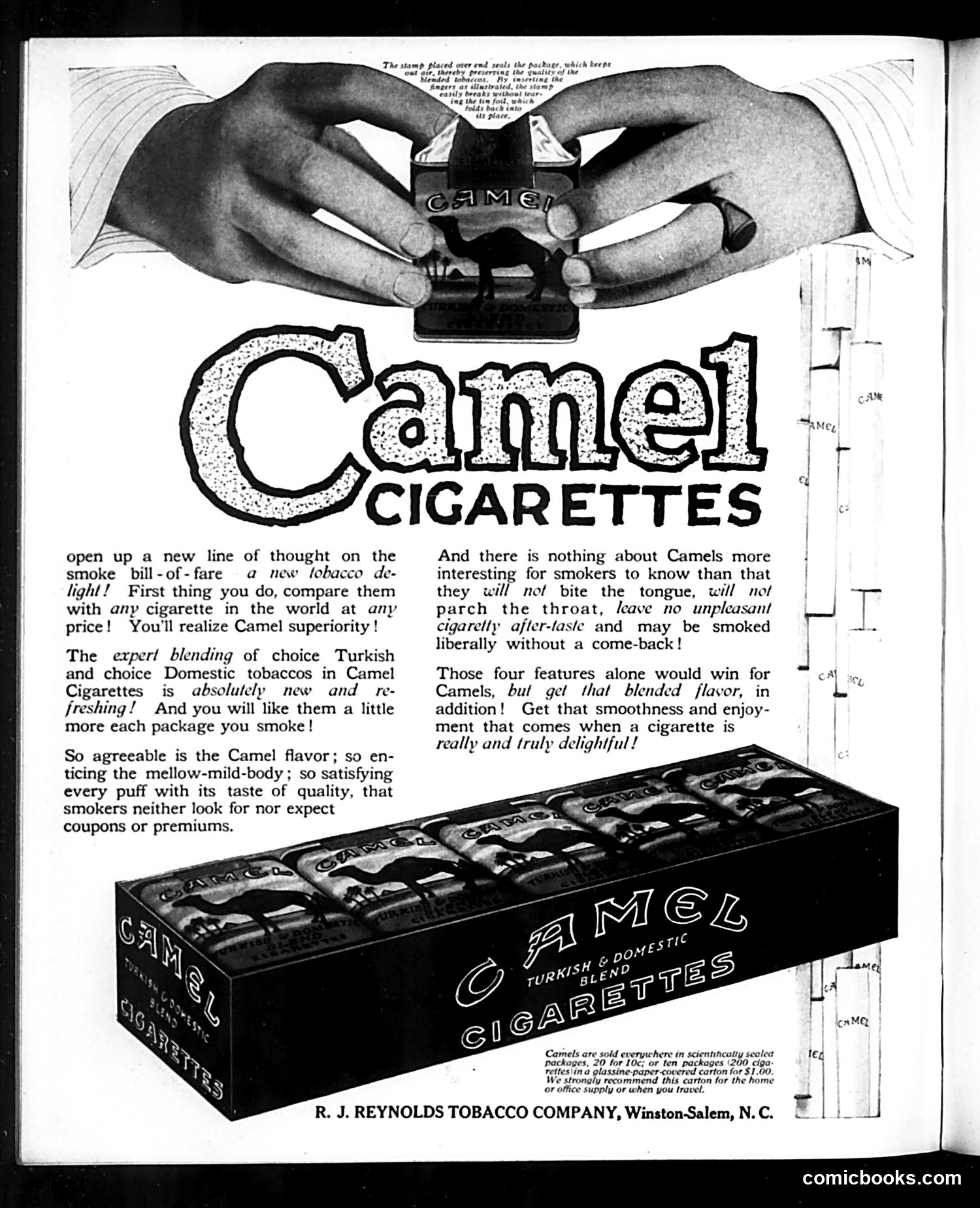
This is **not a cartoon or satire**—it's a straightforward **Camel cigarette advertisement** from Judge magazine. The image shows hands holding a cigarette pack and a product display box. The ad makes specific marketing claims typical of early 20th-century tobacco advertising: Camel's blend of Turkish and domestic tobacco is "absolutely new," won't bite the tongue or parch the throat, has no unpleasant aftertaste, and can be smoked "liberally without a come-back." It emphasizes quality over premiums or coupons. Notably, these claims about health safety—particularly about not irritating the throat or mouth—reflect pre-regulation tobacco marketing when such assertions were unverified and unregulated. The pricing ($1.00 for 200 cigarettes) and packaging details date this to the early 1900s.
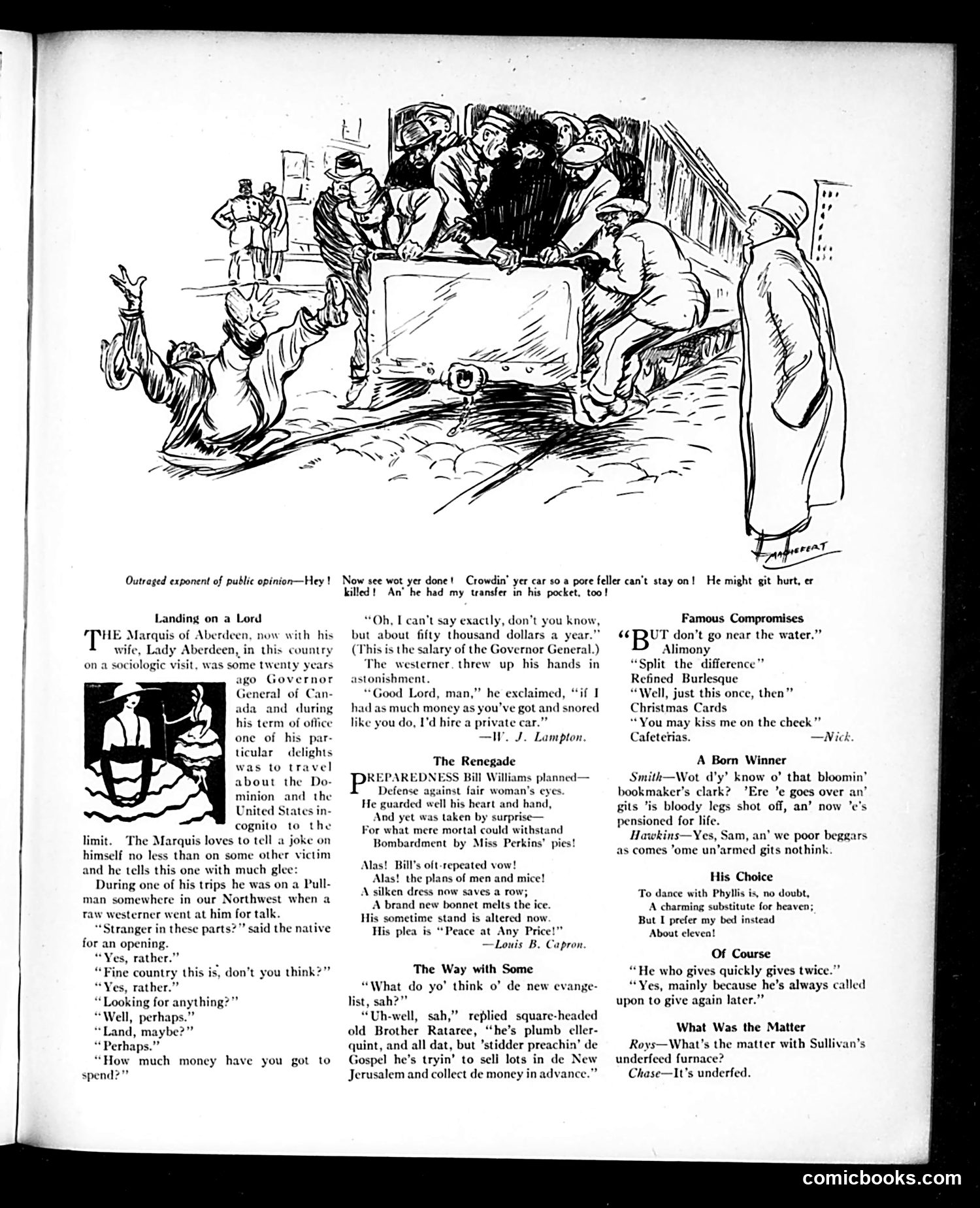
The top cartoon satirizes the Marquis of Aberdeen, a Scottish nobleman visiting North America as Governor General of Canada. The humor lies in his encounter with a blunt American frontier man who, learning the Marquis spends $50,000 yearly, responds with crude practicality: if he had that much money, he'd hire a private car rather than snore in public transport. The satire targets the class gap between European aristocrats and American democratic directness—the "rude" westerner deflates the nobleman's pretensions through honest criticism rather than deference. Below are miscellaneous jokes and short satirical pieces typical of Judge's format, including commentary on evangelists hawking Jerusalem real estate and observations about working-class life. The humor is period-specific, relying on dialect humor and social observations now dated but reflecting early 20th-century attitudes toward class, immigration, and American informality versus Old World formality.
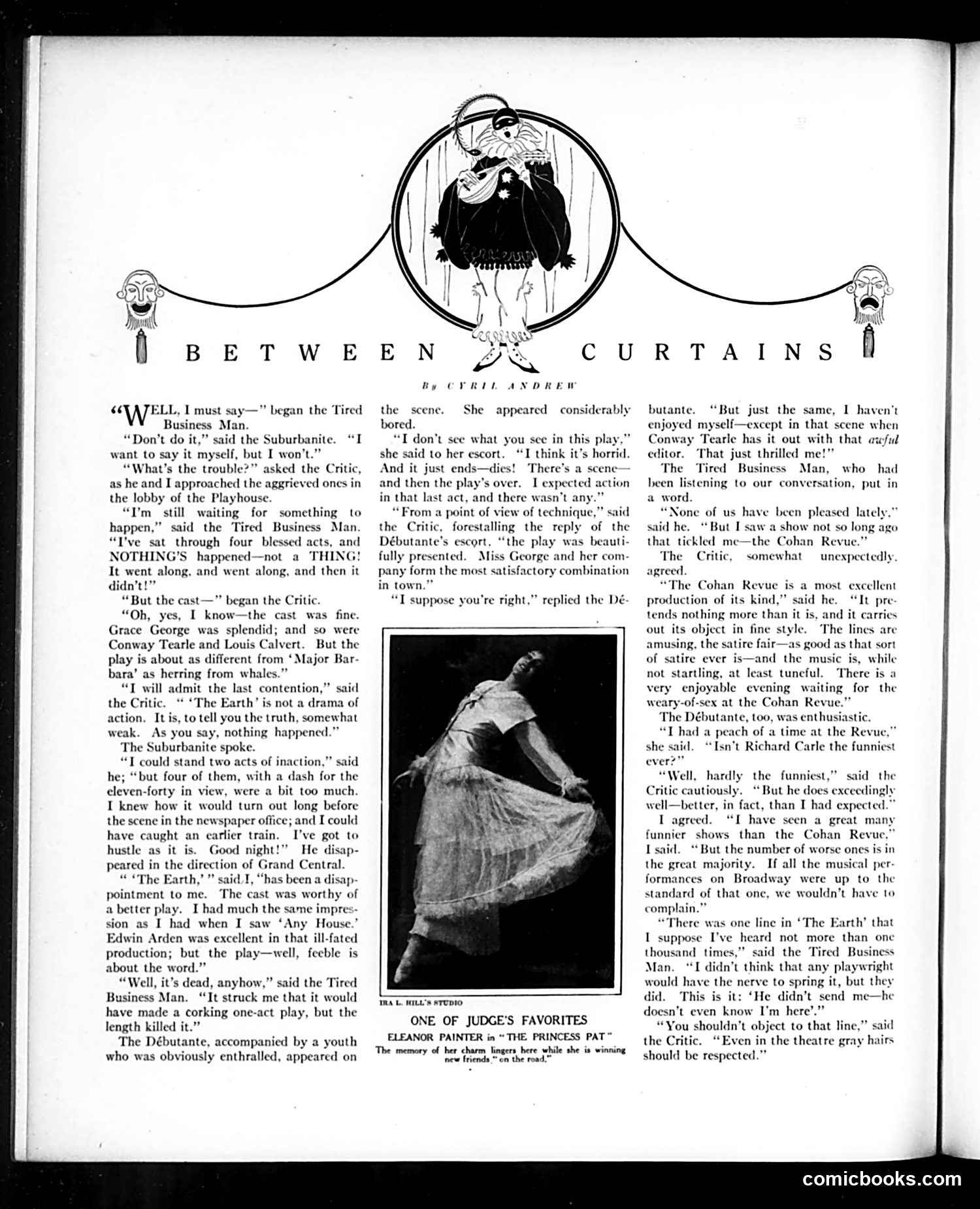
This page from Judge magazine presents a theater criticism discussion among four characters—a Tired Business Man, a Suburbanite, a Critic, and a Débutante—debating Shaw's play "The Earth." **The Satire:** The joke mocks both pretentious theatergoers and mediocre dramatic productions. The Tired Business Man and Suburbanite criticize the play for lacking action across four acts, while the Critic defends its technical merits. Their disagreement illustrates the gap between artistic merit and popular entertainment. **Key References:** Grace George, Conway Tearle, and Louis Calvert were actual prominent stage actors of the era. "The Earth" appears to be a real play being critiqued. The mention of the "Cohan Revue" (likely George M. Cohan's production) represents crowd-pleasing entertainment that contrasts with Shaw's weightier drama. **The Point:** Judge satirizes early 20th-century theater culture—both snobby critics valuing technique over enjoyment, and average audiences wanting spectacle over substance. The accompanying photograph shows Eleanor Painter in "The Princess Pat," adding to the theatrical theme.
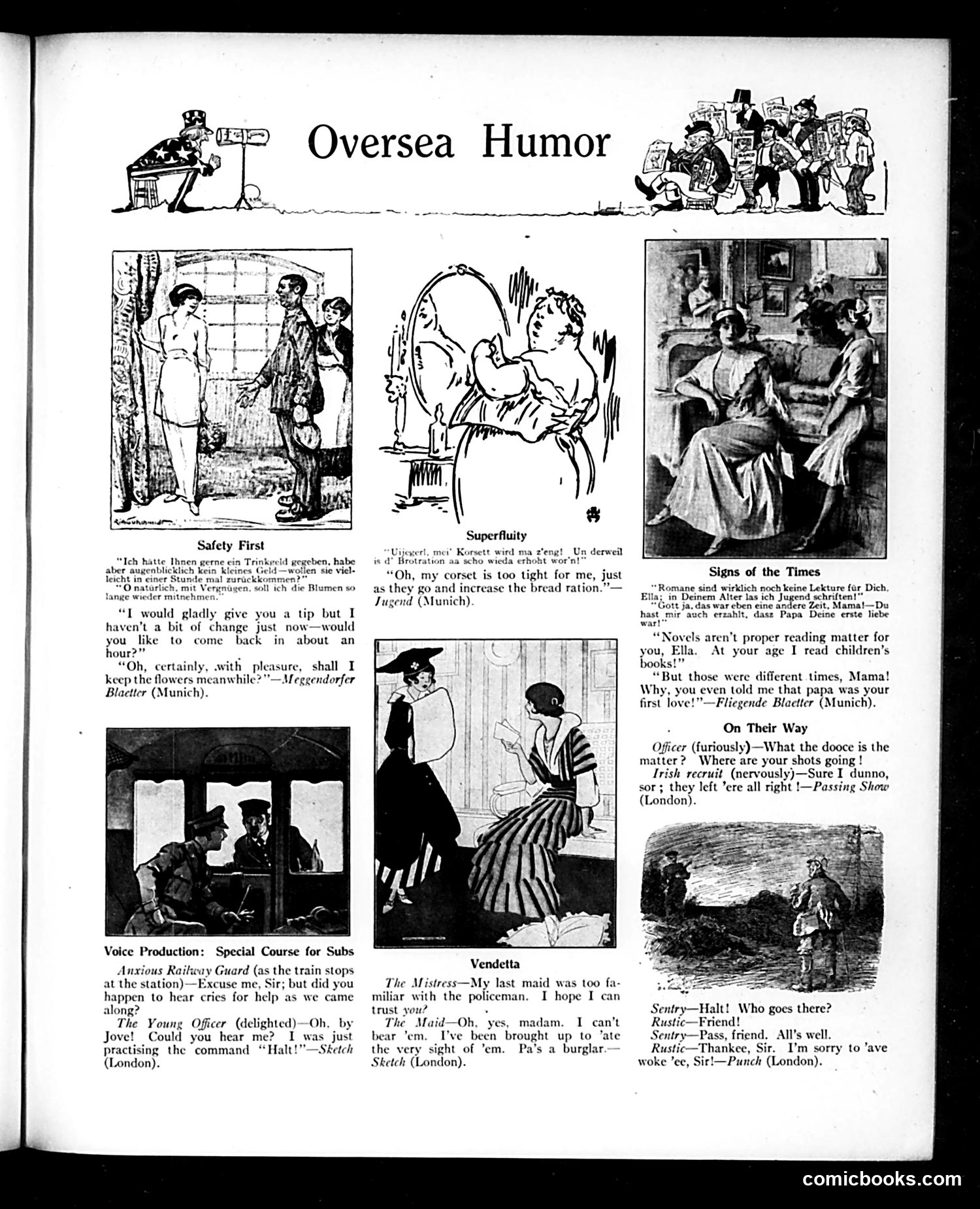
This page collects short humorous anecdotes from European publications, reflecting wartime concerns circa 1914-1918. **Key themes:** - **"Safety First"** and **"Voice Production"**: German and British military humor about soldiers' discipline and communication—likely poking fun at rigid military training. - **"Superfluity"**: A German cartoon mocking rationing contradictions—a woman complains her corset is too tight while authorities increase bread rations, satirizing wartime food shortages and absurd priorities. - **"Vendetta"**: A maid reveals her father is a burglar, comic social commentary on class and criminality. - **"Signs of the Times"**: A mother scolds her daughter for reading "novels" instead of children's books, then admits she read similar material at that age—ironic generational hypocrisy about changing moral standards. - **"On Their Way"**: An Irish recruit's shots go astray; a rural sentry greets a stranger—both mock military incompetence and rustic simplicity. The page satirizes wartime anxieties, class tensions, military absurdity, and changing social norms across Allied nations.
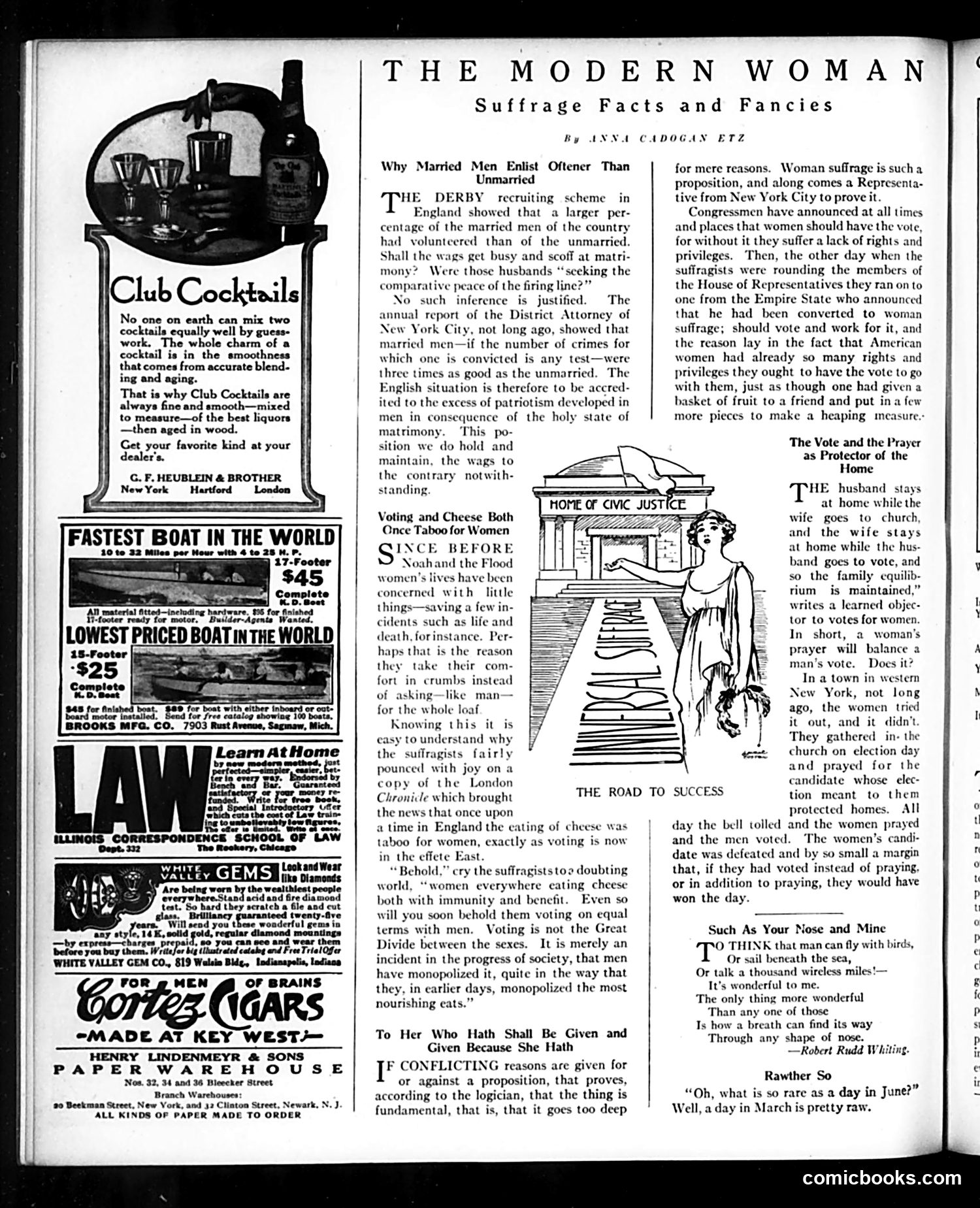
This page from *Judge* magazine presents three satirical arguments against women's suffrage, written by Anna Cadogan Etz. **First argument**: Married men enlisted more readily than unmarried men during the Derby recruiting scheme, supposedly proving matrimony instills patriotism—not that husbands escape unhappy homes. **Second argument**: The suffragists celebrated learning that women once couldn't eat cheese (like voting now), predicting voting rights would follow naturally. The satire mocks this optimism, suggesting women historically accepted smaller roles ("crumbs instead of the whole loaf") and won't suddenly demand equality. **Third argument** (incomplete): A congressman claimed conversion to woman suffrage, though his actual reasoning is cut off mid-sentence—likely suggesting the reasons are contradictory or absurd. The overall satire ridicules suffragists' logic while implicitly questioning women's readiness for political participation. This reflects early 20th-century anti-suffrage sentiment common in conservative publications.
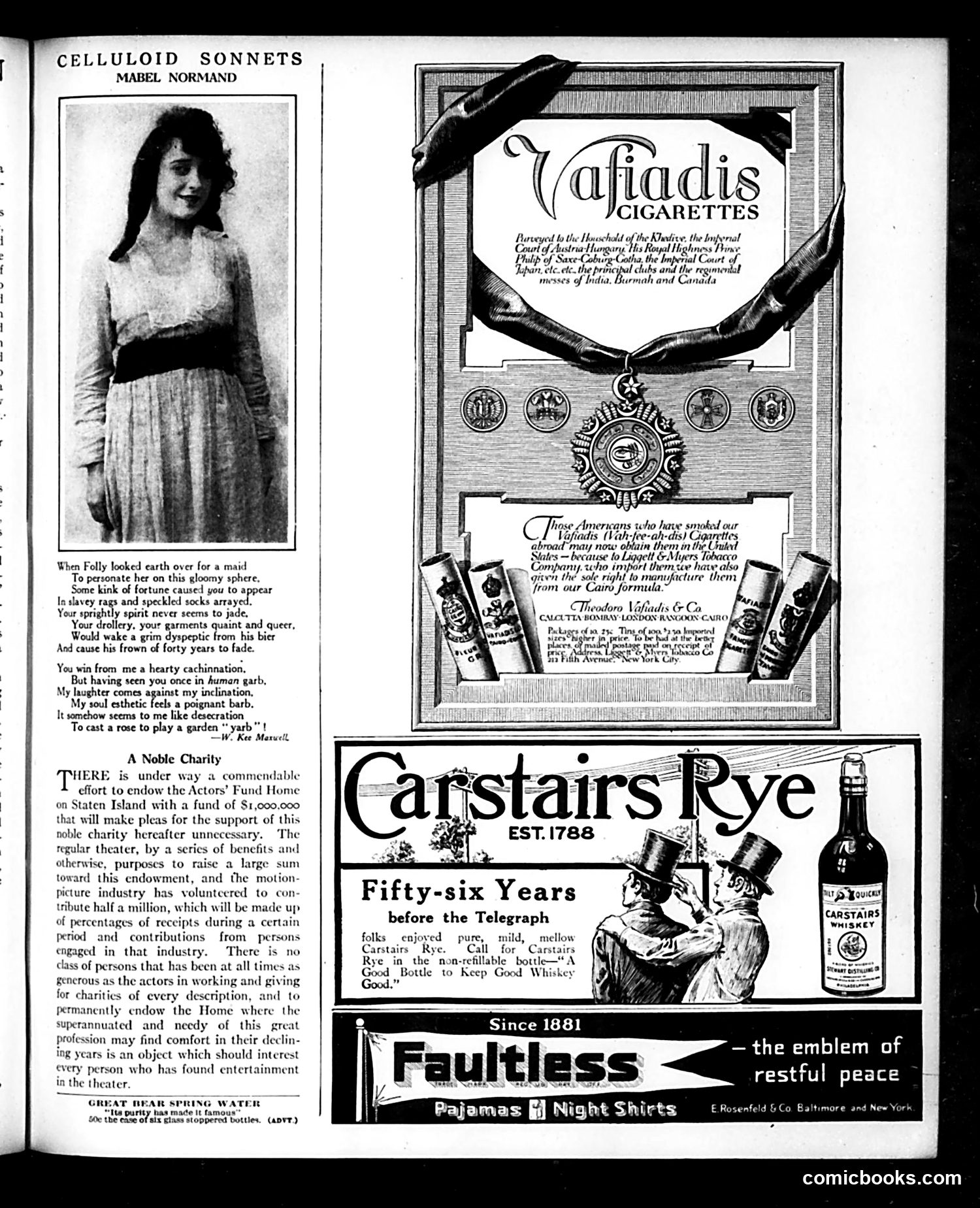
This page primarily features **advertisements and celebrity content** rather than political satire. The "Celluloid Sonnets" section celebrates **Mabel Normand**, a silent film comedian known for slapstick roles in "slavey rags and speckled socks." The poem humorously laments that seeing her in dignified "human garb" ruins the comedic magic—it's like asking a rose to play a common vegetable ("yarb"). This reflects early cinema's rigid typecasting. The main editorial discusses fundraising for the **Actors' Fund Home**, a charitable institution for retired entertainers. It notes the motion-picture industry volunteering half a million dollars—significant for legitimizing the nascent film industry as a respectable profession. The remaining content consists entirely of **product advertisements**: Vafiadis cigarettes (marketed as refined, approved by royalty), Carstairs rye whiskey, Faultless pajamas, and spring water. These high-end brands targeting affluent readers dominated Judge magazine's revenue.
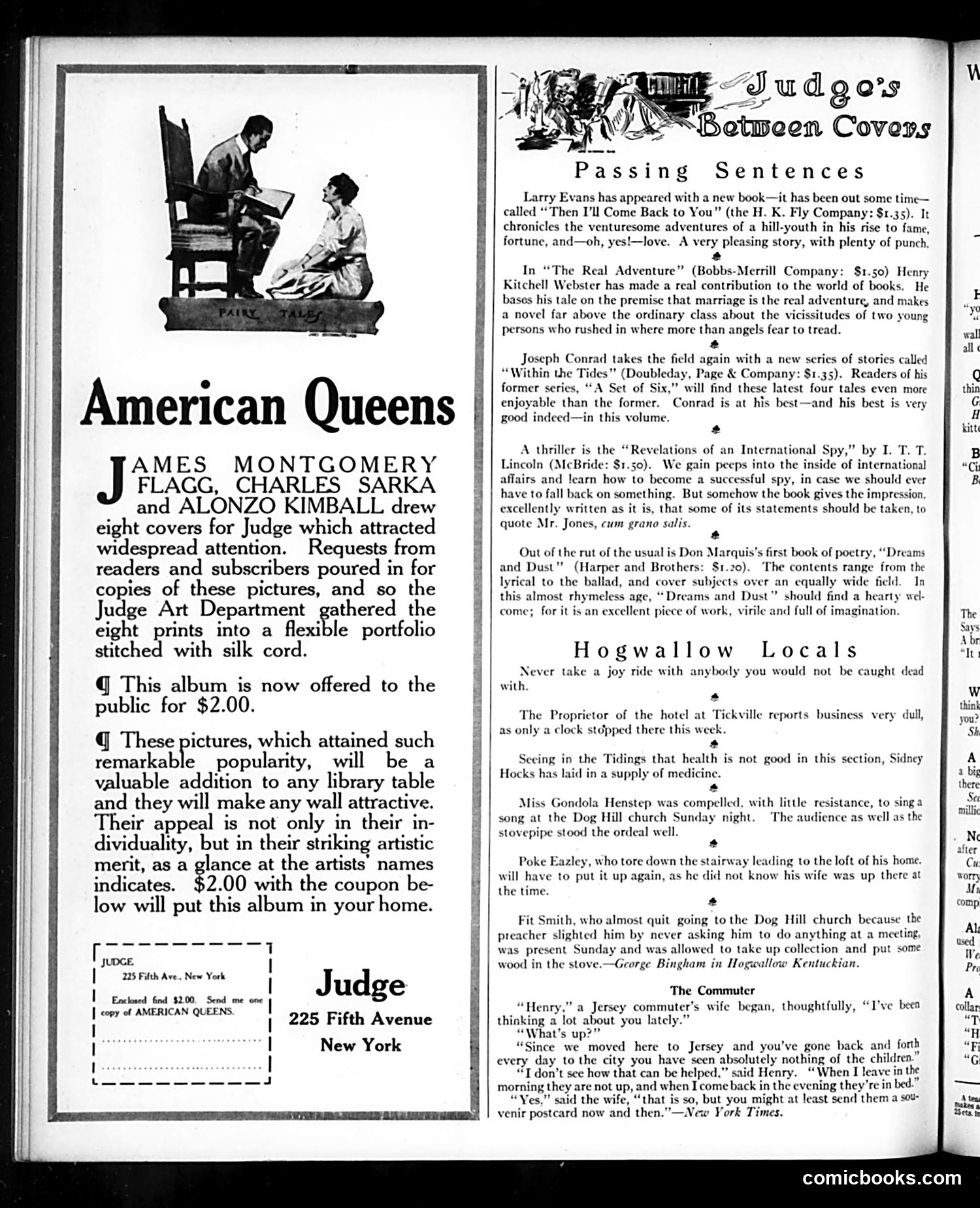
This page is primarily **advertising and book reviews**, not political satire. **Main Content:** The left side advertises "American Queens," a portfolio of eight cover illustrations by prominent Judge artists James Montgomery Flagg, Charles Sarka, and Alonzo Kimball. These covers had generated reader demand, so Judge compiled them into a silk-bound album sold for $2.00. **Right Side:** "Passing Sentences" reviews contemporary books (1910s-era), including works by Larry Evans, Henry Kitchell Webster, Joseph Conrad, and Don Marquis—straightforward literary criticism praising their merit and readability. Below that, "Hogwallow Locals" presents rural humor—brief anecdotes about small-town characters (Miss Gondola Henstep, Poke Eazley, Fit Smith) in a folksy Kentucky setting. These are gentle jokes about provincial life: hotel emptiness, medical ignorance, church dynamics, and domestic mishaps. **No significant political content or caricature** appears on this page. It's primarily commercial and humorous filler typical of Judge's advertising sections.
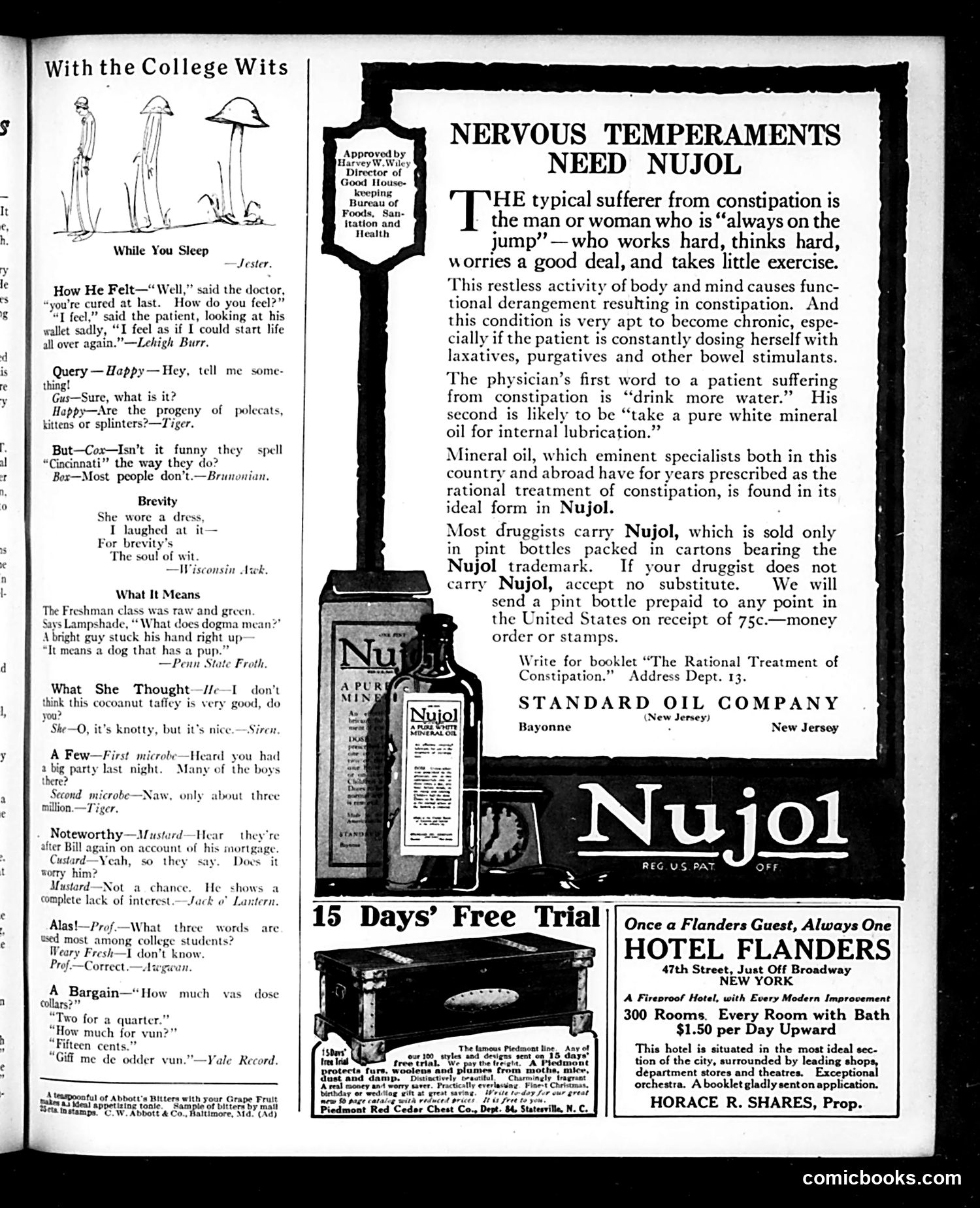
This page contains primarily **college humor and advertisements** rather than political satire. The left column features jokes "With the College Wits"—brief, pun-based humor from college publications (Penn State Froth, Tiger, etc.). These target college students with wordplay: a doctor-patient joke, puns on "Cincinnati's" spelling, and a misheard definition of "dogma" as "a dog that has a pup." The center and right are dominated by a **Nujol mineral oil advertisement** claiming to treat constipation, particularly in "nervous temperaments" of overworked professionals. It emphasizes mineral oil as the physician-approved remedy over harsh laxatives—typical early 20th-century medical marketing. Additional ads include Abbott's Bitters (a stomach tonic) and Hotel Flanders in New York. **The satire here is minimal**—these are light collegiate jokes reflecting college magazine culture of the era, paired with period advertisements. There are no identifiable political figures or social commentary beyond gentle mockery of college student behavior and speech patterns.
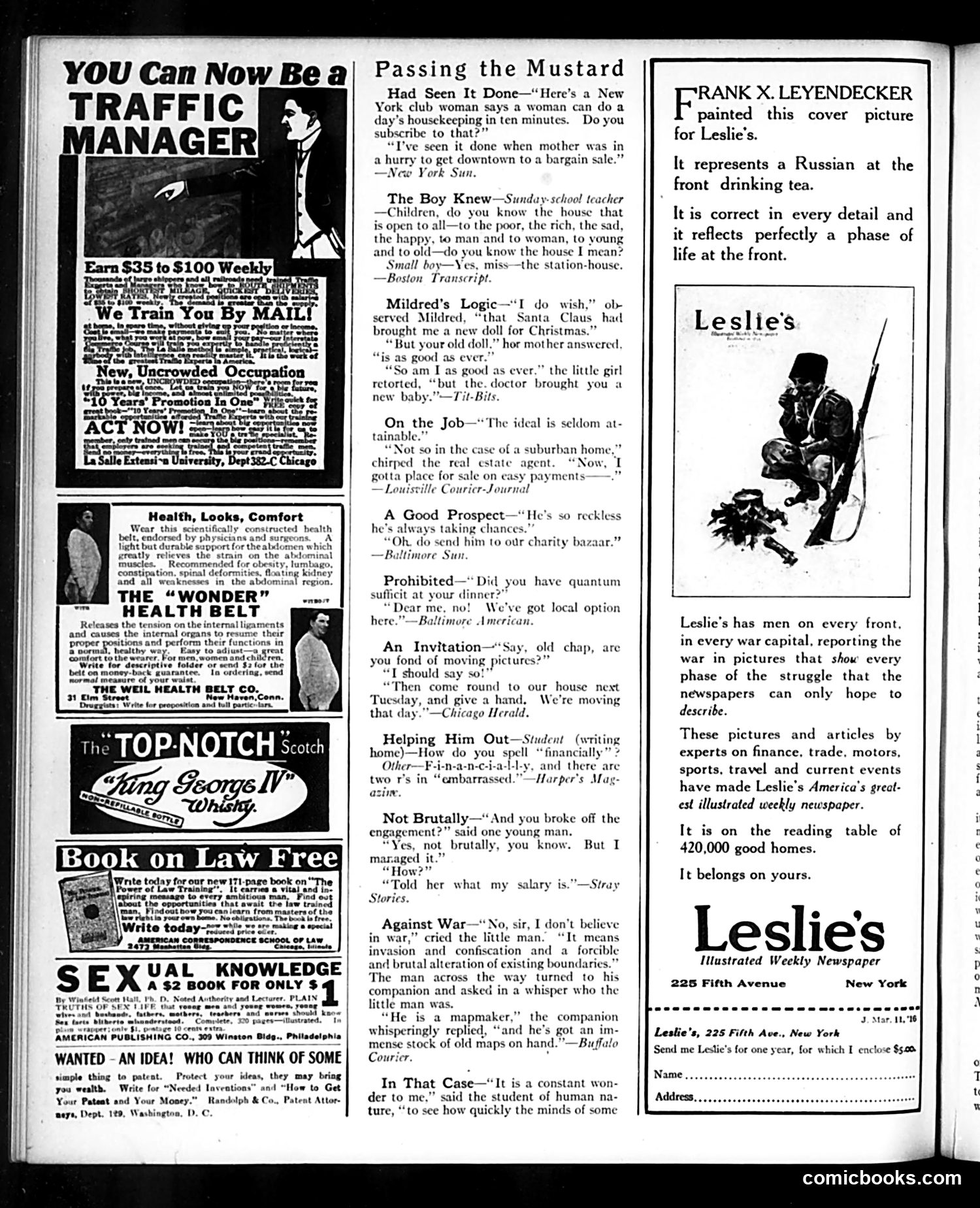
This page is primarily **advertisements and short humorous anecdotes**, not political cartoons. The left side features ads for mail-order courses (traffic manager training), health belts, and patent services—typical early 20th-century periodical fare. The right side contains Leslie's Weekly magazine promotion, featuring a cover illustration by Frank X. Leyendecker depicting a Russian soldier drinking tea at the front. The accompanying text emphasizes Leslie's war reporting capabilities, suggesting this page dates to **World War I era** when such coverage was commercially significant. The center column contains brief comedic "filler" jokes—most are gentle domestic humor about housekeeping, dolls, and courtship misunderstandings. One joke references "local option" (Prohibition-related legislation), dating the page to the 1910s-20s period. There is **no significant political satire** on this page. It's a commercial and entertainment product typical of Judge magazine's mixed-content format during the WWI period.
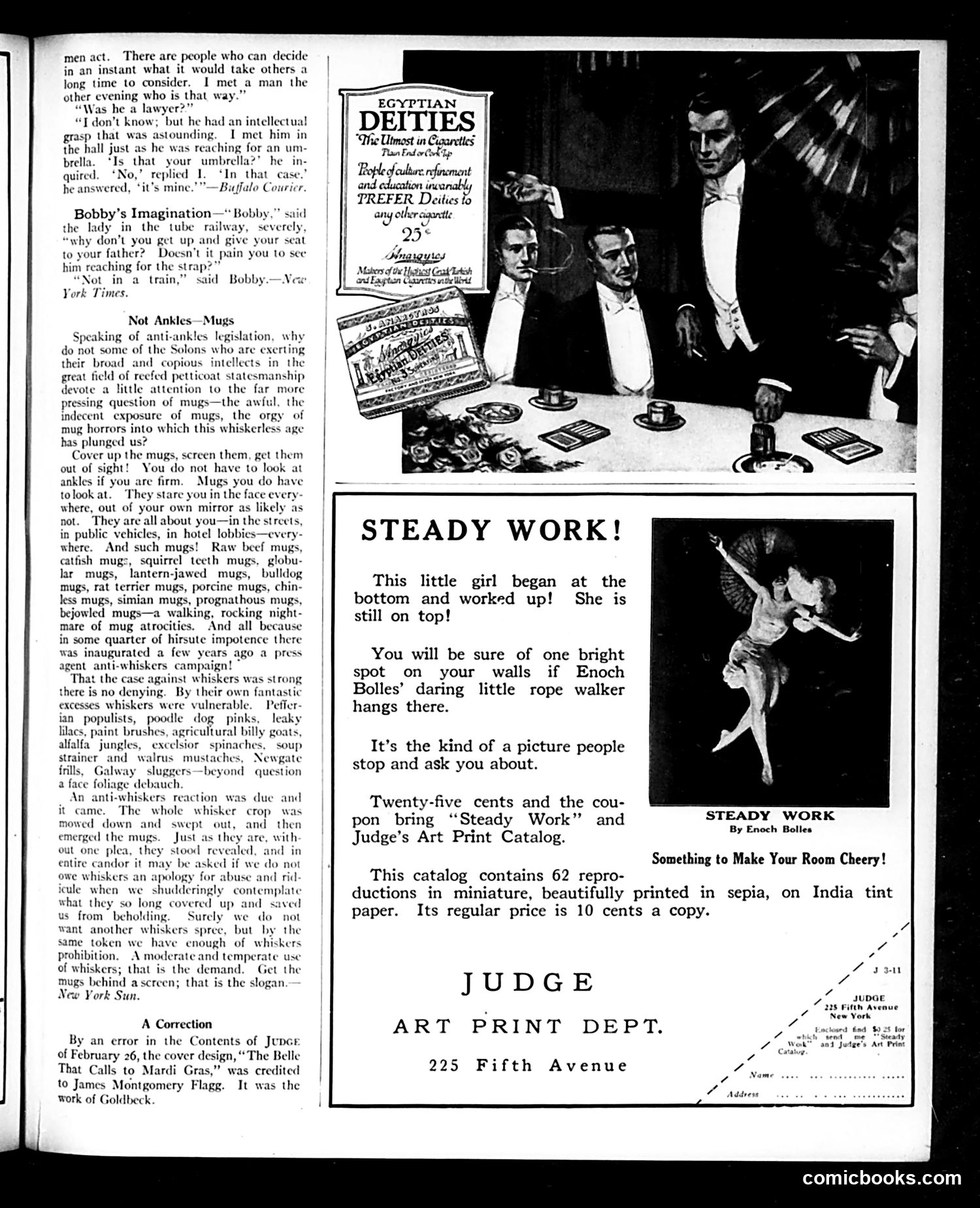
This page combines satirical commentary with advertising. The main satirical piece, "Not Ankles—Mugs," mocks the anti-ankle legislation movement of the era (circa 1910s-1920s when women's hemlines were controversial). The author argues that if legislators want to regulate women's appearance by requiring longer skirts, they should logically address men's faces instead—cataloging absurd facial types (catfish mugs, bulldog mugs, etc.). The satire's point: the anti-ankle crusaders are hypocritical and ridiculous. The piece notes that whiskers were recently abandoned en masse, revealing the "mug atrocities" underneath, and sarcastically suggests screening men's faces rather than policing women's legs. The advertisements (Egyptian Deities cigarettes, Enoch Bolles' "Steady Work" print) are period typical. The image shows what appears to be a séance or fortune-telling scene, likely illustrating one of the magazine's jokes about spiritualism or consumer culture.
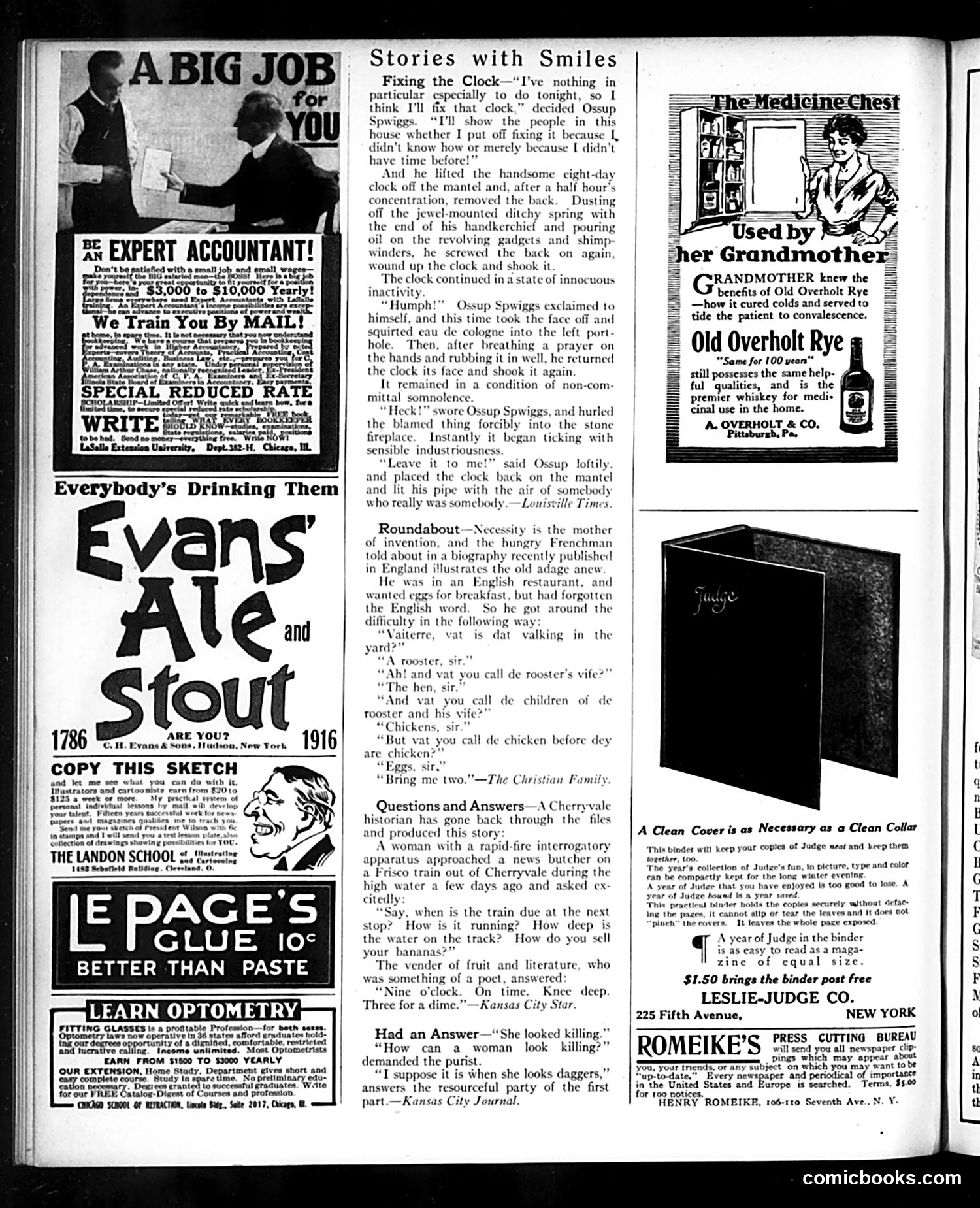
This page primarily contains **humorous short stories and advertisements** rather than political cartoons. The main content is "Stories with Smiles," three anecdotes meant to entertain readers: 1. **"Fixing the Clock"** satirizes amateur handymen—Ossup Swiggs confidently attempts repairs, fails repeatedly, then throws the clock into a fireplace where it mysteriously starts working. 2. **"Roundabout"** jokes about a Frenchman struggling with English vocabulary for eggs, solved through absurdist wordplay about roosters and their offspring. 3. **"Questions and Answers"** depicts a rapid-fire woman pestering a train vendor with questions; he deflects poetically. The page also features **period advertisements**: accounting courses, Evans Ale & Stout (celebrating 130 years), Le Page's Glue, optometry training, and Old Overholt Rye whiskey (marketed as medicinal). **For modern readers**: These are gentle domestic humor and advertising typical of early-20th-century magazines. No specific political satire is evident on this page—it's entertainment-focused content.
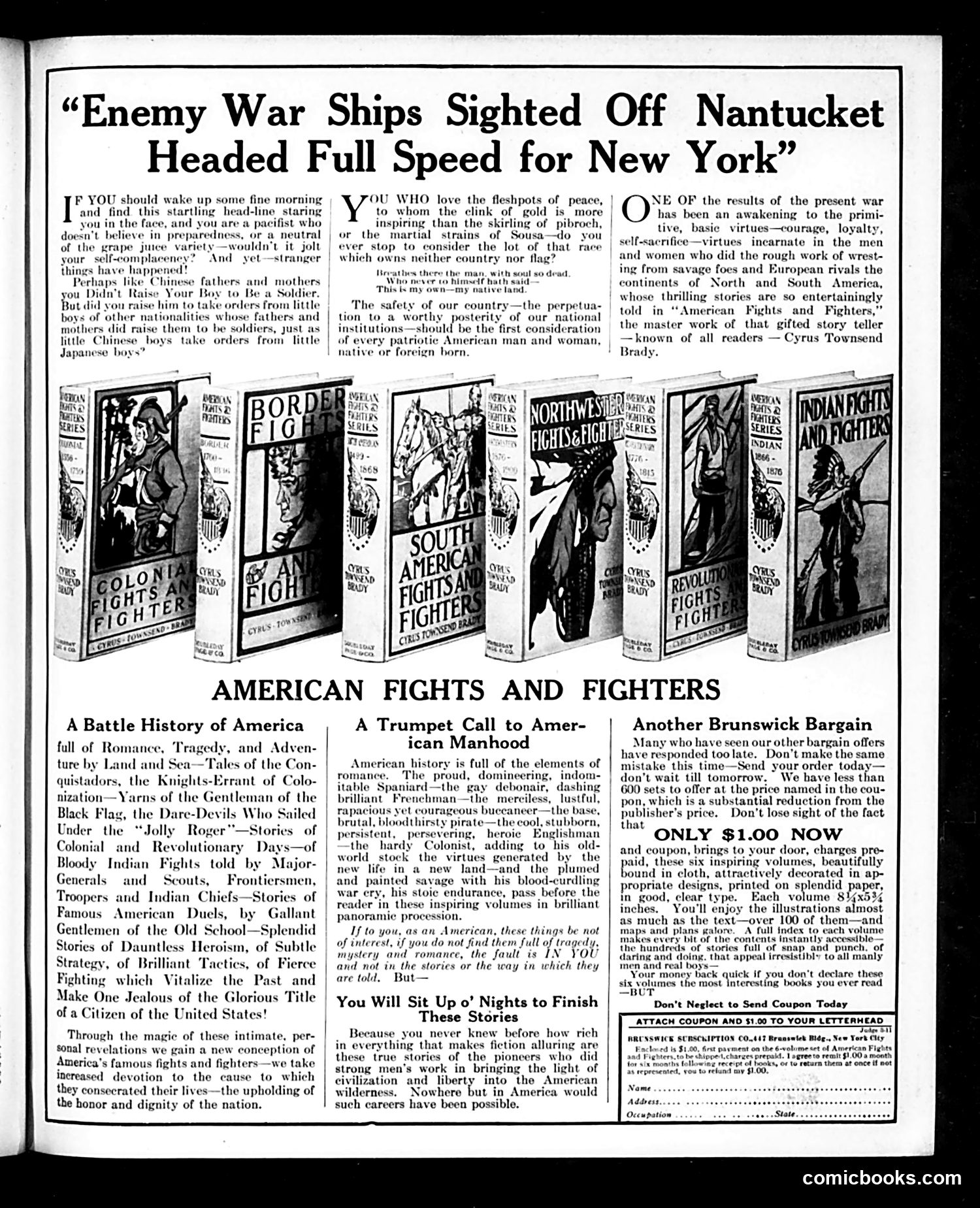
This page combines a sensational news headline with advertising for a book series called "American Fights and Fighters." The headline—"Enemy War Ships Sighted Off Nantucket Headed Full Speed for New York"—appears designed to startle readers, likely referencing WWI anxieties about German naval attacks on American coasts. The editorial content uses this war scare to appeal to patriotism and masculinity, shaming readers (particularly parents) who might not support military preparedness. It questions whether Americans raised their sons to be soldiers or to take "orders from little boys of [other] nationalities." The accompanying book advertisement exploits these same patriotic fears, marketing historical tales of American frontier heroes, colonial fighters, and military exploits. It frames reading these stories as a patriotic duty that will instill "devotion to the cause" of national honor. Together, the content weaponizes wartime anxiety to sell both nationalist ideology and commercial products—a sophisticated propaganda-advertisement hybrid typical of WWI-era publications.
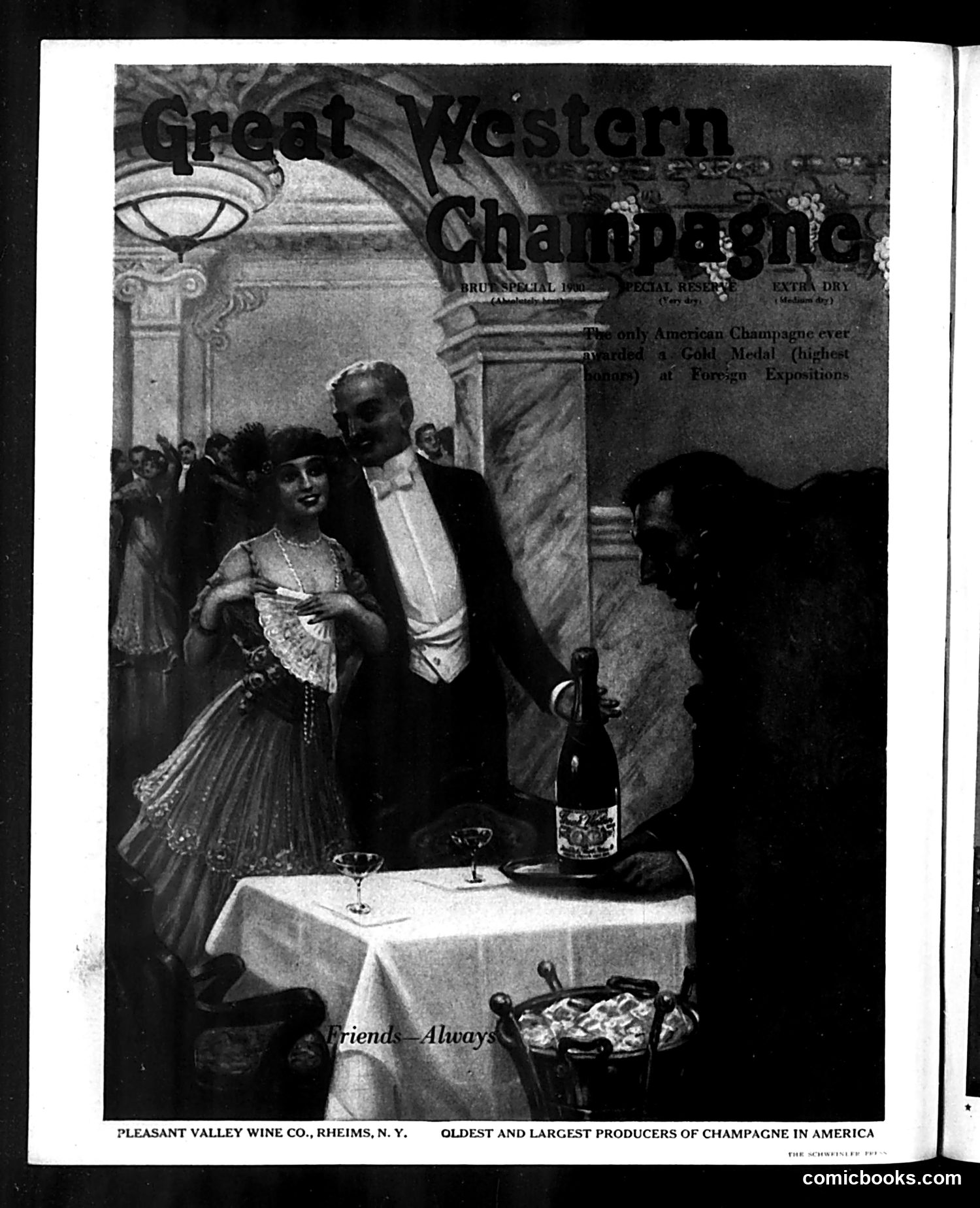
This appears to be a **champagne advertisement** rather than political satire. The page shows an elegant indoor scene with well-dressed figures—a woman in a decorative dress, a man in formal attire with a bow tie, and other guests—gathered around a table with champagne and food. The headline "Great Western Champagne" and text mentioning it as "The only American Champagne ever [winning] 3 Gold Medal (highest honors) at Foreign Expositions" suggests this is promotional material emphasizing American champagne's international prestige. The tagline "Friends—Always" indicates the ad's aspirational messaging: champagne as a marker of refinement and social status. **Context for modern readers:** This reflects the pre-Prohibition era when American champagne production was a point of national pride. The advertisement targets affluent consumers by associating the product with elegance, sophistication, and social standing.