
Judge, 1916-03-11 · page 12 of 28
Judge — March 11, 1916 — page 12: what you’re looking at
What you’re looking at
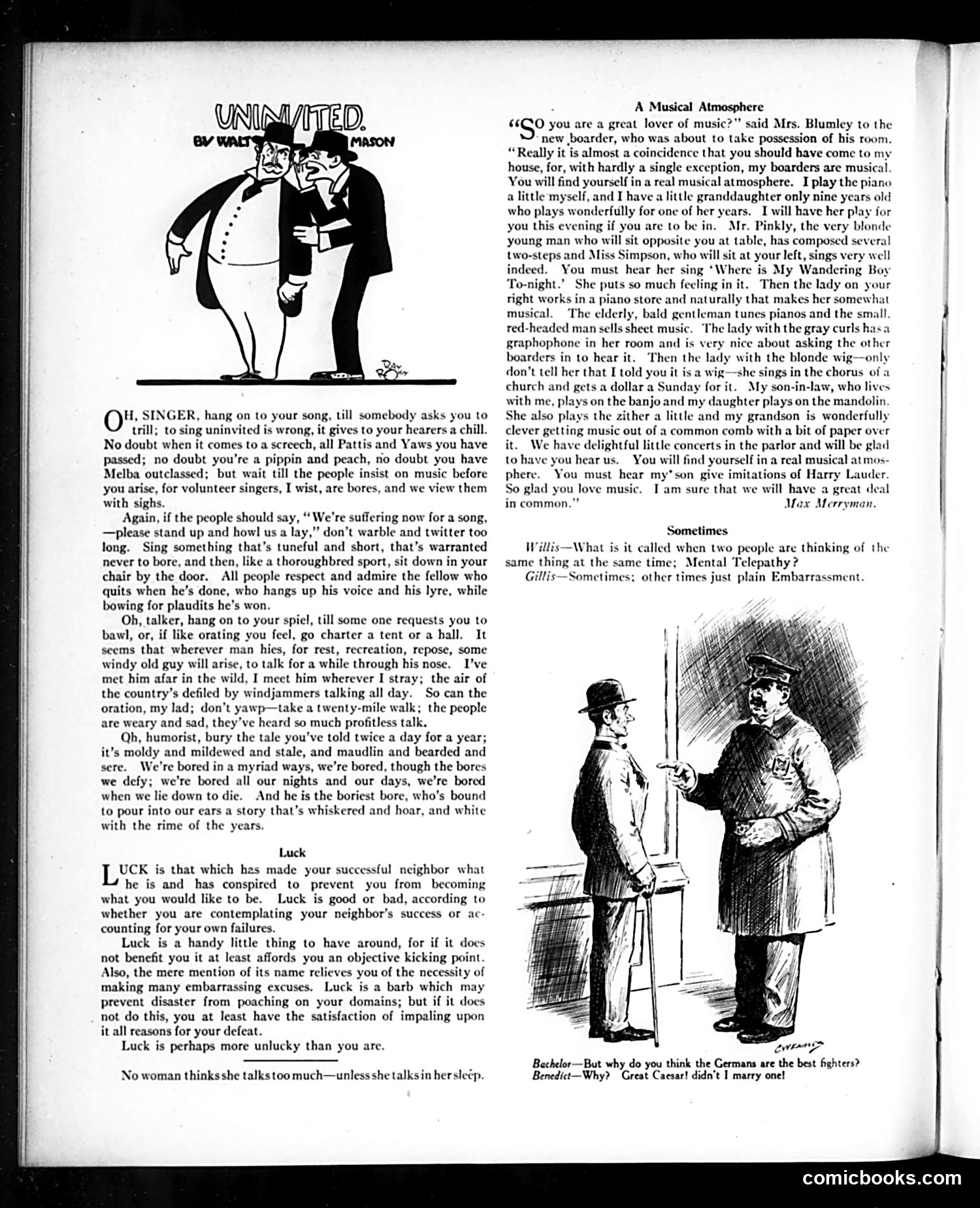
This Judge magazine page contains social satire targeting annoying social behaviors. The main articles mock uninvited singers, long-winded talkers, and repetitive jokesters who bore their audiences—advising them to know when to quit. The humor warns against imposing unwanted entertainment on captive audiences ("All people respect and admire the fellow who quits when he's done"). The cartoon titled "A Musical Atmosphere" satirizes a landlady who boasts that virtually all her boarders are musicians, describing their various musical roles (piano player, composer, singer, piano-store worker, piano tuner, sheet-music seller). The joke is that she's created an inescapably music-saturated boarding house—illustrating the article's theme about forced, unwanted entertainment. The accompanying illustration shows two men, with one asking why Germans make the best fighters, implying a separate joke about military prowess, likely reflecting early 20th-century attitudes.
📄 Transcribed text from this page (OCR, searchable)
Machine-transcribed from the original scan — historical spelling and the odd misread are preserved.
trill; to sing uninvited is wrong, it gives to your hearers a chill. No doubt when it comes to a screech, all Pattis and Yaws you have passed; no doubt you’re a pippin and peach, no doubt you have Melba outclassed; but wait till the people insist on music before you arise, for volunteer singers, I wist, are bores, and we view them with sighs. Again, if the people should say, “ We're suffering now for a song, —please stand up and howl us a lay,” don’t warble and twitter too long. Sing something that’s tuneful and short, that’s warranted never to bore, and then, like a thoroughbred sport, sit down in your chair by the door. All people respect and admire the fellow who quits when he’s done, who hangs up his voice and his lyre, while bowing for plaudits he’s won. Oh, talker, hang on to your spiel, till some one requests you to bawl, or, if like orating you feel, go charter a tent or a hall. It seems that wherever man hies, for rest, recreation, repose, some windy old guy will arise, to talk for a while through his nose. I’ve met him afar in the wild, I meet him wherever I stray; the air of the country’s defiled by windjammers talking all day. So can the oration, my lad; don’t yawp—take a twenty-mile walk; the people are weary and sad, they’ve heard so much profitless talk. Qh, humorist, bury the tale you've told twice a day for a year; it’s moldy and mildewed and stale, and maudlin and bearded and sere. We're bored in a myriad ways, we're bored, though the bores we defy; we’re bored all our nights and our days, we’re bored when we lie down to die. And he is the boriest bore, who’s bound to pour into our ears a story that’s whiskered and hoar, and white with the rime of the years. Luck L&ck is that which hes made your successful neighbor what he is and has conspired to prevent you from becoming what you would like to be. Luck is good or bad, according to whether you are contemplating your neighbor’s success or ac- counting for your own failures. Luck is a handy little thing to have around, for if it does not benefit you it at least affords you an objective kicking point. Also, the mere mention of its name relieves you of the necessity of making many embarrassing excuses. Luck is a barb which may prevent disaster from poaching on your domains; but if it does not do this, you at least have the satisfaction of impaling upon it all reasons for your defeat. Luck is perhaps more unlucky than you are. No woman thinks she talks too much—unless she talksin her sleep. 2 A Musical Atmosphere 66QO you are a great lover of music?” said Mrs. Blumley to the new ,boarder, who was about to take possession of his room. “Really it is almost a coincidence that you should have come to my house, for, with hardly a single exception, my boarders are musical You will find yourself in a real musical atmosphere. I play the piano a little myself, and I have a little granddaughter only nine years old who plays wonderfully for one of her years. I will have her play for you this evening if you are to be in. Mr. Pinkly, the very blonde young man who will sit opposite you at table, has composed several two-steps and Miss Simpson, who will sit at your left, sings very well indeed. You must hear her sing ‘Where is My Wandering Boy To-night.’ She puts so much feeling in it. Then the lady on your right works in a piano store and naturally that makes her somewhat musical. The elderly, bald gentleman tunes pianos and the small. red-headed man sells sheet music. The lady with the gray curls has a graphophone in her room and is y nice about asking the other boarders in to hear it. Then the lady with the blonde wig—only don’t tell her that I told you it is a wig—she sings in the chorus of a church and gets a dollar a Sunday for it. My son-in-law, who lives on the banjo and my daughter plays on the mandolin the zither a little and my grandson is wonderfully gi We have delightful little concerts in the parlor and will be to have you hear us. You will find yourself ina real musical atm< phere. You must hear my*son give imitations of Harry Lauder. So glad you love music. Tam sure that we will have a great deal in common.” Max Merryman, Sometimes Willis—What is it called when two people are thinking of the same thing at the same time; Mental Telepathy? Gillis—Sometimes; other times just plain Embarrassment. CW Bachelor—But why do you think the Germans are the best fighters? Benedict—Why? Great Caesar! didn’t I marry one! comicbooks.com