
Judge, 1916-03-11 · page 18 of 28
Judge — March 11, 1916 — page 18: what you’re looking at
What you’re looking at
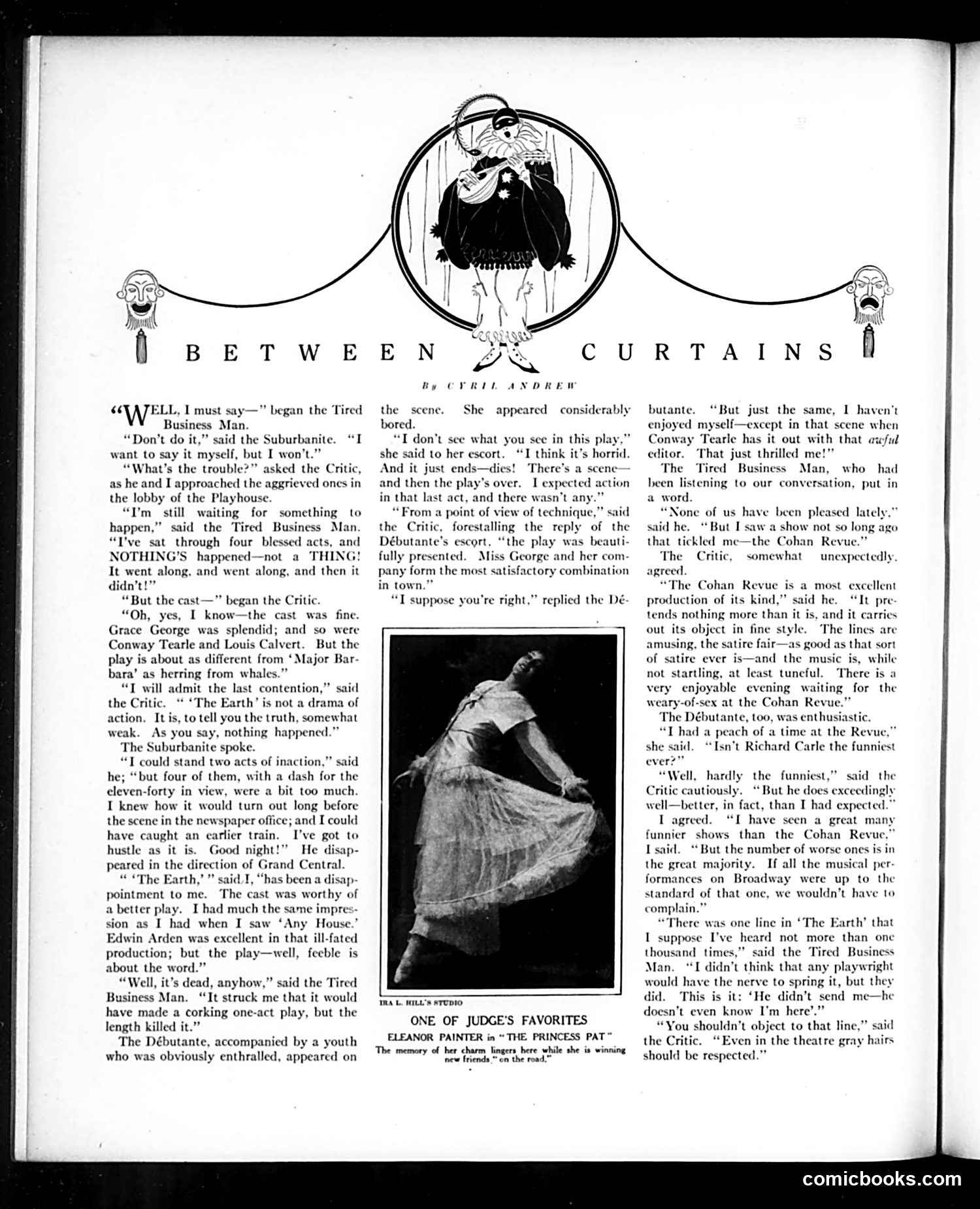
This page from Judge magazine presents a theater criticism discussion among four characters—a Tired Business Man, a Suburbanite, a Critic, and a Débutante—debating Shaw's play "The Earth." **The Satire:** The joke mocks both pretentious theatergoers and mediocre dramatic productions. The Tired Business Man and Suburbanite criticize the play for lacking action across four acts, while the Critic defends its technical merits. Their disagreement illustrates the gap between artistic merit and popular entertainment. **Key References:** Grace George, Conway Tearle, and Louis Calvert were actual prominent stage actors of the era. "The Earth" appears to be a real play being critiqued. The mention of the "Cohan Revue" (likely George M. Cohan's production) represents crowd-pleasing entertainment that contrasts with Shaw's weightier drama. **The Point:** Judge satirizes early 20th-century theater culture—both snobby critics valuing technique over enjoyment, and average audiences wanting spectacle over substance. The accompanying photograph shows Eleanor Painter in "The Princess Pat," adding to the theatrical theme.
📄 Transcribed text from this page (OCR, searchable)
Machine-transcribed from the original scan — historical spelling and the odd misread are preserved.
“ SLL, I must say—” began the Tired Business Man. “Don’t do it,” said the Suburbanite. “I want to say it myself, but I won't “What's the trouble? ked the Critic, as he and I approached the aggrieved ones in the lobby of the Playhouse. “I’m still waiting for something to happen,” said the Tired Business Man. “T've sat through four blessed acts, and NOTHING'S happened—not a THING It went along, and went along, and then it didn’t!” But the cast—" began the Critic. “Oh, yes, I know—the cast was fine. Grace George was splendid; and so were Conway Tearle and Louis Calvert. But the play is about as different from ‘Major Bar- bara’ as herring from whal “T will admit the last contention,” said the Cri “ «The Earth’ is not a drama of action. It is, to tell you the truth, somewhat weak. As you say, nothing happened. The Suburbanite spoke. “T could stand two acts of inaction,” said he; “but four of them, with a dash for the eleven-forty in view, were a bit too much. I knew how it would turn out long before the scene in the newspaper office; and I could have caught an carlier train. I’ve got to hustle as it is. Good night!” He disap- peared in the direction of Grand Central. “ The Earth,’ ” said I, “has been a disa, pointment to me. The cast was worthy of a better pl. I had much the same impre: sion as I had when I saw ‘Any House Edwin Arden was excellent in that ill-fated production; but the play—well, feeble is about the word.” “Well, it’s dead, anyhow,” said the Tired Business Man. “It struck me that it would have made a corking one-act play, but the length killed it.” The Débutante, accompanied by a youth who was obviously enthralled, appeared on CURTAINS CYRIL ANDREW the scene. She appeared considerably bored. “I don’t sce what you see in this play, she said to her escort. “I think it’s horrid. And it just ends—dies! There’s a scene and then the pla I expected action in that last act, and there wasn’t any.” “From a point of view of technique,” said the Critic, forestalling the reply of the Débutante’s escort, “the play was beauti- fully presented. Miss George and her com- pany form the most satisfactory combination in town.” “T suppose you're right,” replied the Dé 's OV TRA L. HILL'S ATUDIO ONE OF JUDGE'S FAVORITES ELEANOR PAINTER in “THE PRINCESS PAT” The memory of her charm lingers here while she is winning new friends "on the road.” “But just the same, I haven't 1 myself—except in that scene when Conway Tearle has it out with that awful editor. That just thrilled me The Tired Business Man, been listening to our conv a word. “None of us have been pleased lately.” said he. ‘But I saw a show not so long ago that tickled me—the Cohan Revue.” The Cri somewhat — unexpectedly agreed. he Cohan Revue is a most excellent production of its kind,” said he. “It pre tends nothing more than it is, and it carries out its object in fine style, The lines are amusing, the satire fair—as good as that sort of satire ever is—and the music is, while not startling, at least tuneful. There i: enjoyable evening waiting for the ry-of-sex at the Cohan Revue. The Débutante, too, was enthusiastic. “Thad a peach of a time at the Revue,” “Isn't Richard Carle the funniest who had ion, put in she said. ever? Well, hardly the funniest,” said the Critic cautiously.“ But he does exceedingly well—better, in fact, than I had expected.” I agreed. “I have seen a great many funnier shows than the Cohan Revue. I said. “But the number of worse ones is in the great majority. If all the musical per- formances on Broadway were up to the standard of that one, we wouldn’t have to complain.” “There was one line in ‘The Earth’ that I suppose I’ve heard not more than one thousand times,” said the Tired Business Man. “I didn’t think that any playwright would have the nerve to spring it, but they did. This is it: ‘He didn’t send me—he doesn’t even know I'm here’. “You shouldn’t object to that line,” said the Critic. “Even in the theatre gray hairs should be respected.” comicbooks.com