
Judge, 1916-03-11 · page 7 of 28
Judge — March 11, 1916 — page 7: what you’re looking at
What you’re looking at
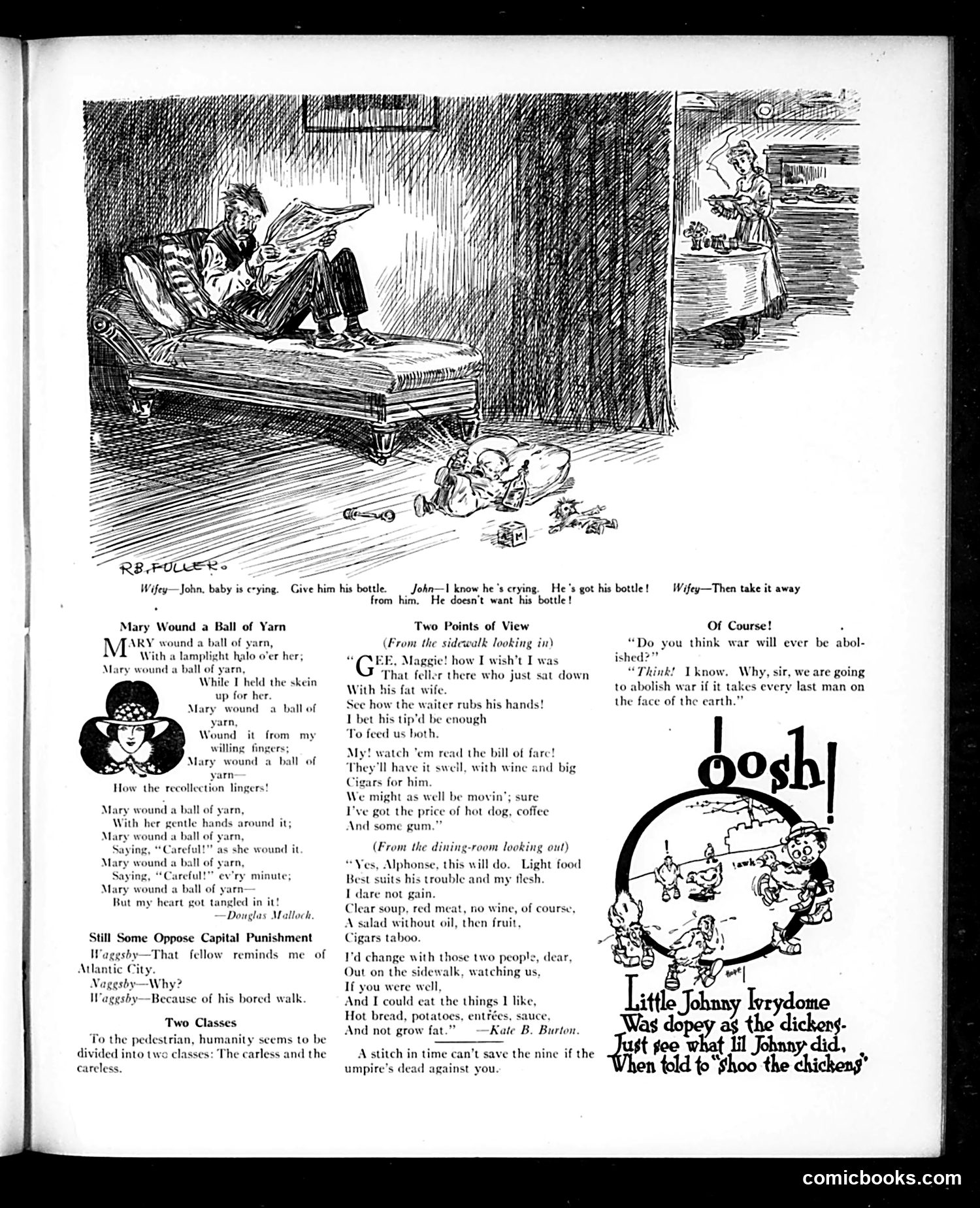
This page contains several satirical pieces reflecting early 20th-century concerns: **Top cartoon**: Shows a domestic scene where a husband on a sofa ignores a crying baby while reading, and the wife must remind him to provide the bottle. The satire mocks paternal irresponsibility and gender dynamics—the implication being fathers were expected to help but often shirked duties. **"Two Points of View"**: Contrasts the perspectives of poor people outside a restaurant (envying the diners' apparent affluence and food) with the wealthy diners inside (who actually eat sparingly due to health/vanity concerns). The satire critiques both class inequality and the irony that money doesn't guarantee happiness or satisfaction. **"Of Course!"**: A brief exchange mocking militaristic fervor, suggesting war will be "abolished" only when every man is dead—cynical commentary on warfare and jingoism. The page also includes sentimental poetry ("Mary Wound a Ball of Yarn") and lighter humor pieces. Overall, it reflects Judge's trademark blend of domestic comedy, class commentary, and antiwar sentiment typical of the era.
📄 Transcribed text from this page (OCR, searchable)
Machine-transcribed from the original scan — historical spelling and the odd misread are preserved.
Wifey—John, baby is crying. Give him his bottle. Mary Wound a Ball of Yarn MESk¥ wound a ball of yarn, With a lamplight halo o'er her; Mary wound a ball of yarn, While I held the skein up for her. Mary wound a ball of yarn, Wound it’ from my willing fingers; Mary wound a ball of yarn How the recollection lingers! Mary wound a ball of yarn, With her gentle hands around it; Mary wound a ball of Sayi ‘areful!” as she wound it nd a ball of yarn, Saying, “Careful!” Mary wound a ball of yarn: But my heart got tangled in it! —Douglas Malloch. y minute; Still Some Oppose Capital Punishment Waggsby—That Mlantic ¢ Vagesby Wageshy—Be fellow reminds me of use of his bored walk. Two Classes To the pedestrian, humanity seems to be divided into two classes: The carless and the careless. John—| know he's crying from him. He doesn’t want his bottle! Two Points of View (From the sidewalk looking in) Maggie! how I wish’t I was That feller there who just sat down With his fat wife. See how the waiter rubs his hands! I bet his tip’d be enough To feed us both. atch “em read the bill of fare! I have it swell, with wine and big Cigars for him. We might as well be movin’; sure I've got the price of hot dog, coffee And some gum.” (From the dining-room looking out) “Yes, Alphonse, this will do. Light food Best suits his trouble and my flesh. I dare not gain. Clear soup, red meat, no wine, of course, A salad without oil, then fruit, aboo. I'd change with those two people, dear, Out on the sidewalk, watching us, If you were well, And I could eat the things 1 like, Hot bread, potatoes, entrées, sauce, And not grow fat.” Kate B. Burton. n’t save the nine if the nst you. A stitch in time umpire’s dead aga He's got his bottle! ea} 7) | ea field — Wifey—Then take it away Of Course! . “Do you think war will ever be abol- ished?” “Think! know. Why, sit, we are going to abolish war if it takes every last man on the face of the earth.” t gee wi i Side thos the chong? comicbooks.com