
Judge, 1916-03-11 · page 8 of 28
Judge — March 11, 1916 — page 8: what you’re looking at
What you’re looking at
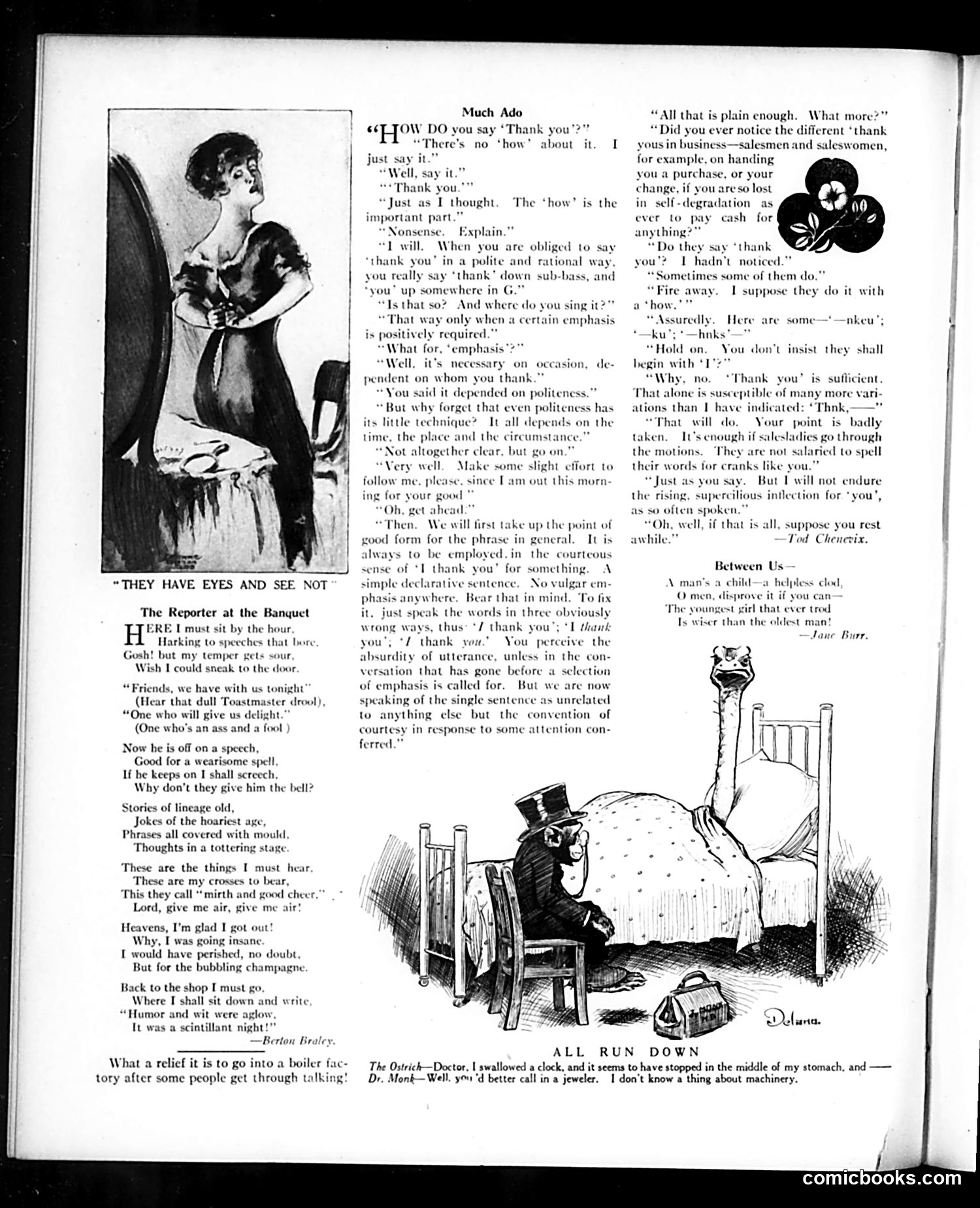
This page satirizes **tedious public speaking and social pretense** through two pieces: **"The Reporter at the Banquet"** (poem by Berton Braley): A journalist is trapped enduring an interminable banquet speech full of tired clichés and stale jokes. He fantasizes about escaping, then must return to write glowing coverage anyway—satirizing the hypocrisy of professional obligation and the gap between private suffering and public praise. **"Much Ado"** (dialogue): Two characters debate the proper technique for saying "thank you"—obsessing over pitch, emphasis, and pronunciation as markers of politeness. The exchange mocks overly pedantic instruction and artificial social conventions. When the instructor criticizes salespeople's intonation, the other character dismisses the concern as irrelevant to actual service, puncturing the pretension. Both pieces target **American upper-class social rituals**—obligatory attendance at boring events and excessive concern with etiquette minutiae—as absurd exercises in maintaining appearances rather than genuine courtesy or meaning.
📄 Transcribed text from this page (OCR, searchable)
Machine-transcribed from the original scan — historical spelling and the odd misread are preserved.
“THEY HAVE EYES AND SEE NOT The Reporter at the Banquet ERE I must sit by the hour Harking to speeches that bore Gosh! but my temper gets sour Wish I could sneak to the door “Friends, we have with us tonight" (Hear that dull Toastmaster drool), “One who will give us delight.” (One who's an ass and a f Now he is off on a speech, Good for a wearisome spell If he keeps on I shall screech, Why don’t they give him the bell? Stories of lineage old, Jokes of the hoariest age, Phrases all covered with mould, Thoughts in a tottering stage These are the things [ must hear These are my crosses to bear, This they call “mirth and good cheer,” Lord, give me air, give me air! Heavens, I’m glad I got out! Why, I was going insane I would have perished, no doubt, But for the bubbling champagne Back to the shop I must go. Where I shall sit down and write, “Humor and wit were aglow It was a scintillant night!" —Berton Braley What a relief it is to go into a boiler fac- tory after some people get through talking! Much Ado «¢LJOW DO you say ‘Thank you’?” “There's no ‘how’ about it. I just say it.” “Well, say it. “Thank you.’ “Just as I thought important part.” Nonsense. Explain.” I will. When you are obliged to say “thank you’ in a polite and rational way, you really say ‘thank’ down sub-bass, and “you up somewhere in G.” Is that so? And where do you sing it?” that way only when a certain emphasis is positively required.” “What for, ‘emphasis “Well, it's necessary on occasion, de- pendent on whom you thank.” “You said it depended on politeness.” “But why forget that even politeness has its little technique? It all depends on the time, the place and the circumstance.” Not altogether clear, but go on.” “Very well. Make some slight effort to follow me. please, since [am out this morn The ‘how’ is the ing for your good * Oh, get ahead.” “Then. We will first take up the point of good form for the phrase in general. It is always to be employed. in. the courteous sense of *T thank you’ for something. A simple declarative sentence. No vulgar em- phasis anywhere. Bear that in mind. ‘To fix it, just speak the words in three obviously wrong ways, thus: ‘/ thank you’; ‘I thank you’; ‘/ thank you.’ You perceive the absurdity of utterance, unless in the con- versation that has gone before a selection But we are now of emphasis is called for. speaking of the single sentence as unrelated to anything else but the convention of courtesy in response to some attention con- ferred.” “All that is plain enough. What more?” “Did you ever notice the different ‘thank yous in business—salesmen and saleswomen, for example, on handing you a purchase, or your change, if you areso lost in self-degradation as ever to pay cash for anything? “Do they say ‘thank you’? [hadn't noticec “Sometimes some of them do.” I suppose they do it with “ Assuredly. He nkeu’; ku’; *—hnks* “Hold on. You don’t insist: they shall begin with "1? “Why, no. ‘Thank you’ is suflicient. That alone is susceptible of many more vari ations than I have indicated: ‘Thnk, — “That will do. Your point is badly taken. I's enough if salesladies go through the motions. ‘They are not salaried to spell their words for cranks like you.” “Just as you say. But I will not endure the rising, supercilious inilection for ‘you’, are some as so often spoken.” “Oh, well, if that is all, suppose you rest Tod Chenev awhile.” Between Us— \ man’s a child—a helpless clod O men, disprove it if you can ‘The youngest girl that ever trod Is wiser than the oldest man! Jane Burr. Delsarter ALL RUN DOWN The Ostrich—Doctor. | swallowed a clock, and it seems to have stopped in the middle of my stomach, and — Dr, Monk—Well. you'd better call in a jeweler. I don’t know a thing about machinery. comicbooks.com