
Judge, 1916-03-11 · page 13 of 28
Judge — March 11, 1916 — page 13: what you’re looking at
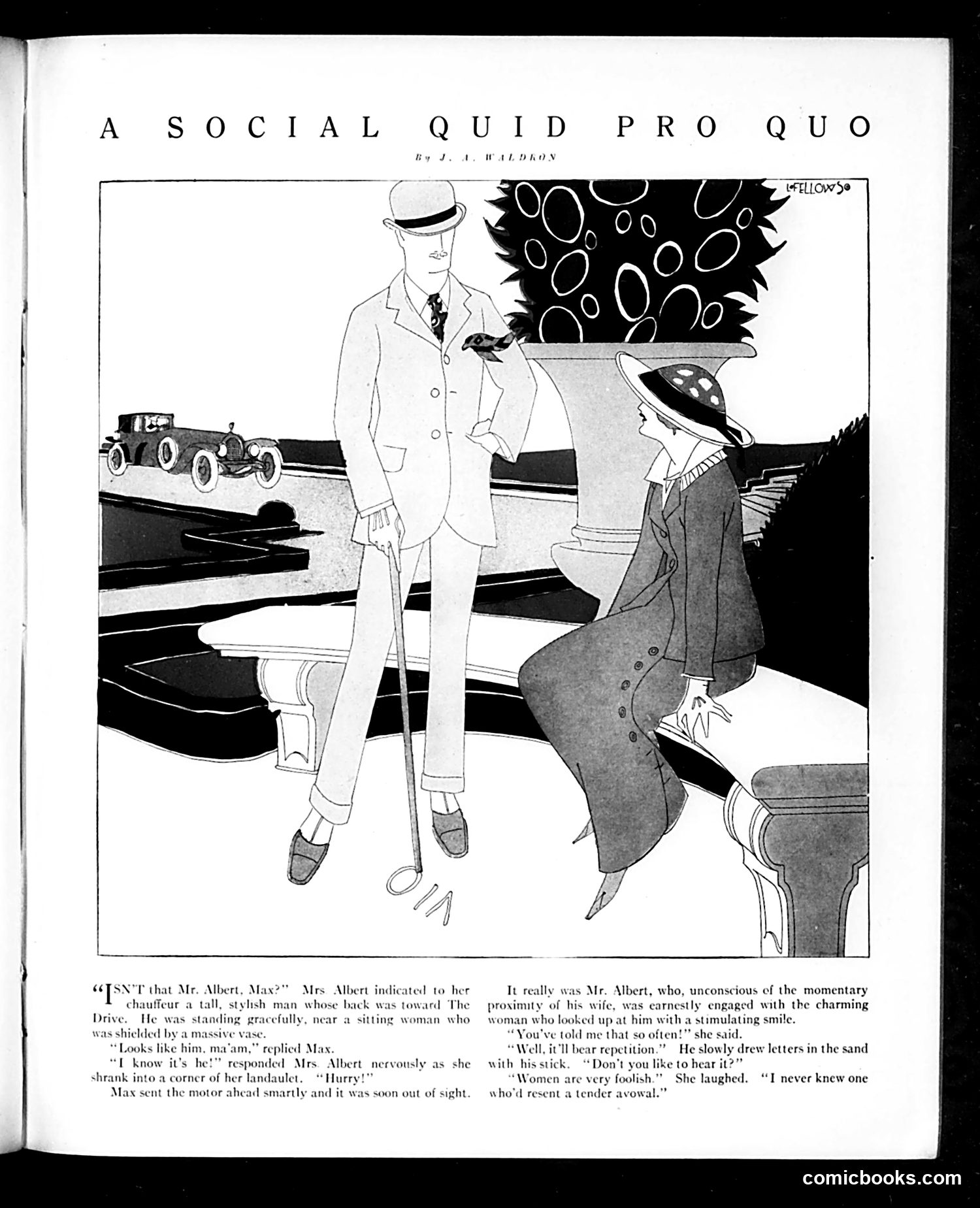
What you’re looking at
This satirical cartoon mocks marital infidelity and the social hypocrisy of the wealthy. Mrs. Albert spots her husband (Mr. Albert) flirting with another woman near "The Drive"—likely a fashionable public promenade. She orders her chauffeur Max to speed away, avoiding confrontation. The irony is explicit in the title "Quid Pro Quo" (an exchange of favors): Mr. Albert charms his companion by repeatedly telling her "I love you," drawing romantic declarations in sand. She feigns modest resistance ("Women are very foolish"), but accepts his advances—a transactional social dance where flattery and romance are bartered goods. The cartoon satirizes both parties: the husband's casual infidelity, the woman's calculated flirtation, and the wife's complicit silence. It reflects Jazz Age anxieties about morality, gender, and whether romantic declarations held genuine meaning or were merely social currency.
📄 Transcribed text from this page (OCR, searchable)
Machine-transcribed from the original scan — historical spelling and the odd misread are preserved.
A SOCIAL By Joa QUID PRO QUO WahDhon \FELLOW Se <6JSN'T that Mr. Albert, Max?" Mrs Albert indicated to her chauffeur a tall, stylish man whose back was acd The Drive. He was standing gracefully, was shielded by am: “Looks like him, ma replied Max. “LT know it’s he!” responded Mrs. Albert nervously as she shrank into a corner of her landaulet. “Hurry!” Max sent the motor ahead smartly and it was soon out of sight. near a sitting woman who It really was Mr. Albert, who, unconscious ef the momentary proximity of his wife, was earnestly engaged with the charming woman who looked up at him with a stimulating smile. “You've told me that so often!” she said. “Well, i'll bear repetition.” He slowly drew letters in the sand with his stick. ‘‘Don't you like to hear it?” “Women are very foolish.” She laughed. who'd resent a tender avowal.”” “T never knew one comicbooks.com