
Judge, 1916-03-11 · page 14 of 28
Judge — March 11, 1916 — page 14: what you’re looking at
What you’re looking at
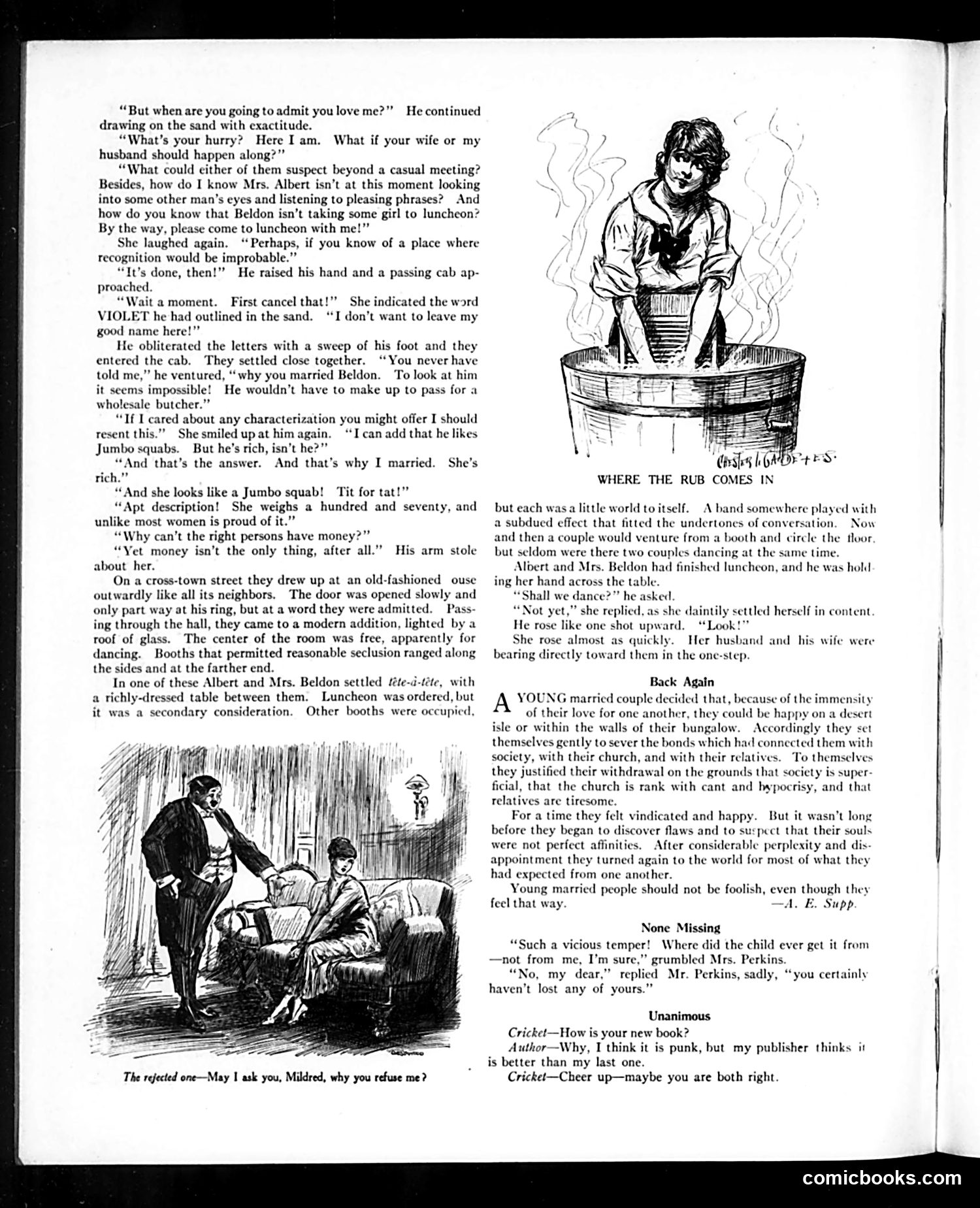
This page satirizes marital infidelity and hypocrisy among the wealthy. The main narrative follows two married people (Albert and Mrs. Beldon) conducting a clandestine affair. The satire centers on their self-deception: they justify meeting secretly by assuming their spouses are similarly unfaithful, then arrange a rendezvous at a discreet establishment designed for such encounters—booths providing "reasonable seclusion" where couples conduct affairs away from society's eyes. The humor lies in their narrow escape when their spouses nearly discover them dancing together. The accompanying story "Back Again" extends the critique, mocking newlyweds who righteously reject society and church as "superficial" and "hypocritical," only to discover their own marriage is flawed. Judge attacks upper-class moral pretense: whether through infidelity or sanctimonious withdrawal from society, the wealthy expose themselves as dishonest and self-serving.
📄 Transcribed text from this page (OCR, searchable)
Machine-transcribed from the original scan — historical spelling and the odd misread are preserved.
“But when are you going to admit you love me?” He continued drawing on the sand with exactitude. “What’s your hurry? Here Iam. What if your wife or my husband should happen along?” “What could either of them suspect beyond a casual meeting? Besides, how do I know Mrs, Albert isn’t at this moment looking into some other man’s eyes and listening to pleasing phrases? And how do you know that Beldon isn’t taking some girl to luncheon? By the way, please come to luncheon with me!” She laughed again. ‘Perhaps, if you know of a place where recognition would be improbable.” “It’s done, then!” He raised his hand and a passing cab ap- proached. “Wait a moment. First cancel that!” VIOLET he had outlined in the sand. “I good name here!” He obliterated the letters with a sweep of his foot and they entered the cab. They settled close together. ‘You never have told me,” he ventured, “why you married Beldon. To look at him it seems impossible! He wouldn’t have to make up to pass for a wholesale butcher.” “If L cared about any characterization you might offer I should resent this.” She smiled up at him again. “I can add that he likes She indicated the word don’t want to leave my Jumbo squabs. But he’s rich, isn’t he?” “And that’s the answer. And that’s why I married. She's rich.” “And she looks like a Jumbo squab! Tit for tat!”” “Apt description! She weighs a hundred and seventy, and unlike most women is proud of it.” “Why can’t the right persons have money?” “Yet money isn’t the only thing, after all.” about her. On a cross-town street they drew up at an old-fashioned ouse outwardly like all its neighbors. The door was opened slowly and only part way at his ring, but at a word they were admitted. Pass- ing through the hall, they came to a modern addition, lighted by a roof of glass. The center of the room was free, apparently for dancing. Booths that permitted reasonable seclusion ranged along the sides and at the farther end. In one of these Albert and Mrs. Beldon settled ¢éte-d-téte, with a richly-dressed table between them. Luncheon was ordered, but it was a secondary consideration. Other booths were occupied, His arm stole HL The rejected one—May | ask you, Mildred, why you refuse me? “Csfes 4 WHERE THE RUB COMES IN but each was a little world to itself. A band somewhere played with a subdued effect that fitted the undertones of conversation. Now and then a couple would venture from a booth and circle the floor but seldom were there two couples dancing at the same time. Albert and Mrs. Beldon had finished luncheon, and he was hold ing her hand across the table. Shall we dance?” he asked. Not yet,” she replied, as she daintily settled herself in content He rose like one shot upward. ‘“‘Look!”” She rose almost as quickly. Her husband and his wife were bearing directly toward them in the one-step. Back Again A YOUNG married couple decided that, because of the immensity of their love for one another, they could be happy on a desert isle or within the walls of their bungalow. themselves gently to sever the bonds which had connected them with i ¢ church, and with their relati To themselves they justified their withdrawal on the grounds that society is super- ficial, that the church is rank with cant and bypocrisy, and that relatives are tiresome. For a time they felt vindicated and happy. But it wasn’t long before they began to discover flaws and to suspect that their souls were not perfect affinities. After considerable perplexity and dis- appointment they turned again to the world for most of what they had expected from one another. Young married people should not be foolish, even though they feel that way. A. E. Supp. Accordingly they set es. None Missing “Such a vicious temper! Where did the child ever get it from —not from me, I’m sure,” grumbled Mrs. Perkins. “No, my dear,” replied Mr. Perkins, sadly, “you certainly haven't lost any of yours. Unanimous Cricket—How is your new book? Author—Why, I think it is punk, but my publisher thinks it is better than my last one. Cricket—Cheer up—maybe you are both right. comicbooks.com