
Judge, 1916-03-11 · page 4 of 28
Judge — March 11, 1916 — page 4: what you’re looking at
What you’re looking at
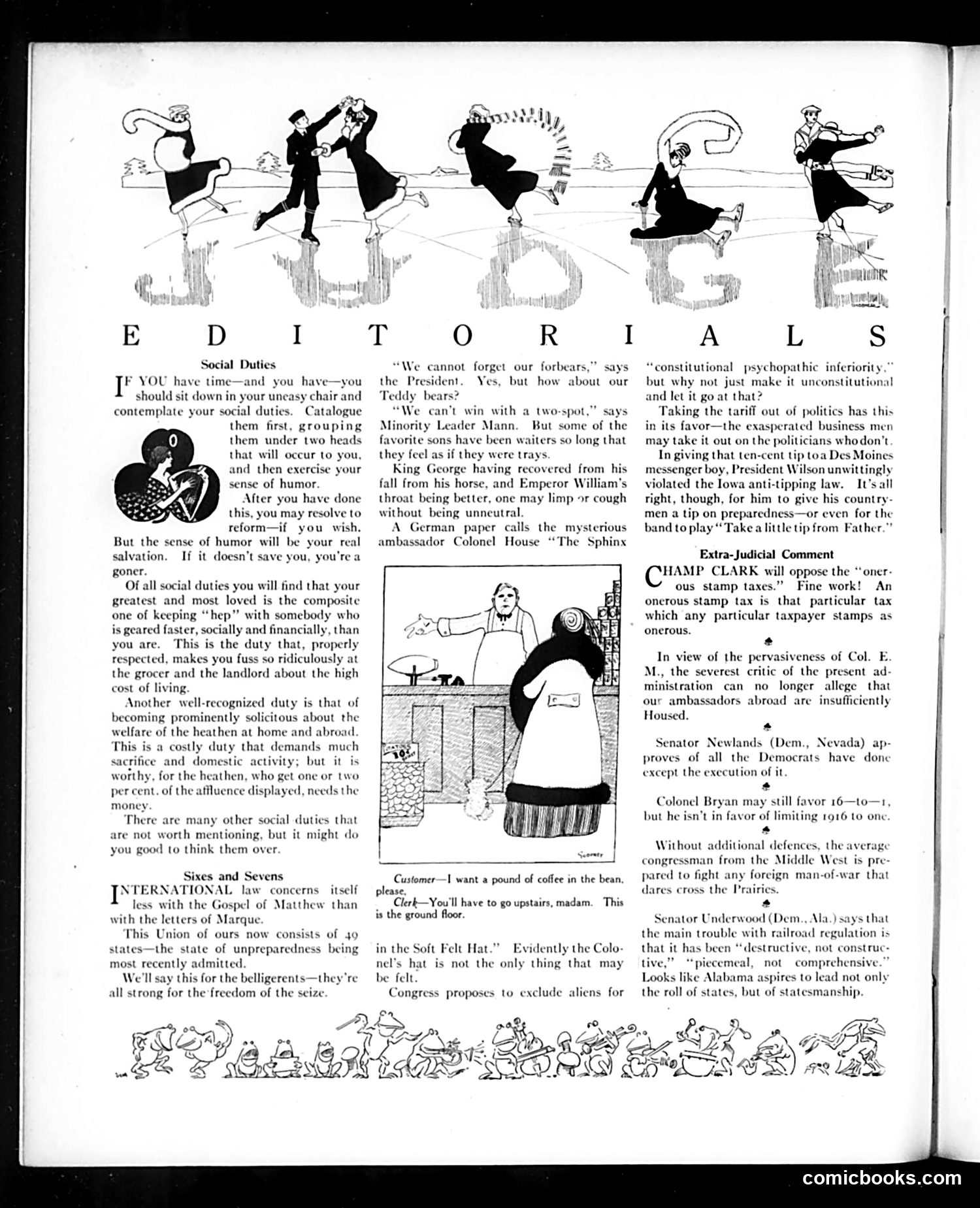
This Judge magazine page features political commentary from the early 20th century. The top illustration spells "EDITORIALS" with figures performing acrobatic stunts, humorously suggesting editorial writing involves balancing acts. The text discusses several political figures and issues: **Referenced figures:** President Wilson, Teddy Roosevelt (mentioned as "bears"), Minority Leader Mann, Colonel E.M. (criticizing ambassador appointments), Champ Clark (opposing "onerous stamp taxes"), Senator Newlands (Nevada Democrat), Colonel Bryan, and Senator Underwood (Alabama Democrat). **Main topics:** social duties, tariffs, railroad regulation, and congressional debates about military preparedness and alien exclusion. The cartoon of the customer and clerk discusses coffee pricing—likely reflecting inflation concerns. The overall tone is satirical commentary on contemporary political dysfunction and policy debates.
📄 Transcribed text from this page (OCR, searchable)
Machine-transcribed from the original scan — historical spelling and the odd misread are preserved.
Social Duties I YOU have time—and you have—you should sit down in your uneasy chair and contemplate your social duties. Catalogue them first, grouping them under two heads that will occur to you, and then exercise your sense of humor. After you have done this, you may resolve to reform—if you wish. But the sense of humor will be your real ation. If it doesn’t you, you're a goner. Of all social duties you will find that your greatest and most loved is the composite one of keeping “hep” with somebody who is geared faster, socially and financially, than you are. This is the duty that, properly respected, makes you fuss so ridiculously at the grocer and the landlord about the high cost of living. Another well-recognized duty is that of becoming prominently solicitous about the welfare of the heathen at home and abroad. This is a costly duty that demands much sacrifice and domestic activity; but it is worthy, for the heathen, who get one or two per cent. of the affluence displayed, needs the money There are many other social duties that are not worth mentioning, but it might do you good to think them over. Sixes and Sevens NTERNATIONAL law concerns _ itself less with the Gospel of Matthew than with the letters of Marque. This Union of ours now consists of 40 states—the state of unpreparedness being most recently admitted We'll say this for the belligerents—they're all strong for the freedom of the seize. Kr aeadtt “We cannot forget our forbears,” says the President. Yes, but how about our Teddy bears? We can’t win with a two-spot,” says Leader Mann. But some of the favorite sons have been waiters so long that they feel as if they were trays. King George having recovered from his fall from his horse, and Emperor William's throat being better, one may limp or cough without being unneutral A German paper calls the mysterious ambassador Colonel House “The Sphinx Customer—I want a pound of coffee in the bean. please. Clerk—You'll have to go upstairs, madam. This is the ground floor, in the Soft Felt Hat.” Evidently the Colo- nel’s hat is not the only thing that may be felt. Congress proposes to exclude aliens for ENS cA I “constitutional psychopathic inferiority.” but why not just make it unconstitutional and let it go at that? Taking the tariff out of politics has this in its favor—the exasperated business men may take it out on the politicians whodon’t In giving that ten-cent tip toa Des Moine: messenger boy, President Wilson unwittingly violated the Iowa anti-tipping law. It’s all right, though, for him to give his country- men a tip on preparedness—or even for the band to play“ Take alittle tip from Father.” Extra-Judicial Comment HAMP CLARK will oppose the “oner- ous stamp taxes.” Fine work! An onerous stamp tax is that particular tax which any particular taxpayer stamps as onerous. * In view of the pervasiveness of Col. M., the severest critic of the present ad- ministration can no longer allege that our ambassadors abroad are insufficiently Housed. 2 Senator Newlands (Dem., Ne’ proves of all the Democrats except the execution of it ¢ Colonel Bryan may still favor 146—to—1, but he isn’t in favor of limiting 1916 to onc * ada) ap have done Without additional defences, the average congressman from the Middle West is pre- pared to fight any foreign man-of-war that Prairies. * Senator Underwood (Dem,, Ala.) says that the main trouble with railroad regulation is that it has been “destructive, not construc- tive,” “piecemeal, not comprehensive.” Looks like Alabama aspires to lead not only the roll of states, but of statesmanship. dares cross the comicbooks.com