
A complete issue · 28 pages · 1915
Judge — September 11, 1915
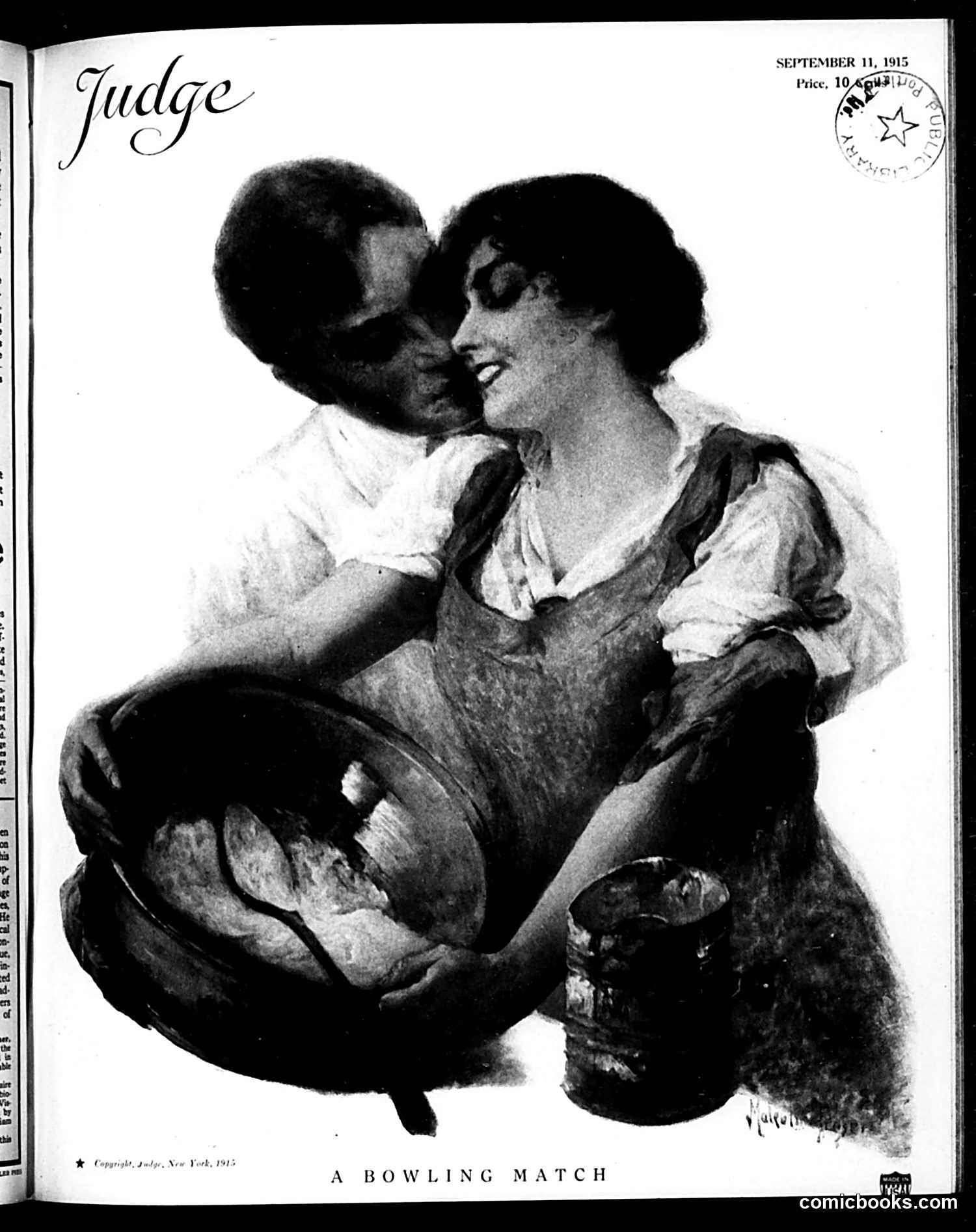
This illustration depicts a couple in an intimate embrace, with the man kissing the woman's cheek while she holds what appears to be a bowling ball. The caption "A Bowling Match" creates a double entendre—playing on "match" as both a bowling competition and a romantic pairing. The satire appears to target courtship customs of the era, suggesting that bowling alleys served as social venues where young people could interact. The joke likely mocks either the awkwardness of public displays of affection in such settings, or satirizes bowling as a supposedly genteel recreational activity that actually facilitated romantic encounters. The illustration's style and the magazine's focus suggest this is gentle social satire about American dating customs rather than serious political commentary.
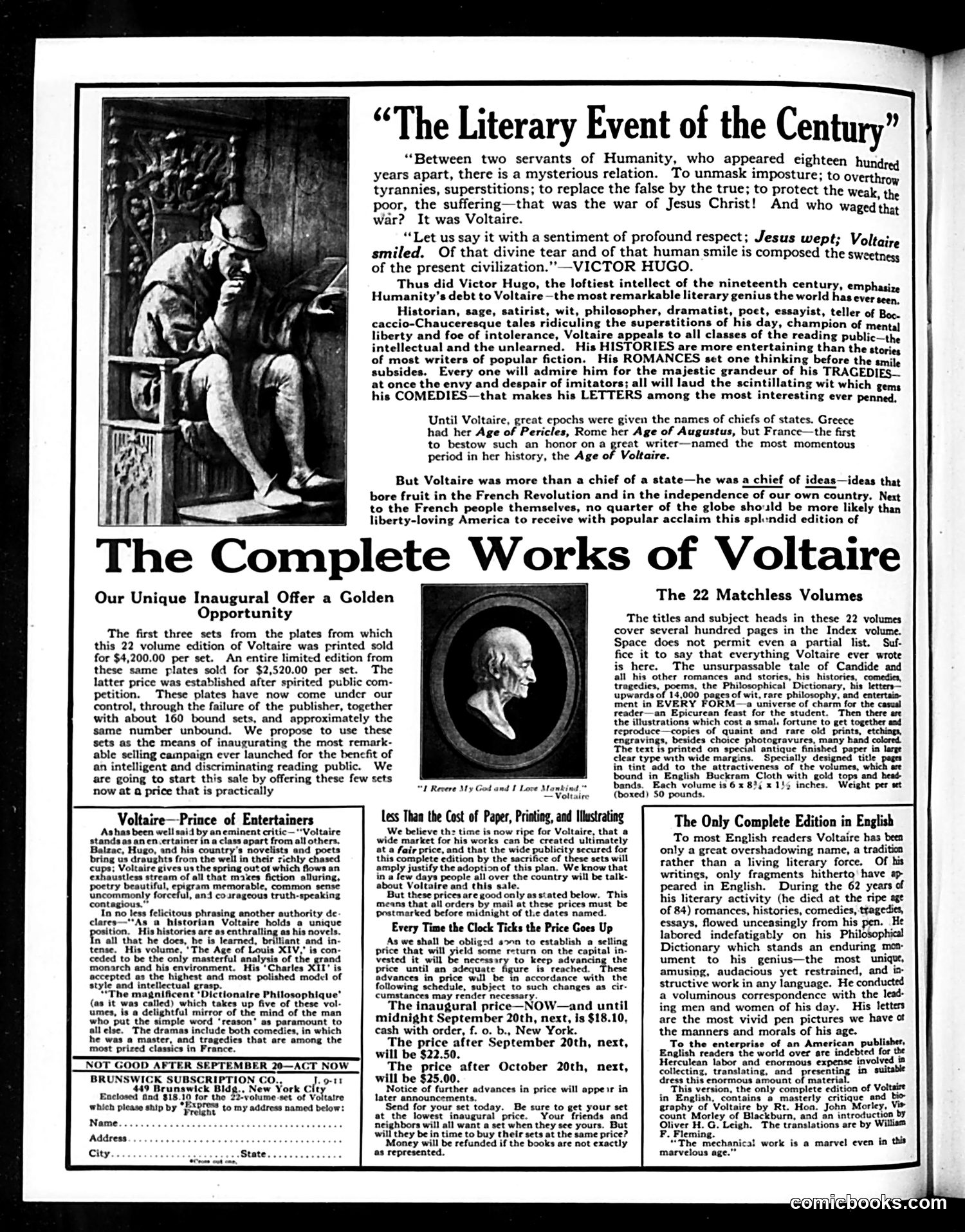
This page is primarily **advertising, not satire**. It promotes "The Complete Works of Voltaire" — a 22-volume English edition being sold by subscription. The left illustration shows a figure (presumably Voltaire) in 18th-century dress, positioned as an intellectual authority. The text celebrates Voltaire as a "chief of ideas" whose writings influenced the French Revolution and American independence. The "Literary Event of the Century" heading uses a Victor Hugo quote comparing Jesus and Voltaire to elevate the philosopher's cultural significance. Rather than satirizing Voltaire or making political points, Judge uses this prestigious historical figure to market the books to educated American readers, positioning Voltaire ownership as a mark of intellectual sophistication. The advertising copy emphasizes comprehensiveness, rarity of the original plates, and competitive pricing—standard sales tactics.
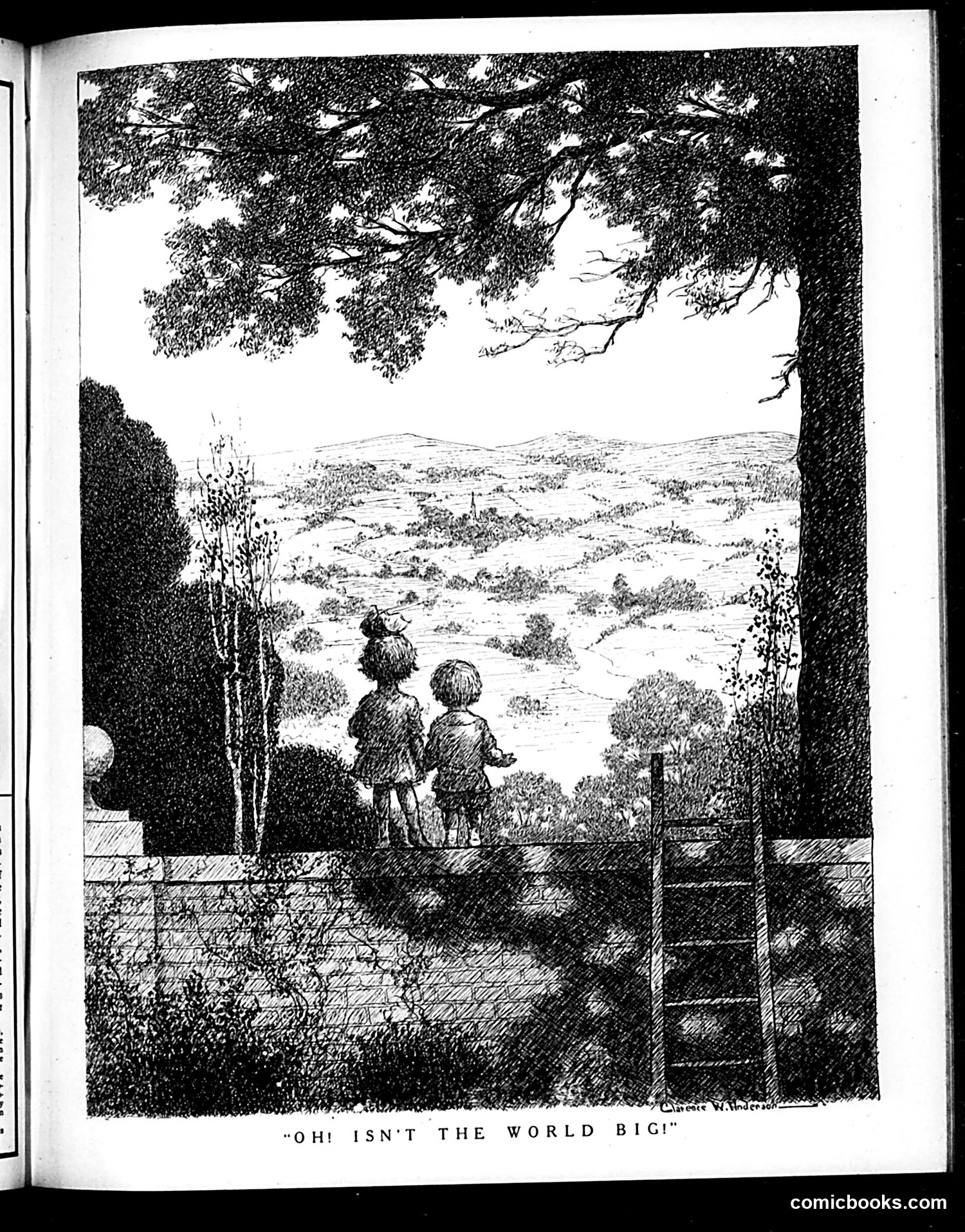
This illustration depicts two children standing at a fence, gazing out at an expansive landscape. The caption reads "O H! ISN'T THE WORLD BIG!" This appears to be a sentimental rather than satirical piece, likely from Judge magazine's editorial/illustrative section. It captures a moment of childhood wonder—two young figures confronting the vastness of the world beyond their immediate domestic sphere. The composition, with the framing fence and overhanging tree, emphasizes the contrast between the confined foreground and the expansive view beyond. The artwork itself demonstrates careful pen-and-ink technique typical of early-to-mid 20th century magazine illustration. Without additional context or OCR'd text surrounding this image, it appears to be either a standalone sentimental illustration or accompaniment to a story about childhood perspective and discovery rather than political satire.
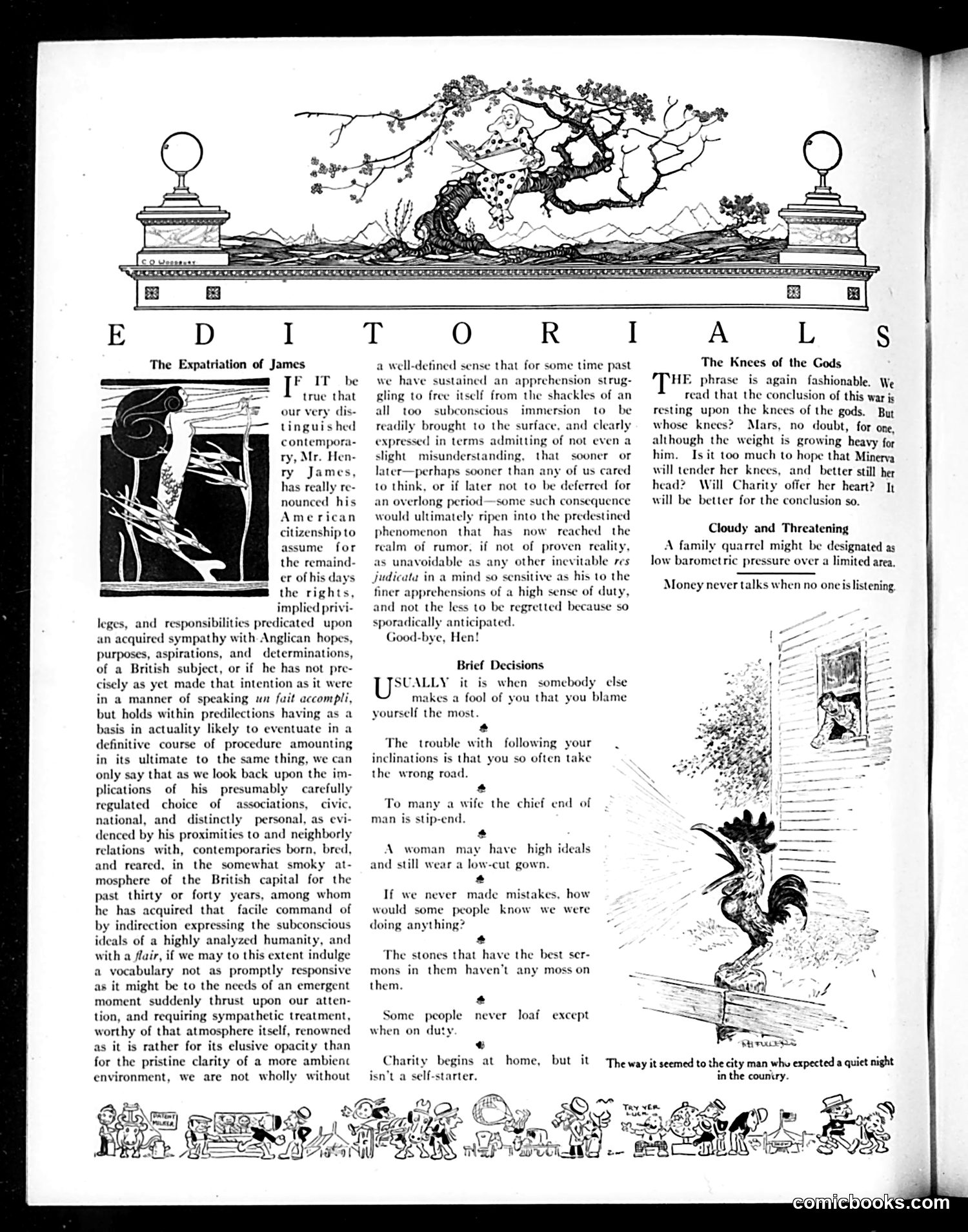
This editorial page from *Judge* magazine contains three distinct sections: **"The Expatriation of James"** (left): A substantial article discussing someone named James who has renounced American citizenship. The text debates whether this decision represents legitimate philosophical grounds or reflects poorly on American society. The accompanying illustration shows a figure in profile. **"The Knees of the Gods"** (right): Commentary on a war's conclusion and divine intervention, referencing Mars and whether the gods will offer charity. **"Brief Decisions"** (center): A collection of aphoristic observations on human nature—marriage, ideals, mistakes, and charity—presented without clear satirical targets. The bottom features a decorative border with small illustrated vignettes of everyday life. Without clearer identification of "James" or the specific war referenced, the precise historical context remains unclear.
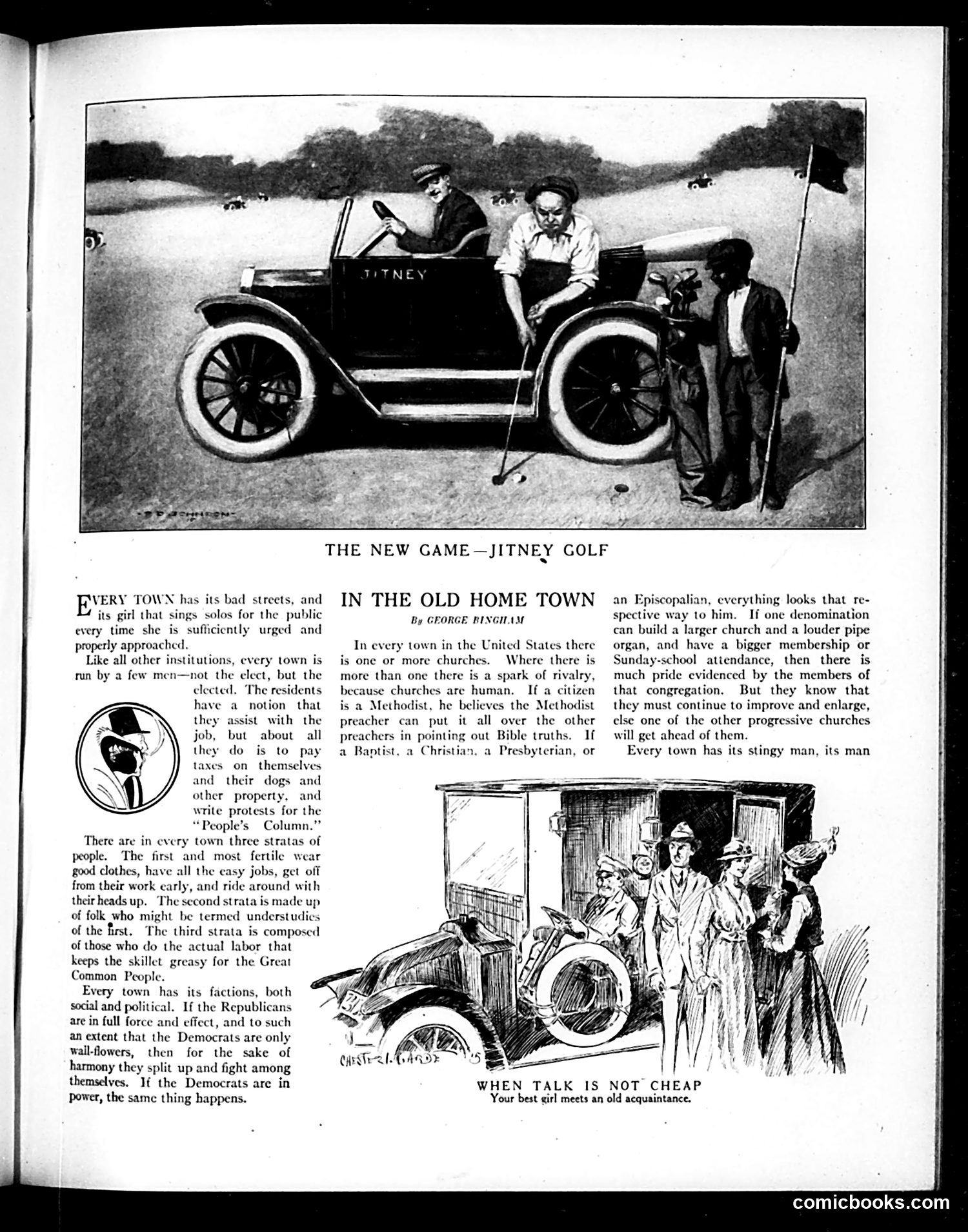
This page contains two distinct items: **"The New Game—Jitney Golf"** (top): Shows a Jitney automobile being used as a golf ball. This satirizes the "jitney" craze—cheap, informal ride-sharing vehicles that competed with established transportation. The joke treats the car itself as disposable, mocking both the vehicles' low status and perhaps the fad's absurdity. **"When Talk Is Not Cheap"** (bottom): An illustration captioned "Your best girl meets an old acquaintance," showing a woman chatting with an old friend while her male companion waits awkwardly in a car. This jokes about boring waiting times during social encounters—a relatable domestic humor piece common to Judge's satirical approach. The accompanying article "In the Old Home Town" discusses small-town social dynamics and church rivalries, separate from the cartoons' humor.
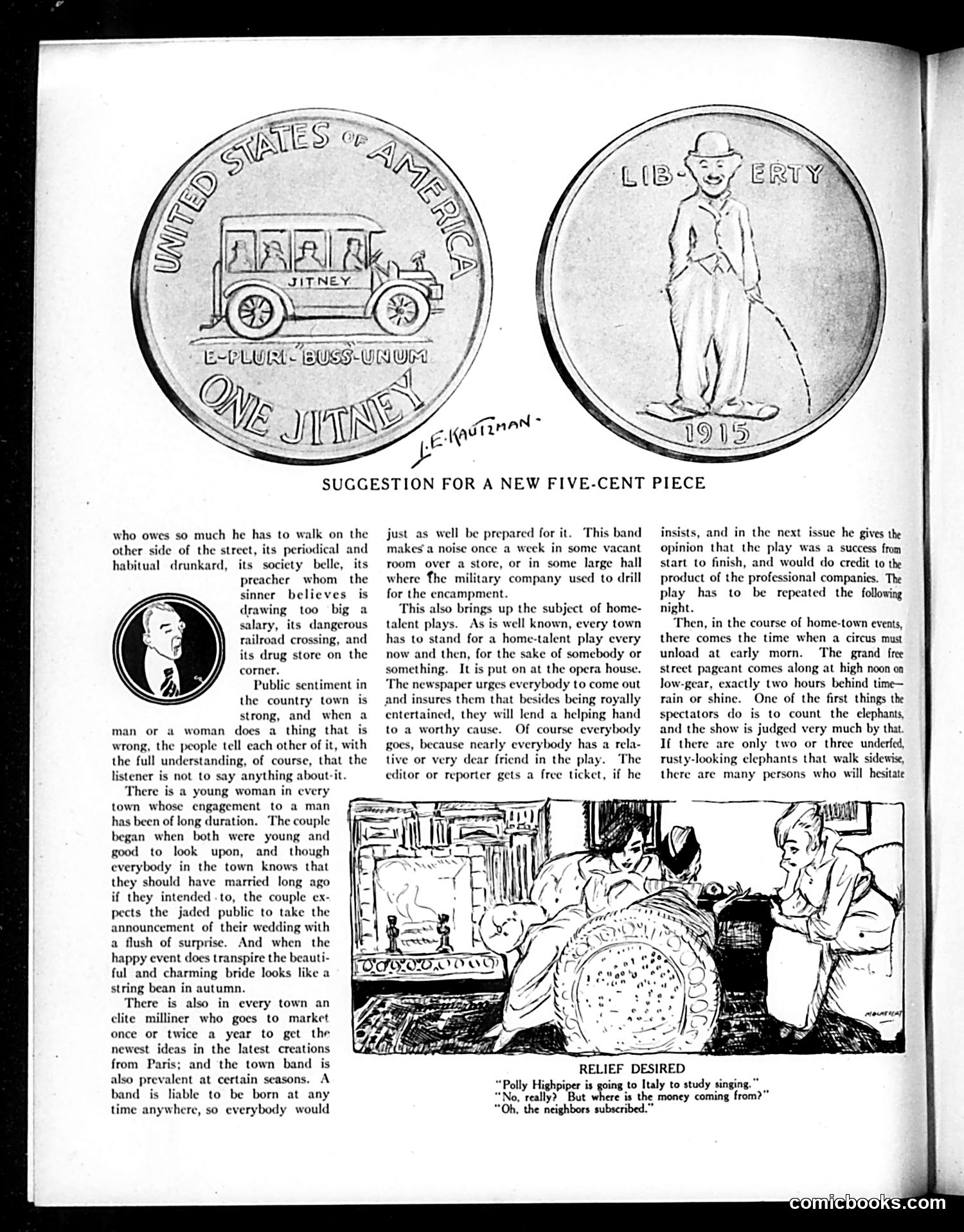
The page presents satirical commentary on small-town American life circa 1915. The top coins show a proposed "Jitney" (early shared-ride automobile) design and Liberty imagery—likely satirizing contemporary currency debates or transportation innovations. The main text mocks predictable small-town social types: the perpetually engaged couple, the elite milliner copying Paris fashions, the amateur town band, and especially the obligatory "home-talent play" at the opera house. The satire targets small-town hypocrisy—how neighbors gossip yet attend these mediocre productions out of obligation to relatives, then the local editor praises them anyway. The bottom cartoon titled "Relief Desired" jokes about a girl named Polly Highpiper claiming to study singing in Italy, with neighbors footing the bill. The implication is unclear but suggests either charitable gullibility or an excuse for questionable behavior. Overall, Judge ridicules provincial American culture's conformity, pretension, and social pressure—common targets of urban satirical magazines mocking rural/small-town life.
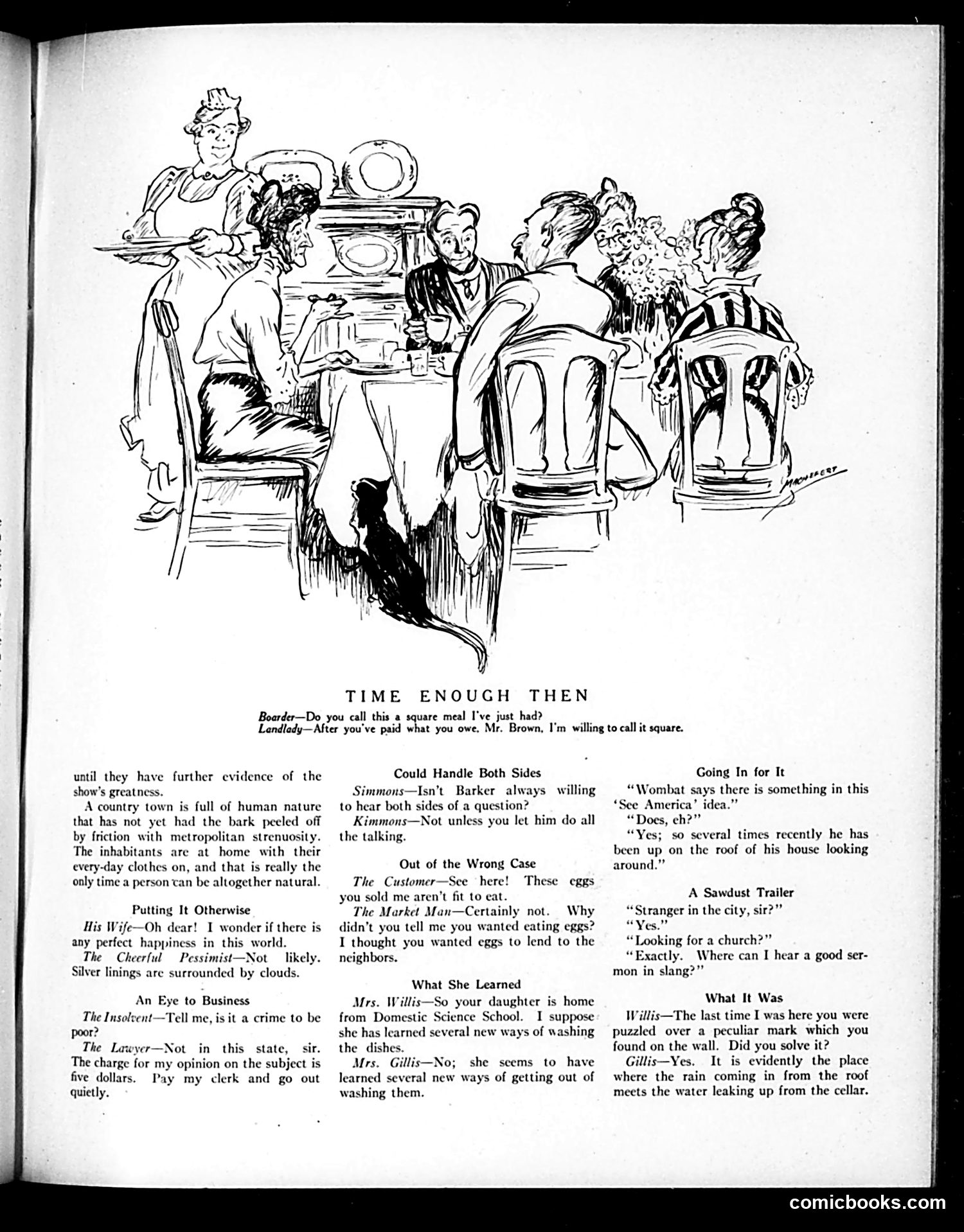
This page contains multiple brief humorous vignettes typical of early 20th-century American satirical magazines. The main cartoon, "Time Enough Then," depicts a boarder and landlady in a familiar domestic conflict: he complains about the meal's quality, and she retorts that she'll call it "square" only after he pays his outstanding debt—a pun on "square meal." The surrounding short jokes mock various social types: a lawyer who charges for obvious advice, a market vendor selling inedible eggs, a pessimist who finds no silver linings, and a man searching for churches with sermons "in slang." One joke mocks a daughter's domestic science education as teaching avoidance rather than actual housework. These satirize working-class struggles (unpaid rent, poor food quality), professional cynicism, failed social aspirations, and changing gender roles. The humor relies on wordplay and class-based observations recognizable to Judge's educated, middle-class readership.
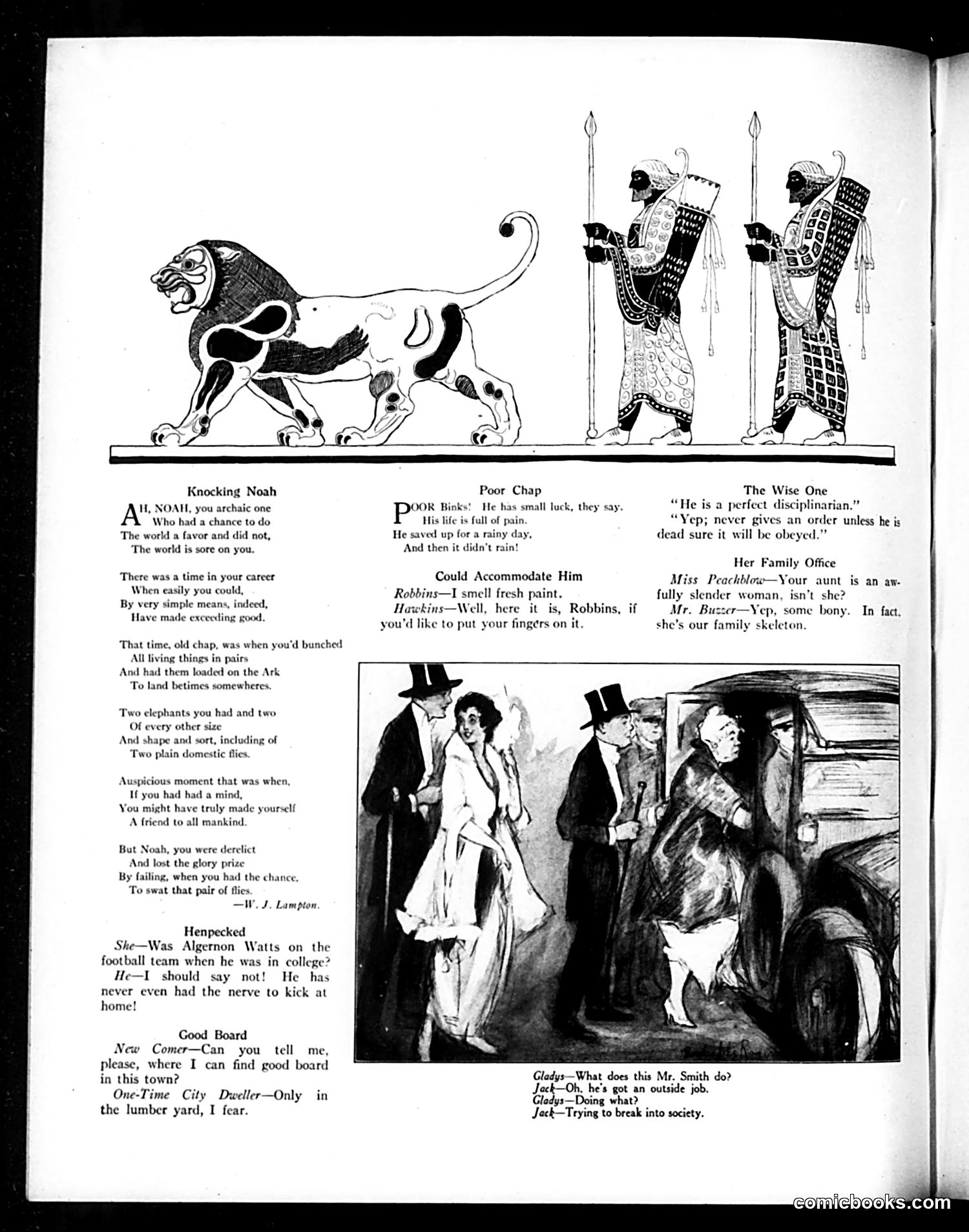
This page contains several short satirical jokes and a literary piece, rather than political cartoons. **"Knocking Noah"** is a humorous poem by W.J. Lampton criticizing Noah for not using the Flood as an opportunity to eliminate flies—suggesting he failed mankind by not killing the two flies aboard the Ark. It's absurdist humor about missed chances. The remaining items are brief social jokes typical of Judge's format: - **"Henpecked"** jokes about a timid man afraid to "kick at home" - **"Good Board"** puns on "board" (lodging vs. lumber) - **"Poor Chap"** ironizes someone who saved for rain that never came - **"Could Accommodate Him"** involves fresh paint and wordplay - **"Her Family Office"** uses "family skeleton" (secret shame) as a pun about a thin aunt - **"Jack trying to break into society"** satirizes social climbing as criminal behavior The Egyptian-themed illustration at top appears decorative. These are light, domestic humor pieces reflecting early 20th-century magazine conventions rather than serious political satire.
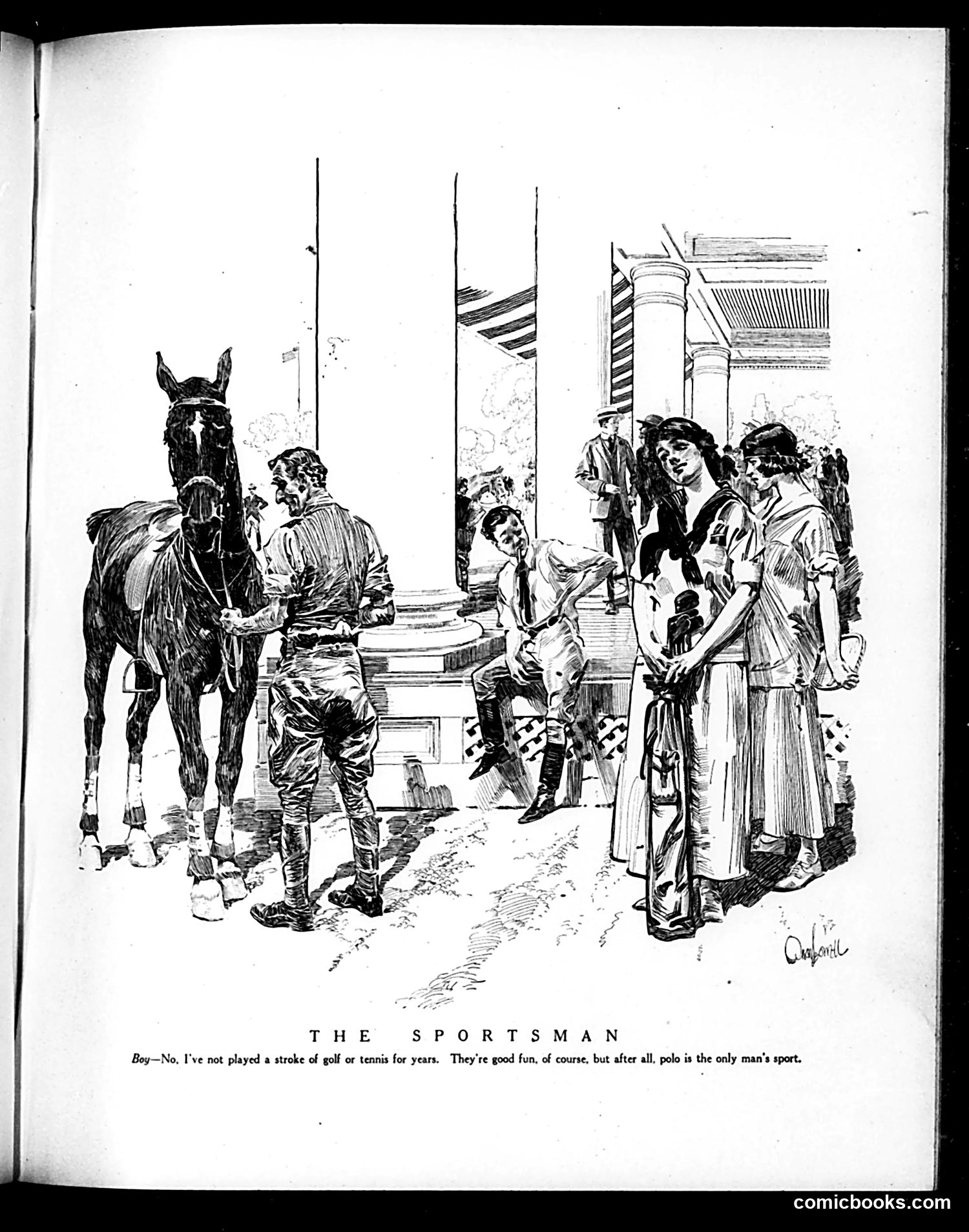
This cartoon satirizes class pretension and snobbery. A mounted polo player speaks to a boy, dismissing golf and tennis as mere "fun" while declaring polo "the only man's sport." The satire targets the wealthy elite's belief in polo's superiority—polo was an expensive sport requiring horses and access to exclusive clubs, affordable only to the very rich. The joke mocks this attitude's absurdity: the speaker dismisses two legitimate sports as inferior simply because polo's exclusivity and cost made it a status symbol among the upper class. By presenting this claim so matter-of-factly, the cartoonist ridicules the pretentiousness of wealthy men who used sporting choices to assert social dominance and masculine superiority. The crowd of onlookers suggests the public spectacle of such aristocratic posturing.
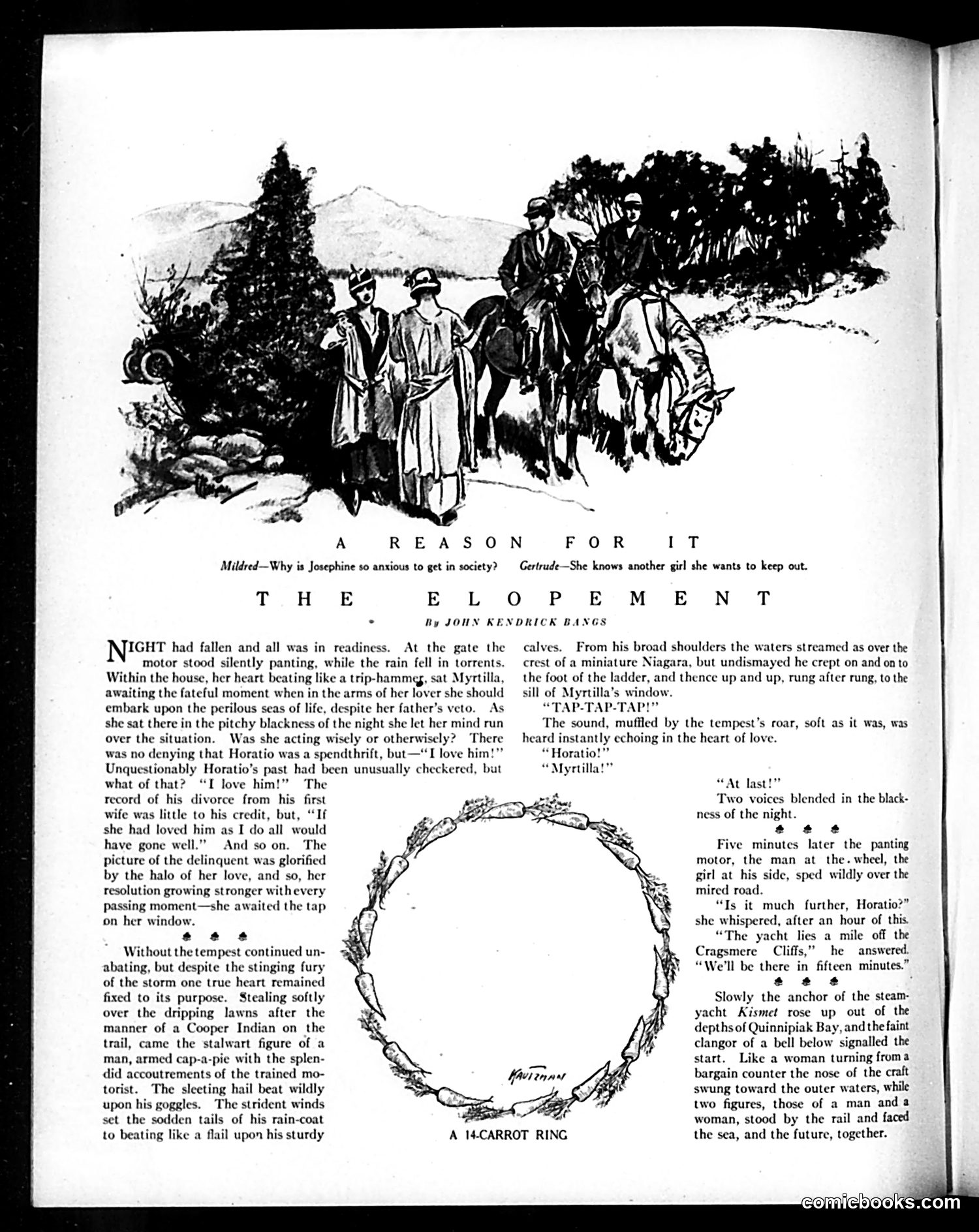
This page contains a romantic short story rather than political satire. The narrative describes a young woman named Myrtilla eloping with her lover Horatio despite her father's disapproval. Horatio arrives dramatically in a rainstorm, climbs to her window, and they escape by motorcar to a waiting yacht. The small joke at the top—about Josephine wanting entry to society primarily to exclude a rival—is mild social commentary on female competitiveness and snobbery, typical of Judge's light satirical humor. The story itself emphasizes the romantic drama of elopement, with vivid descriptions of the storm and their escape. The title "A 14-Carrot Ring" (a pun on "carat") suggests an engagement ring, though the wordplay appears in the illustration caption rather than the narrative itself. This reflects early 20th-century magazine fiction blending humor with sentimental romance.
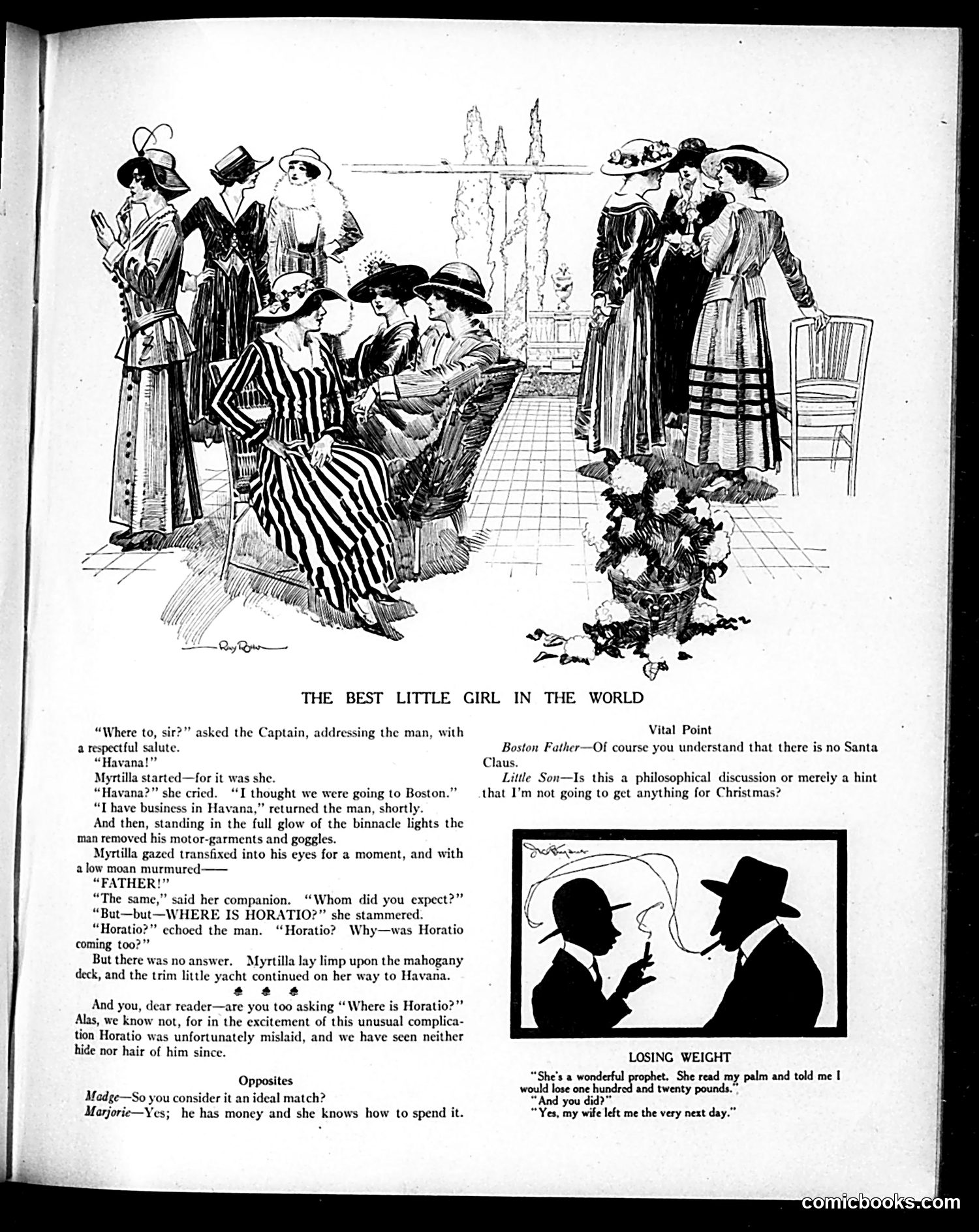
This page contains **three separate satirical pieces** typical of early 20th-century American humor: 1. **"The Best Little Girl in the World"** (main illustration): A serialized story-cartoon about a young woman named Myrtilla whose sea voyage takes an unexpected turn when her father appears instead of her expected companion "Horatio." The narrative plays on melodramatic plot twists—the surprise revelation, the fainting heroine, the mysteriously "mislaid" love interest. It's satirizing the overwrought romantic stories popular in contemporary fiction. 2. **"Vital Point"**: A joke mocking rigid Boston parenting—a father's blunt denial of Santa Claus framed as philosophical discussion rather than simple gift-withholding. 3. **"Losing Weight"**: A domestic comedy where a wife leaves her husband after a fortune teller's prediction, which he misinterprets as weight-loss advice. All three pieces rely on **domestic scenarios and relationship comedy** rather than political satire, reflecting Judge's general editorial focus on social manners and modern life humor.
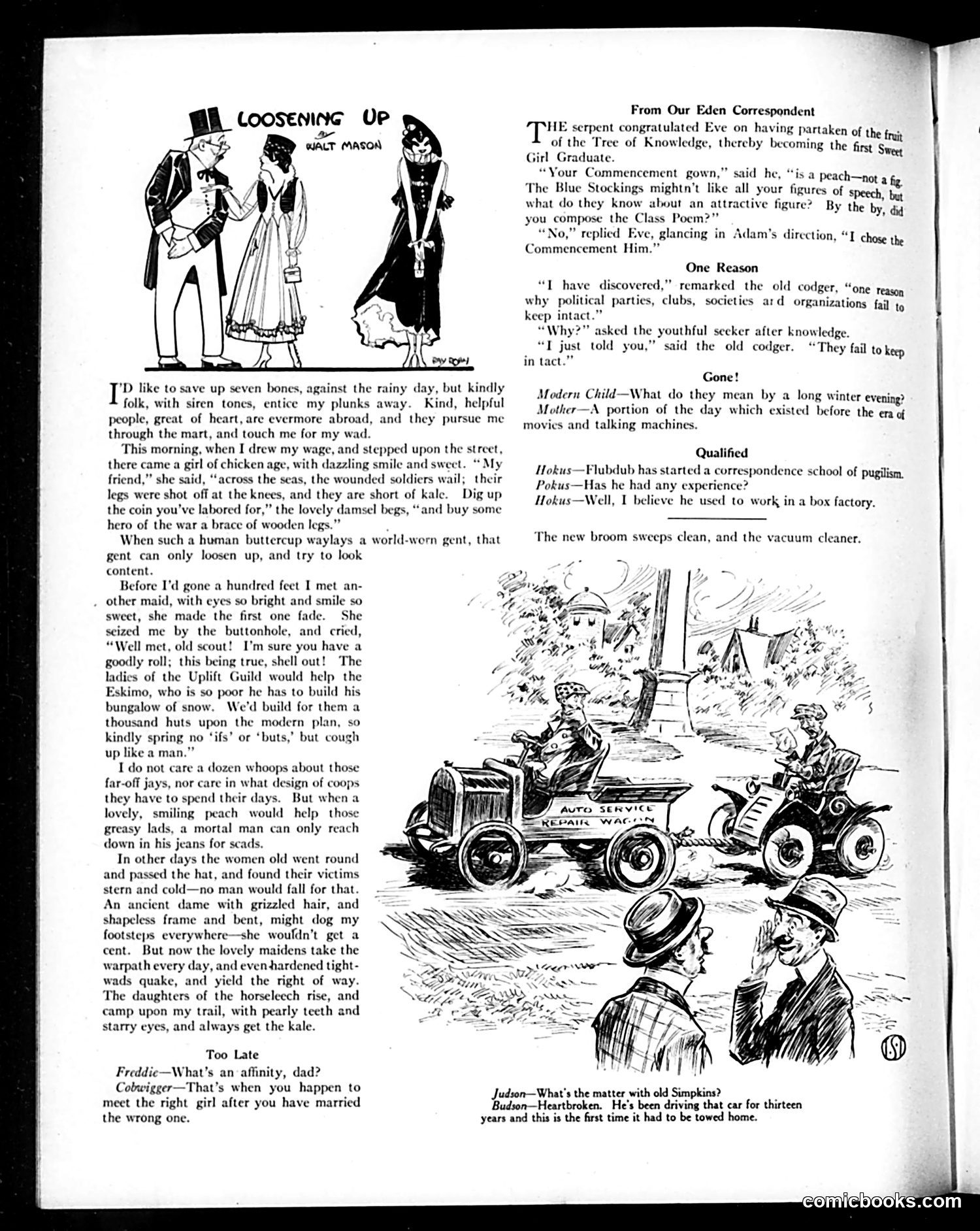
This page contains multiple satirical pieces typical of early 20th-century American humor: **"Loosening Up"** (top cartoon): A three-panel illustration satirizing women's fashion and social pretension, showing figures in formal dress with commentary on "Blue Stockings" (educated women viewed as unfeminine). **"From Our Eden Correspondent"**: Biblical satire mocking women's education, with Eve as the "first sweet girl graduate." The serpent's flirtation and condescension toward female intellect reflects period attitudes dismissing women's learning. **"One Reason"** and other brief jokes: Wordplay and social commentary—the politics joke is a pun about organizations failing to "keep intact," while other sections mock charitable solicitation by attractive women and reference the "Uplift Guild." **Bottom cartoon**: Shows working-class figures and vehicles, appearing to satirize labor or business matters. The overall tone reflects Judge's satirical approach to contemporary social tensions: women's education and independence, changing gender dynamics, and evolving charitable practices—all treated with the magazine's characteristic irreverent humor.
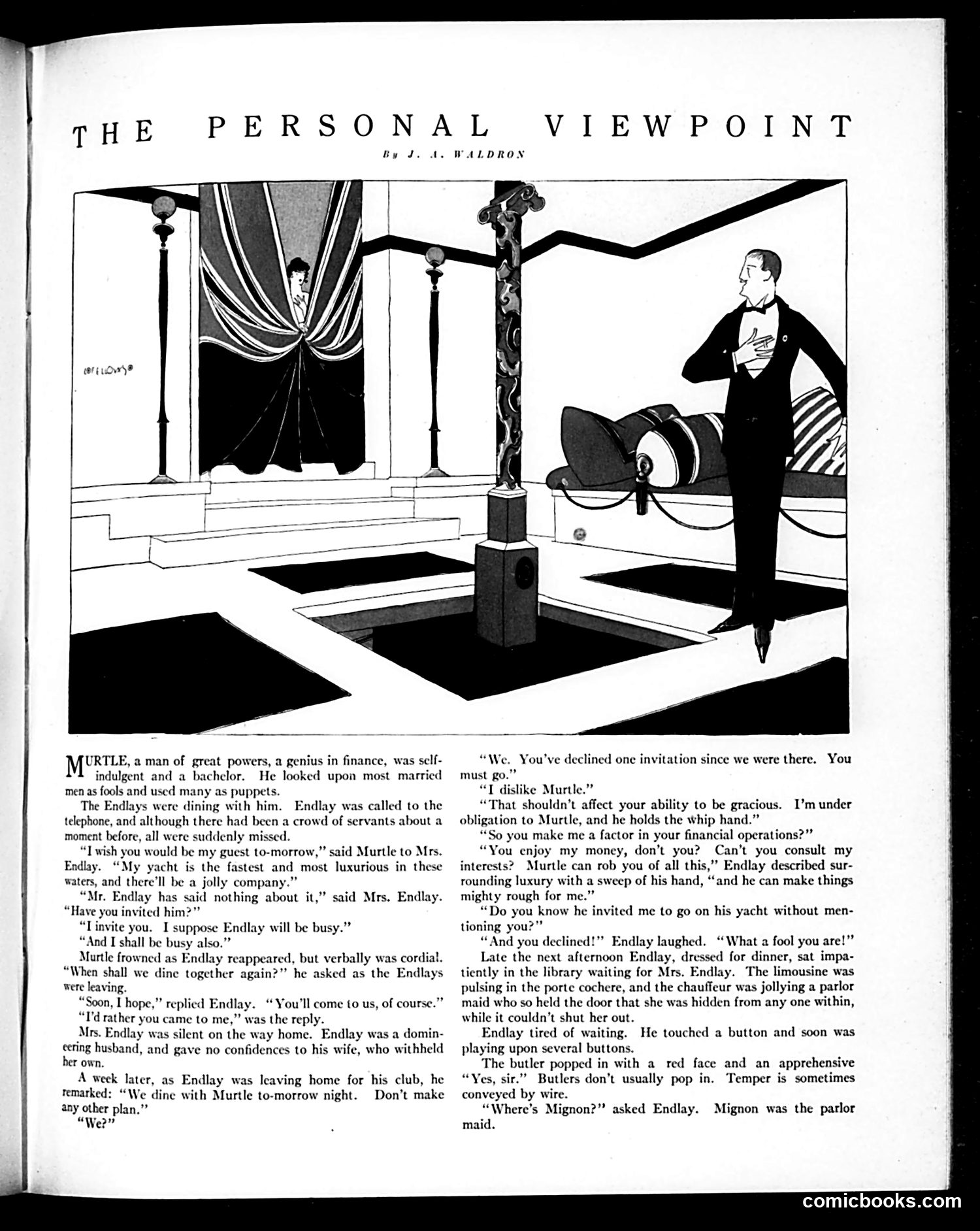
This satirical story critiques marital power dynamics among the wealthy. Murtle, a wealthy financier and bachelor, attempts to manipulate Mrs. Endlay by inviting her alone to his yacht—a social impropriety. Her husband Endlay, financially dependent on Murtle's goodwill, bullies his wife into compliance, explicitly stating Murtle "holds the whip hand" and controls their luxury lifestyle. The cartoon illustrates this dynamic: Endlay stands in his elegant home, a puppet-like figure awaiting his wife. The satire targets how wealthy men like Murtle use financial power to dominate social situations and marriages, and how husbands like Endlay treat wives as assets to be leveraged for business advantage rather than as autonomous people. The humor is dark—exposing the transactional, exploitative nature of gilded-age marriages among the financially powerful.
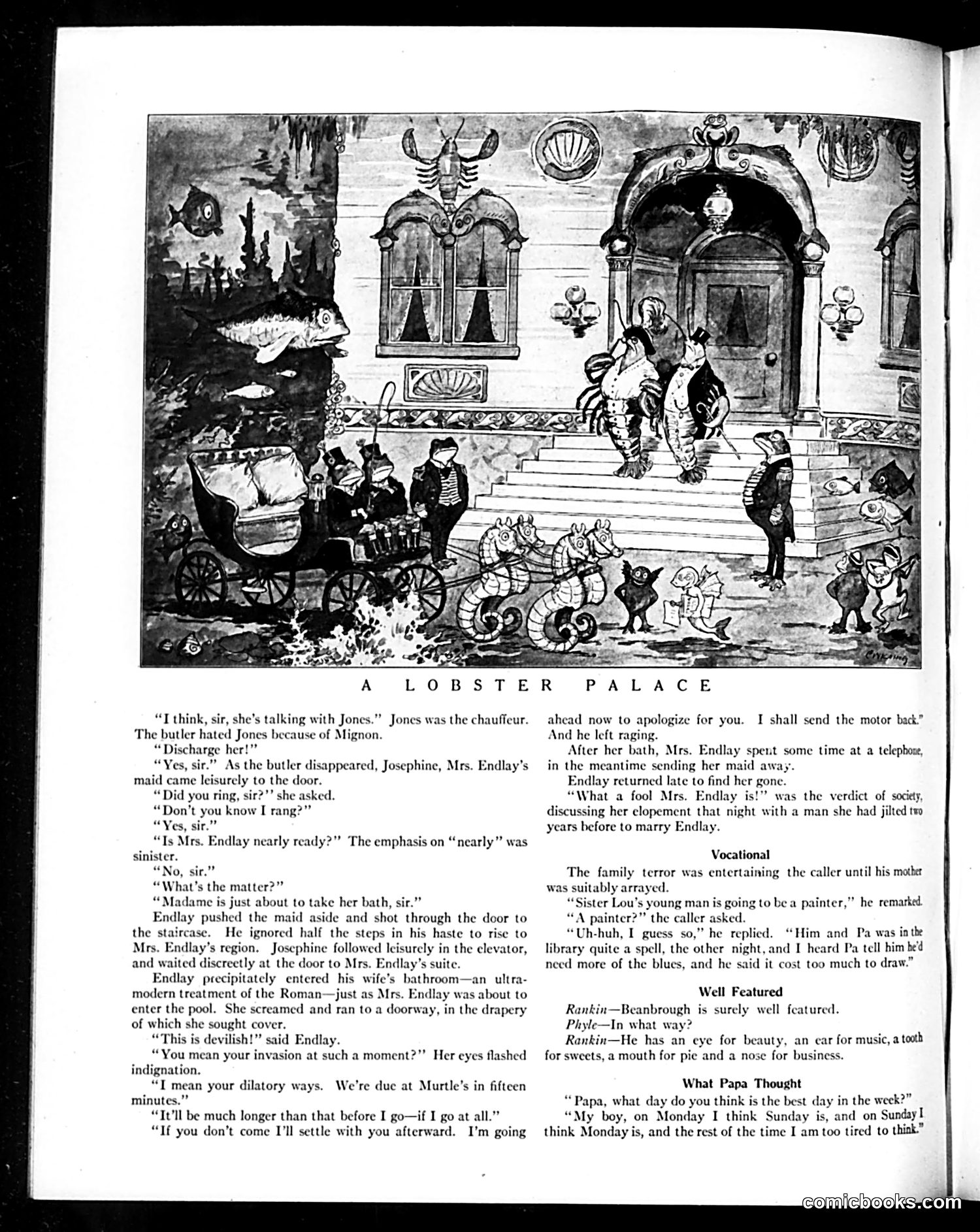
This page presents a serialized domestic comedy satirizing upper-class marital discord and servant dynamics. The main illustration depicts an ornate, luxurious interior where Mr. Endlay interrupts his wife's bath—a shocking breach of propriety—to rush her to a social engagement at "Murtle's." Mrs. Endlay, insulted by his rudeness, refuses to attend. The satire targets several social pretensions: the husband's obsession with maintaining appearances at fashionable events, the wife's dignified defiance, and servants (Jones the chauffeur, Josephine the maid) as sources of household tension and gossip. The story concludes with Mrs. Endlay eloping with a former suitor, leading society to mock her as foolish—the ultimate humiliation for status-conscious aristocrats. The accompanying comic vignettes mock pretentiousness: an aspiring "painter" who needs expensive blues, and a father too exhausted by weekly drudgery to think clearly. "Lobster Palace" likely refers ironically to an upscale dining venue, emphasizing the shallow materialism of the characters.
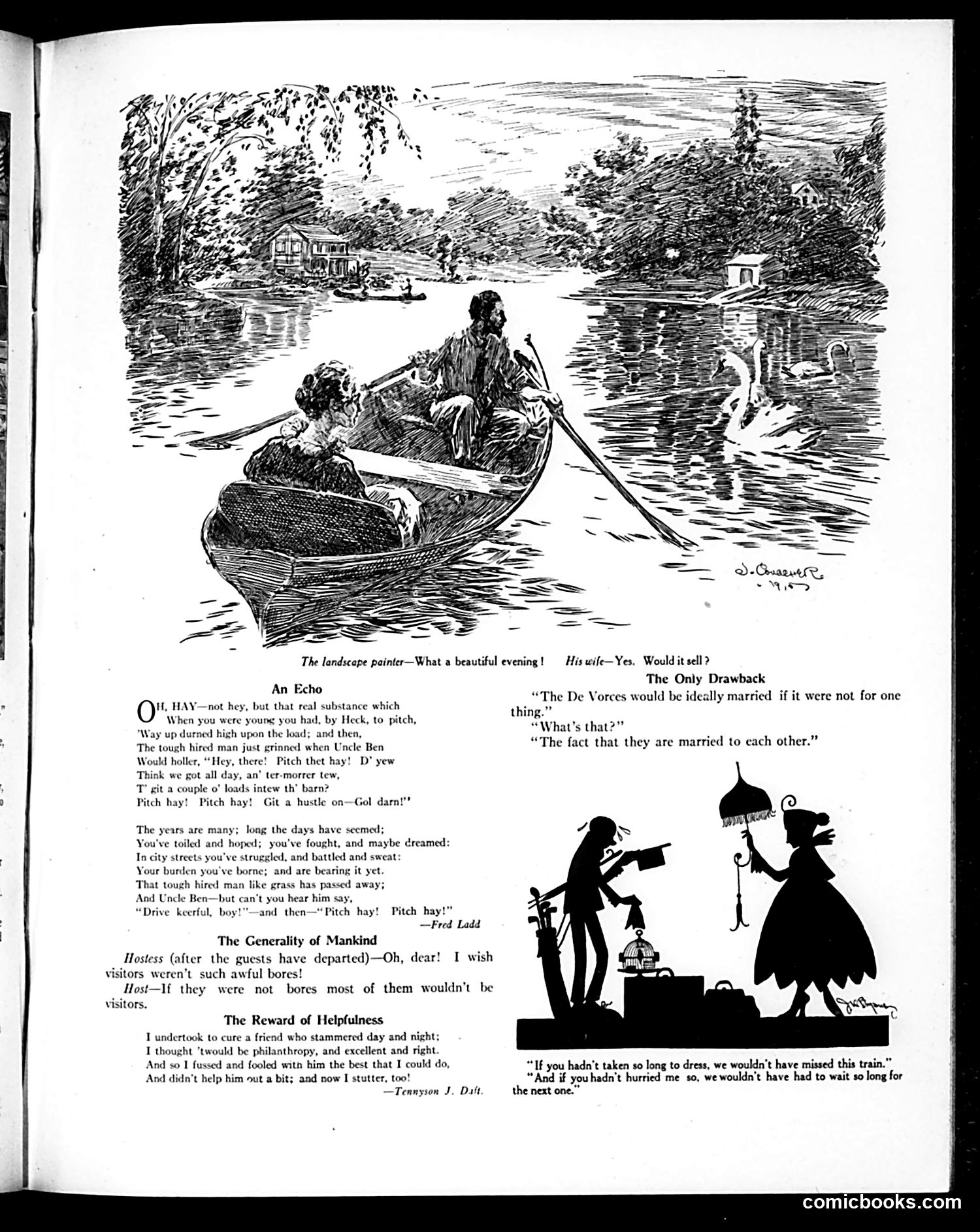
This page contains several satirical pieces reflecting early 20th-century social humor: **"An Echo"** (poem by Fred Ladd): Nostalgic commentary on aging. A man recalls his youth doing farm labor under an impatient boss's demands ("Pitch hay!"), now ironically hears those same urgencies in life's pressures—suggesting we never escape the relentless demands of our era. **"The Generality of Mankind"**: A brief joke about social obligation. The host notes that boring people wouldn't visit if they weren't inherently boring—dark humor about why we tolerate tedious guests. **"The Reward of Helpfulness"**: Punning joke where attempting to help a stammering friend by "fussing" over him causes the helper to develop a stutter—karmic irony about well-intentioned meddling backfiring. **"The Only Drawback"** (cartoon): Satirizes marriage discord. The De Vorces would be "ideally married" except they're married *to each other*—biting commentary on incompatible spouses. The bottom dialogue mocks couples' petty blame-shifting about being late. All pieces use humor to critique human nature, aging, social pretense, and marital friction.
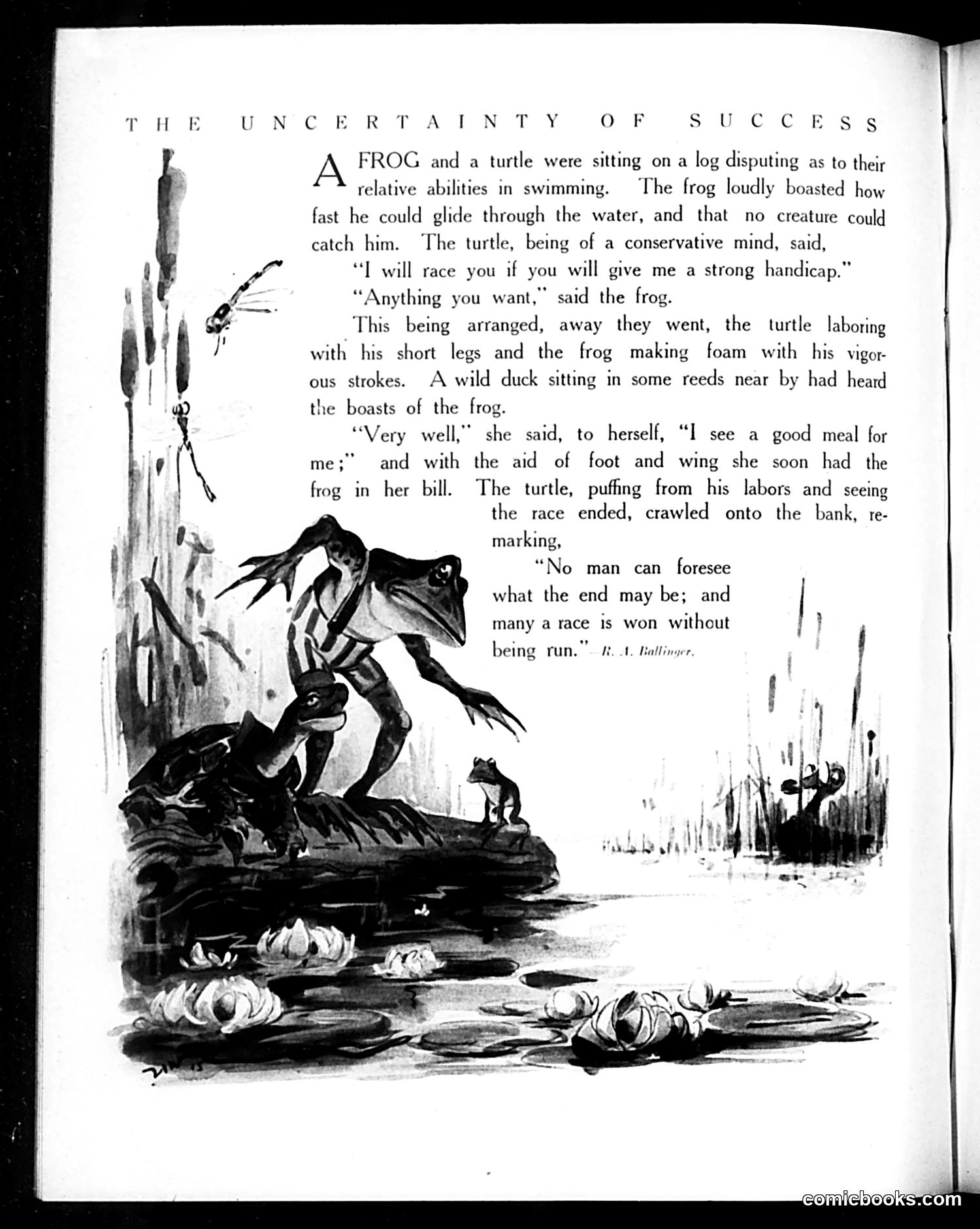
This is a fable illustrated as social commentary. A boastful frog challenges a cautious turtle to a race. Despite the frog's superior speed and arrogance, an unexpected wild duck—representing unforeseen external forces—catches and kills the frog mid-race. The turtle, humble and conservative, survives by reaching the bank. The moral, attributed to R.A. Ballinger, warns that overconfidence and assumptions about outcomes are unreliable. Success depends not on apparent advantages but on factors beyond one's control. For Judge's readers, this likely critiqued American business culture and political confidence of the era—cautioning that boastfulness about competitive superiority (whether commercial or political) ignores unpredictable circumstances that determine actual outcomes. The "uncertainty of success" is the title's theme.
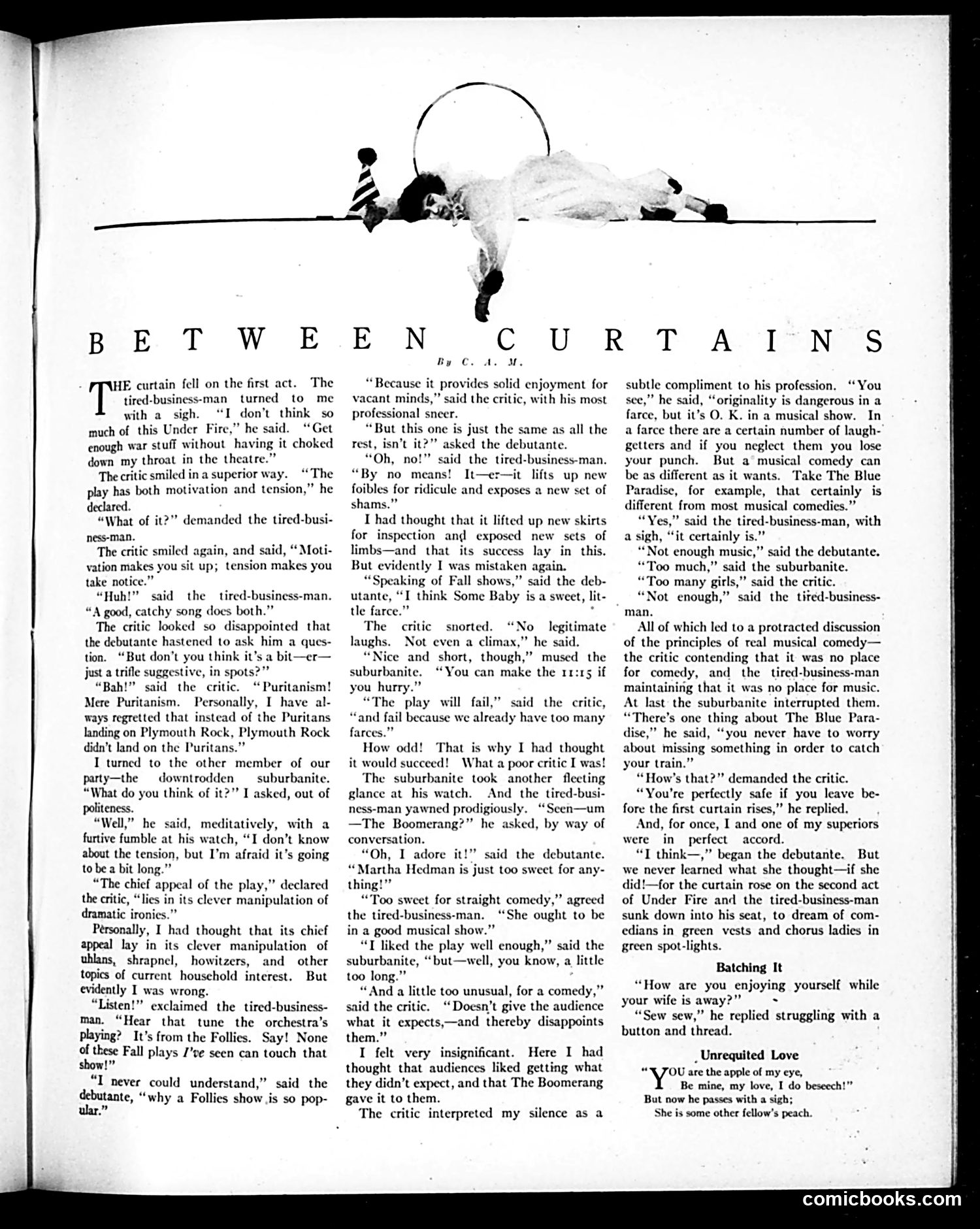
This page satirizes the clash between theatrical critics and ordinary theatergoers. The cartoon depicts four audience members debating a play called "Under Fire": **The Characters:** - A pretentious **critic** who uses highbrow language ("motivation," "dramatic ironies," "legitimate laughs") - A **tired businessman** seeking entertainment and catchy songs - A **debutante** concerned with propriety - A **suburbanite** preoccupied with catching his train **The Satire:** The humor lies in the critic's intellectual snobbery versus the common audience's practical desires. The critic dismisses popular Follies shows as "vacant minds" entertainment while praising artistically worthy but tedious plays. Meanwhile, the businessman simply wants good music and action; the suburbanite just wants it to end on time. The point: critics privilege abstract artistic principles over what audiences actually enjoy. The critic dismisses successful shows and predicts failures, yet audiences flock to what he scorns—suggesting critics are disconnected from public taste and usefulness.
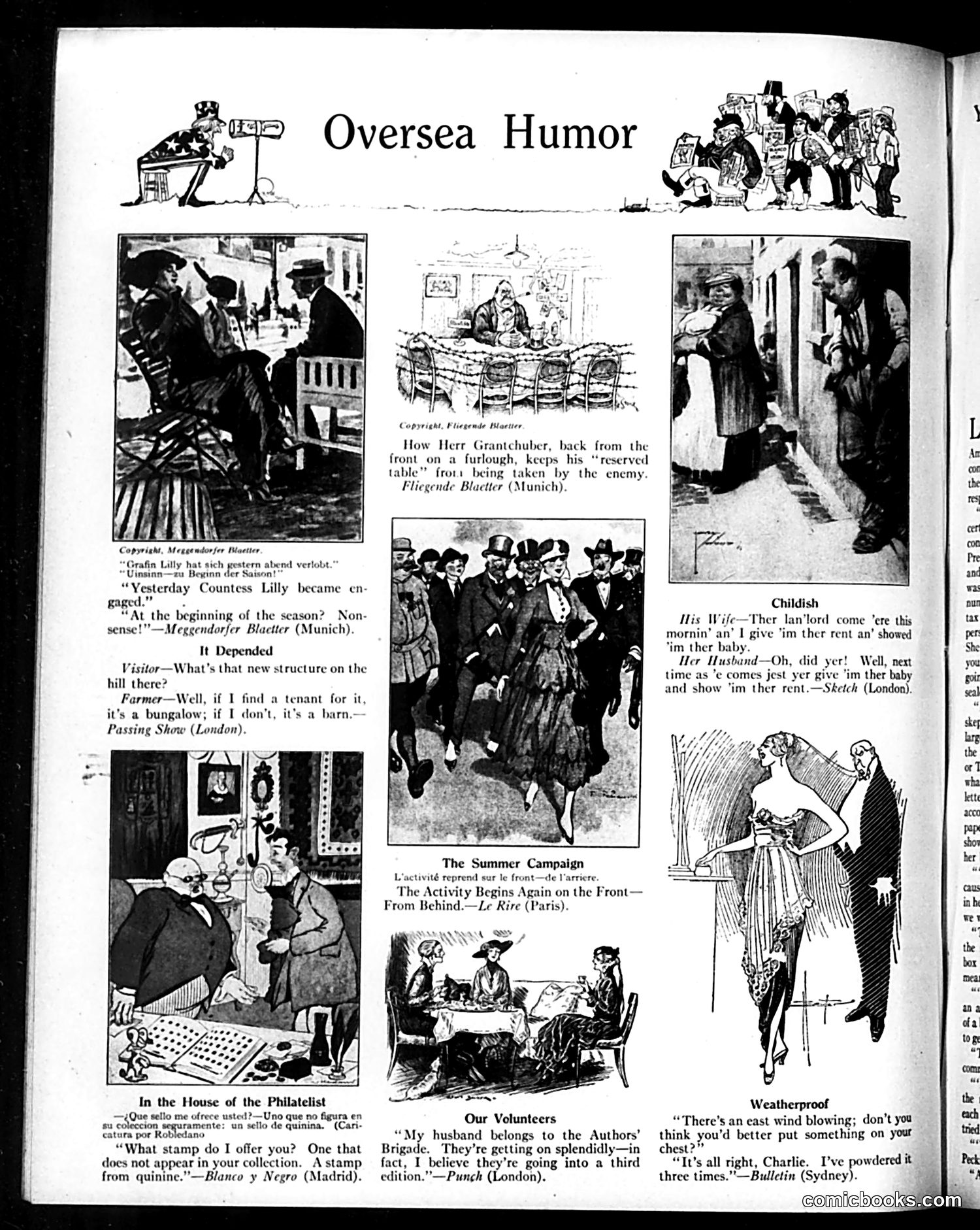
This page collects international satirical cartoons and jokes from European and British publications, demonstrating early 20th-century humor across different cultures. The content includes: **War-era satire**: References to WWI (soldiers on furlough, "Front" activity, "Authors' Brigade" jokes about military recruitment) appear throughout. **Class humor**: A philatelist's joke about rare stamps; a farmer's wordplay about whether a structure is a "bungalow" or "barn" (implying class distinctions). **Domestic/working-class comedy**: British and Spanish sketches feature landlords, rent disputes, and marital banter in working-class dialect. **Social observation**: The "Countess Lilly" engagement joke mocks seasonal social conventions among the wealthy. The page demonstrates Judge's role as a cosmopolitan outlet showcasing international wit, primarily targeting educated readers familiar with European publications and multilingual jokes. The cartoons emphasize universal themes—marriage, money, class—while the publication credits (Munich, Madrid, Paris, London, Sydney) emphasize global sophistication.
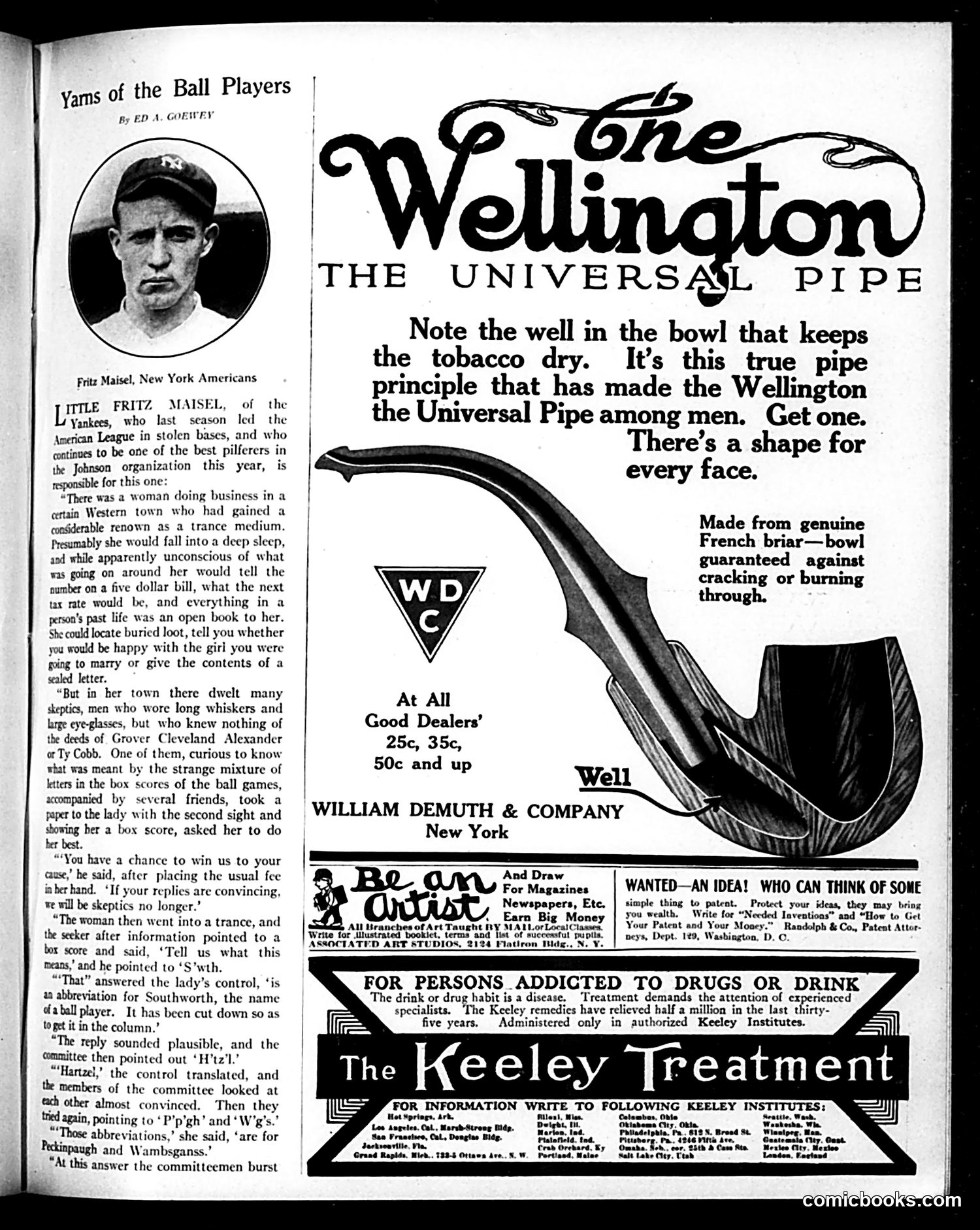
This page contains a humorous anecdote attributed to **Fritz Maisel**, a New York Yankees player known for stealing bases. The joke ridicules **spiritualist mediums**—popular fraudsters of the era who claimed supernatural powers to answer questions about the future and past. The satire works by showing how a gullible skeptic committee brings a "trance medium" a baseball box score, demanding she prove her abilities. She does—but only by pretending mysterious abbreviations (like "S'wth," "H'tz'l," "P'p'gh," and "W'g's") are actually shortened player names. The committee, unfamiliar with how baseball statistics are printed, believes her supernatural act has worked. The joke mocks both **credulous believers in spiritualism** and the **obscurity of baseball box-score notation** to general readers of the era. It's essentially a con-artist tale framed as sports anecdote. The rest of the page is primarily advertising (Wellington pipes, art lessons, the Keeley Institute for addiction treatment).
This page is **primarily advertisements** with a literary story excerpt, not political satire. The ads feature: - **Black & White Scotch Whisky**: Claims superiority through "Government supervision" and aging in sherry casks—likely referencing Prohibition-era regulations or post-WWI quality standards - **Hotel Cumberland**: NYC luxury hotel advertising modern amenities (private baths, screened windows, Oriental rugs) - **Harry P. Stimson**: Hotel proprietor credential The featured content is **"From a Sinner's Diary,"** a humorous, rambling essay-story with social observations (husbands/wives relationships, land speculators' repetitive stories) and a lengthy anecdote about a Plymouth Rock hen that survived rural mishaps and adventure. The tone is whimsical Americana. There are no identifiable political cartoons or caricatures on this page. The references to "Yankees" and baseball names (Peckinpaugh, Wambsganss) in the OCR'd text appear fragmentary and may relate to a different article not fully visible.
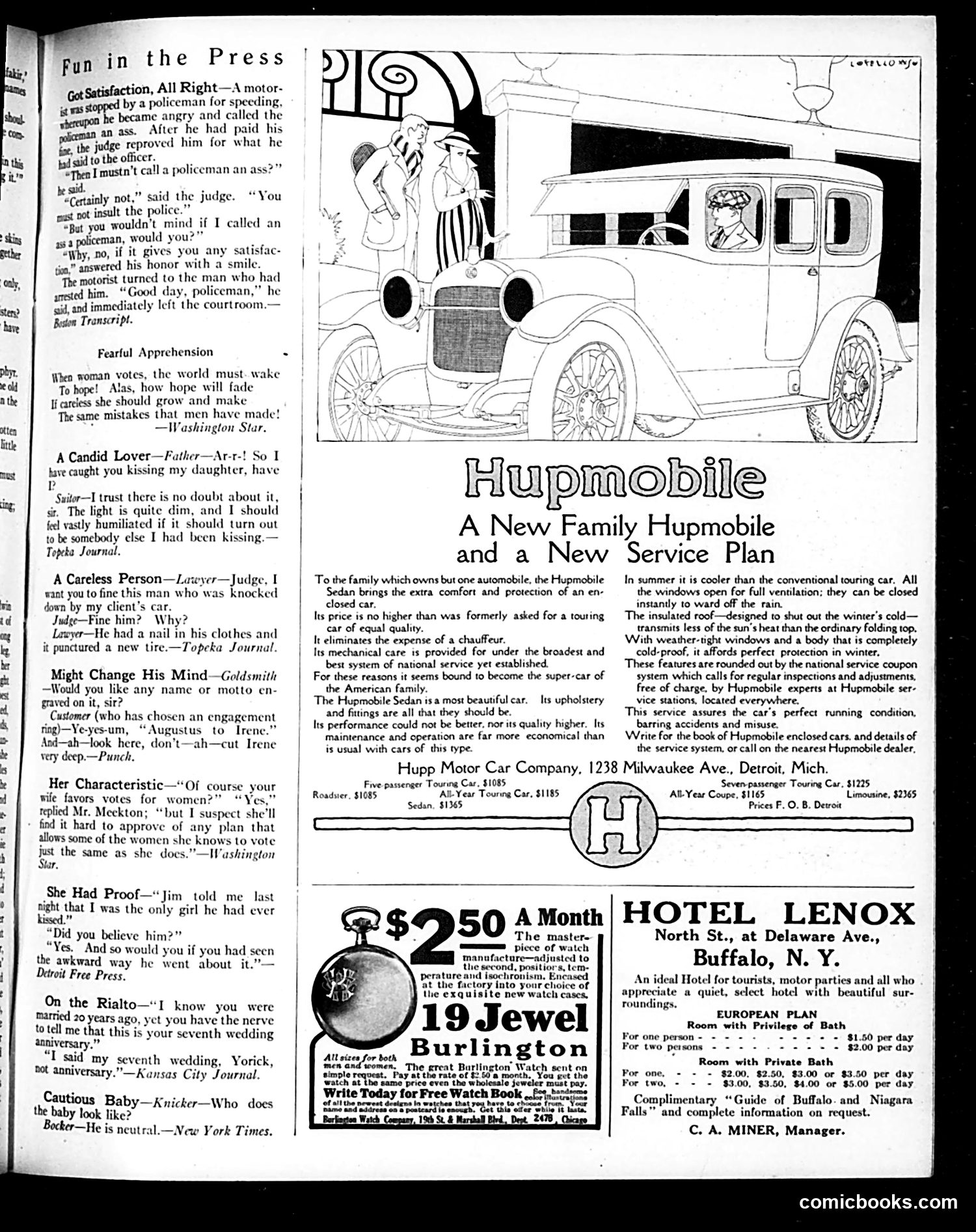
This is primarily an **advertising and humor page** from Judge magazine. The main content consists of: **Left side:** Brief satirical jokes from various newspapers, including: - A motorist insulting a policeman and getting comeuppance from a judge - Jokes about women's suffrage ("Fearful Apprehension") - Various relationship and marital humor pieces **Central cartoon:** Shows a man being stopped by a police officer while driving, illustrating the "Got Satisfaction, All Right" anecdote about a speeding motorist. **Right side:** Large **Hupmobile automobile advertisement** promoting their new enclosed sedan, emphasizing comfort, weather protection, and economical operation compared to touring cars. **Bottom:** Advertisements for a Burlington watch ($2.50/month payment plan, 19 jewels) and Hotel Lenox in Buffalo. The page reflects **early 1910s concerns**: women's voting rights, automobile culture, and consumer goods. It's essentially a humor-and-advertising hybrid typical of Judge magazine's format—light social commentary mixed with commercial promotion.
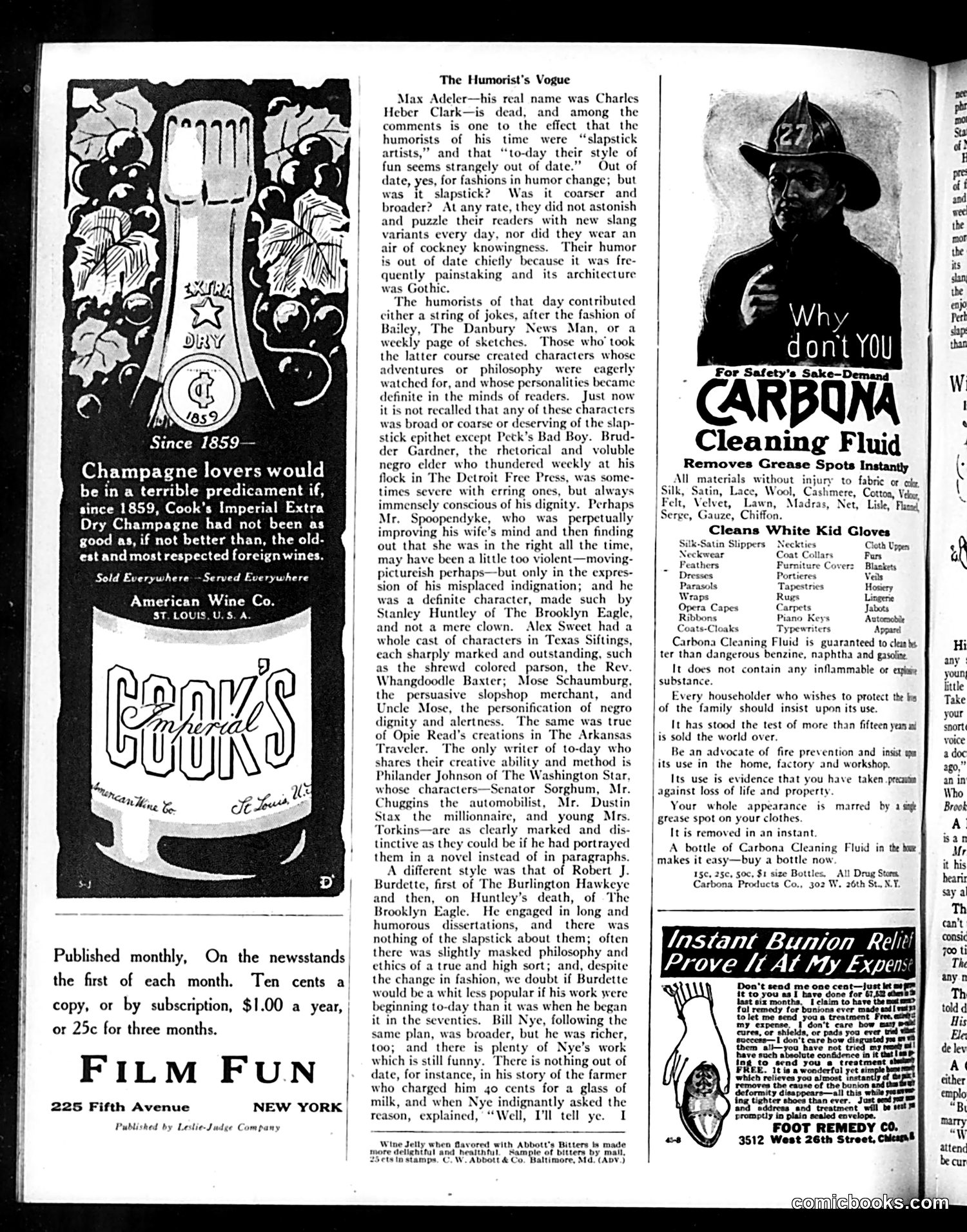
This page is primarily **an essay about humor history**, not a political cartoon. The main article, "The Humorist's Vogue," eulogizes Max Adeler (Charles Heber Clark), a deceased humorist, and defends 19th-century American humor against claims it was crude "slapstick." The author argues that earlier humorists like Petk's Bad Boy, Brudder Gardner, and Alex Sweet created **memorable, well-developed characters**—not mere buffoons. He contrasts this with contemporary humor and praises Philander Johnson of *The Washington Star* as the modern equivalent, whose characters (Senator Sorghum, Mr. Chuggins) are equally distinctive. The piece is a **cultural defense**: dismissing old humor as "slapstick" misses its architectural sophistication. The argument suggests fashions change, but quality endures. The page also contains **period advertisements** (Cook's Champagne, Carbona Cleaning Fluid, Foot Remedy) and a notice that *Film Fun* magazine costs 10 cents.
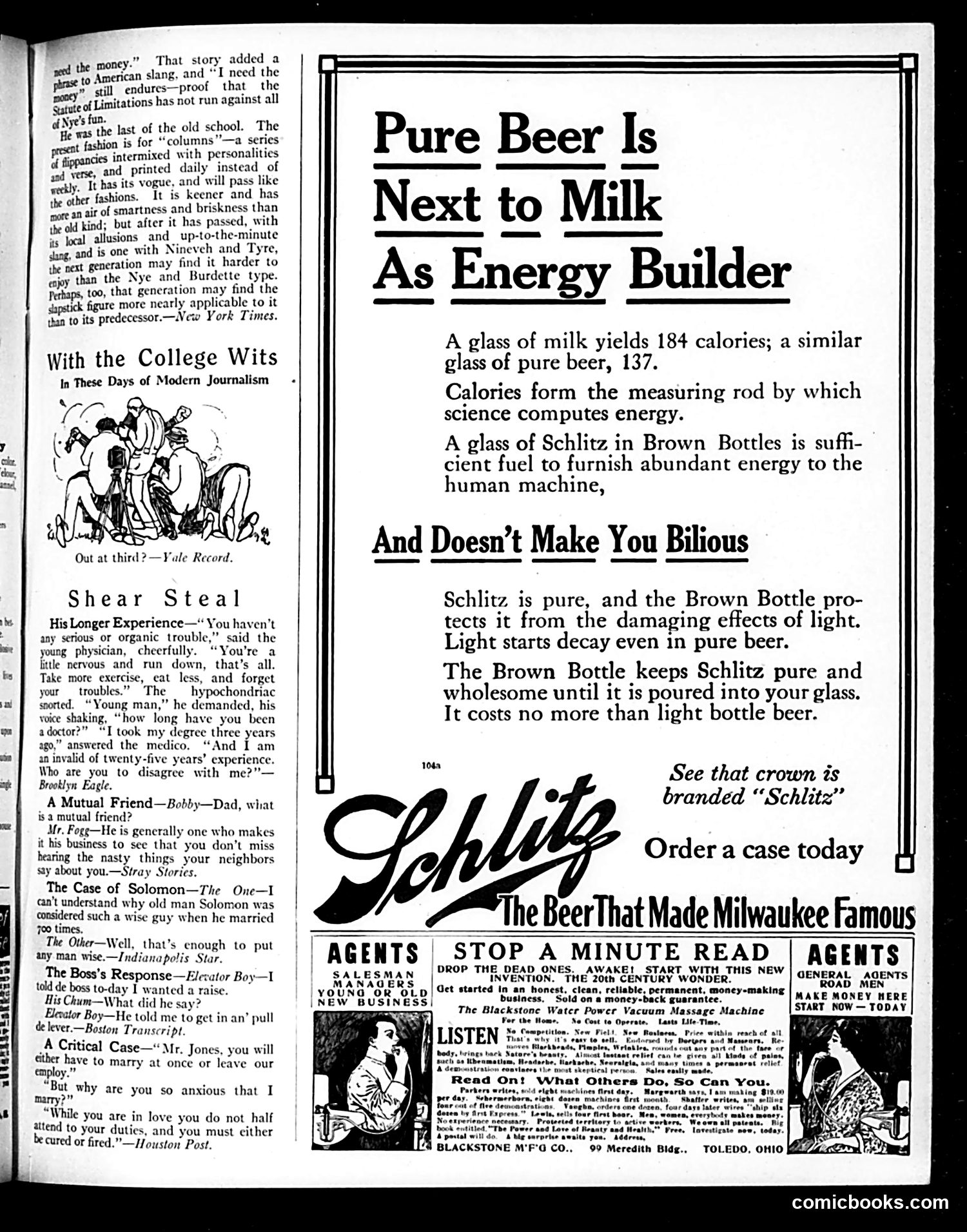
This page combines satirical humor with period advertising. The left side features short joke pieces typical of Judge magazine's humor section—brief anecdotes mocking hypochondriacs, misunderstandings of language, and social awkwardness. These rely on turn-of-the-century conventions: the anxious patient, the literal-minded youth, the presumptuous youth contradicting experience. The dominant content is a **Schlitz beer advertisement** making health claims now illegal: that beer equals milk as an "energy builder," with precise calorie counts (137 vs. 184). The ad emphasizes the brown bottle's supposed purity advantages—protecting beer from light damage. The slogan, "The Beer That Made Milwaukee Famous," references the city's prominent brewing industry. Below appear recruiting ads for agents and salesmen—common classified advertisements of the era. The advertisement's pseudo-scientific health claims (calories measuring energy, beer as fuel) reflect pre-FDA regulation practices, when brewers freely made nutritional and medicinal assertions without scientific substantiation.
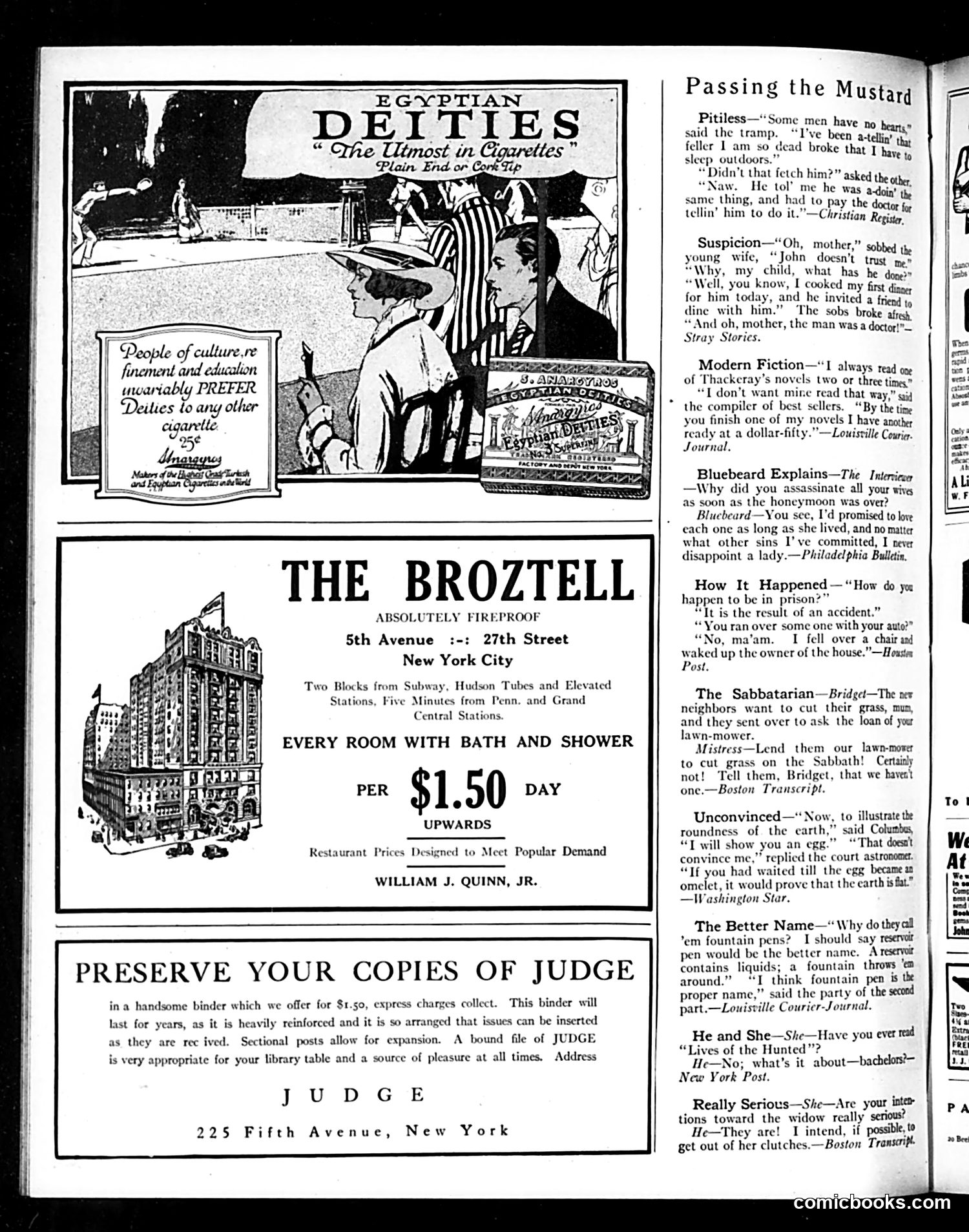
This page is primarily **advertising and humor**, not political cartooning. The top advertisement shows **Egyptian Deities cigarettes**, using an Orientalist aesthetic popular in early 20th-century marketing. The satire targets cultural pretension: wealthy consumers prefer cigarettes branded with references to ancient civilization over ordinary brands. Below are three hotel and magazine advertisements with no satirical content. The right column contains **humorous anecdotes** ("Passing the Mustard," etc.)—short jokes on domestic life, marriage, and courtship. These represent Judge's standard humor formula: brief, pun-heavy scenarios mocking human foibles like marital suspicion, pretentious literature consumption, and romantic mishaps. The humor is genteel, middle-class oriented, and relies on wordplay rather than social commentary. No specific political figures or events are referenced. This is typical filler content from an era when magazines mixed advertising with light entertainment.
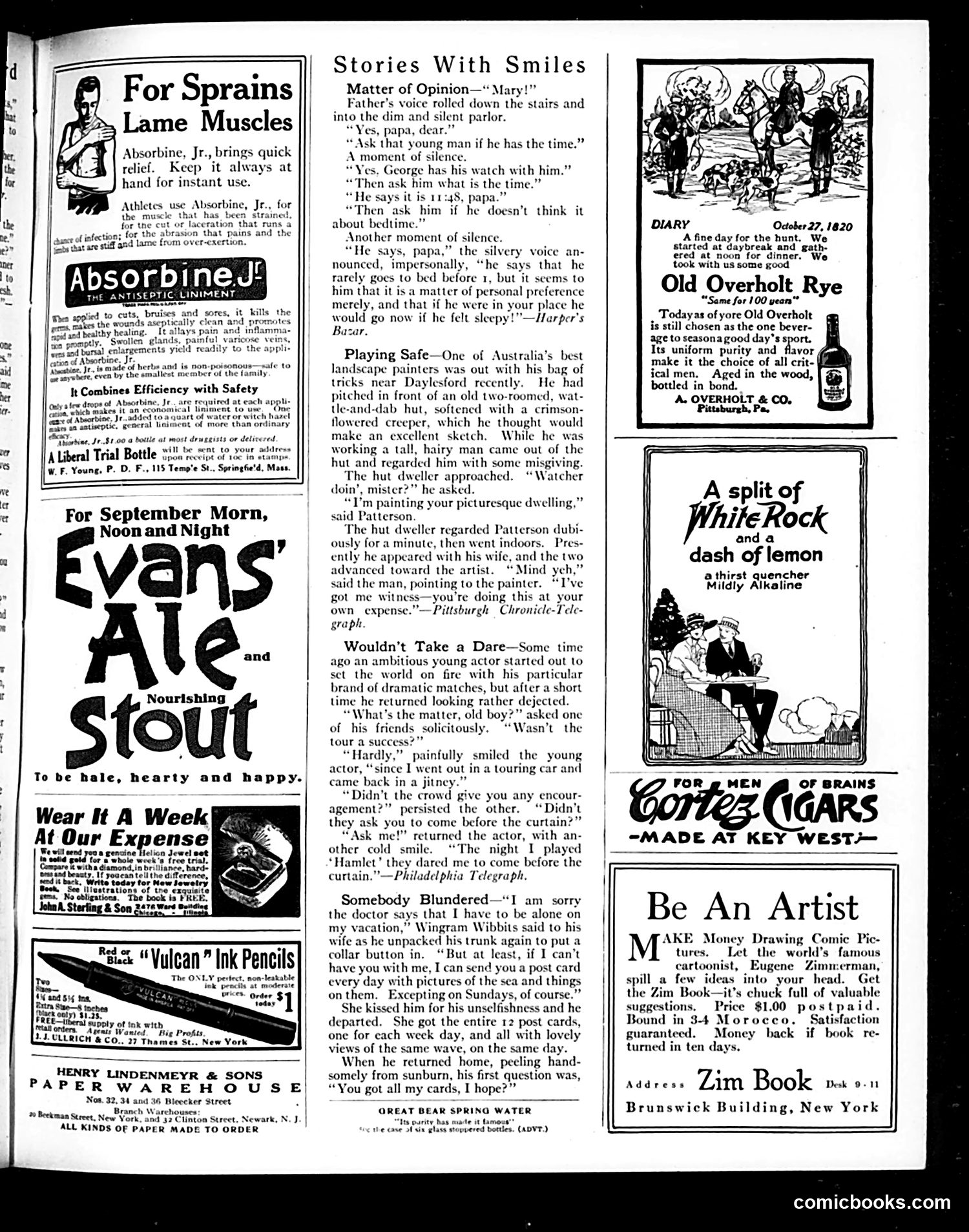
This page is primarily **advertisements and humor fillers**, not political satire. The content includes: **Left side**: Product ads (Absorbine Jr. liniment, Evans' Ale, ink pencils, paper warehouse). **Center**: "Stories With Smiles"—brief humorous anecdotes with no political content: - A father uses his daughter as intermediary to hint a suitor should leave - An Australian painter is confronted by a suspicious hut-dweller who demands a "witness" to prove he's not committing a crime - A struggling actor returns from a failed touring production (possibly performed in a "jitney"—a cheap vehicle) - A man's vacation plans disrupted by a missing collar button **Right side**: Advertisements (Old Overholt Rye whiskey, White Rock lemon soda, Gorges cigars, "Be An Artist" mail-order cartooning course). The humor relies on everyday domestic situations and social awkwardness—typical light entertainment for Judge's audience rather than political commentary.
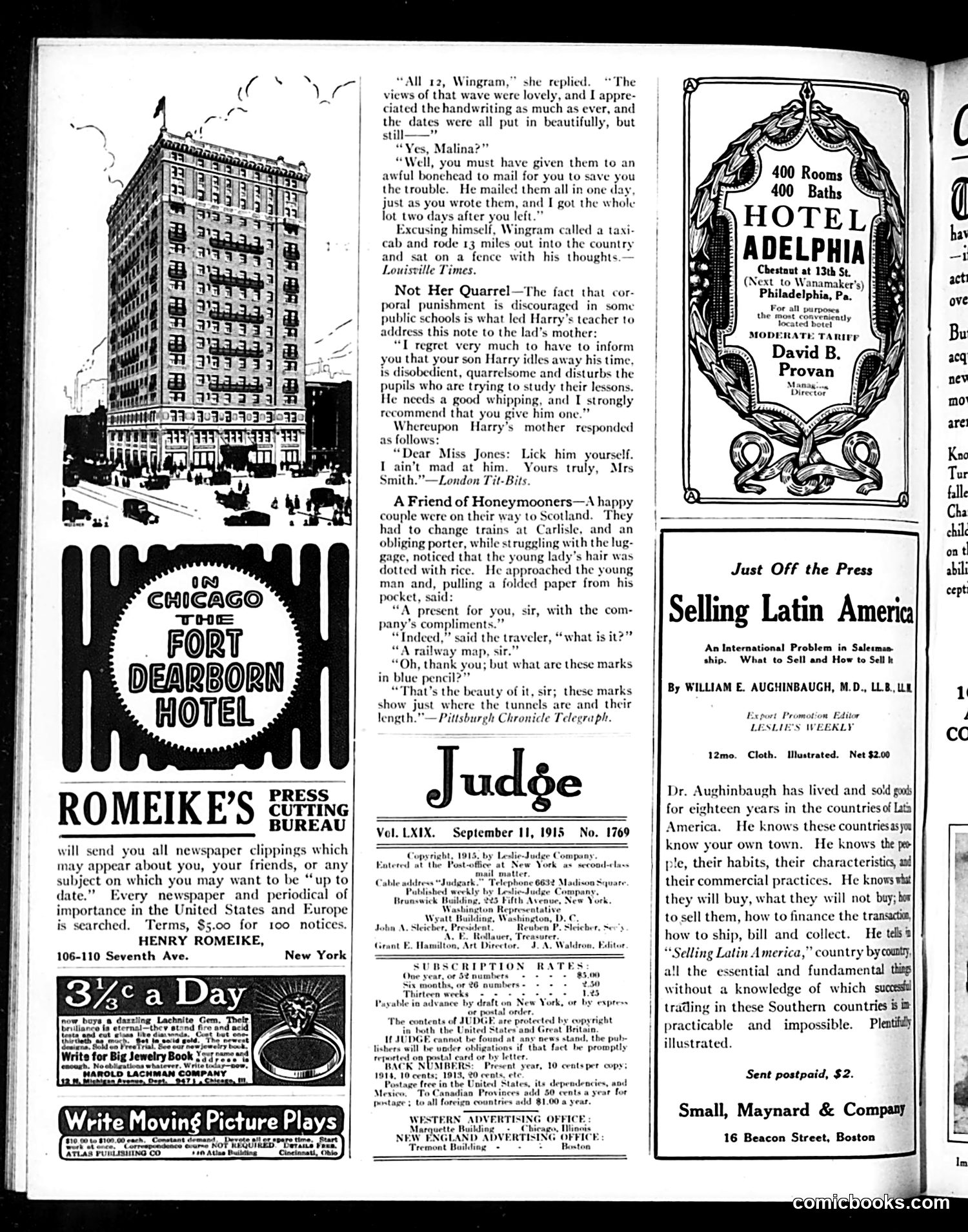
This page is primarily **advertisements and text content** rather than political cartoons. The main elements are: **Advertisements:** The Fort Dearborn Hotel (Chicago), Romeike's Press Cutting Bureau (a clipping service), and a book advertisement for "Selling Latin America" by William E. Aughinbaugh. **Humor Sections:** The page contains three brief anecdotes rather than political satire: - A story about misdated letters causing romantic confusion - A school discipline anecdote mocking progressive education policies (a teacher's note recommending corporal punishment, met with a mother's sarcastic refusal) - A honeymoon joke about a porter giving newlyweds a railway map marked with tunnel locations as a "present" The only substantive social commentary appears in "Not Her Quarrel," which satirizes the contemporary debate over eliminating corporal punishment in public schools—a real Progressive-era educational reform controversy. Otherwise, this is a standard magazine issue mixing light humor with commercial advertising.
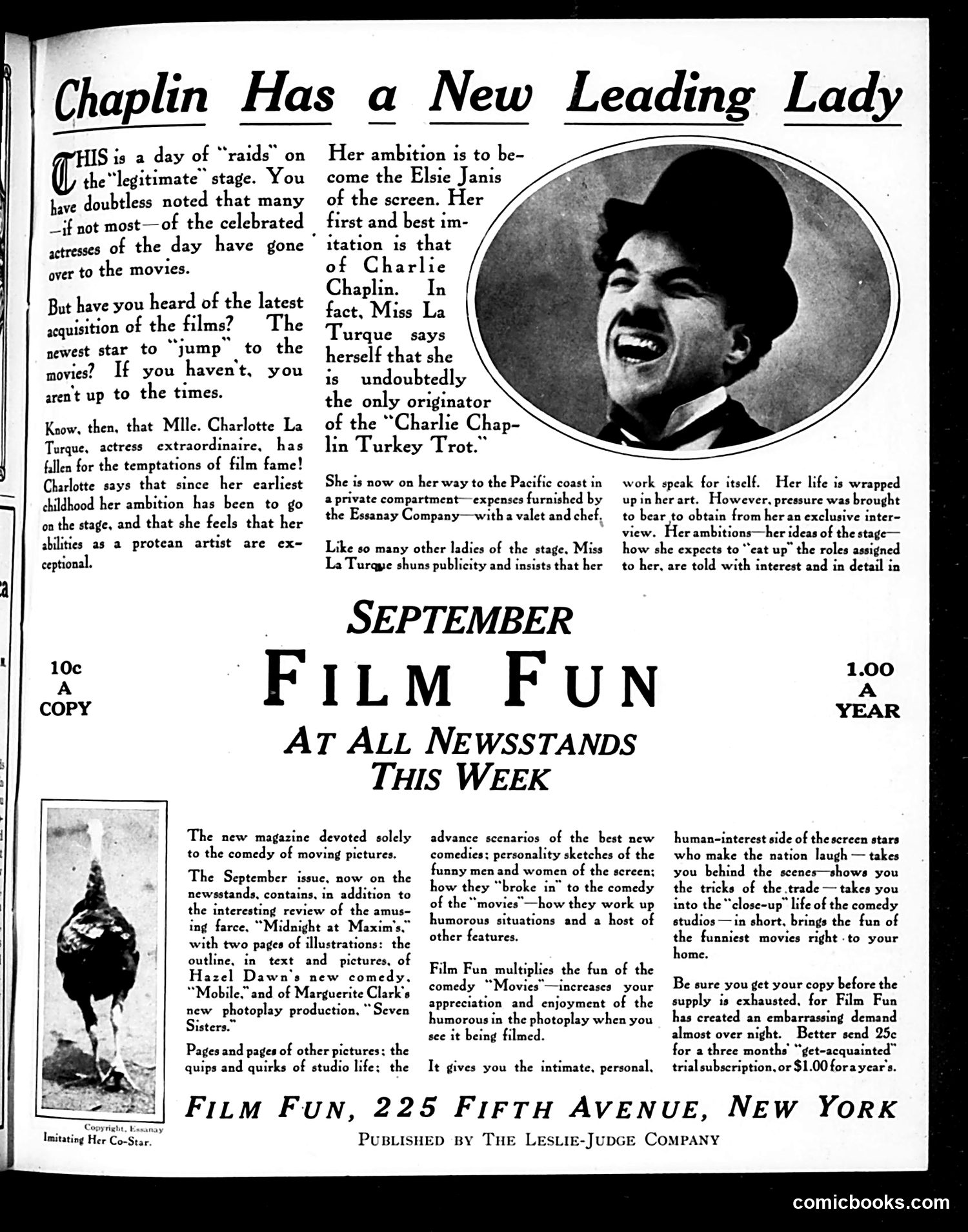
This is primarily **advertising copy** for *Film Fun* magazine (September issue), disguised as entertainment journalism. The "Chaplin Has a New Leading Lady" article is a fictional puff piece promoting the magazine itself. **The Setup:** The text announces that stage actresses are increasingly moving to film—a real trend of the era. It then introduces "Mlle. Charlotte La Turque," who claims to be the originator of the "Charlie Chaplin Turkey Trot" and is heading to Essanay Company (a real early film studio) with a valet and chef. **The Joke:** This is likely entirely fabricated—a mock-serious celebrity profile parodying the breathless coverage of film stars. The absurdities (the character's unlikely name, her pretentious claims, the over-the-top travel arrangements) signal this is satirical. **The Point:** The ad promotes *Film Fun* magazine by demonstrating the gossipy, behind-the-scenes Hollywood content it allegedly offers—backstage stories, personality sketches, and insider access to comedy filmmaking.
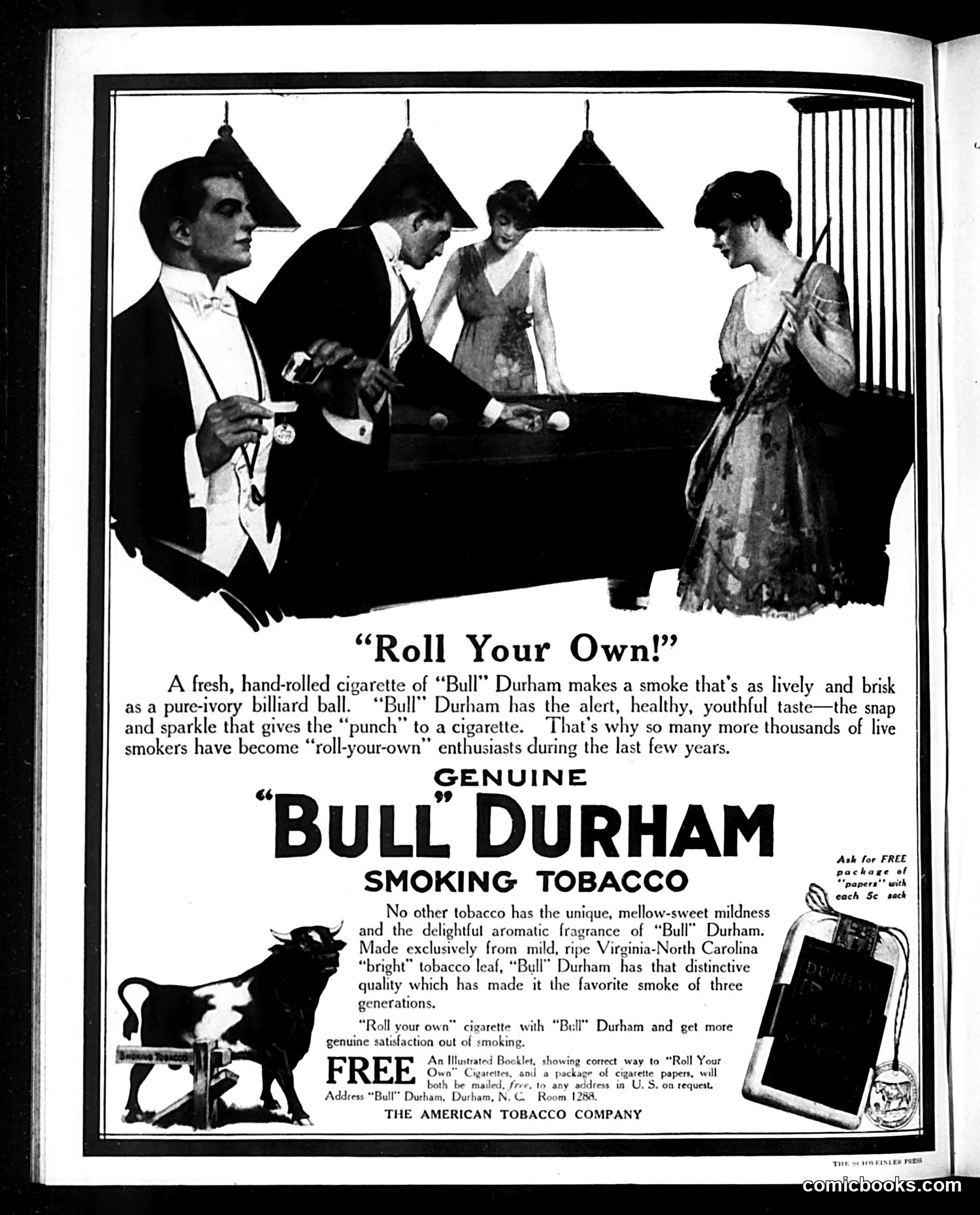
This page is **primarily an advertisement**, not political satire. It's a Bull Durham smoking tobacco ad from *Judge* magazine, featuring a social scene at what appears to be a billiard hall or gentleman's club. The image shows well-dressed figures—men in formal wear and women in period dress—gathered around a pool table. The ad uses aspirational imagery to market hand-rolled cigarettes as sophisticated and socially desirable. The "Roll Your Own!" slogan promoted the practice of rolling loose tobacco into cigarettes, positioning it as fresher and more satisfying than factory-made options. The text emphasizes Bull Durham's "alert, healthy, youthful taste"—marketing language that would be shocking today given tobacco's known health effects. The bull logo and offer of free rolling papers and instruction booklets were standard tobacco marketing tactics of the early 20th century. This represents pre-regulation advertising when such claims were uncontested and health warnings nonexistent.