
Judge, 1915-09-11 · page 7 of 28
Judge — September 11, 1915 — page 7: what you’re looking at
What you’re looking at
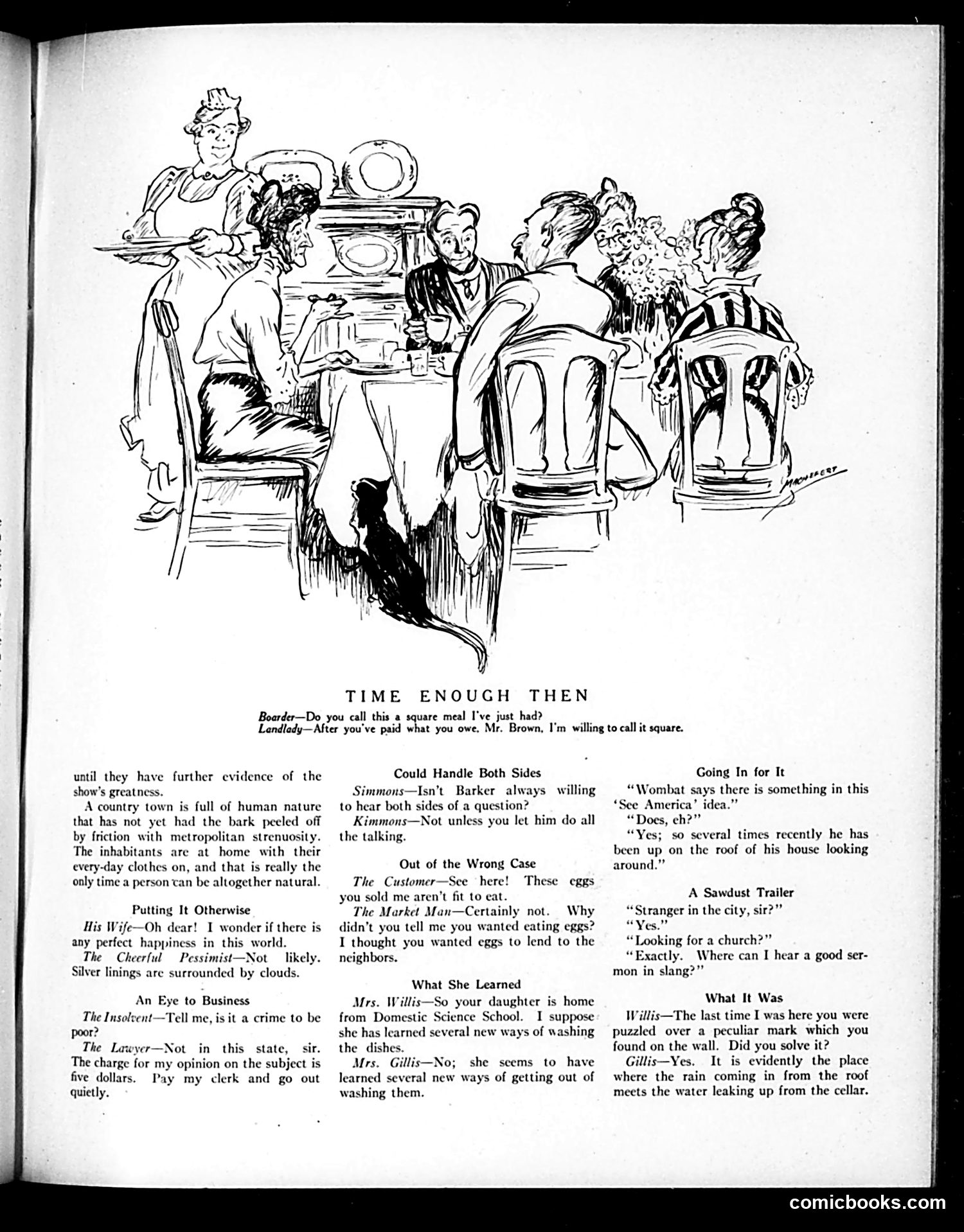
This page contains multiple brief humorous vignettes typical of early 20th-century American satirical magazines. The main cartoon, "Time Enough Then," depicts a boarder and landlady in a familiar domestic conflict: he complains about the meal's quality, and she retorts that she'll call it "square" only after he pays his outstanding debt—a pun on "square meal." The surrounding short jokes mock various social types: a lawyer who charges for obvious advice, a market vendor selling inedible eggs, a pessimist who finds no silver linings, and a man searching for churches with sermons "in slang." One joke mocks a daughter's domestic science education as teaching avoidance rather than actual housework. These satirize working-class struggles (unpaid rent, poor food quality), professional cynicism, failed social aspirations, and changing gender roles. The humor relies on wordplay and class-based observations recognizable to Judge's educated, middle-class readership.
📄 Transcribed text from this page (OCR, searchable)
Machine-transcribed from the original scan — historical spelling and the odd misread are preserved.
TIME ENOUGH THEN Boarder—Do you call this a square meal I've just had? Lendlady—After you've paid what you owe, Mr. Brown, I'm willing to call it square. until they have further evidence of the show's greatness. A country town is full of human nature that has not yet had the bark peeled off by friction with metropolitan strenuosity. The inhabitants are at home with their every-day clothes on, and that is really the only time a person can be altogether natural. Putting It Otherwise His Wife—Oh dear! I wonder if there is in this world. Cheerful Pessimist—Not likely. Silver linings are surrounded by clouds. An Eye to Business The Insolvent—Tell me, is it a crime to be poor? The Lawyer—Not in this state, sir. The charge for my opinion on the subject is five dollars. Pay my clerk and go out quietly. Could Handle Both Sides Simmons—Isn’t Barker always willing to hear both sides of a question? Kimmons—Not unless you let him do all the talking. Out of the Wrong Case The Customer—Sce here! These eggs you sold me aren't fit to eat. The Market Man—Certainly not. Why didn’t you tell me you wanted eating eggs? I thought you wanted eggs to lend to the neighbors. What She Learned Mrs. Willi: from Domest she has learned the dish Mrs. Gillis—No; she seems to have learned several new ways of getting out of washing them. your daughter is home ience School. I suppose everal new ways of washing Going In for It “Wombat says there is something in this ‘See America’ idea.” “Does, ch?” “Yes; so several times recently he has been up on the roof of his house looking around.” A Sawdust Trailer “Stranger in the city, sir?” “Yes.” “Looking for a church?” “Exactly. Where can I hear a good ser- mon in slang?” What It Was Willis—The last time I was here you were puzzled over a peculiar mark which you found on the wall. Did you solve it? Gillis—Yes. It is evidently the place where the rain coming in from the roof meets the water leaking up from the cellar. comicbooks.com