
Judge, 1915-09-11 · page 4 of 28
Judge — September 11, 1915 — page 4: what you’re looking at
What you’re looking at
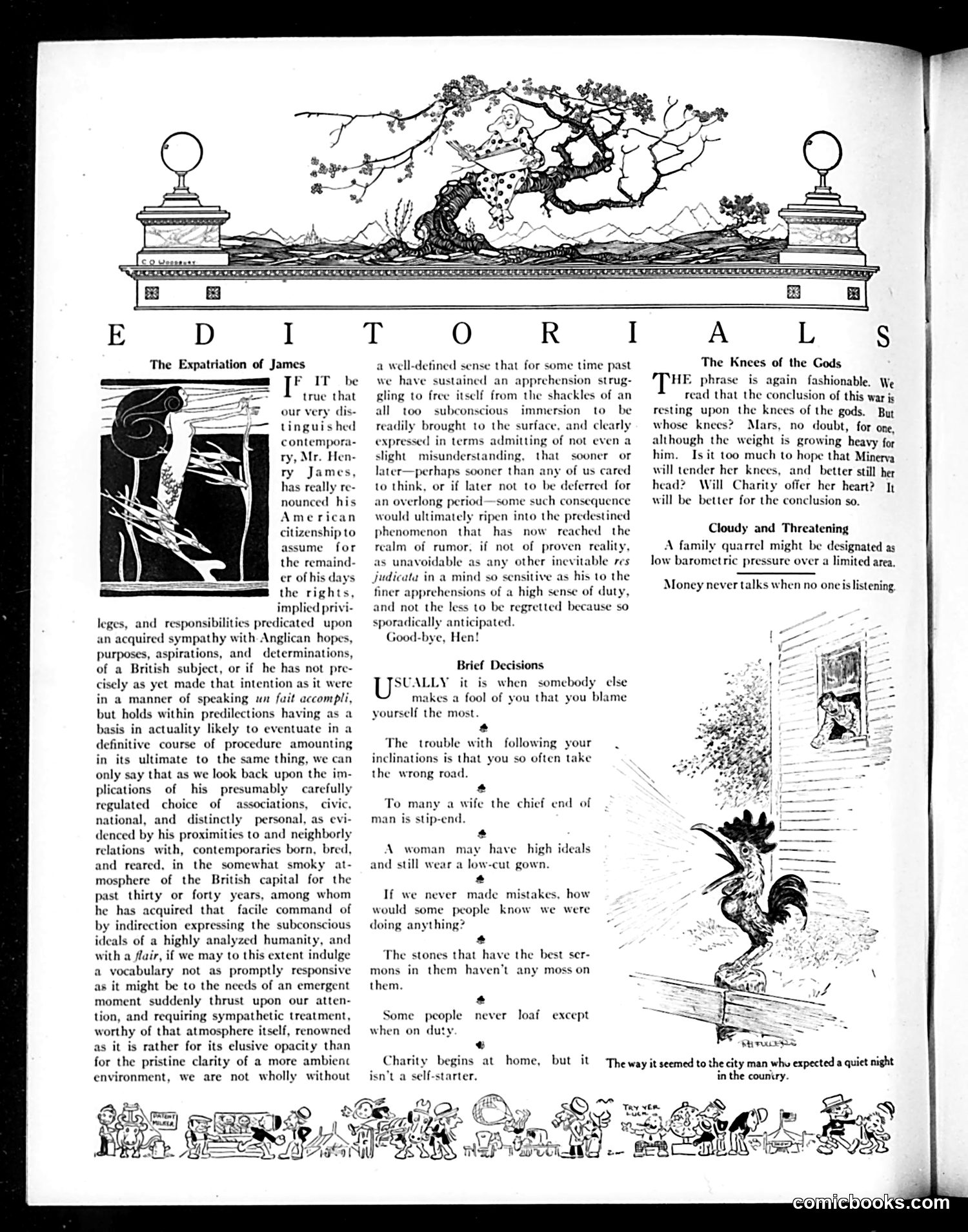
This editorial page from *Judge* magazine contains three distinct sections: **"The Expatriation of James"** (left): A substantial article discussing someone named James who has renounced American citizenship. The text debates whether this decision represents legitimate philosophical grounds or reflects poorly on American society. The accompanying illustration shows a figure in profile. **"The Knees of the Gods"** (right): Commentary on a war's conclusion and divine intervention, referencing Mars and whether the gods will offer charity. **"Brief Decisions"** (center): A collection of aphoristic observations on human nature—marriage, ideals, mistakes, and charity—presented without clear satirical targets. The bottom features a decorative border with small illustrated vignettes of everyday life. Without clearer identification of "James" or the specific war referenced, the precise historical context remains unclear.
📄 Transcribed text from this page (OCR, searchable)
Machine-transcribed from the original scan — historical spelling and the odd misread are preserved.
The Expatriation of James I IT be true that our very dis- tinguished contempora- ry, Mr. Hen- ry James, has really re- nounced his American citizenship to assume for the remaind- er of his days the right implied pri leges, and responsibilities predicated upon an acquired sympathy with Anglican hopes, spirations, and determinations, h subject, or if he has not pre- cisely as yet made that intention as it were in a manner of speaking un fait accompli, but holds within predilections having as a basis in actuality likely to eventuate in a © course of procedure amounting in its ultimate to the same thing, we can only say that as we look back upon the im- plications of his presumably carefully regulated choice of associations, civic, ional, and distinct personal, as evi- denced by his proximities to and neighborly relations with, contemporaries born, bred, and reared, in the somewhat smoky at- mosphere of the British capital for the past thirty or forty years, among whom he has acquired that facile command of by indirection expressing the subconscious ideals of a highly analyzed humanity, and with a flair, if we may to this extent indulge a vocabulary not as promptly responsive as it might be to the needs of an emergent moment suddenly thrust upon our atten- tion, and requiring sympathetic treatment, worthy of that atmosphere itself, renowned as it is rather for its elusive opacity than for the pristine clarity of a more ambienc environment, we are not wholly without —) Y t Ses) eRe ps® PL BES Ll a well-defined sense that for some time past we have sustained an apprehension strug- gling to free itself from the shackles of an all too subconscious immersion to be readily brought to the surface, and clearly expressed in terms admitting of not even a slight’ misunderstanding, that sooner or later—perhaps sooner than any of us cared to think, or if later not to be deferred for an overlong period —some such consequence would ultimately ripen into the predestined phenomenon that has now reached the realm of rumor, if not of proven reality, as unavoidable as any other inevitable res judicata in a mind so sensitive as his to the finer apprehensions of a high sense of duty, and not the less to be regretted because so sporadically anticipated. Good-bye, Hen! Brief Des Usury it is when somebody else makes a fool of you that you blame yourself the most. 2 The trouble with following your inclinations is that you so often take the wrong road. & To many a wife the chief end of man is stip-end. s \ woman may have high ideals and still wear a low-cut gown. 2 If we never made mistakes, how would some people know we were doing anything? 2 The stones that have the best ser- mons in them haven't any moss on them. ¢ Some people never loaf except when on duty. * Charity begins at isn’t a self-starter. home, but it The Knees of the Gods HE phrase is again fashionable. We read that the conclusion of this war js resting upon the knees of the gods. But whose knees? Mars, no doubt, for one, although the weight is growing heavy for him. Is it too much to hope that Minerva will tender her knees, and_ better still her head? Will Charity offer her heart? It will be better for the conclusion so. Cloudy and Threatening A family quarrel might be designated as low barometric pressure over a limited area, Money never talks when no one is listening. Mares ‘The way it seemed to the city man why expected a quiet night in the couniry. ww