
Judge, 1915-09-11 · page 13 of 28
Judge — September 11, 1915 — page 13: what you’re looking at
What you’re looking at
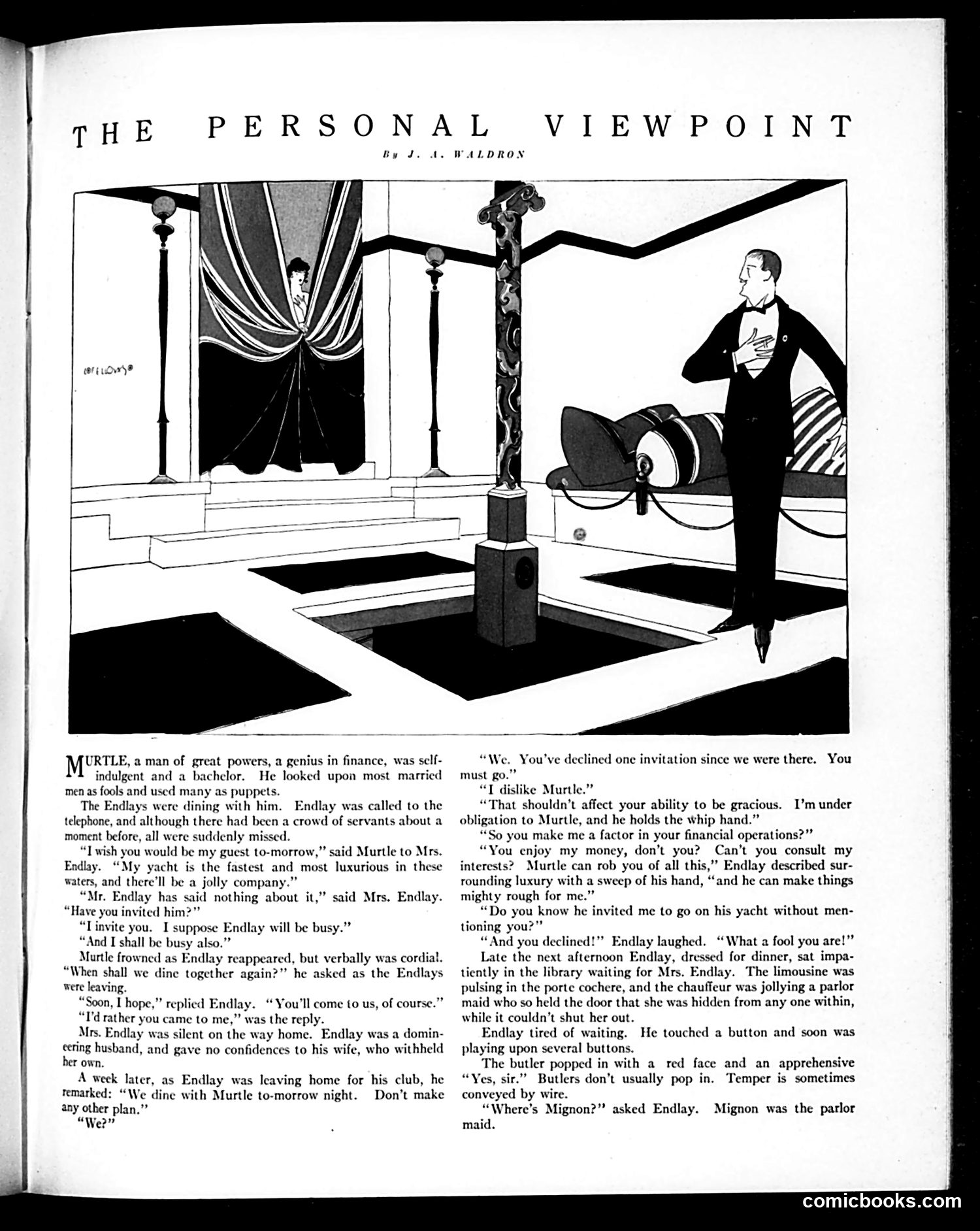
This satirical story critiques marital power dynamics among the wealthy. Murtle, a wealthy financier and bachelor, attempts to manipulate Mrs. Endlay by inviting her alone to his yacht—a social impropriety. Her husband Endlay, financially dependent on Murtle's goodwill, bullies his wife into compliance, explicitly stating Murtle "holds the whip hand" and controls their luxury lifestyle. The cartoon illustrates this dynamic: Endlay stands in his elegant home, a puppet-like figure awaiting his wife. The satire targets how wealthy men like Murtle use financial power to dominate social situations and marriages, and how husbands like Endlay treat wives as assets to be leveraged for business advantage rather than as autonomous people. The humor is dark—exposing the transactional, exploitative nature of gilded-age marriages among the financially powerful.
📄 Transcribed text from this page (OCR, searchable)
Machine-transcribed from the original scan — historical spelling and the odd misread are preserved.
THB PERSONAL By J. aA VIEWPOINT WALDRON MERE, aman of great powers, a genius in finance, was sclf- indulgent and a bachelor. He looked upon most married men as fools and used many as puppets. The Endlays were dining with him. Endlay was called to the telephone, and although there had been a crowd of servants about a moment before, all were suddenly missed. “IT wish you would be my guest to-morrow,” said Murtle to Mrs. Endlay. “My yacht is the fastest and most luxurious in these waters, and there'll be a jolly company.” “Mr. Endlay has said nothing about it, “Have you invited him?” “Linvite you. I suppose Endlay will be busy.” “And I shall be bus: s Murtle frowned as Endlay reappeared, but verbally was cordial. “When shall we dine together again?” he asked as the Endlays were leaving. “Soon, I hope,” replied Endlay. “ You'll come to us, of course.” “T'd rather you came to me,” was the reply. Mrs. Endlay was silent on the way home. Endlay was a domin- cering husband, and gave no confidences to his wife, who withheld her own. A week lat Endlay was leaving home for his club, he remarked: “We dine with Murtle to-morrow night. Don’t make any other plan.”” “Wer” said Mrs. Endlay. “We. You've declined one invitation since we were there. You must go.”” “T dislike Murtle.” “That shouldn’t affect your ability to be gracious. obligation to Murtle, and he holds the whip hand.” “So you make me a factor in your financial operations?” “You enjoy my money, don’t you? Can’t you consult my interests? Murtle can rob you of all this,” Endlay described sur- rounding luxury with a sweep of his hand, “and he can make things mighty rough for me.” “Do you know he invited me to go on his yacht without men- tioning you?” “And you declined!” Endlay laughed. “What a fool you are!” Late the next afternoon Endlay, dressed for dinner, sat impa- tiently in the library waiting for Mrs. Endlay. The limousine was pulsing in the porte cochere, and the chauffeur was jollying a parlor maid who so held the door that she was hidden from any one within, while it couldn’t shut her out. Endlay tired of waiting. He touched a button and soon was playing upon several buttons. he butler popped in with a red face and an apprehensive “Yes, sir.” Butlers don’t usually pop in. Temper is sometimes conveyed by wire. “Where’s Mignon?” asked Endlay. maid. I’m under Mignon was the parlor comicbooks.com