
A complete issue · 28 pages · 1915
Judge — July 17, 1915
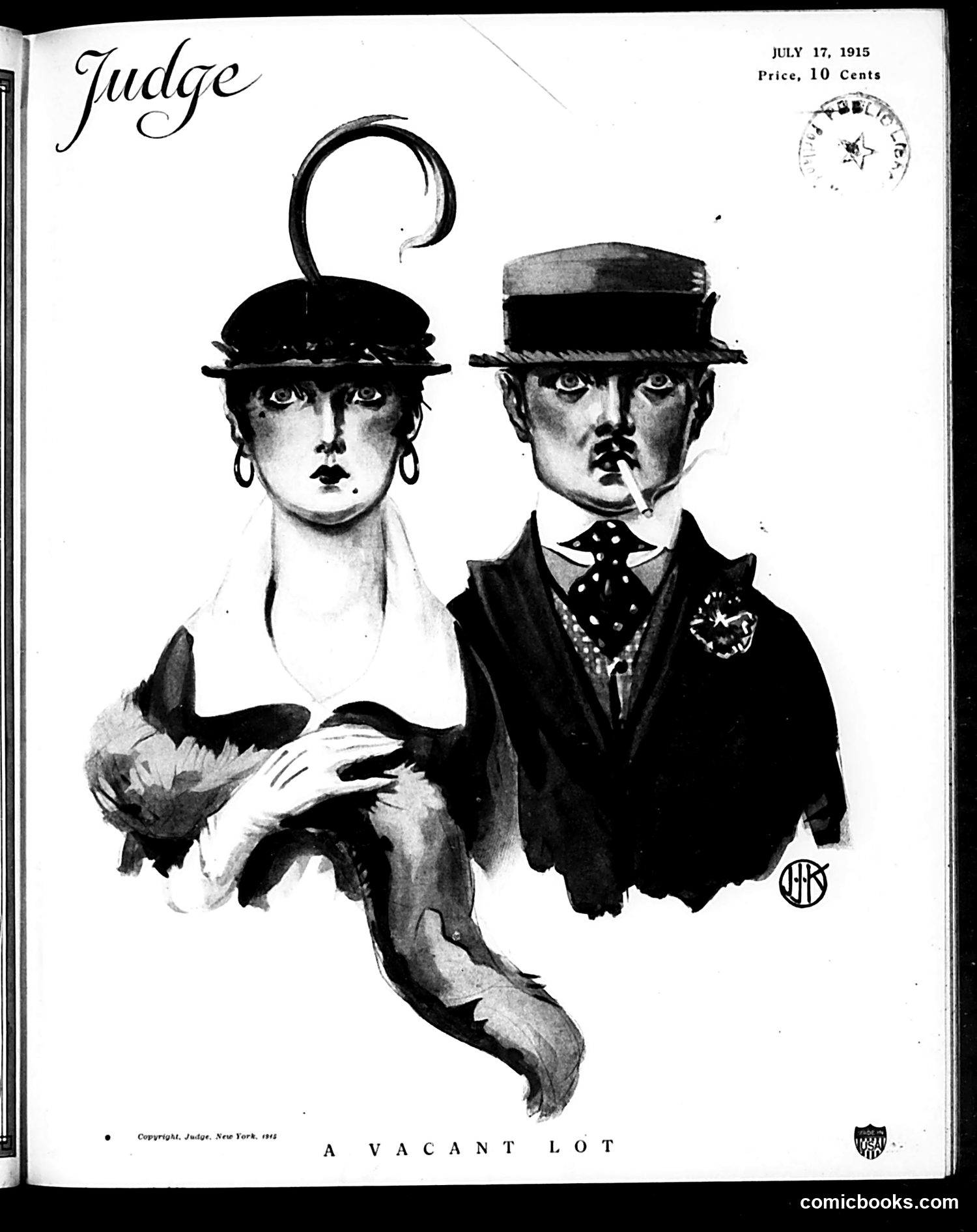
This cartoon satirizes two figures labeled as a "vacant lot"—a real estate term for unused, empty property. The illustration depicts a well-dressed man and woman with exaggerated, vacant expressions and empty stares, their faces drawn to emphasize intellectual emptiness. The woman wears fashionable 1915 attire with an elaborate hat; the man sports a formal suit and polka-dot tie. The satire likely targets either members of high society or wealthy individuals known for their lack of substance or intelligence. The "vacant lot" metaphor suggests these people occupy space in society but contribute nothing of value—their minds, like empty real estate, are barren and undeveloped. This reflects Judge magazine's typical social commentary mocking pretentious or superficial members of the upper classes.
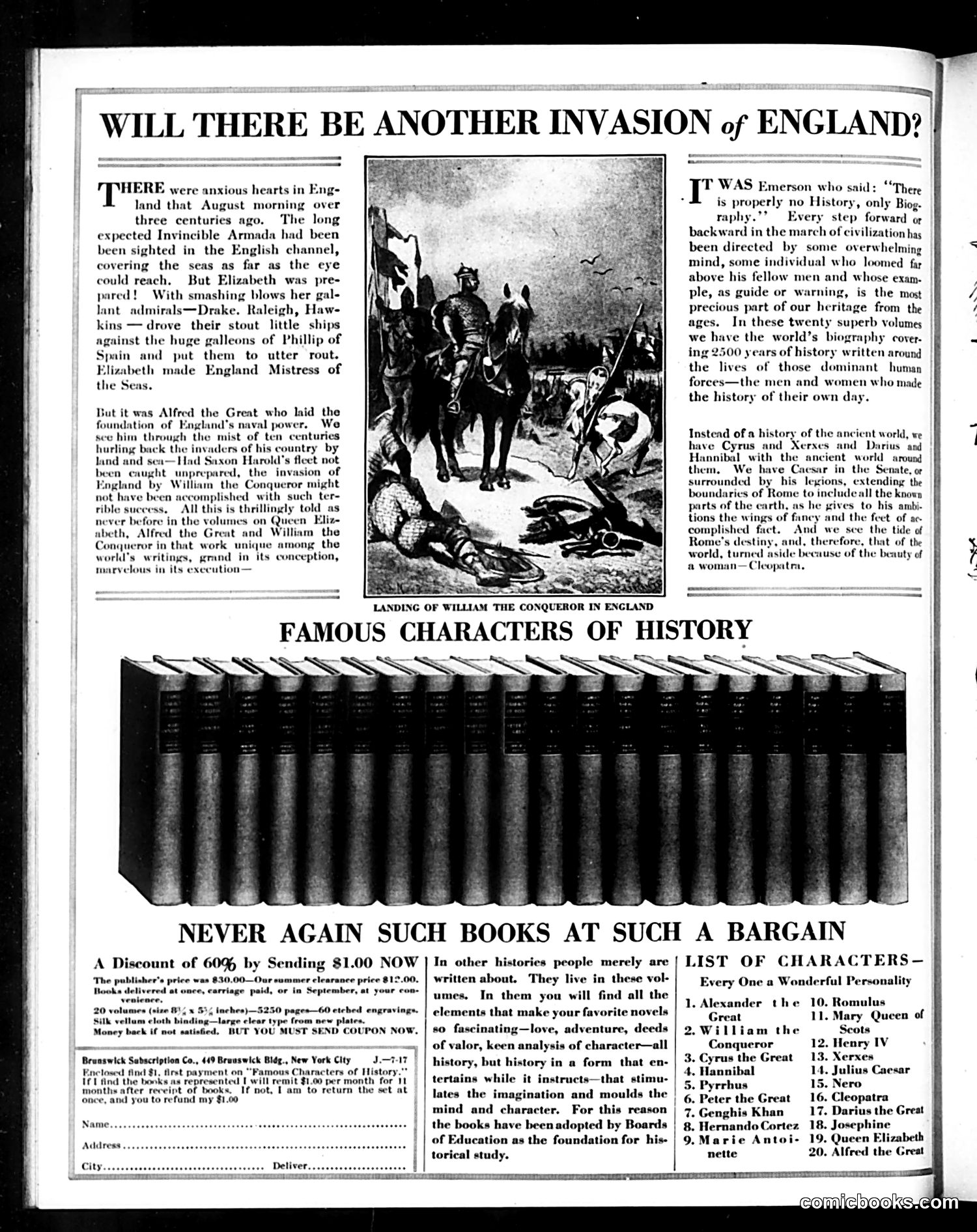
This page is primarily **advertising, not satire**. The headline "Will There Be Another Invasion of England?" is clickbait for a book series advertisement rather than political commentary. The text discusses historical invasions (the Spanish Armada, William the Conqueror) to promote a 20-volume "Famous Characters of History" encyclopedia set. The central illustration depicts William the Conqueror's 1066 landing in England—a historical image, not a cartoon. The advertisement emphasizes that these volumes contain biography-based history rather than dry historical facts, and offers a 60% discount ($1.00 down payment). The list of "characters" includes figures like Julius Caesar, Hannibal, and Cleopatra. **No political satire appears on this page.** It's a straightforward sales pitch using historical drama to market educational books.
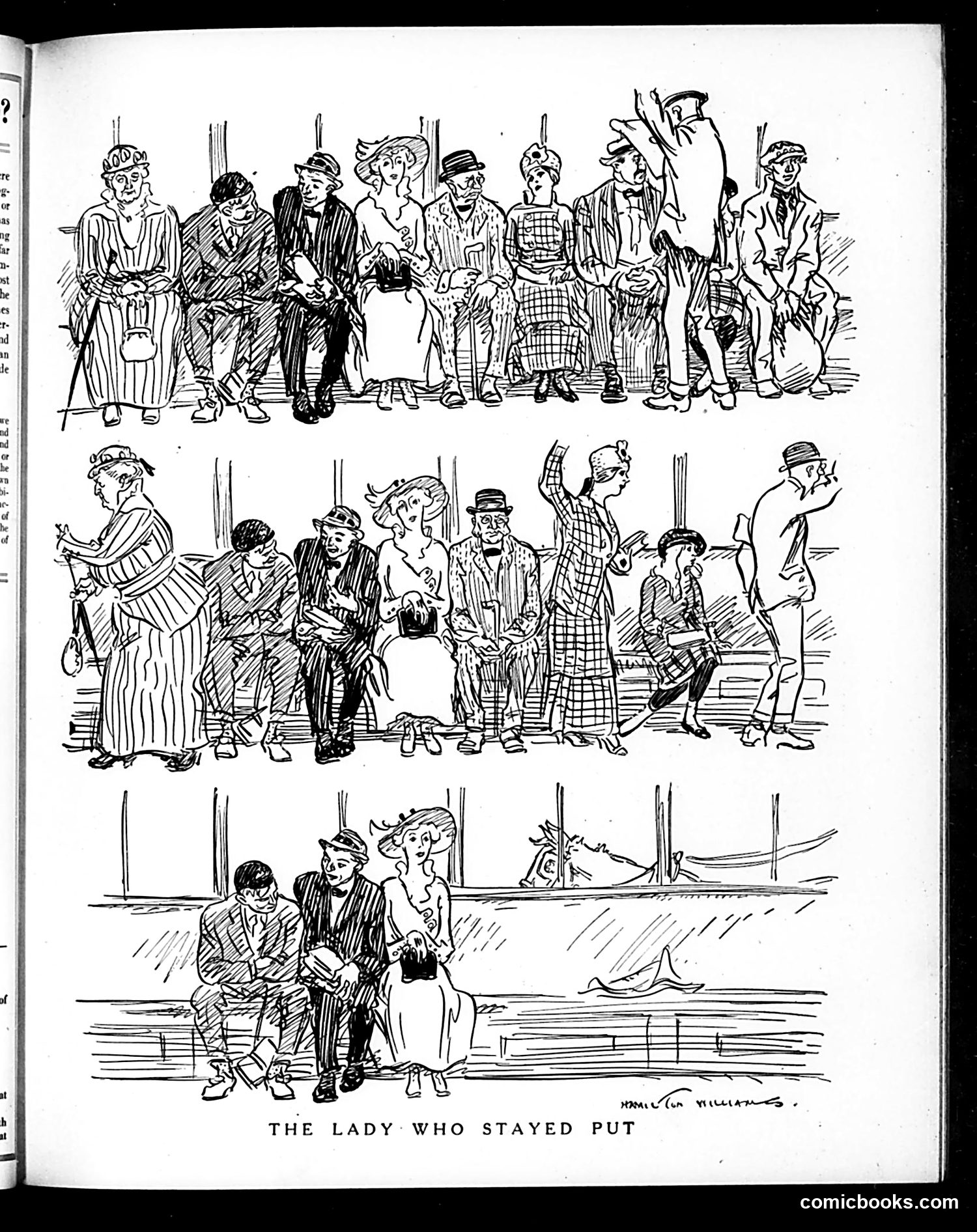
This cartoon from *Judge* magazine satirizes immigration and class attitudes of the early 20th century. The three panels show the same scene with different social groups at what appears to be a dock or emigration point. The title "The Lady Who Stayed Put" suggests the joke centers on a woman's stationary position amid changing surroundings. The artwork contrasts elegantly dressed upper-class figures with working-class immigrants and laborers. The repetition of the woman's presence across panels—while crowds of different social types rotate around her—appears to mock either xenophobic attitudes toward newcomers or the perceived immobility of established American society during periods of mass immigration. The satire likely critiques social anxiety about demographic change.
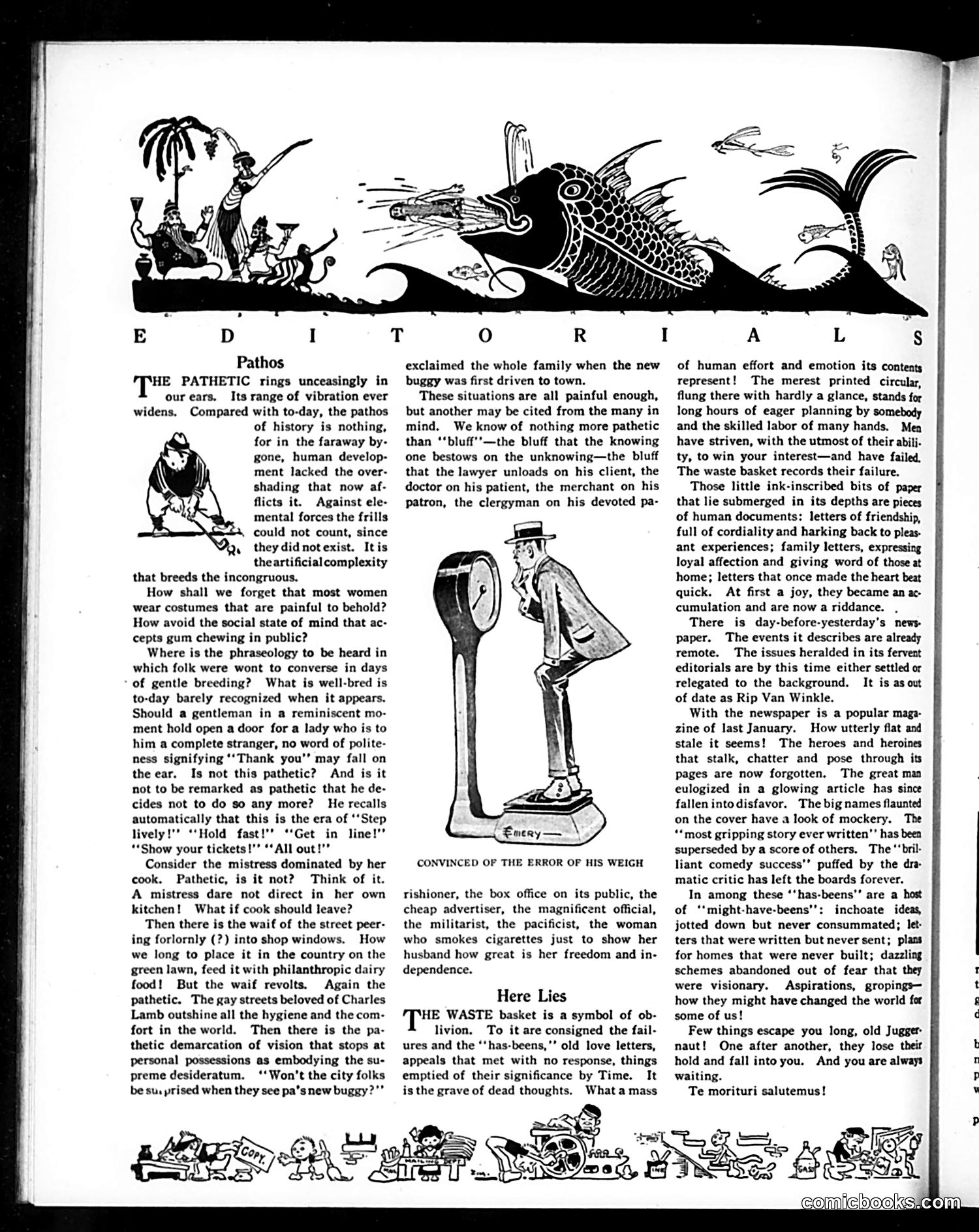
This page from *Judge* magazine critiques modern social behavior through the essay "Editorials" and accompanying illustrations. The text laments the loss of traditional courtesy and gentility—specifically mentioning how women wear painful fashion, men lack proper manners, and social hierarchies have deteriorated. The illustrations satirize these failings: a figure demonstrates improper posture or behavior; another shows a man with an oversized head labeled "Conceit," suggesting vanity; and a wastepaper basket symbolizes discarded values—"old love letters" and meaningful documents reduced to trash by Time. The piece mourns what the author sees as the erosion of refinement in the modern era, contrasting contemporary rudeness with idealized Victorian-era propriety. It's fundamentally nostalgic social criticism, typical of early 20th-century conservative commentary.
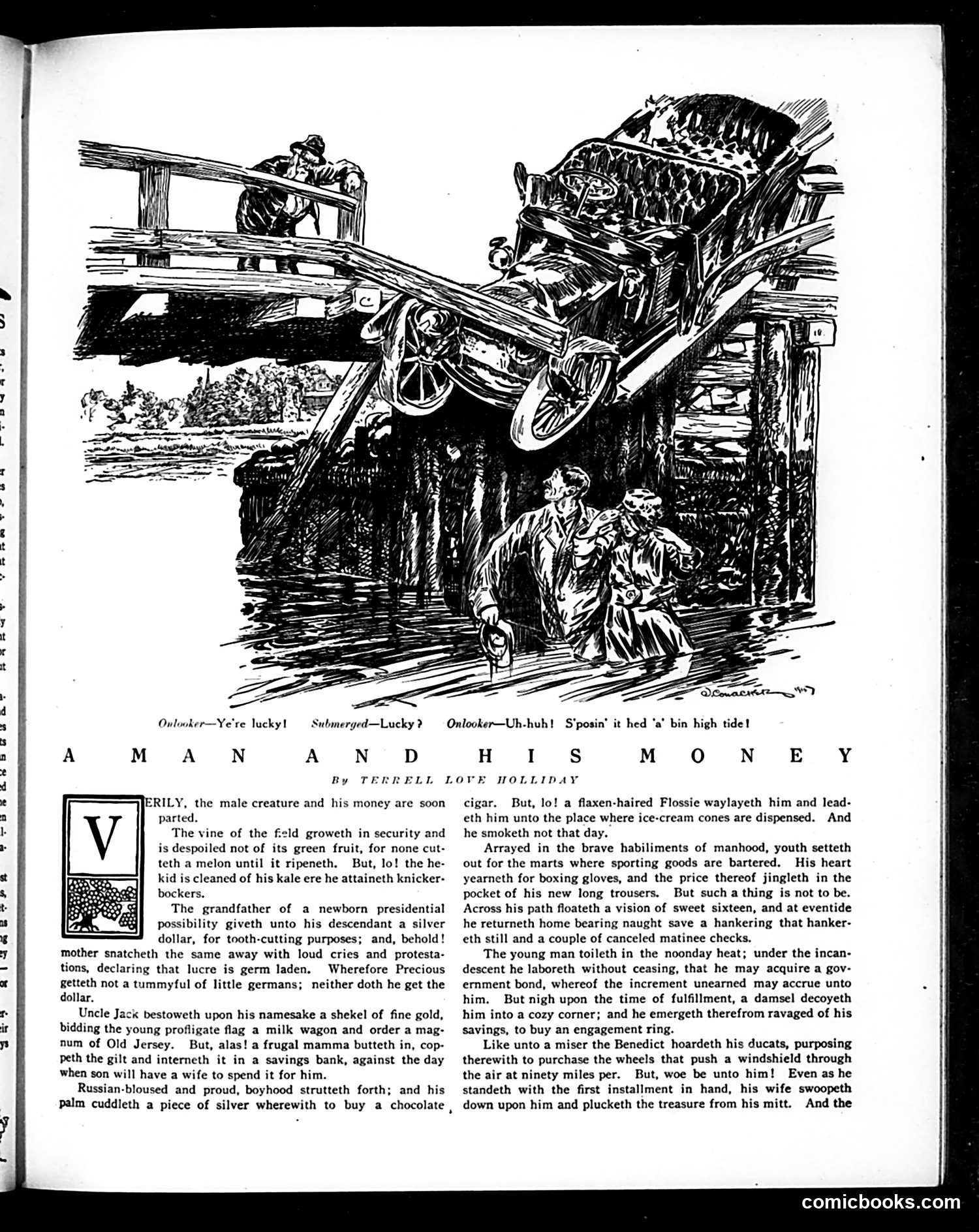
This page from *Judge* magazine presents a satirical story about a young man receiving unexpected wealth. The illustration shows dockside workers discovering what appears to be money or valuables, with one character exclaiming about "high tide." The accompanying narrative mocks the predictable folly of sudden fortune: a young man inherits money but immediately squanders it on frivolous purchases—ice cream, boxing gloves, and new clothes—rather than making prudent investments. The story sardonically notes his wife will pluck the "treasure from his mitt," suggesting his money will be spent by others. This reflects *Judge's* recurring satirical theme: the inability of the working and lower-middle classes to manage unexpected wealth responsibly, a common early-20th-century anxiety about social mobility and financial literacy.
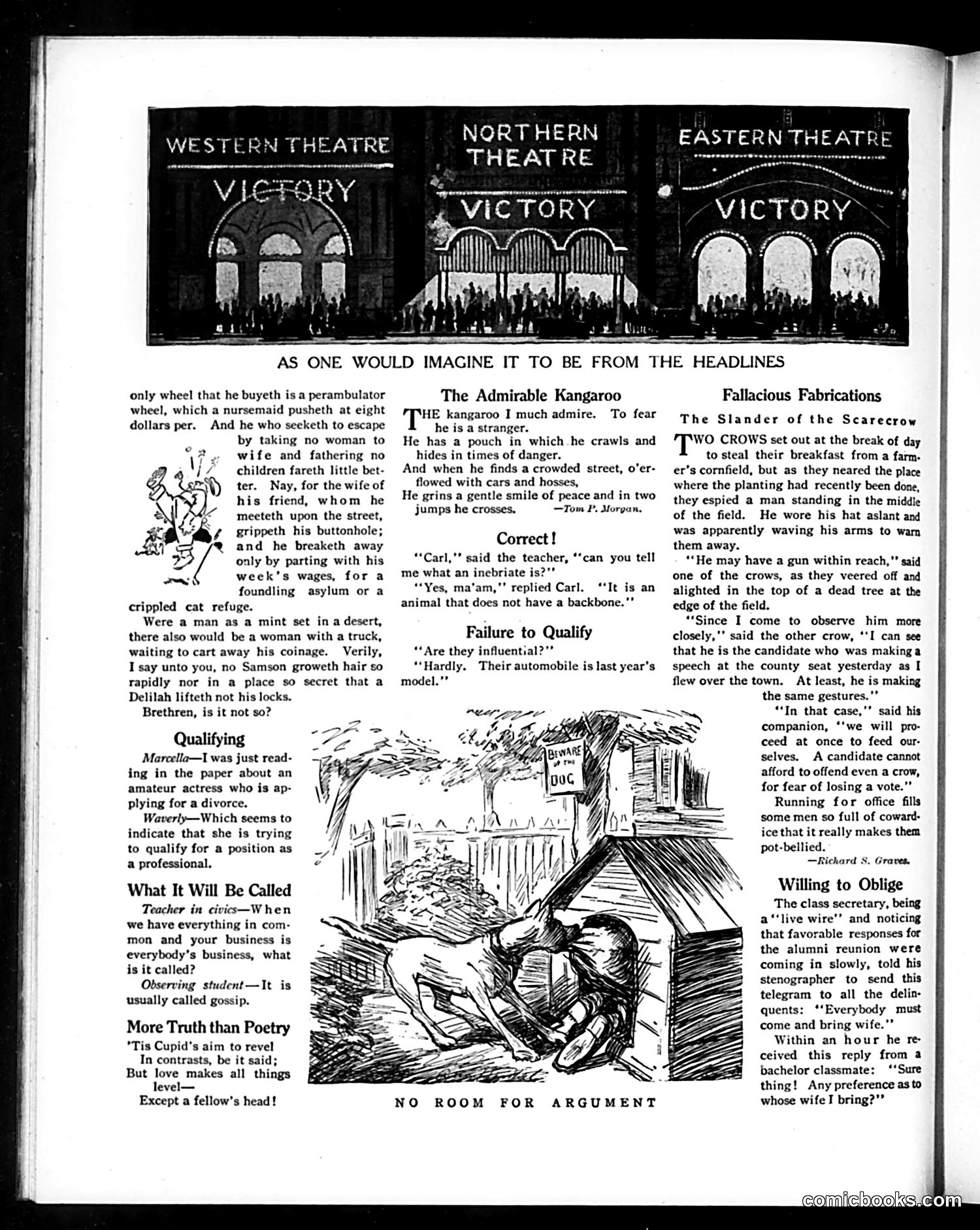
This Judge magazine page contains satirical humor typical of early 20th-century American comedy. The main sections are: **Theater Headers**: Three stylized theater fronts labeled "Victory"—likely referencing WWI victory imagery, used ironically as backdrop for mundane domestic humor. **Cartoons and Jokes**: Short satirical pieces mocking: - Marriage and women's financial demands ("a woman with a truck, waiting to cart away his coinage") - Amateur actresses seeking divorces to qualify as "professionals" - A schoolboy's crude definition of "inebriate" as an animal without a backbone - Politicians compared unfavorably to scarecrows—both make empty gestures **Tone**: The humor targets wives' spending habits, gossip, and politicians' ineffectiveness. The scarecrow cartoon specifically mocks political candidates as fraudulent and cowardly. The overall message reflects early 20th-century cynicism about marriage, women's independence, and political leadership—perspectives considered socially acceptable for satirical magazines of that era.
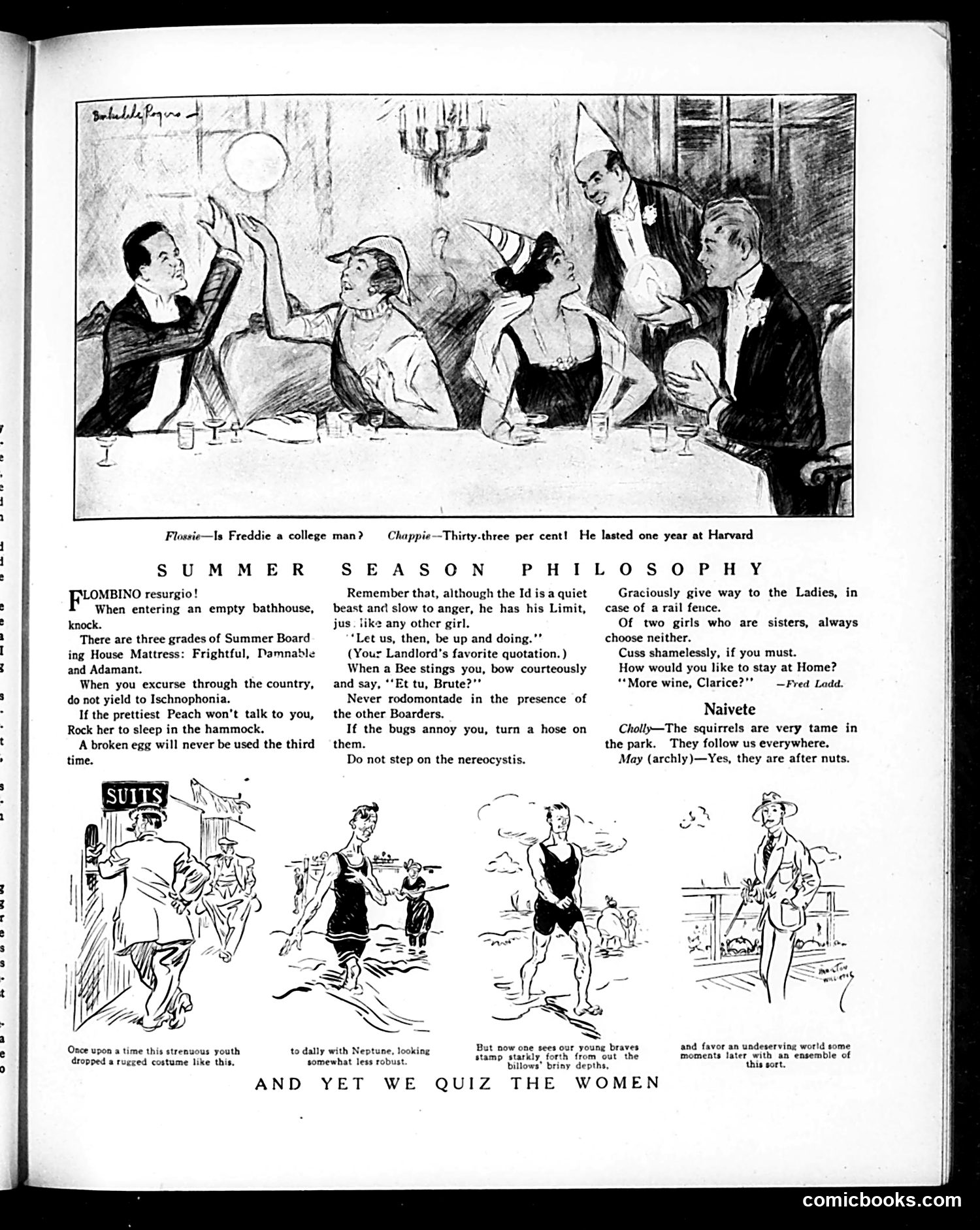
This page satirizes summer resort culture and the pretensions of young men vacationing at boarding houses. The top cartoon depicts a dinner party where "Freddie" lasted only one year at Harvard—implying he's a failed intellectual now affecting sophistication at summer resorts. The "Summer Season Philosophy" section mocks both the pseudo-intellectual attitudes of male guests (with references to Freudian psychology—"the Id") and the absurd etiquette rules of boarding house life (don't step on seaweed, bow when bees sting you). The accompanying sketches show young men awkwardly transitioning from formal wear to beach attire, satirizing their self-conscious masculinity. The final section, "And Yet We Quiz The Women," suggests women remain the real puzzle—while these men posture with fake wisdom, they fundamentally misunderstand women's motivations (the squirrel joke reveals male naïveté about female behavior). The overall satire targets upper-middle-class male vanity and pretension during the leisure season.
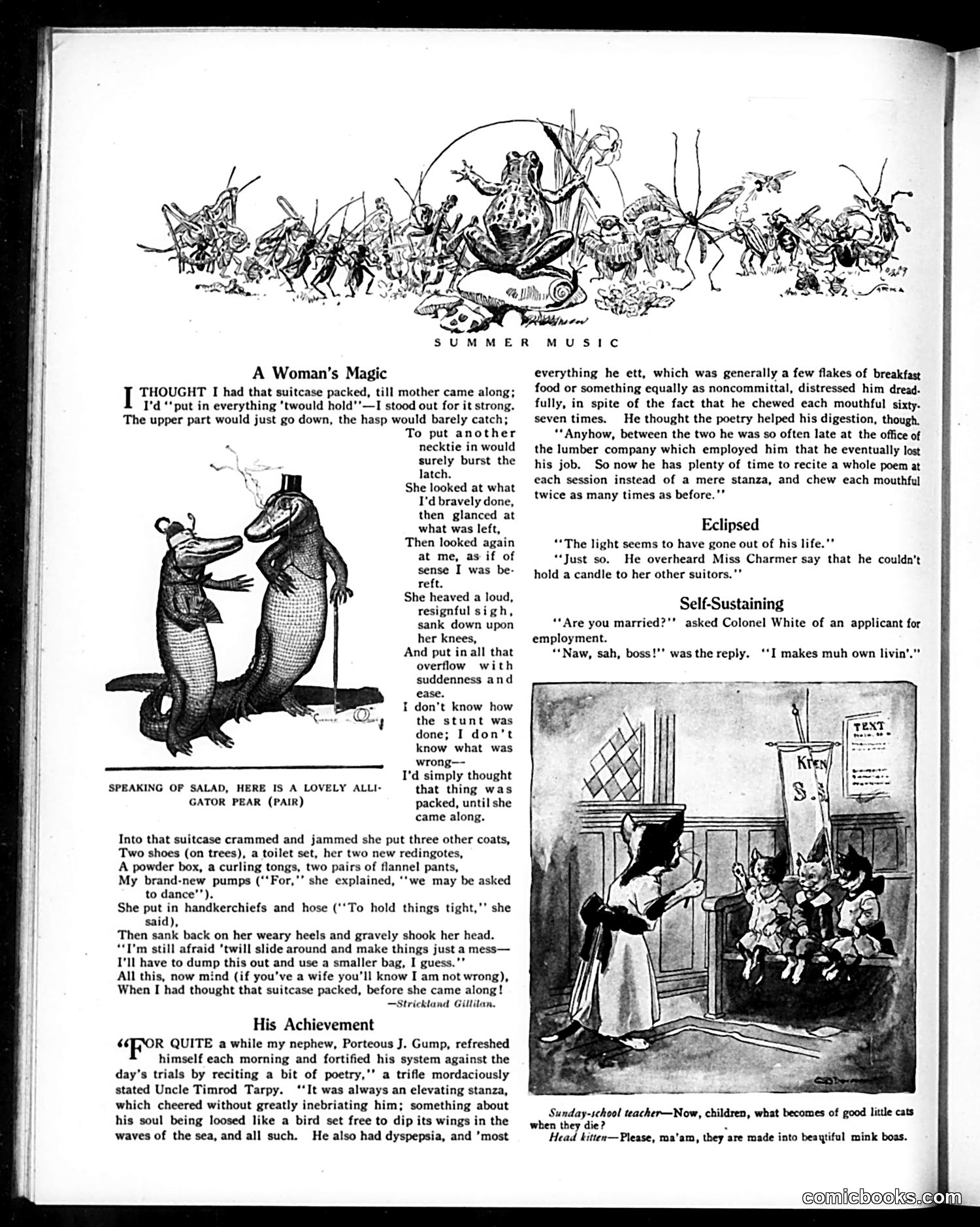
This page from *Judge* contains three separate humorous pieces typical of early 20th-century American satire: **"A Woman's Magic"**: A poem mocking the supposed mystical ability of mothers/wives to pack luggage. The narrator believes his suitcase is completely full until his mother arrives and somehow miraculously fits triple the contents. The satire targets male helplessness and female domestic cleverness—a common gender stereotype of the era. **"His Achievement"**: A brief anecdote about a man whose poetry recitation habit ironically causes him to lose his job (chronic lateness), but now unemployed, he has unlimited time for his hobby. The joke satirizes self-deception and the impracticality of intellectual pursuits over work obligations. **"Self-Sustaining" and "Eclipsed"**: Micro-jokes; the final panel shows Sunday school children discussing what happens to dead cats—with dark humor suggesting they become mink coats, satirizing both childhood innocence and women's fashion. The cartoon of the alligator pear (avocado) is a visual pun on "pair."
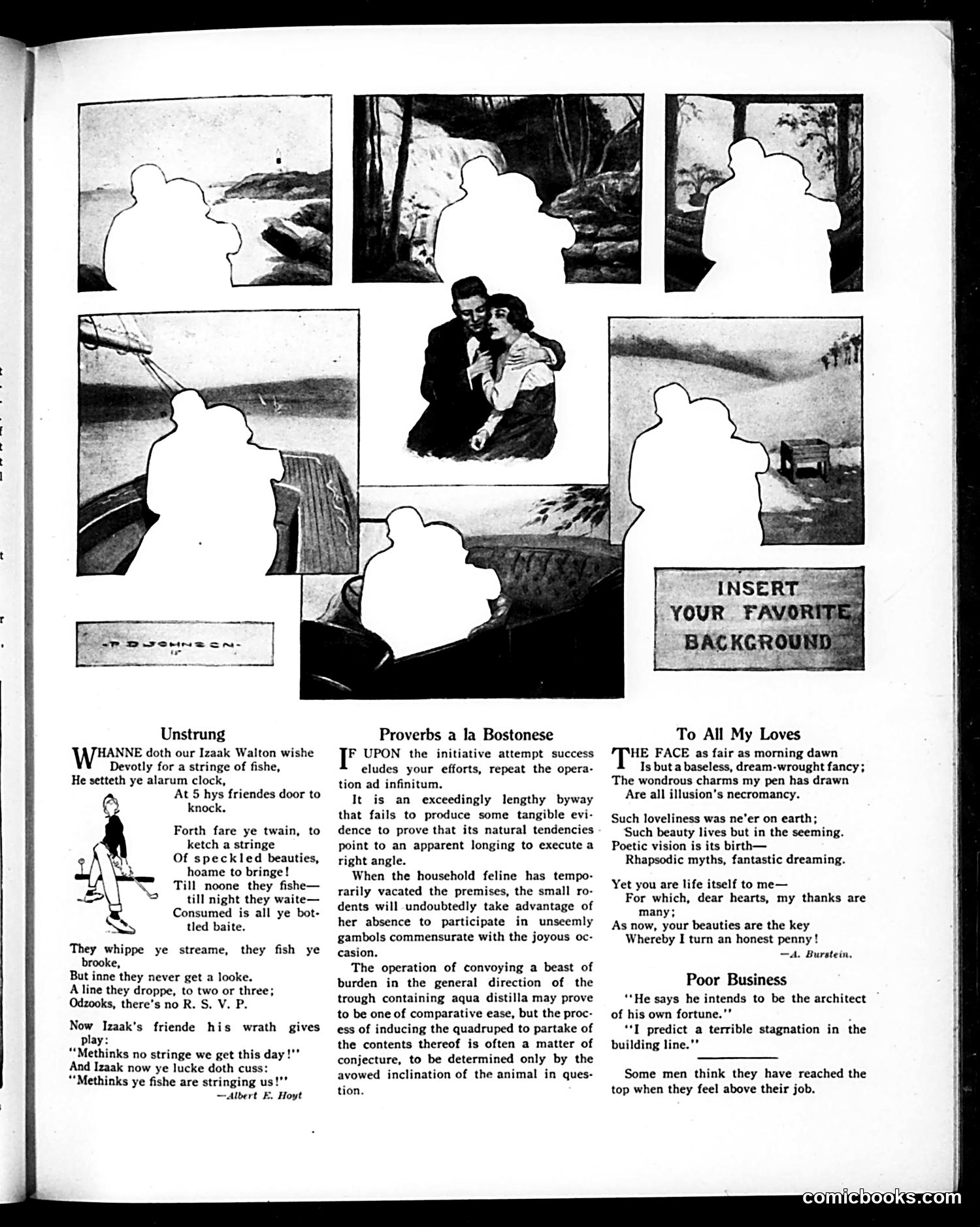
This page contains three separate satirical pieces: **"Unstrung"** (left): A humorous poem mocking unsuccessful fishing expeditions, written in pseudo-archaic style mimicking Izaak Walton's famous fishing treatise. Two friends spend all day fishing without success, with the punchline that "the fishe are stringing us"—a play on waiting in vain. **"Proverbs à la Bostonese"** (center): Satire of Boston intellectualism, presenting common sayings (like "when the cat's away, the mice will play") in deliberately overwrought, pretentious language. The joke mocks Bostonians' tendency toward verbose, affected speech. **"To All My Loves"** and **"Poor Business"** (right): Brief verses. The first is romantic mockery—a poet admitting his beautiful descriptions are pure fiction he profits from. The second mocks men who overestimate their abilities, predicting economic decline for those who think themselves above their work. The page's central image shows silhouetted figures against photographic backgrounds, with instructions to "INSERT YOUR FAVORITE BACKGROUND"—likely an advertising or reader-participation element common to Judge.
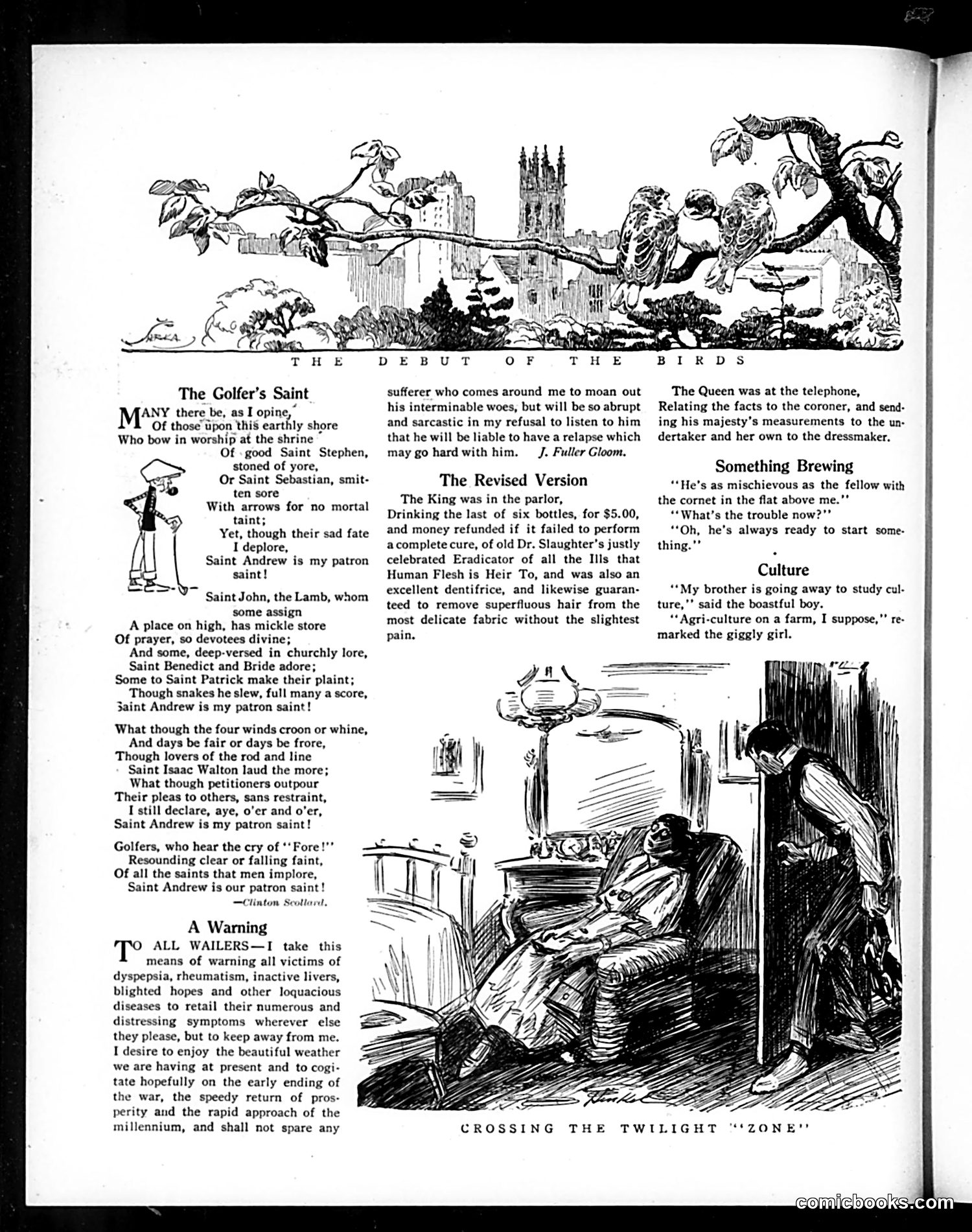
This page contains several satirical pieces from Judge magazine: **"The Golfer's Saint"** is a humorous poem (in the style of traditional ballads) declaring Saint Andrew as the patron saint of golfers—a joke about golf's cultural prominence and how devotees treat the sport with religious fervor. **"A Warning"** is a curmudgeonly rant by "J. Fuller Gloom" refusing to listen to complainers during wartime, wanting instead to enjoy good weather and anticipate peace and prosperity. It's satirizing pessimistic whiners. **"The Revised Version"** mocks patent medicine advertising by rewriting a nursery rhyme where the King drinks Dr. Slaughter's bogus $5 "cure-all" tonic (also claimed as toothpaste and hair remover), leading to his death—the Queen notifies the coroner. It ridicules the absurd over-promising of fraudulent medicines. **"Something Brewing"** and **"Culture"** are brief joke exchanges about mischief-making and a boy's pretentious claim to study "culture" (deflated when a girl suggests he means farm agriculture). The cartoons illustrate these pieces with period ink drawings.
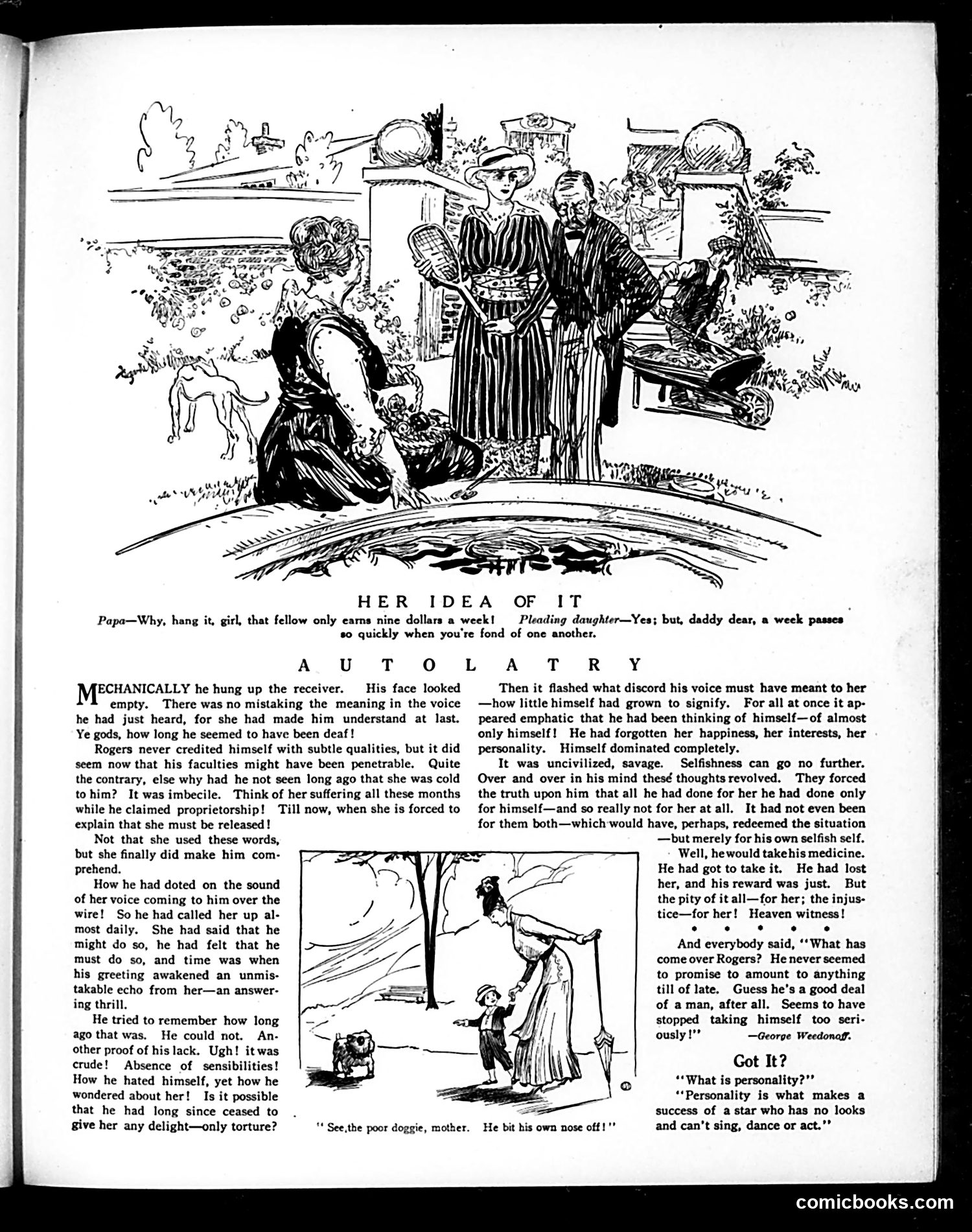
This page satirizes early 20th-century courtship and male selfishness through two connected pieces. **The top cartoon** mocks a suitor earning only nine dollars weekly—an inadequate income for marriage. The father dismisses him as a poor prospect, while the daughter defends him romantically. The satire targets class consciousness in marriage markets. **The main story "Autolatory"** (a pun on "auto" + "idolatry") follows a man named Rogers who realizes—too late—that his entire courtship was self-centered. He called her daily for *his* pleasure, pursued her for *his* satisfaction, never considering *her* happiness or interests. The revelation comes when she phones to end things. The story's moral: his selfishness destroyed the relationship. **The final illustrated vignette** shows a woman teaching a child that even dogs bite their own noses when selfish—a crude visual metaphor for self-destruction through narcissism. The page's repeated theme: masculine self-absorption ruins romance. The closing definition of "personality" suggests character matters more than looks—a progressive note for the era.
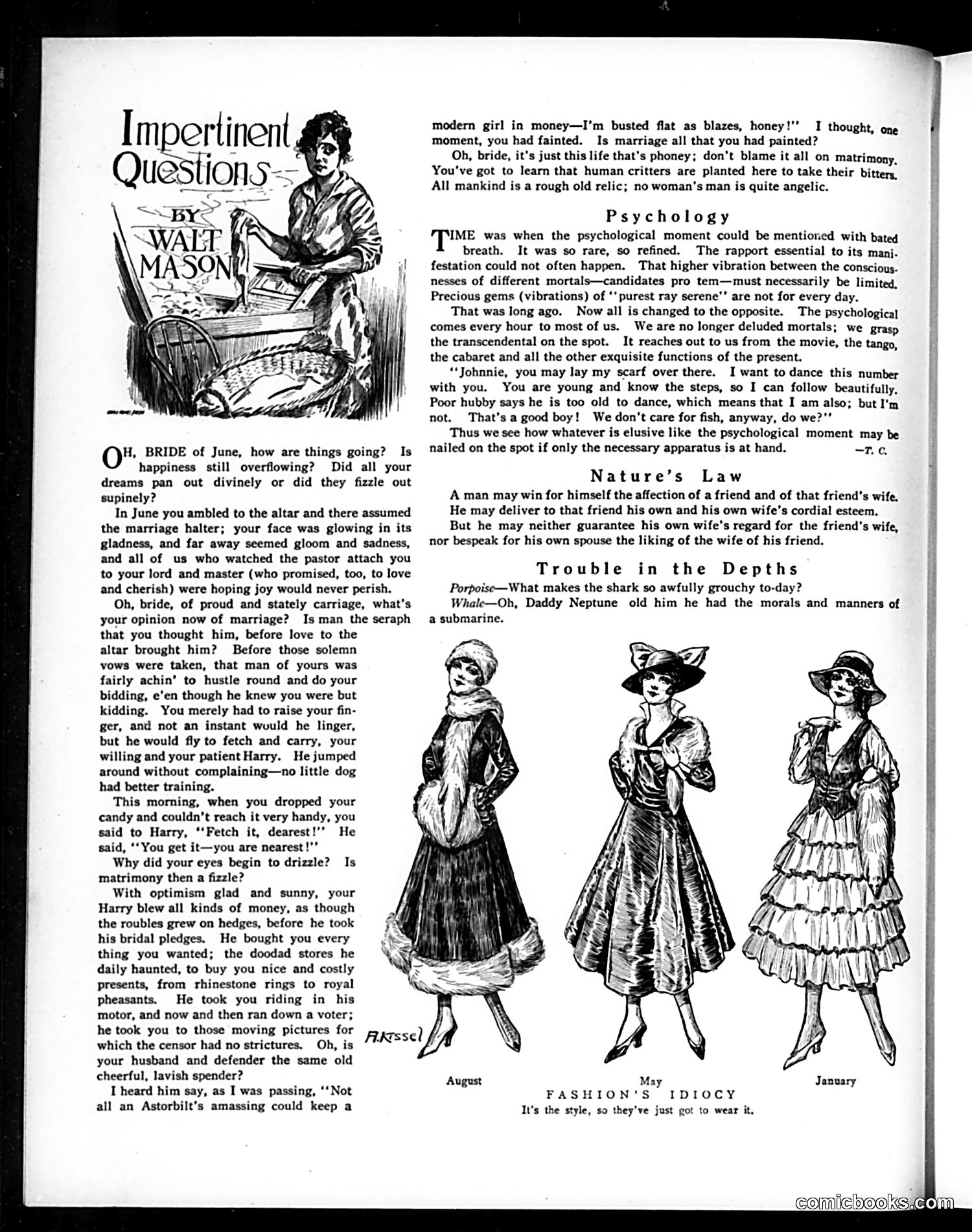
This page contains three satirical pieces mocking early 20th-century social pretensions: **"Impertinent Questions"** addresses a newlywed bride, sarcastically contrasting her romantic expectations with disappointing marital reality. The joke: her devoted husband who once eagerly fetched her candy now refuses, claiming she's "nearest." Mason suggests marriage exposes life's harsh truths—husbands are neither angels nor endless spenders. The piece mocks both romantic idealism and the economic strain of maintaining a fashionable lifestyle. **"Psychology"** satirizes the era's obsession with psychological terminology and "refined moments." Mason argues that what was once rare and precious (genuine emotional connection) is now cheaply manufactured through modern entertainment—movies, tangos, cabarets—where anyone can access "transcendental" experiences artificially. **"Fashion's Idiocy"** (bottom) pairs three dated dress illustrations from different months, captioning them "It's the style, so they've just got to wear it"—mocking women's blind adherence to arbitrary fashion trends. All three pieces share a cynical, conservative tone criticizing modern life's phoniness and excess.
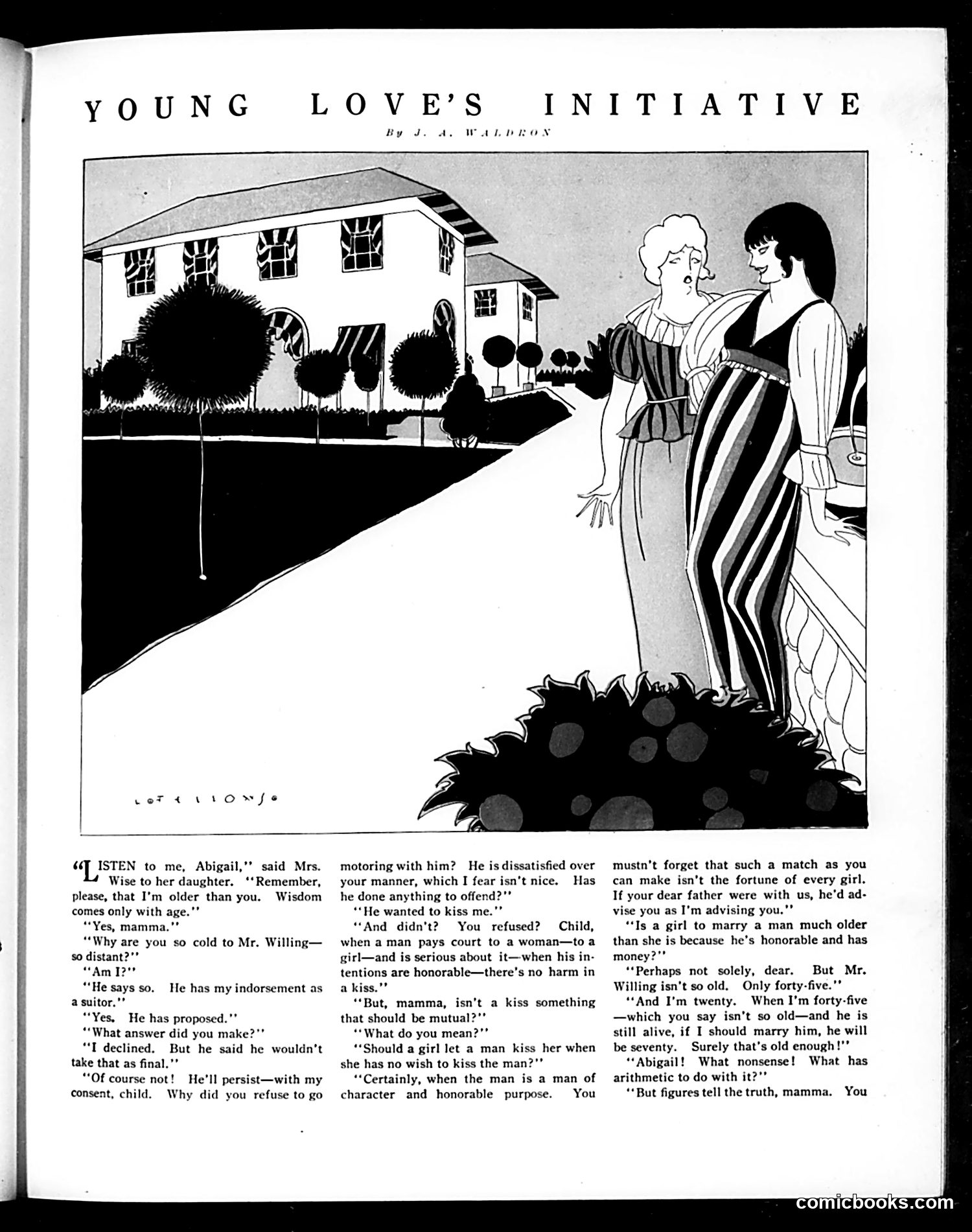
This satirical story mocks outdated Victorian-era attitudes toward marriage. Mrs. Wise pressures her young daughter Abigail to accept Mr. Willing's proposal despite significant age gaps and her lack of romantic interest. The mother represents stuffy parental authority, insisting that a girl should accept an older, wealthy "honorable" man regardless of personal preference—particularly if he persists despite rejection. The satire highlights the absurdity: when Abigail refuses an unwanted kiss and does the math (she's 20, he's 45, making him 70 at her 45), the mother dismisses this rational objection as irrelevant. The cartoon's title "Young Love's Initiative" is ironic—it depicts not young love's agency but rather young women's lack of it, controlled by mothers prioritizing financial security over daughters' wishes or consent. The satire criticizes the era's transactional approach to marriage.
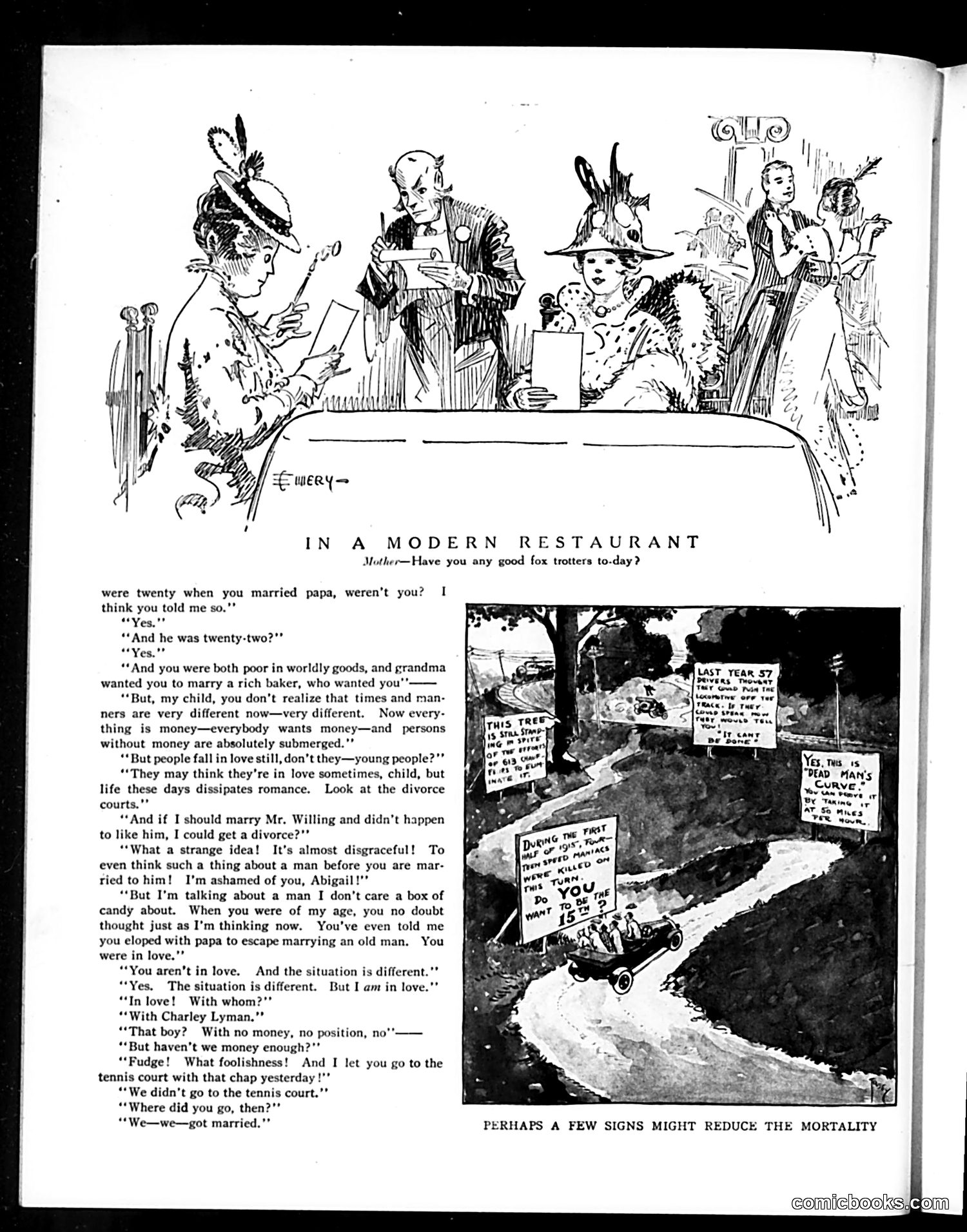
This two-part cartoon mocks early 20th-century social hypocrisy about love and marriage. **The Dialogue (left):** A mother lectures her daughter Abigail about practicality in marriage, insisting modern times demand financial security over romance. The mother reveals she herself eloped with Abigail's father for love—yet condemns her daughter for falling in love with the poor Charley Lyman. The daughter's final revelation ("We—we—got married") exposes the mother's complete hypocrisy: after lecturing against impractical romance, her daughter has done exactly what the mother once did. **The Photograph (right):** "Perhaps a Few Signs Might Reduce the Mortality" shows a roadside covered with hand-painted warning signs about dangerous driving conditions—a commentary on reckless automobile accidents. This likely connects to the elopement: young lovers driving carelessly mirror society's dangerous contradictions about courtship and morality. The satire critiques how adults abandon their youthful romantic ideals once wealthy, then hypocritically deny the same freedom to their children.
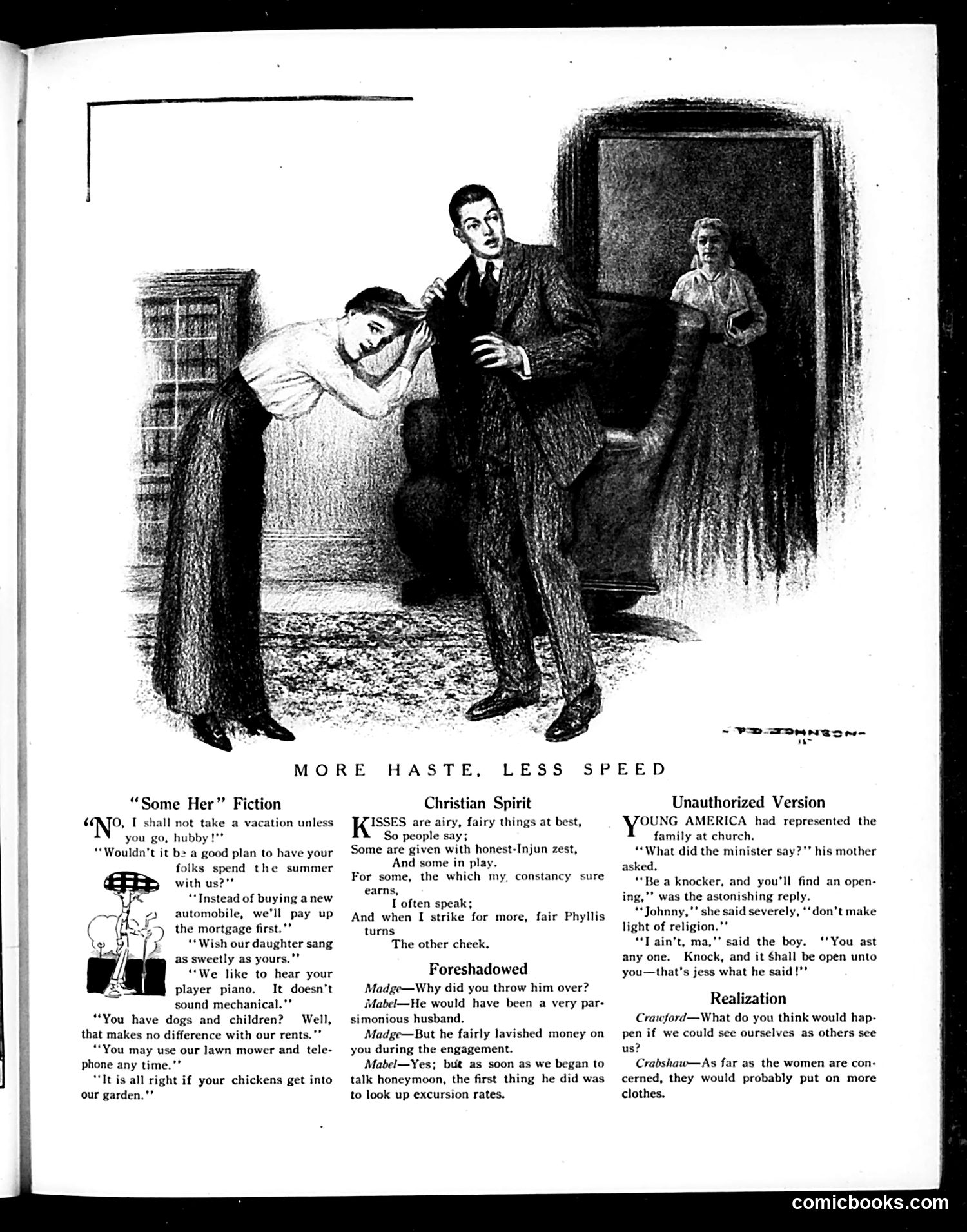
This page contains three separate satirical pieces mocking social hypocrisy and gender relations in early 20th-century America. **"Some Her" Fiction** contrasts saccharine romantic ideals with pragmatic marital reality. The quoted dialogue presents exaggeratedly selfless spouses—wives sacrificing vacations, husbands prioritizing mortgages—depicting the falseness of sentimental fiction versus actual domestic life. **"Christian Spirit"** mocks a woman's materialism disguised as principle. Mabel rejected an engaged suitor not for character flaws but because he immediately began researching cheap honeymoon excursion rates, revealing her actual interest was expensive spending, not love. **"Unauthorized Version"** plays on biblical misquotation. A boy innocently applies "knock and it shall be opened unto you" literally, missing the spiritual meaning—humor derived from childish literalism exposing the gap between religious teaching and worldly behavior. The cartoon illustration depicts what appears to be a domestic scene with haste and impatience. Overall, Judge satirizes the gap between professed values and actual behavior across marriage, religion, and social interaction.
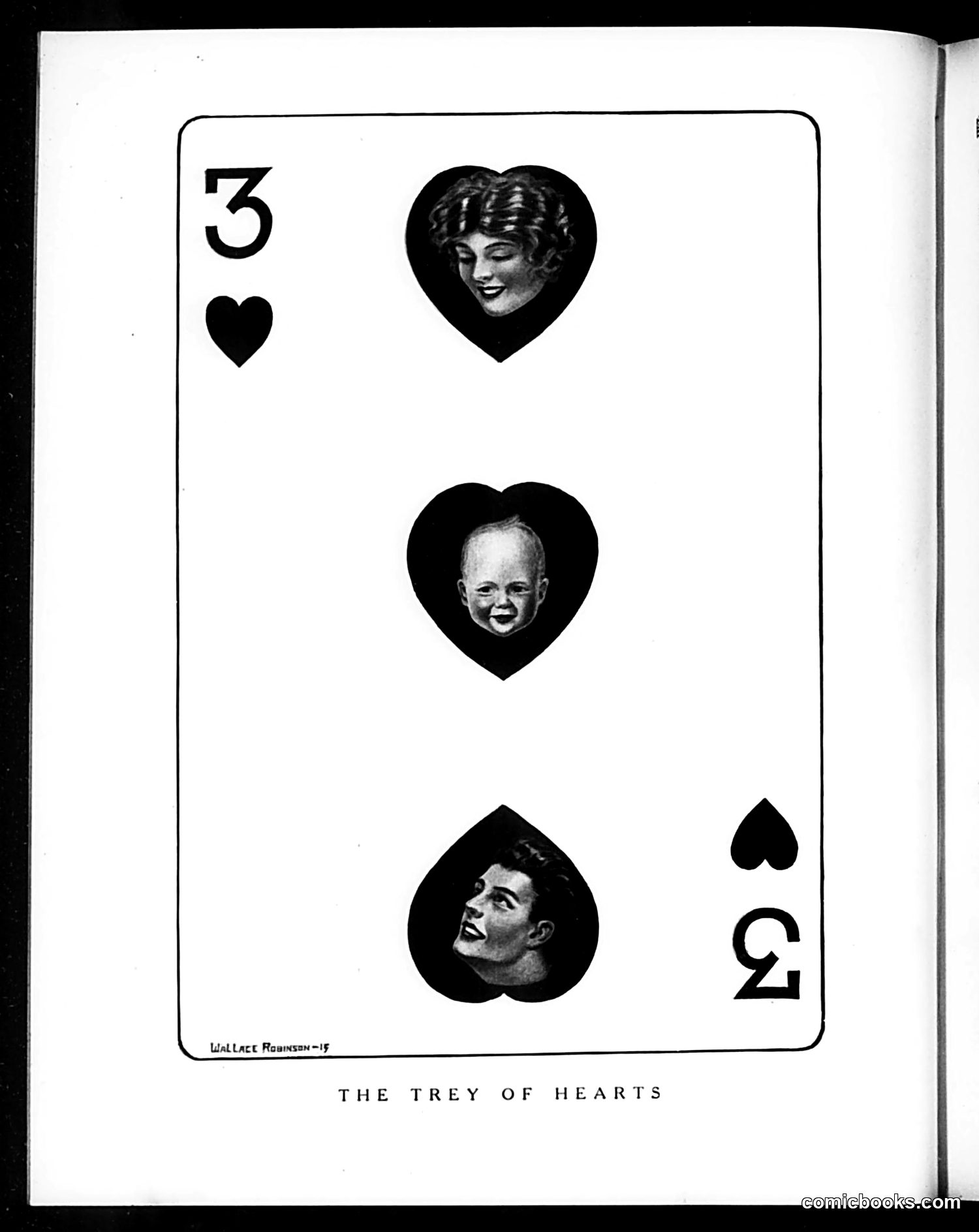
This is a playing card design from Judge magazine titled "The Trey of Hearts," featuring three faces in heart-shaped frames. The artist signature reads "Wallace Robinson—15" (likely 1915). The card appears to be part of a series satirizing American public figures through a novelty deck format. Without clearer identification of the three individuals pictured, I cannot definitively name them. However, the format—presenting prominent people as playing cards—was a common Judge magazine device for social and political commentary. The "trey" (three) refers to the card's rank. The satire likely relies on readers recognizing these figures and understanding why they were grouped together or what the card's title suggests about their collective significance or relationships.
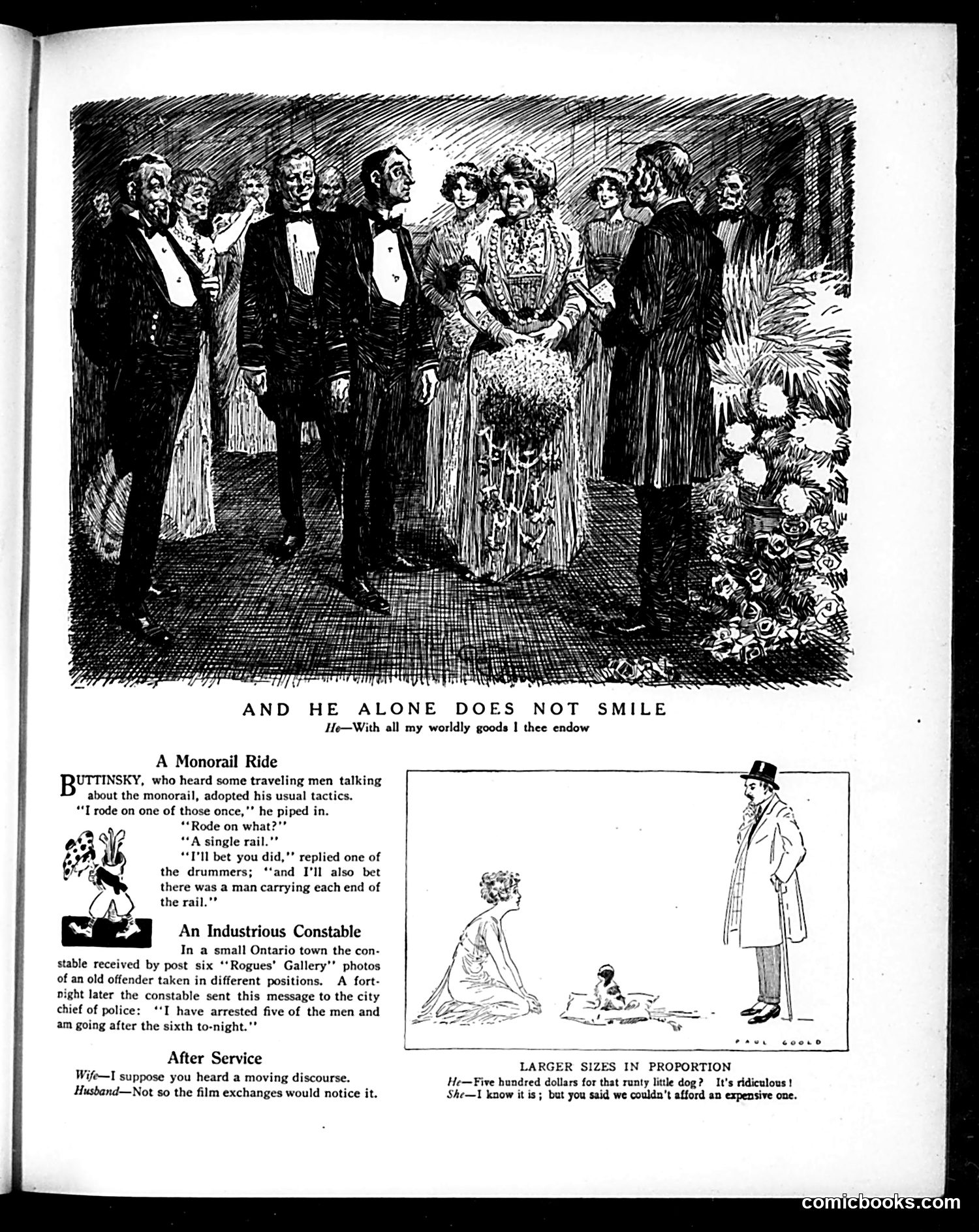
**Top Image**: A formal wedding scene where the groom stands apart, unsmiling, while the bride and wedding guests appear celebratory. The caption references the marriage vow "with all my worldly goods I thee endow," suggesting the joke is about a groom's reluctance or unhappiness about financial obligations in marriage. **Three Humorous Anecdotes Below**: 1. **"A Monorail Ride"**: Satirizes a braggart named Buttinsky who claims to have ridden a monorail. Drummers (traveling salesmen) mock him by suggesting he rode a single rail carried by two men—implying his story is absurd and he's a chronic liar. 2. **"An Industrious Constable"**: An Ontario police officer receives mugshots of a criminal in different poses but interprets them as six different men, arresting five and pursuing a "sixth." The satire targets police incompetence. 3. **"After Service"** and **"Larger Sizes"**: Brief husband-wife jokes about cinema quality and dog prices—using spousal disagreement for humor. The page is early 20th-century satirical humor targeting vanity, dishonesty, and marital dynamics.
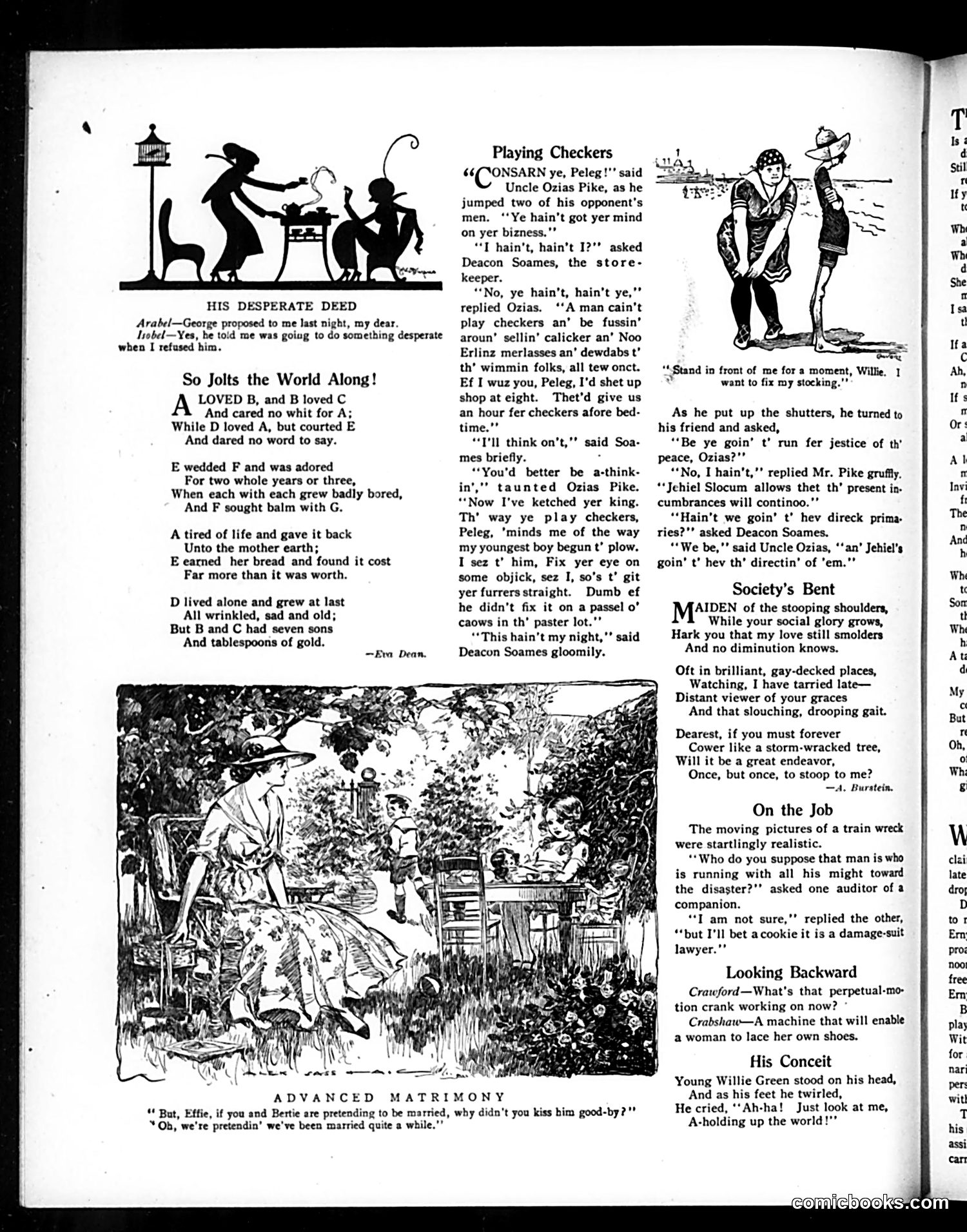
This page contains several satirical pieces typical of early 20th-century American humor: **"His Desperate Deed"** (top): A brief comic exchange where a woman mentions her suitor proposed as "something desperate"—the joke being that proposing marriage is treated as an act of desperation. **"So Jolts the World Along!"** (left): A poem satirizing romantic chaos and life's disappointments. It traces interconnected love triangles where people pursue unrequited interests, ultimately showing that only those with simple contentment (B and C) prosper, while others die, struggle financially, or grow lonely. **"Playing Checkers"** (center): Rural New England dialogue featuring Uncle Ozias Pike lecturing Deacon Soames about distraction while playing checkers. The humor lies in Ozias's folksy, rambling anecdotes about farming that distract from the game itself—a gentle satire of small-town gossip. **"Advanced Matrimony"** (bottom): A joke about newlyweds pretending to be long-married to avoid romantic displays. The page also includes brief social commentary pieces and poems on courtship, law, and vanity, typical of Judge's mix of humor and gentle social criticism.
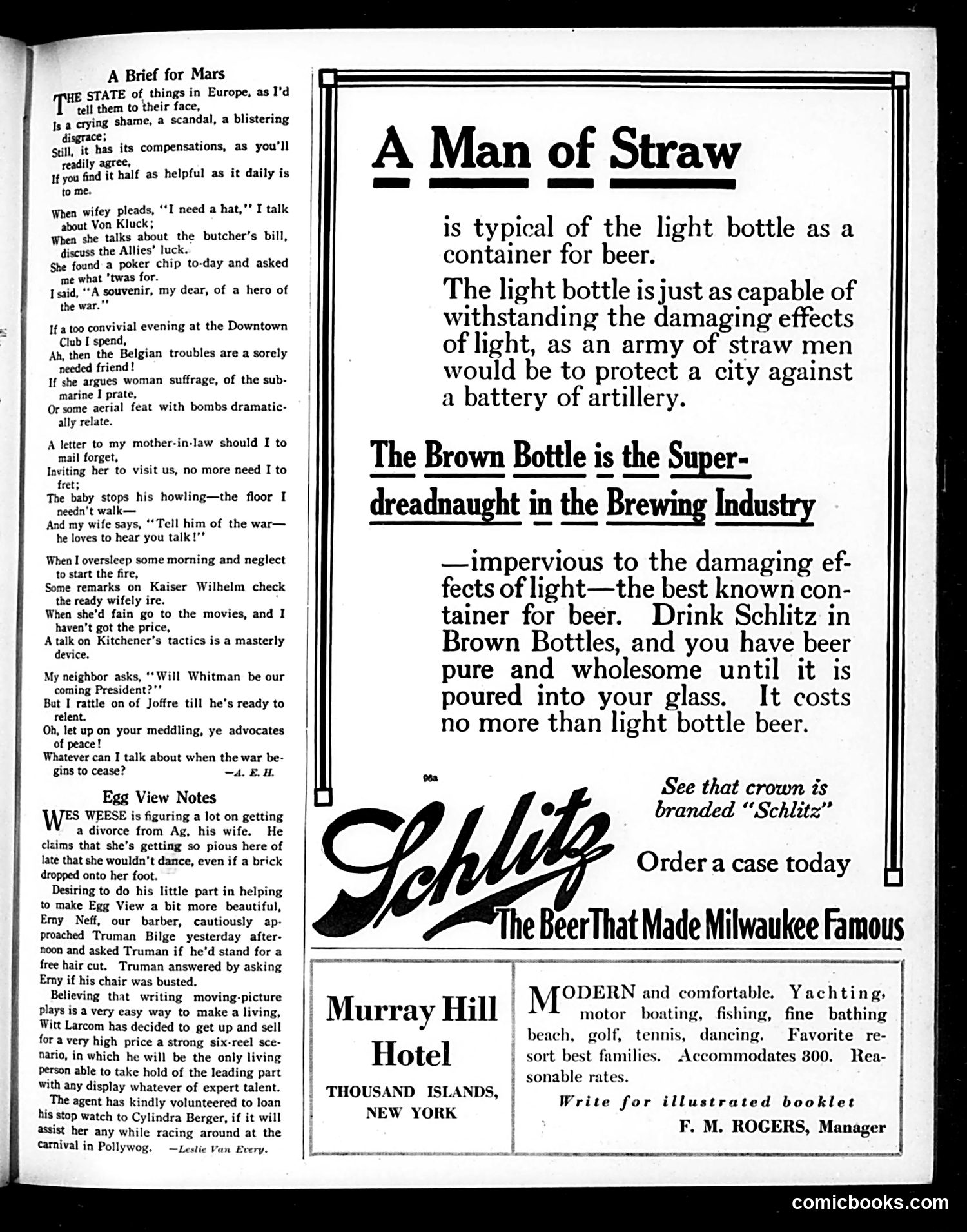
This page contains two distinct sections: **Left side — "A Brief for Mars" and "Egg View Notes":** Satirical commentary on WWI's pervasive influence on American domestic life. The author jokes that he uses World War I references (Von Kluck, Belgian troubles, Kaiser Wilhelm, Kitchener, Joffre) as convenient conversational deflections to avoid discussing marital complaints, household duties, and domestic annoyances. The satire mocks how thoroughly the war has saturated American discourse—it's become a universal excuse. "Egg View Notes" offers small-town gossip unrelated to the war. **Right side — Schlitz Beer Advertisement:** A full-page commercial comparing beer bottle colors using military metaphors. Light bottles are "straw men" (ineffective protection), while brown bottles are "super-dreadnaughts" (superior warships), better protecting beer from light damage. The ad capitalizes on wartime language to market superior packaging—a clever if tone-deaf marketing strategy using military vocabulary during active conflict. The page primarily serves as advertising with satirical commentary as filler content, typical of Judge's format.
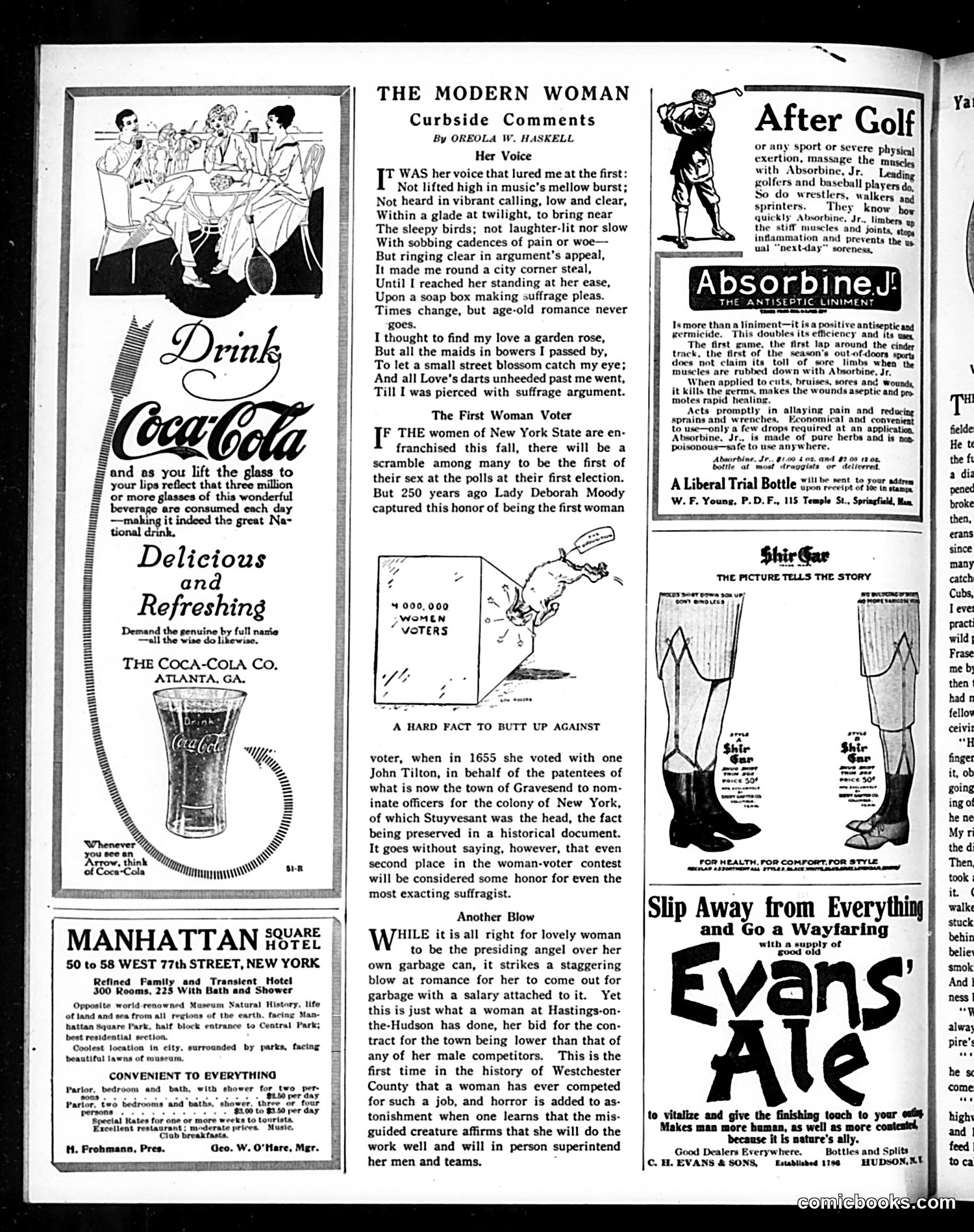
This page satirizes early 20th-century feminism and women's suffrage. The central poem "Her Voice" mocks a man attracted to a woman making "suffrage pleas" from a soapbox—inverting romantic ideals by suggesting modern women's political activism replaces traditional femininity. "The First Woman Voter" references Lady Deborah Moody, who apparently voted in 1655 New York, positioning her as America's first female voter. The article humorously suggests New York women will scramble for the honor of being "first" at the polls in an upcoming election (likely 1920, before the 19th Amendment). The cartoon showing "1,000,000 Women Voters" illustrates the anxieties many contemporaries felt about women's political participation—treating mass female voting as a notable, somewhat alarming phenomenon. The remaining content consists of period advertisements (Coca-Cola, Absorbine liniment, Evans shoe polish) typical of Judge's revenue model.
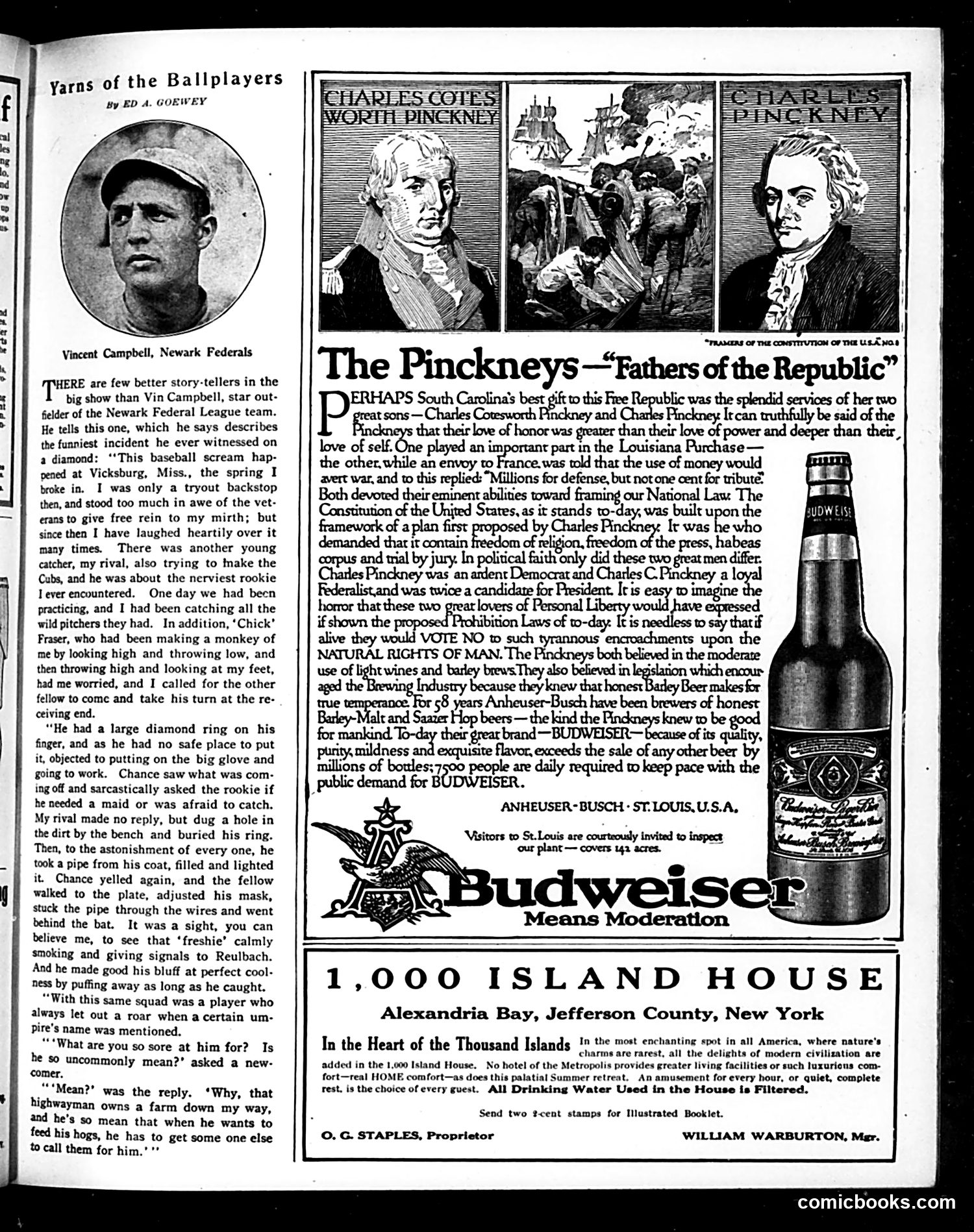
**Left section ("Yarns of the Ballplayers"):** This is a baseball anecdote featuring Vincent Campbell of the Newark Federals (a Federal League team). The story depicts a nervous rookie catcher who, rather than remove his diamond ring before catching, buries it and then smokes a pipe while working—described as a display of nerveless bravado. The piece is sports humor with no apparent political satire. **Right section (Advertisement):** A Budweiser ad titled "The Pinckneys—Fathers of the Republic" attempts to link the historical Pinckney brothers (Charles Cotesworth and Charles) to beer consumption. The text claims they "believed in the moderate use of light wines and barley brews" and celebrates Anheuser-Busch's 58-year history as "brewers of honest" beer. This is commercial propaganda using Founding Fathers imagery to legitimize alcohol during the Prohibition era—a clear attempt to argue against temperance laws by invoking respected historical figures.
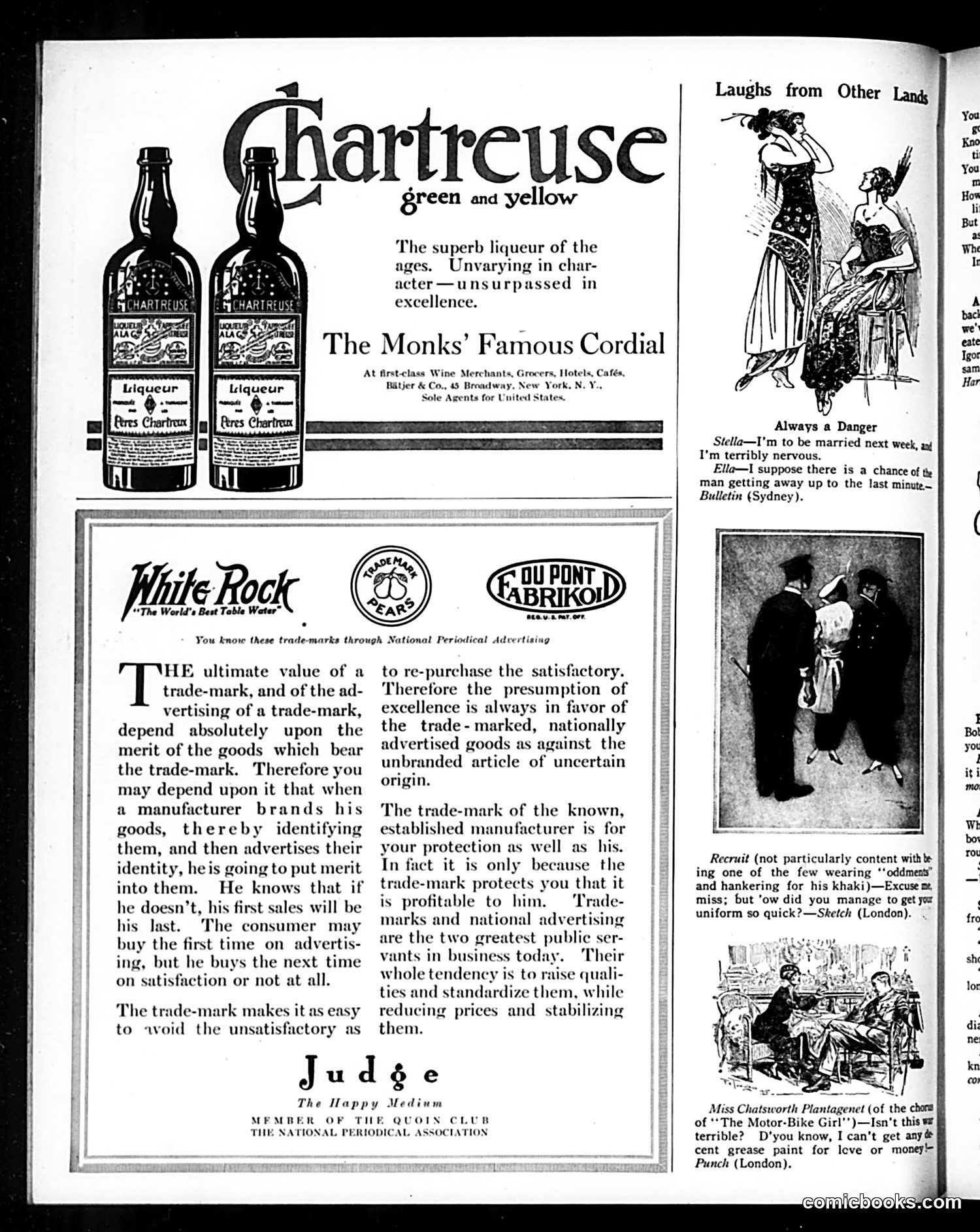
This page is primarily **advertising**, not political satire. It features: 1. **Chartreuse liqueur ad** (top): Promotes "The Monks' Famous Cordial," a green-and-yellow French liqueur, positioning it as a premium product available through major retailers. 2. **Trade-mark editorial** (center): An essay-style advertisement for White Rock, Bachmeteff, and DuPont Fabrikoid brands. The text argues that trade-marks and national advertising guarantee product quality—manufacturers won't advertise inferior goods because repeat purchases depend on satisfaction. This reflects early 20th-century advertising philosophy: branded goods are inherently trustworthy. 3. **"Judge" house ad** (lower left): Promotes the magazine itself as "The Happy Medium." 4. **Humor shorts** (right column): Brief jokes from international publications about marriage jitters, military recruits, and theatrical makeup—filler content typical of Judge's format. The page demonstrates how satirical magazines subsidized themselves through advertising while maintaining editorial voice. No significant political or social satire is present here.
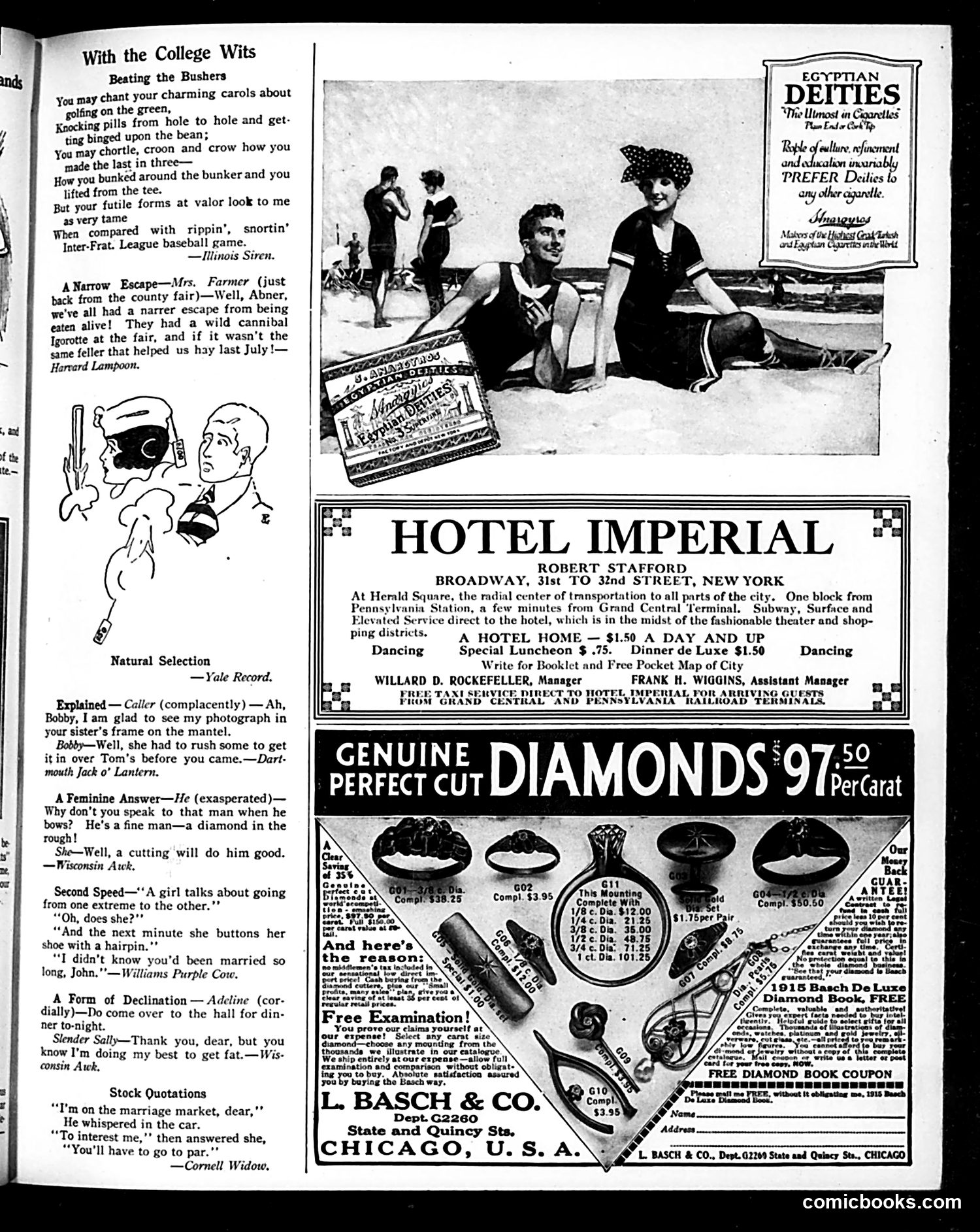
This page from *Judge* magazine consists primarily of **college humor** and **advertisements** rather than political satire. The "With the College Wits" section collects humorous quips from various college publications (Illinois Siren, Harvard Lampoon, Yale Record, etc.). These jokes mock college life: a narrow escape from a "wild cannibal Igorotte" at a county fair; a girlfriend displaying a suitor's photograph only to hide a rival's before he arrives; a woman using a hairpin as a shoe button; a girl claiming to diet while contradicting herself through impulsive behavior; and a woman demanding a suitor "go to par" (golf terminology applied to romance). The humor targets predictable college social dynamics—dating competition, female vanity, and romantic maneuvering—typical of 1910s-era collegiate satire. The page is otherwise dominated by **period advertisements**: the Hotel Imperial in Manhattan, Egyptian Deities cigarettes, and L. Basch & Co. diamonds. These occupy roughly half the page space. No significant political content appears here.
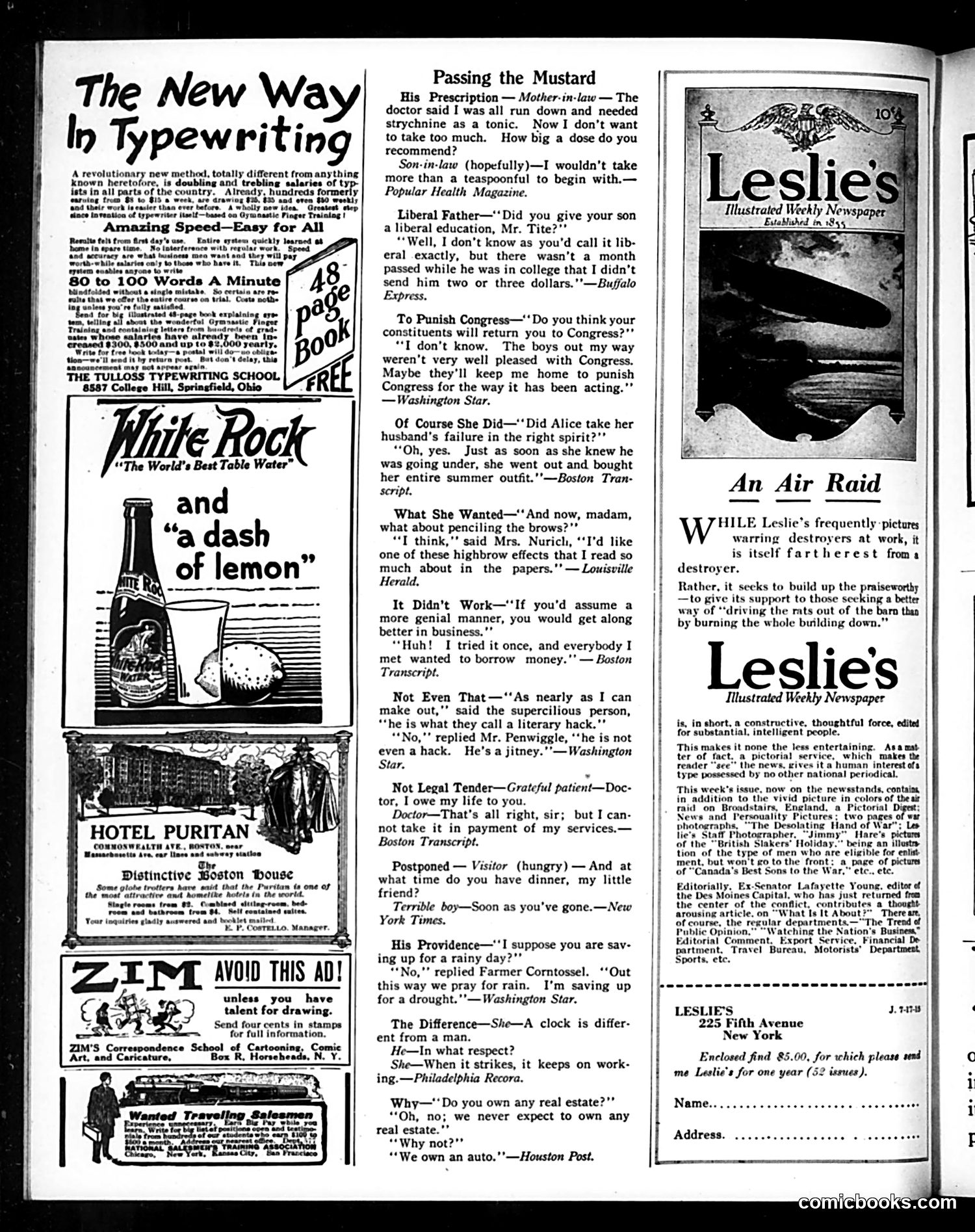
This page comprises mostly **advertisements and humor columns**, not political cartoons. The content reflects early 20th-century American satirical humor. The "Passing the Mustard" section collects brief jokes on domestic and social themes: a son-in-law hoping his mother-in-law takes lethal doses of strychnine (dark humor about difficult in-laws); a congressman suggesting voters might punish Congress by keeping him home; a wife buying a summer outfit upon hearing her husband is "going under" financially (satirizing female materialism); and a farmer saving money not for rainy days but for droughts (rural vs. urban perspectives). The page also advertises the Tullos Typewriting School, promoting a "revolutionary" finger-training method, and various hotels and correspondence schools. The Leslie's advertisement on the right contrasts itself with destructive forces, using a wartime metaphor: rather than "burning the whole building down," it supports constructive solutions—typical Progressive-era rhetoric about reform and improvement.
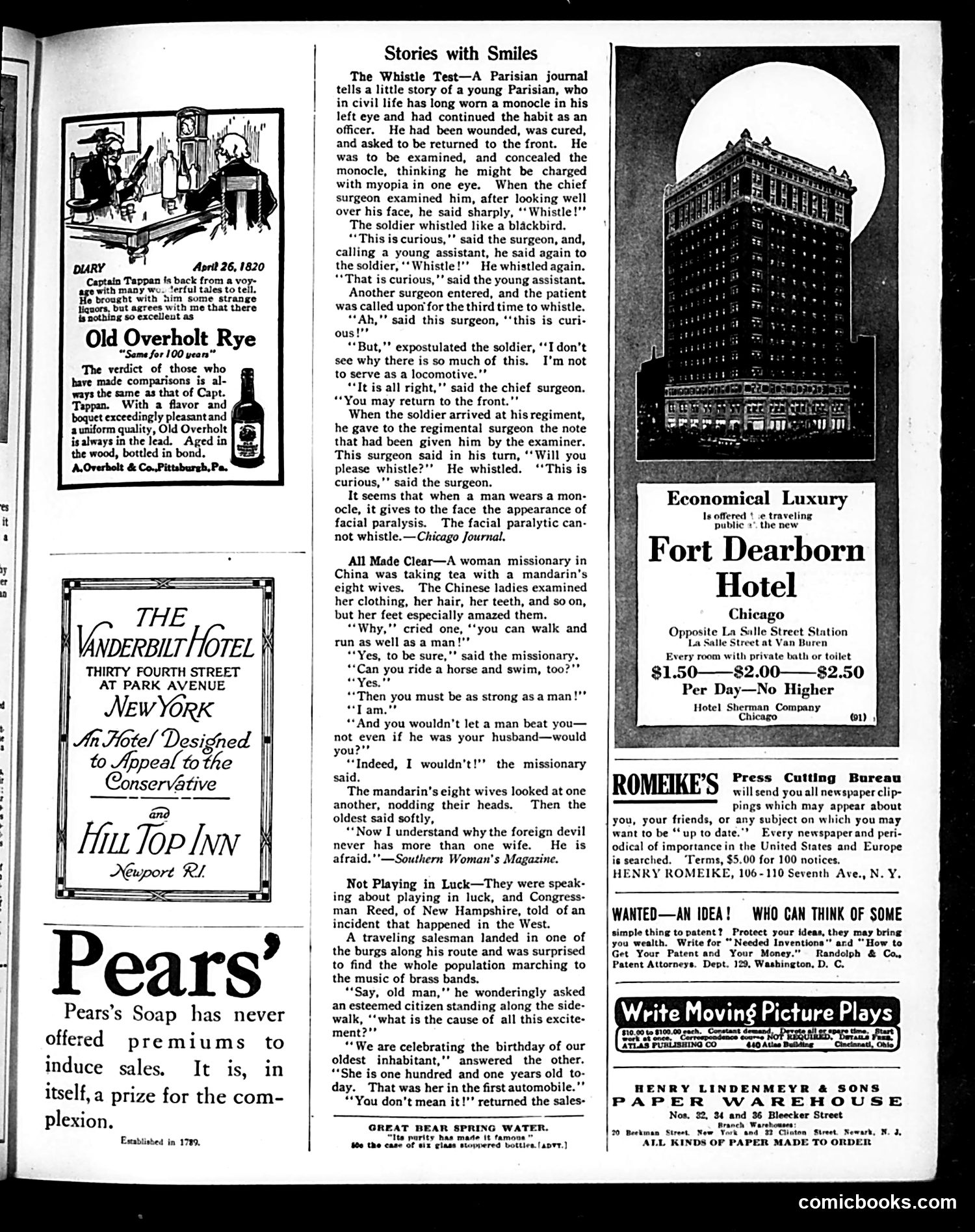
This page is primarily **advertising with humorous filler content**, not political satire. The main cartoons and "Stories with Smiles" are light anecdotes rather than social commentary. **The humor relies on:** 1. **"The Whistle Test"**: A WWI-era joke about a French officer concealing his monocle during a military medical exam. The punchline satirizes military bureaucracy—doctors repeatedly ask him to whistle (testing for facial paralysis, which monocles visually mimic) before finally clearing him for duty. 2. **"All Made Clear"**: A condescending anecdote about Western women's independence baffling Chinese wives, who conclude Western men fear strong women. This reflects early-20th-century gender stereotypes. 3. **"Not Playing in Luck"**: A mild joke about a traveling salesman witnessing a celebration for a town's 101-year-old resident. The page's primary purpose is advertising—Old Overholt whiskey, The Vanderbilt Hotel, and Pears' Soap dominate the layout. The anecdotes serve as entertainment filler between ads.
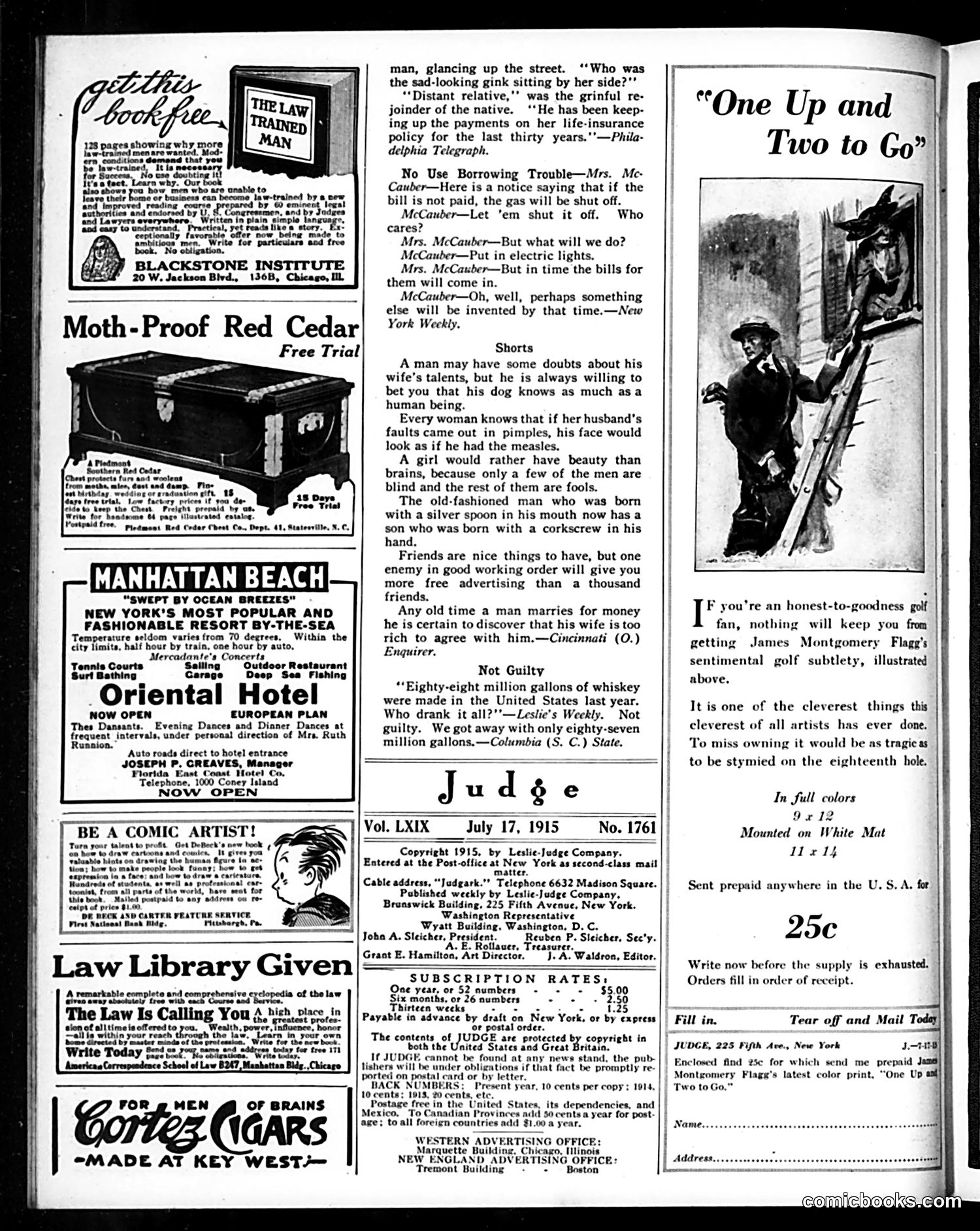
This page consists primarily of brief satirical jokes and advertisements rather than a political cartoon. The main content includes short humorous pieces satirizing American social conventions: one jokes about a man financing a woman's life insurance for thirty years (implying an illicit relationship); another features a married couple named McCauber, where the husband dismissively suggests they'll invent electric lights when gas is shut off for unpaid bills—mocking both domestic discord and naive optimism about technological progress. Other "Shorts" section jokes target marital relations, male attitudes toward women's intelligence, and economic inequality. A notable feature promotes James Montgomery Flagg's golf illustration advertised as having accomplished something "clever" by depicting a golfer "stymied on the eighteenth hole"—a golf-specific joke about missing a crucial final shot. The page is dated July 17, 1915, and contains typical Judge magazine advertisements for hotels, cigars, and correspondence schools. There are no identifiable political figures or events referenced on this particular page.
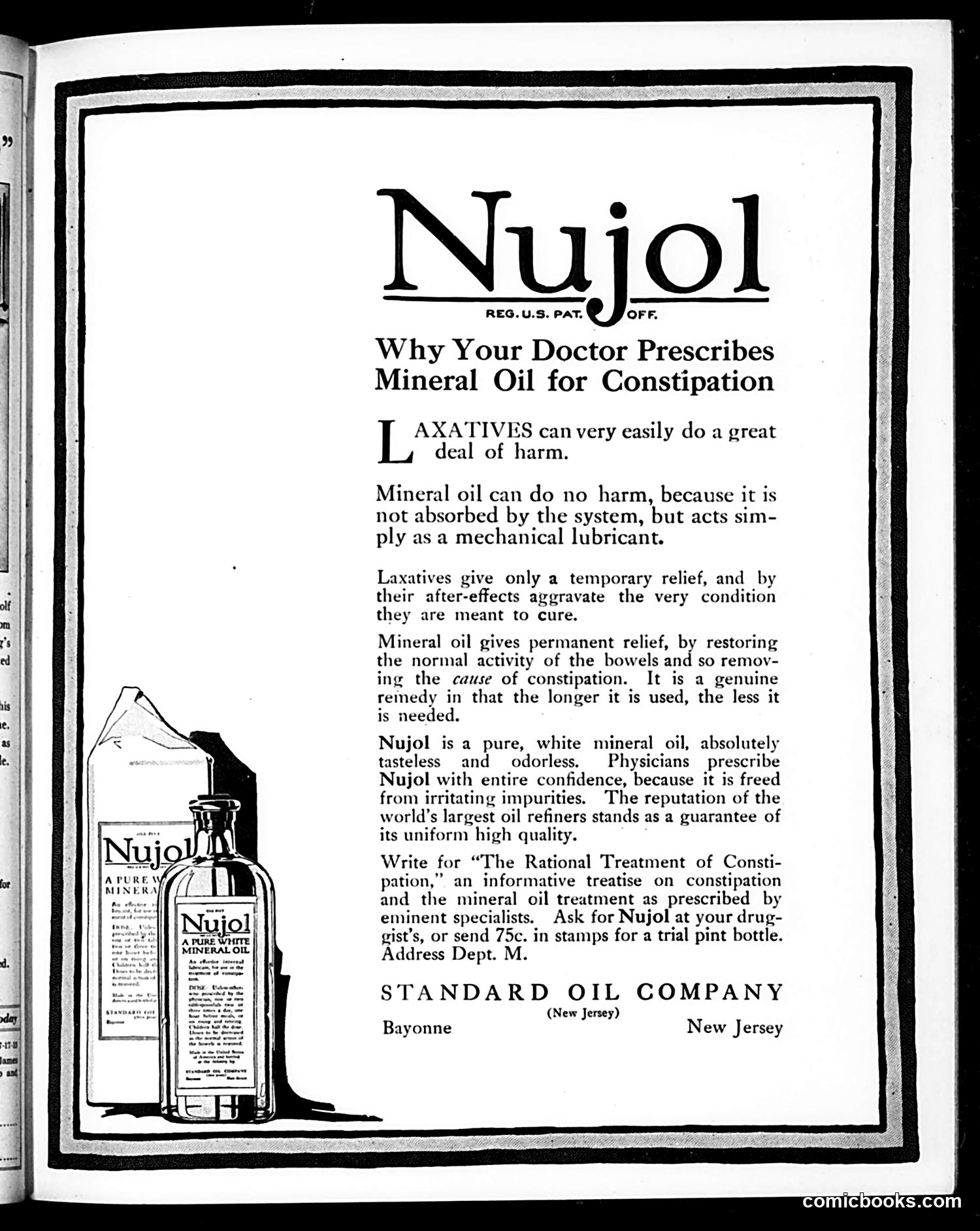
This page is **primarily a paid advertisement**, not satirical content. It promotes Nujol, a mineral oil laxative manufactured by Standard Oil Company (New Jersey). The ad uses a common early-20th-century marketing strategy: positioning the product as medically superior by contrasting it against competitors. It argues that traditional laxatives cause harm through temporary relief and rebound effects, while Nujol's mineral oil acts as a "mechanical lubricant" that restores natural bowel function permanently. The appeal to physician endorsement and scientific authority ("eminent specialists") was standard advertising rhetoric of this era. The offer of a free informative pamphlet on constipation treatment reflects how companies educated consumers about digestive health. There is **no political satire or caricature** visible on this page—it's a straightforward (if quaintly earnest) product advertisement typical of Judge magazine's commercial content.
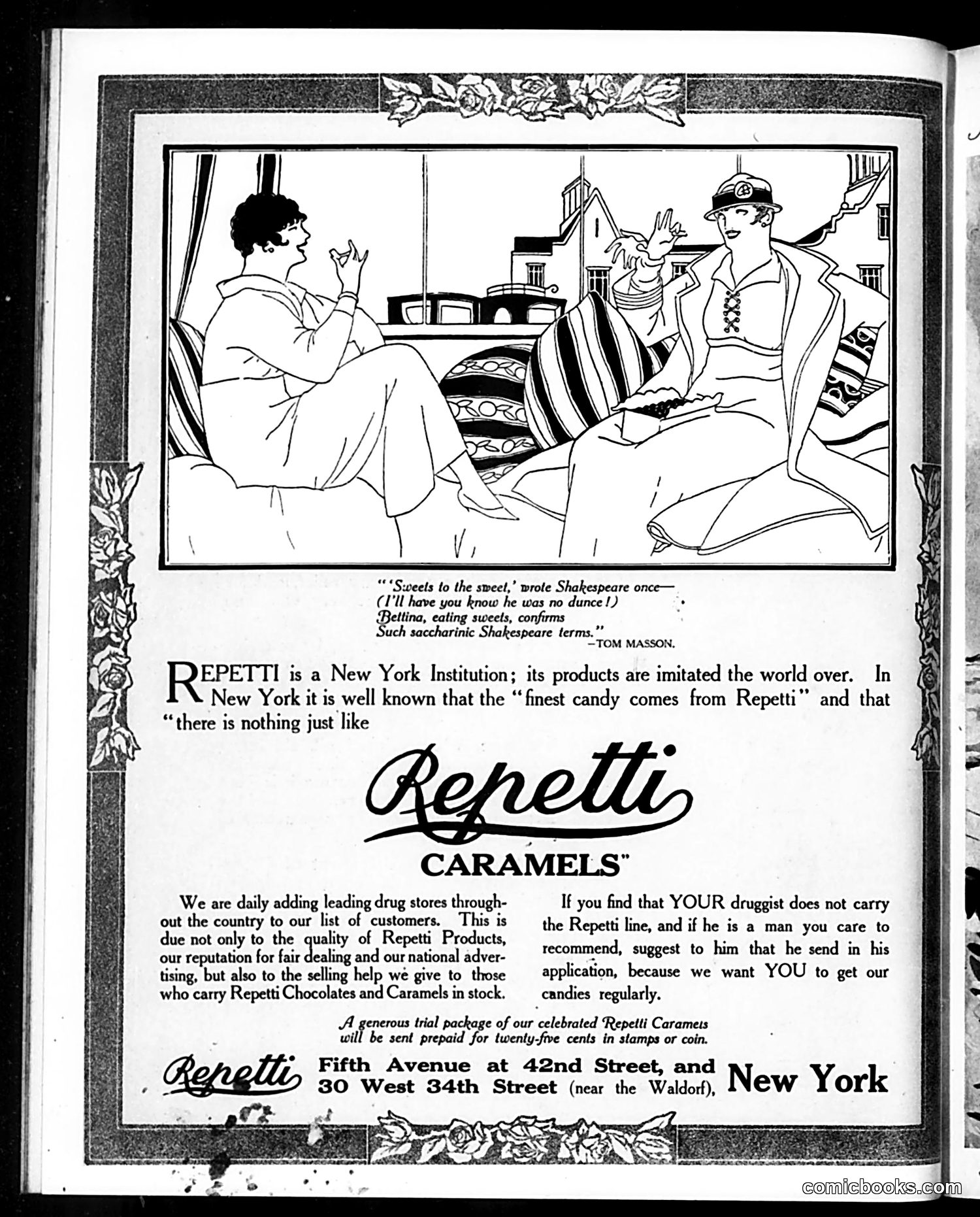
This page is primarily a **candy advertisement**, not political satire. It promotes Repetti Caramels, a New York confectionery brand. The illustration shows two fashionably dressed women in what appears to be a 1920s interior, with one woman seated eating candy while conversing with a visitor. The accompanying verse by Tom Masson humorously references Shakespeare's "Sweets to the sweet" to praise the product. The ad claims Repetti is an established New York institution whose candies are imitated worldwide. It encourages readers to ask their local druggist to stock the line and offers a trial package for 25 cents. The company had two Manhattan locations: Fifth Avenue at 42nd Street and West 34th Street near the Waldorf Hotel. **For modern readers**: This reflects early 20th-century advertising that positioned quality candies as luxury goods sold through drugstores, with literary references designed to appeal to educated consumers.