
Judge, 1915-07-17 · page 4 of 28
Judge — July 17, 1915 — page 4: what you’re looking at
What you’re looking at
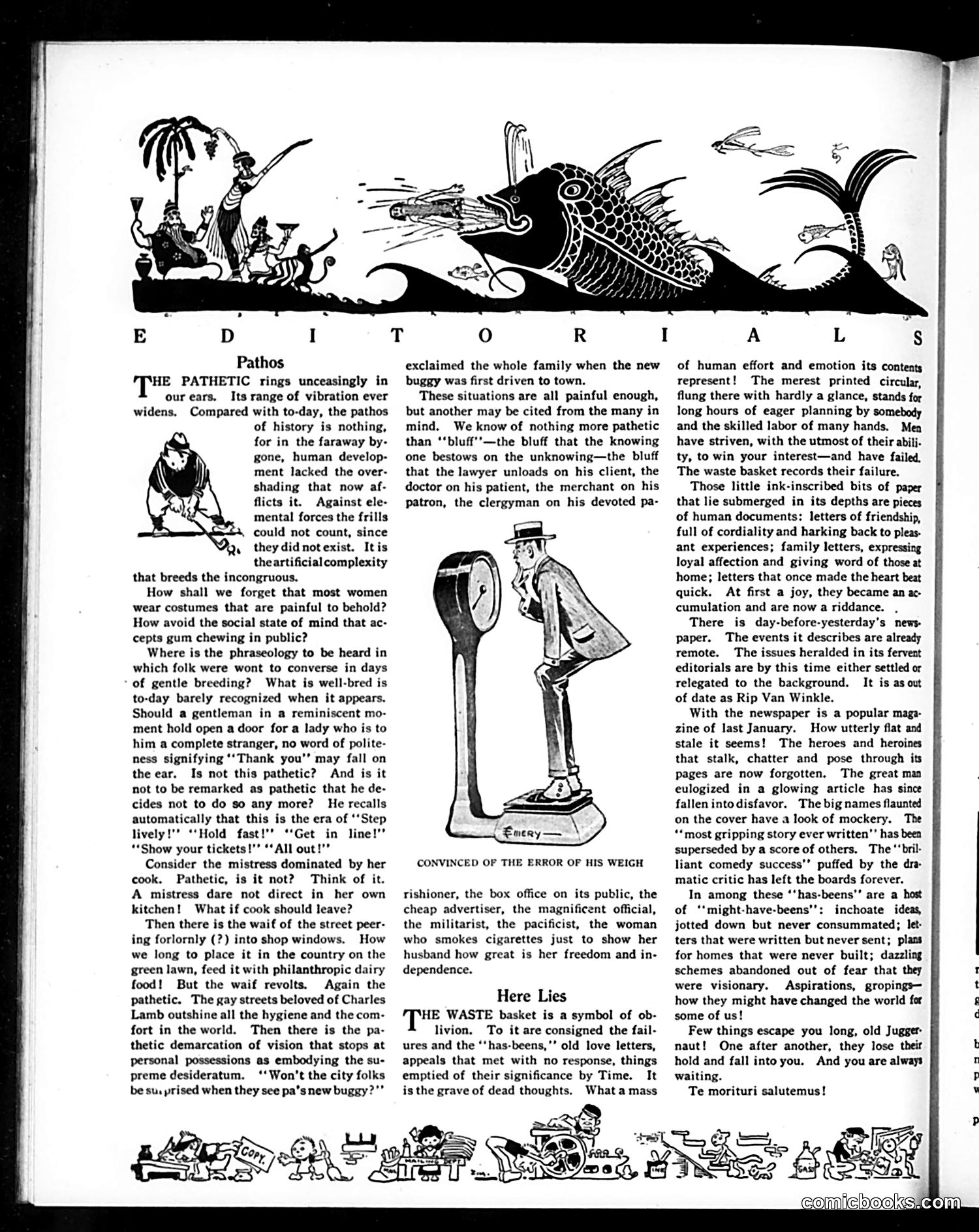
This page from *Judge* magazine critiques modern social behavior through the essay "Editorials" and accompanying illustrations. The text laments the loss of traditional courtesy and gentility—specifically mentioning how women wear painful fashion, men lack proper manners, and social hierarchies have deteriorated. The illustrations satirize these failings: a figure demonstrates improper posture or behavior; another shows a man with an oversized head labeled "Conceit," suggesting vanity; and a wastepaper basket symbolizes discarded values—"old love letters" and meaningful documents reduced to trash by Time. The piece mourns what the author sees as the erosion of refinement in the modern era, contrasting contemporary rudeness with idealized Victorian-era propriety. It's fundamentally nostalgic social criticism, typical of early 20th-century conservative commentary.
📄 Transcribed text from this page (OCR, searchable)
Machine-transcribed from the original scan — historical spelling and the odd misread are preserved.
Te PATHETIC rings unceasingly in our ears. Its range of vibration ever widens. Compared with to-day, the pathos of history is nothing, for in the faraway by- gone, human develop- ment lacked the over- shading that now af- flicts it. Against ele- mental forces the frills could not count, since they did notexist. Itis theartificialcomplexity that breeds the incongruous. How shall we forget that most women wear costumes that are painful to behold? How avoid the social state of mind that ac- cepts gum chewing in public? Where is the phraseology to be heard in which folk were wont to converse in days of gentle breeding? What is well-bred is to-day barely recognized when it appears. Should a gentleman in a reminiscent mo- ment hold open a door for a lady who is to him a complete stranger, no word of polite- ness signifying ‘‘Thank you’’ may fall on the ear. Is not this pathetic? And is it not to be remarked as pathetic that he de- cides not to do so any more? He recalls automatically that this is the era of ‘‘Step lively!"" *‘Hold fast!’ ‘Get in line!" **Show your tickets!'’ ‘*All out!’’ Consider the mistress dominated by her cook. Pathetic, is it not? Think of it. A mistress dare not direct in her own kitchen! What if cook should leave? Then there is the waif of the street peer- ing forlornly (?) into shop windows. How we long to place it in the country on the green lawn, feed it with philanthropic dairy food! But the waif revolts. Again the pathetic. The gay streets beloved of Charles Lamb outshine all the hygiene and the com- fort in the world. Then there is the pa- thetic demarcation of vision that stops at personal possessions as embodying the su- preme desideratum. ‘‘ Won't the city folks be su. prised when they see pa’s new buggy?" exclaimed the whole family when the new buggy was first driven to town. These situations are all painful enough, but another may be cited from the many in mind. We know of nothing more pathetic than ‘‘bluff’’—the bluff that the knowing one bestows on the unknowing—the bluff that the lawyer unloads on his client, the doctor on his patient, the merchant on his patron, the clergyman on his devoted pa- CONVINCED OF THE ERROR OF HIS WEIGH rishioner, the box office on its public, the cheap advertiser, the magnificent official, the militarist, the pacificist, the woman who smokes cigarettes just to show her husband how great is her freedom and in- dependence. Here Lies HE WASTE basket is a symbol of ob- livion. To it are consigned the fail- ures and the ‘‘has-beens,"’ old love letters, appeals that met with no response, things emptied of their significance by Time. It is the grave of dead thoughts. What amass of human effort and emotion its contents represent! The merest printed circular, flung there with hardly a glance, stands for long hours of eager planning by somebody and the skilled labor of many hands. Men have striven, with the utmost of their abili. ty, to win your interest—and have failed, The waste basket records their failure. Those little ink-inscribed bits of paper that lie submerged in its depths are pieces of human documents: letters of friendship, full of cordiality and harking back to pleas- ant experiences; family letters, expressing loyal affection and giving word of those at home; letters that once made the heart beat quick. At first a joy, they became an ac cumulation and are now a riddance. . There is day-before-yesterday’s news paper. The events it describes are already remote. The issues heralded in its fervent editorials are by this time either settled or relegated to the background. It is as out of date as Rip Van Winkle. With the newspaper is a popular maga- zine of last January. How utterly flat and stale it seems! The heroes and heroines that stalk, chatter and pose through its pages are now forgotten. The great man eulogized in a glowing article has since fallenintodisfavor. The big names flaunted on the cover have a look of mockery. The “*most gripping story ever written"’ has been superseded by a score of others. The ‘‘bril- liant comedy success’’ puffed by the dra matic critic has left the boards forever. In among these ‘‘has-beens”’ are a host of ‘‘might-have-beens’’: inchoate ideas, jotted down but never consummated; let: ters that were written but never sent; plans for homes that were never built; dazzling schemes abandoned out of fear that they were visionary. Aspirations, gropings— how they might have changed the world for some of us! Few things escape you long, old Jugger- naut! One after another, they lose theif hold and fall into you. And you are always waiting. Te morituri salutemus! Fe ee it ee ee aS at Gas oak ee