
Judge, 1915-07-17 · page 12 of 28
Judge — July 17, 1915 — page 12: what you’re looking at
What you’re looking at
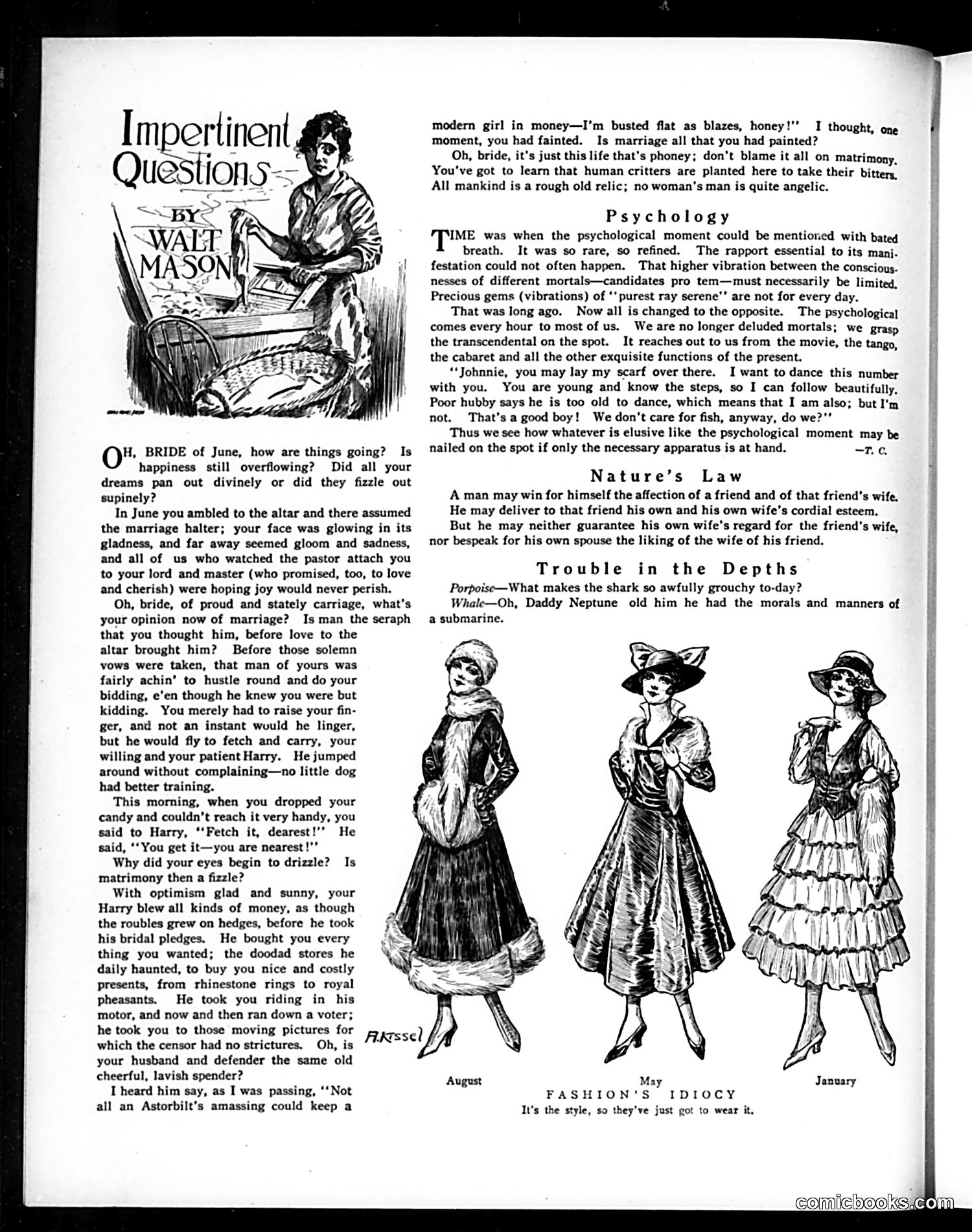
This page contains three satirical pieces mocking early 20th-century social pretensions: **"Impertinent Questions"** addresses a newlywed bride, sarcastically contrasting her romantic expectations with disappointing marital reality. The joke: her devoted husband who once eagerly fetched her candy now refuses, claiming she's "nearest." Mason suggests marriage exposes life's harsh truths—husbands are neither angels nor endless spenders. The piece mocks both romantic idealism and the economic strain of maintaining a fashionable lifestyle. **"Psychology"** satirizes the era's obsession with psychological terminology and "refined moments." Mason argues that what was once rare and precious (genuine emotional connection) is now cheaply manufactured through modern entertainment—movies, tangos, cabarets—where anyone can access "transcendental" experiences artificially. **"Fashion's Idiocy"** (bottom) pairs three dated dress illustrations from different months, captioning them "It's the style, so they've just got to wear it"—mocking women's blind adherence to arbitrary fashion trends. All three pieces share a cynical, conservative tone criticizing modern life's phoniness and excess.
📄 Transcribed text from this page (OCR, searchable)
Machine-transcribed from the original scan — historical spelling and the odd misread are preserved.
H, BRIDE of June, how are things going? Is happiness still overflowing? Did all your dreams pan out divinely or did they fizzle out supinely? In June you ambled to the altar and there assumed the marriage halter; your face was glowing in its gladness, and far away seemed gloom and sadness, and all of us who watched the pastor attach you to your lord and master (who promised, too, to love and cherish) were hoping joy would never perish. Oh, bride, of proud and stately carriage, what's your opinion now of marriage? Is man the seraph that you thought him, before love to the altar brought him? Before those solemn vows were taken, that man of yours was fairly achin’ to hustle round and do your bidding, e’en though he knew you were but kidding. You merely had to raise your fin- ger, and not an instant would he linger, but he would fly to fetch and carry, your willing and your patient Harry. He jumped around without complaining—no little dog had better training. This morning, when you dropped your candy and couldn't reach it very handy, you said to Harry, ‘‘Fetch it, dearest!’’ He said, ‘‘You get it—you are nearest!’’ Why did your eyes begin to drizzle? Is matrimony then a fizzle? With optimism glad and sunny, your Harry blew all kinds of money, as though the roubles grew on hedges, before he took his bridal pledges. He bought you every thing you wanted; the doodad stores he daily haunted, to buy you nice and costly presents, from rhinestone rings to royal pheasants. He took you riding in his motor, and now and then ran down a voter; he took you to those moving pictures for which the censor had no strictures. Oh, is your husband and defender the same old cheerful, lavish spender? I heard him say, as I was passing, ‘‘Not all an Astorbilt’s amassing could keep a modern girl in money—I’m busted flat as blazes, honey!’’ I thought, one moment, you had fainted. Is marriage all that you had painted? Oh, bride, it’s just this life that’s phoney; don’t blame it all on matrimony, You've got to learn that human critters are planted here to take their bitters, All mankind is a rough old relic; no woman's man is quite angelic. Psychology IME was when the psychological moment could be mentioned with bated breath. It was so rare, so refined. The rapport essential to its mani- festation could not often happen. That higher vibration between the conscious. nesses of different mortals—candidates pro tem—must necessarily be limited, Precious gems (vibrations) of ‘‘ purest ray serene’’ are not for every day. That was long ago. Now all is changed to the opposite. The psychological comes every hour to most of us. We are no longer deluded mortals; we grasp the transcendental on the spot. It reaches out to us from the movie, the tango, the cabaret and all the other exquisite functions of the present. ‘Johnnie, you may lay my scarf over there. I want to dance this number with you. You are young and know the steps, so I can follow beautifully, Poor hubby says he is too old to dance, which means that I am also; but I'm not. That’s a good boy! We don’t care for fish, anyway, do we?'’ Thus we see how whatever is elusive like the psychological moment may be nailed on the spot if only the necessary apparatus is at hand. —..¢c Nature’s Law A man may win for himself the affection of a friend and of that friend's wife. He may deliver to that friend his own and his own wife’s cordial esteem. But he may neither guarantee his own wife's regard for the friend's wife, nor bespeak for his own spouse the liking of the wife of his friend. Trouble in the Depths Porpoise—What makes the shark so awfully grouchy to-day? Whale—Oh, Daddy Neptune old him he had the morals and manners of a submarine. May FASHION'S IDIOCY It's the style, so they've just got to wear it, comicbooks, | i 3