
Judge, 1915-07-17 · page 22 of 28
Judge — July 17, 1915 — page 22: what you’re looking at
What you’re looking at
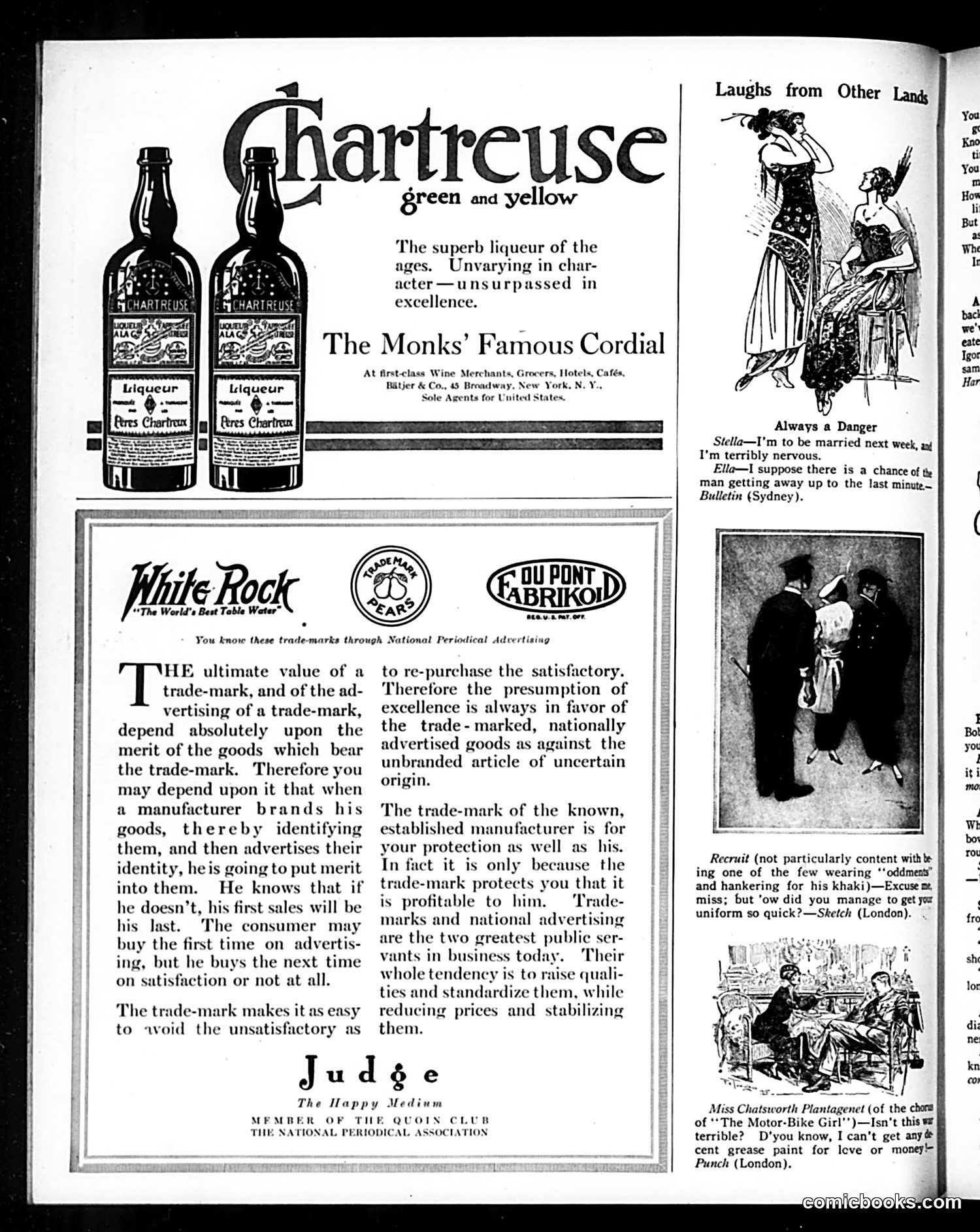
This page is primarily **advertising**, not political satire. It features: 1. **Chartreuse liqueur ad** (top): Promotes "The Monks' Famous Cordial," a green-and-yellow French liqueur, positioning it as a premium product available through major retailers. 2. **Trade-mark editorial** (center): An essay-style advertisement for White Rock, Bachmeteff, and DuPont Fabrikoid brands. The text argues that trade-marks and national advertising guarantee product quality—manufacturers won't advertise inferior goods because repeat purchases depend on satisfaction. This reflects early 20th-century advertising philosophy: branded goods are inherently trustworthy. 3. **"Judge" house ad** (lower left): Promotes the magazine itself as "The Happy Medium." 4. **Humor shorts** (right column): Brief jokes from international publications about marriage jitters, military recruits, and theatrical makeup—filler content typical of Judge's format. The page demonstrates how satirical magazines subsidized themselves through advertising while maintaining editorial voice. No significant political or social satire is present here.
📄 Transcribed text from this page (OCR, searchable)
Machine-transcribed from the original scan — historical spelling and the odd misread are preserved.
Rartreuse| The Monks’ Famous Cordial green and yellow The superb liqueur of the ages. Unvarying in char- acter —unsurpassed in excellence. At first-class Wine Merchants, Grocers, Hotels, C: Biitjer & Co., Sole Agents for United Sta MiiteRock (& Mauer err You know these trade-marks through National Periodical Advertising HE ultimate value of a trade-mark, and of the ad- vertising of a trade-mark, depend absolutely upon the merit of the goods which bear the trade-mark. Therefore you may depend upon it that when a manufacturer brands his goods, thereby identifying them, and then advertises their identity, heis going to put merit into them. He knows that if he doesn’t, his first sales will be his last. The consumer may buy the first time on advertis- ing, but he buys the next time on satisfaction or not at all. The trade-mark makes it as e to avoid the unsatisfactory 4 to re-purchase the satisfactory. Therefore the presumption of excellence is always in favor of the trade- marked, nationally advertised goods as against the unbranded article of uncertain origin. The trade-mark of the known, established manufacturer is for your protection as well as_ his. In fact it is only because the trade-mark protects you that it is profitable to him. — Trade- marks and national advertising are the two greatest public ser- vants in business today. Their whole tendency is to raise quali- ties and standardize them, while reducing prices and stabilizing them. Judge The Happ MEMBER OF TI THE NATIONAL PERL y Medinm 1k QUOIN CLUB ODICAL ASSOCIATION _ from Other Lands Always a Danger Stella—I'm to be married next week, a I'm terribly nervous. Ella—I suppose there is a chance of tle man getting away up to the last minute— Bulletin (Sydney). Recruit (not particularly content with b& ing one of the few wearing ‘‘oddmen’s” and hankering for his khaki)—Excuse m, miss; but ‘ow did you manage to get yor uniform so quick?—Sketch (London). Miss Chatsworth Plantagent ret (of the chons of ‘The Motor-Bike Girl’ Isn't this terrible? D'you know, I can’t get any & cent grease paint for leve or money Punch (London).