
A complete issue · 32 pages · 1915
Judge — July 3, 1915
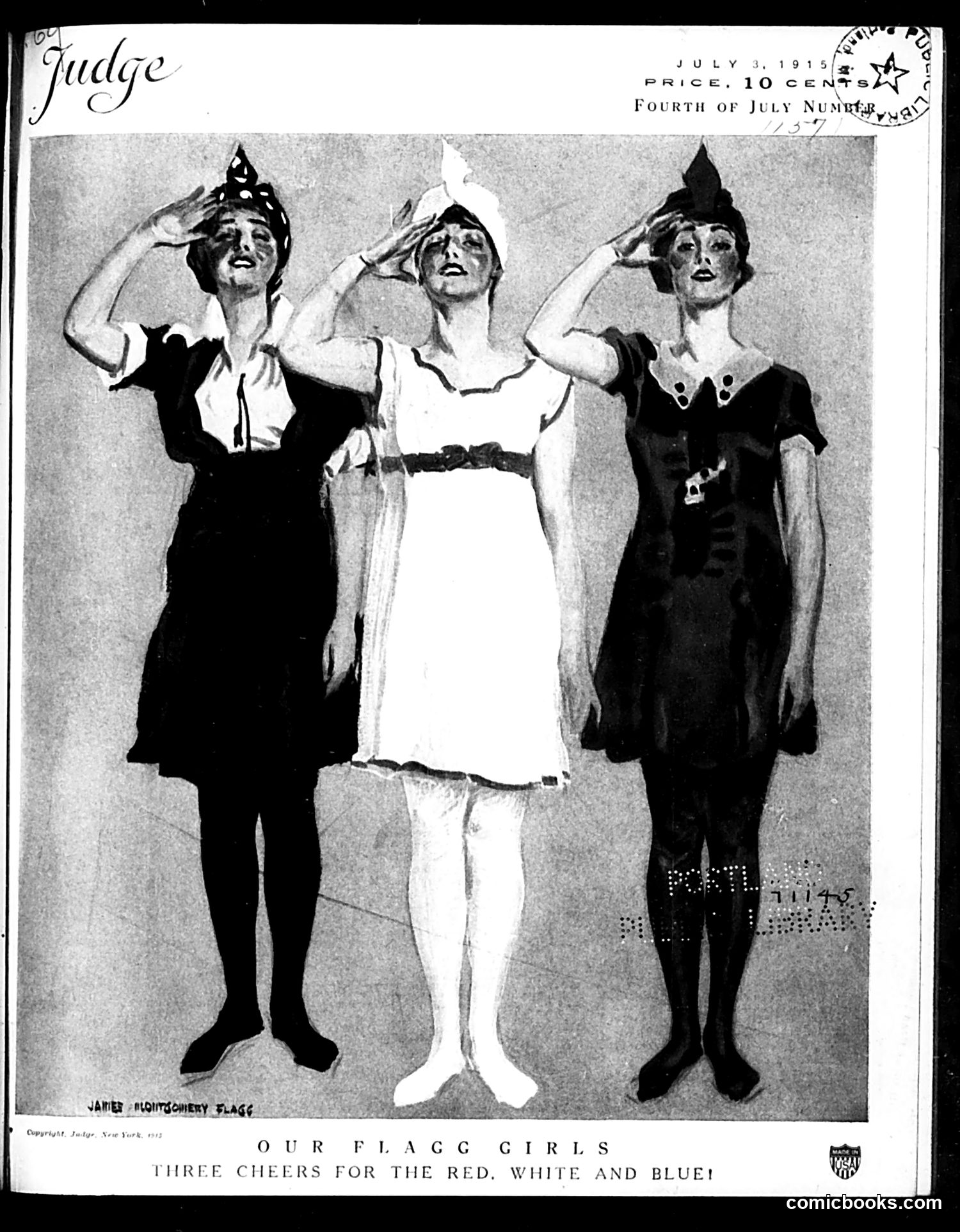
This July 3, 1915 Judge magazine cover depicts three women in patriotic costumes representing American flag colors—red, white, and blue. Each wears a pointed hat and adjusts it with a saluting gesture. The illustration appears to be a straightforward patriotic image celebrating American national identity ahead of Independence Day. However, the timing is significant: 1915 was marked by intense debates over American neutrality during World War I and anxieties about national loyalty. The "flagge girls" likely represent an appeal to unified American patriotism, though the specific satirical intent—whether mocking excessive patriotism, questioning loyalty claims, or simply promoting holiday spirit—isn't entirely clear from the image alone.
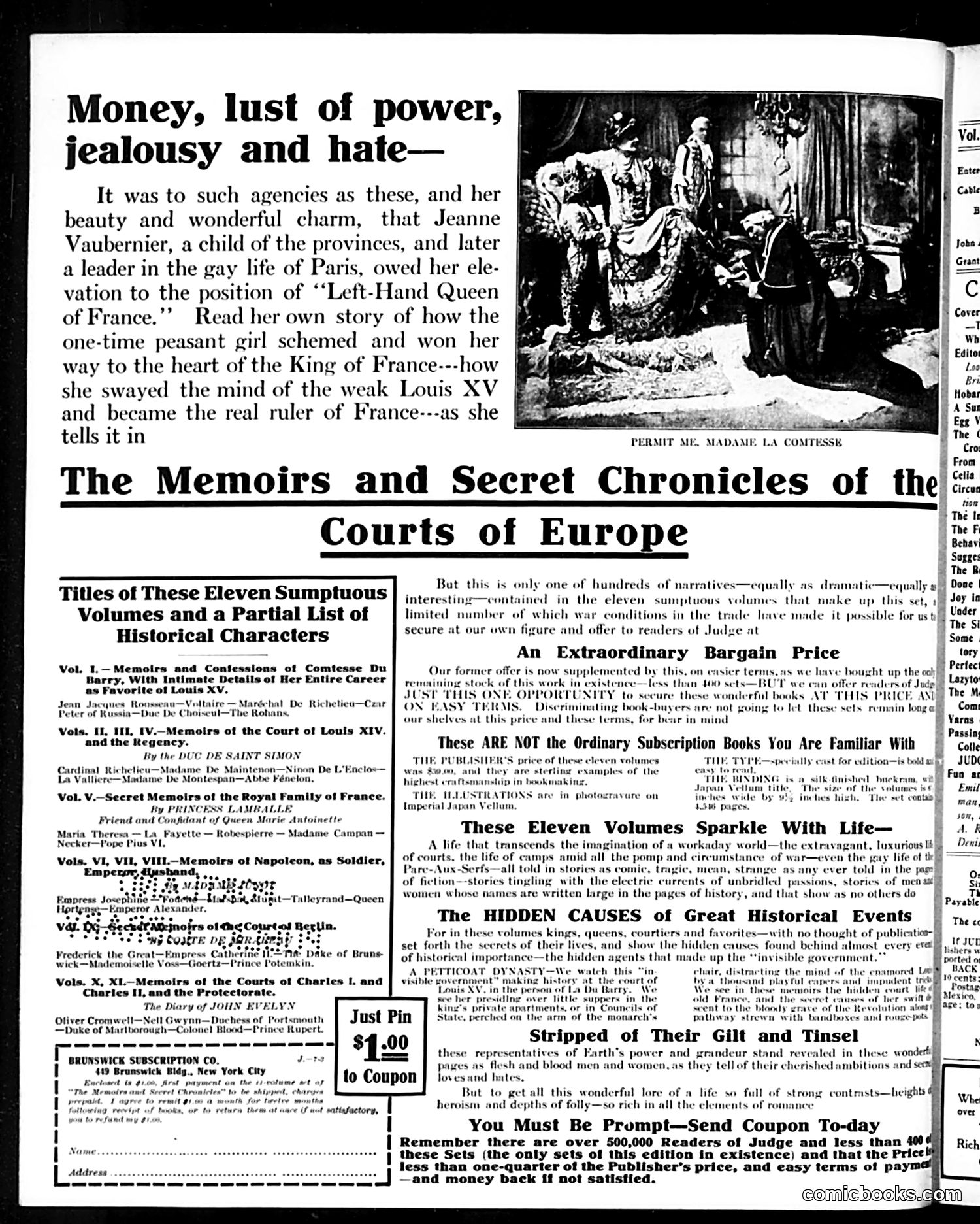
This page is primarily **advertising**, not political satire. It promotes "The Memoirs and Secret Chronicles of the Courts of Europe"—a eleven-volume book set about historical European royalty and scandal. The advertisement uses sensational copy to sell the books, featuring a dramatic image labeled "PERMIT ME, MADAME, LA COMTESSE" showing what appears to be a period court scene. The text emphasizes lurid narratives about figures like Jeanne Vaubernier (the "Left-Hand Queen of France") and her influence over Louis XV. The ad emphasizes these are not ordinary subscription books, promoting an "extraordinary bargain price" with a $1.00 coupon offer. The marketing targets readers interested in royal intrigue, scandal, and historical gossip rather than serious scholarship.
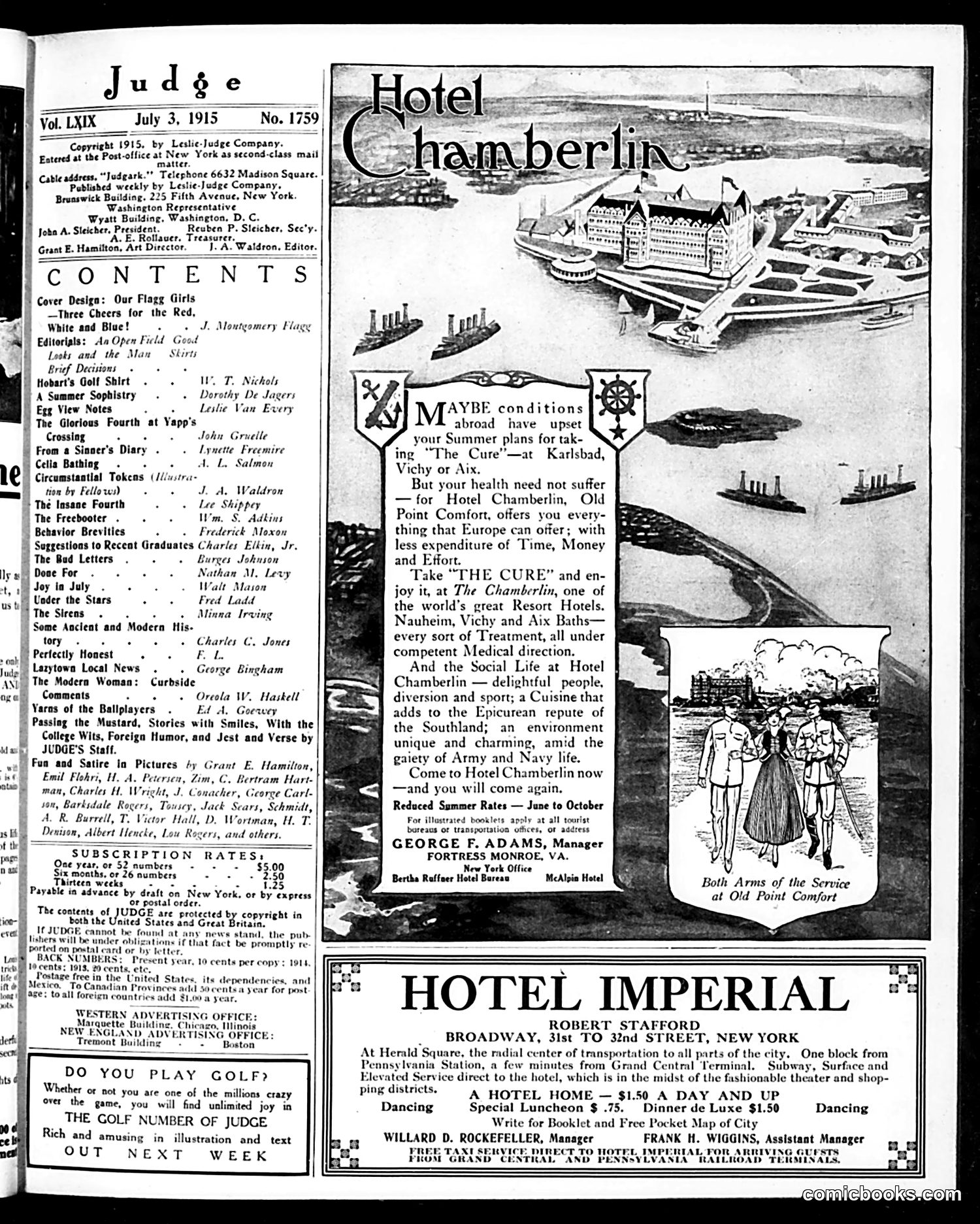
This page is primarily **advertising**, not political satire. The dominant content features two hotel advertisements: 1. **Hotel Chamberlin** (Old Point Comfort, Virginia) - A resort advertisement emphasizing it offers European spa treatments and leisure activities as an alternative to traveling abroad during World War I. The ad suggests staying in America while getting "the cure" (spa treatments) available at famous European destinations like Karlsbad and Vichy. 2. **Hotel Imperial** (Broadway, New York) - A budget hotel advertisement claiming "A HOTEL HOME—$1.50 A DAY AND UP." The page's left side contains the magazine's contents and subscription information. There is no identifiable political cartoon or satire visible in the image—it's a commercial advertising page typical of early 20th-century magazine layouts.
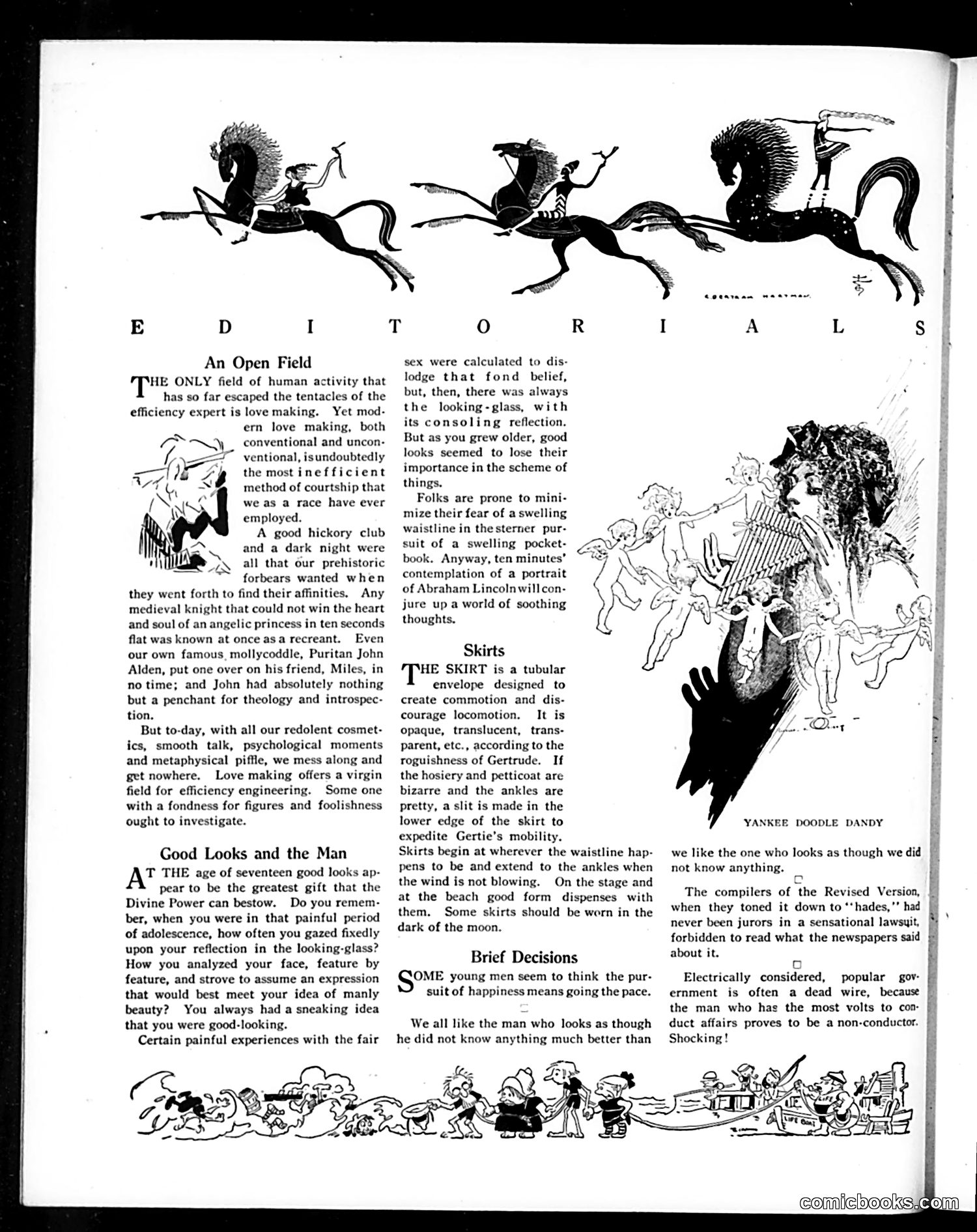
This appears to be a humor/advice page from Judge magazine, not a political cartoon. The header "EDITORIALS" features silhouettes of figures on horseback or rearing animals, though their specific identities are unclear from the image alone. The page contains three essay-style sections: "An Open Field" (about courtship and love-making), "Good Looks and the Man" (discussing male appearance and self-presentation), and "Skirts" (analyzing women's fashion choices). A section titled "Brief Decisions" offers aphoristic observations, including commentary on appearing ignorant as desirable in men. The content satirizes social conventions and dating customs of the era through humor and gentle social critique rather than partisan politics.
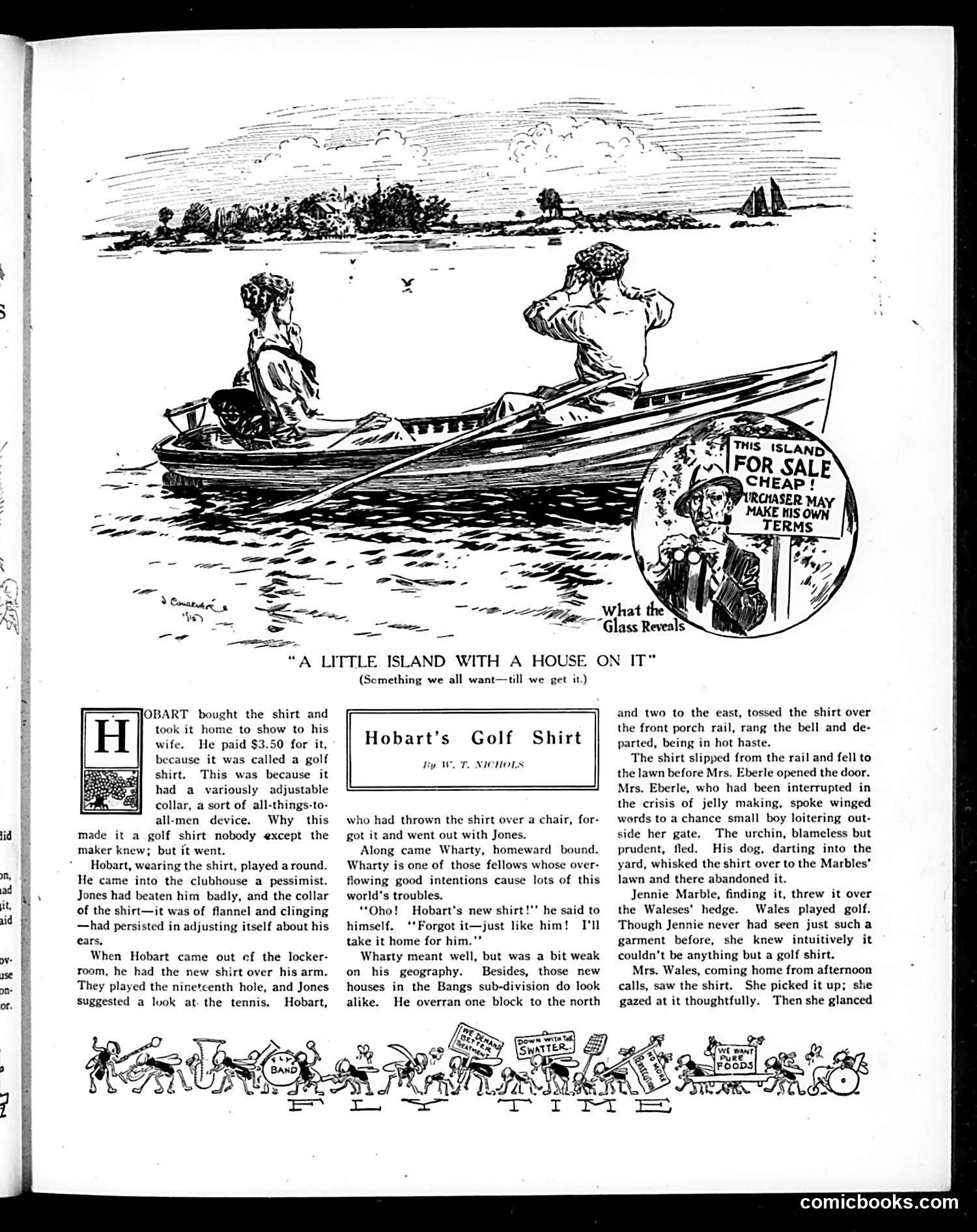
This is primarily a fictional short story titled "Hobart's Golf Shirt" by W.T. Nichols, not political satire. The narrative concerns a golf shirt with an adjustable collar that becomes a source of comic chaos. Hobart buys the shirt, wears it to play golf, and it gets thrown around by various characters (Jones, Wharty, Jennie Marble, Mrs. Wales) in a series of escalating mishaps—each person tossing it further afield until it ends up abandoned on a lawn. The illustration at top shows two people in a boat viewing an island, with an inset circle revealing a real estate agent hawking "This Island for Sale Cheap!"—likely the story's punchline setup about desirable property. This is light humor about everyday domestic absurdity rather than political commentary.
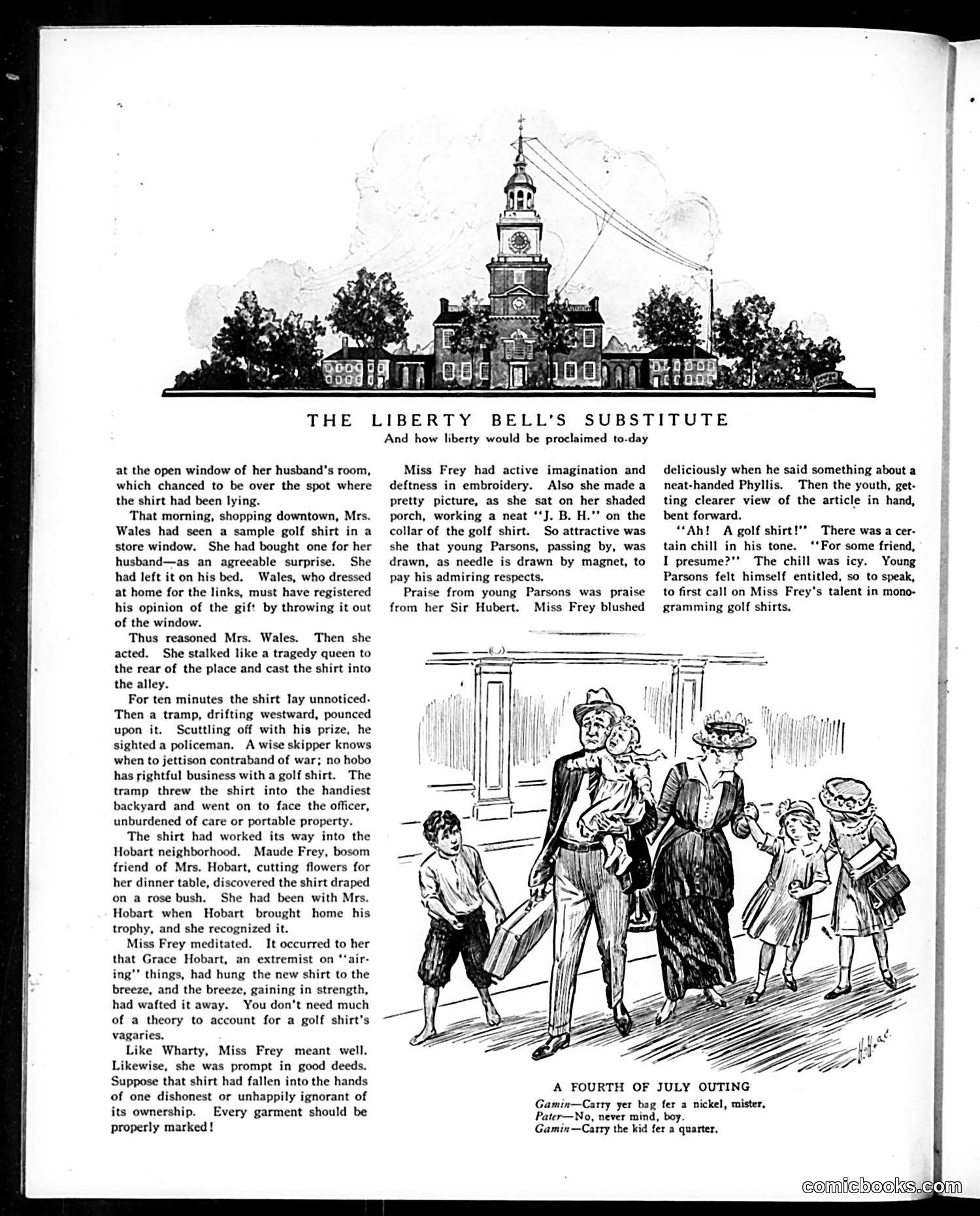
This satirical story mocks the cascading consequences of minor domestic decisions. Mrs. Wales buys her husband a golf shirt; he rejects it by throwing it out the window. The shirt travels through a tramp, a backyard, and lands with neighbor Miss Frey, who embbroiders the initials "J.B.H." on it—assuming it belongs to her friend Grace Hobart. Young Parsons, visiting Miss Frey, sees her embroidering and grows jealous, assuming the shirt is a gift for another man. The title's joke: just as the Liberty Bell cracked and required a substitute, this golf shirt becomes a substitute Liberty Bell—proclaiming liberty (and chaos) through its uncontrolled journey and the misunderstandings it generates. The lower cartoon shows Fourth of July street life: a street child ("gamin") offering to carry a gentleman's golf bag for a nickel, then his child for a quarter—likely satirizing working-class poverty and commercialized charity.
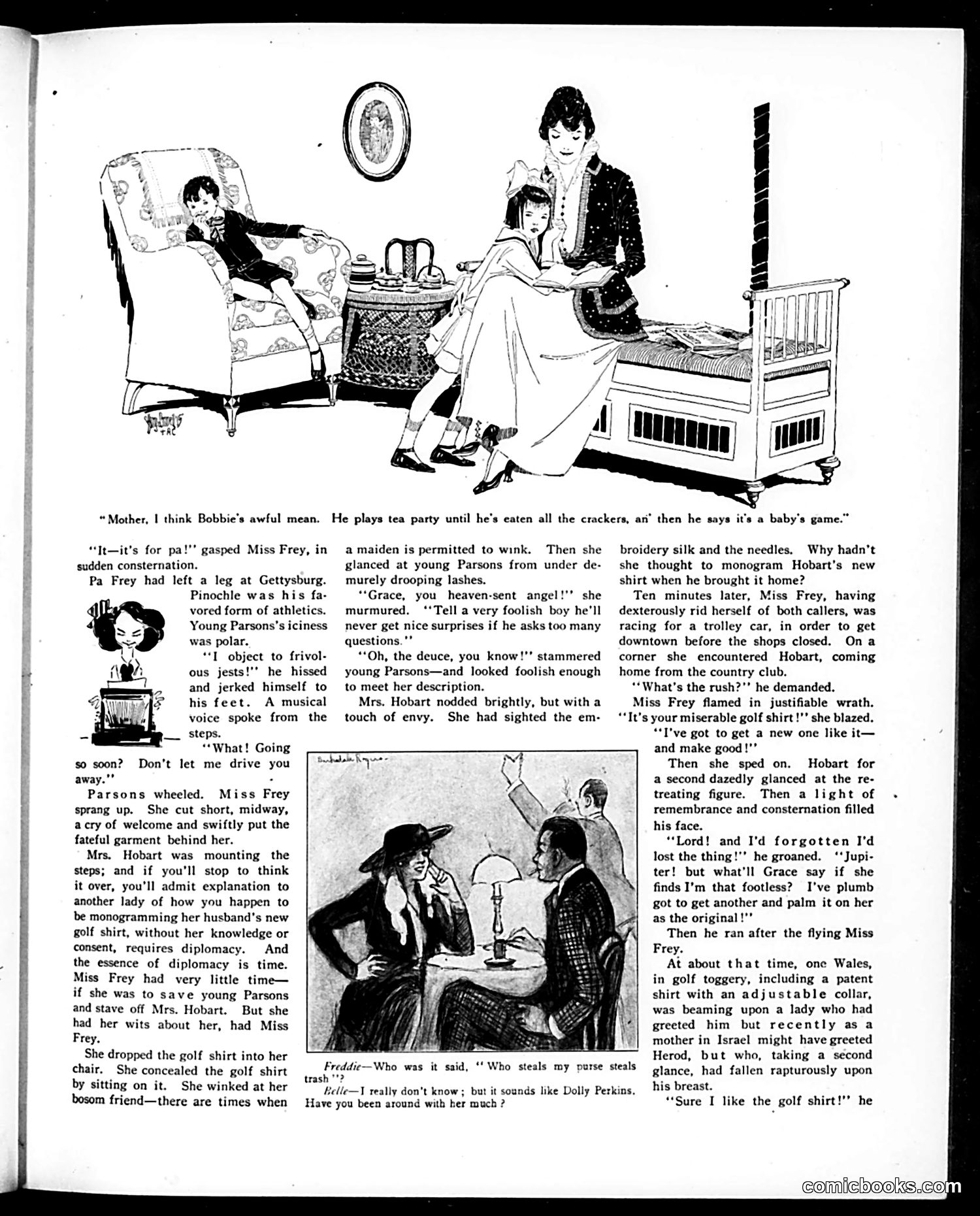
This is a humorous domestic fiction story, not political satire. The plot involves Miss Frey secretly embroidering Mr. Hobart's new golf shirt as a gift when Mrs. Hobart unexpectedly arrives. To conceal the compromising situation from Mrs. Hobart (who might be jealous), Miss Frey hides the shirt and flirts with young Parsons to distract him. The comedy hinges on social conventions: a single woman monogramming a married man's garment requires explanation to avoid scandal. The story escalates as Miss Frey must obtain an identical replacement shirt before shops close. The reference to "Pa Frey had left a leg at Gettysburg" invokes Civil War service, establishing the story's era (early 1900s). The humor relies on miscommunication, rushed complications, and the irony that both Mr. and Mrs. Hobart separately plan to secretly replace the "lost" shirt.
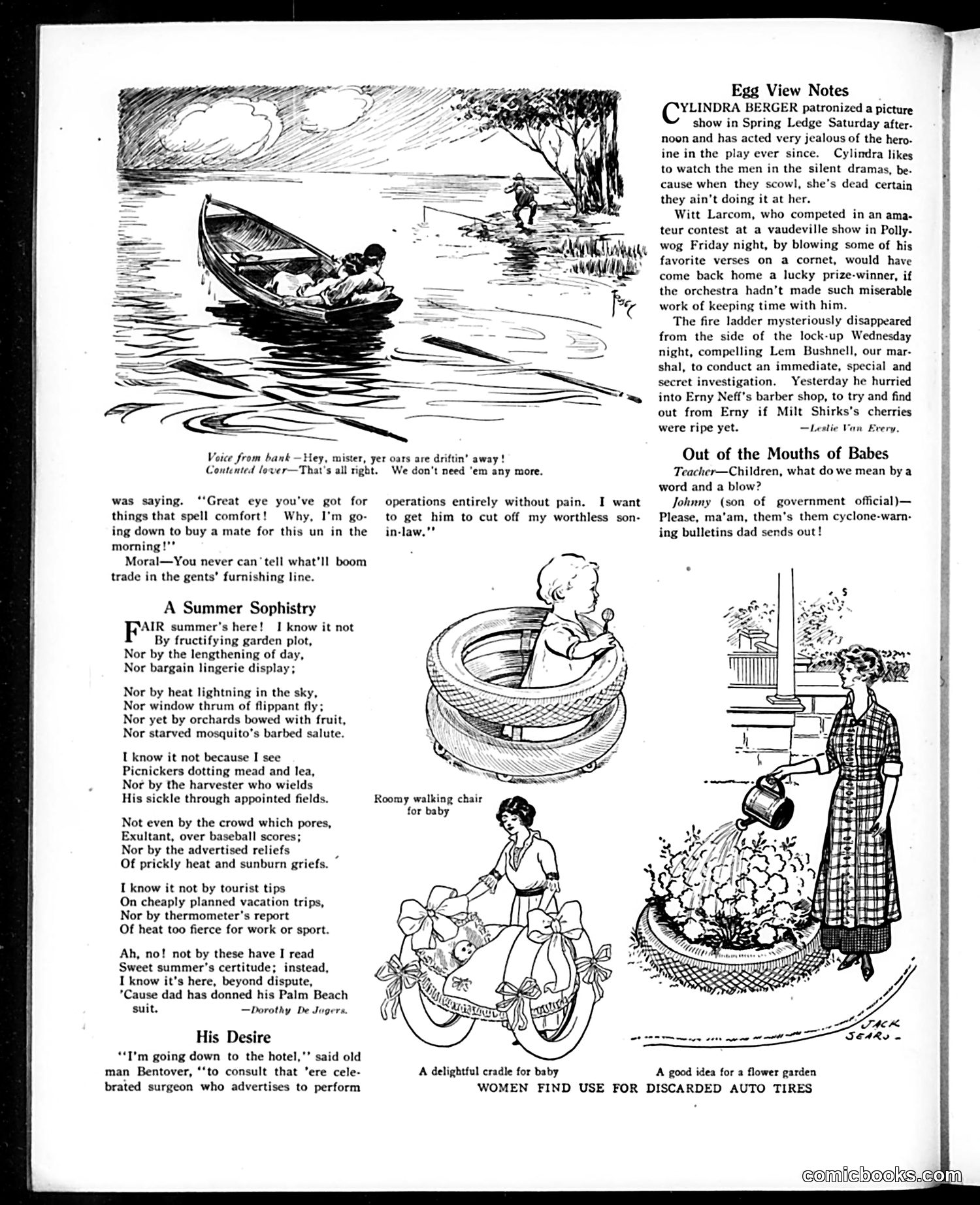
This page contains several short humorous pieces typical of early 20th-century American magazine humor: **"Egg View Notes"** is a gossip column about small-town characters (Cylindra Berger, Witt Larcom, Lem Bushnell). The jokes rely on local knowledge and gentle mockery—a jealous woman at movies, a musician out of sync with the orchestra, a mysteriously missing fire ladder. **"Out of the Mouths of Babes"** is a joke where a government official's son confuses weather bulletins with cyclone warnings—satirizing bureaucratic incompetence in a child's innocent misunderstanding. **"A Summer Sophistry"** is a poem claiming summer's arrival isn't proven by gardens, heat, or tourists, but by one fact: "dad has donned his Palm Beach suit"—mocking people's actual summer priorities versus romantic notions. **Bottom illustrations** show period inventions: a baby carriage made from auto tires, and a "roomy walking chair" (also tire-based). These demonstrate practical Depression-era resourcefulness. The overall tone is gentle, domestic Americana satire aimed at middle-class readers.
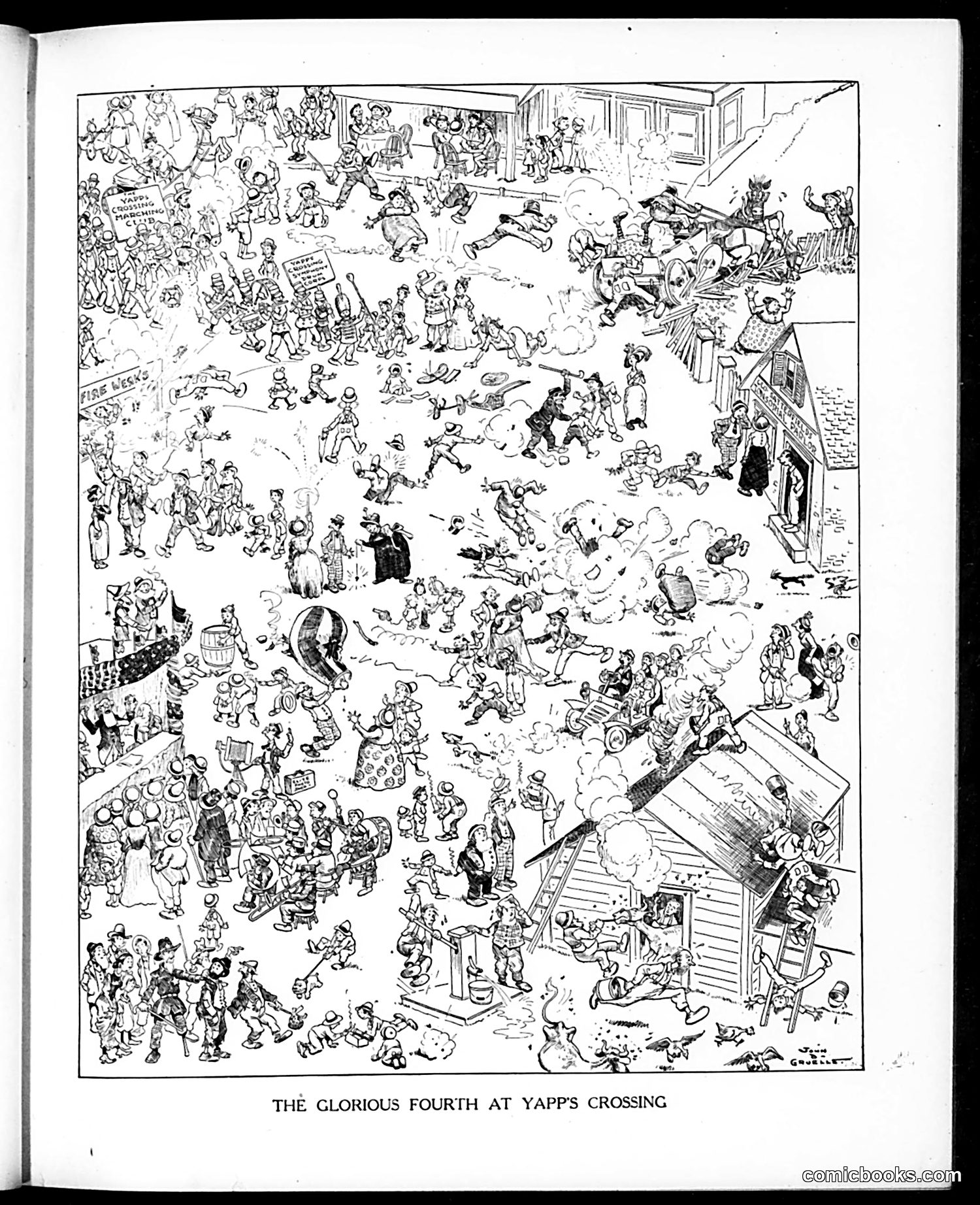
This is a densely-packed satirical illustration depicting a chaotic Fourth of July celebration at a rural location called Yapp's Crossing. The image shows hundreds of people engaged in various Independence Day activities—fireworks, parades, games, and general mayhem. The satire targets small-town American holiday chaos: reckless fireworks use, drunken revelry, accidents, and general disorder. Figures appear to be injured, fleeing explosions, or engaged in undignified behavior. A burning building is visible, suggesting destructive consequences. The work mocks how communities celebrated Independence Day with dangerous abandon, particularly criticizing the lack of safety and the contrast between the holiday's dignified purpose and the actual pandemonium it inspired in practice. It's classic Judge magazine social commentary through comedic exaggeration.
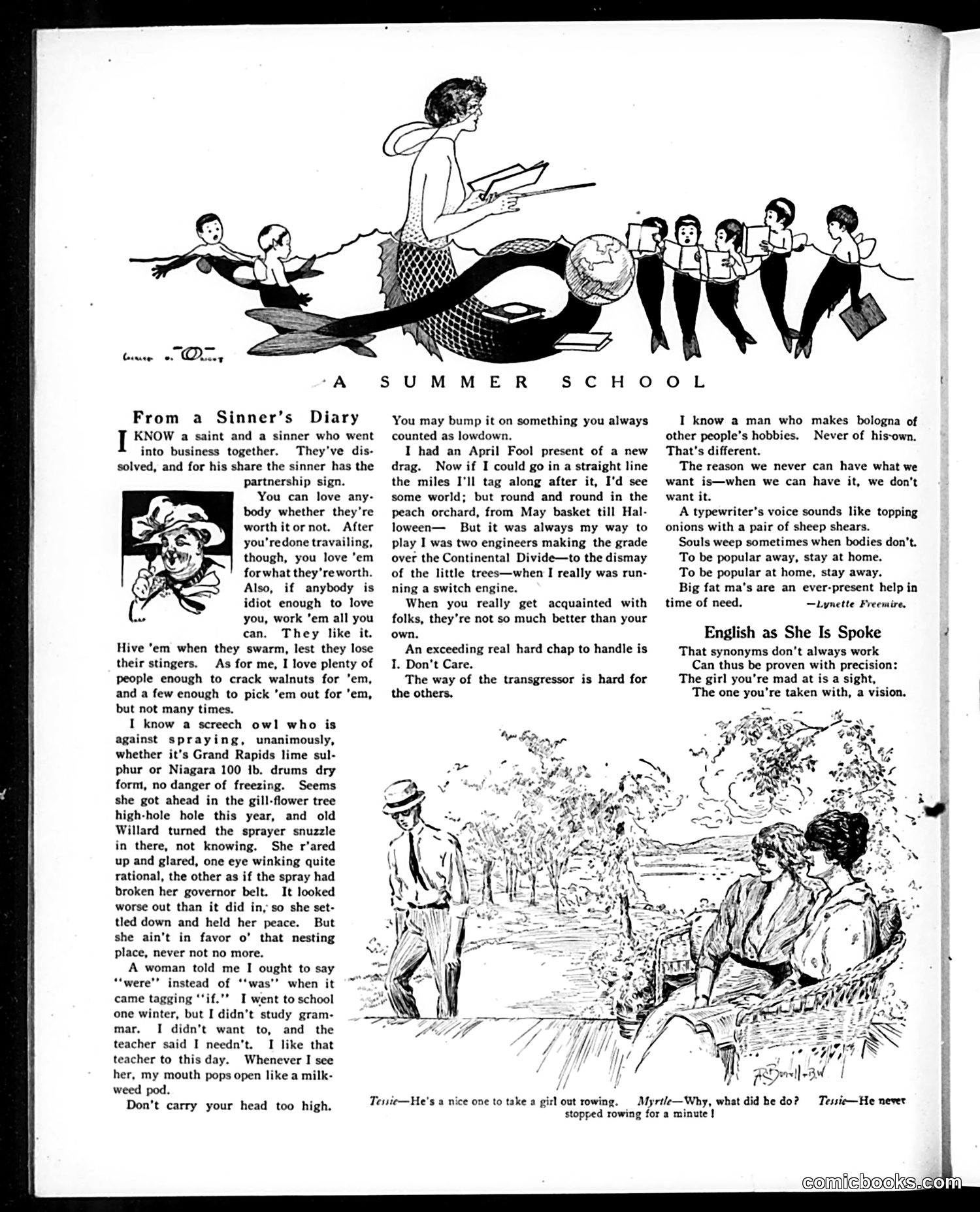
This page contains humorous social commentary typical of Judge's early 20th-century satirical style. The top illustration depicts a carefree woman leading schoolchildren, representing the idealized notion of summer vacation and leisure education. The main text, "From a Sinner's Diary," offers cynical observations on human nature: dishonest business partnerships, conditional love based on utility, and the hypocrisy of social behavior. The anecdote about the owl getting sprayed satirizes people who complain about problems *after* they occur. The lower sections mock grammar pedantry ("English as She Is Spoke") and include a joke about a man who stops rowing during a date—implying laziness or inattentiveness makes him unreliable company. Overall, the page satirizes pretension, hypocrisy, and social climbing while celebrating plainspoken common sense and self-awareness. The tone is gently misanthropic but not mean-spirited.
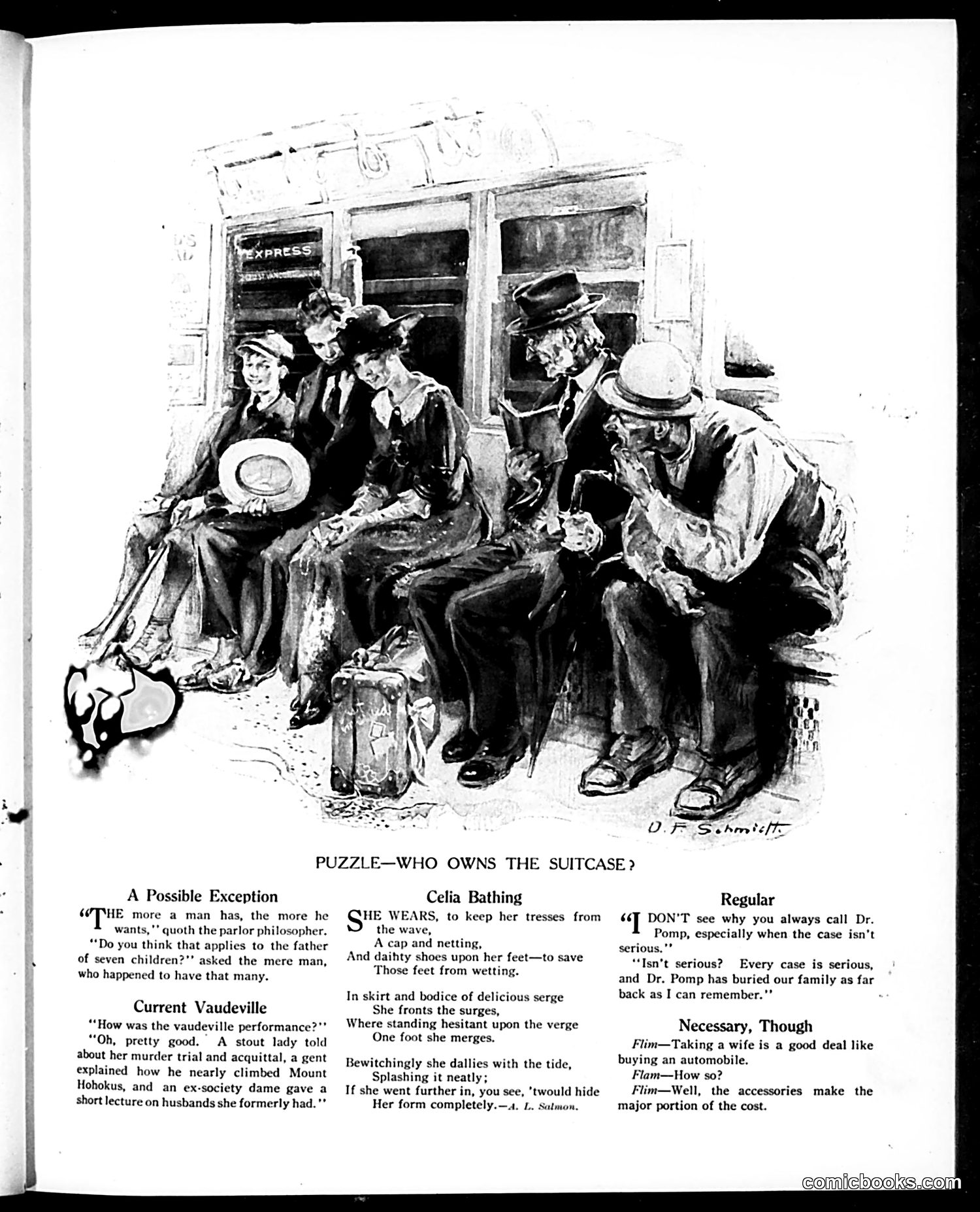
This page contains multiple satirical pieces typical of early 20th-century humor magazines: **Main cartoon** ("Puzzle—Who Owns the Suitcase?"): Shows travelers on what appears to be a train, parodying the "whodunit" mystery genre popular at the time. **Text humor pieces** include: - **"A Possible Exception"**: Jokes about large families contradicting the saying that wealth breeds desire for more. - **"Current Vaudeville"**: Mocks lowbrow vaudeville entertainment—a murder trial story, tall tales about climbing mountains, and divorce lectures—reflecting middle-class disdain for popular entertainment. - **"Celia Bathing"**: Satirizes women's modest swimming attire (caps, shoes, long skirts) that defeats the purpose of bathing by preventing actual water contact. - **"Regular"** and **"Necessary, Though"**: Brief jokes about doctors and marriage costs, reflecting common domestic anxieties. The overall tone satirizes contemporary social conventions, entertainment, and gender behavior with gentle, class-conscious humor typical of Judge's audience.
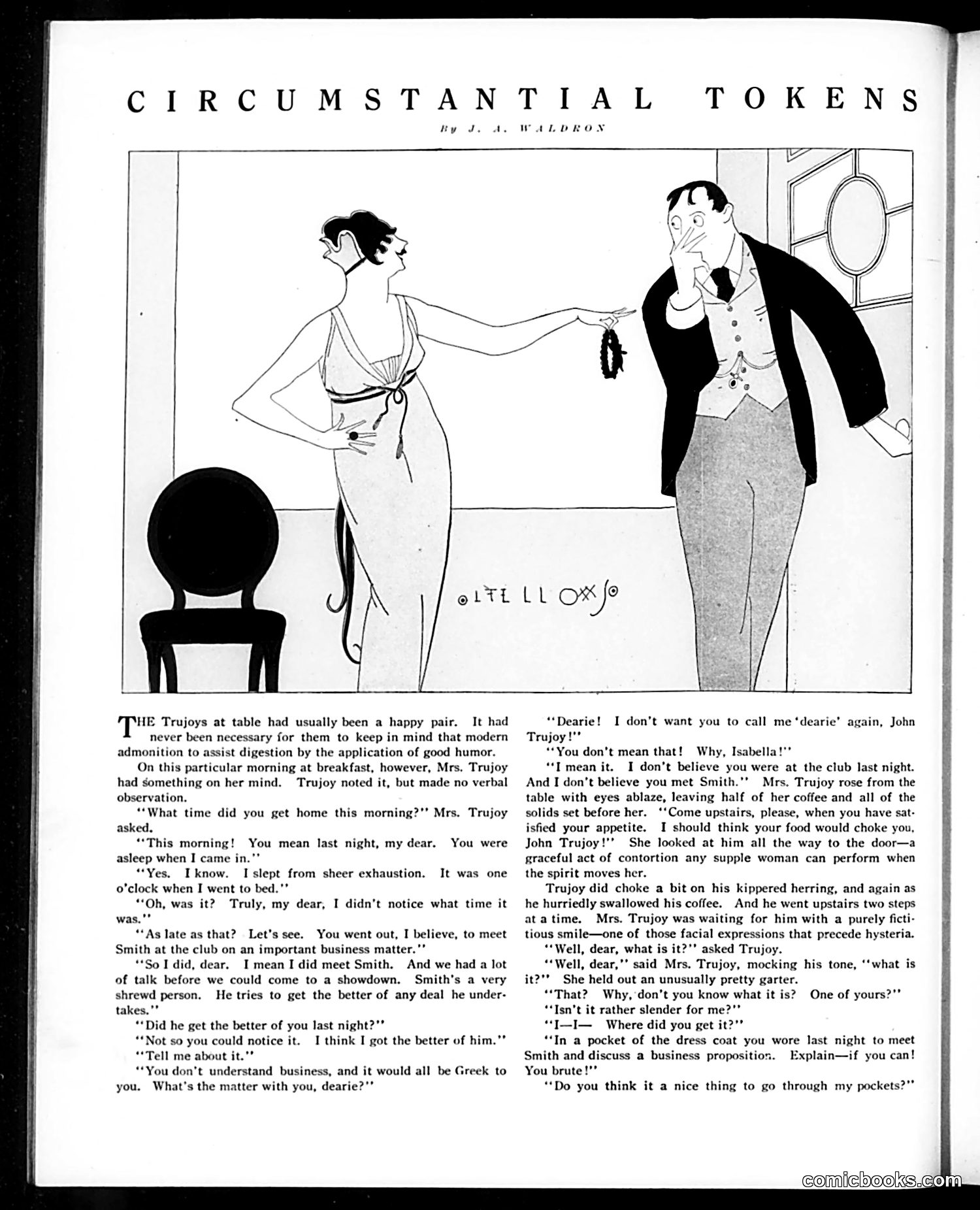
This cartoon illustrates a domestic infidelity accusation, presented as marital satire. Mr. Trujoy claims he spent the evening at his club conducting business with a man named Smith. His wife, suspicious of his late return, discovers a woman's garter in his coat pocket—"circumstantial" evidence of an affair. The humor trades on early-20th-century gender dynamics: Mrs. Trujoy's indignation at being called "dearie," her dramatic exit, and her willingness to search his pockets, contrasted with Mr. Trujoy's stammering denials. The cartoon satirizes both marital suspicion and masculine infidelity excuses typical of the era. The illustration shows the confrontation scene—she holds the damning garter while he recoils defensively. This type of domestic comedy was standard Judge magazine fare, reflecting anxieties about fidelity and changing gender relations in early-20th-century American middle-class life.
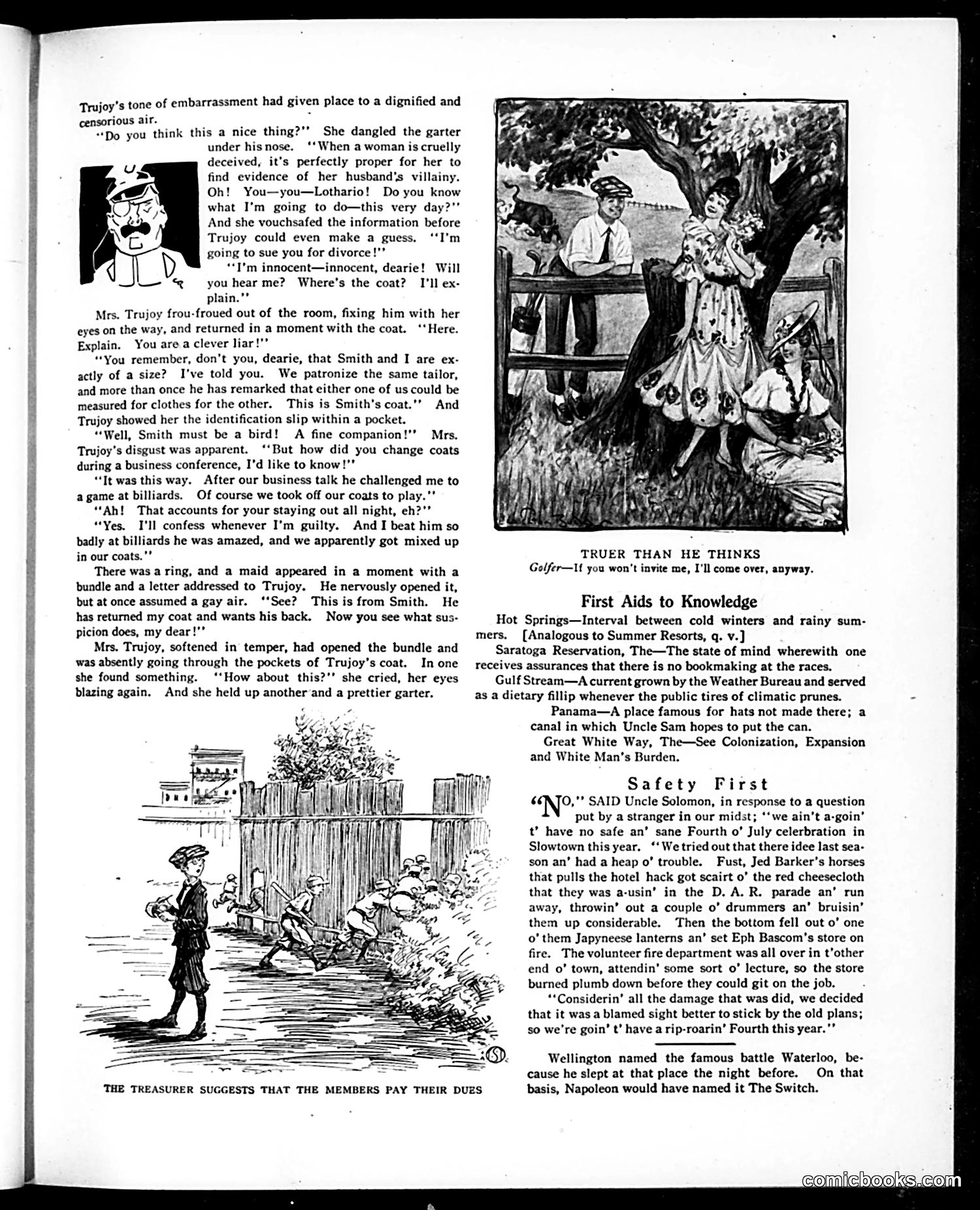
This page contains a humorous domestic drama about Mr. Trujoy, caught with a woman's garter in his coat pocket. His wife threatens divorce, but he explains the coat belongs to his friend Smith—they're identical sizes and swapped coats after playing billiards. A letter from Smith arrives confirming the mix-up, seemingly exonerating Trujoy. However, Mrs. Trujoy discovers a *second*, prettier garter in the coat, implying Smith's involvement with another woman—or suggesting Trujoy's story was a convenient lie all along. The satire targets husbands' creative excuses for infidelity and wives' investigative suspicions in marriage. The punchline—the second garter—undercuts Trujoy's vindication, suggesting guilty men always have another layer of deception. Lower sections include joke definitions ("First Aids to Knowledge") mocking contemporary topics like Panama, and a rural safety story about a "safe and sane" Fourth of July celebration gone wrong—satirizing progressive safety campaigns.
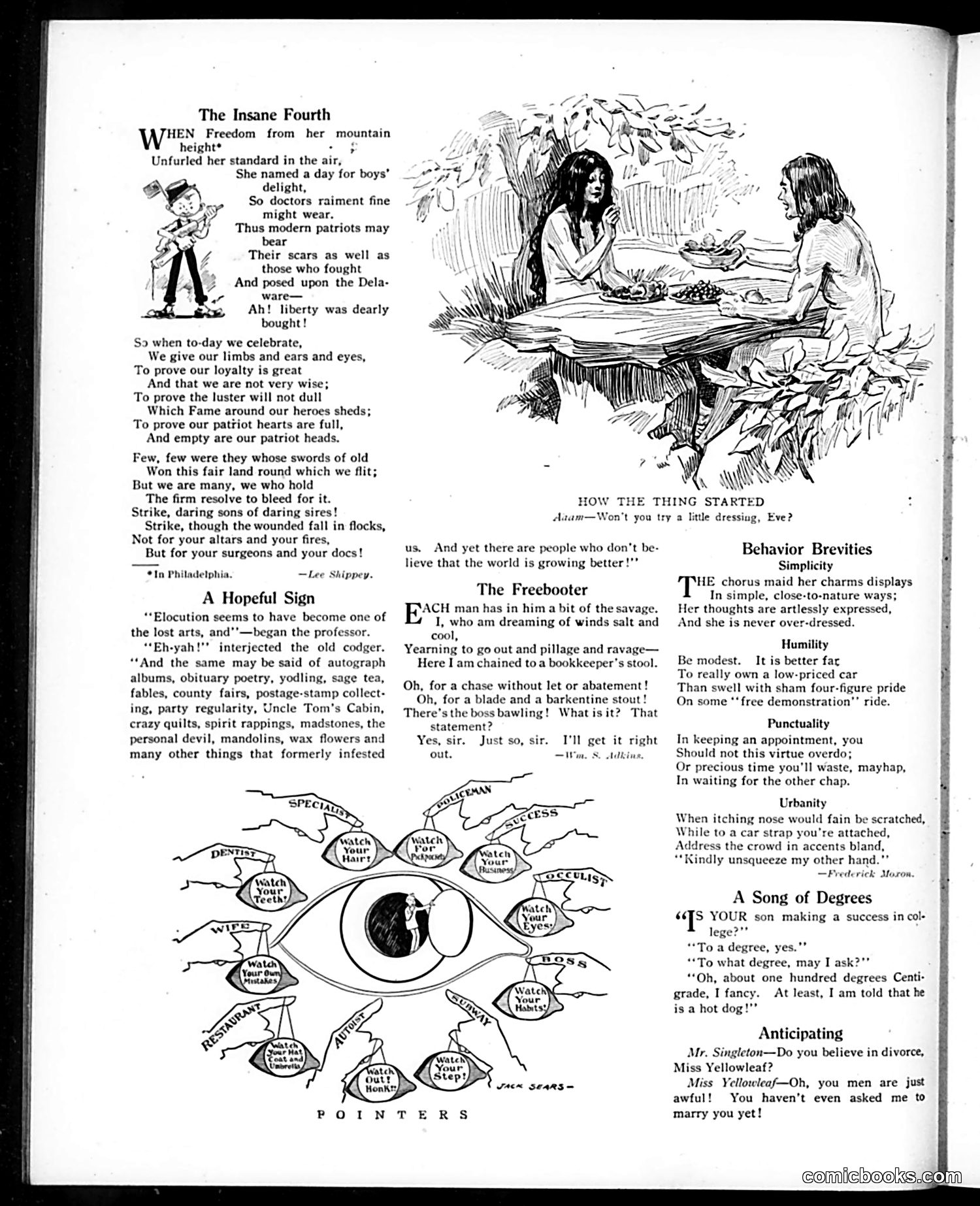
This poem mocks Americans celebrating Independence Day recklessly. The satire contrasts the sacrifice of Revolutionary War founders ("few, few were they whose swords of old / Won this fair land") with modern celebrants who carelessly injure themselves—losing "limbs and ears and eyes"—while claiming patriotic devotion. The poem's bitter punchline reveals the true motivation: citizens bleed "Not for your altars and your fires, / But for your surgeons and your docs!"—suggesting celebrants injure themselves primarily to benefit doctors financially, not from genuine patriotism. The accompanying illustration (top right) shows "How the Thing Started," depicting Adam offering Eve "a little dressing"—a crude visual pun suggesting humanity's injuries and the need for medical treatment originated at creation itself. This reflects Progressive-era skepticism toward jingoistic patriotism and critiques the commercialization of national holidays, with doctors profiting from preventable Fourth of July injuries caused by fireworks and reckless behavior.
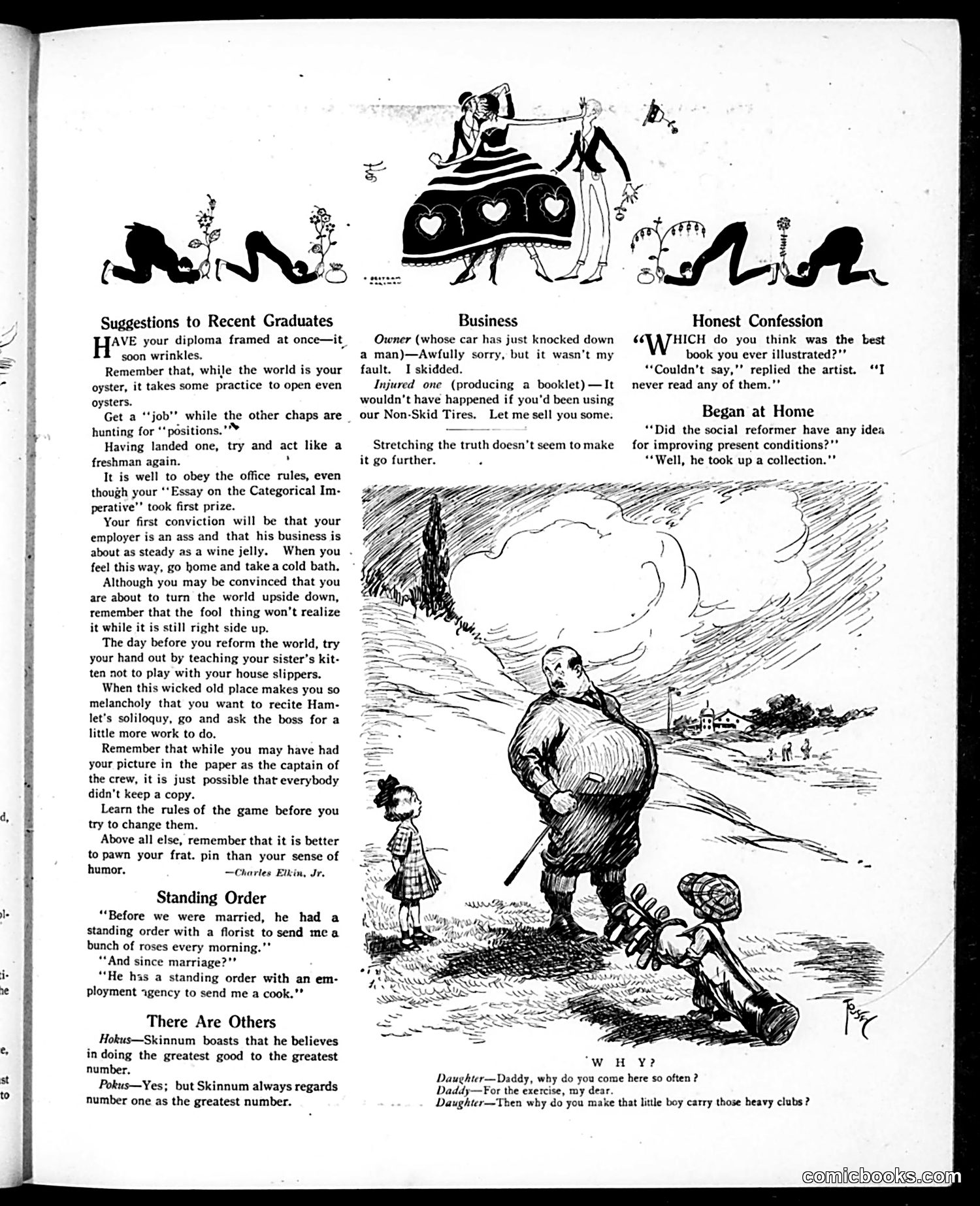
This page contains several satirical humor pieces targeting early 20th-century American social types: **"Suggestions to Recent Graduates"** mocks idealistic new graduates by advising them to abandon their philosophical pretensions ("Categorical Imperative") and accept workplace humiliation. The satire suggests young people overestimate their importance—their newspaper photos mean nothing. **"Business" and "Standing Order"** jokes target commercial dishonesty and marital disappointment. The car-accident victim immediately tries selling non-skid tires despite causing injury; the husband replaces romantic roses with hiring a cook. **"Honest Confession"** ridicules artists as frivolous—the illustrator admits never reading the books he illustrated. **"Began at Home"** satirizes hypocritical reformers who claim moral authority while exploiting child labor for personal benefit (having a boy carry golf clubs). The large cartoon shows a golfer and child, visualizing the final joke's critique of class exploitation disguised as virtue. All pieces mock pretension, dishonesty, and hypocrisy across professions and classes, typical of Judge's satirical approach.
This appears to be an **advertisement** rather than a political cartoon. The image shows what looks like a staged scene at a Standard Oil Company office or location (with locations listed as New York, Albany, and possibly Boston). The photograph depicts two figures in what appears to be an interior doorway or entrance, with architectural details like a striped awning visible above. Without clearer OCR text or additional context about the surrounding page content, the specific message or satire is **unclear**. Given that this is from *Judge* magazine, it may be satirizing Standard Oil Company's business practices or corporate image, but the actual point of any satire or humor cannot be reliably determined from the image alone.
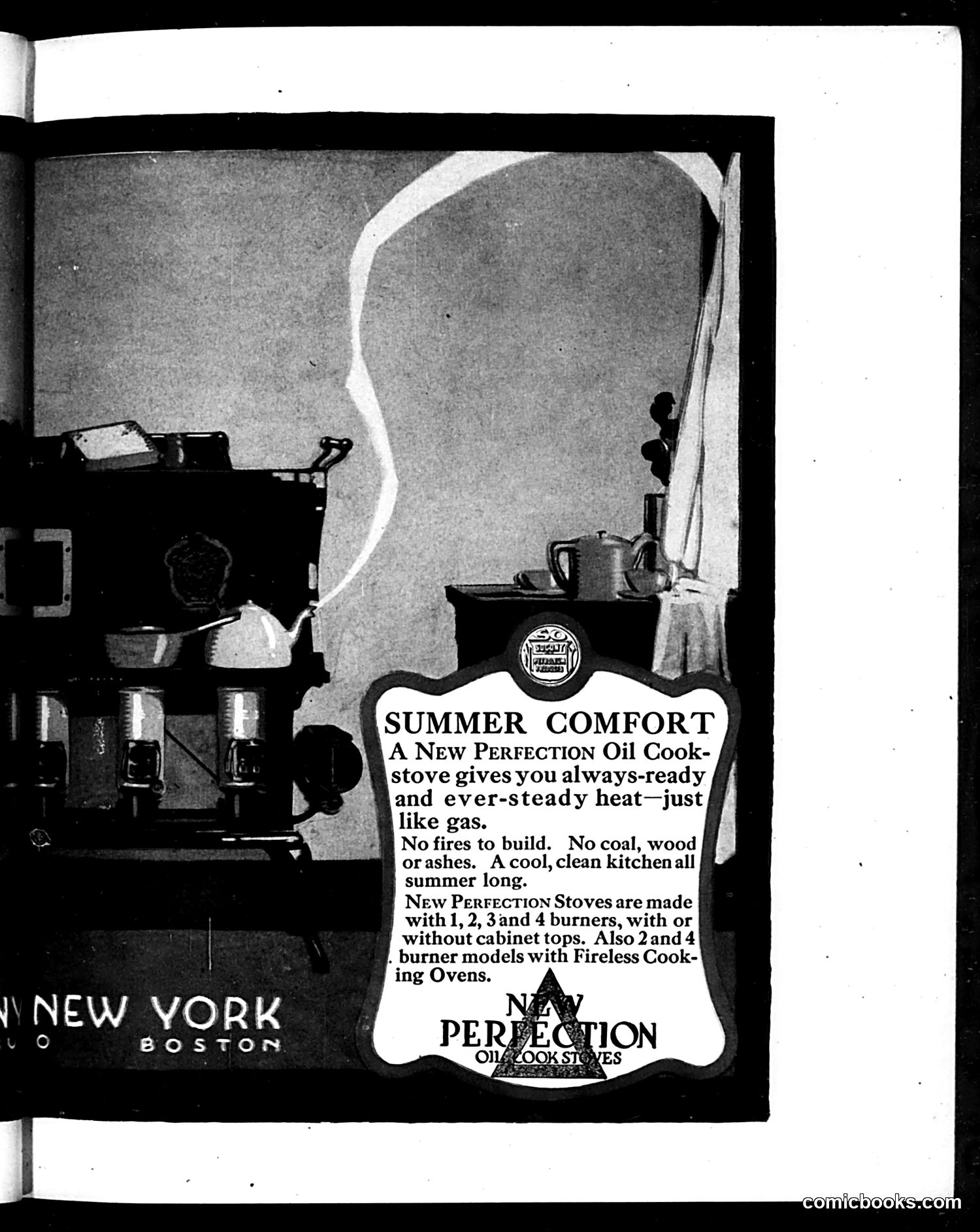
This is a full-page advertisement rather than satirical content. It promotes the "New Perfection Oil Cookstove," marketed as a summer kitchen solution that provides steady heat "just like gas" without requiring fires, coal, wood, or ash cleanup. The ad emphasizes convenience and cleanliness—appealing to housewives tired of traditional stove maintenance during hot months. The visual shows a stylized kitchen with the stove and period furnishings. The appeal is practical: no mess, no heat buildup from traditional fuel, and various burner configurations available. This reflects early 20th-century kitchen modernization, when oil-burning stoves represented technological progress over wood/coal alternatives. The ad targets affluent urban readers (referencing New York and Boston offices) who could afford such appliances.
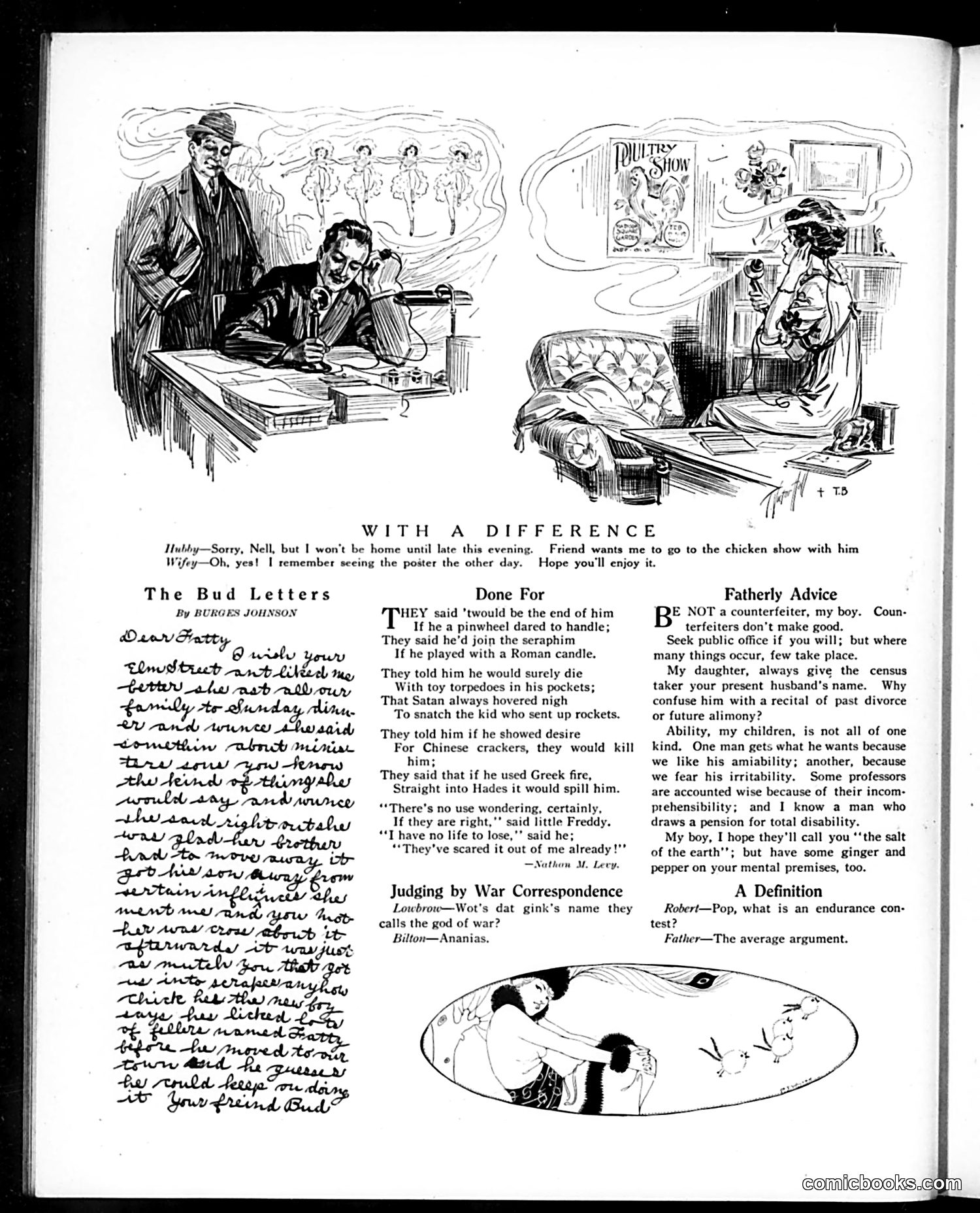
This page contains light domestic and social humor typical of early 20th-century American satire. **"With a Difference"** depicts a husband excusing himself from an evening at home by claiming he must attend a "chicken show" with a friend. The wife's cheerful acceptance—claiming to remember seeing the poster—suggests she's either oblivious or deliberately playing along, likely implying the "chicken show" is a euphemism for something else (a bar, gambling, or time with questionable company). The humor relies on the audience recognizing this as an obvious lie the wife pretends to believe. **Other pieces** include "The Bud Letters" (handwritten correspondence), "Done For" (a poem mocking parental warnings about fireworks), "Fatherly Advice" (cynical observations about counterfeiting, politics, and marriage), and "A Definition" (defining endurance contests as arguments). The cartoons and text represent genteel, domestic comedy aimed at middle-class readers—poking fun at marital dynamics, parental anxiety, and social pretense rather than addressing serious political issues.
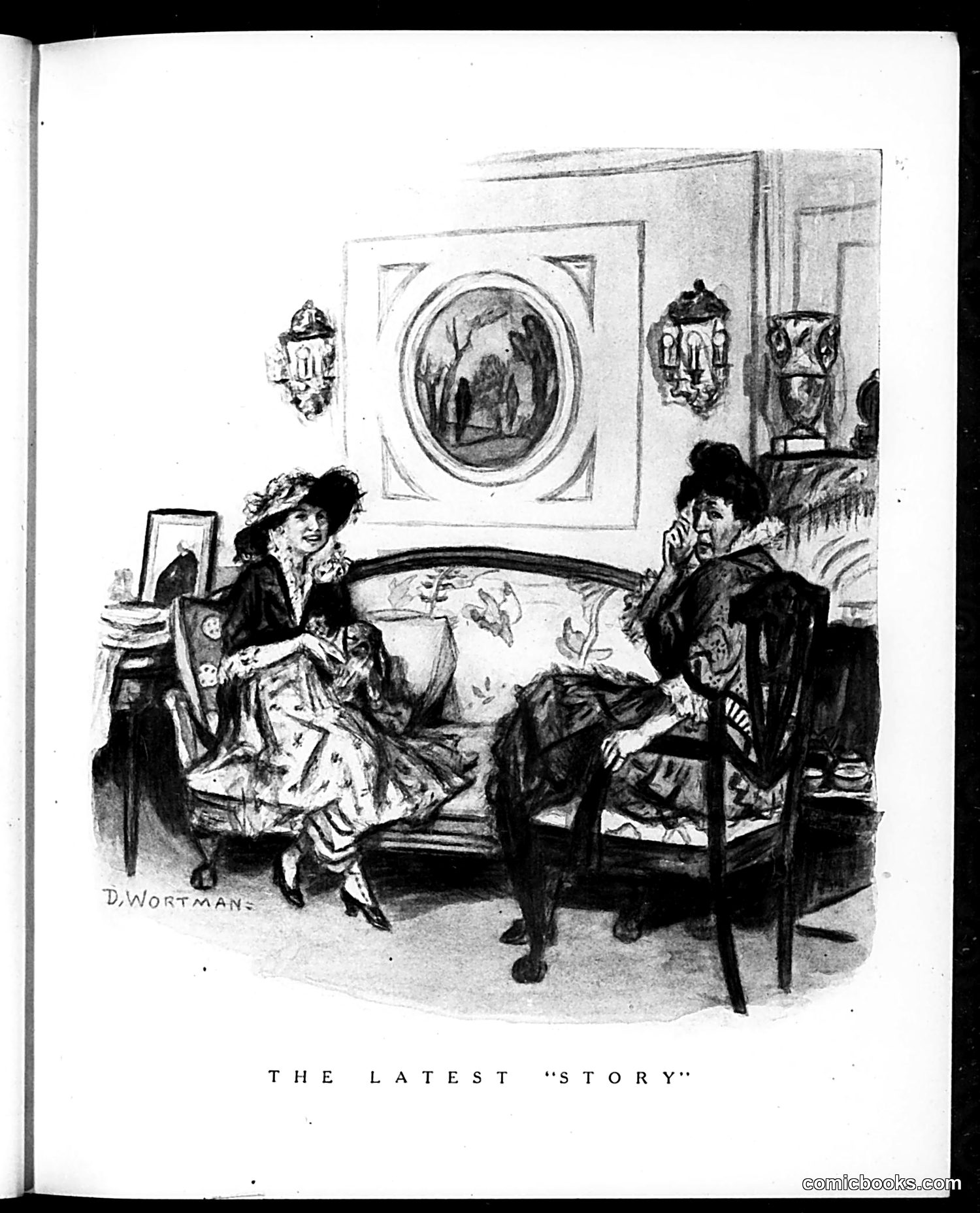
This cartoon depicts a domestic scene where a well-dressed woman sits on a sofa, apparently sharing gossip or scandal with a male visitor. The elegant interior—with its framed portrait, decorative urns, and ornate furnishings—establishes an upper-class setting. The satire appears to target society gossip and rumor-mongering among the wealthy. The title "The Latest 'Story'" (with quotation marks suggesting unreliability) mocks how scandalous tales circulate through high society. The woman's animated expression and the man's attentive posture suggest the transmission of potentially fabricated or exaggerated social news—a common Judge magazine theme critiquing the idle preoccupations of the leisure class and their obsession with each other's affairs.
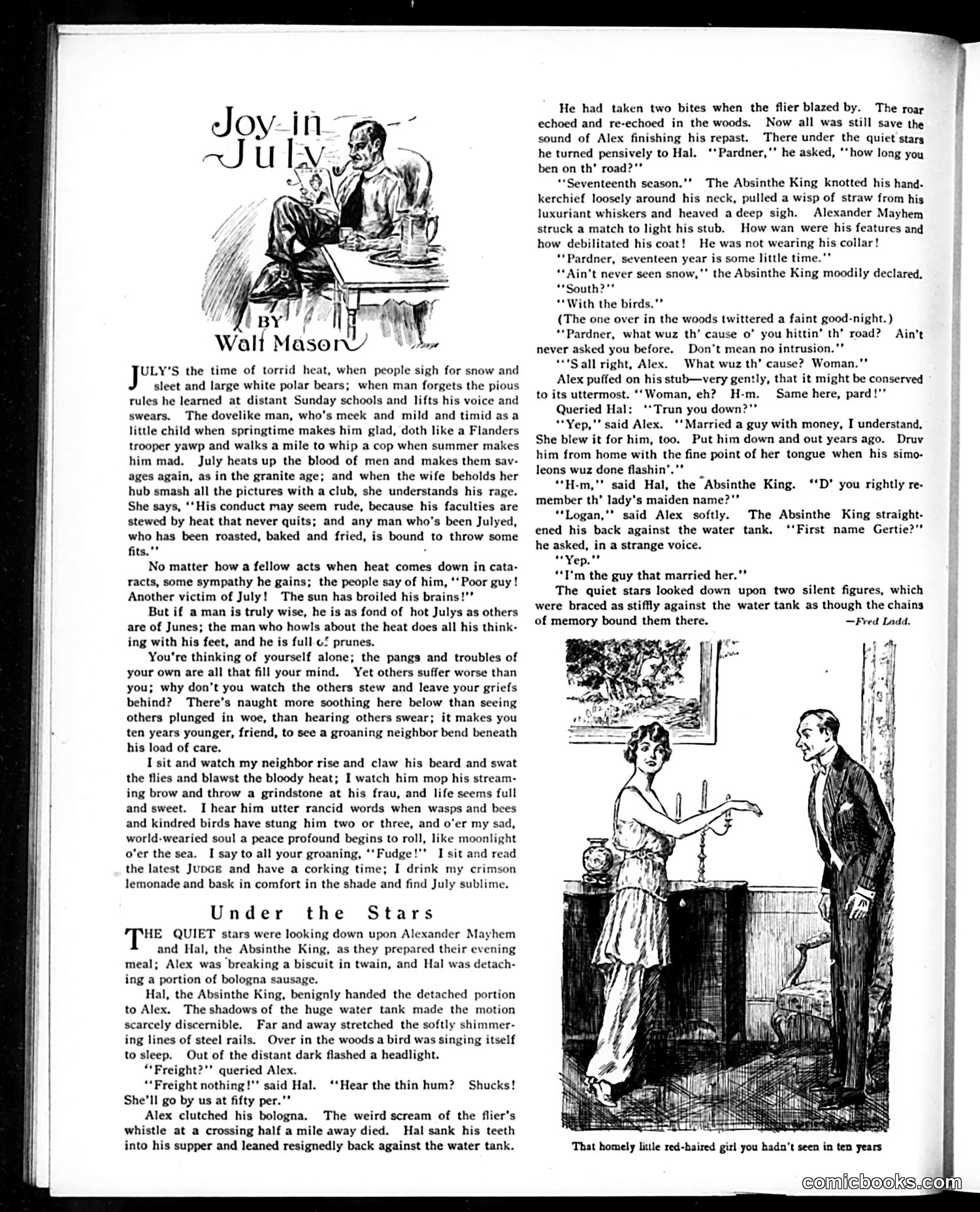
**"Joy in July"** is a humorous essay arguing that summer heat, while making ordinary people irritable and violent, should be enjoyed as entertainment. The author finds schadenfreude in watching neighbors suffer—watching them swat flies, fight with wives, and lose their temper provides comic relief. The satire mocks both the heat's effects on human behavior and the author's gleeful selfishness in enjoying others' misery. **"Under the Stars"** tells a sentimental hobo story about two drifters sharing a meal by railroad tracks. The narrative has romantic trappings—quiet stars, rural setting—but the ending is darkly ironic: after seventeen seasons riding the rails, one man appears worn and debilitated. The juxtaposition with the preceding essay creates a contrast between comfortable readers' amusement at others' suffering and the actual hardship of vagrant life during this era.
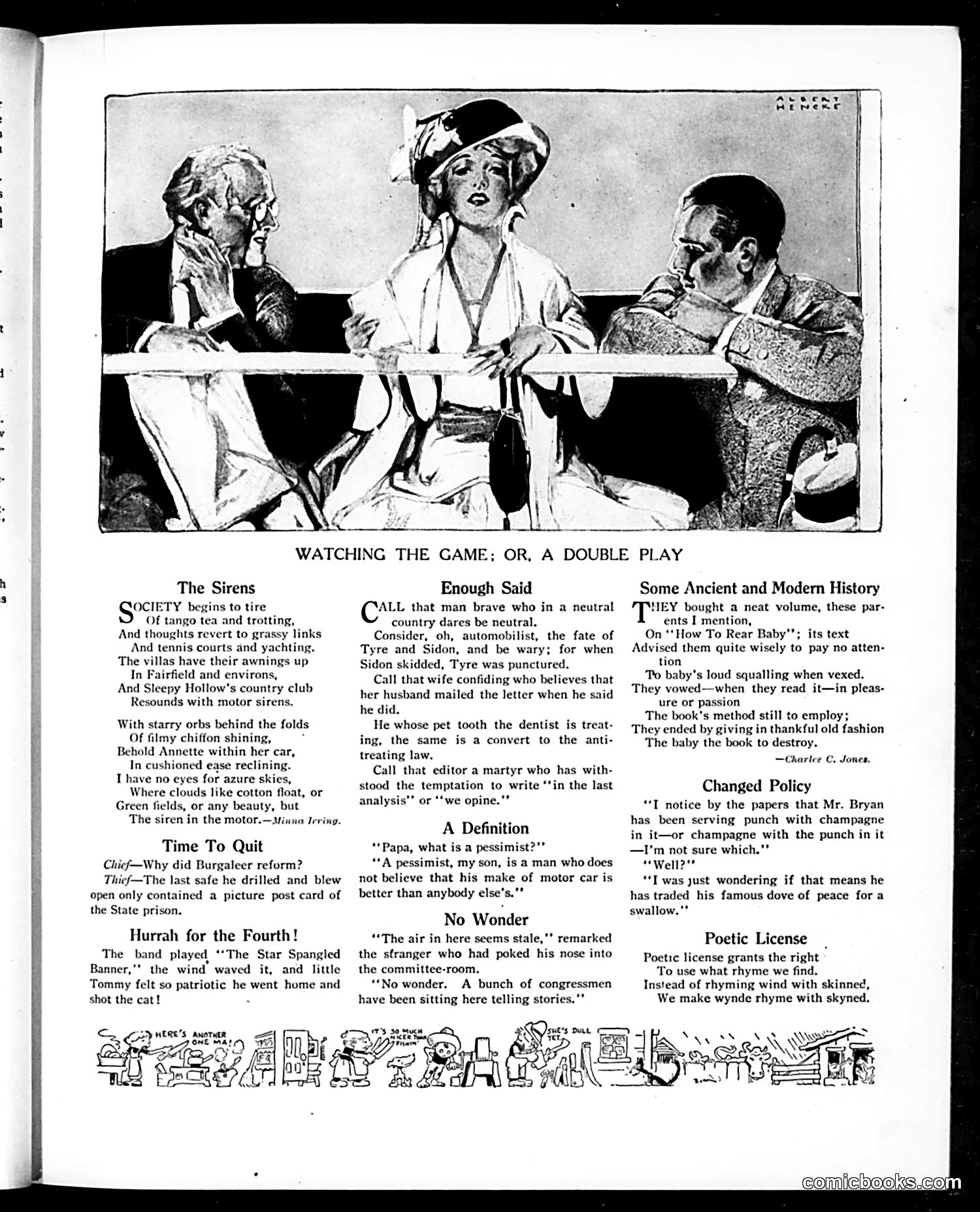
This page from *Judge* satirizes early 1920s American leisure culture and politics through multiple brief humorous pieces. The main cartoon depicts three society figures observing something, likely commenting on wealth and social pretension during the "Roaring Twenties" boom. Key pieces include: **"The Sirens"**: Mocks the wealthy's obsession with automobiles and leisure activities (country clubs, yachting) over natural beauty. **Political humor**: References to Burgalees (safecracker reform), congressmen's dishonesty, and **William Jennings Bryan's** shift from pacifism ("dove of peace") to serving alcohol—satirizing his apparent abandonment of prohibition-era principles. **"A Definition"**: Mocks automotive enthusiasm and competitive pride in car ownership—reflecting 1920s car culture's social significance. **"No Wonder"**: Cynical commentary on congressional corruption and dishonesty. The humor relies on readers understanding contemporary social anxieties: automobile mania, wealth display, political hypocrisy, and changing social values of the era.
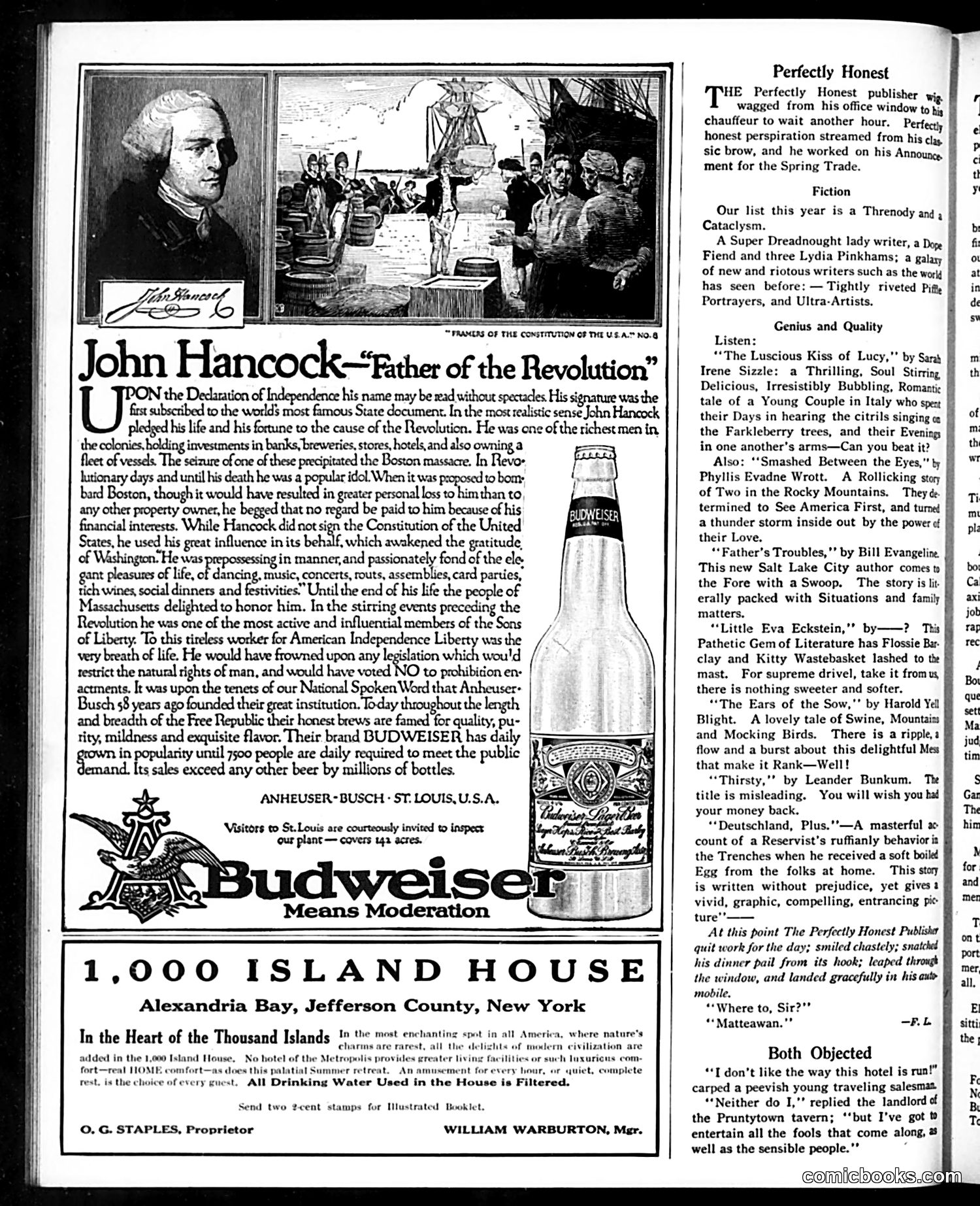
This Judge magazine page satirizes publishing and advertising through contrasting content. The "Perfectly Honest" publisher section mocks the publishing industry's grandiose spring announcements—promising melodramatic titles ("Threnody and Cataclysm") and exaggerated author descriptions while the publisher perspires anxiously, suggesting the desperation behind the hype. The dominant feature is an Anheuser-Busch advertisement exploiting John Hancock's Revolutionary legacy. It draws a parallel between Hancock's historical opposition to prohibition and the beer company's opposition to alcohol restrictions, falsely implying Hancock would support their product. The advertisement cynically appropriates patriotic imagery to legitimize commercial interests. The "Genius and Quality" section sarcastically reviews overwrought romantic fiction titles, further ridiculing both publishers' pretensions and readers' tastes. Together, these elements critique how American institutions—publishing, advertising, commerce—manipulate history and language to obscure commercial motives behind appeals to tradition and authenticity.
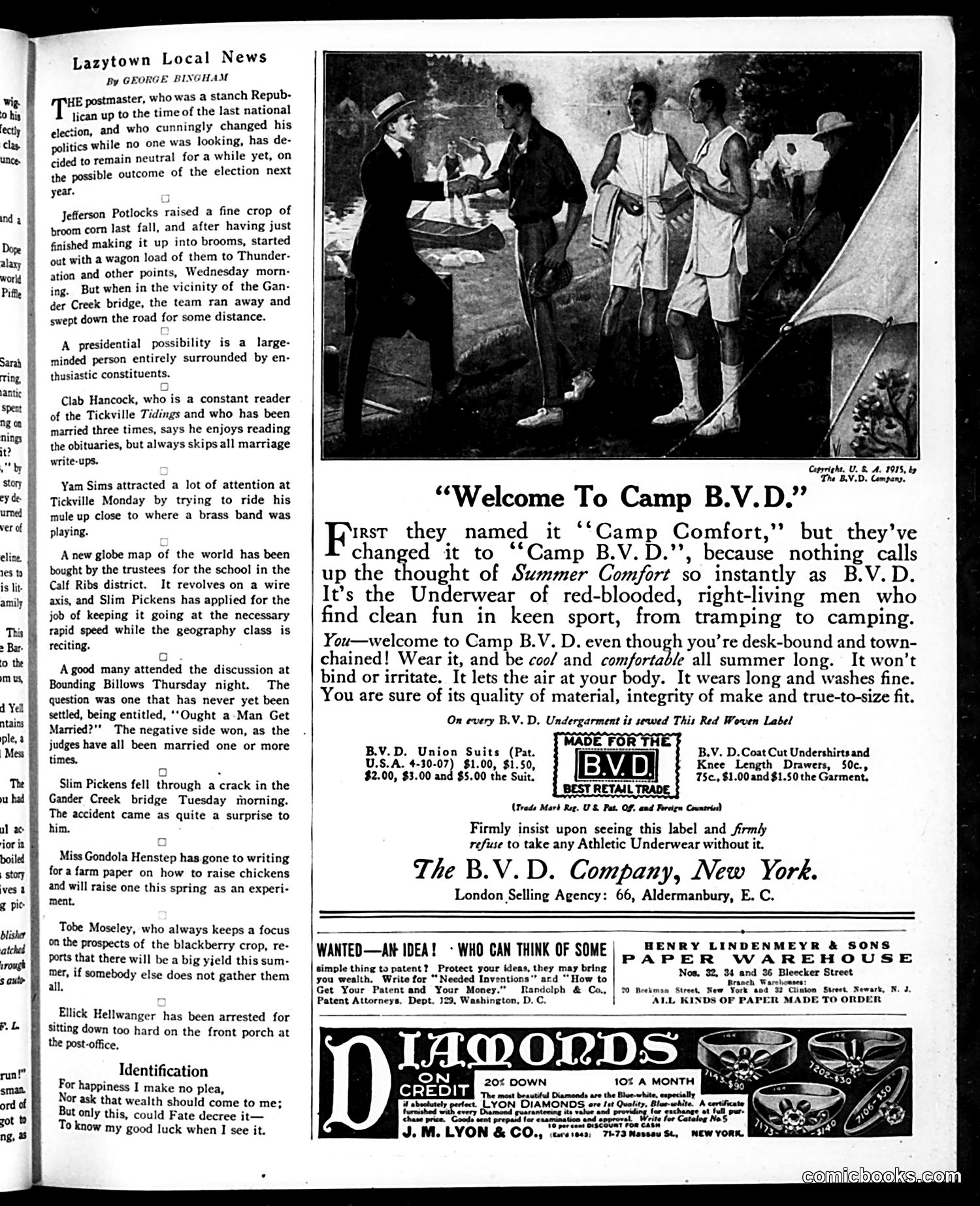
This page is primarily a **B.V.D. underwear advertisement** disguised as editorial content. The large photograph shows men at a camp, presumably modeling or promoting the product. The ad uses patriotic, masculine appeal: B.V.D. underwear is positioned as worn by "red-blooded, right-living men" engaged in wholesome activities like camping and sports. The text emphasizes comfort, durability, and quality—practical selling points for the era. The framing as "Camp B.V.D." transforms product placement into lifestyle marketing, suggesting the underwear enables an active, outdoor American life. This was a common early-20th-century advertising strategy: associate consumer goods with desirable social values and activities rather than simply listing features. The "Lazytown Local News" section above contains humorous rural vignettes that fill space and provide editorial cover for the advertisement-heavy page, typical of *Judge* magazine's format blending humor with commercial content.
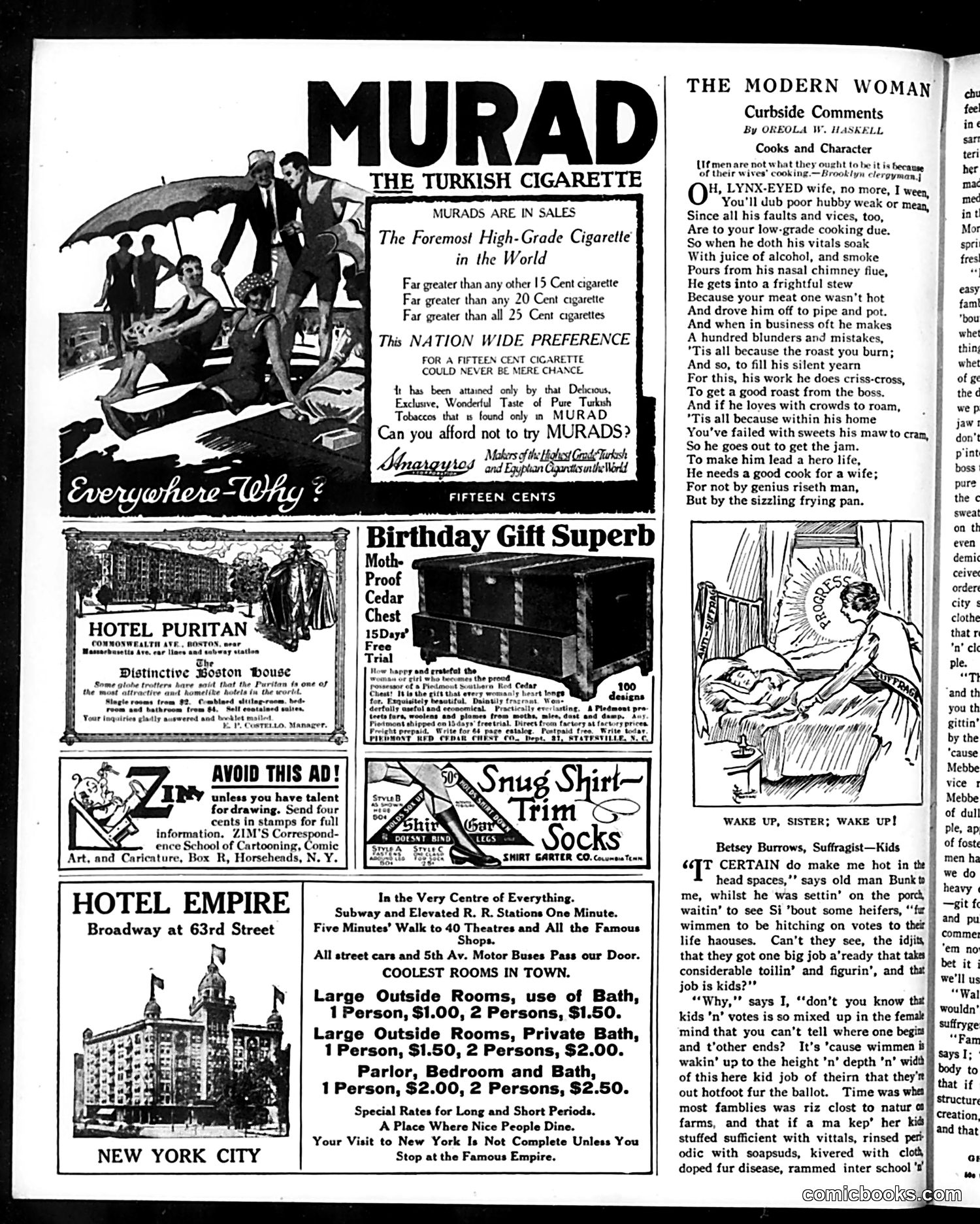
This page is primarily **advertisements** with one satirical essay. The main Murad cigarette ad uses the common early-20th-century marketing tactic of claiming superiority through "nation-wide preference"—a vague appeal to popularity rather than evidence. The **satirical content** appears in "The Modern Woman" section by Oreola W. Haskell. It mocks husbands who blame their wives' poor cooking for their own moral failings—drinking, infidelity, and professional failures. The satire argues that men use "bad cooking" as an excuse for bad behavior, when they should take personal responsibility. The essay "Betsey Burrows, Suffragist—Kids" below satirizes a woman arguing that voting rights matter as much as childcare duties. The male narrator dismissively suggests women's primary job is raising children, implying suffrage is a distraction—a common anti-suffrage argument of the era. Both pieces reflect pre-1920 debates about women's roles: domestic responsibilities versus civic participation.
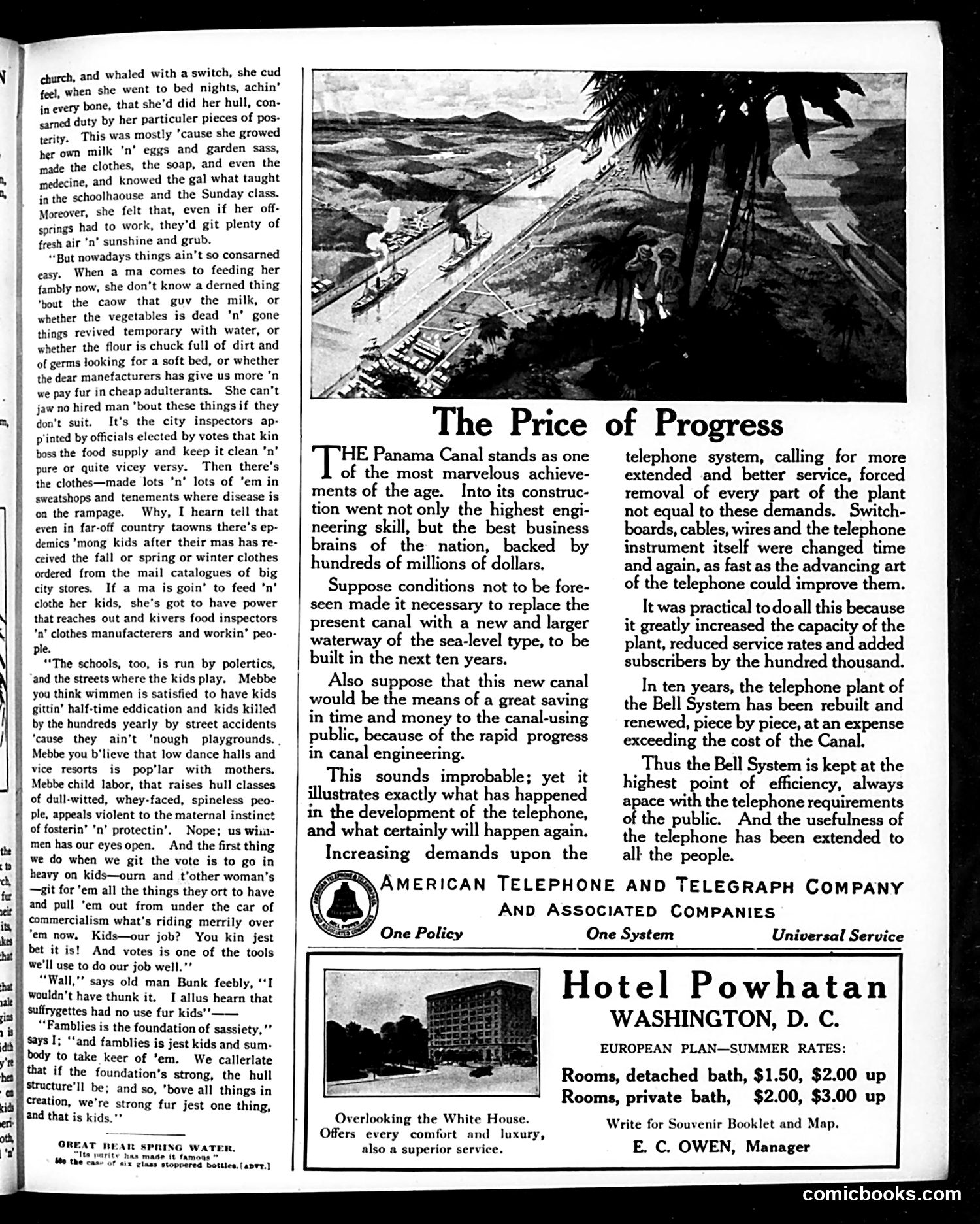
This page presents a **pro-suffrage argument disguised as rural dialect humor**. The left column features an elderly rural woman explaining to "old man Bunk" why women need voting rights. She argues that modern mothers cannot adequately protect their children without political power—they cannot control food safety inspectors, sweatshop conditions, school administration, or street safety. The satire targets anti-suffragettes who claimed women didn't care about children; the speaker proves the opposite: mothers desperately want votes *specifically to protect kids*. The right side's "Price of Progress" article uses the Panama Canal as metaphor: just as the telephone system constantly upgrades infrastructure to meet expanding demands, society must evolve its institutions (implicitly: grant women suffrage) to address new challenges. **Context**: This appears from the Progressive Era (pre-1920), when suffragettes argued women's traditional domestic role as mothers actually *required* political participation to influence public policy affecting families and children.
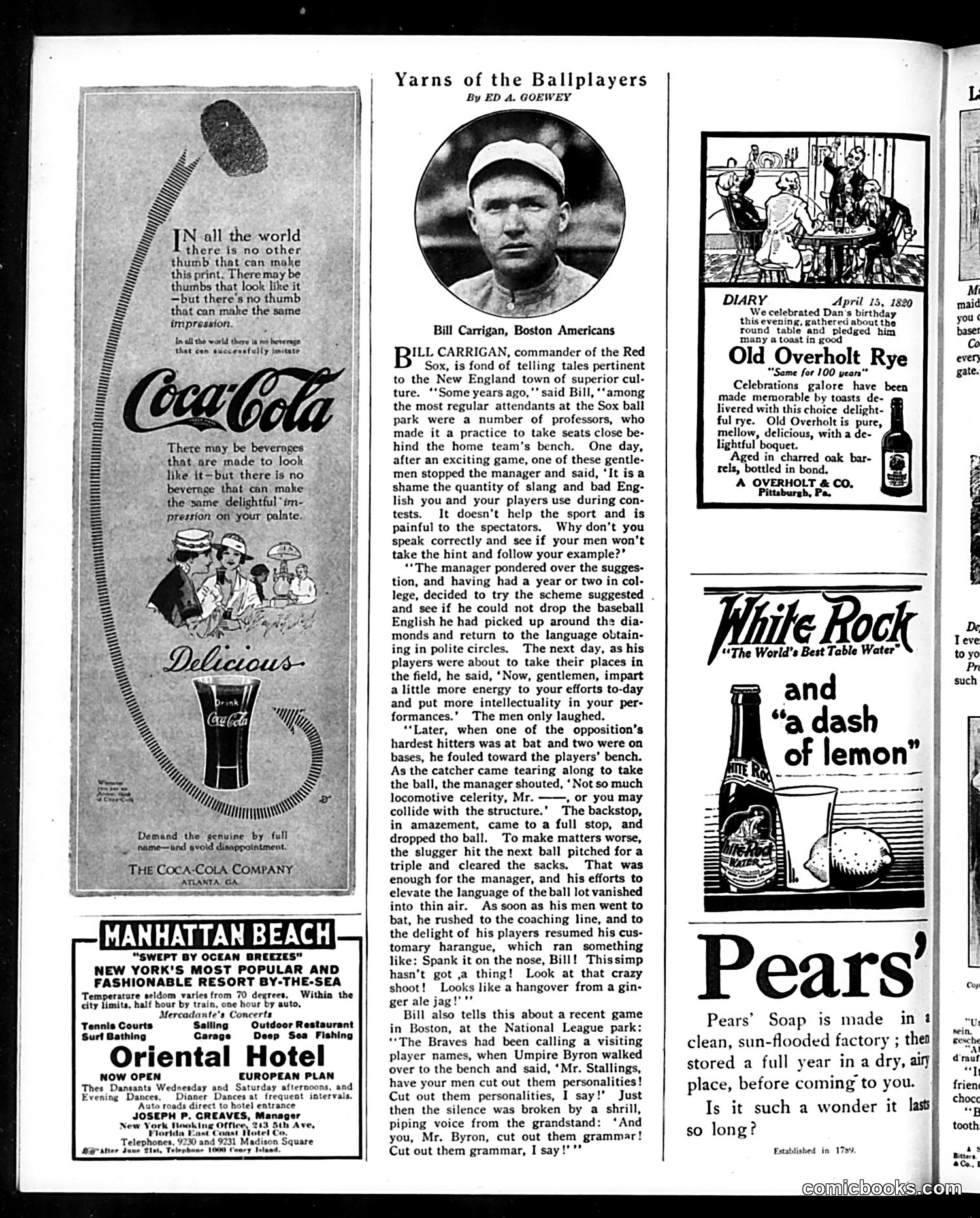
This is a humorous anecdote by Ed A. Goewey about **Bill Carrigan**, manager of the Boston Red Sox, illustrating the clash between academic refinement and baseball culture. The joke hinges on a professor's complaint that players use excessive slang and poor English during games. The manager attempts to reform their speech using elaborate, polite language ("impart a little more energy," "locomotive celerity"). This backfires comically: the players don't understand him, he becomes distracted during play (causing errors), and he abandons the experiment entirely—immediately reverting to crude baseball vernacular ("Spank it on the nose, Bill!"). A secondary punchline involves an umpire trying to enforce civility, only to be heckled by a grandstand spectator with identical grammar errors, suggesting that crude language is endemic to the sport and social class. The satire mocks both pretentious academic interference in sports and the futility of imposing "civilized" speech on working-class ballplayers.
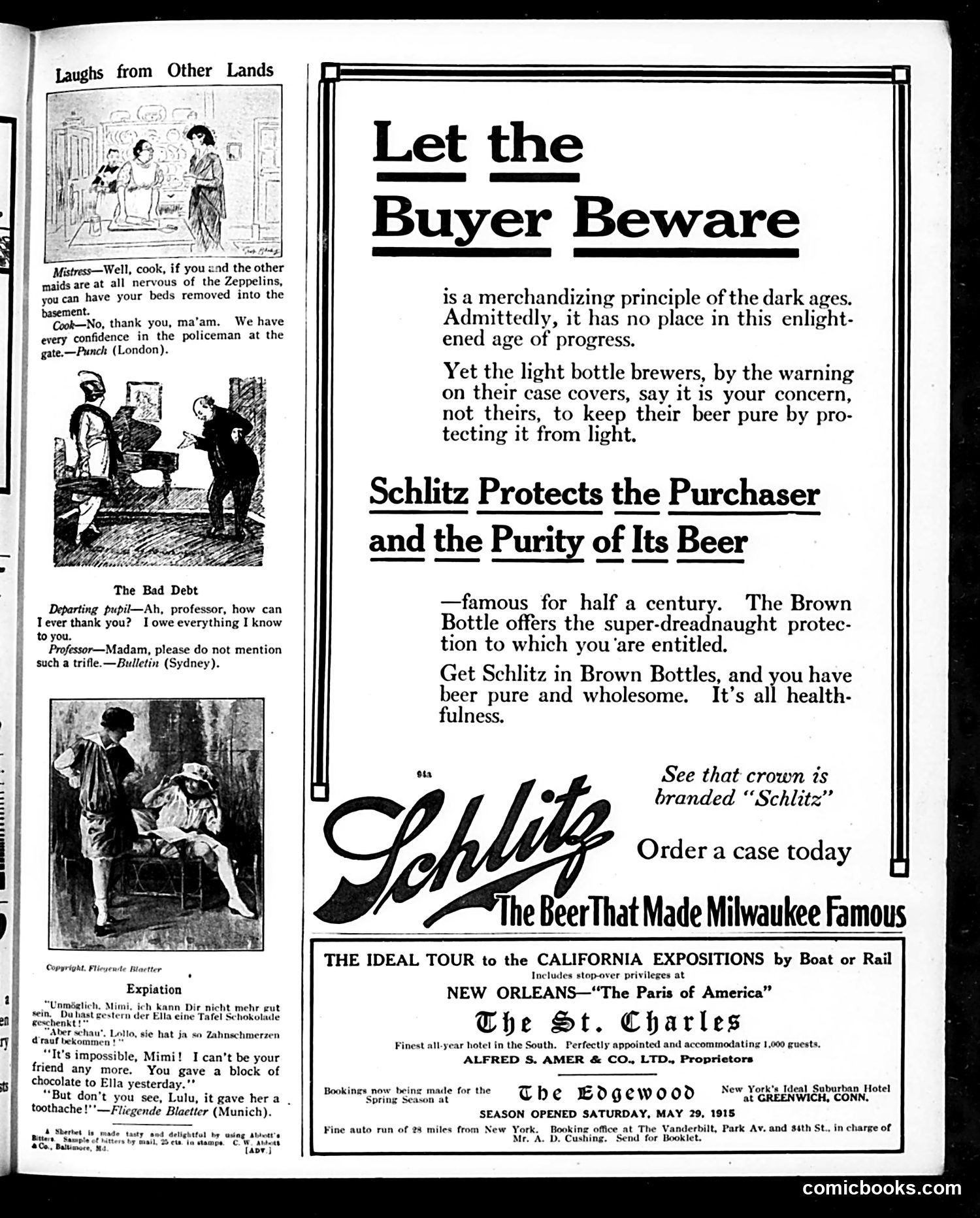
This page collects brief satirical jokes from European publications, primarily focused on WWI-era humor. The three cartoons mock everyday anxieties: 1. **"Zeppelins"**: References German airship raids on Britain, joking that servants trust the policeman at the gate to protect them—absurd given the military threat from above. 2. **"The Bad Debt"**: A professor-student exchange satirizing intellectual pretension; the student claims to owe everything to the professor, who dismissively calls it trivial. 3. **"Expiation"**: A German cartoon (Fliegende Blätter) about a girl who can no longer befriend another because she gave her chocolate that caused a toothache—mocking the logic of petty grudges. The right side is a **Schlitz beer advertisement** criticizing competing brewers who warn customers to protect beer from light, positioning Schlitz's brown bottles as superior protection. This is commercial messaging, not satire.
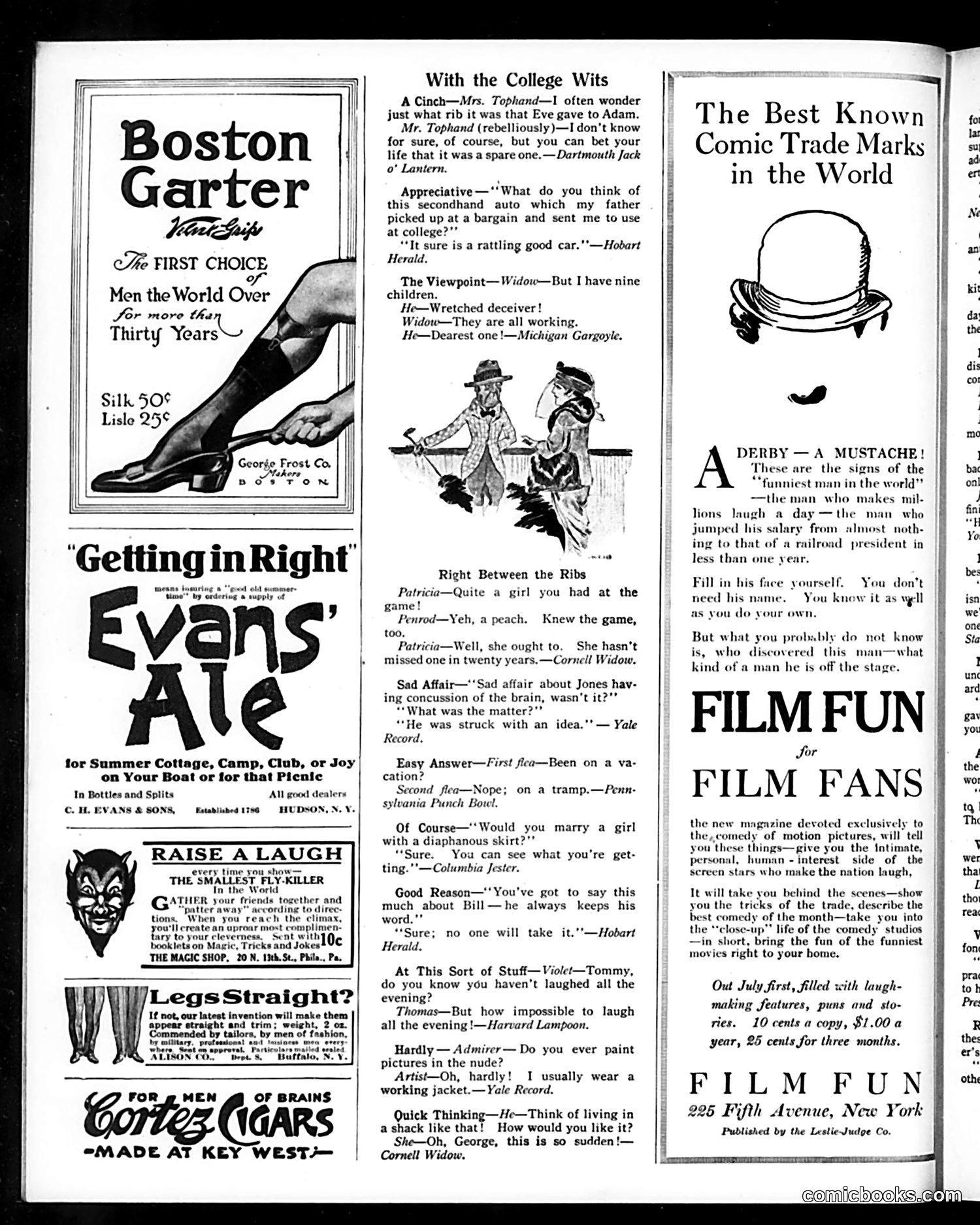
This page is primarily **advertisements and college humor**, not political satire. The left side features product ads (Boston Garter hosiery, Evans Ale, a leg-straightening device, Cortez cigars). The center section, "With the College Wits," collects jokes from various college humor magazines (Dartmouth, Yale, Cornell, etc.). These are genteel, innocent puns about dating, automobiles, and relationships—typical early-20th-century collegiate humor with no political content. The right side advertises **Film Fun magazine**, which appears to reference **Charlie Chaplin** (the derby hat and mustache are his iconic trademarks, though he's not named). The ad promotes a new fan magazine about comedy film stars, promising behind-the-scenes stories about "screen stars who make the nation laugh." **Overall**: This is a commercial/entertainment page with no significant political commentary—just product marketing and light college humor typical of the 1910s-1920s era.
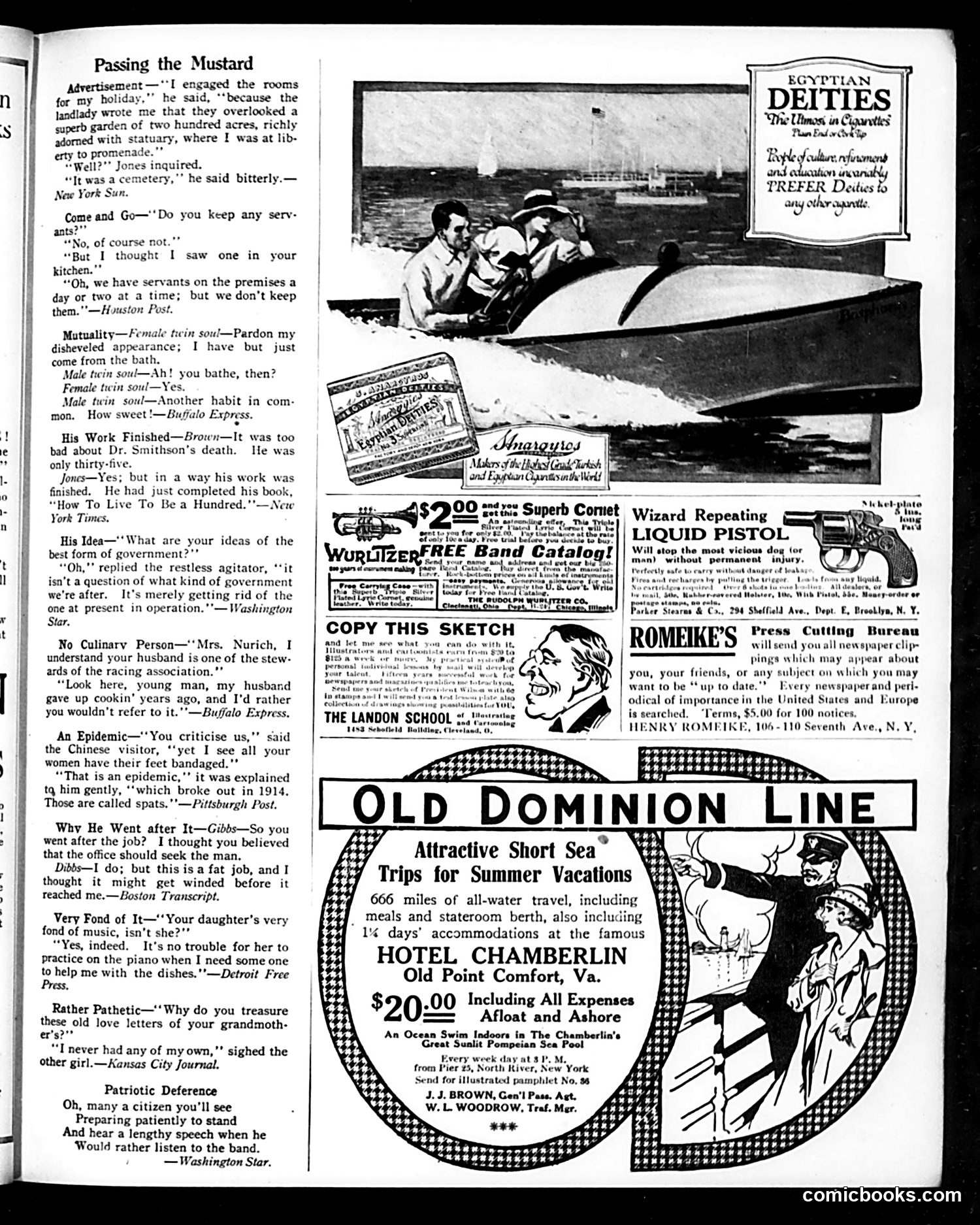
This page is primarily **humor columns and advertisements** rather than political cartoons. The left column contains brief jokes—mostly domestic and social humor typical of early 20th-century American magazines. The humor reflects period anxieties and cultural attitudes: a joke mocks an overly romantic holiday rental advertised as overlooking a "garden" that turns out to be a cemetery; another jokes about a Chinese visitor's confusion regarding American women's "bandaged feet," which are actually 1920s-style spats (leg wrappings)—suggesting contemporary fascination with exotic "Oriental" customs. The right side features cigarette and travel advertisements, including an Old Dominion Line vacation package to a Virginia resort hotel. **No significant political cartoons or caricatures appear on this page.** The content is generic commercial humor and ads typical of Judge's format during this era, relying on wordplay, romantic misunderstandings, and social observation rather than political satire.
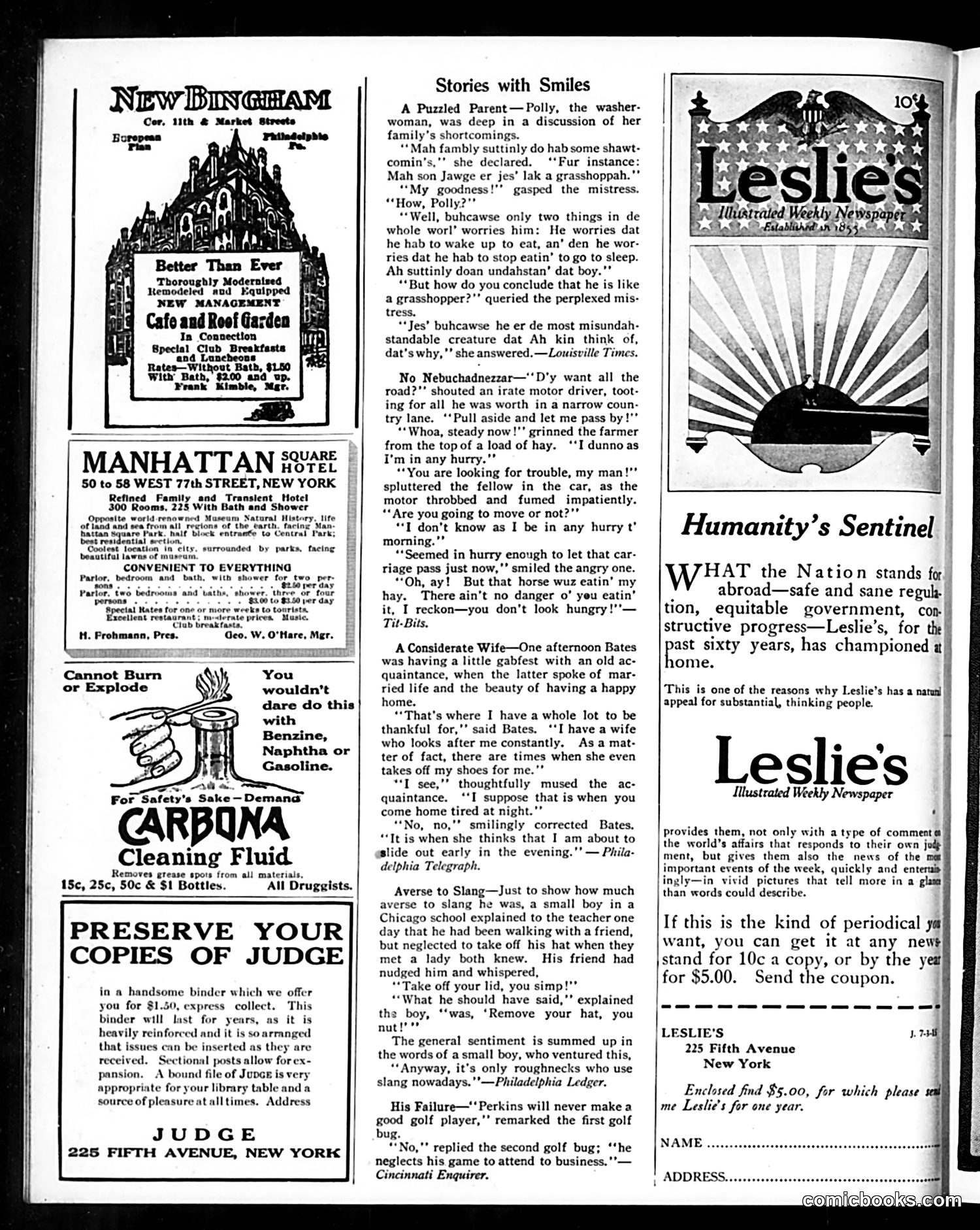
This page is primarily **advertising and filler content** rather than political satire. The main material consists of: **"Stories with Smiles" section:** A series of brief humorous anecdotes using dialect humor (common to early 20th-century magazines): 1. A washerwoman explains her son is like a grasshopper because he only worries about eating and sleeping 2. A farmer frustrates an impatient motorist by moving slowly with his hay wagon 3. A husband's considerate wife removes his shoes—but only when she suspects he might sneak out early These jokes rely on **working-class characters and their perceived foibles**—lazy sons, stubborn farmers, and marital dynamics. The humor is gentle domestic comedy rather than political satire. The page also contains numerous hotel and product advertisements (Manhattan Square Hotel, Carbona cleaning fluid, Judge magazine subscriptions). Leslie's magazine promotes itself as "Humanity's Sentinel" for nation-building values. There are **no identifiable political figures or pointed social commentary**—this appears to be a standard early-1900s magazine filler page mixing mild domestic humor with advertising.
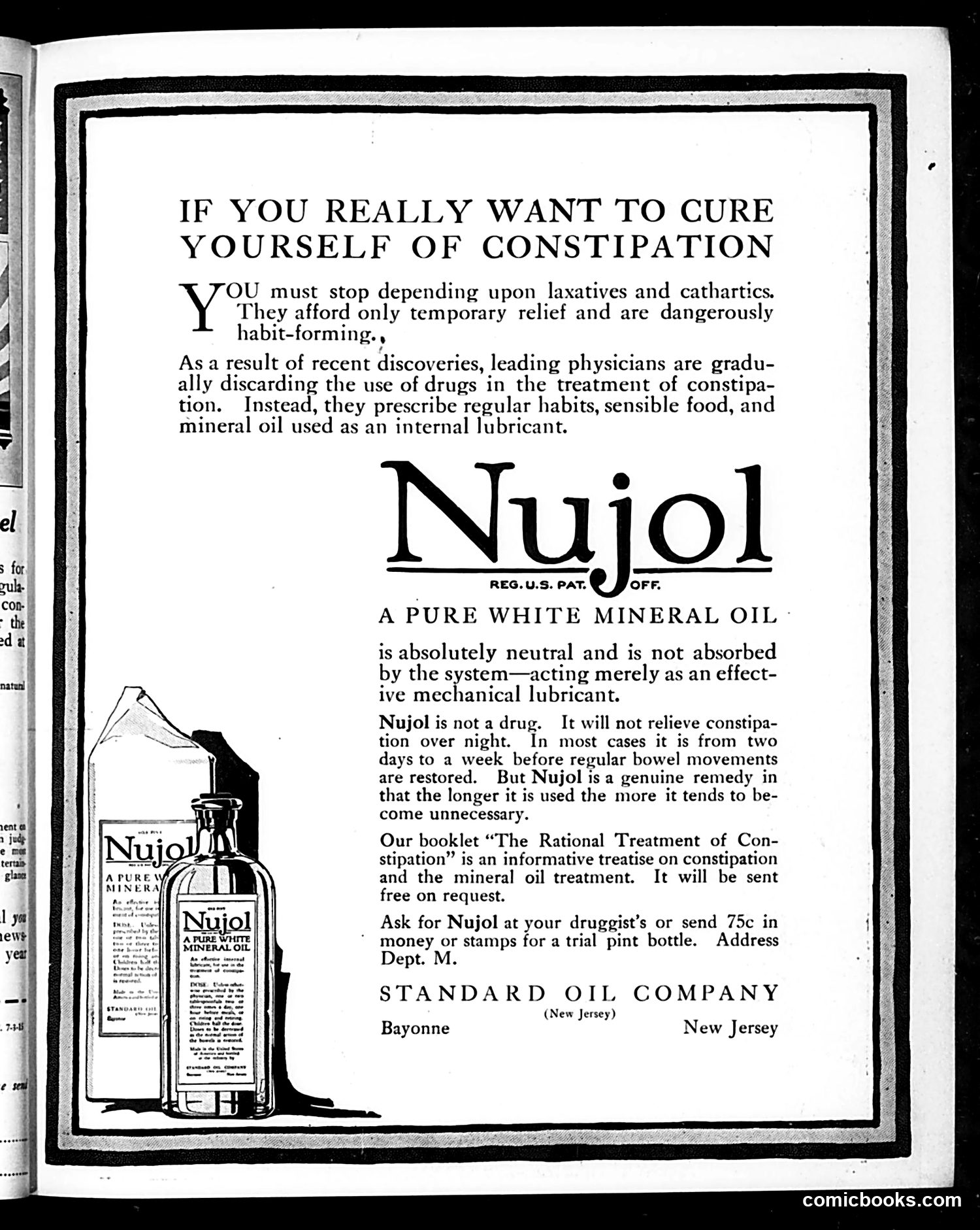
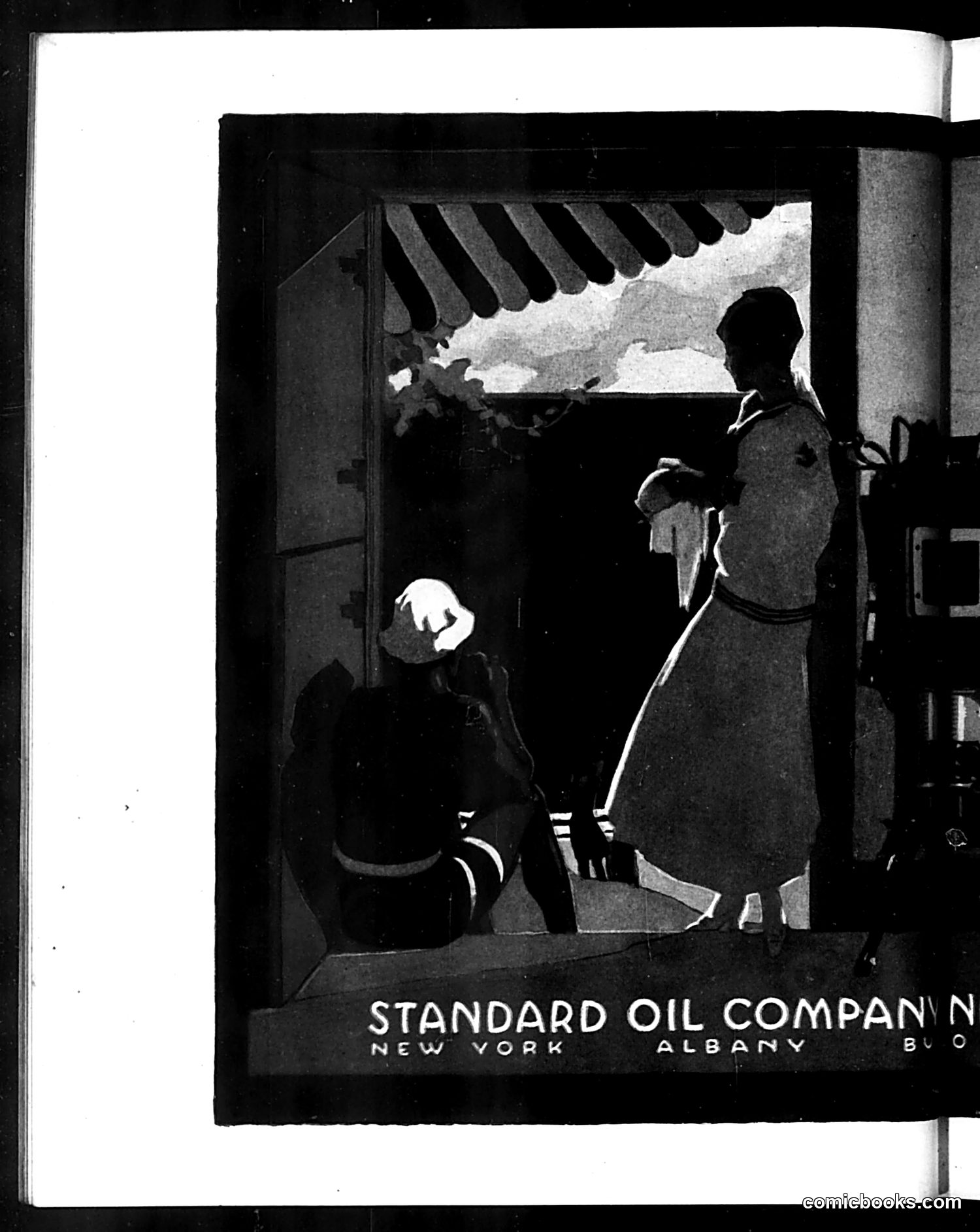
This is a full-page advertisement, not satire or political commentary. Standard Oil Company promotes Nujol, a mineral oil laxative, by positioning it as a modern, scientific alternative to traditional harsh laxatives and cathartics. The ad's pitch reflects early 20th-century medical trends: physicians were moving away from aggressive purgatives toward gentler interventions emphasizing "regular habits, sensible food," and mechanical lubrication rather than drugs. Nujol is marketed as non-habit-forming and non-absorbed, working slowly over days rather than overnight—presented as evidence of legitimacy. The bottle illustration shows the product's branding. The company offers a free educational booklet and trial bottle for 75 cents, typical marketing of the era. This represents how Standard Oil diversified beyond petroleum into consumer health products during this period.
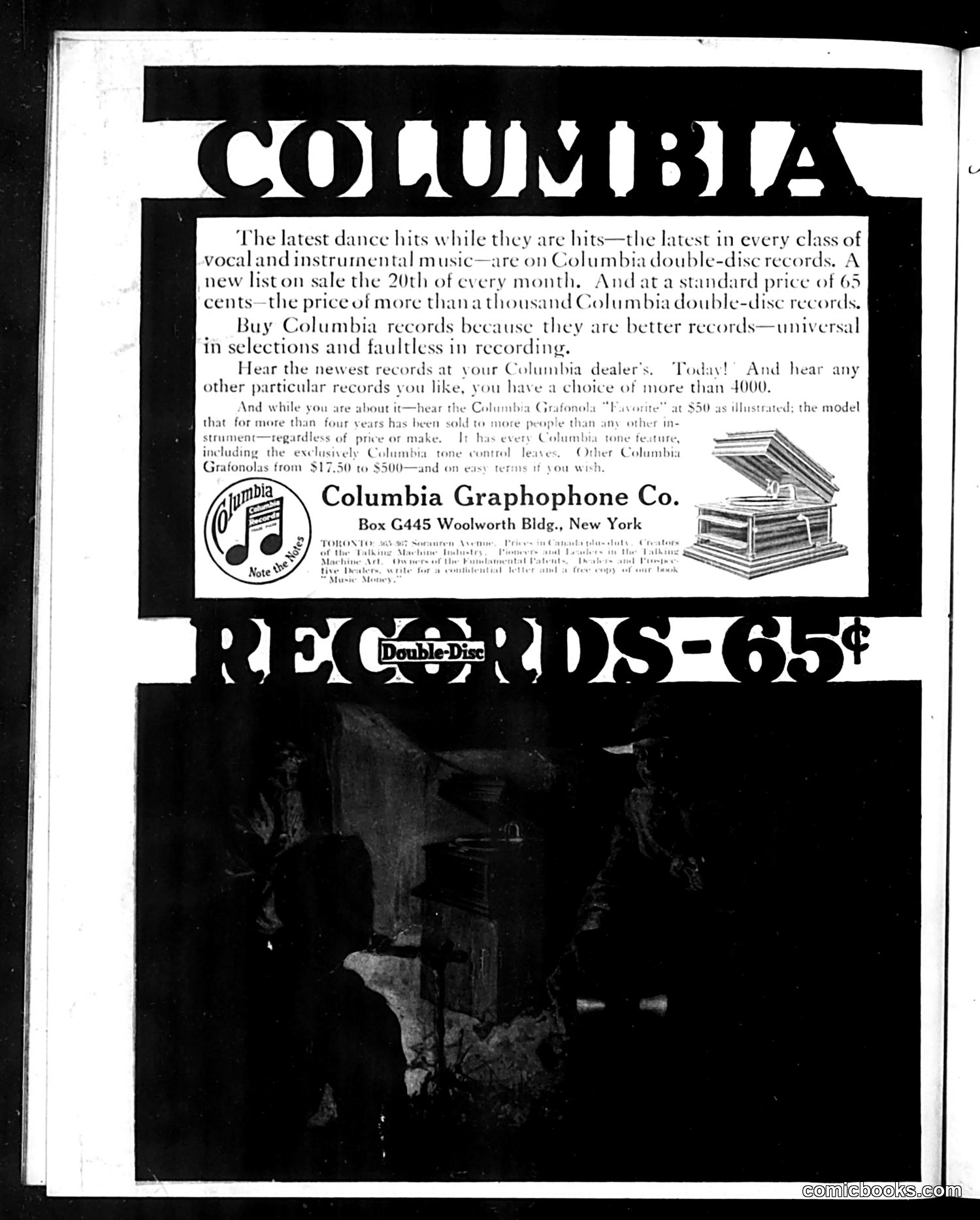
This is primarily an **advertisement**, not a political cartoon. It's a full-page ad for Columbia Graphophone Company promoting their double-disc records at 65 cents each. The ad emphasizes Columbia's competitive advantages: access to latest "dance hits," a new list released monthly, a large selection (over 4,000 titles), and superior recording quality. It also promotes their "Grafonola" phonograph model, priced around $50, which had apparently outsold competing models for four years. The only visual element beyond text is an illustration of the Grafonola phonograph and the Columbia logo (a musical note in a circle). There is no satire, political commentary, or cartoon content—this is straightforward commercial messaging typical of Judge magazine's revenue model.