
Judge, 1915-07-03 · page 6 of 32
Judge — July 3, 1915 — page 6: what you’re looking at
What you’re looking at
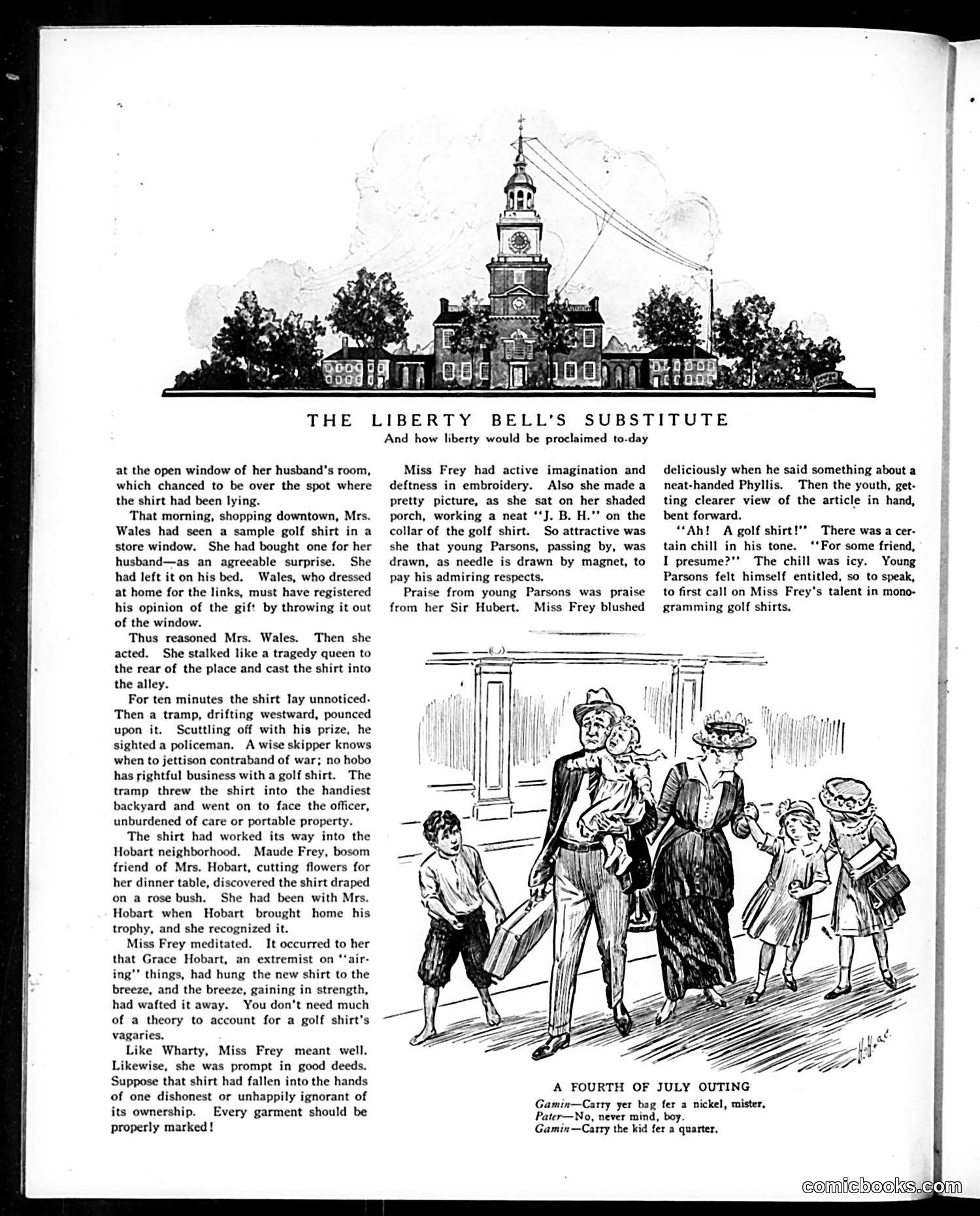
This satirical story mocks the cascading consequences of minor domestic decisions. Mrs. Wales buys her husband a golf shirt; he rejects it by throwing it out the window. The shirt travels through a tramp, a backyard, and lands with neighbor Miss Frey, who embbroiders the initials "J.B.H." on it—assuming it belongs to her friend Grace Hobart. Young Parsons, visiting Miss Frey, sees her embroidering and grows jealous, assuming the shirt is a gift for another man. The title's joke: just as the Liberty Bell cracked and required a substitute, this golf shirt becomes a substitute Liberty Bell—proclaiming liberty (and chaos) through its uncontrolled journey and the misunderstandings it generates. The lower cartoon shows Fourth of July street life: a street child ("gamin") offering to carry a gentleman's golf bag for a nickel, then his child for a quarter—likely satirizing working-class poverty and commercialized charity.
📄 Transcribed text from this page (OCR, searchable)
Machine-transcribed from the original scan — historical spelling and the odd misread are preserved.
“RBB0 17 Ti THE LIBERTY BELL'S SUBSTITUTE at the open window of her husband's room, which chanced to be over the spot where the shirt had been lying. That morning, shopping downtown, Mrs. Wales had seen a sample golf shirt in a store window. She had bought one for her husband—as an agreeable surprise. She had left it on his bed. Wales, who dressed at home for the links, must have registered his opinion of the gift by throwing it out of the window. Thus reasoned Mrs. Wales. Then she acted. She stalked like a tragedy queen to the rear of the place and cast the shirt into the alley. For ten minutes the shirt lay unnoticed. Then a tramp, drifting westward, pounced upon it. Scuttling off with his prize, he sighted a policeman. A wise skipper knows when to jettison contraband of war; no hobo has rightful business with a golf shirt. The tramp threw the shirt into the handiest backyard and went on to face the officer, unburdened of care or portable property. The shirt had worked its way into the Hobart neighborhood. Maude Frey, bosom friend of Mrs. Hobart, cutting flowers for her dinner table, discovered the shirt draped on a rose bush. She had been with Mrs. Hobart when Hobart brought home his trophy, and she recognized it. Miss Frey meditated. It occurred to her that Grace Hobart, an extremist on ‘‘air- ing’’ things, had hung the new shirt to the breeze, and the breeze, gaining in strength, had wafted it away. You don’t need much of a theory to account for a golf shirt’s vagaries. Like Wharty, Miss Frey meant well. Likewise, she was prompt in good deeds, Suppose that shirt had fallen into the hands of one dishonest or unhappily ignorant of its ownership. Every garment should be properly marked! And how liberty would be proclaimed to-day Miss Frey had active imagination and deftness in embroidery. Also she made a pretty picture, as she sat on her shaded porch, working a neat ‘‘J. B. H.’’ on the collar of the golf shirt. So attractive was she that young Parsons, passing by, was drawn, as needle is drawn by magnet, to pay his admiring respects. Praise from young Parsons was praise from her Sir Hubert. Miss Frey blushed deliciously when he said something about a neat-handed Phyllis. Then the youth, get- ting clearer view of the article in hand, bent forward. “Ah! A golf shirt!"* There was a cer- tain chill in his tone. ‘‘For some friend, I presume?'' The chill was icy. Young Parsons felt himself entitled, so to speak, to first call on Miss Frey’s talent in mono- gramming golf shirts. A FOURTH OF JULY OUTING Gamin—Carry yer bag fer a nickel, mister, Pater—No, never mind, boy. Gamin—Carry the kid fer a quarter,