
Judge, 1915-07-03 · page 21 of 32
Judge — July 3, 1915 — page 21: what you’re looking at
What you’re looking at
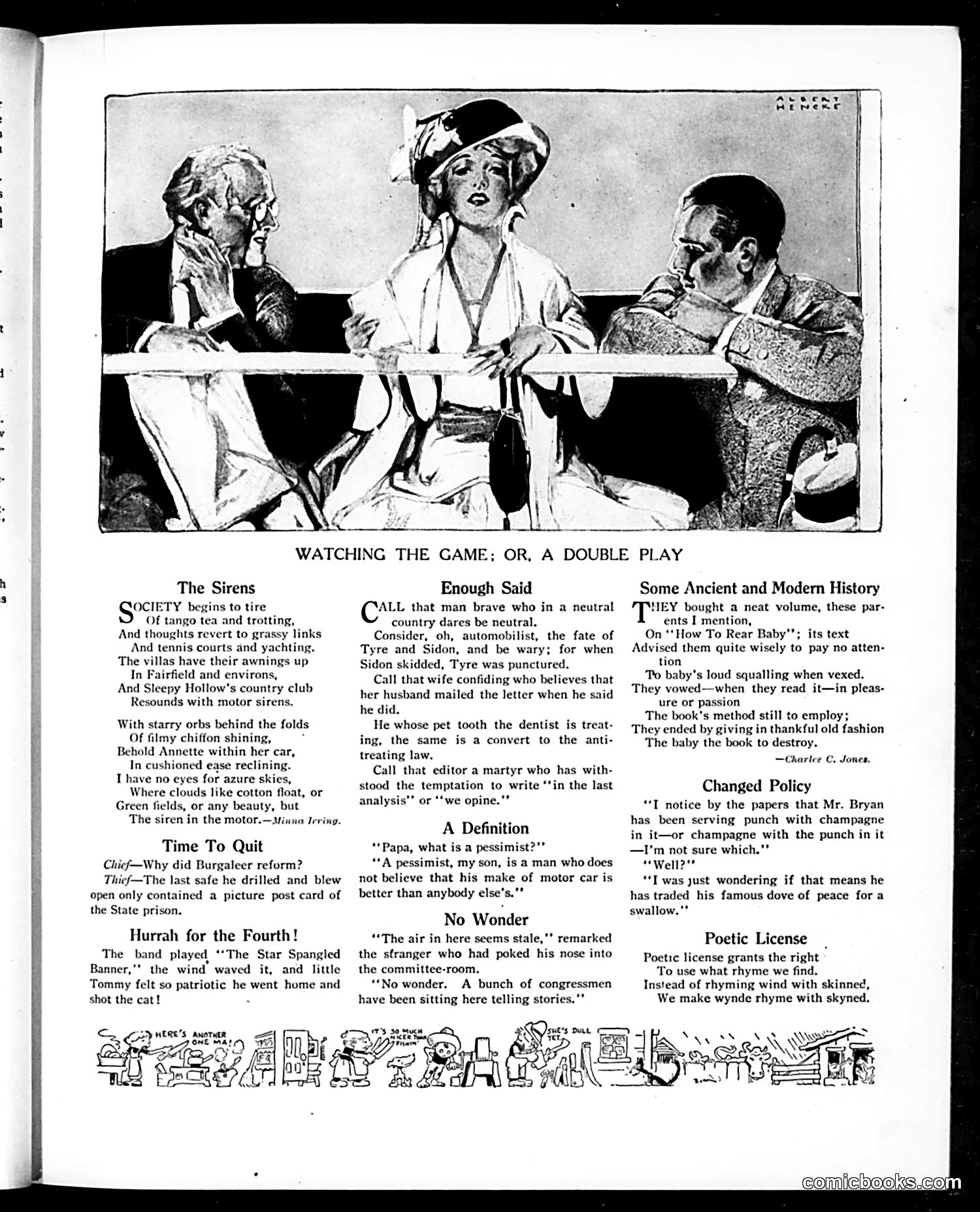
This page from *Judge* satirizes early 1920s American leisure culture and politics through multiple brief humorous pieces. The main cartoon depicts three society figures observing something, likely commenting on wealth and social pretension during the "Roaring Twenties" boom. Key pieces include: **"The Sirens"**: Mocks the wealthy's obsession with automobiles and leisure activities (country clubs, yachting) over natural beauty. **Political humor**: References to Burgalees (safecracker reform), congressmen's dishonesty, and **William Jennings Bryan's** shift from pacifism ("dove of peace") to serving alcohol—satirizing his apparent abandonment of prohibition-era principles. **"A Definition"**: Mocks automotive enthusiasm and competitive pride in car ownership—reflecting 1920s car culture's social significance. **"No Wonder"**: Cynical commentary on congressional corruption and dishonesty. The humor relies on readers understanding contemporary social anxieties: automobile mania, wealth display, political hypocrisy, and changing social values of the era.
📄 Transcribed text from this page (OCR, searchable)
Machine-transcribed from the original scan — historical spelling and the odd misread are preserved.
WATCHING THE GAME; OR, A DOUBLE PLAY The Sirens OCIETY begins to tire Of tango tea and trotting, And thoughts revert to grassy li And tennis courts and yachting. The villas have their awnings up In Fairfield and environs, And Sleepy Hollow's country club Resounds with motor sirens. With starry orbs behind the folds Of filmy chiffon shining, Behold Annette within her car, In cushioned ease reclining. I have no eyes for azure skies, Where clouds like cotton float, or Green fields, or any beauty, but The siren in the motor.—Minna Irving. Time To Quit Chief—Why did Burgaleer reform? Thicf—The last safe he drilled and blew open only contained a picture post card of the State prison, Hurrah for the Fourth! The band played, “The Star Spangled Banner,’’ the wind waved it, and little Tommy felt so patriotic he went home and shot the cat! Sy HERE'S AnoTMER Ay bothers = Enough Said Cet that man brave who in a neutral country dares be neutral. Consider, oh, automobilist, the fate of Tyre and Sidon, and be wary; for when Sidon skidded, Tyre was punctured. Call that wife confiding who believes that her husband mailed the letter when he said he did. He whose pet tooth the dentist is treat- ing, the same is a convert to the anti- treating law. Call that editor a martyr who has with- stood the temptation to write ‘‘in the last analysis’’ or ‘‘we opine."" A Definition **Papa, what is a pessimist?’” **A pessimist, my son, is a man who does not believe that his make of motor car is better than anybody else’s.’” No Wonder “The air in here seems stale,’’ remarked the stranger who had poked his nose into the committee-room. “*No wonder. A bunch of congressmen have been sitting here telling stories.’" Some Ancient and Modern History Tuy bought a neat volume, these par- ents I mention, On **How To Rear Baby’?; its text ised them quite wisely to pay no atten- jon To baby’s loud squalling when vexed. They vowed—when they read it—in pleas- ure or passion The book's method still to employ; They ended by giving in thankful old fashion The baby the book to destroy. —Charlee C, Jones. Changed Policy “T notice by the papers that Mr. Bryan has been serving punch with champagne in it—or champagne with the punch in it —I'm not sure which."" ““Well?”* “‘T was just wondering if that means he has traded his famous dove of peace for a swallow."" Poetic License _ Poetic license grants the right To use what rhyme we find. Instead of rhyming wind with skinned, We make wynde rhyme with skyned.