
Judge, 1915-07-03 · page 15 of 32
Judge — July 3, 1915 — page 15: what you’re looking at
What you’re looking at
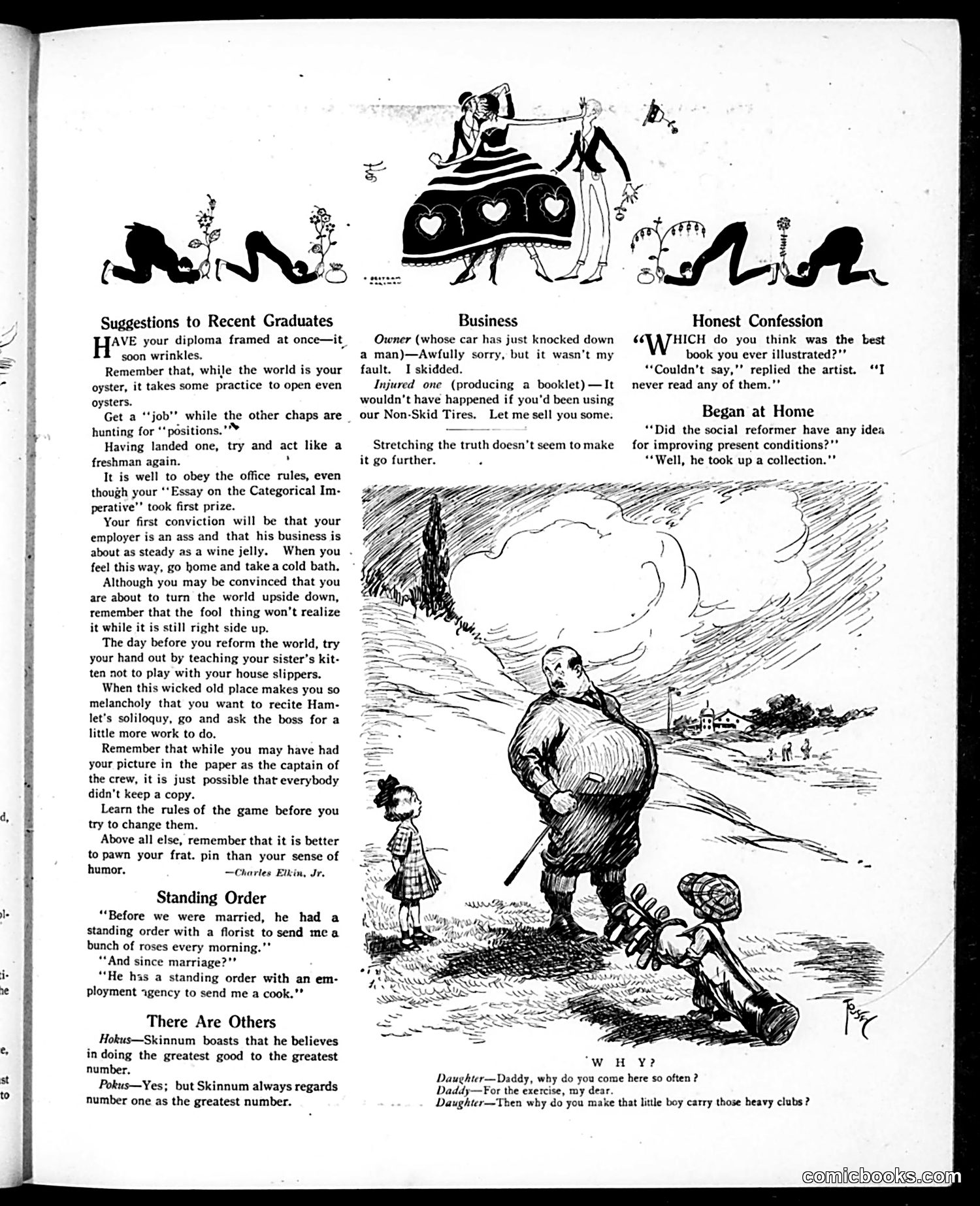
This page contains several satirical humor pieces targeting early 20th-century American social types: **"Suggestions to Recent Graduates"** mocks idealistic new graduates by advising them to abandon their philosophical pretensions ("Categorical Imperative") and accept workplace humiliation. The satire suggests young people overestimate their importance—their newspaper photos mean nothing. **"Business" and "Standing Order"** jokes target commercial dishonesty and marital disappointment. The car-accident victim immediately tries selling non-skid tires despite causing injury; the husband replaces romantic roses with hiring a cook. **"Honest Confession"** ridicules artists as frivolous—the illustrator admits never reading the books he illustrated. **"Began at Home"** satirizes hypocritical reformers who claim moral authority while exploiting child labor for personal benefit (having a boy carry golf clubs). The large cartoon shows a golfer and child, visualizing the final joke's critique of class exploitation disguised as virtue. All pieces mock pretension, dishonesty, and hypocrisy across professions and classes, typical of Judge's satirical approach.
📄 Transcribed text from this page (OCR, searchable)
Machine-transcribed from the original scan — historical spelling and the odd misread are preserved.
Rewnct eS eee Suggestions to Recent Graduates H’ve your diploma framed at once—it, soon wrinkles. Remember that, while the world is your oyster, it takes some practice to open even oysters. Get a ‘‘job’’ while the other chaps are _ 5 hunting for ‘positions.’ Having landed one, try and act like a ; freshman again. . It is well to obey the office rules, even though your ‘‘Essay on the Categorical Im- perative’’ took first prize. Your first conviction will be that your employer is an ass and that his business is about as steady as a wine jelly. feel this way, go home and takea cold bath, Although you may be convinced that you are about to turn the world upside down, remember that the fool thing won't realize it while it is still right side up. The day before you reform the world, try your hand out by teaching your sister’s kit- ten not to play with your house slippers. When this wicked old place makes you so melancholy that you want to recite Ham- let's soliloquy, go and ask the boss for a little more work to do, Remember that while you may have had your picture in the paper as the captain of the crew, it is just possible that everybody didn't keep a copy. Learn the rules of the game before you try to change them. Above all else, remember that it is better to pawn your frat. pin than your sense of humor. —Charles Elsin, Jr. Standing Order “Before we were married, he had a standing order with a florist to send mea bunch of roses every morning.”* “And since marriage?"’ “He has a standing order with an em- ED DORIS ES IT RAL RE 7. ne ployment agency to send me a cook."* There Are Others Hokus—Skinnum boasts that he believes J in doing the greatest good to the greatest number, re, Pokus—Yes; but Skinnum always regards number one as the greatest number. When you . Business Owner (whose car has just knocked down a man)—Awfully sorry, but it wasn’t my fault. I skidded. Injured one (producing a booklet)—It wouldn't have happened if you'd been using our Non-Skid Tires. Let me sell you some. Stretching the truth doesn’t seem to make it go further. ‘6 Bars ‘Wik Honest Confession 6 HICH do you think was the best book you ever illustrated?’ “*Couldn’t say,’’ replied the artist. ‘IT never read any of them."’ Began at Home “‘Did the social reformer have any idea for improving present conditions?’ **Well, he took up a collection.’’ ¥2 Daughter—Daddy, why do you come here so often ? Daddy—For the exercise, my dear. Daughter—Then why do you make that little boy carry those heavy clubs ? comichooks.