
A complete issue · 24 pages · 1915
Judge — January 2, 1915
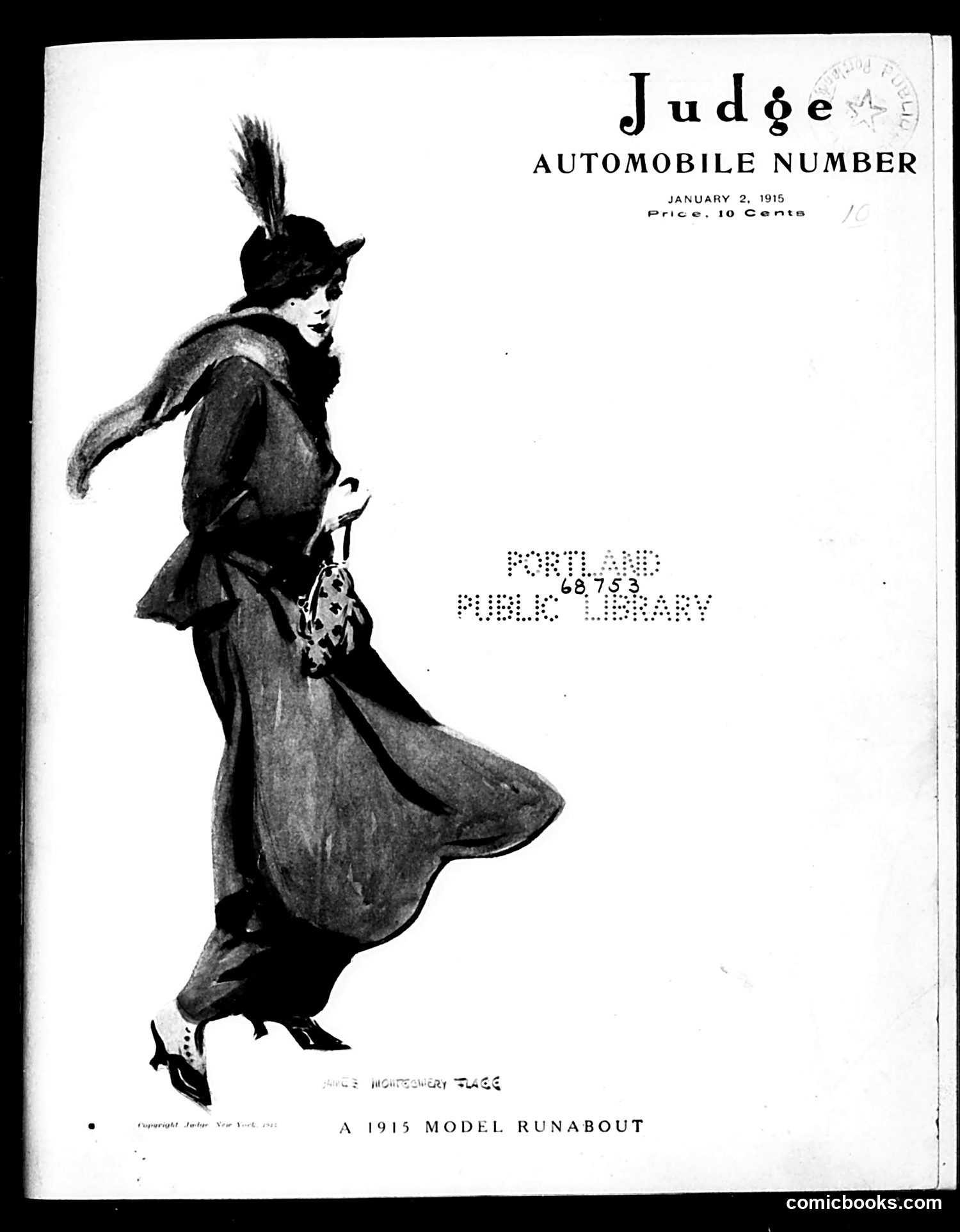
This cover features a fashionable woman in an elegant coat and feathered hat, mid-stride in a dynamic pose. The illustration advertises "A 1915 MODEL RUNABOUT" — a type of early automobile. The satire appears to play on the emerging cultural tension around women's newfound mobility and independence that automobiles represented. The woman's spirited, almost reckless posture suggests both the excitement and anxiety some felt about women operating vehicles independently. The "runabout" — an affordable, open-air car — made personal transportation accessible beyond the wealthy, challenging traditional gender roles about women's place and freedom of movement. The cover reflects 1915 anxieties about modernization, gender, and automotive culture.
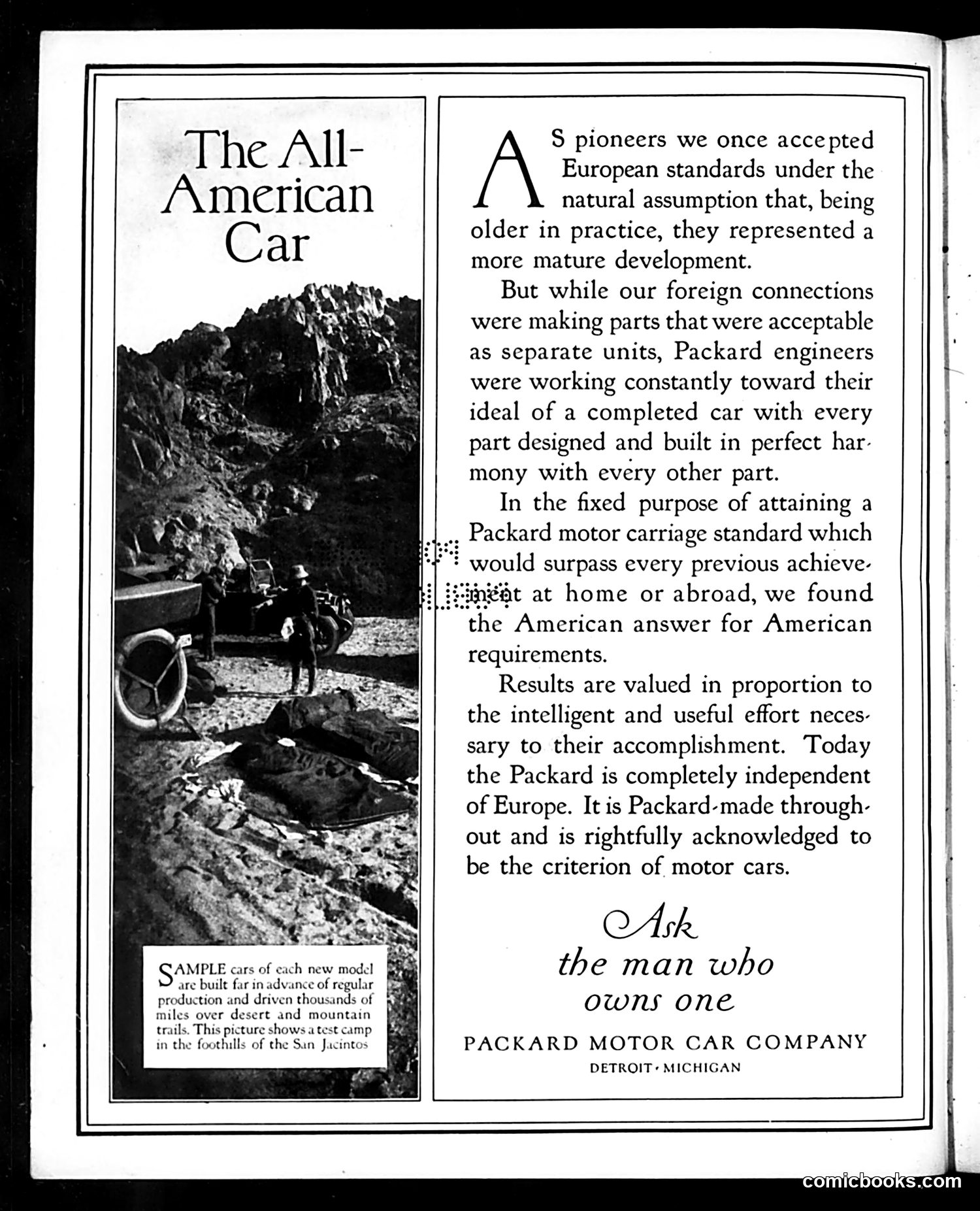
This is a **Packard Motor Car Company advertisement**, not satirical content. The page presents Packard's marketing argument for American automotive superiority circa 1910s-1920s. The text argues that while European manufacturers traditionally set standards (being "older in practice"), Packard engineers rejected this assumption. They pursued complete, integrated American design rather than assembling European components. The advertisement claims Packard achieved a superior "All-American Car" that surpassed both domestic and foreign standards. The photograph shows a Packard being tested on desert and mountain terrain—demonstrating ruggedness and reliability as proof of American engineering excellence. The message reflects early 20th-century American industrial nationalism and the emerging belief that American manufacturing could innovate beyond European tradition.
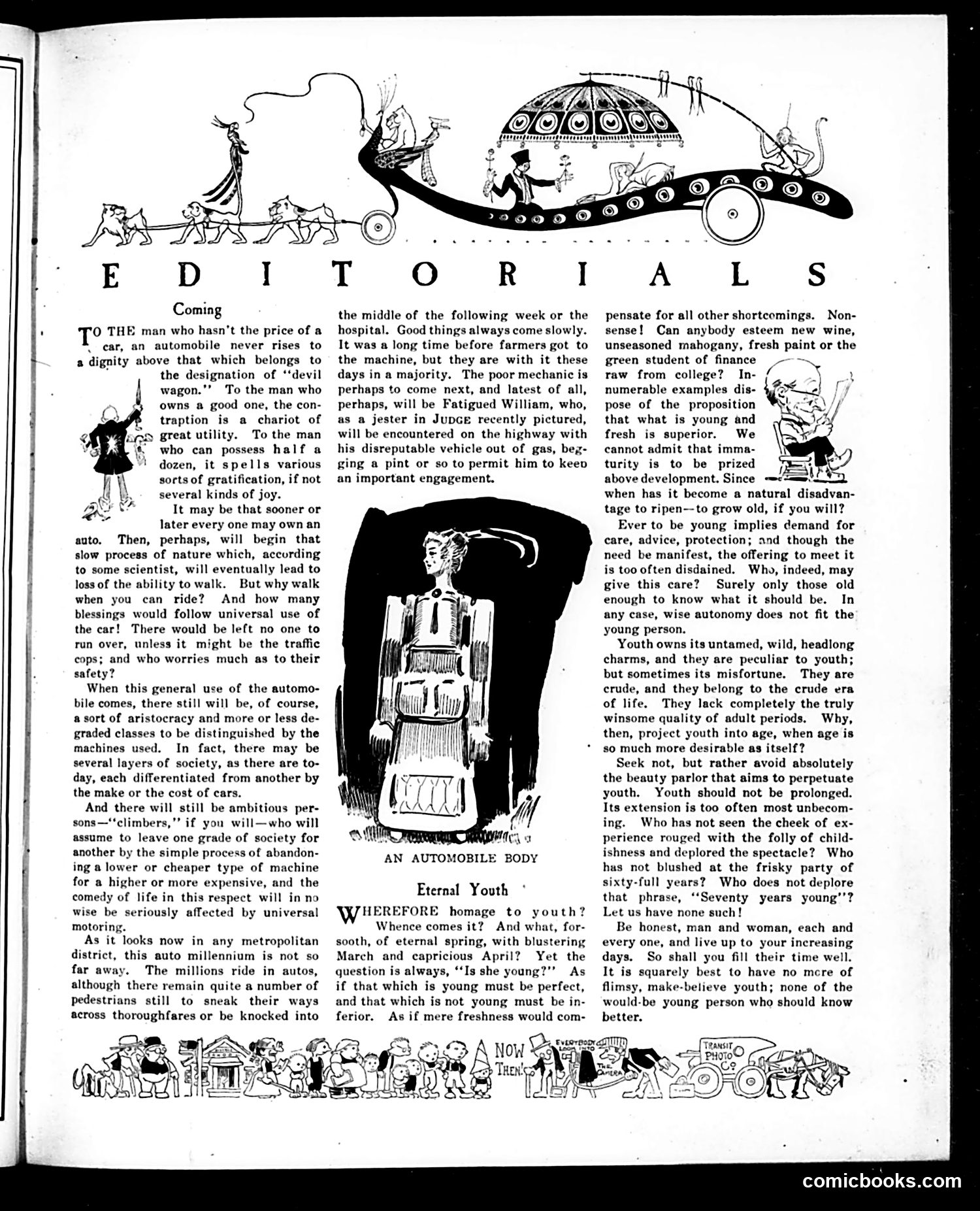
This page features two distinct sections: **Header Illustration ("Editorials")**: An elaborate decorative header depicting an ornate chariot or vehicle laden with mechanical/automobile imagery, suggesting early 20th-century fascination with motorized transportation as a symbol of progress and modern society. **Main Editorial ("Eternal Youth")**: The text discusses automobiles as status symbols and their role in creating social stratification. It critiques society's obsession with youth and newness, warning against prolonging childhood or refusing to mature. The central illustration shows an "automobile body"—likely a visual pun comparing a car's exterior to human physicality. **Social Commentary**: The piece satirizes both the automobile industry's expansion and contemporary anxieties about modernization, class hierarchy, and generational values during what appears to be the early automotive era in America.
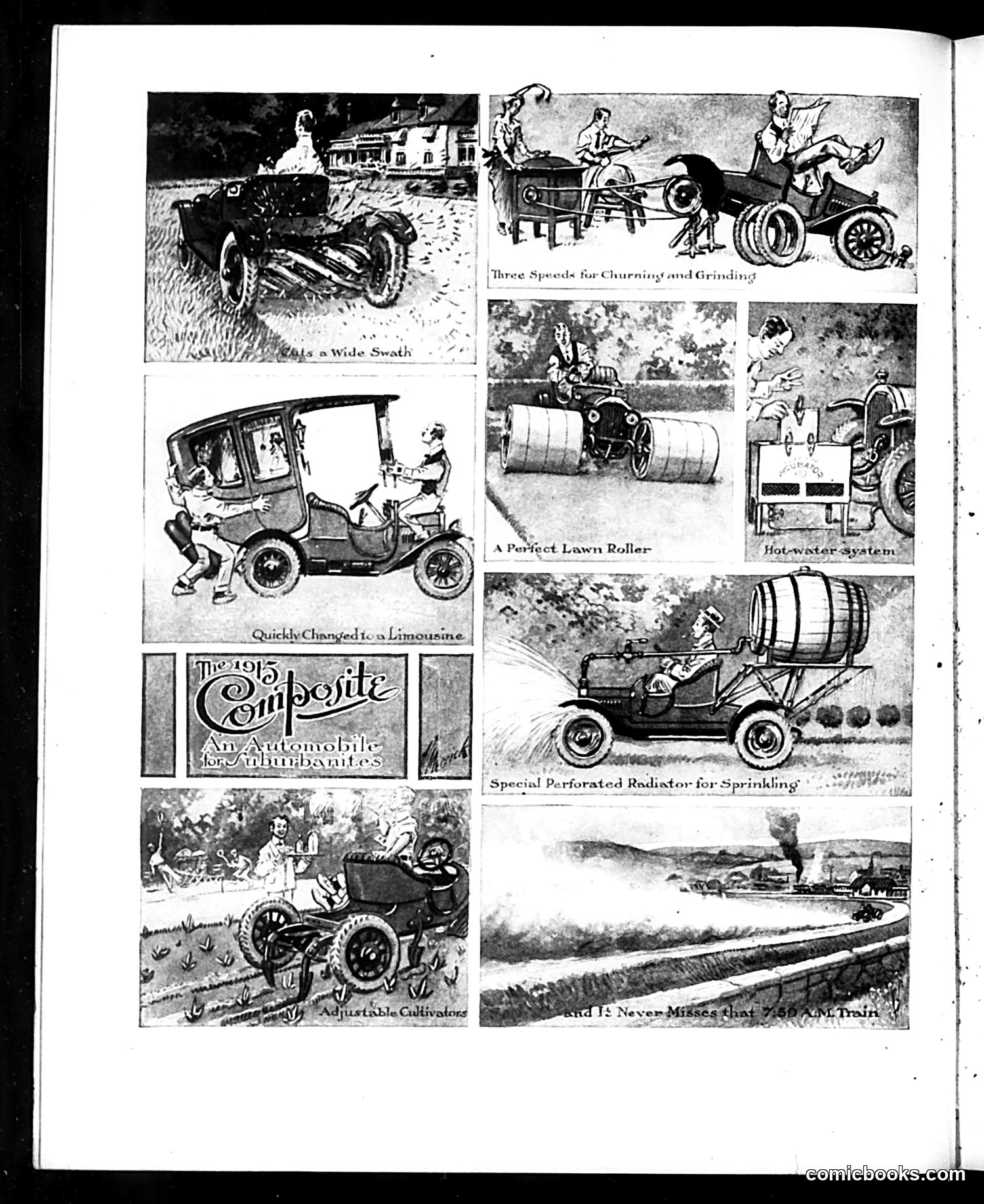
This page is primarily **advertising rather than political satire**. It showcases "The 1915 Composite: An Automobile for Umbrellaites"—a humorous concept car designed with multiple attachments for various household tasks. The cartoons depict absurd attachments transforming a basic automobile into specialized equipment: a lawn roller, hot-water system, sprinkler, cultivator, and others. The final image shows the vehicle equipped as a train, suggesting ultimate versatility. The satire targets not politics but **consumer culture and advertising itself**—mocking the contemporary trend of marketing multi-purpose gadgets and "all-in-one" solutions. The joke is that manufacturers were promising automobiles could replace nearly every household tool, reflecting early-20th-century optimism about automotive technology solving everyday problems.
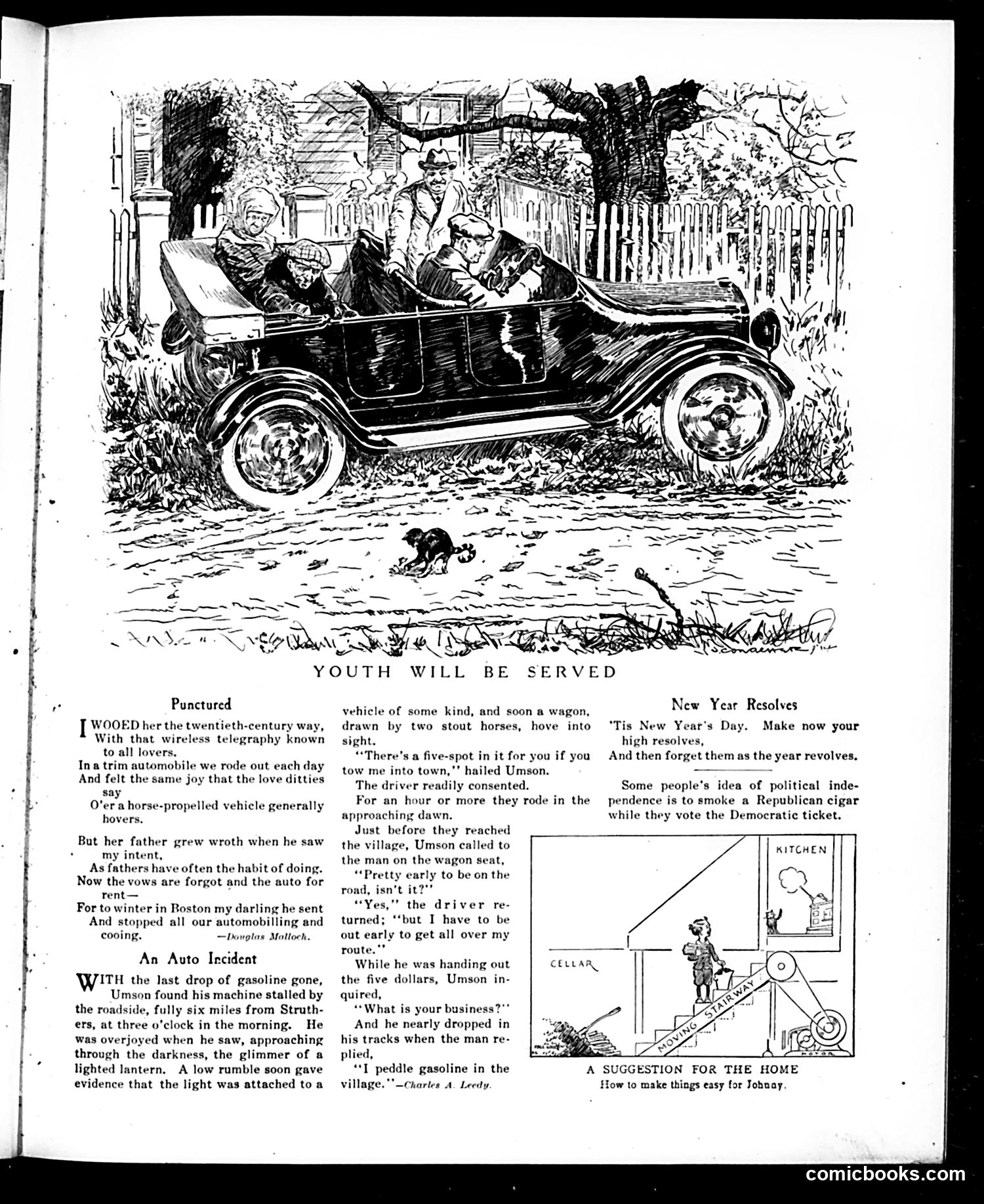
This page contains two unrelated pieces of early 20th-century American humor: **"Youth Will Be Served"** - A comic strip about an automobile incident where a father objects to his daughter riding in a car with a young man, reflecting period anxieties about automobiles as vehicles for unsupervised youth socializing. **"Punctured" and "An Auto Incident"** - Humorous anecdotes about early motorcar mishaps and the novel experience of automobile travel, including stories about gasoline rationing and mechanical failures. The **"New Year Resolves"** section mocks political hypocrisy—specifically, voters who adopt contradictory New Year's resolutions while voting against their stated principles (Democratic voters claiming Republican ideals, etc.). The bottom diagram, **"A Suggestion for the Home,"** appears to be practical household advice, unrelated to satire. The content reflects an era when automobiles were still novelties and political inconsistency was considered amusing rather than typical.
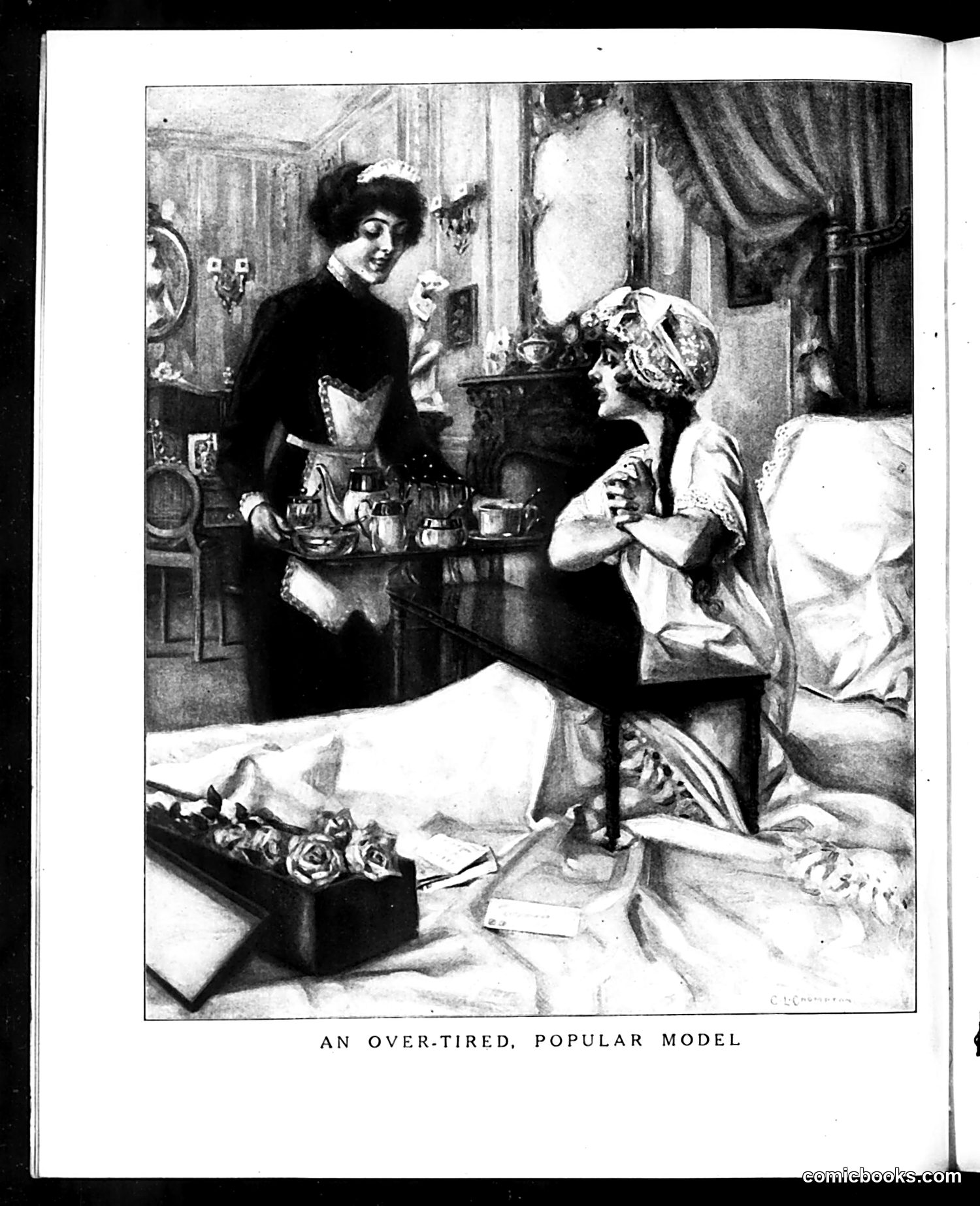
This illustration satirizes the exhaustion of a fashionable woman who has become a popular artist's model. The seated woman, dressed in elaborate period costume with an ornate headpiece, appears fatigued while being attended to by her maid (standing, in black dress) in what appears to be a luxurious bedroom or dressing room. The satire targets the demanding lifestyle of professional models during this era—constantly posing for artists, wearing uncomfortable costumes, and maintaining fashionable appearances. The caption's irony suggests that despite her popularity and the glamorous setting with its fine furnishings, the model is physically exhausted from the endless demand for her services. This reflects early 20th-century commentary on the labor conditions and physical toll of modeling work.
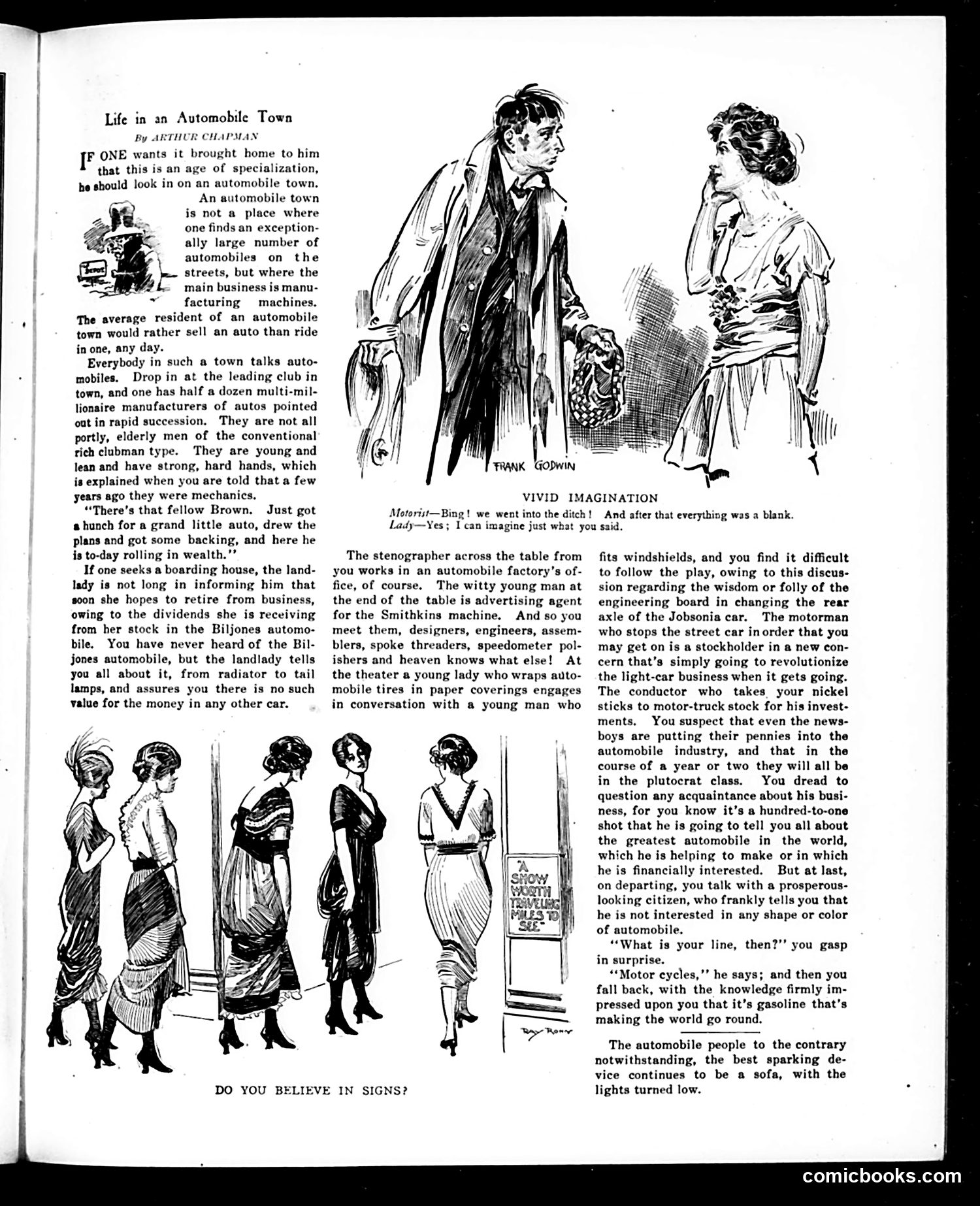
This article satirizes early 20th-century American automobile manufacturing towns—industrial centers where car production dominated the economy and culture. Chapman mocks how automobile manufacturing had created a new class of wealthy industrialists and how the industry permeated every aspect of social life. The satire highlights: **Social mobility**: Former mechanics rapidly became millionaires through auto manufacturing, disrupting traditional class structures. **Obsessive specialization**: Every townsperson—stenographers, theater-goers, motormen, newsboys—was somehow invested in or employed by the auto industry, making conversation inescapable. **The punchline** subverts expectations: After describing universal automobile obsession, Chapman reveals one prosperous citizen uninterested in cars—he's invested in *motorcycles* instead. The final joke about sofas with "lights turned low" deflates the industrial enthusiasm with old-fashioned romance. The cartoons illustrate social pretension and fashion influenced by automobile culture, reinforcing how thoroughly the industry had reshaped American life.
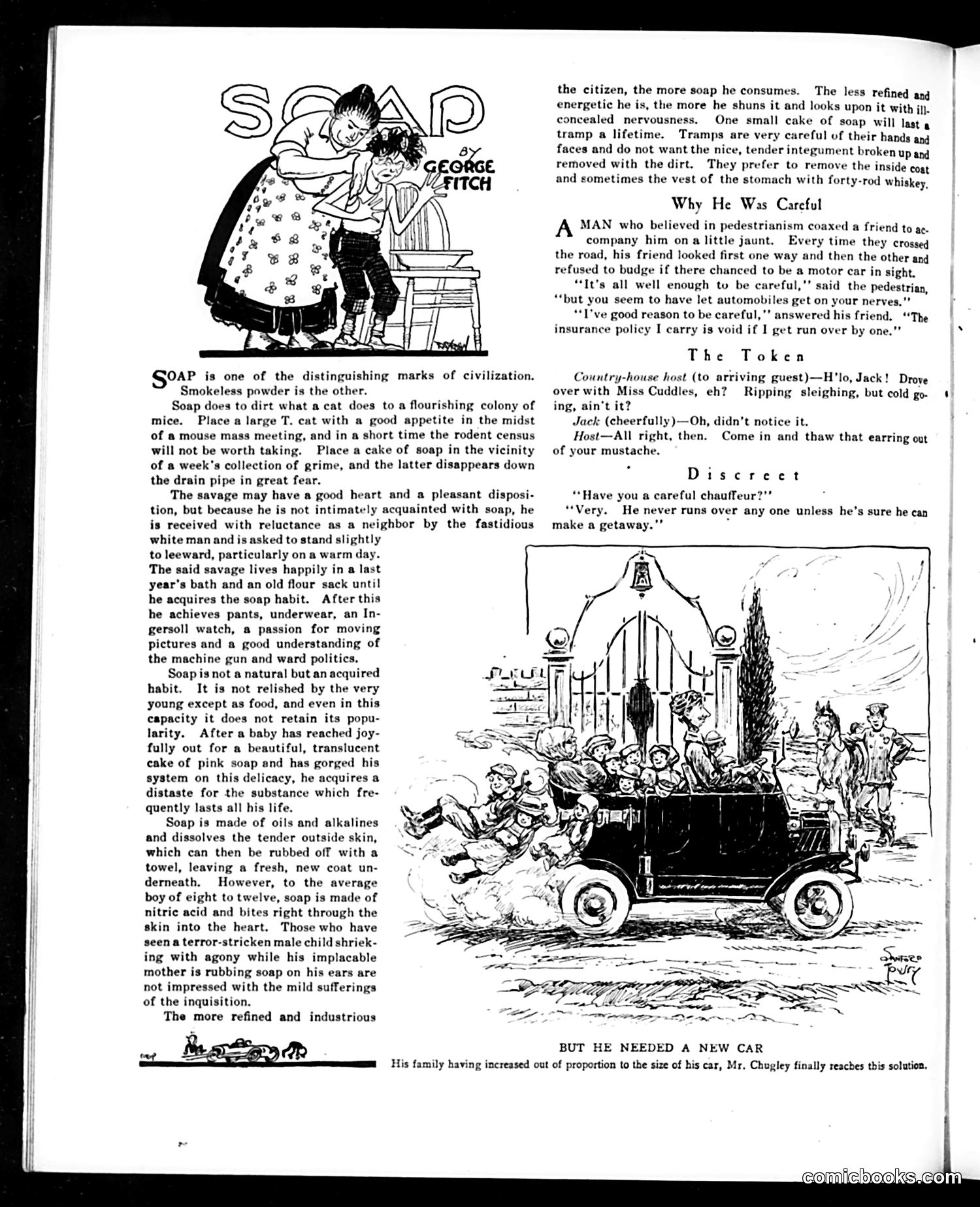
This page contains three distinct humor pieces: **"Soap" (by George Fitch):** A satirical essay using soap as a metaphor for civilization. It argues soap distinguishes "refined" citizens from "savages" and working-class people (notably tramps), reflecting period attitudes that linked personal hygiene to social status and morality. The piece is ethnically condescending, suggesting indigenous peoples lack civilization until acquiring soap habits along with watches and interest in "ward politics." **"Why He Was Careful":** A joke about a cautious driver whose insurance policy voids coverage if hit by a motor car—an absurd clause played for humor about the perceived dangers of early automobiles. **"The Token" and "Discreet":** Brief jokes about winter socializing and, humorously, a chauffeur's willingness to hit pedestrians if he can escape—dark humor about automobile safety. **"But He Needed a New Car":** An illustration showing a man whose family has outgrown his vehicle, depicting early-1900s concerns about automobile practicality and family growth. The page reflects early-20th-century attitudes about class, hygiene, and technology.
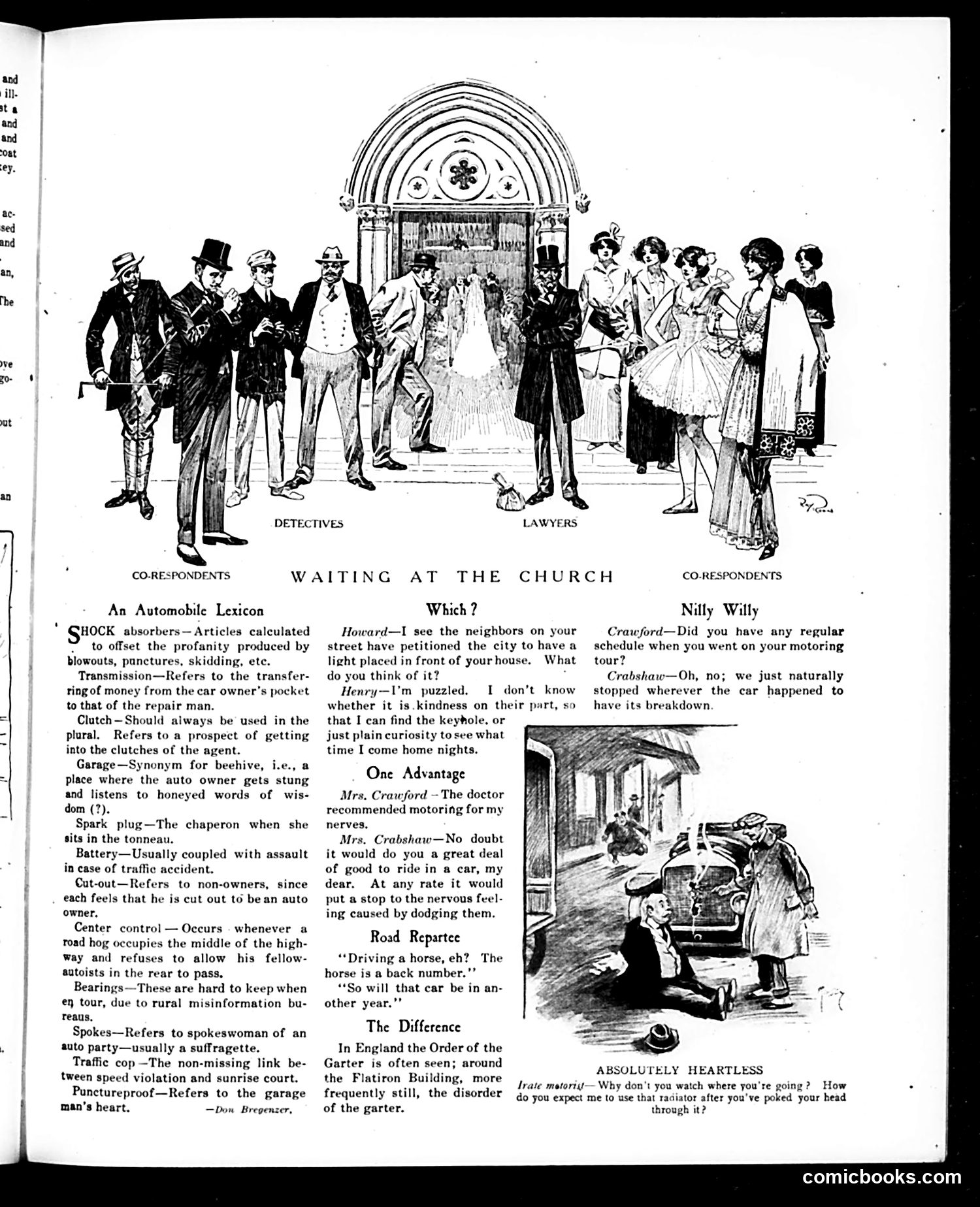
This page satirizes early automobile culture and social anxieties of the era. The central illustration shows detectives, lawyers, and "co-respondents" (likely divorce case participants) gathered at a church—suggesting automobiles enabled illicit affairs by providing private transportation. The "Automobile Lexicon" column mocks car ownership pretensions through automotive puns: "garage" equals getting "stung," "transmission" means money leaving owners' pockets, "spokes" references suffragettes (women advocating for driving rights). The humor targets both automotive unreliability and emerging social changes. Other jokes ridicule dangerous driving habits, nervous drivers, and the automobile's disruptive social impact. The "Order of the Garter" reference jokes about women losing undergarments due to bumpy rides—mixing automotive danger with sexual innuendo typical of the era's satirical magazines. Overall, the page reflects period anxieties: automobiles as morally corruptive, mechanically unreliable, and dangerous to traditional social order—particularly regarding women's newfound mobility and independence.
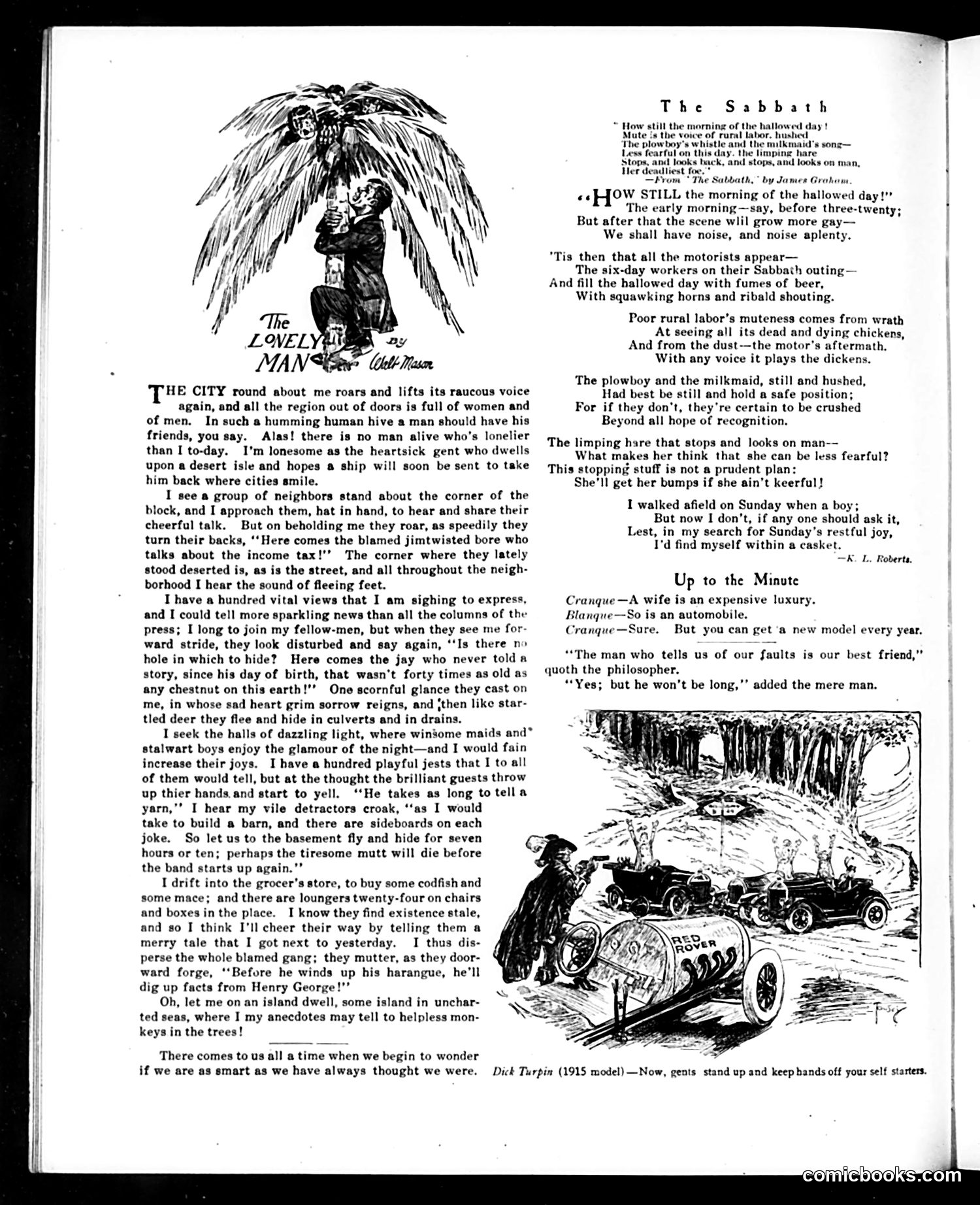
**"The Lovely Man"** (left) satirizes a social bore—a man whose tedious stories and tiresome conversation cause neighbors, party guests, and shopkeepers to literally flee whenever he approaches. The joke is that despite living in a crowded city, he's utterly alone because nobody will tolerate his company. The humor targets the archetype of the relentless raconteur who won't stop talking (particularly about income tax and worn-out jokes). **"The Sabbath"** (right) mocks the violation of the Christian Sabbath by motorists. The poem contrasts the peaceful early morning with the afternoon invasion of six-day workers taking "Sabbath outings" in automobiles—creating noise, pollution, and dead animals. The satire criticizes how automobiles and working-class leisure activities desecrate what was traditionally a quiet, religious day of rest. The rural workers are angered by the dust and dead livestock left in the motors' wake. Both pieces critique early 20th-century urban social behavior and modernization's disruptions.
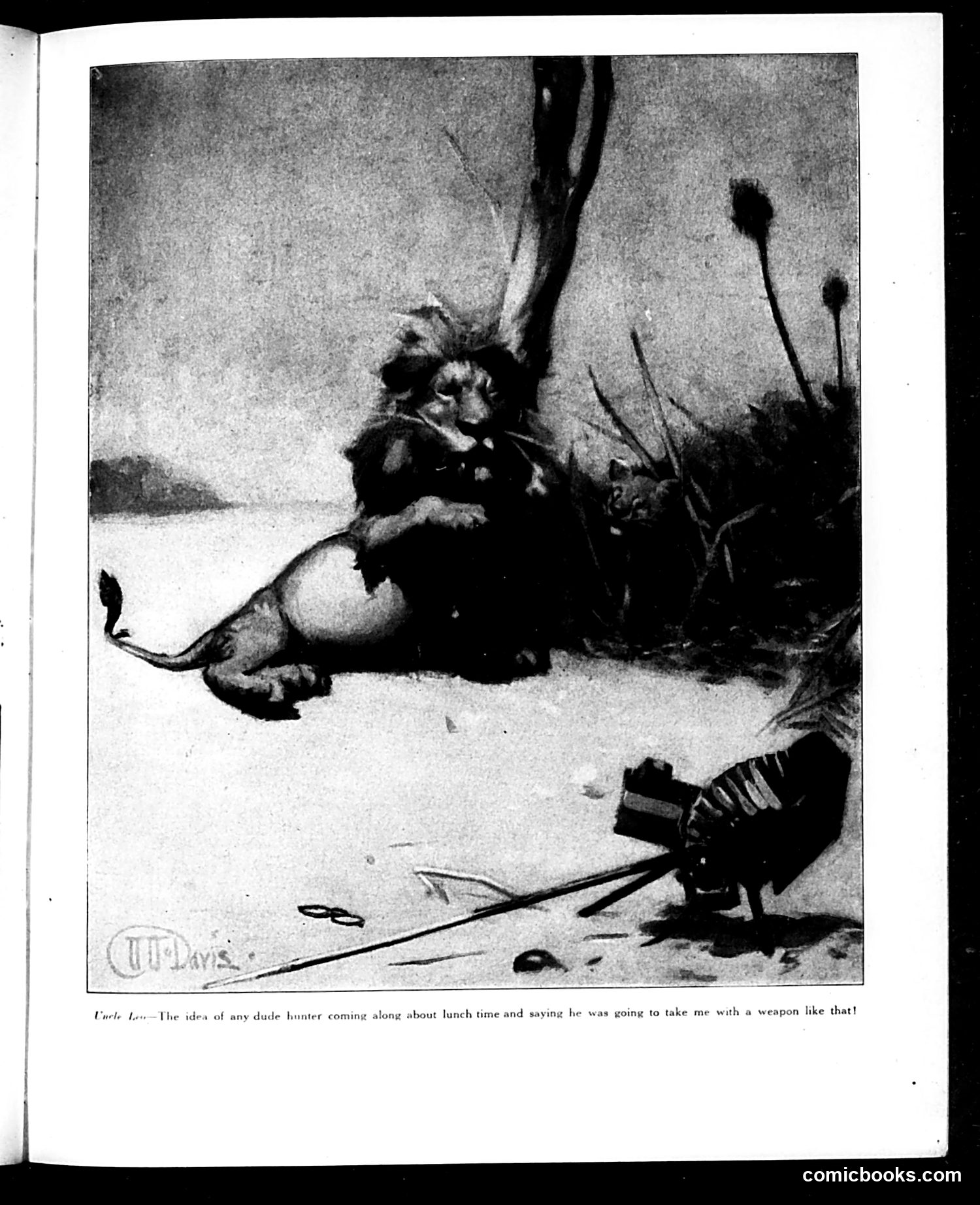
This appears to be a single cartoon titled "Uncle Joe" (visible in the signature area). The image shows a figure lying on the ground near water and vegetation, with what appears to be a large weapon or tool nearby. The caption references "any dude hunter coming along about lunch time and saying he was going to take me with a weapon like that!" This suggests satirical commentary on hunting culture or weapons, though the specific political/social reference is unclear from the visible text alone. The cartoon likely comments on either the absurdity of certain hunting practices or makes a social observation about masculinity and weapons, but without fuller context or a clearer date, the precise target of satire cannot be definitively identified. The humor appears physical/visual rather than strictly political.
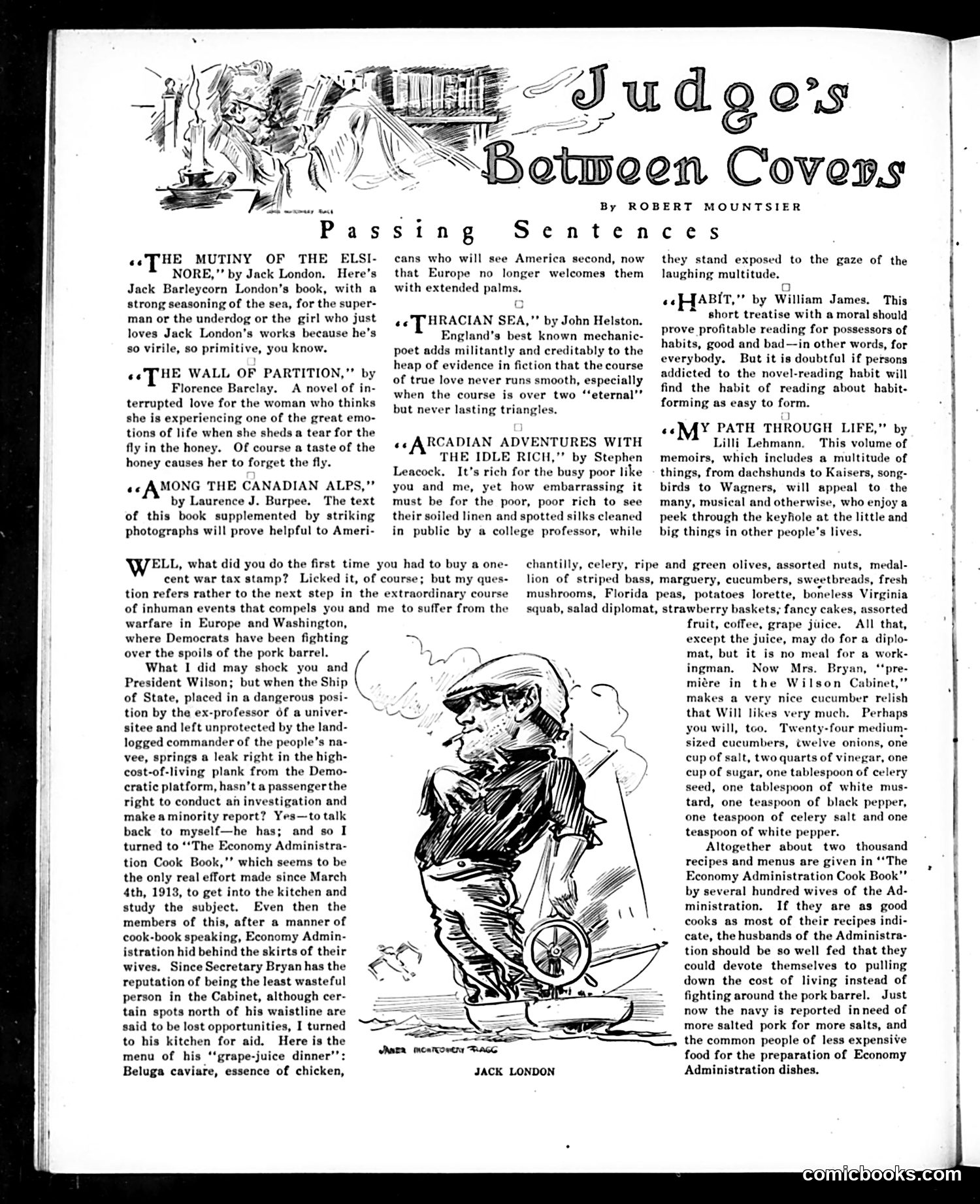
This page combines book reviews with political satire targeting the Wilson administration's handling of wartime economics. The central column contains a lengthy complaint about war tax stamps and the "high-cost-of-living" resulting from Democratic policies, framed as a humorous investigation into government waste. The satirical point: Secretary of State William Jennings Bryan, known for advocating temperance and frugality, allegedly served an extravagant "grape-juice dinner" (grape juice being his signature beverage) featuring luxury items like beluga caviar—a stark contradiction to his reputation for thriftiness. The author sarcastically suggests this demonstrates how even the administration's "least wasteful" official cannot actually economize during wartime. The sketch of Jack London at left illustrates the accompanying book reviews. The satire mocks both government hypocrisy and the era's popular literature.
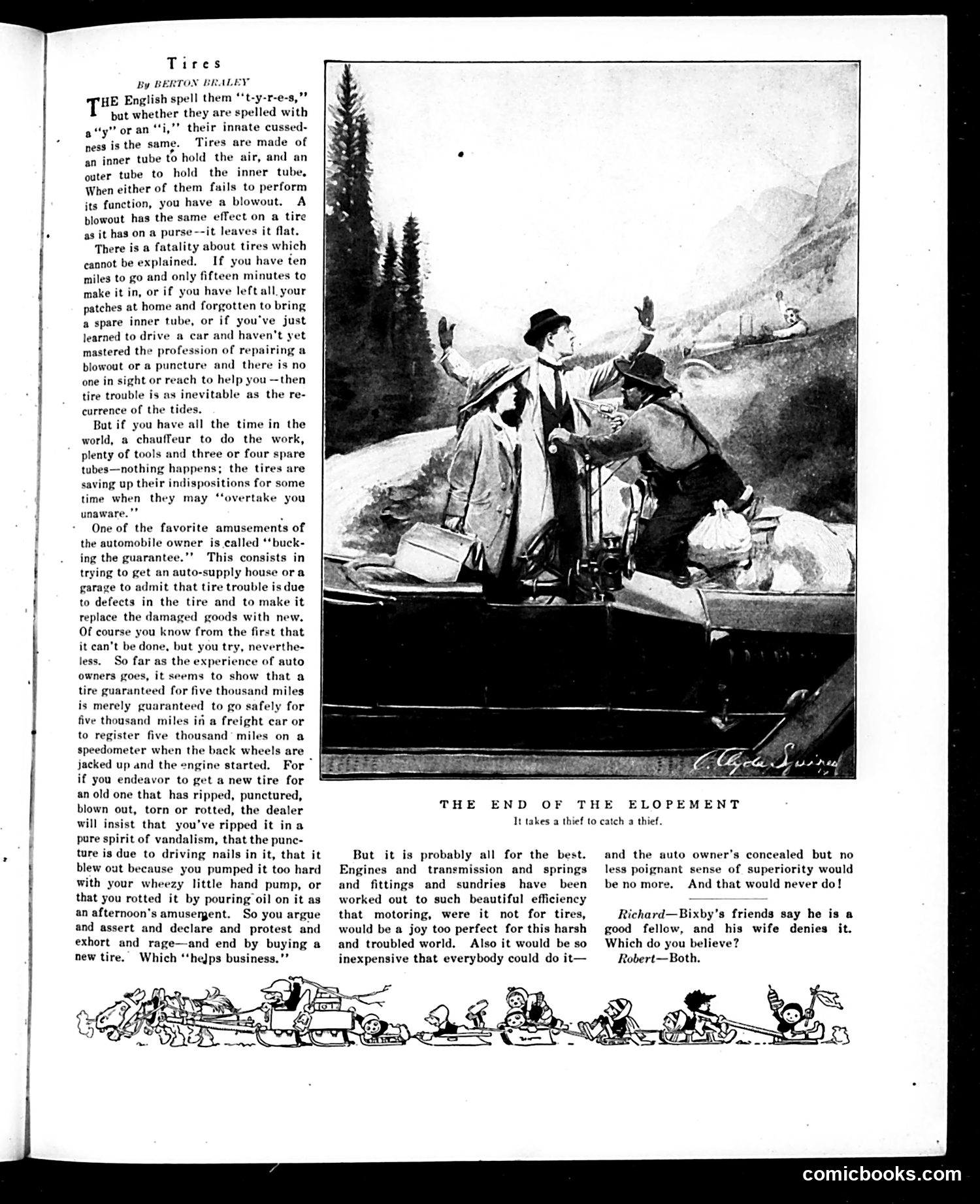
This satirical article mocks the inevitable frustrations of early automobile ownership, specifically tire problems. The piece uses bitter humor to describe how tire failures follow a cruel Murphy's Law: they occur precisely when you're unprepared or in a hurry, but never when you have time and tools to fix them. The satire targets two groups: incompetent tire manufacturers who issue worthless guarantees (tires guaranteed for 5,000 miles only work reliably when sitting in a freight car), and consumers who futilely attempt to claim warranty replacements despite knowing they'll lose. The final joke suggests tire troubles actually benefit society—without them, motoring would be so perfectly reliable and cheap that everyone could afford cars, eliminating the wealthy automobile owner's sense of superiority. The accompanying cartoon "The End of the Elopement" appears unrelated, showing a roadside automotive mishap.
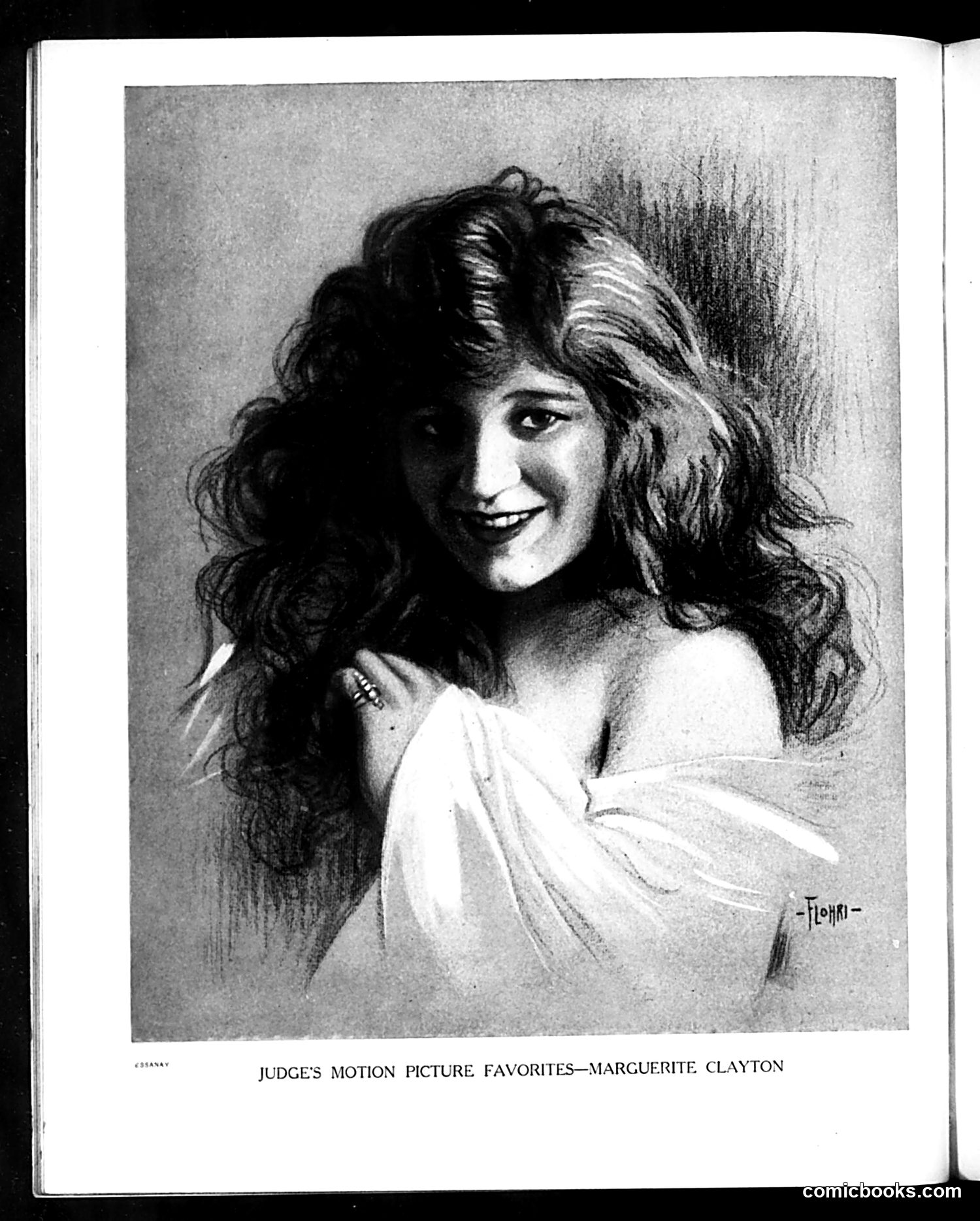
This page from the satirical magazine *Judge* features a portrait of Marguerite Clayton, identified as one of Judge's "Motion Picture Favorites." The image is a glamour photograph—a common feature in early twentieth-century magazines celebrating film industry personalities. Clayton appears to be a silent film actress whose work *Judge* readers would have recognized. The portrait itself contains no obvious satire; rather, it represents *Judge* magazine's coverage of popular entertainment and celebrity culture during the early motion picture era. The carefully rendered charcoal or pencil drawing, signed by the artist, presents Clayton as an attractive, fashionable woman typical of promotional imagery for stage and screen performers of that period.
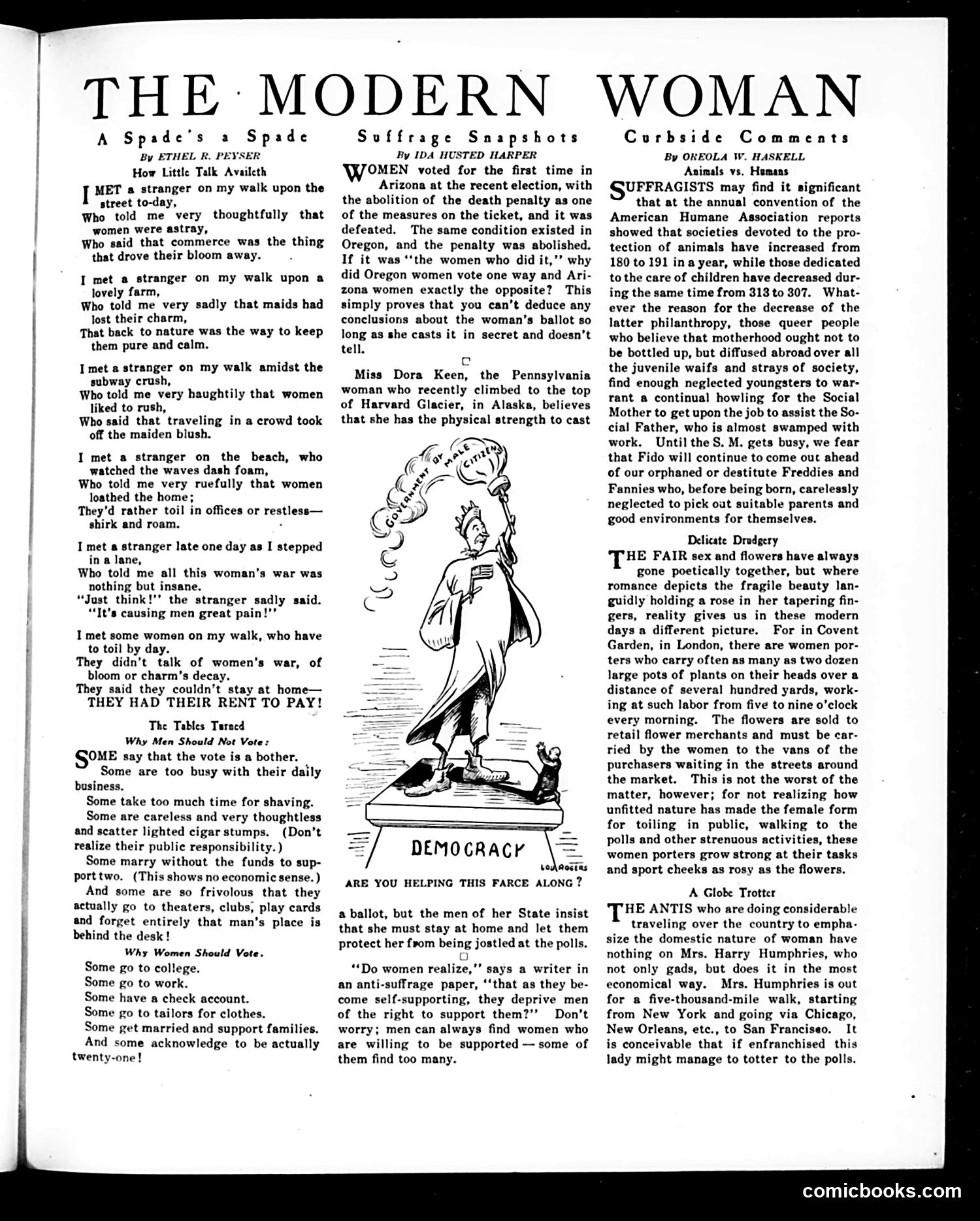
This page satirizes anti-suffrage and anti-feminist arguments through sharp irony. **The main cartoon** depicts a woman labeled "Democracy" balanced precariously on a pedestal, suggesting the instability of female political participation—a common anti-suffrage trope. **"A Spade's a Spade"** (left column) mocks men who blame women's "decline" on commerce, cities, and work. The poem's punchline reveals the real issue: working women have "THEIR RENT TO PAY"—dismissing romantic complaints as privileged nonsense. **"The Tables Turned"** flips the script, listing absurd reasons men shouldn't vote (frivolousness, poor finances) that mirror actual anti-suffrage arguments against women, exposing their hypocrisy. **"Suffrage Snapshots"** (right) challenges specific anti-suffrage claims: women voting differently in Arizona vs. Oregon proves they're independent thinkers; Miss Dora Keen's glacier-climbing proves physical capability; and the sarcastic response about "depriving men of support" mocks protectionist arguments. The page argues suffragists are rational while opponents traffic in emotion and contradiction.
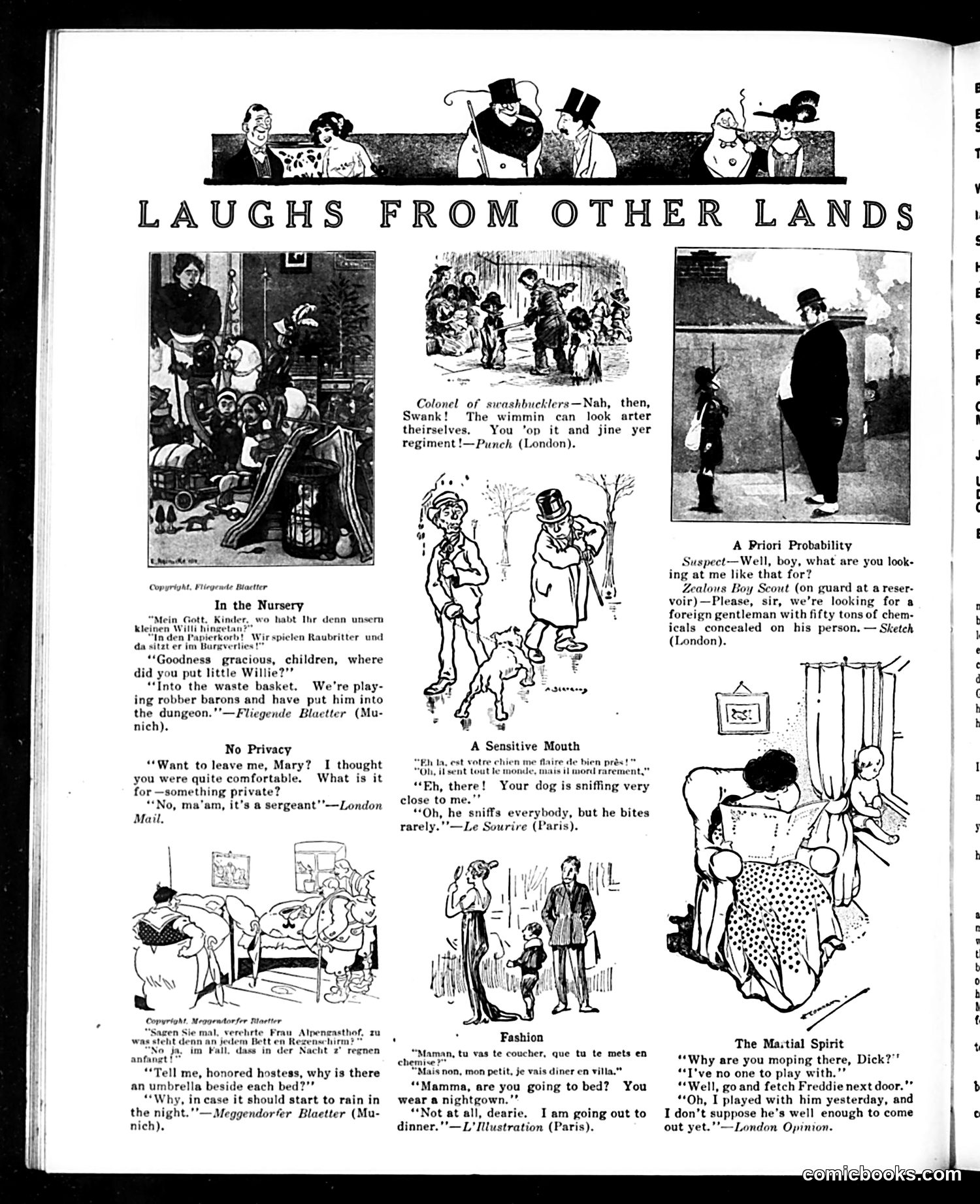
This page reprints comic anecdotes and cartoons from European satirical magazines (Punch, Le Sourire, L'Illustration, etc.), showcasing different national humor styles. The jokes reflect early 20th-century social observations: children's unsupervised play ("robber barons"), rigid class hierarchies (a sergeant replacing a maid), practical absurdities (umbrellas by beds), and gender roles (a mother prioritizing dinner out over bedtime). One cartoon mocks military posturing ("swashbucklers"). Another shows post-WWI anxiety—a Boy Scout searching for foreign spies with chemicals, reflecting fears of sabotage or chemical warfare. The humor is gentle, domestic, and class-conscious rather than overtly political. Judge presents these as culturally distinctive examples of "foreign" wit for American readers, emphasizing how different nations find humor in their own social customs and concerns.
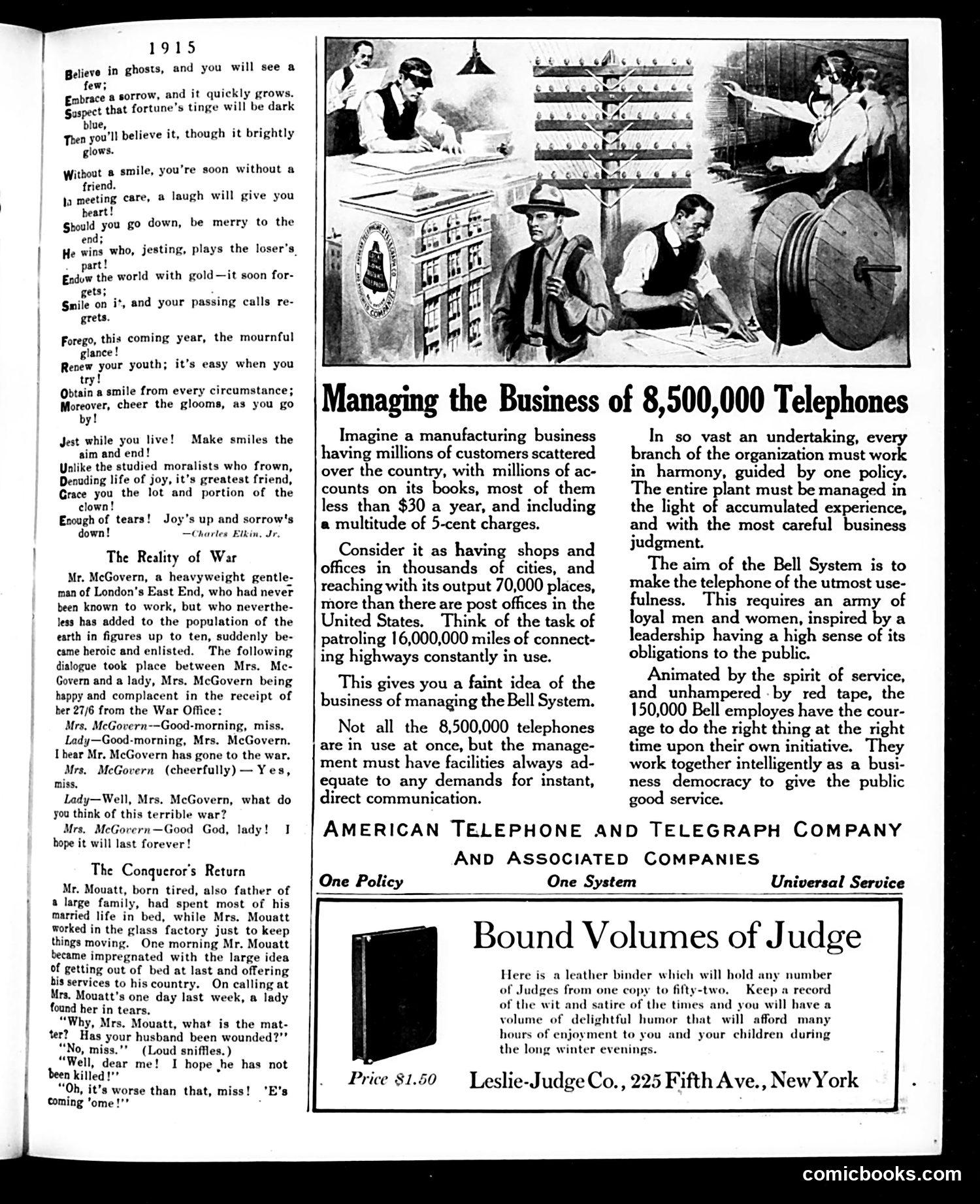
This page contains three distinct elements: **Poetry & Comic Sketches (Left):** Light verses about maintaining optimism, followed by two humorous dialogues satirizing working-class British attitudes toward World War I. "The Reality of War" mocks a poor, unemployed man ("never been known to work") who enlists and receives a government stipend—his wife hopes the war continues forever because the financial support improves her life. "The Conqueror's Return" ridicules a lazy husband who finally leaves bed to enlist; his wife weeps not because he's wounded, but because he's returning home, depriving her of his absence. **Bell System Advertisement (Right):** The bulk of the page is corporate propaganda for AT&T, emphasizing the Bell System's scale (8.5 million telephones, 150,000 employees) and organizational efficiency. Period photographs show telephone infrastructure and workers. **Bottom Advertisement:** Unrelated book promotion. The page exemplifies Judge's typical mix: sentimental patriotic verse, working-class comedy exploiting wartime economic desperation, and substantial paid advertising.
This page is primarily **advertising and editorial content** rather than political satire. The main article is "Riding in Other People's Cars" by Douglas Malloch—a humorous essay about being a passenger in automobiles owned by others. **The satire/humor** is social commentary on early automobiles (circa 1915): Malloch jokes that his ignorance about cars actually makes him a better passenger than knowledgeable owners. He humorously contrasts his blissful obliviousness to mechanical problems with owners' anxiety. He also pokes fun at rural Americans' resistance to automobiles—describing a farmer's creative curse words when stuck behind a car. **The cartoons** appear to be generic promotional illustrations unrelated to the article's content—one shows a woman (likely advertising agent recruitment) and another advertises Blackstone Manufacturing. The page is **90% advertisements** for hotels (New Orleans' St. Charles), correspondence schools (cartooning), talent recruitment, and patent medicines ("Don't-Snore" product). This was typical Judge magazine format of the era.
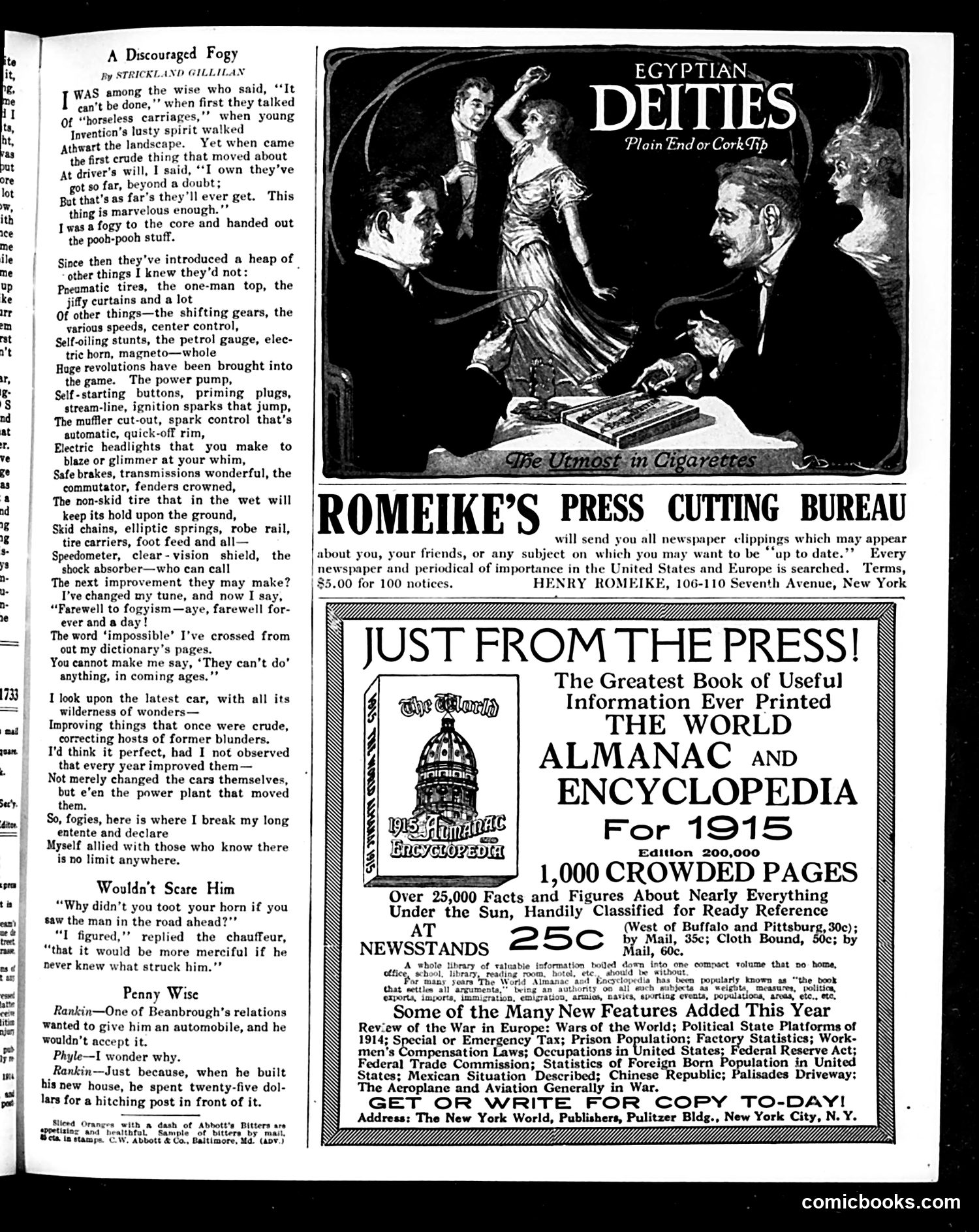
This page contains **three short humorous pieces** about automobiles, plus advertisements. **"A Discouraged Fogy"** satirizes someone who initially dismissed cars as impossible improvements, then grudgingly admits he was wrong as automobiles gained features (self-starters, electric lights, etc.). The joke mocks old-fashioned skeptics who resist technological change. **"Wouldn't Scare Him"** is a dark joke: a chauffeur doesn't warn a pedestrian because hitting him would be more merciful than the surprise. It satirizes early driving dangers and callous attitudes. **"Penny Wise"** is a brief joke about a man refusing a free automobile gift because he spent $25 on a decorative hitching post for his new house—mocking penny-pinching hypocrisy. The page also advertises Egyptian Deities cigarettes and Romeike's Press Cutting Bureau (a clipping service), plus the 1915 World Almanac and Encyclopedia. The content reflects 1910s anxieties about rapid technological change and social disruption caused by automobiles.
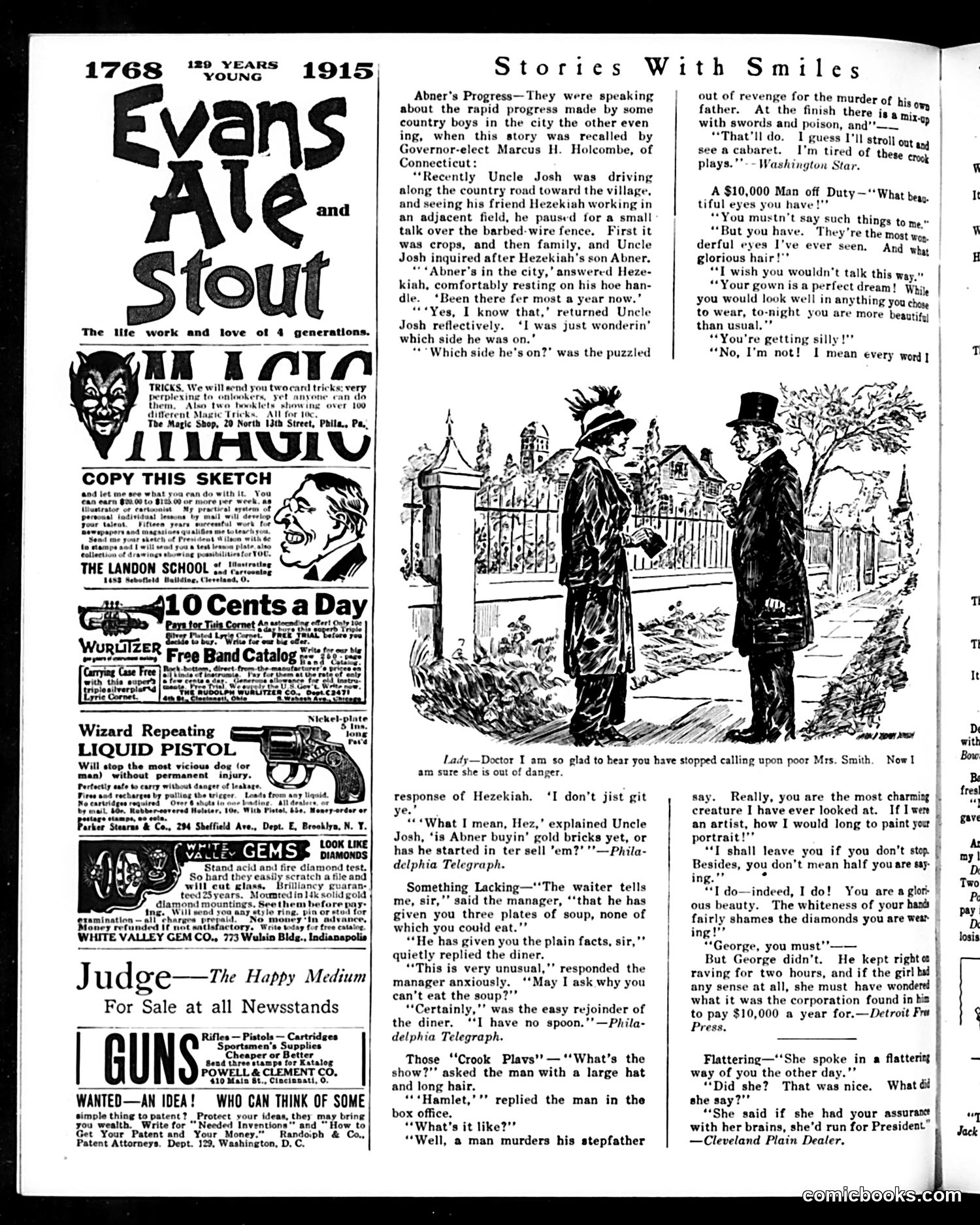
This page from Judge magazine (circa 1915, based on the Evans Ale masthead dating to 1768-1915) contains **primarily advertisements and humorous anecdotes** rather than political cartoons. The main illustrated cartoon depicts **two gentlemen in formal dress conversing near an ornate gate**, likely illustrating one of the jokes below it—possibly the "Lady—Doctor" anecdote where a physician boasts excessively about a woman's appearance. The humor throughout reflects **early 20th-century sensibilities**: rural characters like "Uncle Josh" and "Hezekiah" discussing country boy "Abner's" progress in the city; a waiter unable to serve soup without a spoon; a man defending murdering his stepfather in a theatrical "Hamlet." The page is dominated by **commercial advertisements** for inventions (patents, gem stones, firearms, a "Liquid Pistol"), The Landon School of Illustrating, and Evans Ale—typical of Judge's revenue model. **No major political figures or satire are evident** on this particular page.
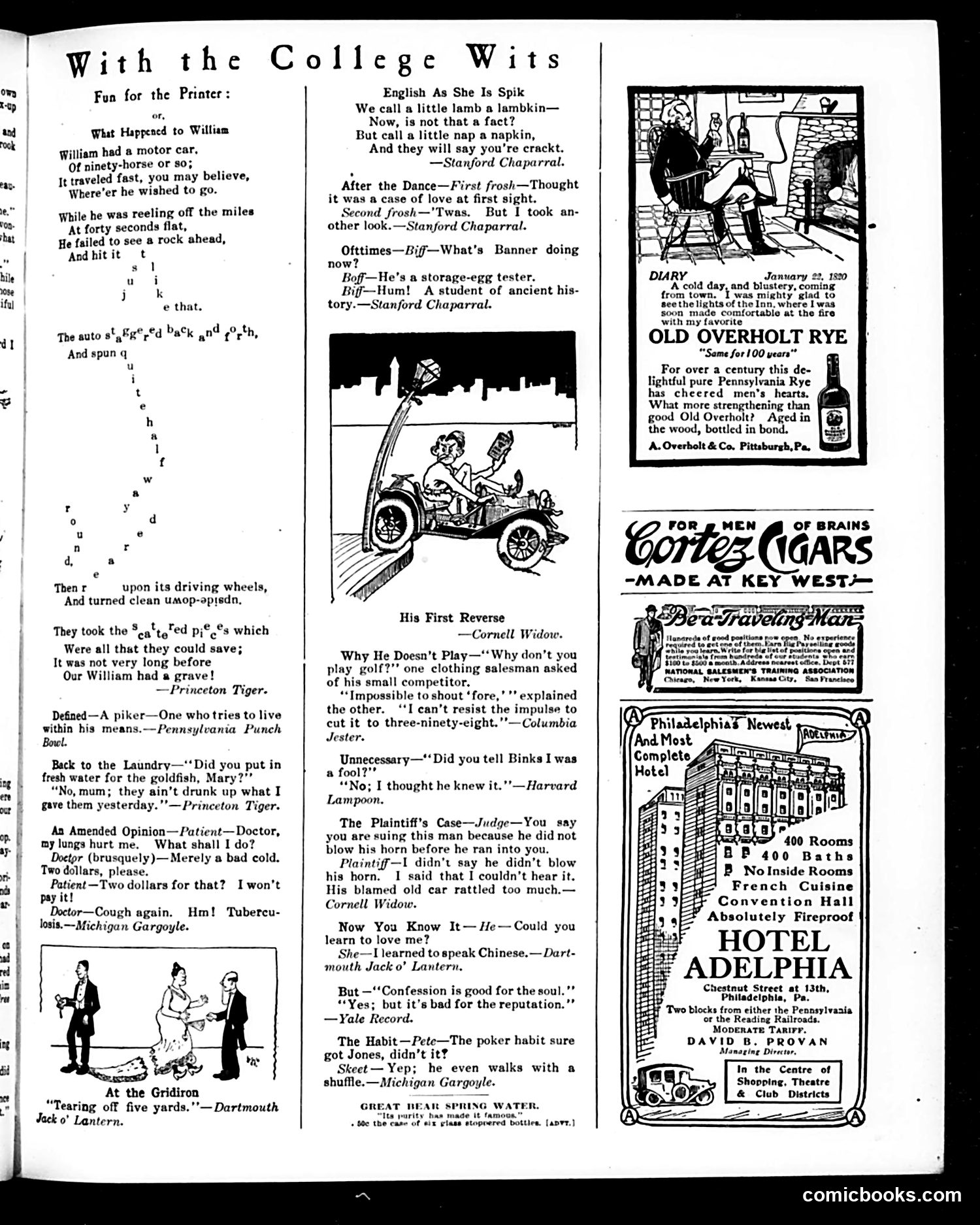
This is primarily a **humor collection page** from January 1920, featuring jokes submitted by college newspapers (Stanford, Cornell, Harvard, etc.), rather than political satire. The content includes: - **Short comedic pieces** mocking college life: a motorist who crashes at high speed ("William had a motor car"), freshman naïveté, and dating mishaps - **Wordplay humor**: "lambkin" vs. "napkin" puns, and absurdist jokes about professions - **Sports/campus culture jokes**: references to football ("tearing off five yards") and golf The **cartoons** show slapstick scenarios—a car accident, a man being ejected from a spinning vehicle—typical of 1920s visual humor. The page is **largely advertising**: Old Overholt Rye whiskey (legal in 1920, pre-Prohibition), Cortez cigars, Hotel Adelphia, and "traveling man" employment ads dominate the right side. **For modern readers**: This represents pre-Prohibition commercial culture and college humor traditions that predate modern comedy formats. The jokes are mild by today's standards and reflect early-20th-century undergraduate sensibilities.
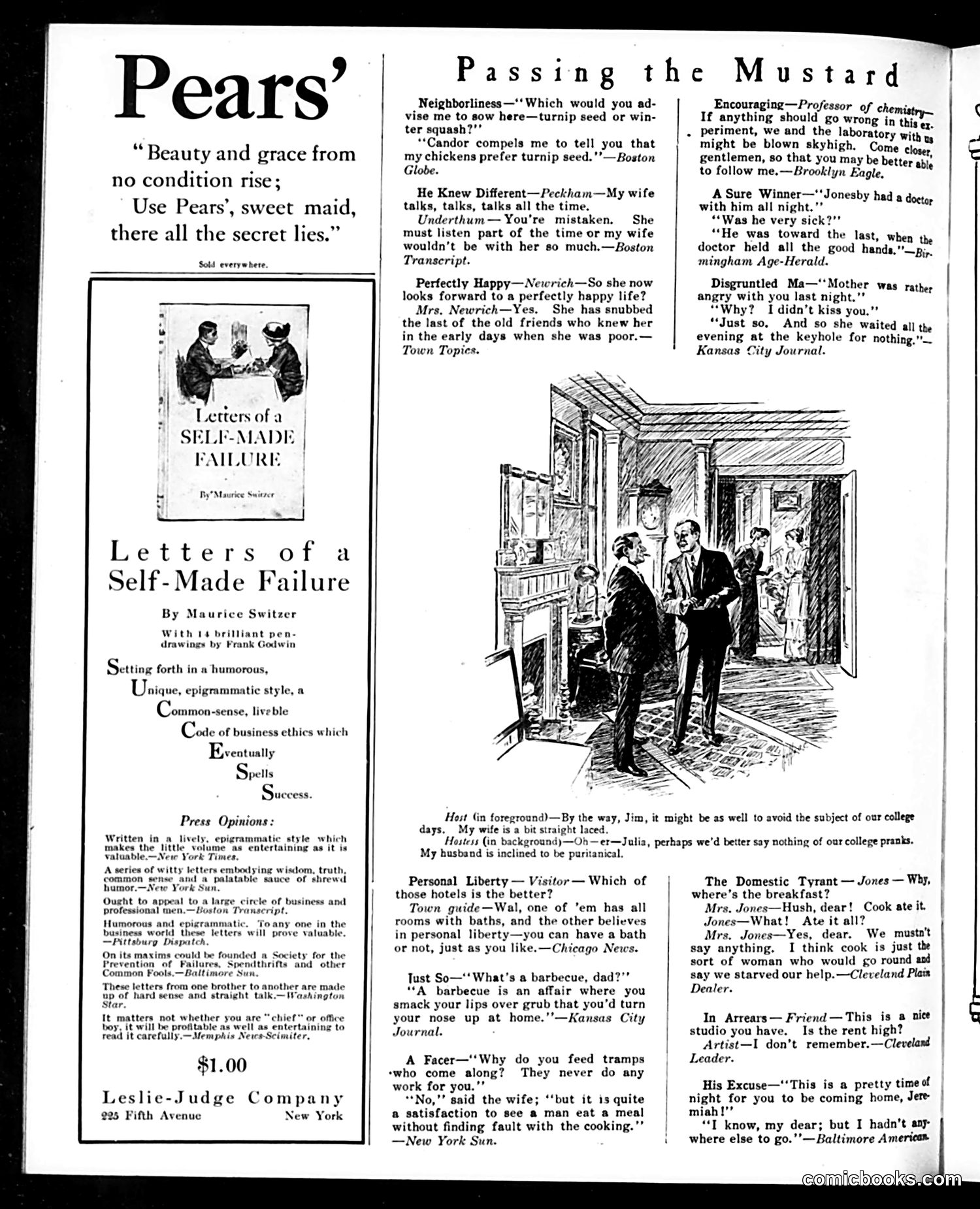
This page from *Judge* magazine contains multiple short humorous anecdotes rather than a single political cartoon. The content reflects early-20th-century American domestic and social humor. The sketched illustration shows men in business attire in what appears to be an office or laboratory setting, accompanying jokes about workplace dynamics and social etiquette. The written jokes touch on common domestic situations: nagging wives, servant problems, conjugal relations, and class anxieties (notably, a wealthy woman snubbing her poor former friends). The satire targets conventional social pretenses—people maintaining false propriety while harboring practical concerns. A recurring theme is the tension between stated values and actual behavior (wives spying through keyholes, servants eating the breakfast they're supposed to cook). The page also advertises Maurice Switzer's book *Letters of a Self-Made Failure*, a business ethics guide presented humorously. The humor assumes a male-centered, middle-class readership concerned with wives' behavior, servant management, and social status maintenance.
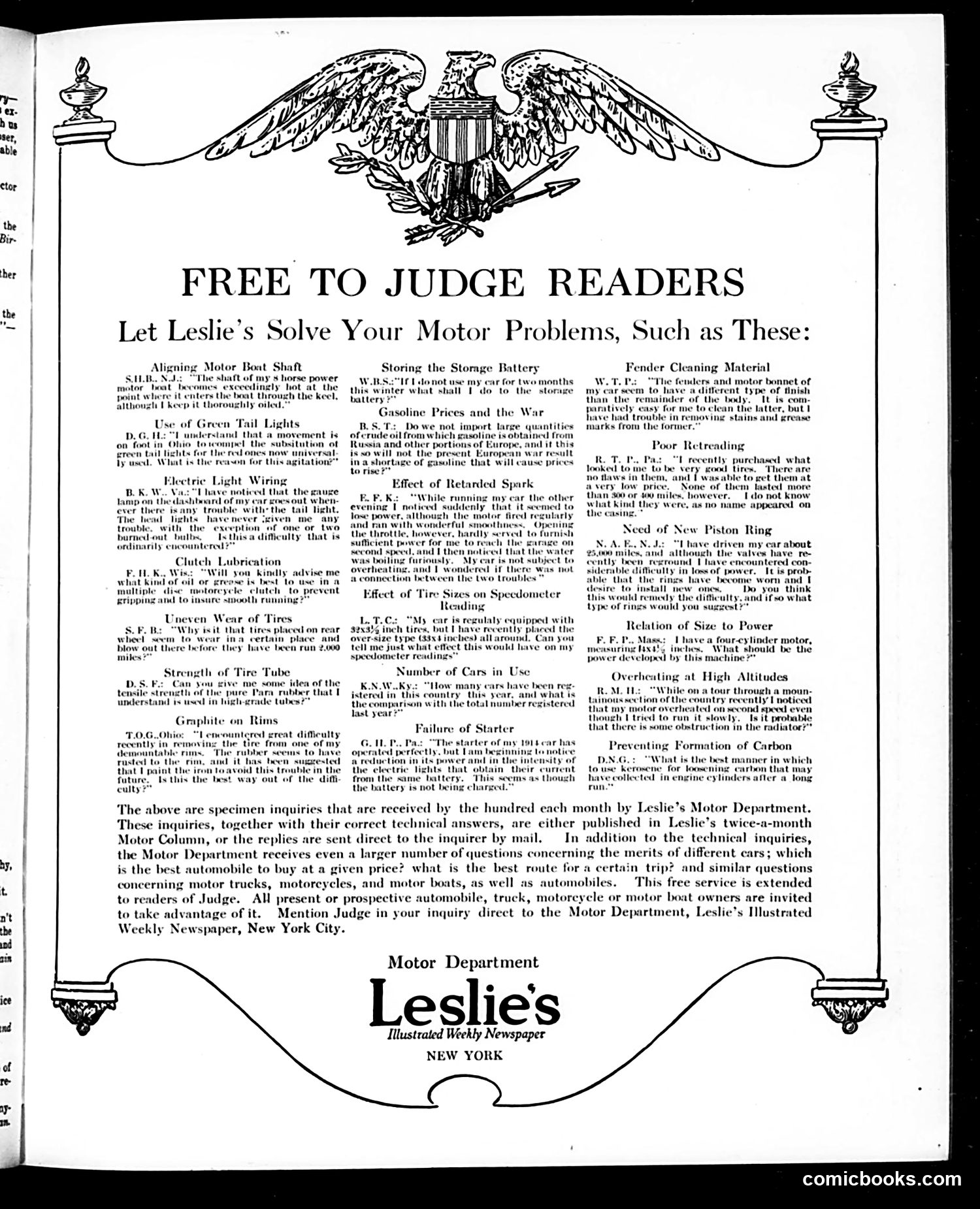
This is a **Motor Department advice column** from Leslie's Illustrated Weekly Newspaper. The eagle and decorative header are the publication's standard masthead, not satirical imagery. The page presents reader questions about automobile maintenance and operation—aligning motor boat shafts, storing batteries, tire wear, electrical wiring, spark timing, overheating, and similar technical issues. Each question receives a brief technical answer. The text explicitly states these are "specimen inquiries" published twice monthly in Leslie's Motor Column, with replies also sent directly to readers by mail. The service is extended to "all present or prospective automobile, truck, motorcycle or motor boat owners." This represents **early automotive consumer advice**—a practical service page, not satire or political commentary.
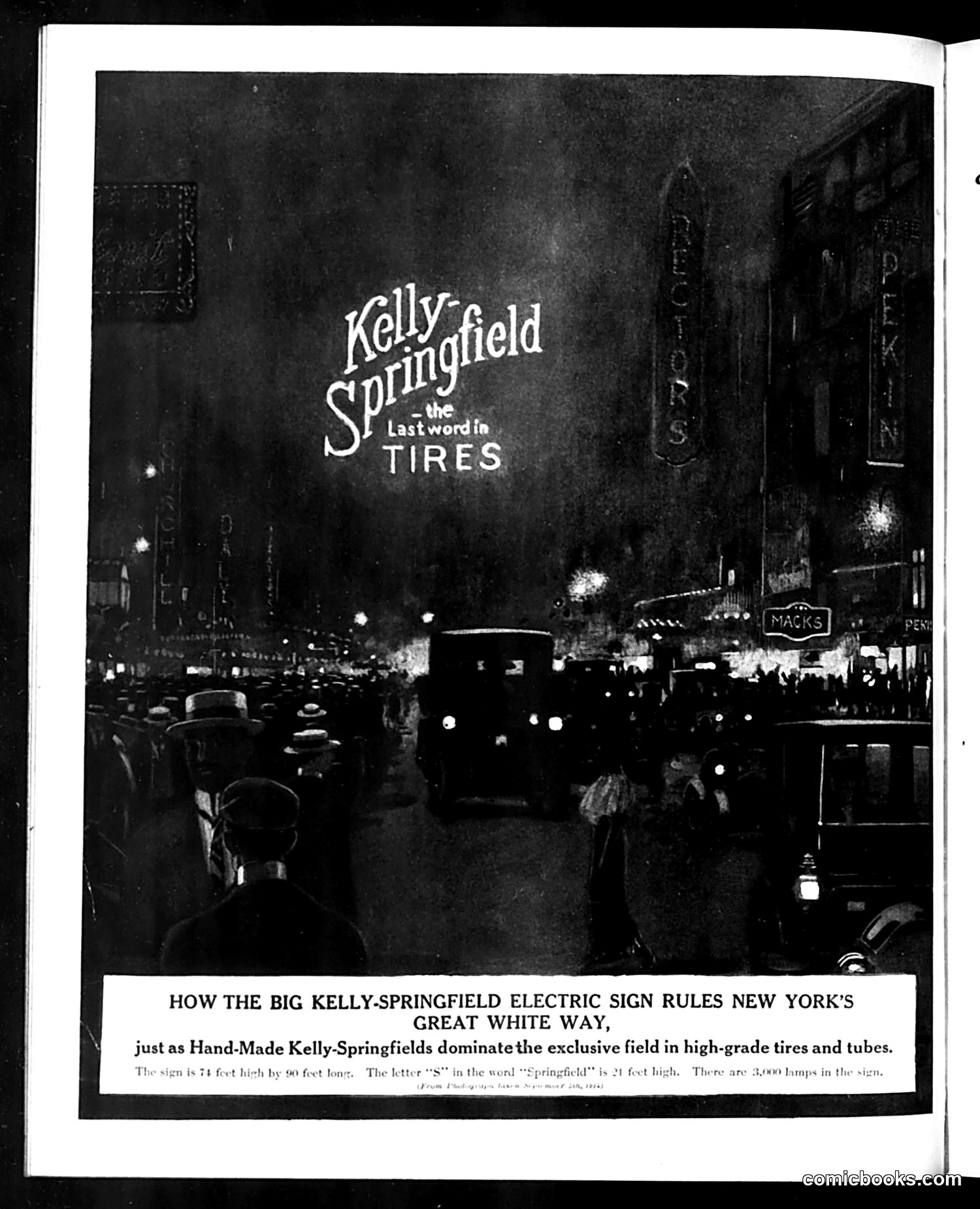
This is primarily an **advertisement**, not satirical content. It promotes Kelly-Springfield tires by showcasing their massive electric billboard sign on New York's "Great White Way" (Broadway's theater district). The page depicts a nighttime street scene with vehicles and pedestrians dwarfed beneath an enormous illuminated sign reading "Kelly Springfield—the Last word in TIRES." The accompanying text boasts that the sign dominates the landscape just as Kelly-Springfield tires dominate the tire market. The advertisement uses the spectacle of modern electric signage—itself a novelty and status symbol in early 20th-century urban America—to position the tire brand as dominant and prestigious. The claim of "3,000 lamps" in the sign emphasizes technological achievement and scale. This reflects how corporations used Times Square's emerging billboard culture to advertise premium consumer goods to the city's growing automobile-driving population.